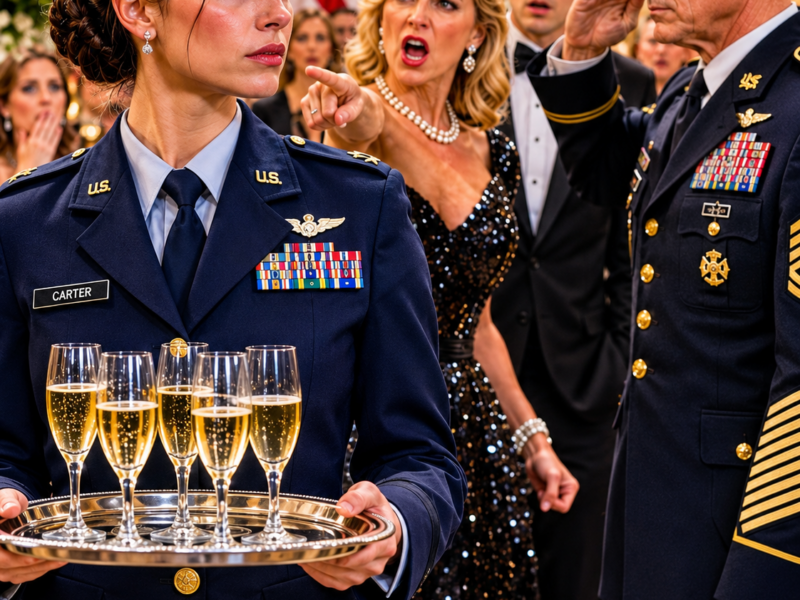
“I stood in my mother’s birthday party wearing my Army captain’s uniform when she placed a silver serving tray in my hands and ordered me to pour drinks for the guests
I looked at my mother for several seconds before answering Arthur.
“No, sir. She didn’t know.”
Eleanor shifted uncomfortably.
“Emily, that’s not entirely fair. You never told me about any of this.”
I set the silver tray on the nearest table.
“Mom, I told you I was deployed to Afghanistan. I told you I was injured. I told you I received a medal. You changed the subject every time.”
“That’s not true.”
“Do you remember the phone call three years ago when I told you I was coming home after the operation?”
She looked away.
“I was busy that day.”
“You were planning Daniel’s engagement party.”
Daniel rubbed the back of his neck.
“Emily, maybe we shouldn’t do this in front of everyone.”
I turned toward him.
“You were the one who called my military career a hobby.”
“I was joking.”
“You’ve been making that joke for ten years.”
Arthur Vance stood quietly beside the fireplace.
He didn’t interrupt.
The guests had stopped pretending to enjoy their conversations.
My mother finally turned toward him.
“Mr. Vance, I’m sure you understand that families have disagreements. Emily can sometimes be difficult.”
Arthur’s expression hardened.
“Mrs. Carter, I have spent three years trying to find the officer who brought my son home.”
He reached into his jacket and pulled out his phone.
“David called me that morning from the hospital. He was still recovering from his injuries, but the first thing he asked was whether Captain Carter had made it out.”
He showed me a photograph.
It was a picture of a young soldier sitting in a hospital bed, his arm wrapped in bandages.
I recognized him immediately.
David Vance.
He had been one of the twelve men trapped in Kunar Valley.
“That’s David,” I whispered.
Arthur nodded.
“He asked me to find you. He wanted to thank you in person.”
I looked at the photograph longer than I intended.
I remembered carrying David through a narrow passage while bullets struck the rocks above us.
He had been bleeding heavily.
At one point, he had begged me to leave him behind because he believed he was slowing the team down.
I had told him that wasn’t an option.
“You’re coming home,” I’d said.
He had looked at me and answered, “You promise?”
I’d promised.
And I had kept it.
Arthur put his phone away.
“David is now a civilian. He works with veterans who are struggling to adjust after returning home. He still talks about that mission.”
My mother lowered her eyes.
“I had no idea.”
Arthur looked at the silver tray.
“Clearly.”
Daniel stepped forward.
“Mr. Vance, I appreciate what Emily did. Truly. But I hope we can separate her military service from our business discussions.”
Arthur turned toward him.
“Why would I do that?”
Daniel swallowed.
“Because we’ve spent months negotiating this partnership. Our financial projections are strong. The company has already invested considerable resources.”
“I know.”
“We’ve built something substantial.”
Arthur studied him.
“Then tell me something, Daniel. What do you believe makes a person trustworthy?”
Daniel seemed surprised by the question.
“Keeping your word. Being dependable. Delivering results.”
“Good answer.”
Arthur glanced at me.
“That’s exactly what your sister did when twelve people were depending on her.”
My brother’s jaw tightened.
I could see him trying to understand how a conversation about his birthday had turned into something he couldn’t control.
Then Arthur continued.
“But I didn’t come here tonight simply because of Captain Carter. I came because I was considering putting forty million dollars into your company.”
Daniel nodded eagerly.
“Exactly, sir.”
“And I wanted to understand the people I would be doing business with.”
My mother stepped closer.
“Mr. Vance, please don’t let a family misunderstanding affect a serious business arrangement.”
Arthur looked at her.
“Mrs. Carter, I haven’t made a decision because your daughter was wearing a uniform. I’ve made it because I’ve seen how people behave when they believe someone has nothing to offer them.”
He paused.
“I watched your daughter spend the evening serving drinks while you introduced her as someone who mostly does office work.”
My mother’s cheeks turned red.
“She offered to help.”
I almost laughed.
Not because anything was funny.
Because she had just rewritten the entire evening in one sentence.
Arthur turned back to Daniel.
“I need to speak with you privately.”
Daniel nodded quickly.
“Of course.”
They walked toward the study.
The door closed behind them.
For the first time that evening, my mother approached me without an audience between us.
“Emily, why didn’t you tell me about the twelve soldiers?”
I looked at her.
“I tried.”
“You never gave me the details.”
“Mom, you never asked.”
She opened her mouth, then closed it.
I could see that she wanted to argue.
But for once, she didn’t.
Daniel’s wife, Rachel, approached us.
She was carrying a small plate of birthday cake.
“Emily, I saved you a piece.”
“Thank you.”
She looked toward the study.
“Your brother is probably panicking.”
“He’s had a difficult year.”
Rachel gave me a tired smile.
“He’s had a difficult year because he keeps trying to make everything look successful before it actually is.”
I looked at her.
She lowered her voice.
“There’s something you should know.”
Before she could continue, the study door opened.
Daniel came out first.
His face had lost its color.
Arthur followed him.
“Mr. Vance?” my mother asked.
Arthur adjusted his jacket.
“I won’t be moving forward with the partnership.”
The room went silent.
Daniel stepped toward him.
“Sir, please. We can work through whatever concerns you have.”
“My decision is final.”
“Forty million dollars is a significant investment. You’re really canceling everything because of an awkward family moment?”
Arthur looked at him steadily.
“No, Daniel. I’m canceling because I no longer believe this is the right partnership.”
My mother gripped the back of a chair.
“But the contracts—”
“Have not been finalized.”
Daniel’s voice rose.
“Do you understand what this means for my company?”
Arthur nodded.
“I do. I also understand what my money would be supporting.”
He looked at me.
“Captain Carter, I hope you don’t mind me saying this, but I would be honored if you came to dinner with David sometime. He’s wanted to thank you for years.”
“I would be happy to see him, sir.”
Arthur extended his hand.
I shook it.
Then he turned and walked toward the entrance.
The two men who had accompanied him followed.
Daniel watched them leave.
When the door closed, he turned toward me.
“You couldn’t just keep quiet tonight, could you?”
I stared at him.
“Daniel, I barely spoke.”
“You had to stand there in that uniform and make everyone look at me.”
“I didn’t make you do anything.”
“You knew who Arthur was.”
“I had never met him before tonight.”
“Then how did he know you?”
I took a breath.
“Because I helped bring his son home.”
Daniel laughed bitterly.
“Well, congratulations. I hope it was worth forty million dollars.”
The words hit harder than I expected.
I looked at my brother, the boy I’d once carried on my shoulders at the county fair, the teenager I’d helped study for his driver’s test, the man whose birthday I had driven four hours to celebrate.
“Those twelve soldiers were worth more than forty million dollars to the people who loved them.”
Daniel looked away.
My mother stepped between us.
“Enough. Both of you.”
I turned toward her.
“Mom, I’m leaving.”
“Emily, wait.”
I reached for my coat.
She followed me into the hallway.
“Please don’t leave like this.”
I stopped beside the front door.
“How would you like me to leave?”
She looked at my uniform.
“I didn’t know those medals meant so much.”
“They don’t mean what you think.”
“What do you mean?”
I touched the small row of ribbons above my pocket.
“They aren’t decorations, Mom. Every one of them reminds me of something I survived, someone I served beside, or someone who didn’t come home.”
Her eyes filled with tears.
“I never understood.”
“You never tried.”
She reached for my hand.
I stepped back, not to punish her, but because I wasn’t ready.
Then she said something I hadn’t expected.
“Your father would have been so proud of you.”
That nearly broke me.
My father had been the one person who never questioned my decision to enlist.
When I was seventeen, he had driven me to a recruiting office and waited outside for almost two hours.
He hadn’t wanted me to join the Army because he thought it would be easy.
He wanted me to understand that my choices belonged to me.
I remembered him standing in our old kitchen, holding the letter that confirmed my acceptance into officer training.
“Whatever you become, Emily,” he’d said, “make sure you can look yourself in the mirror.”
I swallowed.
“I wish Dad could have seen me tonight.”
My mother nodded.
“So do I.”
For a moment, neither of us spoke.
Then I opened the door.
The cold November air moved across my face.
“Goodnight, Mom.”
I walked toward my car.
But before I reached it, I heard someone calling my name.
“Emily, wait!”
It was Rachel.
She hurried down the front steps, holding her phone.
“There’s something I need to tell you about Daniel.”
I stopped.
“What is it?”
She glanced back at the house.
“I didn’t want to say anything in front of everyone.”
My stomach tightened.
“Rachel, what’s going on?”
She took a breath.
“Daniel knew you were coming tonight.”
“Of course he did. I told Mom last week.”
“No. I mean he knew you’d be wearing your uniform.”
I stared at her.
“Why would that matter?”
Rachel unlocked her phone.
“Because he told me he was worried you might embarrass him in front of Arthur.”
I felt a chill that had nothing to do with the weather.
“He said that?”
She nodded.
“He wanted you to change before you arrived. When you said you couldn’t, he told your mother to keep you away from the business meeting.”
I looked back at the house.
“Why?”
Rachel hesitated.
“Because he thought Arthur might ask about your military career.”
I couldn’t understand.
“Why would Daniel care?”
Rachel lowered her voice.
“Because he knew Arthur had been searching for the officer who saved David.”
I stood motionless.
My brother had known.
He had known that the man whose forty-million-dollar investment he desperately wanted had spent three years looking for me.
And he had still wanted me hidden away.
“How long has he known?” I asked.
“Since last month. Arthur’s office contacted Daniel’s company to confirm whether you were related to him. Daniel found out why they were asking.”
I stared at the illuminated windows.
“Did he tell my mother?”
“I don’t know. But he definitely knew.”
Rachel looked genuinely uncomfortable.
“I’m sorry, Emily.”
I thanked her and drove away.
That night, I stayed in a hotel near the interstate.
I couldn’t sleep.
Around two in the morning, my phone rang.
It was Daniel.
I watched it ring twice before answering.
“What?”
“Emily, we need to talk.”
“I’m listening.”
“Arthur’s decision has put us in a terrible position.”
“I know.”
“The bank has already been asking questions about our projected investment.”
I sat up.
“What does that have to do with me?”
He exhaled sharply.
“Nothing. I’m not blaming you.”
“You just did that at the party.”
“I was upset.”
“Daniel, what do you want?”
There was a long silence.
Then he said, “I need you to call Arthur.”
I closed my eyes.
“No.”
“Just hear me out.”
“I heard you.”
“Emily, please. If he hears from you that this was a misunderstanding, maybe he’ll reconsider.”
“That’s not my responsibility.”
“You know how important this is.”
“Yes, Daniel. I know exactly how important it is.”
His voice became quieter.
“You’re my sister.”
I looked at the hotel curtains.
“Then you should have treated me like one.”
He didn’t answer.
I ended the call.
The following morning, I received a message from Arthur.
It was short.
“Captain Carter, David would like to meet you. If you’re available, we’d appreciate the opportunity.”
I replied that I would be happy to see him.
Two days later, I met Arthur and his son at a small restaurant in Raleigh.
David was thinner than I remembered.
He walked with a slight stiffness in his right leg, but his smile was unmistakable.
When he saw me, he stood.
“Captain Carter.”
“David.”
He reached out, then seemed unsure whether to shake my hand or hug me.
I smiled.
“Either is fine.”
He laughed and hugged me carefully.
For several seconds, neither of us spoke.
Then he stepped back.
“I’ve wanted to do this for three years.”
“You don’t owe me anything.”
“Maybe not. But I needed you to know what happened after we got home.”
We sat down.
David told me about his recovery, his rehabilitation, and the difficult months after leaving the Army.
He spoke about the other eleven soldiers.
One had returned to college.
Another had become a firefighter.
Two were raising young families.
One was still receiving medical treatment.
“They all remember you,” David said.
“Not just the rescue. The way you talked to us.”
I looked down at my coffee.
“I was trying to keep everyone focused.”
David shook his head.
“You told us our families were waiting. You kept repeating that nobody was being left behind.”
Arthur reached across the table.
“That’s why I wanted to meet you.”
He paused.
“There’s something else.”
He placed a small envelope on the table.
Inside was a photograph.
It showed the twelve soldiers standing together several months after the mission.
I was standing at the edge of the group, my left arm in a sling.
On the back, someone had written:
“To Captain Carter. You brought us home. We’ll carry that with us forever.”
I ran my thumb over the handwriting.
“Who wrote this?”
“David,” Arthur answered.
I looked at him.
He smiled.
“We all signed it.”
I couldn’t speak for a moment.
I had spent years believing that the most meaningful parts of my military service were the moments nobody outside the unit would ever understand.
That photograph reminded me that I hadn’t been carrying those memories alone.
David leaned forward.
“Captain, there’s one more thing. We’re organizing a veterans’ support program. A few of us are helping recently discharged soldiers find jobs, housing, and counseling.”
“That’s wonderful.”
“We’d like you to come speak at our first gathering.”
I hesitated.
“I’m not sure I’m the right person.”
David smiled.
“You were the right person when twelve men needed someone to lead them through a valley. I think you’ll be fine talking to a room.”
I laughed softly.
“Let me think about it.”
“Take your time.”
For the first time in a long while, I left a meeting feeling appreciated without having to prove anything.
But the situation with my family wasn’t over.
A week later, my mother called.
I nearly let it go to voicemail.
Then I answered.
“Hello?”
“Emily, it’s Mom.”
“Hi.”
“Could we have lunch?”
I waited.
“Just the two of us,” she added. “No birthday party. No guests. No business.”
I agreed.
We met at a small diner halfway between Charlotte and my base.
My mother arrived early.
She had ordered coffee but hadn’t touched it.
When I sat down, she looked older than I remembered.
Not physically.
Something about her expression had changed.
“I’ve been thinking about what you said.”
I placed my hands on the table.
“Which part?”
“That I never asked.”
She looked down.
“I thought I was being supportive when I told you to choose a safer career. I thought the Army was something you would eventually grow out of.”
“I never asked you to approve of my choices.”
“I know.”
She took a shaky breath.
“After your father died, I became afraid of losing anyone else. Daniel stayed close. You kept leaving for assignments. I convinced myself that if I focused on the life I could see, I wouldn’t have to worry about the one I couldn’t.”
I listened.
It was the first time she’d ever explained her behavior without blaming me.
“But that doesn’t excuse how I treated you,” she continued.
“No, it doesn’t.”
She nodded.
“I know.”
A waitress brought our food.
Neither of us touched it immediately.
My mother reached into her purse and pulled out a small photograph.
It was an old picture of Dad and me at my high school graduation.
He had one arm around my shoulders.
I was holding my diploma and smiling.
“I found this in his desk,” she said.
I took it carefully.
“He kept it?”
“He kept everything.”
My eyes burned.
For a while, we talked about my father.
Not about his funeral or the years afterward.
We talked about his terrible jokes, his love of baseball, and how he used to burn pancakes every Sunday.
It was the first conversation with my mother in years that didn’t feel like a competition with Daniel.
Before we left, she said, “I want to come to your next ceremony.”
I looked at her.
“You don’t have to.”
“I know. I want to.”
I nodded.
“Then I’ll send you the details.”
We didn’t hug.
Not yet.
But when I walked to my car, she called after me.
“Emily?”
I turned.
“I’m proud of you.”
I didn’t know what to say.
So I simply nodded and drove back to base.
Meanwhile, Daniel’s business began facing questions from its lenders.
The forty-million-dollar partnership had been expected to provide funding for several developments.
Without it, the company needed to restructure.
I didn’t celebrate his problems.
I knew that a failed business could affect employees, contractors, and families who had nothing to do with what happened at the party.
A few weeks later, Daniel called again.
This time, he sounded different.
“Emily, can we meet?”
“Why?”
“I owe you an apology.”
I considered refusing.
Then I remembered that he was still my brother, even if I wasn’t ready to trust him.
We met at a coffee shop near our mother’s house.
He arrived without his usual expensive watch and designer jacket.
He looked exhausted.
For several minutes, he talked about the company.
Then he stopped himself.
“That’s not why I asked you to come.”
I waited.
He looked at his hands.
“I knew Arthur was looking for you.”
I didn’t react.
“Rachel told me.”
He nodded.
“I found out when his office contacted us. They asked whether I was related to an Army officer named Emily Carter.”
“Why didn’t you tell me?”
He gave a bitter laugh.
“Because I was afraid.”
“Of what?”
“That Arthur would care more about you than my company.”
I stared at him.
“He wasn’t choosing between us, Daniel.”
“I know that now.”
He rubbed his forehead.
“I thought if you stayed out of sight, the meeting would go smoothly. I didn’t want him asking questions I couldn’t answer.”
“What questions?”
Daniel looked away.
“About the kind of person I was.”
I said nothing.
He continued.
“I’ve spent years trying to prove that I’m successful. I wanted Mom to be proud of me. I wanted Dad to be proud of me. I wanted everyone to think I had built something important.”
“And you thought I was a threat to that?”
He nodded.
“I didn’t want to be the ordinary brother standing beside the sister who saved twelve soldiers.”
I felt a sadness I hadn’t expected.
“You were never competing with me.”
“I know.”
He swallowed.
“I should have been proud of you.”
“Yes, you should have.”
He nodded again.
Then he said something that surprised me.
“I’m not asking you to call Arthur. I’m not asking you to fix the company.”
I looked at him carefully.
“I’m glad.”
“I’m asking if there’s any chance we can start over.”
I didn’t answer immediately.
An apology could be sincere and still arrive too late to repair everything.
“I don’t hate you, Daniel,” I finally said.
He looked up.
“But I can’t pretend that night didn’t happen.”
“I understand.”
“If you want a relationship with me, it has to be different. You can’t respect me only when someone important is watching.”
He nodded.
“I know.”
“And Mom has to understand that too.”
“I think she does.”
We finished our coffee.
There was no dramatic hug.
No promise that everything would suddenly be perfect.
But when we stood to leave, Daniel asked whether I would be home for Thanksgiving.
I told him I would try.
It was a small answer.
For the first time, it felt honest.
Three months later, I attended the first gathering of David’s veterans’ support program.
The event was held in a community center outside Raleigh.
There were about sixty people in attendance, including former service members, family members, and volunteers.
David introduced me.
When I stepped toward the microphone, I noticed something on the front row.
My mother was sitting beside Rachel.
Daniel was standing near the back wall.
He had come without telling me.
I looked at the audience.
For a moment, I thought about the birthday party.
The silver tray.
The champagne glasses.
My mother’s quiet embarrassment.
My brother’s laughter.
Then I looked at David.
He gave me a small nod.
I began speaking.
“I used to think that bringing twelve soldiers home was the most important thing I would ever do.”
The room became quiet.
“But over time, I learned that coming home isn’t always the end of the difficult part. Sometimes the hardest work begins after the uniform comes off.”
I spoke about the challenges veterans faced.
I spoke about the importance of checking on people after the celebrations ended.
I spoke about the families who waited, the friendships that endured, and the people who carried invisible injuries long after their physical wounds healed.
I didn’t tell the audience that my own family had once failed to understand what my uniform meant.
That story belonged to me.
When I finished, the room applauded.
David stood first.
Then the other veterans joined him.
I looked toward the front row.
My mother was crying.
Daniel was clapping quietly.
After the event, my mother approached me.
She didn’t mention the medals.
She didn’t mention Arthur Vance.
She simply said, “I heard what you said about coming home.”
I nodded.
She touched my arm.
“I think I finally understand why you never wanted us to worry about you.”
I looked at her.
“I didn’t want you to worry. I wanted you to know me.”
She lowered her eyes.
“I’m trying.”
“I can see that.”
She hugged me.
This time, I let her.
Daniel waited until she stepped away.
He held out a small package.
“Happy belated birthday,” he said.
I laughed.
“My birthday was months ago.”
“I know. I owe you a lot of things.”
Inside the package was a simple leather frame.
There was no expensive jewelry or extravagant gift.
Just a handwritten note.
It read:
“For the sister who taught me what courage actually looks like. I’m sorry it took me so long to see it.”
I looked at him.
“Thank you.”
He nodded.
“You’re welcome.”
We didn’t become the perfect family that afternoon.
My mother still had moments when she slipped into old habits.
Daniel still struggled with his pride.
And I still found it difficult to let people close after years of learning to keep my emotions contained.
But we began making different choices.
Daniel eventually sold part of his company and restructured the remaining business.
He found new investors on different terms and learned to be more honest about what his company could deliver.
He never recovered the original $40 million partnership.
Arthur Vance never changed his decision.
But several months later, Arthur invited me and David to a veterans’ charity dinner.
He introduced me to a room full of people, not as the woman who had embarrassed her family, but as the captain who had helped bring twelve soldiers home.
I didn’t need the introduction.
I knew who I was.
Still, when David stood beside me and raised his glass, I felt grateful.
“To the people who don’t leave anyone behind,” he said.
We raised our glasses.
I thought about the twelve soldiers.
I thought about the four people who had entered that valley together.
I thought about the one promise I’d made to a wounded young man who believed he might never see his family again.
And I thought about the silver tray.
For a long time, I had remembered that evening as the night my family humiliated me.
But it eventually became the night I stopped measuring my worth by whether they recognized it.
My medals were not proof that I deserved respect.
I deserved respect before anyone knew what they meant.
A few months later, my mother attended another military ceremony at Fort Liberty.
She arrived early and sat in the front row.
When I walked onto the field in uniform, she stood with the other families.
I saw her wipe her eyes.
Afterward, she approached me and carefully touched one of the ribbons on my chest.
“Can you tell me what this one means?”
I smiled.
“Of course, Mom.”
And for the first time in my life, she listened to the entire story.
Not because a wealthy businessman was watching.
Not because my brother needed something.
Not because my uniform suddenly made me important.
She listened because I was her daughter.
That was all I had wanted.
I never forgot the twelve soldiers who came home that day.
But I also never forgot the lesson I learned at my brother’s birthday party.
Sometimes, the people who know your name the longest are the last to understand who you really are.
And sometimes, the greatest victory isn’t making someone regret underestimating you.
It’s reaching a point where you no longer need them to recognize your worth.
The End.









