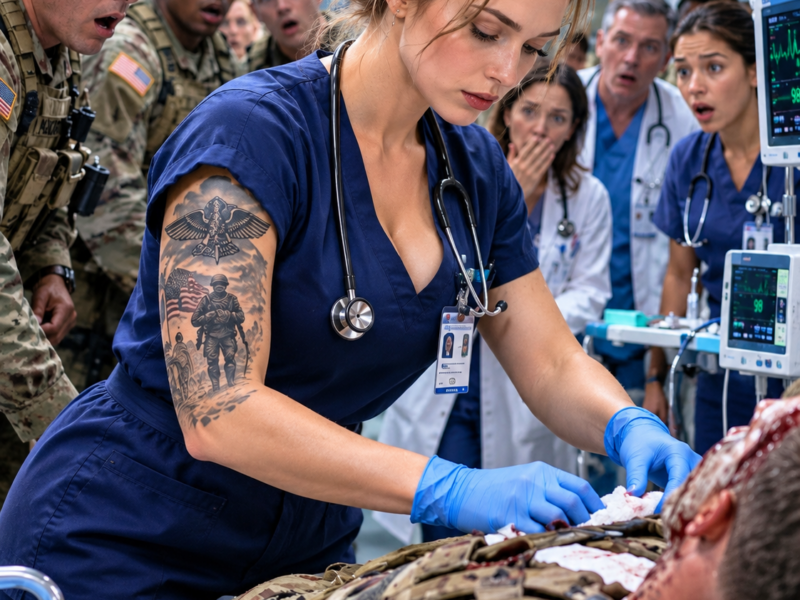
“I saved a dying soldier’s life in a suburban Ohio emergency room, but when his squad leader grabbed my wrist and saw the faded tattoo beneath my sleeve
The first red light caught me three blocks from the hospital.
I stopped hard enough that my burned left hand slipped against the steering wheel, sending a sharp wave of pain through my palm.
“Dammit.”
I kept my eyes on the rearview mirror.
No black SUV.
No headlights following me.
No Garrett.
That should have made me feel better.
It didn’t.
I drove through the intersection when the light changed, taking streets I hadn’t used in years. My apartment was twelve minutes away, but going there would be the first thing anyone tracking me would expect.
I knew the rules.
Never go home after contact.
Never return to a familiar location.
Never assume the first attack was the last.
Five years ago, those rules had kept me alive.
This morning, they felt like a sentence.
My phone vibrated in the passenger seat.
I glanced down.
Unknown Number.
I let it ring.
It stopped.
Three seconds later, a text appeared.
You still drive that ugly Honda?
My stomach tightened.
I pulled into the parking lot of a closed grocery store and stared at the screen.
Another message arrived.
Nice work in the garage, Ghost.
I didn’t move.
The men in the SUV hadn’t been following me randomly. Someone knew who I was before they reached the hospital.
Someone knew about Task Force 73.
And someone had watched me fight.
I typed one word.
Who?
The response came almost immediately.
Someone who remembers Damascus.
I dropped the phone onto the passenger seat.
For several seconds, I listened to the engine idle.
Damascus.
There were only three people who could have known what happened there in enough detail to recognize me from that fight.
One was dead.
One had disappeared.
And the third was the reason Task Force 73 had been erased.
Colonel Nathaniel Voss.
I had watched his photograph burn five years ago.
I had personally confirmed the location of his body.
At least, that’s what I had been told.
My phone vibrated again.
Don’t go home. They’re already there.
I looked toward the road.
Then I started the car.
I drove to a twenty-four-hour laundromat on the edge of town, parked behind a delivery truck, and used the bathroom to examine my injuries.
Two bruised ribs.
A badly burned left palm.
A shallow cut near my hairline.
Nothing immediately life-threatening.
I cleaned the burn as best I could with bottled water and wrapped it loosely in gauze from the small emergency kit I kept beneath my driver’s seat.
Then I looked at my reflection.
The woman staring back at me looked exhausted.
She also looked familiar.
I hadn’t seen that expression in a long time.
It was the expression I wore before operations when I knew someone wasn’t coming back.
I took the phone from my pocket and called a number I hadn’t dialed in five years.
It rang four times.
A man’s voice answered.
“Hello?”
I closed my eyes.
“Daniel.”
Silence.
Then a quiet exhale.
“Clare?”
“Yes.”
“You’re supposed to be dead.”
“I’ve heard that before.”
“Where are you?”
“Ohio.”
“That’s not what I asked.”
I looked through the laundromat window at the empty parking lot.
“Somewhere I shouldn’t be.”
Daniel Mercer had been our communications specialist in Task Force 73.
He was also the only person I had ever trusted with the truth about what happened in Damascus.
We had not spoken since the night our unit was destroyed.
“How did you get this number?” he asked.
“Someone texted me.”
“What did they say?”
I read the messages aloud.
When I finished, Daniel didn’t respond immediately.
Then he said something that made the room seem smaller.
“Voss is alive.”
I gripped the phone.
“Don’t.”
“I’m not guessing, Clare.”
“I saw his body.”
“No, you saw a body in a burned building. The identification came from a report you never signed.”
I remembered the smoke.
The collapsing ceiling.
The two men who had carried me out.
The military doctor who told me Voss hadn’t survived.
I remembered asking to see him.
I remembered being told there was nothing left to see.
“Why would you tell me this now?”
“Because I found something three days ago.”
“What?”
“A transfer order.”
“From where?”
“An intelligence contractor called Blackridge Strategic.”
I recognized the name.
Blackridge had been a small private intelligence company when Task Force 73 was operational. It specialized in surveillance, asset extraction, and the kind of work that never appeared in official reports.
“Who runs it?”
“Voss.”
I looked down at my bandaged hand.
“That’s impossible.”
“Clare, listen to me. The operation that killed your team wasn’t an enemy ambush. Someone gave them your location, your route, and the names of the people inside the compound.”
My throat tightened.
“I know.”
“No. You know what they told you afterward. You don’t know what I found.”
I stood up.
“Daniel, what did you find?”
“An extraction payment authorized forty-eight hours before Damascus.”
“To whom?”
He hesitated.
Then he said, “Your squad leader.”
For a moment, the only sound I could hear was the washing machines turning behind me.
Our squad leader had been Captain Marcus Hale.
He had pulled two wounded soldiers from a burning vehicle before taking a bullet through the neck.
I had held him while he died.
“That’s not funny,” I whispered.
“I’m not joking.”
“Marcus would never have sold us.”
“Then someone used his authorization.”
“Who?”
“I don’t know. But the payment was routed through a medical evacuation account.”
I stared at the white tile beneath my feet.
Medical evacuation.
That phrase opened a door in my memory.
A helicopter.
A blood-soaked stretcher.
A medic shouting for me to keep pressure on a man’s chest.
And a small black case strapped beneath the stretcher.
I had seen that case before.
In Damascus.
“Daniel, where are you?”
“Not somewhere I can tell you over the phone.”
“Then give me a place.”
“There’s an old maintenance depot outside Dayton. I’ll send you the address.”
“Don’t send anything to this phone.”
“I already did.”
The call ended.
I looked at the screen.
A single message appeared with an address and a time.
Then another message arrived.
Clare, one more thing.
The ranger who brought you into this is not who he says he is.
I read it twice.
Garrett.
I immediately thought of his face in the hospital hallway.
The way his expression had changed when he saw my tattoo.
The way he had said Task Force 73.
And the way he had found my car without needing my last name.
I called his number.
He answered on the first ring.
“Clare.”
“Where did you get my hospital information?”
A pause.
“That’s what you want to ask me?”
“Answer the question.”
“Your name was on the incident paperwork.”
“My last name wasn’t.”
He said nothing.
“How did you know where I parked?”
“Because we followed you out.”
My fingers tightened around the phone.
“You followed me?”
“Not to hurt you.”
“That’s what every man says before he does something stupid.”
“Clare, listen.”
“No. You listen. You brought armed men into my hospital, you brought a firefight into my parking garage, and now somebody knows where I work.”
“We didn’t choose the hospital.”
“Who did?”
Another pause.
Then Garrett spoke more quietly.
“Someone sent us there.”
I felt the blood drain from my face.
“Who?”
“We received an anonymous location from a source we believed was reliable. It said Liam was compromised and needed immediate medical attention.”
I leaned against the bathroom counter.
“Your wounded man was the reason you came to my hospital?”
“Yes.”
“And the explosion?”
“Was supposed to kill all of us.”
I closed my eyes.
“Garrett, what exactly were you carrying?”
“A drive.”
“What was on it?”
“We haven’t been able to open it.”
“Then why were people trying to kill you?”
“Because the drive contains a list of personnel involved in an operation called Ash Lantern.”
I stopped breathing for a second.
Ash Lantern.
I hadn’t heard that name since Damascus.
“Garrett,” I said carefully. “Where did you get that drive?”
“From a dead man.”
“Who?”
“An intelligence officer named Samuel Pike.”
I gripped the edge of the counter.
Samuel Pike had been the last person to speak to me before the operation in Damascus.
He had told me the mission was routine.
He had told me our extraction route was secure.
And he had disappeared the morning after the compound burned.
“Garrett, you need to get away from that drive.”
“Why?”
“Because if it contains what I think it contains, you’re not being hunted because of what you stole.”
“What does that mean?”
I stared at my reflection.
“It means somebody wants to know who has it.”
I ended the call.
Then I left the laundromat through the back entrance.
By 9:20 a.m., I was outside Dayton.
The maintenance depot sat behind an abandoned industrial park, surrounded by chain-link fencing and weeds growing through cracked pavement.
I parked two streets away and approached on foot.
Daniel’s old gray pickup stood beside the loading bay.
He was waiting near the side entrance.
He looked older than I remembered.
His hair had gone almost completely gray, and a slight tremor moved through his right hand as he reached for the door.
But his eyes were the same.
“You’re hurt,” he said.
“You’re observant.”
He looked at the bandage.
“Garage?”
“Long story.”
“Voss?”
“Possibly.”
Daniel opened the door.
Inside, the depot smelled of dust, motor oil, and wet concrete.
A folding table stood in the middle of the room with a laptop, several printed photographs, and a sealed envelope.
Daniel locked the door behind us.
“Before I show you anything, I need you to understand something.”
“I’ve never been particularly patient with introductions.”
He ignored that.
“I didn’t find the payment record by accident. Someone sent it to me.”
“Who?”
“An account that had been inactive since Damascus.”
I looked at the laptop.
“Show me.”
Daniel opened a photograph.
It showed a military transport helicopter sitting on a landing pad at night.
A date was printed beneath it.
September 14.
Five years earlier.
The night before the operation.
“That’s our extraction aircraft,” I said.
“Yes.”
He enlarged the photograph.
There were six people near the helicopter.
Five were members of our team.
The sixth stood near the rear landing gear, wearing a dark civilian jacket.
I leaned closer.
The image was grainy, but I recognized the posture.
The narrow shoulders.
The slight tilt of the head.
Samuel Pike.
“Why is he there?”
“That’s the question.”
Daniel opened another file.
It contained a list of names, payment numbers, and transfer dates.
I read the first three entries.
Then I stopped.
My own name was there.
CLARE BENNETT.
Beside it was a payment authorization for $250,000.
I stared at the screen.
“What is this?”
Daniel swallowed.
“An asset compensation payment.”
“I never received that.”
“I know.”
“Who authorized it?”
He pointed to the bottom of the page.
NATHANIEL VOSS.
My hands went cold.
“Why would Voss authorize money to me?”
Daniel looked at me.
“Because the payment wasn’t meant for you.”
He opened a second document.
It was a transfer order for a witness protection relocation program.
My name appeared again.
This time, beside a different classification.
DECEASED ASSET — STATUS CONFIRMED.
I stepped away from the table.
For five years, I had believed I was hiding from the people who wanted me dead.
But according to that document, someone had already declared me dead.
Someone had been using my identity to move money, authorize operations, and erase evidence.
“Daniel,” I said slowly, “how many people know I’m alive?”
“Until this morning? I thought none.”
“And now?”
He looked toward the locked door.
“Someone knows.”
A faint metallic sound came from outside.
Daniel turned off the laptop.
I raised one hand.
Neither of us moved.
The sound came again.
Three knocks.
A pause.
Then two more.
Daniel’s face lost its color.
“That’s not a random knock,” he whispered.
“Who is it?”
He didn’t answer.
Instead, he reached beneath the table and pulled out a compact pistol.
I looked at him.
“You brought me here without telling me you were expecting company?”
“I wasn’t.”
The knocking stopped.
Then a voice came through the door.
“Daniel? It’s Garrett.”
I stared at the door.
Daniel looked at me.
“Do you know him?”
“Unfortunately.”
I moved toward the entrance but stopped before reaching it.
“Garrett, how did you find us?”
“Because I followed the only person I thought might know what was happening.”
“That’s not an answer.”
“Clare, open the door.”
I didn’t.
“Why?”
“Because I have something you need to see.”
Daniel shook his head urgently.
I ignored him.
“Put it under the door.”
A few seconds passed.
Then a small black flash drive slid across the concrete.
Garrett’s voice came again.
“That’s the original drive Liam was carrying. The one we recovered from Samuel Pike.”
I looked down at it.
Daniel’s face changed.
He recognized the serial number.
“That’s impossible,” he whispered.
I picked up the drive with my right hand.
“Why?”
Daniel looked at me.
“Because I already have a copy of that drive.”
I turned toward the laptop.
“Then what is this?”
Before he could answer, the computer screen came back to life.
A single file opened automatically.
No password.
No security prompt.
Just a video.
The image was dark and grainy.
Then a man’s face appeared.
Colonel Nathaniel Voss.
Older.
Thinner.
But unmistakable.
He looked directly into the camera.
“Clare Bennett,” he said.
I felt my knees weaken.
“If you’re watching this, then the first part of the operation has failed.”
He leaned closer.
“There’s something you need to know about Damascus.”
The video flickered.
Then Voss spoke a sentence that made Daniel lower his gun.
“Your team wasn’t sent there to retrieve an intelligence asset.”
He paused.
“You were sent there to retrieve yourself.”
I stared at the screen.
“What?”
Voss continued.
“Five years ago, Task Force 73 uncovered evidence that Blackridge had been selling operational identities to foreign buyers. Your team discovered the transaction, but you didn’t know what you were carrying.”
The image shifted.
A photograph appeared.
It showed a young woman in military uniform.
Me.
Standing beside a medical transport helicopter.
I recognized the day.
I had been injured during a previous operation and transported to a field hospital.
Voss continued.
“Your blood samples, medical records, and operational identity were used to build a classified biometric access profile. That profile opened accounts, approved transfers, and authorized operations in your name.”
Daniel looked at me.
I couldn’t speak.
“Your identity was the key,” Voss said. “The operation in Damascus was designed to recover the original biometric archive before the investigation reached the people who created it.”
The video paused.
Then another image appeared.
A photograph of a black medical case.
The same case I had seen beneath the stretcher five years earlier.
My mouth went dry.
“That case was loaded onto the extraction helicopter,” I whispered.
Daniel nodded slowly.
“I found the flight manifest.”
I looked back at the screen.
Voss’s expression hardened.
“Clare, someone inside your old team sold the extraction route. Someone who knew where you would be and what you were carrying.”
The video ended.
The room remained silent.
Then a second file appeared.
A list of names.
I read them slowly.
Samuel Pike.
Nathaniel Voss.
Marcus Hale.
And finally…
Garrett Cole.
I looked toward the door.
The man outside spoke before I could.
“Clare, I can explain.”
Daniel raised his pistol.
I stared at the name.
“Garrett,” I called through the door. “Why is your name on this list?”
Silence.
Then he answered.
“Because I was there.”
I looked at Daniel.
He looked back at me.
Neither of us moved.
Garrett continued.
“I was the extraction officer in Damascus. I was supposed to get your team out.”
My mouth went dry.
“You were there?”
“Yes.”
“Then why didn’t you tell me?”
“Because the man who ordered the extraction was Voss.”
I stared at the screen.
“And you worked for him?”
“No,” Garrett said. “I was the one who was supposed to stop him.”
A second later, the door handle moved.
I raised my pistol.
“Don’t.”
The handle stopped.
Garrett spoke through the door.
“Clare, I have a photograph. It proves who sold your location.”
“Put it under the door.”
A photograph slid across the concrete.
I picked it up.
The image showed a military operations room.
Several officers stood around a table covered with maps.
One man was seated near the center.
His face was partially turned toward the camera.
I knew him immediately.
Marcus Hale.
My old squad leader.
The man whose blood had soaked my uniform.
The man I had believed died saving us.
But he was not looking at the maps.
He was looking directly at the camera.
And beside him, smiling faintly, stood Nathaniel Voss.
I looked at the date printed on the photograph.
September 15.
The morning after the supposed ambush.
Marcus had been alive.
My hands began to shake.
Daniel whispered, “Clare…”
I turned the photograph over.
There was a handwritten message on the back.
The dead don’t testify.
For five years, I had carried Marcus’s death like a stone inside my chest.
Now I was looking at proof that he had survived the operation.
And that someone had made sure I believed otherwise.
I lowered the photograph.
“Garrett,” I said, “open the door.”
The door swung inward.
Garrett stood in the entrance, his weapon holstered, his face drawn.
I held up the photograph.
“Where is Marcus Hale?”
Garrett looked at it.
Then he looked at me.
“He’s alive.”
The words struck harder than the gunfire in the parking garage.
“Where?”
“Blackridge has been holding him at a private medical facility outside Columbus.”
“Why?”
“Because Marcus wasn’t the one who sold your team.”
I stared at him.
“Then who was?”
Garrett took a breath.
“Voss used Marcus’s authorization to make the payment. Marcus discovered it after the operation and tried to expose him. They kept him alive because he was the only person who could authenticate the original mission orders.”
Daniel stepped forward.
“Why didn’t you tell us?”
“Because I didn’t know if the information was real until Liam recovered the drive.”
I looked at the black flash drive in my hand.
“How long have you known?”
“Three days.”
“And you still brought your men to my hospital?”
Garrett looked down.
“I didn’t know you were the nurse until I saw your tattoo.”
I laughed once.
There was no humor in it.
“Five years, Garrett. Five years of pretending I was dead. Five years of trying to become someone who could sleep through the night. And you walk into my workplace with a wounded man and a loaded secret.”
“I know.”
“No, you don’t.”
He didn’t argue.
That was the first thing he had done all morning that I respected.
I placed the photograph on the table.
“Where is the facility?”
Garrett gave me the address.
Daniel immediately searched it.
A private rehabilitation center outside Columbus, officially registered as a long-term neurological recovery facility.
The facility had three floors, private security, and a restricted medical wing.
“Marcus has been there for five years?” I asked.
Garrett nodded.
“He’s been under sedation for most of that time. They kept his condition stable, but he was never supposed to leave.”
I looked at the photograph again.
“Then we’re getting him out.”
Garrett nodded.
“I thought you’d say that.”
“No. You thought I’d do what you needed.”
His expression tightened.
“What’s the difference?”
“The difference is that this time, I decide what happens.”
We spent the next hour reviewing everything Daniel had collected.
There were payment records, flight manifests, medical transfers, and partial copies of the original mission files.
The evidence pointed to a network inside Blackridge that had been using stolen military identities to authorize covert operations.
The biometric archive was the center of it.
And my identity was still active.
Daniel found the most recent authorization.
It had been issued six hours earlier.
A transfer order for a classified medical asset.
The name attached to it was mine.
CLARE BENNETT.
I stared at the date.
“They’re moving something today.”
Garrett leaned over the screen.
“Where?”
Daniel enlarged the destination.
A private airfield near Columbus.
The transfer was scheduled for 8:00 p.m.
“What are they moving?” Garrett asked.
Daniel opened the attached medical manifest.
My name appeared again.
This time, under the heading:
PRIMARY BIOMETRIC SOURCE.
I felt a cold pressure settle behind my ribs.
“They’re moving the original archive,” I said.
Garrett shook his head.
“No. That can’t be right.”
“Why?”
“Because the archive was destroyed in Damascus.”
I looked at him.
“Apparently, somebody forgot to tell Blackridge.”
Daniel checked the file properties.
Then his face changed.
“Clare…”
“What?”
“The transfer order was approved using your biometric identity.”
I stared at the screen.
“How?”
He opened the authorization history.
The system showed a successful verification at 6:12 a.m.
The location was a medical facility outside Columbus.
I looked at Garrett.
“Someone has my biometric profile.”
Garrett nodded.
“That’s what Voss wanted.”
I turned back to the screen.
“Then we don’t go after the archive.”
Daniel frowned.
“What do you mean?”
“We go after the person using it.”
I looked at Marcus’s photograph.
“If he’s alive, he knows how the original system was built. He can tell us how to shut it down.”
Garrett studied me.
“And if he doesn’t cooperate?”
I picked up my jacket.
“Then we’ll find out whether he’s still the man I remember.”
By 7:30 p.m., we were outside the medical facility.
I had changed into dark clothing and wrapped my injured palm in fresh gauze.
My ribs hurt every time I breathed, but I could move.
Garrett’s men were positioned nearby.
Carter had recovered from the garage fight with a bruised shoulder and a cut above his ear.
Liam was still in surgery recovery, so he remained under medical supervision.
I didn’t want another wounded man.
I had enough of those in my memory.
Daniel stayed with the communications equipment in a vehicle outside the perimeter.
Garrett stood beside me near the service entrance.
“You don’t have to do this,” he said.
I looked at him.
“Don’t confuse me with someone who needs permission.”
He nodded.
Then he handed me a small photograph.
It was an old team picture.
Marcus stood in the middle, one arm around me, the other around Daniel.
I remembered that day.
We had been arguing about whose turn it was to buy breakfast.
Marcus had laughed so hard he spilled coffee over his uniform.
I had forgotten the sound of it.
“Where did you get this?” I asked.
“From Liam.”
I slipped the photograph into my pocket.
We entered through the service corridor after the security team diverted the facility’s attention to a false equipment alarm.
Inside, the building was quiet.
Too quiet.
The walls were painted a soft cream color, and framed landscapes hung at regular intervals.
It looked like a place designed to make people forget they were being watched.
We found the restricted medical wing on the second floor.
A nurse stood behind a glass desk.
Garrett approached her.
“We’re here for Marcus Hale.”
She glanced at her computer.
“He’s not accepting visitors.”
I stepped forward.
“He’s not a visitor. He’s a former service member whose medical records have been concealed.”
Her expression changed.
“I don’t know what you’re talking about.”
I placed the photograph on the counter.
“Then perhaps you can explain why his name appears on a classified transfer order.”
She looked at the image.
Then at me.
Her fingers moved toward the desk phone.
Garrett caught her wrist before she could press the button.
“Don’t.”
I stepped between them.
“Let go.”
He released her.
I looked at the nurse.
“I’m not here to hurt you. I need to know which room he’s in.”
She hesitated.
Then she quietly pointed down the corridor.
“Room 214.”
I walked past her.
At the end of the hallway, I found the door.
There was a small observation window.
I looked inside.
A man lay in the bed.
His hair was gray at the temples.
His face was thinner than I remembered.
But the scar across his chin was unmistakable.
Marcus Hale.
I opened the door.
The room smelled of antiseptic and stale air.
A monitor displayed his heart rate.
His eyes were closed.
A feeding tube ran beneath the blanket.
I stood beside the bed for a long moment.
“Marcus.”
Nothing.
I reached for his hand.
His fingers were warm.
“Captain, it’s Clare.”
His eyelids moved.
Then slowly opened.
His eyes were unfocused at first.
He looked at the ceiling.
Then toward me.
His lips moved.
I leaned closer.
He whispered one word.
“Run.”
I stepped back.
“What?”
His eyes widened with sudden fear.
“Clare…”
He tried to lift his hand.
The monitor began to accelerate.
“Marcus, you’re safe.”
He shook his head weakly.
“No.”
His fingers closed around my wrist.
“Voss…”
I leaned closer.
“What about Voss?”
Marcus swallowed.
“He’s not…”
His breathing became uneven.
I pressed the call button.
Garrett rushed into the room.
“What happened?”
Marcus looked at him.
For a second, his expression changed.
Recognition.
Then terror.
“Get him away from me.”
Garrett stopped.
“Marcus, it’s me.”
Marcus shook his head.
“He’s the one.”
The room seemed to tilt.
I looked at Garrett.
He didn’t move.
Marcus’s grip tightened around my wrist.
“Garrett sold the extraction route.”
I stared at him.
Garrett’s face went pale.
“That’s not true.”
Marcus struggled to breathe.
“He was paid.”
I turned toward Garrett.
“Say something.”
He looked at Marcus.
Then at me.
And finally, he lowered his eyes.
“I was ordered to deliver the route.”
My throat tightened.
“You knew?”
“I didn’t know the target was your team.”
“That’s convenient.”
“I was told we were extracting a compromised intelligence asset. Voss said your unit had already been evacuated.”
Marcus made a weak, angry sound.
“You’re lying.”
Garrett’s jaw tightened.
“I didn’t know.”
Marcus looked at me.
“Clare… don’t let him…”
The monitor alarm sounded.
A nurse rushed in.
“Everyone out!”
I stepped away as the medical team surrounded the bed.
Garrett grabbed my arm.
I tore free.
“Don’t touch me.”
“Clare, I can explain.”
“You had five years.”
“I know.”
“You had five years to tell me.”
His face tightened.
“I was trying to find Marcus.”
“And you found me instead.”
He didn’t answer.
The medical team stabilized Marcus after several minutes.
When the room finally quieted, he was awake again, though his voice was weaker.
I sat beside him.
“Tell me what happened.”
He looked at me for a long time.
Then he spoke.
“Voss wanted the archive. Your medical profile was the key. We discovered the operation was compromised the night before the extraction.”
“Why didn’t you warn us?”
“I tried.”
He looked toward the window.
“Garrett changed the extraction route.”
I closed my eyes.
“Did he know?”
Marcus swallowed.
“I don’t know what he knew.”
That distinction mattered.
It was not forgiveness.
It was not innocence.
It was the first honest answer I had heard all day.
Marcus continued.
“I confronted Voss after the compound burned. He told me you were dead. He said the rest of the team had been eliminated and the archive was recovered.”
“Then why keep you alive?”
“Because I had the original authorization key.”
He shifted painfully.
“Voss couldn’t activate the archive without it. He needed my signature and your biometric profile.”
I looked at Garrett through the open doorway.
“Why didn’t he take it?”
“Because I refused.”
Marcus closed his eyes.
“They kept me sedated. Every few months, they tried again.”
My hands curled into fists.
“How do we stop them?”
Marcus looked at me.
“There’s a shutdown sequence.”
“Where?”
“On the original archive. But it requires two authorizations.”
“Yours and mine?”
He nodded.
“Your biometric profile and my command key.”
I looked at Daniel’s photograph in my pocket.
“Then we have to get to the airfield.”
Marcus shook his head.
“Too late.”
I glanced at the clock.
7:54 p.m.
The transfer was scheduled for 8:00.
“Where is Voss?”
Marcus looked directly at me.
“He’s already there.”
We left the facility with Marcus under medical supervision and the original authorization key secured by Daniel.
Garrett remained with us, but I didn’t trust him.
I wasn’t sure I ever would again.
At 8:17 p.m., we reached the airfield.
A small hangar stood beyond the runway, its doors partially open.
A private transport aircraft waited on the tarmac.
Several men in dark clothing moved around it.
Daniel studied the security feed.
“There’s a second entrance on the east side.”
Garrett looked at me.
“We can take the hangar.”
“No.”
“Clare—”
“We don’t know how many people are inside. We don’t know what they’re protecting. And we don’t know whether the archive is even there.”
Daniel pointed at the screen.
“There’s someone approaching the aircraft.”
I leaned forward.
A man stepped into view.
Older.
Thin.
Wearing a dark coat.
He turned toward the camera.
Nathaniel Voss.
For five years, I had imagined what I would do if I ever saw him again.
I had pictured anger.
Violence.
Questions that would never have answers.
Instead, I felt something colder.
Recognition.
He looked exactly like the man who had sent us to die.
“Let’s go,” I said.
We entered through the eastern service door.
Inside the hangar, a metal case sat on a table beside a laptop.
Voss stood on the other side.
He didn’t look surprised when he saw me.
“Clare.”
I stopped several feet away.
“Colonel.”
He smiled faintly.
“I wondered how long it would take you.”
“Five years, apparently.”
His smile disappeared.
“You were never supposed to survive Damascus.”
I looked at him.
“Neither were my teammates.”
“War is rarely clean.”
“Neither is betrayal.”
He glanced toward Garrett.
“You brought him.”
I turned slightly.
“Did you expect me to leave him behind?”
Voss looked amused.
“Garrett was always useful. He understood orders.”
Garrett’s expression hardened.
“Not yours.”
Voss gave a quiet laugh.
“Then why did you deliver the route?”
Garrett said nothing.
Voss turned back to me.
“You see? People are complicated. They make decisions. They regret them. Then they spend the rest of their lives trying to become better men.”
I looked at the case.
“What’s inside?”
“The original biometric archive.”
“Why move it?”
“Because the company has outlived its usefulness.”
He opened the laptop.
On the screen was a list of names.
Hundreds of them.
Military personnel.
Intelligence officers.
Medical contractors.
People whose identities had been used without their knowledge.
Voss looked at me.
“Do you understand what this represents?”
“Evidence.”
“Power.”
“Blackmail.”
“Security.”
I almost laughed.
“You built an entire operation around stolen identities and called it security?”
He leaned against the table.
“Governments are built on secrets, Clare. You know that.”
I did.
That was what made it worse.
Voss continued.
“Your team discovered a system that was already operating. I made the decision to preserve it.”
“You sold us.”
“I preserved the mission.”
“Marcus nearly died.”
“He made his choice.”
“And the men who trusted you?”
Voss looked away for the first time.
“They understood the risks.”
I stepped closer.
“No, Nathaniel. They understood the mission. You changed it.”
His expression hardened.
“Give me the authorization key.”
“No.”
“Then you leave me no choice.”
He nodded toward the men around the hangar.
They raised their weapons.
Garrett moved in front of me.
I caught his shoulder.
“Move.”
He looked back.
“Clare—”
“I said move.”
He stepped aside.
I looked at Voss.
“You want the key?”
He nodded.
“Then explain something first.”
His eyes narrowed.
“What?”
“Why did you need my identity after Damascus?”
He hesitated.
Just a fraction.
But I saw it.
“Because the archive was never complete,” I continued. “You needed the original source to authorize new transfers.”
Voss said nothing.
“And because my profile was still active, you could use my name to approve operations even after declaring me dead.”
His expression changed.
I had found the answer.
The system was not simply a collection of stolen identities.
It was designed to continue functioning through people who no longer knew they were part of it.
I looked at Daniel.
He understood.
He had already connected the laptop to the secure equipment in his vehicle.
“How long?” I asked.
“Two minutes,” he answered.
Voss heard him.
His face twisted.
“What have you done?”
I didn’t respond.
Daniel activated the shutdown sequence using Marcus’s original command key and my biometric verification.
The laptop screen went black.
A warning appeared.
ARCHIVE AUTHENTICATION FAILED.
Then another.
ALL ACTIVE TRANSFERS SUSPENDED.
Voss lunged toward the table.
Garrett intercepted him.
The two men crashed against the metal case.
One of the guards raised his weapon.
I moved behind a steel support beam as the first shot struck the hangar wall.
The sound rolled through the building.
Carter and the remaining Rangers entered from the eastern entrance.
They didn’t fire blindly.
They took cover, called out positions, and forced the guards away from the aircraft.
Garrett struggled with Voss near the table.
Voss reached inside his coat.
Garrett caught his wrist.
A small pistol fell to the floor.
Voss struck Garrett across the face and broke free.
He reached the aircraft steps.
I followed.
“Voss!”
He turned.
For a moment, we stood facing each other across the open tarmac.
The cold night air moved through the hangar.
He looked at me with something close to disappointment.
“You could have had a future.”
“I had one.”
“You threw it away.”
“No. You took it.”
His expression changed.
Then he looked toward the runway.
Sirens approached in the distance.
Daniel had transmitted the archive evidence to the military review authorities and federal investigators before the shutdown completed.
Voss glanced at the aircraft.
Then at me.
There was nowhere left to go.
He slowly raised his hands.
Garrett approached from behind, blood running from a cut above his eyebrow.
Voss looked at him.
“You were supposed to be better than this.”
Garrett stopped beside me.
“No,” he said quietly. “I was supposed to be better than I was.”
The authorities took Voss into custody.
The original archive was secured.
The active transfers were suspended, and the evidence was preserved for a full investigation.
No one called it a victory that night.
There were too many names on the list.
Too many families who would learn that someone they trusted had used their identity.
Too many people who had died believing their deaths were accidents.
But the system was no longer operating in the dark.
And that was a beginning.
Three weeks later, I returned to the hospital.
My left hand had healed enough for light duties, though the burn had left a pale scar across my palm.
My ribs were better.
My sleep was not.
The hospital administrator offered me a temporary position in another department.
I declined.
I wanted to work in the emergency room.
Not because I enjoyed chaos.
Because I knew what it meant to be the person lying beneath those lights, waiting for someone to decide whether your life was worth fighting for.
Liam survived surgery.
He visited me before his discharge.
He looked embarrassed when he approached the nurses’ station.
“Hey, Clare.”
I looked up from the chart.
“How’s the chest?”
“Still hurts when I laugh.”
“Then stop laughing.”
He smiled.
Then his expression became serious.
“Garrett told me what happened.”
I closed the chart.
“Garrett talks too much.”
“He also told me you saved my life.”
I shrugged.
“You did most of the work by surviving.”
Liam looked down at his hands.
“Thank you.”
I nodded.
That was enough.
Later that afternoon, I received a message from Daniel.
Marcus is awake. He’s asking for you.
I stared at the screen for several seconds.
Then I picked up my coat.
The rehabilitation center looked different in daylight.
The hallways were brighter.
The rooms were quieter.
Marcus was sitting beside the window when I entered.
He looked thinner, but he was no longer attached to the machines that had kept him alive.
He turned his head.
“Still driving that ugly Honda?”
I stopped in the doorway.
For a second, I couldn’t speak.
Then I laughed.
It came out unevenly, almost painfully.
“Still making terrible jokes, Captain?”
He smiled.
“Some things survive.”
I pulled a chair beside him.
We sat quietly for a while.
Then he looked at my hand.
“Garage?”
“Something like that.”
“Did you win?”
“I drove away.”
He nodded.
“That’s usually the important part.”
I looked out the window.
A line of trees moved gently in the wind.
“Marcus, I need to ask you something.”
“Go ahead.”
“Did you know Garrett had changed the extraction route?”
He was quiet for a long time.
“Yes.”
I turned toward him.
“Then why didn’t you stop him?”
“I tried.”
His voice was low.
“He told me the route had been changed by command. I believed him because I wanted to believe him.”
I looked at the floor.
“That doesn’t excuse it.”
“No.”
He folded his hands.
“But it explains why I didn’t shoot him when I found out.”
I watched him carefully.
“Do you forgive him?”
Marcus considered the question.
“I don’t know.”
That answer surprised me.
He continued.
“Maybe one day. Maybe not. But I won’t let what he did decide the rest of my life.”
I understood that better than I wanted to.
Before I left, Marcus reached toward the bedside table and picked up a small envelope.
“I kept this.”
He handed it to me.
Inside was a photograph of Task Force 73.
All of us standing in front of a transport helicopter.
Marcus in the center.
Daniel beside him.
Me with my hair tied back and a smile I barely recognized.
On the back, someone had written:
Nobody gets left behind.
I held the photograph carefully.
For years, I had believed that sentence was a promise we had failed to keep.
Now I understood that it was a responsibility we could still choose to honor.
Garrett visited the hospital two days later.
He didn’t come into the nurses’ station.
He waited near the employee exit.
I found him there when my shift ended.
His eyebrow was healing.
His expression was tired.
“I heard Marcus is doing better,” he said.
“He is.”
“I’m glad.”
I waited.
Garrett looked at the floor.
“I know I don’t deserve forgiveness.”
“You’re right.”
He nodded.
“I should have told you about Damascus. I should have told you what I knew about Voss.”
“Yes.”
“I was afraid.”
I studied him.
“Of what?”
“That if I admitted what happened, I’d have to live with it.”
I looked at him for a moment.
“You’re going to have to live with it anyway.”
He nodded.
“I know.”
He reached into his jacket and removed a small envelope.
Inside was a copy of the original extraction authorization.
His signature was at the bottom.
“I gave this to the investigators,” he said. “I also gave them my statement about the route change.”
I looked at the signature.
“You could lose everything.”
“I know.”
“Your career.”
“I know.”
“Your freedom.”
He swallowed.
“I know.”
I put the paper back in the envelope.
“Then maybe you’re finally doing something right.”
He didn’t ask for forgiveness.
I appreciated that.
When I walked toward my car, he stayed where he was.
I didn’t look back.
Not because I hated him.
Because I had spent too many years turning around to see whether the past was still following me.
That evening, I drove home.
The Honda made its usual grinding noise when I turned into the apartment complex.
The hallway smelled of someone’s dinner and laundry detergent.
My ceiling fan still clicked every seventh rotation.
Nothing about the place had changed.
I set my keys on the counter and placed Marcus’s photograph beside them.
Then I took off my jacket.
The faded tattoo on my wrist was still there.
The cracked skull.
The broken compass.
The knife through the center.
For five years, I had kept it covered because I thought the person it represented had to remain buried.
I ran my thumb over the old ink.
Then I pulled my sleeve back down.
Not out of fear.
Simply because I was tired.
The next morning, I returned to the hospital.
Trauma Bay 3 was being cleaned when I arrived.
The fluorescent light still flickered.
The monitor still made its steady electronic rhythm.
A young man sat on the edge of the bed, waiting for someone to examine his injured shoulder.
He looked frightened.
I recognized the expression immediately.
I walked over and pulled up a stool.
“What’s your name?”
“Tyler.”
“All right, Tyler. I’m Clare. Let’s take a look.”
He glanced at my bandaged palm.
“Did you hurt your hand?”
I looked at the scar.
“Something like that.”
“Does it still hurt?”
“Sometimes.”
He nodded.
Then he looked at the monitor.
“Am I going to be okay?”
I adjusted the blood pressure cuff around his arm.
“Let’s start by figuring out what’s wrong, and then we’ll take it one step at a time.”
He took a breath.
I did the same.
Outside the room, the hospital continued moving.
Phones rang.
Shoes squeaked against the floor.
Somewhere, a nurse laughed at something another nurse had said.
Ordinary sounds.
Ordinary lives.
For the first time in five years, I didn’t feel the need to escape them.
I had spent so long trying to become someone who had never been a soldier that I had forgotten I could be both.
I could carry the past without letting it choose my future.
And when the monitor beside Tyler began to beep steadily, I realized there was something else I had finally learned.
Saving a life didn’t erase the ones I had lost.
But it meant I hadn’t lost the ability to save another.
I pulled my stool closer and reached for the chart.
My shift had just begun.
The END.









