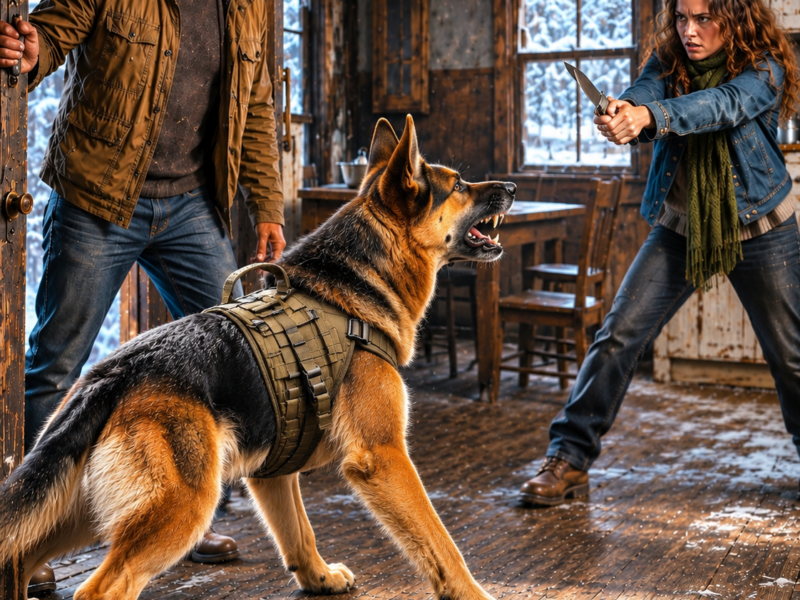
“I paid twenty dollars for an abandoned cabin outside a small Montana town, and when my German Shepherd started clawing at a loose floorboard
The photograph trembled between my fingers.
For several seconds, I couldn’t hear the wind outside or the low growl coming from Ranger.
All I could see was the woman standing beside me in that picture.
Her name was Sarah Carter.
I hadn’t seen her in twelve years.
And the last time I had, she was standing in a hospital parking lot in Virginia, crying while I walked away.
“Jack?” Emily whispered.
I looked down at her.
“How did your mother know me?”
Emily shook her head.
“She said you were a good man. She said you helped her when nobody else would.”
I turned the photograph over again.
The handwriting was unmistakable.
Sarah had written it.
I remembered the night she gave me that same sentence, although I had never seen it written down.
We had met during a Navy deployment overseas.
Sarah was a civilian intelligence analyst working with a joint military team.
She was sharp, stubborn, and had a habit of drinking terrible coffee while correcting everyone’s reports.
She wasn’t part of my unit, but we became friends.
At the time, I was younger and thought being a good soldier meant keeping every personal feeling locked away.
Sarah disagreed.
She used to tell me that the hardest thing for a man to do was admit when he needed somebody.
We lost contact after I returned home.
A few months later, I received a message saying she had married and moved west.
I had no reason to question it.
Now her daughter was sitting in front of me, wearing a bracelet with her name engraved on it, telling me that her mother was dead.
And a stranger outside my cabin knew my name.
I slipped the photograph into my pocket.
“Emily, I need you to tell me something. Did your mother ever mention why she wanted you to find me?”
She nodded.
“She said you knew about the lighthouse.”
I stared at her.
The lighthouse.
That was not a random word.
During our deployment, Sarah and I had once worked on an intelligence investigation involving a shipping company suspected of moving classified military equipment through civilian ports.
The operation had been shut down before it reached a conclusion.
The files were sealed.
Several people were reassigned.
I had been told the investigation was over.
I looked toward the window.
The man in the black coat was still standing there.
He wasn’t smiling anymore.
“Emily, listen carefully. I’m going to take you somewhere safe.”
She gripped my sleeve.
“Are you going to leave me?”
“No.”
I said it before I had time to think.
“I’m not leaving you.”
I called 911.
I didn’t give the stranger a chance to influence the conversation.
I explained that I had found a frightened child hiding beneath the floorboards, that an unknown man was outside, and that the child believed he had harmed her family.
The dispatcher asked whether anyone was injured.
I said Emily appeared dehydrated and had visible bruising.
Then I asked for both police and medical assistance.
When I ended the call, I moved Emily into the kitchen, away from the windows.
Ranger stayed beside her.
The man outside finally approached the door.
Three knocks.
Not loud.
Not angry.
Almost polite.
“Mr. Bennett?”
I didn’t answer.
“My name is Daniel Mercer. I’m here for Emily.”
Emily buried her face in Ranger’s fur.
I stepped toward the door but kept it locked.
“How do you know my name?”
“Your name is on the property paperwork.”
That answer sounded reasonable.
Too reasonable.
“What’s your relationship to Emily?”
“I’m a family friend.”
“She doesn’t seem happy to see you.”
A pause.
Then he said, “She’s been through a difficult experience. Children sometimes become confused.”
I looked through the small glass panel.
Mercer appeared to be in his early fifties.
Clean-shaven.
Well dressed.
A silver watch on his left wrist.
He held a leather folder under one arm.
“I have legal documentation establishing that I’m authorized to take custody of her.”
“Then you can show it to the police.”
His expression hardened.
“You don’t understand what you’re getting involved in.”
“Maybe not. But I understand that she’s afraid of you.”
He looked past me through the glass.
For the first time, I saw his eyes move toward the kitchen.
“Emily,” he called softly. “Sweetheart, come out. Your father is worried.”
Emily made a small sound.
I turned around.
“That’s not her father, is it?”
She shook her head.
Mercer sighed.
“Mr. Bennett, this is becoming unnecessarily complicated.”
“Then leave.”
He stared at me for another moment.
Finally, he returned to his SUV.
But he didn’t drive away.
He parked beside the road and waited.
The police arrived twelve minutes later.
Two officers stepped out of a patrol vehicle.
One was a middle-aged woman named Officer Reynolds.
The other was younger, with a notebook in his hand.
I opened the door and explained what had happened.
Officer Reynolds listened without interrupting.
Then she crouched beside Emily.
“Hi, sweetheart. I’m Officer Reynolds. Can you tell me your name?”
“Emily.”
“Okay, Emily. Are you hurt?”
Emily looked at me before answering.
“My head hurts.”
The officer noticed the cut near her hairline.
She asked permission before examining it.
Emily nodded.
The younger officer walked toward Mercer’s vehicle.
Mercer stepped out immediately and began speaking.
I couldn’t hear everything, but I saw him hand over several documents.
Officer Reynolds returned after a few minutes.
“Mr. Bennett, the gentleman claims he’s Daniel Mercer, a licensed guardian appointed by Emily’s father.”
“Her father?”
“That’s what he says.”
“Emily told me he’s not her father.”
Officer Reynolds glanced toward the child.
“Has she explained why?”
“Not yet.”
She nodded.
“We’ll have to verify the custody documents before anyone leaves with her.”
Mercer approached.
“Officer, I appreciate your caution, but the child has a history of emotional instability.”
Emily’s fingers tightened around Ranger’s collar.
Officer Reynolds looked at him.
“Has she been medically evaluated?”
“Of course.”
“By whom?”
“Her family physician.”
“What’s the doctor’s name?”
Mercer hesitated.
It lasted less than two seconds.
But I noticed.
“I can provide that information to the department.”
“Good. Please do.”
The ambulance arrived shortly afterward.
The paramedics examined Emily and recommended taking her to the hospital.
She refused to let go of my hand.
I crouched beside her.
“I’ll follow right behind you.”
“Promise?”
“I promise.”
She looked at Ranger.
“Can he come?”
I smiled sadly.
“Not in the ambulance, sweetheart. But he’ll be right beside me.”
For the first time, she allowed someone other than me to help her.
At the hospital, a nurse gave her warm blankets and a cup of hot chocolate.
She drank slowly this time.
The doctor found that she was dehydrated, underweight, and had an untreated infection from a small wound on her foot.
Thankfully, her injuries didn’t appear life-threatening.
While Emily rested, Officer Reynolds asked me to explain my connection to Sarah.
I told her everything I remembered.
When I mentioned the old intelligence investigation, she stopped writing.
“Was that investigation classified?”
“Parts of it.”
“Do you have any documentation?”
“No.”
She considered that.
“Mr. Bennett, I need to ask you something. Did Sarah ever tell you she was afraid for her life?”
I looked at the photograph.
“Not directly.”
“Did she ever mention Daniel Mercer?”
I shook my head.
Officer Reynolds closed her notebook.
“Then I think we need to find out who he really is.”
A few hours later, a social worker named Melissa arrived.
She explained that Emily would remain under protective supervision while authorities verified her identity and custody arrangements.
Mercer had left the hospital.
But before he did, he requested a meeting with the attending physician.
He claimed he had an urgent legal right to remove Emily.
The hospital refused.
I was sitting beside Emily’s bed when she finally spoke about her mother.
“Mom used to sing when she cooked.”
I looked up from my coffee.
“What did she sing?”
“Old songs. She said you knew one of them.”
I tried to remember.
Then it came back.
Sarah used to sing an old folk song whenever our team was stuck waiting somewhere.
She never remembered all the words.
She would make up the rest.
Emily reached beneath her pillow.
She pulled out a small brass key.
“Mom gave me this before she died.”
I leaned forward.
“Where did she get it?”
“She said it opened something at the cabin.”
I examined the key.
There was a tiny number stamped into the metal.
17.
The next morning, Officer Reynolds arranged for a search of the cabin with my permission.
The investigation was now being handled as a possible child endangerment and missing-person case.
I returned with two officers and Ranger.
The cabin looked exactly as we had left it.
Except the photograph above the fireplace was gone.
I checked the floor.
The empty space where the frame had hung was covered by a clean rectangle in the dust.
Someone had entered while we were at the hospital.
Officer Reynolds called for additional assistance.
I checked the doors.
No broken locks.
No damaged windows.
Whoever had come inside had used a key.
I remembered the brass key Emily had shown me.
Number 17.
I searched the cabin until I found a small metal cabinet built into the wall behind the kitchen shelves.
It had no visible handle.
Only a narrow keyhole.
I inserted the brass key.
It turned.
Inside was a brown envelope, a flash drive, and a small notebook.
The envelope had my name written across it.
Not my full name.
Just:
JACK.
I opened it carefully.
The letter inside was written by Sarah.
“Jack,
If Emily has reached you, then I failed to protect her from the people who came after us.
I need you to understand that I never lied about who you were to me.
You were the only person I trusted with the truth.
The night you left Virginia, I tried to tell you something important.
But I was told you had already been warned to stay away from me.
I believed them.
I shouldn’t have.
The lighthouse records are still alive.
Daniel Mercer knows where they are.
He thinks Emily knows too.
She doesn’t.
Please don’t let him convince you that this is about a custody dispute.
It isn’t.
It’s about what happened twelve years ago.”
I read the letter twice.
The date at the bottom was six weeks before Sarah’s reported death.
My throat tightened.
Sarah had been alive only weeks earlier.
I looked at Officer Reynolds.
“Who reported her death?”
She studied the letter.
“We’ll find out.”
I opened the notebook.
Most of the pages contained dates, names, and shipping references.
One entry appeared repeatedly:
LIGHTHOUSE — ACCOUNT 17.
Beside it were several numbers.
I recognized the format.
They were not account numbers.
They were coordinates.
The flash drive might contain the explanation.
But Officer Reynolds insisted that we not open it on a personal computer.
She arranged for a digital forensics specialist.
We waited until the following afternoon.
By then, the story had begun to unravel.
Sarah Carter had not died in a car accident, as her death certificate claimed.
There was no verified crash report.
No hospital record.
No funeral documentation.
Her death had been certified through a private medical service connected to a company called Northstar Logistics.
The same company appeared in the notebook.
The same company had been investigated during my final deployment.
And Daniel Mercer was listed as its former security director.
I sat across from the forensic specialist while he examined the flash drive.
He found several encrypted folders.
One contained financial records.
Another contained photographs of shipping containers.
The third contained a video file.
The specialist opened it.
Sarah appeared on the screen.
She looked thinner than I remembered.
Her hair was shorter.
There were dark circles beneath her eyes.
But she was alive.
She looked directly into the camera.
“If you’re watching this, Jack, then Emily found the cabin.”
I leaned forward.
“Sarah…”
She continued.
“I don’t know how much time I have, so I’m going to tell you what I should have told you years ago.”
She explained that the shipping investigation had uncovered a private network moving stolen military technology through legitimate commercial ports.
Northstar Logistics was responsible for arranging the shipments.
Mercer had been managing security and paying off officials to keep the operation hidden.
Sarah had discovered that the company was also selling information about military personnel.
Names.
Assignments.
Family addresses.
Travel schedules.
The information was being used to identify people who could be threatened, manipulated, or silenced.
When Sarah attempted to report it, the investigation was compromised.
Several people were removed from their positions.
Some disappeared.
She had gone into hiding.
Then she had discovered something even more disturbing.
Her daughter had been listed in a private file.
Emily’s information had been added to a record connected to a payment made twelve years earlier.
The payment had been authorized under my old unit’s identification code.
I looked at the screen.
Sarah’s eyes filled with tears.
“Jack, I know what the records suggest. But I need you to remember something. You were never responsible for what happened to us.”
The video paused briefly.
Then she leaned closer.
“Someone used your credentials to approve the first transfer. I found the original authorization, and I know whose name was attached to it.”
The video ended.
Nobody spoke.
I stared at the blank screen.
I had spent twelve years believing that our investigation had been shut down because of a paperwork error.
Now I understood that someone had used my identity to protect a criminal operation.
But the worst part wasn’t the theft.
It was that my name had been used to put Sarah and Emily in danger.
Officer Reynolds asked the specialist to continue examining the drive.
He found another file.
It was labeled:
17 — ORIGINAL AUTHORIZATION.
The document contained a signature.
Mine.
Except it wasn’t.
I knew my own signature.
The one on the screen had been copied from an old deployment report.
Underneath it was a second name.
A name I recognized immediately.
Commander Robert Hayes.
My former commanding officer.
The man who had personally recommended me for the SEAL program.
The man who had attended my wedding.
The man who had stood beside me at the funeral of one of my teammates.
I had trusted him with my life.
And he had been the last person to sign off on the investigation before it was buried.
I pushed my chair back.
“That’s impossible.”
Officer Reynolds looked at me.
“You know him?”
“He was my commanding officer.”
“Could he have had access to your credentials?”
I stared at the document.
“He had access to everything.”
The next twenty-four hours were a blur of interviews, phone calls, and official requests.
A federal investigator contacted Officer Reynolds.
The case was transferred to a joint task force.
They confirmed that Hayes had retired from active service and was now working as a consultant for a private defense contractor.
Northstar Logistics had dissolved three years earlier.
Its remaining assets had been transferred through several shell companies.
And Daniel Mercer had been working under a different identity.
But we still didn’t know where Sarah was.
Or whether she was alive.
Then Emily asked to see me.
She was sitting on the hospital bed, drawing a picture with colored pencils.
It showed a cabin, a dog, and three people standing outside.
One was tall.
One was small.
The third had long brown hair.
“Is that your mother?”
She nodded.
“She said she might come back.”
I sat beside her.
“Did she tell you where she was going?”
Emily looked at the picture.
“She said she had to make something right.”
I swallowed.
“Did she say when she’d return?”
“She said if the bad people stopped looking, she’d come home.”
I placed my hand on the bed.
“Emily, I want to find her.”
She looked up.
“Even if she’s not alive?”
I didn’t answer immediately.
Then I nodded.
“Even then.”
Three days later, the federal investigators found a location connected to the coordinates in Sarah’s notebook.
It was an abandoned coastal property in Washington state.
A lighthouse stood at the edge of the property, surrounded by thick forest and a long stretch of rocky shoreline.
The place had been used as a storage site for Northstar documents.
Investigators believed the original shipping records might still be there.
I was not officially assigned to the operation.
But I knew the terrain from the satellite photographs.
And I knew the significance of the old records.
I offered to help identify the documents and any familiar names.
The task force agreed to let me accompany them as a civilian consultant.
Before I left, I visited Emily.
She was staying in a secure children’s facility while the court reviewed her situation.
Ranger was lying beside her bed.
She had become attached to him almost immediately.
“Are you going somewhere?” she asked.
“Yes.”
“To find Mommy?”
I nodded.
She handed me a folded drawing.
It showed the same cabin.
This time, the woman with long brown hair was standing in the doorway.
“Tell her I kept the picture,” Emily said.
“I will.”
“And tell her Ranger misses her too.”
I smiled.
“Ranger misses everyone who gives him snacks.”
She laughed.
It was the first genuine laugh I’d heard from her.
I folded the drawing carefully and put it in my jacket.
The lighthouse was colder than I expected.
The ocean wind came hard off the water, and the old structure stood against the gray sky like something that had been forgotten on purpose.
The task force arrived shortly after sunrise.
They found a locked storage room beneath the lighthouse.
Inside were filing cabinets, old computers, and dozens of sealed boxes.
The original records were there.
So was a second flash drive.
And on a desk near the back wall was a photograph of Sarah.
It had been taken recently.
She was standing beside a small wooden house.
Behind her was a handwritten date.
Only two days earlier.
I picked up the photograph.
“She’s alive.”
The investigator examined the image.
“We need to verify that.”
Then one of the agents called from the hallway.
“There’s someone in the lower room.”
We moved toward the staircase.
A woman was sitting on the floor beside an old radiator.
Her hair was longer than in the video.
Her face was pale.
But I recognized her immediately.
Sarah.
For a moment, neither of us moved.
Then she looked up.
“Jack?”
I couldn’t find the words.
She stood slowly.
Her eyes filled.
“I thought you were dead.”
I took one step forward.
“I’ve been told the same about you.”
She let out a shaky laugh that turned into a sob.
I wanted to ask a hundred questions.
Instead, I stood there while she covered her mouth with one hand.
“Emily?” she whispered.
“She’s safe.”
Sarah grabbed the railing.
“Where is she?”
“Montana. She’s getting medical care.”
“Did she find the cabin?”
“She did.”
Sarah closed her eyes.
For the first time, I saw her shoulders relax.
Then she looked at me.
“Did you see the records?”
“Yes.”
“Did you see Hayes’s name?”
I nodded.
She looked toward the investigators.
“Then we need to get the original authorization into federal custody before he knows we’ve found it.”
The agents secured the records.
They also discovered that Sarah had been living in the property under a false identity.
She had gone there after escaping a vehicle that Mercer had arranged to follow her.
She had been injured and had spent several days hiding in the storage area.
She had sent the video and the photograph to the cabin through a trusted contact, hoping Emily would eventually find the key.
But she hadn’t known whether Emily would make it there.
She hadn’t known whether I would ever see the letter.
And she hadn’t known whether Mercer had already reached the property.
I asked her the question that had been sitting in my chest for twelve years.
“Why didn’t you tell me what happened in Virginia?”
Sarah looked down.
“Because I was told you had been killed in an operation overseas.”
I stared at her.
“What?”
She nodded slowly.
“They showed me a report. Your name was on it. Your unit identification was attached. They told me you died protecting classified material.”
I shook my head.
“I was alive.”
“I know that now.”
She looked up.
“I should have checked. I should have found another way. But I was pregnant, Jack. I was scared, and they had already shown me how much they knew about my family.”
I looked at her.
“Emily?”
Sarah nodded.
“She’s yours.”
The words landed quietly.
There was no dramatic music.
No sudden movement.
Just the distant sound of the ocean hitting the rocks beneath the lighthouse.
I sat down on the nearest chair.
Sarah continued.
“I found out a few months after you left. I tried to contact you, but your number had changed. Then I received the report saying you were dead. By the time I realized it was false, I had already been threatened.”
I rubbed my hands over my face.
“Why didn’t you tell Emily?”
“Because I wanted her to have a normal life. I told her you were someone who had helped me when I was young. I didn’t want her to grow up waiting for a father who might never come.”
I looked at the photograph in my hand.
The little girl in the pink sweater.
The bracelet.
The fear in her eyes.
I had been standing in front of my own daughter without knowing it.
Sarah sat beside me.
“I’m sorry.”
I couldn’t answer immediately.
There was too much anger.
Too much grief.
Too much time.
But none of it belonged to Emily.
I looked at Sarah.
“We have to tell her the truth.”
She nodded.
“Yes.”
The federal investigation moved quickly after that.
The original records established that Hayes had authorized the use of falsified credentials to conceal Northstar’s shipments.
The evidence also showed that Mercer had helped arrange the threats against Sarah and had attempted to take Emily after discovering that she had reached the cabin.
Hayes was arrested at his home two weeks later.
Mercer was detained while attempting to leave the country.
Several former contractors and officials were charged as investigators traced the financial network.
The case took months to complete.
Some people denied everything.
Others cooperated once they realized the original records had been recovered.
I was cleared of the false authorization.
But the investigation also forced me to confront how much of my past had been built on information someone else had manipulated.
Sarah needed time to recover.
Emily needed time to trust.
And I needed to learn how to be a father to a little girl who had spent years believing that the people who came looking for her were dangerous.
The first time Sarah and Emily saw each other again, I waited outside the room.
I could hear Emily asking questions.
I could hear Sarah crying.
Then the door opened.
Emily stood in the doorway.
Her eyes were red.
“Jack?”
“Yeah, sweetheart?”
She looked at me for a long moment.
“Is she really my mommy?”
I nodded.
“Yes.”
She looked down at her bracelet.
Then she ran into Sarah’s arms.
I turned away to give them privacy.
Ranger pressed his head against my leg.
I scratched behind his ears.
“Good job, buddy.”
He wagged his tail.
The next several months were not easy.
Sarah had to rebuild her life.
Emily had nightmares.
Sometimes she refused to sleep unless the hallway light stayed on.
Sometimes she hid food in her bedroom drawers.
I learned not to make a big deal about those things.
I simply made sure she knew there would always be food in the kitchen and that nobody would take her away without explaining where she was going.
We moved back to Montana after Sarah was medically cleared.
The twenty-dollar cabin became our home.
I repaired the roof, replaced the windows, and rebuilt the porch.
Sarah planted flowers beside the front steps.
Emily painted her bedroom yellow.
Ranger claimed the warmest spot near the fireplace.
One afternoon, I found Emily sitting on the floor beside the loose floorboard.
I had repaired the opening months earlier, but she still liked to sit near it.
“What are you doing?” I asked.
She looked up.
“Making sure nobody is hiding.”
I sat beside her.
“That’s a good job.”
She rested her head against my shoulder.
“Do you think we can stay here forever?”
I looked around the cabin.
The same walls that had once hidden her from the world now held the sound of Sarah humming in the kitchen.
Ranger was asleep near the stove.
A pair of little pink boots sat beside the front door.
“Not forever,” I said.
“Why?”
“Because someday you’ll get bigger, and you’ll want to see the world.”
She considered that.
“Can we come back?”
I smiled.
“Every time.”
That evening, Sarah and I sat on the porch after Emily had gone to bed.
The mountains were dark against the fading sunset.
She handed me a cup of coffee.
“Do you ever wish you hadn’t bought this place?” she asked.
I looked at the cabin.
Twenty dollars.
A broken roof.
A loose floorboard.
A little girl who had been waiting for someone to find her.
I shook my head.
“No.”
Sarah rested her hand over mine.
“I’m sorry it took so long.”
I looked at her.
“Me too.”
Neither of us pretended that twelve missing years could be repaired in a few months.
There were conversations still waiting to happen.
There were apologies that would take time.
There were memories we would have to learn how to carry together.
But we had stopped running.
And for the first time in a long while, that felt like enough.
A few weeks later, Emily asked me to help her make a small wooden sign for the cabin.
We painted it white and let her choose the words.
She wrote them carefully, one letter at a time.
HOME IS WHERE SOMEONE COMES LOOKING FOR YOU.
I hung it beside the front door.
Ranger sat beneath it, watching her work.
Emily stepped back to admire the sign.
Then she slipped her hand into mine.
I had spent years believing that the most important thing I could do was protect people from danger.
But standing there with my daughter, I finally understood something I had missed.
Sometimes protection wasn’t about fighting the people outside.
Sometimes it was about making sure the people inside never had to be afraid again.
And that little twenty-dollar cabin, the place everyone else had considered worthless, became the first home where all three of us finally felt safe.
THe end.









