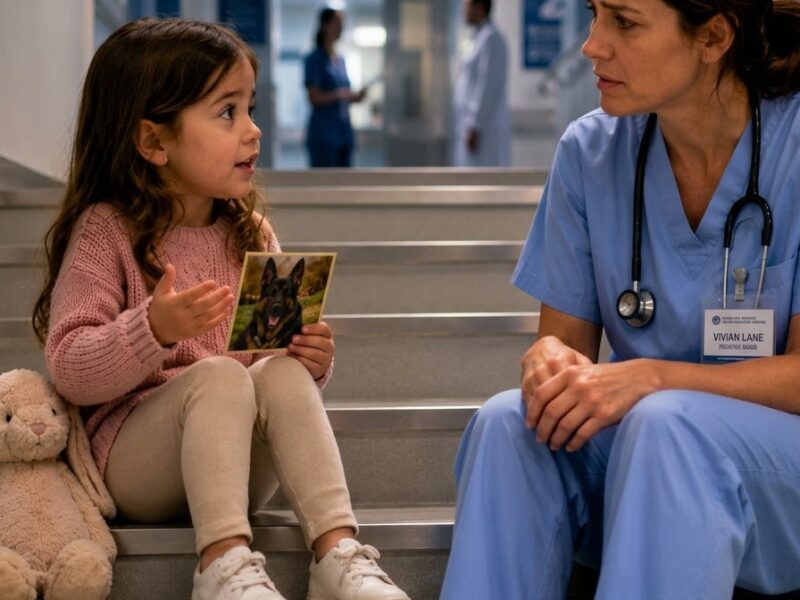
“I MISS HIM…” A five-year-old girl sat alone on the cold hospital stairs, clutching her K9’s bloodstained leash while a nurse walked past her without stopping
The emergency wing of the military medical facility was rarely quiet, but the air that evening carried a heavy, metallic silence. I was carrying a thick stack of intake files toward the trauma department when I saw her.
She was sitting alone on the cold concrete steps leading up to the second-floor viewing balcony. Her name was Lily, and she looked far too small for the vast, sterile hallway surrounding her. Her pink sneakers hung inches above the ground, dangling uselessly over the edge of the stair. What caught my eye wasn’t just her isolation; it was what she held in her lap. Her tiny hands were wrapped tightly around a heavy, reinforced nylon K9 leash—one end stained with dark, dried blood.
A nurse rushed past her without looking down, her shoes squeaking against the linoleum. Nobody seemed to notice the five-year-old girl sitting in the dark shadow of the stairwell.
I set the medical files on a nearby cart and walked over, lowering myself onto the step beside her.
“Sweetheart, are you okay?” I asked softly.
She shook her head, keeping her eyes fixed on the floor. “I miss him.”
Her voice was barely a whisper, fragile and hoarse from crying.
“Who do you miss?”
“My dog,” she said. She held up the leash, letting the heavy steel clip clatter softly against the step. “His name is Max.”
I initially assumed Max was a family pet brought along during some chaotic evacuation. But as I reached out to steady the leash, I saw the thick metal tag attached near the hand loop. It wasn’t a standard pet tag. It was a military identification plate, stamped with a serial number, a blood type, and the crest of the Tactical K9 Division.
“Is he inside?” I asked, pointing toward the heavy double doors of the veterinary trauma unit across the courtyard.
Lily nodded, her lips trembling. “He’s hurt because of me.”
“Oh, no. I’m sure that’s not true,” I said, leaning in to look at her face. “Whatever happened, it wasn’t your fault.”
She wiped her eyes with the sleeve of her faded yellow sweater. “He told me to run, but I didn’t listen.”
A cold stillness settled in my chest. “Who told you to run, Lily?”
“My daddy.” She raised a finger and pointed across the hall toward the human intensive care unit. “My daddy is Max’s soldier.”
The pieces began to fall into place with a terrifying clarity. Earlier that evening, a high-priority medevac had brought in a Special Operations handler following a catastrophic explosive event during a domestic training exercise at the edge of the base. The handler was in critical condition, unconscious and suffering from severe blast trauma. Nearby, the base’s veterinary trauma team had been scrambled to stabilize his Malinois, who had sustained shrapnel wounds and severe smoke inhalation while shielding someone in the blast zone.
Lily had been brought in by a military escort half an hour later, wrapped in a blanket, quiet and forgotten in the administrative storm that followed high-level casualties.
I took her small, cold hand in mine. “Tell me what happened, Lily.”
She stared down at her pink sneakers for a long moment, her breath hitching. “Daddy said Max would find me.”
“Find you where?”
“In the house,” she cracked, her eyes welling up with fresh tears. “There was smoke everywhere. It was loud and hot. Daddy fell down, and then Max came through the window. He pushed me under the bed and stayed on top of me.”
I felt a chill run down my spine. The official intake report had mentioned a controlled demolition accident near the abandoned housing quarters, but Lily’s story sounded far more chaotic, far more dangerous than a simple range accident.
“He stayed there until the soldiers came,” she whispered.
She unzipped a small blue backpack resting next to her on the stairs and pulled out a folded piece of paper. The edges were singed black. She unfolded it carefully on her knees.
It was covered in bright crayon drawings. One panel showed a little girl holding a massive black-and-tan dog’s paw. Another showed a man in camouflage uniform lying beneath a giant yellow sun. And the last drawing—drawn with heavy, frantic red strokes—showed a house surrounded by towering flames.
At the bottom of the page, in uneven, oversized letters, Lily had written three words:
MAX SAVED ME.
Before I could ask her more, the heavy double doors of the surgical wing burst open. A senior surgical technician rushed out, looking frantically around the corridor until his eyes landed on us.
“Is Lily here?” he called out.
Lily instantly jumped to her feet, dropping her backpack but keeping her fingers clamped onto the bloodstained leash. “Is Max okay?”
The doctor jogged over, dropping to one knee so he was at eye level with the girl. His expression was grave, his scrubs splattered with saline and antiseptic. “He’s alive, sweetheart, but he’s very weak. The shrapnel missed his heart, but his lungs took a lot of damage from the smoke. He needs a major surgery to clean out the debris, and his heart rate is dropping.”
Lily turned her tear-streaked face toward me, her eyes wide with desperate hope. “Can you make him better?”
I looked at the child, then down at the heavy military leash in her small hands. Though my official title in this facility was administrative trauma coordinator, my past—the part I rarely spoke about—lay deep in combat veterinary medicine.
“I’ll do everything I can,” I promised her.
I escorted Lily to the pediatric quiet room under the care of a staff volunteer, ensuring she had a warm blanket and some juice. Then I scrubbed in and entered the veterinary operating bay.
For three brutal hours, the surgical team worked under the harsh glare of the overhead lights. Max was a majestic Belgian Malinois with a heavy chest, a dark mask, and a body scarred from years of tactical service. We cleared the debris from his airway, sutured the lacerations along his flank, and stabilized his blood pressure. He was a fighter, breathing steadily by the time we transferred him to the recovery cage.
By four in the morning, the hospital had settled into a quiet hum. I walked back to the pediatric waiting room and found Lily fast asleep in a vinyl armchair. Her small frame was curled into a ball, one cheek resting against her arm, her tiny fingers still tightly wrapped around Max’s leash.
“Nurse Miller?”
I turned around. The lead veterinary technician was standing in the doorway, holding a plastic biohazard bag. Inside was Max’s heavy Kevlar tactical vest, torn and blackened by fire.
“We were stripping down his gear for decontamination,” the technician said, his voice laced with confusion. “We found something tucked into the interior armor pocket. It was wrapped in water-resistant plastic, but it has your name on it.”
He reached into the bag and handed me a small, smoke-stained envelope. Written across the front in dark, familiar handwriting was my full name: Sarah Miller.
My hands began to tremble. I hadn’t touched Max until tonight. I had never met his handler. I had spent the last ten years keeping a low profile, working administrative shifts, hiding away from the battlefield memories that haunted my sleep.
I carefully tore open the seal and pulled out a faded, golden-toned photograph.
The breath was knocked completely out of my lungs.
The photograph was fifteen years old. It showed a young woman in an Army training uniform—myself—standing in the bright sunlight of a Texas training facility. Standing next to me, his arm draped casually over my shoulder, was my older brother, David. And between us, sitting proudly on the grass, was a dark-coated German Shepherd puppy.
I turned the photograph over. Written on the back in David’s sharp, slanted script were two lines:
“If I don’t come home, she’ll know how to save him. Don’t let the fire take the bloodline.”
A wave of vertigo washed over me. Fifteen years ago, my brother David had deployed overseas as a Special Forces handler. He never came back; his unit was lost during a tragic mountain operation in the Korengal Valley. For fifteen years, I believed everything connected to David had been buried in that dirt.
I looked from the photograph to the sleeping girl holding the leash, and then toward the recovery ward where Max lay breathing quietly.
Max wasn’t just a random military dog. He was the direct descendant of my brother’s legendary working dog. And the man lying unconscious in the human ICU wasn’t just a soldier—he was David’s former teammate, the last surviving witness to the fire that took my brother’s life.
The morning sun broke through the blinds of the hospital, casting long, golden bars across the floor of the ICU observation room. I stood behind the double-paned glass, watching the monitors hum around the handler’s bed. His name on the chart read Master Sergeant Marcus Vance. His face was bruised, a thick white bandage wrapped tightly around his skull, but his chest rose and fell with steady, mechanical rhythm.
“You’ve been standing there for twenty minutes, Sarah,” Dr. Mitchell said, stepping up beside me with two paper cups of coffee. He offered one to me. “The surgical team says Marcus is stable. Blast concussion, fractured ribs, but no permanent neurological damage. He’ll wake up soon.”
“He was with David,” I said, my voice barely above a whisper. I didn’t take my eyes off Marcus. “In 2011. When the outpost went down.”
Mitchell froze, the coffee cup halfway to his mouth. He looked at me, then at the man in the bed. “Are you sure?”
I pulled the smoke-stained photograph from my coat pocket and held it against the glass. “This was in Max’s tactical vest. David wrote this message fifteen years ago. Marcus carried it. He’s been carrying it this whole time.”
Mitchell sighed heavily, leaning his shoulder against the window frame. “Sarah, you know as well as I do that the official report on Outpost Bravo was sealed by the Department of Defense. Your brother was listed as missing in action, presumed dead after the command bunker collapsed in the fire. If Vance was there, he never gave a public deposition.”
“Because someone made sure he didn’t,” I replied, my mind spinning.
I turned and walked back toward the veterinary recovery ward. Max was awake now. The Malinois was lying on a padded mat inside a large recovery enclosure, his head resting on his paws. His deep brown eyes tracked me the moment I opened the door. He didn’t growl. He didn’t bark. As I knelt beside the enclosure, he raised his heavy head and let out a soft, low whine, pressing his snout against the steel mesh.
I opened the cage door and sat on the floor beside him. Max immediately shifted his body, resting his heavy, bandaged head directly in my lap.
“Hey boy,” I murmured, my fingers sinking into his soft fur behind his ears. “You remember the scent, don’t you?”
Dogs from David’s lineage were raised with a specific handler scent-marker protocol—a unique mixture of cedar and lavender oil that David used to train his pups so they would recognize family members if they were ever separated. I had kept a small bottle of that exact oil on my desk for fifteen years out of grief and habit. Max had smelled it on my hands the moment I treated him in the operating room.
“What were you protecting, Max?” I whispered to the dog. “What did they try to burn down last night?”
Suddenly, the door to the recovery ward swung open. A man in a crisp, dark civilian suit stepped inside, accompanied by two armed Military Police officers. He carried a leather briefcase and had a stern, razor-sharp jawline that screamed high-level intelligence contractor.
“Sarah Miller?” the man asked, his voice smooth and cold.
I didn’t stand up. I kept my hand on Max’s head. “Yes. Who are you?”
“I am Director Sterling from the Defense Logistics and Asset Oversight Office,” he said, stepping closer. “I am here to take custody of military working asset K9-442, designated ‘Max,’ as well as all personal belongings recovered from the site of last night’s incident.”
Max’s body went rigid beneath my hands. A low, dangerous rumble vibrated deep in the dog’s chest.
“Max is currently recovering from major invasive surgery,” I said coldly. “He is not fit for transfer.”
“That is a determination for our medical board, Miss Miller,” Sterling replied, reaching into his coat to produce a folded set of transfer orders. “This animal is classified as specialized military property tied to an ongoing national security investigation. The incident at the abandoned quarter master facility last night involved sensitive equipment. We are impounding the dog and closing the file.”
“Equipment?” I scoffed, standing up slowly and stepping between Sterling and the cage. “A five-year-old girl was in that building, Director. A soldier is currently in a coma in the ICU. This wasn’t an equipment failure.”
Sterling’s eyes narrowed slightly, a subtle twitch revealing his annoyance. “The child was not supposed to be on the premises. Master Sergeant Vance violated base safety protocols by bringing a civilian into a restricted area. The resulting fire was an unfortunate accident caused by aging fuel lines.”
“You’re lying,” I said bluntly.
The two MPs behind Sterling shifted their weight, their hands resting near their sidearms.
“Miss Miller, I suggest you step aside,” Sterling said, his tone dropping into a silent threat. “Your brother’s legacy in the Army was complicated. It would be a tragedy if your civilian employment here was similarly… derailed.”
“Is that a threat, Director?”
“It is a reality check,” Sterling said. “Hand over the dog’s gear and step out of the room.”
Before the tension in the room could explode, a soft voice spoke from the hallway door.
“He can’t take Max, Aunt Sarah.”
We all turned. Lily was standing in the doorway, wearing her oversized yellow sweater, her pink sneakers quiet against the floor. She was clutching her crayon drawing to her chest.
Sterling scowled, looking down at the child. “Child, go back to the nursery.”
Lily ignored him. She walked right past the armed MPs, straight to my side, and reached out to hold my hand. She looked up at Sterling with eyes that held no fear—only the fierce, unbroken clarity that only a child possesses.
“Max didn’t break the pipes,” Lily said clearly, her small voice echoing in the quiet room. “The bad men with the black helmets put the boxes in the wall. Daddy saw them. That’s why they made the fire.”
Sterling’s face turned completely pale.
The air in the room became suffocatingly quiet. Sterling stared down at Lily, his cold composure slipping for a fraction of a second, revealing something dark and desperate beneath.
“The child is traumatized and confused,” Sterling said quickly, turning to the MPs. “Secure the room. Take the dog now.”
“Don’t touch him!” I snapped, stepping directly into the path of the first MP.
Max sprang to his feet inside the cage, ignoring the pain of his surgical sutures, his lips pulled back over sharp white teeth as a fierce, deafening bark rattled the room. The MPs hesitated, unnerved by the sheer fury of the decorated war dog.
“What is going on here?”
Dr. Mitchell walked into the room, his eyes darting between the armed guards, Sterling, and me. Behind him was the base Provost Marshal—a full Colonel in uniform.
“Colonel,” Sterling said, adjusting his tie and recovering his smooth facade. “We are executing an asset retrieval order signed by regional command. Nurse Miller is interfering with federal officials.”
“The order is temporarily suspended, Sterling,” the Colonel said, holding up a hand. “Master Sergeant Vance just woke up in the ICU. And he explicitly requested to speak with his handler team, Nurse Miller, and the Provost Marshal’s office. Nobody moves this dog until I clear it.”
Sterling’s jaw clenched tightly. “Vance is head-injured. His testimony is unreliable.”
“Then you won’t mind if we hear what he has to say,” I said.
Leaving Max under the watchful guard of the Colonel’s own trusted MPs, I took Lily’s hand and walked alongside Mitchell to the ICU.
When we entered the room, Marcus Vance was sitting up slightly in bed, his chest heavily bandaged, an IV line snaking into his arm. His face was weathered, lined with the stress of years in combat, but his eyes were sharp and blue.
The moment he saw me, his eyes widened slightly. He looked down at Lily, who immediately ran to his bedside and hugged his arm carefully, mindful of his injuries.
“Daddy,” she whimpered.
“I’m okay, baby girl,” Marcus rasped, his voice rough from smoke. He stroked her hair gently, then raised his eyes to meet mine. “Sarah.”
It was the first time he had spoken my name. Hearing it in his voice felt like opening a long-buried time capsule.
“You look just like him,” Marcus whispered. “David always said you had the same eyes.”
“Marcus… what happened last night?” I asked, moving closer to the bed while Mitchell closed the door behind us. “What was in that building? Why did Sterling bring armed guards to take Max?”
Marcus pulled Lily closer, his hand resting protectively on her shoulder. “Fifteen years ago, in Korengal, your brother David didn’t die from an enemy mortar strike, Sarah. Our outpost was targeted by a private military contractor operating under a black-budget research initiative known as Project Sentinel.”
I felt my knees go weak. Mitchell caught my arm, guiding me into a chair beside the bed.
“Sentinel was an automated surveillance and perimeter defense program,” Marcus continued, his breath coming in shallow rasps. “They were testing experimental high-frequency radio hardware and acoustic weapons in active combat zones. David found out that the contractor—run by Sterling—was using illegal frequencies that caused severe brain hemorrhages in localized populations, including our own K9 units. David gathered the hard drive evidence and hid it.”
“In the dogs,” I breathed, remembering the photograph and the coded tags.
Marcus nodded slowly. “David knew they were going to silence the outpost to cover up the system failure. Before the strike hit, he encoded the master access keys into the microchip implants of his breeding line. He gave me his puppy—Max’s father—and told me to survive. He told me that if anything ever happened to him, I had to guard that bloodline until I could find you.”
“Why me?” I asked, tears finally spilling over my eyelashes. “I was just a junior medic back then. I left the service!”
“Because you were the only person David trusted who had the veterinary knowledge to extract the bio-encrypted chips without destroying the data,” Marcus said softly. “Last night… I found the last remaining physical hard drive from Project Sentinel. It was hidden inside the wall of the old quarters at Sector 4. But Sterling’s men tracked me. They detonated an incendiary device to destroy the evidence and kill us.”
“Max pushed Lily under the bed,” I said, the picture forming completely in my mind.
“Max took the blast,” Marcus said, his eyes glistening with unshed tears. “He dragged Lily to the window, and I managed to throw her out into the yard before the roof caved in. The data chip isn’t in the building, Sarah. It’s inside Max’s tracking tag.”
Suddenly, the lights in the room flickered violently.
The high-pitched whine of an emergency power failure hummed through the walls. The overhead fluorescent lights buzzed and went dark, leaving the room illuminated only by the faint green glow of the battery-operated heart monitors.
The electronic lock on the ICU door clicked.
“They cut the main grid,” Mitchell warned, reaching for his pocket light. “The hospital’s secondary generator should take ten seconds…”
Ten seconds passed. Darkness remained.
From the hallway outside, the muffled sound of silenced gunshots echoed through the dark corridors.
“Stay down!” Marcus ordered, sliding his legs out of the hospital bed despite the agony shooting through his fractured ribs. He pulled Lily down behind the heavy medical console. “Sarah, get behind the bed!”
“They’re coming for the tag,” I said, my heart hammering against my ribs.
I didn’t have a sidearm, but fifteen years of burying my past hadn’t erased the survival instincts drilled into me during my military training. I reached under the emergency cart and pulled out a heavy steel oxygen cylinder, gripping it like a club.
The heavy glass door of the ICU split open with a sharp, pneumatic crunch. Two figures dressed in non-reflective black tactical gear slipped into the dark room. Their faces were obscured by dark visors, and their weapons were fitted with heavy suppressors.
“Where is the drive?” one of the men demanded, his voice rasped through a radio filter.
Before Marcus could answer from behind the bed, a massive, muscular shape exploded through the shattered glass panel of the adjoining window.
It was Max.
The Malinois had broken past the guards down the hall the moment the power went out, driven by the instinct to protect his handler and the child. He hit the first contractor with the force of a battering ram, his powerful jaws locking around the man’s forearm, forcing the weapon to discharge uselessly into the ceiling tile.
The contractor screamed as Max dragged him to the floor with brutal efficiency.
“Shoot the dog!” the second man yelled, raising his suppressed rifle toward Max.
“Not on my watch!” I shouted, swinging the heavy steel oxygen tank with all the strength in my body.
The heavy metal cylinder struck the second contractor flush across the side of his helmet. The impact sent him stumbling sideways into the glass partition, his rifle clattering across the floor. Marcus instantly lunged from the bed, wrapping his arms around the man’s legs and pinning him to the ground.
The room descended into a flurry of chaotic, dark violence.
The first contractor managed to push Max off his arm, pulling a combat knife from his vest. He lunged toward the dog, but Max was faster. The dog dodged the blade, leaped onto the bed, and lunged down, biting deep into the contractor’s tactical shoulder harness, driving him flat onto his back.
“Lily, stay under the desk!” I yelled, diving forward to kick the dropped rifle out of the second man’s reach.
Just as Marcus locked the second contractor into a sleeper hold, the hallway doors swung wide open again.
Director Sterling stood in the doorway, illuminated by the red glow of the hallway emergency exit sign. In his right hand, he held a small, black electronic device with a glowing red LED light.
“Enough!” Sterling shouted.
Max froze on top of the pinned contractor, his ears pinning back as a terrible, high-pitched acoustic squeal began to emit from the device in Sterling’s hand. It was the legacy Project Sentinel acoustic weapon—a localized frequency calibrated to disrupt the internal equilibrium of tactical K9s.
Max let out a painful, agonized whimper, collapsing onto his side on the bed, his paws clutching at his ears as his body began to tremble violently.
“Max!” Lily shrieked from under the desk.
“Shut it off!” I screamed, taking a step toward Sterling.
Sterling pointed a compact handgun directly at my chest. “Stand back, Nurse Miller. This frequency will cause a fatal cerebral hemorrhage in the dog within sixty seconds. Hand over the collar tag, or watch your brother’s legacy die right in front of you.”
Marcus groaned on the floor, struggling to stand, but his injuries held him down. Max’s breathing was becoming rapid, shallow, his eyes rolling back in sheer agony as the acoustic wave tore through his sensitive nervous system.
I looked at the dog. I looked at the dark red blood seeping through his fresh surgical bandages. I saw David’s eyes in my memory. I saw the promise written on the back of that golden photograph: Don’t let the fire take the bloodline.
“You think you’re the only one who knows how that system works, Sterling?” I said, my voice dropping into a steady, freezing tone.
Sterling hesitated, his finger tightening on the trigger. “What?”
“David didn’t just hide the decryption key in the dog’s tag,” I said, stepping forward slowly, ignoring the gun pointed at my heart. “He trained me on the override protocol. The Sentinel signal relies on an open local relay. And this hospital’s pediatric wing has an active MRI imaging suite right down the hall.”
I reached into my pocket, pulled out my master administrative access keycard, and slammed it against the wall-mounted emergency control panel behind me.
“Mitchell! Trigger the magnetic purge!” I roared.
Dr. Mitchell, who had been hiding behind the door frame, lunged across the wall panel and smashed his fist down on the red manual override switch for the diagnostic lab next door.
A massive, subterranean thrum echoed through the walls as the heavy industrial electromagnets of the MRI machine roared to life at maximum power.
The sudden, colossal electromagnetic wave surged through the room. The acoustic device in Sterling’s hand instantly burst into sparks, smoking violently as its internal circuits fried. The high-pitched whine cut off instantly.
Sterling gasped, dropping the burning plastic device.
The moment the acoustic agony stopped, Max snapped his eyes open. The Malinois rose from the bed like a phantom reborn from the ashes, a dark, terrifying storm of pure canine fury.
Before Sterling could aim his handgun, Max leaped through the air.
The impact sent Sterling flying backward out into the hallway, his handgun skittering across the floor tiles. Max landed heavily on top of him, his powerful paws pinning the director’s chest to the floor, his sharp jaws resting inches from Sterling’s throat. A low, terrifying growl rattled from the dog’s chest—a promise of absolute destruction if the man moved a single inch.
“Don’t move,” I said, walking out into the hallway and picking up Sterling’s discarded weapon. I pointed it steadily at his face. “Don’t even breathe.”
Sterling lay panting, his face pale with terror, his eyes staring into the dark mask of the Malinois holding him captive. “You… you can’t expose this… it will destroy the department…”
“It will destroy you,” Marcus said, limping out of the ICU room, supported by Dr. Mitchell.
Down the hallway, the sound of heavy boots echoed as the base Provost Marshal and a full squad of heavily armed Military Police officers rounded the corner, their flashlights cutting through the dark smoke of the corridor.
“Clear the hall!” the MP Captain shouted, raising his rifle. But he stopped dead in his tracks when he saw the scene: Director Sterling pinned beneath the decorated military working dog, Marcus leaning against the doorframe, and me holding the gun with steady, practiced precision.
“Captain,” I said, keeping my eyes on Sterling. “Take this man into custody. Charge him with high treason, illegal weapons deployment, and the attempted murder of military personnel.”
The Colonel stepped forward, looking down at Sterling with disgust. “Secure him,” he ordered his men. “And get the backup power restored immediately.”
Within minutes, the emergency generators kicked back on. The bright fluorescent lights flickered back to life, washing away the dark shadows that had filled the hospital. The MPs handcuffed Sterling and his contractors, hauling them away into the night.
I dropped the gun into a biohazard bin and immediately dropped to my knees beside Max.
“Let me look at you, boy,” I said, my hands gently checking his surgical seams.
The stitches had held. Despite the brutal fight, his heart rate was slowing down, returning to a calm, steady rhythm. He turned his head and licked the side of my face, his tail giving two slow, heavy thumps against the floor.
Lily ran out of the room, throwing her arms around Max’s thick neck, burying her face in his fur. “You saved us again, Max!” she cried happily.
Marcus walked over, wincing as he slowly lowered himself onto the floor beside us. He reached out and touched Max’s head, then looked up at me with tears in his eyes.
“David would be proud of you, Sarah,” Marcus said softly. “He spent his whole life trying to protect people. You just saved his legacy.”
I reached down to Max’s collar and unclipped the small, tarnished silver tag that had been tucked beneath his neck fur. I turned it over in my palm. Beneath the dirt and grease of the fire, the engraved letters shone clearly under the white hospital lights:
GHOST NEVER FORGOT.
PROPERTY OF CAPTAIN DAVID MILLER.
“He never left us,” I whispered, holding the tag tightly in my hand. “He was just waiting for us to find each other.”
Three months later.
The morning air at the Fort Liberty K9 Memorial Park was crisp and cool. The sun shone bright over the green fields where tactical handlers trained their young dogs.
I stood near the edge of the field, wearing my new uniform—Lead Veterinary Officer for the Special Operations Canine Division. After the exposure of Project Sentinel, the Department of Defense had fully cleared David’s record, awarding him the Distinguished Service Cross posthumously, while appointing me to lead the oversight of the military’s working dog welfare program.
Next to me stood Marcus, dressed in his Class A dress uniform, looking healthy, strong, and whole again.
And on the grass in front of us, Lily was laughing hysterically as she threw a red rubber ball across the field. Max—fully recovered, his coat sleek and shiny—chased after it with blinding speed, scooping the ball up on the bounce and racing back to drop it right at her feet.
Lily dropped to her knees, wrapping her arms around Max’s neck, while the dog happily licked her cheek.
Marcus turned to me, a warm smile touching his face. “So, Captain Miller. What’s the first mandate for the new department?”
I reached into my pocket, touching the old photograph of David that now sat safely in a protective glass case, along with the silver tag.
I looked out over the field at my niece, my brother’s teammate, and the brave dog who had brought us all back from the ashes.
“The first mandate,” I said softly, watching Max play in the sunlight, “is making sure no hero is ever forgotten again.”
The end.









