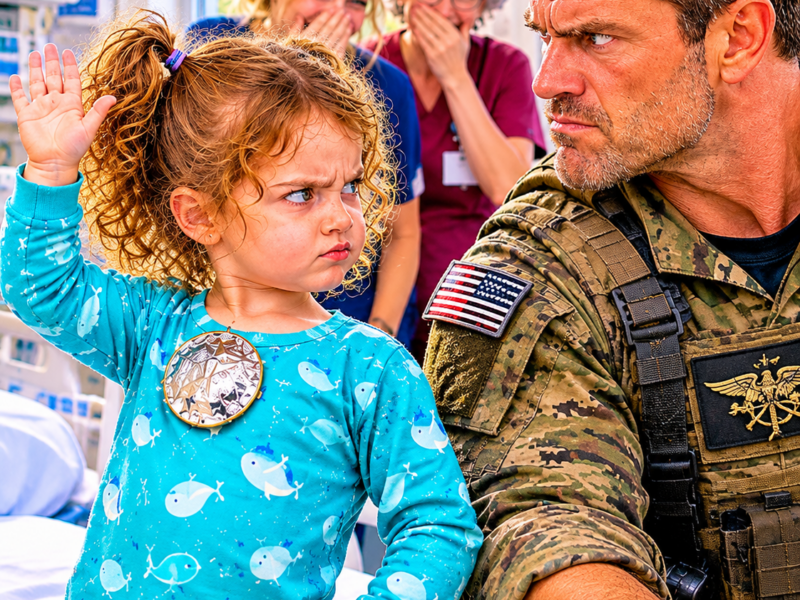
“I had watched admirals silence entire rooms with a single command, but I had never seen one lose an argument to a three-year-old girl in pink sneakers
The envelope trembled slightly in the security officer’s hands.
I couldn’t stop staring at the words printed across it.
DO NOT LET THE CHILD SEE THIS.
Sophie had buried her face against my leg. Her little fingers clutched the fabric of my uniform so tightly that I could feel them shaking.
Captain Nathan Brooks stepped between us and Rear Admiral Hargrove.
“Before anyone touches that envelope,” he said, “I want to know why a three-year-old is frightened of a hospital administrator.”
The admiral’s expression hardened.
“This is a classified matter. You have no authority to interfere.”
Captain Brooks didn’t raise his voice.
“Then explain why classified information is being handled in a pediatric hallway.”
Nobody answered.
The security officer looked toward the administrator, Martin Hale, as if waiting for permission to speak.
Hale swallowed.
“Admiral, perhaps we should take this somewhere private.”
“No,” I said.
The word escaped before I could stop it.
Every face turned toward me.
I was the newest nurse on the floor. I had barely learned where the supply closets were. I had no rank, no influence, and certainly no power to challenge an admiral.
But Sophie was still shaking.
And I had started to understand that the adults in this hallway were more afraid of what she remembered than of what might happen to her.
“She stays with me,” I said.
Hargrove stared at me.
“You have been instructed to clear this area.”
“I’ve also been instructed to protect my patients.”
“She is not your patient.”
“She is a child under our care.”
Captain Brooks gave a slight nod.
“That’s right.”
The admiral turned toward the security officer.
“Give me the envelope.”
The officer hesitated.
It was only a second, but it was enough.
Captain Brooks noticed.
“Who sealed it?”
The officer glanced at the administrator.
“Hospital security received it from the restricted records office, sir.”
“Who authorized the transfer?”
“I don’t know.”
Hale stepped forward.
“I did. The envelope contains personal effects and documents belonging to the child’s mother. They’re being secured for an internal review.”
“What kind of review?” I asked.
“That’s not your concern, Nurse.”
Sophie lifted her head.
“Mommy said the blue bag was mine.”
I knelt beside her.
“What’s inside the blue bag, sweetheart?”
She rubbed her eyes.
“My pictures. And the little phone.”
Captain Brooks looked at the envelope.
“Why would a child’s pictures be part of an internal review?”
Hargrove’s voice became sharp.
“Because the mother is involved in a sensitive investigation. That’s all you need to know.”
I felt my stomach tighten.
“What investigation?”
“Enough.”
The admiral took a step toward us.
Sophie immediately moved behind my chair.
Then she whispered something.
“He put Daddy’s picture in the little phone.”
I looked down at her.
“Your daddy’s picture?”
She nodded.
“Mommy said not to lose it.”
Captain Brooks crouched so he was closer to her height.
“Can you tell me where your daddy is, Sophie?”
She looked at him with solemn eyes.
“On the ship.”
Hargrove’s jaw tightened.
Captain Brooks glanced at me.
“Emma, stay with her.”
Then he faced the admiral.
“Sir, I want to see the medical record and the authorization for this room reassignment.”
“You don’t have clearance.”
“Then contact someone who does.”
Hargrove’s face turned red.
“Captain Brooks, I am ordering you to leave.”
Captain Brooks remained still.
“I heard you, sir.”
It was the first time I’d seen someone acknowledge an order without obeying it.
And somehow, that made the admiral look even more furious.
A few minutes later, a senior hospital physician arrived.
Dr. Evelyn Shaw had been the attending physician responsible for Sophie’s mother, Laura Bennett, since her admission.
She looked exhausted.
When she saw the envelope, she stopped walking.
“Where did you get that?”
Hale answered too quickly.
“It’s being handled.”
Dr. Shaw ignored him.
“I asked where you got it.”
The security officer spoke quietly.
“From the restricted records office.”
Dr. Shaw turned toward Hargrove.
“You told me those records were protected under the patient’s consent.”
“They are.”
“Then why is her daughter’s name on an evidence envelope?”
The admiral didn’t answer.
Dr. Shaw looked at me.
“Emma, how is Sophie?”
“She’s frightened, but physically okay.”
“Has anyone explained what’s happening to her?”
“No.”
“Then nobody is moving her until I speak with her grandmother.”
Hargrove gave a cold laugh.
“You’re all forgetting who is in charge here.”
Dr. Shaw met his eyes.
“I’m responsible for the medical care of this child and her mother. I won’t let an administrative dispute interfere with that.”
Captain Brooks nodded.
“Good.”
For the first time, the admiral seemed outnumbered.
But then the hospital administrator made a phone call.
He stepped away from us and spoke in a low voice.
I couldn’t hear every word.
I did hear one sentence.
“The child has mentioned the phone.”
He listened.
Then his face changed.
“Yes, sir. I understand.”
He ended the call and approached Hargrove.
The admiral listened to his whisper.
When he turned back, his expression was no longer merely angry.
It was determined.
“Remove the child from this corridor.”
Two security officers moved forward.
Captain Brooks stepped in front of them.
“Not without a legal guardian or medical authorization.”
Hargrove looked at him.
“You are making this much worse than it needs to be.”
“Then stop making decisions that frighten a child.”
I reached down and picked up Sophie’s stuffed rabbit.
She took it from me, holding it against her chest.
“Emma?”
“Yes, sweetheart?”
“Can I see Mommy?”
I felt my throat tighten.
“I’ll find out.”
Dr. Shaw was already moving toward the intensive care unit.
“I’ll check on her now.”
I followed her with Sophie while Captain Brooks stayed behind.
At the unit entrance, a nurse named Patricia approached us.
“Emma, I need you to come here.”
Her voice was low.
I asked Sophie to sit beside the nurses’ station with a coloring book.
Then Patricia handed me a folded sheet of paper.
It was a copy of Laura Bennett’s admission record.
“Look at the time,” she whispered.
The record showed Laura had been transferred to intensive care at 2:40 a.m.
But the physician’s note documenting her condition had been entered at 1:55 a.m.
Forty-five minutes before the transfer.
“That could be a documentation error,” I said.
Patricia shook her head.
“Look at the signature.”
At the bottom was the name of a physician I knew.
Dr. Aaron Mitchell.
He had been on vacation that week.
I looked at Patricia.
“Who entered this?”
She lowered her voice.
“Martin Hale’s office requested the record be corrected.”
My stomach dropped.
“Corrected how?”
“They wanted the original note removed.”
I stared at the page.
A patient’s medical record could be amended, but the original entry had to remain traceable. Deleting it was not a correction.
It was concealment.
I turned toward Sophie’s mother.
Through the glass, I could see Laura lying still beneath a white blanket, surrounded by monitors.
Dr. Shaw stood beside her bed, speaking to another physician.
“Is she stable?” I asked.
Patricia nodded.
“For now.”
“Does she know what happened?”
“Not yet.”
I looked back at Sophie.
She was coloring a picture of a yellow house.
She had drawn three people in front of it.
A woman.
A little girl.
And a man wearing a blue uniform.
I returned to her.
“That’s a lovely picture.”
“That’s my family.”
“Who’s the man?”
“My daddy.”
I sat beside her.
“Does he live far away?”
She nodded.
“Mommy says he’s helping people.”
I glanced at the drawing again.
There was something written across the bottom in a child’s uneven letters.
I couldn’t read it at first.
Then I realized it said:
DADDY SAID KEEP THE PHONE SAFE.
I felt a chill move through me.
“Who told you that?”
“Daddy.”
“When?”
Sophie touched the little rabbit’s ear.
“On the phone. Before Mommy got sick.”
I wanted to ask more, but Dr. Shaw returned.
“Emma, Laura is awake.”
Sophie jumped to her feet.
“Mommy!”
Dr. Shaw crouched beside her.
“You can see her for a little while, sweetheart. But you need to be very gentle.”
I carried the coloring book and followed them into the room.
Laura’s eyes opened slowly.
When she saw Sophie, tears gathered immediately.
“My baby.”
Sophie hurried to the bedside and carefully touched her mother’s hand.
“Mommy, I said no.”
Laura gave a weak smile.
“I know, sweetheart.”
Then her eyes moved to me.
“Who are you?”
“Emma Collins. I’m one of the nurses looking after you.”
Laura tried to lift her head.
“Did they take the bag?”
I exchanged a glance with Dr. Shaw.
“They have the blue bag,” I said gently. “But Sophie is safe.”
Laura closed her eyes.
“Did they find the phone?”
I didn’t answer immediately.
“Not that I know of.”
She gripped my hand.
“Please don’t let them take it.”
“Can you tell me why it’s important?”
Laura looked toward Sophie.
“Not in front of her.”
Dr. Shaw stepped closer.
“Laura, we need to understand what’s happening. You’re safe here.”
Laura swallowed.
“My husband was a Navy logistics officer. He discovered that medical supplies meant for deployed units were being redirected through private contractors.”
I felt the room grow cold.
“Military medical supplies?”
She nodded.
“He found invoices for equipment that never arrived. Some shipments were marked delivered, but the units never received them. When he reported it, the records disappeared.”
Her breathing became shallow.
“He started keeping copies.”
Dr. Shaw adjusted her monitor.
“Take your time.”
Laura looked at me again.
“He sent me a recording before he disappeared. He told me to keep it somewhere safe.”
“On the phone?”
She nodded.
“The little phone in Sophie’s bag. It has the original recording and copies of the shipping records.”
I understood why the admiral wanted the bag.
But I still didn’t understand why Sophie was involved.
“Why did he tell Sophie to protect it?”
Laura’s eyes filled with tears.
“She was beside me when he called. He thought she was too young to understand. But she remembered everything.”
Sophie looked up.
“Daddy said the phone was a secret treasure.”
Laura smiled sadly.
“He always made serious things sound like games.”
Then she looked at me.
“He told me that if anything happened, I should contact Captain Nathan Brooks.”
I blinked.
“Captain Brooks?”
Laura nodded.
“He served with my husband. They trusted each other.”
I finally understood why the captain had reacted so strongly when Sophie mentioned the phone.
He wasn’t simply defending a child.
He had recognized a name and a story he knew.
A knock sounded at the door.
Captain Brooks entered.
“Laura.”
She looked at him.
“Nathan.”
He moved to her bedside.
“I’m sorry it took me this long to find you.”
Laura shook her head.
“You came when I needed you.”
He glanced at Sophie.
“And this must be the young lady who told an admiral no.”
Sophie nodded proudly.
“I did.”
Captain Brooks smiled.
“I heard. I think you made a very good decision.”
Then Laura’s expression turned serious.
“Did you bring the people I asked for?”
He nodded.
“An independent investigative team is downstairs. They’re not part of Admiral Hargrove’s command.”
Laura closed her eyes in relief.
“Thank God.”
Captain Brooks turned toward me.
“Emma, I need you to tell me exactly what happened in the hallway.”
I described the order to move Sophie, the envelope, and the administrator’s phone call.
He listened without interrupting.
When I finished, he looked at Laura.
“They’re trying to recover the recording before it reaches investigators.”
Laura nodded.
“That’s what I was afraid of.”
A few minutes later, two federal investigators arrived.
One introduced herself as Special Agent Rebecca Morris.
She explained that an investigation into the missing medical shipments had been underway for months.
Several contractors had been questioned.
But the investigators lacked the original documentation connecting the shipments to senior officials.
Laura’s husband’s recording could provide that missing evidence.
“Do you know who was involved?” Morris asked.
Laura hesitated.
“I know the contractor’s director. I know the names on the invoices. But I don’t know who approved the false delivery reports.”
Morris nodded.
“We’ll establish that through the records.”
Captain Brooks looked toward the door.
“Then let’s secure the phone.”
The problem was that nobody knew where it was.
The blue bag had been taken to the restricted records office.
And the envelope was still in the administrator’s possession.
Morris requested that hospital security preserve all records and provide the bag under documented chain of custody.
Hargrove refused.
He arrived in the room less than ten minutes later.
“You have no authority to conduct an investigation inside my medical facility.”
Agent Morris showed him her credentials.
“I’m not asking your permission, Admiral.”
His eyes narrowed.
“This is a military hospital.”
“And the evidence concerns a federal investigation.”
Hale stood behind him, looking increasingly nervous.
Captain Brooks folded his arms.
“Sir, this is your opportunity to cooperate.”
Hargrove stared at him.
“You have no idea what you’re involved in.”
“Then explain it.”
For several seconds, nobody spoke.
Finally, the admiral looked toward Sophie.
“Your father made a mistake. He took documents that didn’t belong to him.”
Laura tried to sit up.
“My husband reported missing supplies that were supposed to save lives.”
“He violated procedure.”
“He followed it. He reported the discrepancy through the proper channels. Your office closed the complaint.”
Hargrove’s expression changed.
Just slightly.
But enough.
Agent Morris stepped forward.
“Which office, Admiral?”
He didn’t answer.
Hale suddenly spoke.
“Perhaps we should all calm down.”
Morris turned toward him.
“Mr. Hale, did you authorize the removal of Ms. Bennett’s personal belongings?”
“I was following instructions.”
“Whose instructions?”
He looked at Hargrove.
The admiral said nothing.
Hale’s shoulders sank.
“I received a request from the command office.”
“Was it in writing?”
“No.”
“Then who gave it to you?”
Hale opened his mouth.
Closed it.
And finally said, “Admiral Hargrove.”
The room went silent.
Hargrove’s face darkened.
“That is a serious accusation.”
Hale looked frightened.
“I have the call records.”
Agent Morris nodded to another investigator.
“Get them.”
The admiral took a step toward Hale.
“You’d better think carefully about what you’re saying.”
Captain Brooks moved between them.
“Don’t.”
It was a single word.
But the room seemed to stop.
Hargrove looked at him with open contempt.
“You think you’re a hero, Captain?”
“No, sir.”
“Then move.”
“I think this little girl deserves to know that the adults around her are going to protect her.”
Sophie looked up from her mother’s bed.
“I’m not little.”
For the first time that day, I almost laughed.
Captain Brooks glanced at her.
“Fair enough.”
Agent Morris instructed security to retrieve the blue bag.
The security officer who had carried the envelope earlier returned with it.
He placed it on the table.
The bag was scuffed, but otherwise intact.
Sophie immediately recognized it.
“My treasure!”
She reached for it, but Laura gently stopped her.
“Let the investigators check it first, sweetheart.”
Morris opened the bag carefully.
Inside were children’s drawings, a small blanket, a toy phone, and a photograph of a man in Navy uniform holding a baby.
At the bottom was a second phone.
A small, old device with a cracked blue case.
Morris picked it up.
“Is this the one?”
Laura nodded.
“Yes.”
The phone was locked.
She provided the passcode.
A recording appeared on the screen, along with several scanned documents.
Morris listened to the first few seconds through headphones.
Her expression changed.
She turned to her colleague.
“We need to preserve this immediately.”
Hargrove moved forward.
“Those materials are classified.”
Morris raised her hand.
“Do not touch the evidence.”
He stopped.
The recording was not a confession from some mysterious criminal.
It was a conversation between Laura’s husband and a contractor’s representative, discussing shipments that had been marked as delivered despite never reaching their intended units.
The documents included invoice numbers, delivery dates, and authorization codes.
And one of the authorization codes was connected to a command office overseen by Hargrove.
The admiral stared at the phone.
For the first time, he looked less powerful than the people around him.
Agent Morris turned toward him.
“Admiral, we need you to remain available for questioning.”
“I have done nothing wrong.”
“Then you’ll have an opportunity to explain that.”
Hale was asked to provide his records and accompany the investigators.
He looked at me as he passed.
“I was just following orders.”
I didn’t know what to say.
Because I’d heard those words before.
And I was beginning to understand how often they were used to excuse things that should never have happened.
The investigation continued for several weeks.
The records on the phone helped investigators trace a network of false delivery reports and diverted equipment.
Several officials and contractors were suspended.
Hargrove was removed from his command duties pending a formal investigation.
The evidence did not prove that he had personally stolen the supplies, but investigators found that he had authorized efforts to suppress the original complaint and recover Laura’s records.
Martin Hale cooperated and admitted that he had altered hospital documentation at Hargrove’s direction.
Dr. Mitchell’s signature had been copied without his knowledge.
Dr. Shaw’s medical records were restored, and the hospital began an independent review of the care Laura had received.
The most important thing, however, was that Laura recovered.
Slowly.
There were difficult days, and there were nights when Sophie woke up crying for her father.
But her mother was there.
And the blue phone was safely in the hands of investigators.
One afternoon, several weeks after the incident, I found Sophie sitting outside Room 214 again.
She was arranging her plastic animals in a line.
This time, she was smiling.
“Hello, Doctor Sophie,” I said.
She looked up.
“I’m not a doctor.”
“Then what are you?”
She thought carefully.
“I’m the boss.”
I laughed.
“That sounds important.”
“It is.”
She held up her stuffed rabbit.
“He needs a checkup.”
I crouched beside her.
“What’s wrong with him?”
“He’s scared.”
I gently examined the rabbit’s ears.
“Looks like he needs someone to stay with him.”
Sophie nodded.
“That’s what I did with Mommy.”
I looked toward the room.
Laura was sitting up in bed, talking with Captain Brooks.
He had become a familiar visitor, bringing groceries when she returned home and helping her navigate the paperwork left behind by the investigation.
He had never tried to replace Sophie’s father.
Instead, he had made sure she had someone who remembered him.
And that mattered.
A few days later, Laura asked me to join them for a small gathering at the hospital garden.
It was a thank-you event for the nurses and staff who had helped her.
I almost declined.
I hadn’t done anything extraordinary.
I had simply refused to move a frightened child.
But Laura insisted.
When I arrived, Sophie ran toward me holding a folded piece of paper.
“I made you something!”
It was a drawing of a hospital.
There was a woman wearing a pink uniform, a little girl with a rabbit, and a man in a blue uniform standing beside them.
Above the picture, Sophie had written three words with help from her mother:
BRAVE PEOPLE STAY.
I felt my eyes sting.
“That’s beautiful, Sophie.”
She pointed to the woman in pink.
“That’s you.”
Then she pointed to the man.
“That’s Captain Nathan.”
“And who’s that?”
She pointed to the little girl.
“Me.”
I smiled.
“You’re right. You were very brave.”
She shook her head.
“No. I was scared.”
I knelt beside her.
“You can be scared and brave at the same time.”
She considered that.
Then she nodded.
“Like Mommy?”
“Exactly like Mommy.”
Across the garden, Captain Brooks was speaking with Dr. Shaw.
When he noticed me, he walked over.
“Looks like you’ve been promoted.”
I raised an eyebrow.
“To what?”
He nodded toward Sophie.
“Chief of the children’s department.”
Sophie giggled.
“I’m already the boss.”
He smiled.
“Yes, ma’am.”
Laura joined us a moment later.
She looked healthier than she had on the day I first met her.
There was still sadness in her eyes, but it no longer seemed to control every breath she took.
“I wanted to thank you,” she said.
“You don’t owe me anything.”
“I do.”
She glanced at Sophie.
“When she told the admiral no, I was afraid nobody would listen to her. I was afraid that the people with power would decide her little voice didn’t matter.”
She took my hand.
“But you listened.”
I looked at Sophie.
“I think she made it pretty difficult not to.”
Laura laughed softly.
Then her expression became serious.
“My husband used to say that the hardest part of serving was knowing when to follow an order and when to protect someone from a bad one.”
Captain Brooks nodded.
“He said that to me, too.”
I looked at him.
“Did you know him well?”
“Very well.”
He paused.
“He was the kind of man who would have been proud of Sophie today.”
Laura’s eyes filled with tears.
Sophie looked between us.
“Daddy would be proud?”
Captain Brooks crouched beside her.
“More than you know.”
She hugged her rabbit.
“Then I was brave.”
“You were.”
She smiled.
And just like that, the little girl who had stopped an admiral in the middle of a hospital corridor went back to being three years old.
She ran after a butterfly.
She laughed when it flew away.
She asked for a cookie.
And she forgot, for a little while, that grown-ups could make terrible mistakes.
I watched her from the garden bench and thought about my first eleven days as a nurse.
I had believed courage meant knowing exactly what to do.
I had believed authority meant someone else always knew better.
But that day taught me something I would carry for the rest of my career.
A uniform can command respect.
A title can open doors.
A rank can make an entire hallway fall silent.
But none of those things makes someone right.
Sometimes the smallest person in the room is the only one willing to say what everyone else is afraid to say.
And sometimes the bravest thing a nurse can do is stand beside a frightened child and refuse to let her voice disappear.
Sophie had said no to an admiral.
A rookie nurse had said no to intimidation.
And a SEAL captain had said no to silence.
In the end, that tiny word had protected a mother, exposed a cover-up, and reminded an entire hospital what its duty was supposed to be.
Before Sophie left that afternoon, she ran back to me and pressed a little pink sticker onto my sleeve.
It showed a smiling rabbit.
“For being brave,” she said.
I looked down at it.
“Thank you, boss.”
She grinned.
Then she took her mother’s hand and walked toward the exit.
Captain Brooks followed a few steps behind them.
I watched until they disappeared through the doors.
And for the first time since I started working at the hospital, I understood that being a nurse wasn’t just about following protocols or carrying out orders.
It was about remembering who those rules were meant to protect.
Especially when the person who needed protecting was only three years old.
The End.









