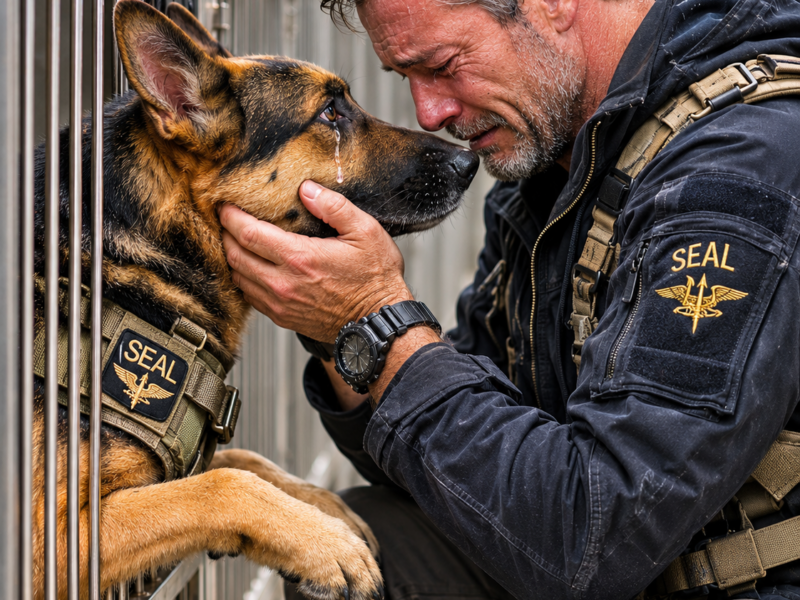
“I had spent three years believing my military dog was dead, so when I walked into a county shelter and heard someone whisper my name from behind a kennel door
“Because if you take that dog home, the people who have been looking for him will find you, too.”
Collins had barely finished speaking when Ranger stepped in front of me.
His body was stiff. His ears were forward, and a low growl rolled through his chest.
I knew that posture.
Ranger wasn’t frightened.
He was warning me.
“Step away from the kennel,” I told Collins.
The manager raised both hands, but his eyes kept moving toward the office at the end of the hallway.
“You’re making a mistake,” he said.
“Maybe. But I’m not leaving without answers.”
Megan stood between us, visibly shaken.
“Mr. Collins, what’s going on? You told me this dog was a stray.”
“He is a stray.”
“Then why is someone coming to collect him?”
Collins looked at her sharply.
“Go back to the front desk.”
She didn’t move.
I crouched beside Ranger and examined the folded paper tucked beneath his collar clasp. It was damp and nearly torn through.
“Easy, buddy.”
Ranger leaned toward my hand.
I carefully slid the paper free.
There were only a few words written on it, in faded blue ink.
MICHAEL. DON’T TRUST THE TRANSFER.
My blood ran cold.
I hadn’t told anyone at the shelter my first name.
I looked at Collins.
“Who wrote this?”
He stepped toward me.
“Give me that.”
I moved the paper behind my back.
“Not a chance.”
His phone rang.
He answered without taking his eyes off me.
“Yes.”
A pause.
“No. He’s here.”
Another pause.
“I understand.”
He hung up.
Then he smiled.
It was the kind of smile men wore when they believed the decision had already been made.
“Your ride is here.”
I heard a vehicle outside.
Megan looked through the window.
A black SUV had stopped beside the entrance.
Two men stepped out.
Neither wore a shelter uniform.
One carried a hard-sided equipment case. The other wore a dark jacket with a small embroidered company logo.
I recognized the logo.
Vanguard Canine Solutions.
Three years earlier, Vanguard had been listed as a private contractor supporting military working-dog programs. I’d seen their vehicles at a base overseas.
I had also heard rumors that some of their employees were involved in moving retired service dogs into private security contracts.
At the time, the rumors had never been substantiated.
Now two of their men were walking toward Ranger.
“Who authorized this transfer?” I asked.
Collins opened his folder.
“It’s all legal.”
“Then you won’t mind showing me the documents.”
He hesitated.
That hesitation told me more than his answer would have.
The front door opened.
The two men entered.
The taller one looked at me, then at Ranger.
“That’s him.”
Ranger barked once.
The sound echoed through the hallway.
The shorter man set his equipment case on the floor.
“We’ll take it from here.”
I stepped between them and the kennel.
“No, you won’t.”
The taller man sighed.
“Sir, we’re here under a transfer authorization. You have no legal authority over this animal.”
“I was his handler.”
“Former handler.”
“He was reported dead.”
The man’s expression didn’t change.
“Administrative error.”
I almost laughed.
An administrative error had apparently kept a military dog missing for three years, placed him in a county shelter under a false name, and arranged for private contractors to collect him before his former handler could ask questions.
“Show me the authorization,” I said.
He pulled a document from his jacket.
I read the first page.
It carried the shelter’s transfer number, an electronic signature, and a reference to a military working-dog disposition order.
But the signature belonged to someone I’d never heard of.
The authorization date was two days before Ranger had supposedly been found.
I looked up.
“You prepared this before the shelter even received him.”
The man’s eyes narrowed.
“That’s not your concern.”
“It became my concern when you put your hands on my dog.”
The shorter man opened the equipment case.
Inside were a muzzle, restraints, and a medical syringe.
Megan took a step backward.
“Why would you need those?”
“Standard transport equipment,” he replied.
Ranger backed into the kennel.
I could hear his breathing change.
He had seen enough.
“Put the case away,” I said.
The taller man reached for my arm.
I caught his wrist and pushed it away.
He stumbled, surprised by how quickly I’d moved.
The second man reached toward his belt.
“Everybody stop!” Megan shouted.
Her voice cracked, but she didn’t retreat.
“I’ve already called the police.”
Collins spun toward her.
“You did what?”
“I called them when you told me to send this man away.”
For the first time, Collins looked genuinely afraid.
The two contractors exchanged a glance.
Then the taller one slowly stepped back.
“This is a misunderstanding,” he said.
“Then explain the syringe,” I replied.
Nobody answered.
A siren sounded in the distance.
The contractors grabbed their equipment case and headed for the door.
Before leaving, the taller man turned toward me.
“You have no idea what that dog is carrying.”
I glanced at Ranger’s collar.
The man’s eyes followed mine.
Then he walked out.
Collins tried to close his folder.
I took out my phone and photographed every page before he could put it away.
He didn’t stop me.
The police arrived four minutes later.
Two officers took statements while another checked the SUV’s registration. The contractors were gone, but the vehicle had been registered to a company with an address in a neighboring county.
Collins claimed he had only followed instructions from a private placement agency.
Megan told the officers everything she’d witnessed.
When I showed them the note, one officer asked whether I knew who had written it.
“No,” I said. “But somebody knew I’d come here.”
I looked down at Ranger.
“And somebody knew he’d recognize me.”
The officers asked me to remain at the shelter until an animal control supervisor could arrive.
I agreed.
I wasn’t going anywhere.
An hour later, a veterinarian examined Ranger.
He was underweight, dehydrated, and suffering from an untreated injury in his right front leg. The wound was old enough to have begun healing incorrectly.
But the veterinarian found something else.
A small puncture mark beneath his shoulder.
“Could be from an injection,” she said. “I can’t tell you what substance without testing.”
I felt anger rising again.
“Was he sedated?”
“Possibly. There are several explanations. We’ll run blood work.”
Ranger looked up at me.
I rubbed his neck.
“It’s okay, buddy.”
His tail moved against the floor.
The animal control supervisor arrived with a copy of Ranger’s intake records.
The file was thin.
Too thin.
It listed the date he had been found, the location near the abandoned warehouse, and a vague description of his condition.
There was no record of who had called animal control.
No photograph from the scene.
No detailed report.
The supervisor frowned.
“This isn’t how we normally document a stray.”
“Can you tell where he came from?”
“Not from this paperwork.”
“Then who approved the transfer?”
She checked the electronic record.
“Collins entered the request. But the approval came through an external account.”
“Whose?”
She turned the screen toward me.
The name was unfamiliar.
The account belonged to Vanguard Canine Solutions.
I stared at it.
“They’ve been planning this since before he arrived.”
The supervisor nodded.
“Looks that way.”
The police agreed to hold the transfer while they reviewed the documents. They also contacted the military office responsible for working-dog records.
I expected that call to take days.
It took less than twenty minutes for someone to respond.
The officer returned with a strange expression.
“Mr. Hayes, the military says the identification number on that collar is still active.”
“Active?”
“Yes. K9-041 was never officially retired or declared dead in the original database.”
I felt the room go quiet.
“That’s impossible. I saw the report.”
“They’re checking the discrepancy.”
I looked at Ranger.
Three years.
Three years of believing he was gone.
And somewhere in an official database, someone had kept him alive.
The veterinarian finished the examination and recommended that Ranger remain under observation overnight.
I sat beside his kennel until the shelter closed.
He refused to sleep unless he could see me.
Whenever I shifted, his eyes opened.
At around ten that evening, my phone rang.
Unknown number.
I answered.
“Hayes?”
A man’s voice.
“Who is this?”
“Someone who worked with your dog.”
My grip tightened.
“Tell me your name.”
“Names don’t matter right now. You need to understand that Ranger wasn’t reported dead because of an explosion.”
I stood up.
“What are you talking about?”
“He was removed from the site before the blast.”
“By whom?”
“Vanguard.”
My mouth went dry.
“Why?”
“Because Ranger found something he wasn’t supposed to find.”
I looked toward the kennel.
“What?”
A pause.
Then the man said, “A shipment that never appeared on any official manifest.”
“What kind of shipment?”
“Military working dogs. Some of them were alive when they disappeared. Some weren’t.”
My stomach turned.
“Where are they?”
“I don’t know all the locations. But Ranger was trained to detect a particular chemical marker. He found it in a transport vehicle connected to Vanguard.”
I glanced at the collar.
“Is that why they want him?”
“Yes. He remembers the scent. And there’s a chance someone trained him to lead them back to the place where the records were hidden.”
“Who trained him?”
“Your former unit’s canine logistics coordinator. His name was Daniel Price.”
I knew the name.
Price had been responsible for arranging the transport of working dogs between deployment sites.
He had signed Ranger’s last movement order.
He had also attended the briefing where we were told Ranger had died.
“Where is Price now?”
“Dead.”
“When?”
“Six months ago.”
I rubbed my forehead.
“Then why call me?”
“Because Price left something behind. And Ranger is the only living witness who can help you find it.”
The call ended.
I tried calling the number back.
It was disconnected.
I sat down beside the kennel.
Ranger had lifted his head.
“Who got you into this, buddy?”
He nudged my hand.
I wished he could answer.
The next morning, a military investigator named Special Agent Rebecca Sloan arrived at the shelter.
She carried official identification and a folder thick enough to suggest she had already been working on the case.
“Mr. Hayes?”
“That’s me.”
She introduced herself, then asked to speak privately.
I followed her into a small office.
“Your former working dog was transferred out of a military holding facility three years ago,” she said. “The movement was recorded as part of a routine disposition process.”
“Except he wasn’t retired.”
“No.”
“Who authorized it?”
“That’s what we’re trying to establish.”
I leaned forward.
“Vanguard tried to take him yesterday.”
“We know.”
“Then you know they’re involved.”
“We have reason to believe they were involved in several unauthorized transfers.”
“Several?”
She opened the folder.
Inside were photographs of military working dogs.
Some were familiar.
One was a German Shepherd named Koda, who had worked with another handler in my unit.
I remembered hearing that Koda had been sent to a rehabilitation center after an injury.
According to Sloan, he had never arrived.
Another photograph showed a black Labrador named Scout.
His handler had been told the dog was retired and adopted.
The adoption record was fake.
“How many?” I asked.
“Currently, we’re investigating eleven missing or misdirected dogs.”
I stared at the photographs.
“Why?”
“Money. Private security contracts. Illegal breeding programs. Possibly something larger.”
“And Ranger?”
“He was assigned to a transport operation after detecting an irregularity in a shipment. The report was altered. Then the dog disappeared.”
“Who altered it?”
“We have several suspects.”
“Is Collins one of them?”
“Possibly. We need evidence.”
I looked through the photographs again.
Then I noticed a detail in Ranger’s old service record.
A red mark beside his identification number.
“What does that mean?”
Sloan studied the page.
“Restricted recovery status.”
“What’s that?”
“It means the dog was flagged for retrieval if found.”
I looked at her.
“Why?”
“Because his training records indicate he can identify the chemical signature used in a specific class of explosive detection operations.”
“That’s standard for his training.”
“Not the signature we’re concerned about.”
She turned the page.
There was a note from Daniel Price.
RANGER RETAINS RECOGNITION OF COMPOUND R-9. DO NOT REASSIGN WITHOUT HANDLER CLEARANCE.
I read it twice.
“What is R-9?”
Sloan closed the folder.
“Something we’re still trying to identify.”
I shook my head.
“Then why would Vanguard need him?”
“Because someone believes he can lead them to a missing storage site.”
I looked toward the hallway.
Ranger was watching us through the glass.
“I’m not letting them take him.”
Sloan nodded.
“That’s why I came.”
She placed a card on the table.
“We can arrange temporary protective custody while we investigate. But I need you to understand something.”
“What?”
“Whoever arranged his disappearance knows where you live.”
I thought of the warning at the shelter.
The black SUV.
The message.
I took the card.
“Then I guess they should have thought twice before bringing him back into my life.”
That afternoon, I was allowed to take Ranger home under a temporary protective agreement.
The veterinarian had cleared him for discharge, provided he received medication and limited exercise.
I brought him to my small house outside town.
He walked slowly through the living room, sniffing every corner.
Then he stopped beside the old leather chair.
It was the chair where he’d slept during our last week together before deployment.
He circled once and lay down.
I sat on the floor beside him.
For a long time, neither of us moved.
Then Ranger lifted his head and rested it on my knee.
I covered his ears with my hand.
“I thought I’d lost you.”
His eyes softened.
“I should’ve looked harder.”
He nudged my chest.
I stayed there until the light outside faded.
At midnight, I woke to a sound at the front door.
Three slow knocks.
I reached for the flashlight beside my bed.
Ranger was already standing.
His ears were forward.
He moved toward the hallway without making a sound.
I followed.
A folded envelope lay on the porch.
No vehicle.
No footsteps.
Just the envelope.
Inside was a photograph.
It showed Ranger standing beside a transport truck.
The image had been taken at night.
On the back, someone had written:
HE REMEMBERS THE PLACE.
Beneath the message was an address.
An old industrial site outside town.
I called Sloan immediately.
She arrived with two agents before sunrise.
They studied the photograph and the address.
“That’s an old storage facility,” she said. “It was leased by Vanguard for a short period.”
“What’s there now?”
“Nothing officially.”
I looked down at Ranger.
He had been pacing since I’d opened the envelope.
His nose moved toward the photograph.
Then he gave three short barks.
The same signal I’d heard in the shelter.
He knew the place.
Sloan noticed.
“Can he track something from the photograph?”
“Not from the image itself.”
I looked at the transport truck.
“Maybe not. But he knows the smell.”
Sloan considered it.
“We’re not taking him into an active operation.”
“I didn’t ask you to.”
She looked at me for a moment.
“Stay behind the perimeter. If he reacts to anything, tell us.”
We drove to the facility with a small team.
The building sat behind a rusted fence, surrounded by overgrown weeds and broken concrete.
Ranger became restless before we reached the entrance.
He pulled toward the east side of the property.
Sloan signaled the team.
A search began.
Inside, the facility was mostly empty.
Dust covered the floors. Several storage bays stood open, and old equipment had been abandoned along the walls.
Then Ranger stopped beside a concrete partition.
He sniffed the base.
Three short barks.
A pause.
One low whine.
My heart jumped.
“Here,” I said.
The investigators searched the wall.
They found a concealed panel behind a stack of damaged pallets.
Behind it was a narrow storage room.
Inside were several metal cases, a laptop, and a row of old transport documents.
One case contained dog collars.
Not ordinary collars.
Military identification collars, each with a serial number.
I recognized two immediately.
Koda.
Scout.
Sloan photographed everything.
Then an investigator opened the laptop.
It was password protected.
But the documents were enough to show that the facility had been used to store records connected to the missing dogs.
There were payment ledgers, transfer orders, and shipping manifests.
One file contained the name of Daniel Price.
Another contained the name of Collins.
And a third carried the signature of a senior military officer.
General Thomas Mercer.
I knew him.
He had visited our unit during the final months of deployment.
He had personally congratulated the team after one successful operation.
He had also signed the report declaring Ranger dead.
Sloan’s expression hardened.
“Now we know how the transfer was authorized.”
A noise came from outside.
A car door.
Then another.
The investigators moved toward the entrance.
Through a narrow window, I saw two men approaching the building.
One was Collins.
The other was the taller contractor from the shelter.
Sloan signaled everyone to hold position.
Collins stopped near the entrance.
“Agent Sloan,” he called. “We need to talk.”
She stepped into view.
“You need to surrender.”
The contractor reached inside his jacket.
The investigators raised their weapons.
“Hands where we can see them!”
He froze.
Collins looked past Sloan.
His eyes found me.
“You should have stayed away from this.”
I stood beside Ranger.
“You should have left him alone.”
Collins laughed.
“You don’t understand what you’ve interrupted.”
“Then explain it.”
He looked toward the storage room.
“Those dogs were never supposed to come home.”
“Why?”
“Because the program was worth millions.”
Sloan stepped forward.
“What program?”
Collins glanced at her.
Then he made a mistake.
He looked toward the contractor.
The contractor moved.
The investigators shouted.
He dropped to the ground as they restrained him.
Collins tried to run, but he was stopped before reaching the fence.
The entire confrontation lasted less than a minute.
No one was seriously injured.
But as Sloan placed Collins in handcuffs, he turned toward me.
“You think you’ve won?”
I said nothing.
“Mercer has friends everywhere.”
Sloan leaned closer.
“Then we’ll have plenty of people to interview.”
Collins was taken away.
The contractor followed.
The facility was secured.
By late afternoon, the first arrests had been made.
The investigation uncovered a network that had diverted military working dogs into private contracts, falsified retirement records, and concealed animals that had been used in dangerous unauthorized operations.
Ranger had discovered one of the transport vehicles because he recognized a chemical compound used to mask the scent of explosive materials.
He had been removed from the unit before he could be reassigned.
The explosion I remembered had happened after his disappearance.
The report had been altered to make it appear that he died in the blast.
In reality, the blast had been used to cover the transfer.
The truth was worse than I had imagined.
And the man who had signed the report was the same officer who had approved the unauthorized movement order.
General Mercer was arrested two weeks later.
Vanguard’s contracts were suspended.
The missing dogs became the priority of a joint recovery effort.
Koda was found at a private training facility in another state.
Scout was located with a security contractor who had no legal ownership documents.
Both dogs were returned to military custody and reunited with their former handlers.
The remaining animals were traced through records recovered from the storage facility.
Some had already been transferred overseas.
Finding them would take time.
But at least the search had finally begun.
Sloan called me one afternoon with an update.
“We recovered the original report from your deployment,” she said. “The section describing Ranger’s death was added after the operation.”
I looked at Ranger, who was sleeping beside the fireplace.
“Who added it?”
“Mercer’s office.”
I closed my eyes.
Three years of grief had been built on a lie.
“Is that all?”
“No. There’s a statement from Daniel Price.”
I sat up.
“What does it say?”
“He admitted he helped move Ranger out of the facility. He claimed he did it because he believed the dog would be destroyed if he stayed.”
“Why didn’t he tell anyone?”
“He was threatened. Then he became part of the operation.”
I looked down at the floor.
“Did he leave anything for me?”
Sloan was quiet.
“Yes. A recording.”
She sent it to me that evening.
I played it on my laptop.
Daniel Price appeared on screen, sitting in a plain office.
He looked tired.
“My name is Daniel Price. I was responsible for coordinating the movement of military working dogs during the period when several animals disappeared.”
He took a breath.
“I signed the transfer order for K9-041. Ranger was not dead. He was alive when I handed him over to Vanguard.”
I gripped the edge of the table.
Price continued.
“I was told he would be used for private detection training. I later learned the transfer was unauthorized. By then, the records had been altered, and I was told that speaking up would put my family at risk.”
He looked directly into the camera.
“Michael Hayes was Ranger’s handler. He deserved the truth. I should have contacted him.”
His eyes lowered.
“Ranger did his job. The people responsible failed him.”
The recording ended.
I sat in silence.
Ranger lifted his head.
I reached down and scratched behind his ear.
“Looks like you were the only one who did your job, buddy.”
He leaned into my hand.
The following weeks were not easy.
Ranger needed physical therapy to regain strength in his injured leg. He woke from nightmares, sometimes barking at empty rooms. Certain sounds made him tremble.
I learned not to rush him.
We walked short distances each morning.
We sat outside in the afternoons.
At night, he slept beside my bed.
Slowly, his confidence returned.
One Saturday, I took him to a quiet field outside town.
The grass was wet from the morning rain.
I unclipped his lead.
He looked at me, waiting.
“Go ahead.”
For a moment, he stayed still.
Then he ran.
Not fast at first.
Just a few steps, testing the ground.
Then faster.
His ears lifted, his tail rose, and he crossed the field with the same energy I’d remembered from our deployments.
I laughed.
A sound I hadn’t heard from myself in years.
Ranger came racing back and pushed his head into my chest.
I dropped to one knee and wrapped both arms around him.
“You’re home,” I whispered.
He pressed his nose against my cheek.
“Yes. You’re home.”
Three months after the shelter reunion, I received a letter from the military.
It formally corrected Ranger’s status.
His death declaration was withdrawn.
His service record was restored.
And the paperwork confirmed that I was eligible to adopt him permanently as his former handler.
I read the letter twice.
Then I placed it beside his old service tag.
For the first time, the number K9-041 didn’t feel like a reminder of something I’d lost.
It felt like proof that someone had finally acknowledged what he had survived.
That evening, Sloan visited with a final update.
“Mercer and the others are facing federal charges,” she said. “The investigation is expanding, but the records you helped recover have made a major difference.”
“Good.”
She glanced at Ranger.
“He’s doing well.”
“He’s getting there.”
She smiled.
“You know, there are programs looking for experienced handlers to help rehabilitate recovered working dogs.”
I looked at her.
“Is that an official offer?”
“Not yet. But it could be.”
I looked toward Ranger.
He was lying beside the fireplace, his chin resting on his paws.
For three years, I’d avoided anything that reminded me of him.
I thought moving on meant leaving that part of my life behind.
I was wrong.
Maybe some things weren’t meant to be left behind.
Maybe they were meant to be carried forward.
Six months later, I started volunteering with a rehabilitation program for retired and recovered military working dogs.
I didn’t rush into it.
I spent the first few weeks learning the dogs’ routines, helping with basic exercises, and sitting quietly with animals who were too frightened to trust another person.
Ranger came with me.
At first, he stayed close.
Then one day, a young German Shepherd named Scout approached him.
Scout had been found in a private facility, underweight and terrified of people wearing uniforms.
Ranger lowered himself to the ground.
He didn’t bark.
He didn’t move.
He simply waited.
After several minutes, Scout stepped forward and sniffed his nose.
Ranger’s tail moved once.
I smiled.
That was how it started.
By the end of the year, Scout was sleeping peacefully in a foster home.
Koda had reunited with his handler.
And the rehabilitation program had helped several other dogs find safe homes.
Ranger was never the same dog he had been before the disappearance.
Neither was I.
But we had learned how to live with what happened.
One evening, as I sat on the porch watching the sun fall behind the trees, Ranger rested his head on my boot.
The old familiar weight.
The same quiet promise.
I looked down at him.
“You know, I spent three years thinking I had to learn how to live without you.”
He blinked slowly.
“But all this time, you were trying to find your way back.”
I scratched behind his ear.
He closed his eyes.
I had walked into that shelter expecting to drop off a few bags of dog food.
I walked out with my best friend, the truth about his disappearance, and a reason to believe that even the deepest betrayal doesn’t have to be the final chapter.
Ranger had spent three years surviving.
Now, at last, he could simply live.
The End.









