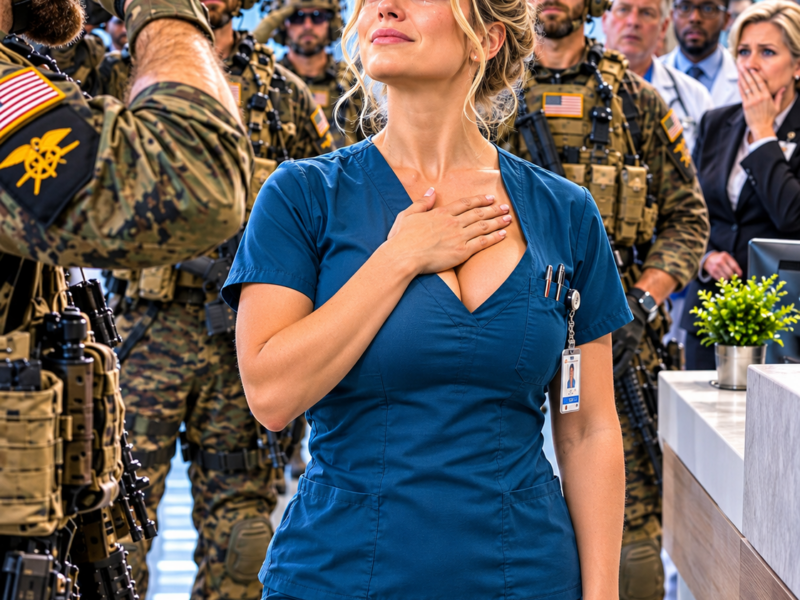
“I had spent six years making sure nobody at St. Marguerite’s Medical Center knew I had once been Captain Dana Cole, an Army combat medic
The silver-haired officer stood beneath the harsh fluorescent lights, his eyes fixed on me.
“Because Miguel believes you’re the only person who can tell us what really happened six years ago, Captain.”
For a moment, the sounds of the emergency department seemed to fade.
The monitors still beeped. Nurses still called out vital signs. Somewhere behind me, a patient was asking for water.
But all I could hear was the word Captain.
Dr. Whitfield gave a short, disbelieving laugh.
“This is absurd. She’s a nurse. A mediocre one, at that. I don’t know what kind of mistake you’ve made, but this woman has no authority here.”
The officer didn’t even look at him.
“My name is Colonel Thomas Bennett. I’m here on behalf of an Army investigative team. And I assure you, there is no mistake.”
He turned slightly, giving me a clearer view of the two men standing behind him.
One carried a thin black folder. The other wore a discreet badge clipped inside his jacket.
“Captain Cole,” Bennett continued, “Master Sergeant Reyes has been trying to locate you for six years.”
My throat tightened.
“Why?”
“Because he has something that belongs to you.”
I glanced toward the trauma bay.
Miguel lay beneath a tangle of wires and tubes, his face pale, his beard damp with sweat.
“He can barely breathe,” I said. “Whatever he has to tell me can wait until he’s stable.”
Bennett nodded.
“That’s why we came here. We need him alive, and we need you to understand that this is bigger than an old battlefield reunion.”
Whitfield stepped forward.
“This conversation is over. You are disrupting patient care. Security!”
No one moved.
Bennett finally turned toward him.
“Doctor, I suggest you stop giving orders until you understand why we’re here.”
Whitfield’s face reddened.
“I run this emergency department.”
“Then you should know that several of your patients have been enrolled in a medical trial without valid consent.”
The words landed harder than a dropped instrument tray.
I looked at the folder in the second investigator’s hand.
“What trial?”
Bennett opened his mouth, but a monitor screamed before he could answer.
Miguel’s blood pressure had dropped.
“Seventy-eight over forty,” a nurse called. “He’s deteriorating!”
I was moving before anyone finished speaking.
“Get another unit of O-negative blood. Open the second line. We need surgery now.”
The emergency physician, Dr. Patel, rushed to the bedside.
“What changed?”
“His pressure is collapsing. The chest decompression helped, but there’s another source of bleeding. We need to find it.”
Dr. Patel looked at the monitor, then at Miguel’s abdomen.
“Possible internal hemorrhage. Call the surgical team.”
Whitfield pushed between us.
“Move. I’ll handle this.”
I didn’t step aside.
“You’ve already lost control of this patient.”
His eyes narrowed.
“Excuse me?”
“You dismissed the tension pneumothorax when I first identified it. Now his pressure is falling. We don’t have time for your ego.”
A silence passed through the room.
Whitfield reached toward the crash cart.
“Give me the emergency medication.”
I saw the syringe in his hand.
I didn’t recognize the label, but I recognized the way he held it: hurried, angry, and without explaining what he intended to administer.
“Stop,” I said.
He ignored me.
I caught his wrist before he could approach Miguel’s IV line.
“Tell us what that is.”
“Let go of me!”
“Not until you explain what you’re about to give him.”
Dr. Patel stepped in.
“Doctor Whitfield, put it down.”
Whitfield jerked his arm away.
“You people are making a serious mistake.”
“Then explain the medication,” Dr. Patel replied.
Whitfield looked around the room, searching for someone who would defend him.
No one did.
He dropped the syringe onto the tray.
The sound was small, but it seemed to change everything.
“Blood is on its way,” a nurse announced.
“Good,” I said. “Keep the pressure up. We need the operating room ready.”
Dr. Patel took over the medical decisions while I helped prepare Miguel for transfer.
My hands were steady again.
That frightened me more than the shaking had.
Because I remembered exactly how it felt to work while someone else’s life hung in the balance.
And I remembered the last time I had stood beside Miguel.
Six years earlier, we had been part of a small medical team attached to an Army unit operating near a remote village.
The mission was supposed to be a routine extraction.
Our team had been ordered to retrieve several wounded soldiers and evacuate them before nightfall.
But the situation changed when we reached the landing zone.
The route was exposed. Communications were failing. The evacuation aircraft had been delayed.
Three men were trapped across an open stretch of ground.
I had gone back for them.
Miguel had been the last person to reach the evacuation point.
He was injured, but he kept moving.
Then the explosion came.
I remembered the flash, the ringing in my ears, and the taste of dust.
I remembered waking up in a field hospital with a fractured shoulder and a message from command that the mission was classified.
I also remembered asking about my father.
He had been part of the support team responsible for coordinating the evacuation.
Nobody would tell me what happened to him.
Three weeks later, I was informed that he had died during the operation.
The official report said he had been killed by enemy fire.
There had been no body returned to us.
There had been no funeral with an open casket.
Only a folded flag and a sealed report.
I resigned not long afterward.
I stopped answering calls from former teammates.
I moved to a different state, changed my routines, and became Dana Cole, the quiet nurse who never talked about the past.
I thought I had left the battlefield behind.
But Miguel had found me.
And he had come carrying something from the day my father disappeared.
“Captain Cole.”
Bennett’s voice pulled me back.
Miguel was being moved toward surgery.
His fingers twitched against the blanket.
I leaned closer.
“Miguel, I’m here.”
His eyes opened halfway.
For one brief second, I saw the man who had once stood beside me under fire.
Then he struggled to speak.
“Dana…”
“Don’t talk. Save your strength.”
He shook his head slightly.
“Your father…”
My chest tightened.
“Not now, Miguel.”
“He didn’t…”
His voice broke into a cough.
I leaned closer, careful not to interfere with the team moving his bed.
“What did you say?”
Miguel’s eyes held mine.
“He didn’t die there.”
The hallway seemed to tilt.
“What?”
His hand found my wrist.
“Your father was alive when we left.”
Then the surgical doors closed between us.
I stood there, unable to move.
For six years, I had lived with the belief that my father had died during a mission I couldn’t save.
For six years, I had blamed myself for surviving when he hadn’t.
Now Miguel had just told me that the official story was a lie.
Colonel Bennett came to stand beside me.
“I know you have questions.”
I turned toward him.
“I have six years of them.”
“I understand.”
“No, you don’t.” My voice cracked. “You don’t know what it was like to receive a folded flag and a classified report instead of my father’s body. You don’t know what it was like to spend years wondering whether he suffered, whether he knew I was looking for him, whether he thought I’d abandoned him.”
Bennett didn’t interrupt.
I took a breath.
“Why didn’t anyone tell me he might have survived?”
“Because the report we received said he was killed during the evacuation.”
“Then why does Miguel say otherwise?”
Bennett glanced toward the surgical doors.
“Because he has evidence that the report was deliberately altered.”
The investigator with the black folder stepped forward.
“Captain, there’s another reason we’re here. We have been investigating St. Marguerite’s for four months.”
I stared at him.
“What does this hospital have to do with my father?”
“Possibly more than you realize.”
He opened the folder and showed me several printed documents.
The first was a list of patient names.
The second contained billing codes.
The third was a consent form.
I recognized the hospital logo at the top.
But the signature at the bottom made my stomach turn.
Dr. Grant Whitfield.
“What am I looking at?”
“An unauthorized clinical trial,” the investigator said. “A pharmaceutical company called Amber’s Pharmaceutical has been paying this hospital to enroll patients in an experimental treatment program.”
“Patients who agreed to participate?”
“That is what the records claim.”
He turned another page.
“We’ve found evidence that consent forms were falsified for patients who were unconscious, confused, or otherwise unable to give informed consent.”
I looked at the names.
Some belonged to people I had treated.
An elderly man who had come in after a stroke.
A woman who had been brought in after a serious car accident.
A young construction worker who had been unconscious for two days.
“They were patients here,” I whispered.
“Yes.”
“Did they know?”
“We don’t believe many of them did.”
My stomach twisted.
“And Whitfield?”
“He appears to have received payments for every patient enrolled. We’re still tracing the money and identifying everyone involved.”
I looked back toward the surgical doors.
“Why bring this to me?”
Bennett’s expression changed.
“Because one of the documents we recovered contains a name connected to the operation six years ago.”
He handed me a photograph.
It showed a man in uniform standing beside a military transport vehicle.
The photograph was grainy, but I knew the face immediately.
My father.
Beneath the picture was a handwritten note.
Transfer authorized. Medical records to be retained under private research agreement.
I felt the blood drain from my face.
“My father wasn’t a researcher.”
“No,” Bennett said. “He was responsible for coordinating medical evacuation logistics. But someone used his name to authorize the transfer of records and personnel after the operation.”
“What personnel?”
Bennett hesitated.
“Several wounded soldiers. One of them was Miguel.”
I looked down at the photograph again.
“Are you saying my father was involved in this trial?”
“We’re saying someone used his identity and authority. We don’t yet know whether he was forced, deceived, or working against the people who arranged it.”
I shook my head.
“My father would never have helped someone experiment on wounded soldiers.”
“We believe that too.”
“Then what happened?”
Bennett’s eyes softened.
“That is what Miguel came here to tell you.”
I wanted to ask more, but a nurse approached.
“Captain Cole? Dr. Patel wants you in the surgical waiting area.”
I looked at Bennett.
“Is he going to survive?”
“He’s a fighter.”
“That isn’t an answer.”
“No,” Bennett admitted. “It isn’t.”
I followed the nurse down the corridor.
For the next two hours, I sat beneath a clock that seemed to move backward.
Every time the surgical doors opened, I looked up.
Every time someone walked toward me, I stood.
I had faced incoming fire with less fear than I felt in that waiting room.
At 1:47 a.m., Dr. Patel finally appeared.
“He’s alive,” he said.
My knees nearly gave way.
“We found significant internal bleeding and controlled it. He lost a lot of blood, but he responded to treatment. He’s going to intensive care.”
“Can I see him?”
“Not yet. He needs time.”
I covered my face with both hands.
For the first time in six years, I let myself cry.
Not quietly.
Not behind a locked bathroom door.
I cried for the father I had lost, for the truth I had never been given, and for the man who had crossed six years and an unknown number of miles to find me.
When I finally returned to the nurses’ station, Dr. Whitfield was gone.
Two security officers stood outside his office.
A hospital administrator was speaking in a low voice with Colonel Bennett.
I approached them.
“Where is he?”
“Dr. Whitfield has been removed from patient care pending an investigation,” the administrator said.
“Removed?”
Bennett answered for him.
“We have enough evidence to prevent him from accessing patient records or interfering with the investigation.”
I looked toward the empty corridor.
“He almost gave Miguel something without explaining what it was.”
“We recovered the syringe,” the investigator said. “It’s being tested. We also found records of medications being used outside approved protocols.”
I felt sick.
“How many patients?”
“We don’t know yet.”
The administrator looked deeply uncomfortable.
“We’re conducting an internal review. We will cooperate fully.”
“An internal review?” I repeated. “People trusted this hospital with their lives.”
He lowered his eyes.
“I understand.”
“No, you don’t. They came here because they were frightened or hurt. Some couldn’t even speak for themselves. Someone used that helplessness to make money.”
No one answered.
I turned away before anger made me say something I couldn’t take back.
The following morning, I returned to the hospital.
I had been told I was still suspended by Whitfield’s order, but the administrator informed me that the suspension was no longer valid.
The emergency department was different without him.
People spoke more freely.
Nurses no longer checked his office before making decisions.
But the silence around Miguel and the investigation remained.
At 10:30 a.m., I was finally allowed into intensive care.
Miguel looked smaller in the hospital bed.
His face was swollen, his left arm wrapped in bandages, and several monitors surrounded him.
But his eyes were open.
“You look terrible,” I said.
He gave a faint smile.
“Still got that bedside manner.”
I pulled a chair beside him.
“You could have called.”
“I did.”
“You could have tried harder.”
“I did that too.”
I looked at him for a long moment.
Then I reached for his hand.
“Tell me about my father.”
Miguel’s smile disappeared.
He stared at the ceiling.
“I’ve replayed that night thousands of times.”
“Start at the beginning.”
He swallowed.
“Your father was supposed to coordinate the evacuation. When the aircraft was delayed, he discovered that the wounded soldiers were being listed under a different transport designation.”
“What does that mean?”
“It meant they weren’t being evacuated to the hospital we were told about.”
I frowned.
“Where were they going?”
“A private medical facility.”
I felt cold.
“Why?”
“Your father didn’t know at first. He thought it was a temporary arrangement because the military hospital was overloaded. Then he saw the paperwork.”
Miguel closed his eyes.
“The forms described the wounded men as volunteers for an experimental treatment program. But none of us had volunteered. Some were unconscious. Others were barely able to understand what was happening.”
“Amber’s Pharmaceutical?”
He nodded.
“They were involved. The company had people at the facility. They were taking samples, recording reactions, and giving us drugs we hadn’t been told about.”
I felt my hands curl into fists.
“My father found out?”
“He confronted them. He told them the records were fraudulent and demanded that we be sent to a proper military hospital.”
“What happened?”
“They tried to stop him.”
Miguel’s voice grew quieter.
“He managed to get three of us out. He helped me reach a transport vehicle and told me to find you if anything happened.”
I stared at him.
“Why didn’t you come to me?”
“I tried. But after the operation, I was moved between hospitals. My records were sealed. Then I was told you had died.”
I recoiled.
“What?”
“They said the explosion had killed you. They said there was no one left to contact.”
I shook my head.
“I was alive.”
“I know that now.”
“How?”
Miguel turned his head toward me.
“Because your father told me.”
My heart seemed to stop.
“When?”
“After I recovered. I was in a military hospital outside the country. Your father came to see me.”
I struggled to breathe.
“You saw him?”
Miguel nodded.
“He was alive. Injured, but alive. He told me you had survived and that he was trying to get home.”
Tears blurred my vision.
“Where is he now?”
Miguel looked away.
“I don’t know.”
The answer hurt more than I expected.
“Then what did you spend six years looking for?”
“The truth.”
He shifted, wincing.
“Your father gave me a small memory card. He said it contained copies of the original evacuation orders, the names of the people involved, and proof that the medical records had been altered.”
“Do you have it?”
Miguel looked toward the bedside table.
“Not anymore.”
I stared at him.
“What do you mean?”
“The men who attacked me were looking for it.”
Bennett, who had been standing quietly near the doorway, stepped forward.
“We recovered the memory card from his clothing.”
Miguel nodded.
“I was bringing it to Dana.”
Bennett placed a sealed evidence bag on the table.
Inside was a small, dark memory card.
I couldn’t take my eyes off it.
“Is my father’s message on there?”
“Possibly,” Bennett said. “We’ll have to verify the contents and authenticate the records.”
Miguel’s fingers tightened around mine.
“He wanted you to hear his voice.”
I looked at him.
“What?”
“He recorded something for you. He said if I ever found you, I should let you listen to it.”
I felt my throat close.
Bennett studied the evidence bag.
“We’ll make a forensic copy and preserve the original. If there’s a personal message, we’ll arrange for you to hear it.”
I nodded.
For the first time, I had something more than a sealed report.
I had a chance.
The next several days passed in a blur of interviews, medical evaluations, and investigative meetings.
I gave a formal statement about the mission.
I explained what I remembered about the evacuation, the delayed aircraft, and the orders that had changed at the last minute.
I told them about the men I had carried across the open ground.
I told them about my father’s final radio transmission.
I had never told anyone the full story before.
Not my colleagues.
Not the hospital counselors.
Not even the people who had tried to help me after I left the Army.
But now, with the truth beginning to surface, I realized that silence had protected no one.
It had only left the people responsible free to continue.
The investigation uncovered a chain of falsified records linking the military operation to the private medical trial.
The original evacuation logs had been altered.
Several patients had been transferred under false identities.
And documents recovered from St. Marguerite’s showed that Whitfield had been using the same fraudulent consent process for months.
Amber’s Pharmaceutical had funded the program through a network of payments disguised as research grants.
The money had passed through several accounts before reaching the hospital.
Whitfield had signed the forms.
He had approved the enrollments.
And he had received payments tied to the number of patients entered into the trial.
The memory card contained copies of the original records.
It also contained a short audio file.
My father’s voice.
When Bennett told me it was ready, I asked to listen alone.
He brought me into a small conference room and placed a laptop on the table.
The audio was old and distorted.
There was static, then a familiar breath.
Then my father spoke.
“Dana, if you’re hearing this, I need you to know something.”
I pressed my hand against my mouth.
“I’m sorry I wasn’t there when you needed me. I know you think you failed us, but you didn’t. You did exactly what I taught you to do. You went back for people who needed help.”
His voice trembled.
“I got out. I’m alive. I don’t know how long I can stay hidden, and I don’t know whether I’ll be able to contact you again. But I need you to understand that I never abandoned you.”
A pause.
“I found out what they were doing to the wounded soldiers. I tried to stop it. The people behind it have influence, and they will do whatever they can to keep this buried.”
I closed my eyes.
“If Miguel reaches you, trust him. He is a good man. He kept his promise.”
Another pause.
“And Dana, don’t spend the rest of your life hiding because of what happened that night. You were never responsible for what they did. You were the reason three men came home.”
The recording ended.
I sat completely still.
For six years, I had imagined my father’s final moments.
I had wondered whether he had been frightened.
Whether he had called my name.
Whether he had died believing I had been left behind.
Now I knew he had survived.
He had remembered me.
He had wanted me to know that I was not to blame.
I replayed the message once.
Then again.
When I finally left the room, Bennett was waiting outside.
“Is he alive?” I asked.
He didn’t answer immediately.
“We’re following several leads. The recording suggests he was alive after the operation, but it doesn’t tell us where he went.”
“Then find him.”
“We’re trying.”
“No.” I looked directly at him. “Find him.”
Bennett nodded.
“I promise we will pursue every credible lead.”
I wanted to believe him.
For the first time in six years, I had a reason to hope.
Three weeks later, Dr. Whitfield was arrested.
The charges included medical fraud, falsification of patient records, and endangerment.
The state medical board suspended his license, and the hospital’s internal review revealed that the unauthorized trial had involved far more patients than anyone initially suspected.
Several families were contacted.
Some were devastated to learn that their loved ones had been enrolled without proper consent.
Others were relieved that someone had finally investigated the unexplained complications they had been told were unavoidable.
Amber’s Pharmaceutical became the subject of a wider federal investigation.
The hospital issued a public apology and began cooperating with authorities.
But apologies could not undo what had happened.
They could only be the beginning of accountability.
Miguel recovered slowly.
He spent another two weeks in intensive care before being transferred to a rehabilitation unit.
I visited him whenever my shifts allowed.
Sometimes we talked about the mission.
Sometimes we talked about ordinary things.
And sometimes we sat in silence.
One afternoon, he watched me adjusting the blanket over his legs.
“You’re still doing that.”
“Doing what?”
“Acting like you can fix everything.”
I gave him a tired smile.
“It’s a bad habit.”
“It’s not a bad one.”
I sat down.
“I should have found you.”
“You were busy surviving.”
“I should have known what happened to my father.”
“You were given a false report. That’s not the same as failing to look.”
I stared at my hands.
“I spent six years thinking I had left everyone behind.”
Miguel shook his head.
“You didn’t leave us. You were hurt too.”
I looked up.
“And you spent six years trying to find me.”
“Someone had to bring you the message.”
He reached for my hand.
“Your father trusted me with it.”
I squeezed his fingers.
“Thank you for keeping your promise.”
He smiled.
“Thank you for coming back.”
A month after the investigation began, the hospital board invited me to a meeting.
I expected another interview.
Instead, the administrator stood and announced that the hospital was creating a new emergency trauma response program.
The program would focus on rapid assessment, crisis coordination, and protecting vulnerable patients from preventable harm.
They wanted me to lead it.
I stared at him.
“Why me?”
“Because your intervention helped save Master Sergeant Reyes, and because your knowledge of trauma response goes far beyond what we understood when you joined this hospital.”
I almost laughed.
For three years, I had been told to stay quiet.
To follow orders.
To stop making people uncomfortable.
Now they were asking me to teach others how to speak up.
The administrator continued.
“We would also like to name the new rapid-response protocol in your honor.”
I shook my head.
“I don’t need a protocol named after me.”
“It’s not about recognition,” Bennett said from the back of the room. He had attended as an observer for the investigation. “It’s about making sure the lesson isn’t forgotten.”
The administrator nodded.
“We’re calling it the Cole Protocol.”
I looked around the room.
The nurses who had once watched Whitfield humiliate me were there.
Dr. Patel was there.
Even Mr. Ferris, the elderly patient who had visited twice a month, had somehow been invited.
He sat in the front row, wearing his best jacket.
When our eyes met, he gave me a small smile.
I remembered what he had told me months earlier.
He hoped I would stop hiding.
I had thought he meant the scar on my arm.
Now I understood he meant everything.
“I’ll accept,” I said.
“But I want one condition.”
The administrator leaned forward.
“What is it?”
“Every nurse in this department gets the authority to raise a safety concern without being punished for it. No patient should ever suffer because someone is afraid to challenge a doctor.”
Dr. Patel nodded immediately.
“That should have been standard all along.”
“It will be,” the administrator promised.
The promotion ceremony took place two weeks later.
I stood in front of the emergency department staff in a simple navy uniform.
No medals.
No military insignia.
Just my name embroidered over my heart.
Dana Cole.
Nurse.
Director of Emergency Trauma Response.
Mr. Ferris approached me after the ceremony.
“I told you,” he said.
I laughed softly.
“You did.”
“You stopped hiding.”
I looked down at my left forearm.
The scar was still there.
I had stopped covering it with long sleeves.
It was not beautiful.
It was not something I wanted strangers to ask about.
But it was part of me.
And I no longer needed to pretend it wasn’t.
That evening, Miguel came to see me.
He was walking with a cane, moving slowly but steadily.
He looked at the framed certificate on my desk.
“Director Cole,” he said. “Sounds important.”
“Don’t start.”
“Wouldn’t dream of it.”
He sat down and glanced at the photograph on my shelf.
It showed three soldiers standing beside a field ambulance.
I was in the middle.
Miguel stood on my right.
My father stood on my left.
It had been taken before the mission.
Before the explosion.
Before the lies.
I picked it up.
“I want to find him.”
Miguel nodded.
“Then we’ll keep looking.”
I placed the photograph back on the shelf.
For years, I had believed that surviving meant learning how to forget.
I had buried my medals.
Changed my routines.
Hidden my scar.
And made myself smaller so no one would ever ask who I had been.
But the truth had never disappeared.
It had waited in an old memory card, in a wounded man’s determination, and in a message recorded by a father who refused to let his daughter carry blame that did not belong to her.
I still didn’t know where my father was.
I still didn’t know how many people had helped conceal the truth.
There would be more interviews, more hearings, and more painful discoveries.
But I was no longer facing them alone.
Miguel had kept his promise.
My father had left me a message.
And I had finally stopped running from the woman I used to be.
The next time the emergency department doors opened and a wounded stranger came through, I didn’t think about the past as something I needed to escape.
I thought about the people who needed someone to stand beside them.
I stepped forward.
My hands were steady.
My voice was clear.
“Tell me what happened,” I said. “We’re going to take care of you.”
And for the first time in six years, I knew exactly who I was.
THe end









