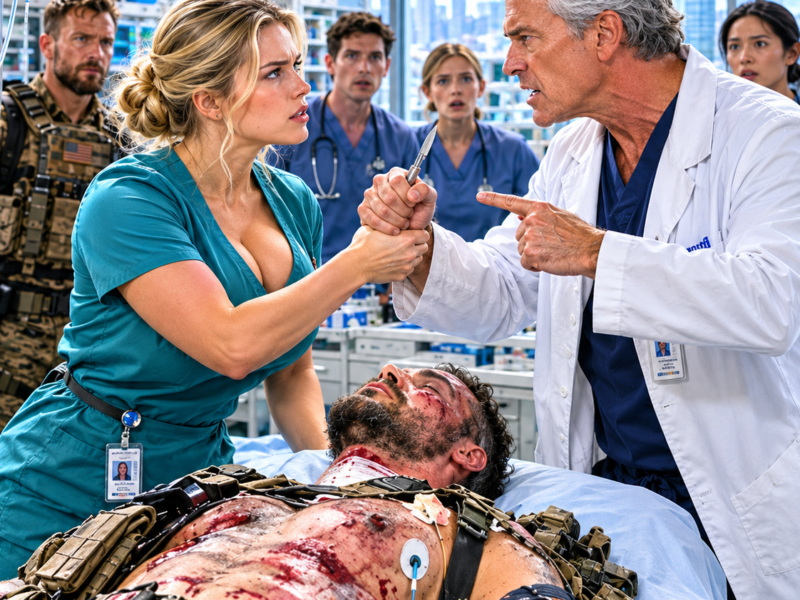
“I had spent six years making sure nobody at St. Adrian’s Medical Center remembered my face, my voice, or my past.
Daniel’s monitor screamed again.
For one terrible second, I forgot the hospital around me.
I saw Jake Mercer standing in the rain six years earlier, grinning at me through the open door of an armored vehicle.
I heard his voice.
“Don’t worry, Halo. I’ll bring everyone home.”
Then the memory vanished.
“She’s not touching him again!” Dr. Hale shouted.
Two security officers entered the trauma bay.
I stepped away from Daniel’s bed, but I didn’t take my eyes off the monitor.
“His pressure is dropping. He’s bleeding internally. He needs immediate surgical intervention.”
Hale pointed at me.
“She’s been removed from the case. Get her out.”
The emergency physician, Dr. Patel, looked between us.
“Richard, she’s right about the bleeding. We need to move.”
Hale turned on him.
“I’m the chief of trauma surgery.”
“And I’m the physician responsible for this patient right now,” Patel replied. “We are not wasting another minute.”
For once, someone had challenged him.
The security officers stopped.
Patel turned toward the team.
“Prepare the operating room. Massive transfusion protocol. Notify vascular surgery.”
I stepped back as they moved Daniel toward the surgical elevators.
His hand slipped from the side of the bed.
I caught it.
“Daniel, stay with me.”
His eyes opened briefly.
“Halo.”
“I’m here.”
He tried to speak.
“Jake…”
“I know.”
He shook his head weakly.
“No. The truth…”
Then the doors closed between us.
I stood in the hallway with blood on my sleeves and a name I hadn’t heard in six years echoing through my mind.
Hale approached me.
“Give me your identification badge.”
I looked at him.
“Excuse me?”
“You’re suspended pending investigation. You interfered with a physician’s orders, attempted to direct a trauma response, and compromised patient care.”
I almost laughed.
A man had nearly died because Hale refused to recognize a life-threatening emergency, and somehow I was the one being accused of compromising patient care.
I removed my badge and placed it in his hand.
“Fine.”
He leaned closer.
“You should have stayed quiet.”
I looked directly at him.
“That’s what I’ve been doing for six years.”
Then I walked away.
I didn’t know that within an hour, the entire hospital would learn what my silence had been hiding.
At 3:30 a.m., three people entered St. Adrian’s through the main doors.
The first was a woman in her early sixties, wearing a Navy dress uniform.
Her posture was straight, her silver hair neatly arranged, and the stars on her shoulders caught the fluorescent light.
Two officers followed her.
A civilian investigator carried a thick folder.
I was standing near the vending machines when I heard her ask the receptionist a question.
“Where can I find Lieutenant Commander Elena Vass?”
My stomach tightened.
I turned.
Admiral Margaret Lawson.
My former commanding officer.
She looked across the lobby and found me immediately.
For several seconds, she said nothing.
Then her expression softened.
“Hello, Halo.”
I hadn’t heard that greeting from someone I trusted in six years.
I swallowed.
“Admiral.”
She walked toward me.
“I’ve been looking for you.”
I glanced toward the emergency department.
“Daniel is in surgery.”
“I know. That’s why I’m here.”
Before I could respond, Hale appeared behind us.
He had clearly been listening.
“Excuse me. This is a private medical facility. You can’t simply walk in and demand to see an employee.”
The admiral turned.
“Who are you?”
“Dr. Richard Hale. Chief of trauma surgery.”
She looked at the identification badge clipped to his coat.
Then she looked at the folder in the investigator’s hands.
“You’re the physician responsible for this department?”
“Yes.”
“Then I suggest you pay attention.”
The investigator opened the folder.
“Lieutenant Commander Elena Vass. Former Navy hospital corpsman and nurse corps officer. Assigned to fourteen deployments supporting special warfare medical operations. Recipient of two Bronze Stars with Valor and one Silver Star. Credited with saving forty-one lives under combat conditions.”
The receptionist stopped typing.
A nurse coming out of the elevator froze.
Hale stared at me.
“That’s impossible.”
The investigator continued.
“She disappeared from active service following Operation Blackwater six years ago. Her last known operational identity was Halo.”
Hale looked at me as though he had never seen me before.
“You’re telling me this nurse…”
The admiral interrupted.
“I’m telling you that the woman you just tried to remove from a trauma bay has more experience treating catastrophic injuries than most physicians encounter in their entire careers.”
I lowered my eyes instinctively.
The admiral noticed.
“Elena.”
I looked up.
“You don’t have to hide in front of me.”
Those words nearly broke me.
Hale recovered enough to straighten his coat.
“Regardless of her history, she violated hospital protocol.”
The admiral turned toward him.
“Your hospital protocol will be reviewed. So will your treatment of Daniel Reyes.”
Hale’s jaw tightened.
“He’s a civilian patient.”
“He’s also a federal witness.”
The investigator closed the folder.
“And we have reason to believe the attack that brought him here is connected to a criminal investigation involving this hospital.”
Hale’s expression changed.
It was only for a moment.
But I saw it.
So did the admiral.
“Interesting,” she said.
Then she turned toward me.
“Come with me. We need to talk.”
We entered an empty consultation room.
The admiral closed the door.
For a moment, she simply watched me.
“You look tired.”
I gave a small, humorless smile.
“That’s what happens when you spend six years trying not to exist.”
She lowered herself into a chair.
“Elena, I owe you the truth.”
I remained standing.
“You owe me more than that.”
“I know.”
“Did you know Daniel was alive?”
She looked down.
“Yes.”
The answer landed harder than I expected.
I sat slowly.
“How long?”
“Four months after Blackwater, we received confirmation that he had survived the initial attack. He was being treated at a restricted medical facility.”
I stared at her.
“Four months?”
“Yes.”
“And you let me believe he was dead.”
“We were trying to identify the people who had compromised the operation.”
I shook my head.
“You could have told me.”
“We believed the fewer people who knew, the safer he would be.”
“Was I not allowed to know because you didn’t trust me?”
She looked directly at me.
“I trusted you more than anyone in that unit. That’s why I was afraid you would go looking for him.”
I stood again.
“Of course I would have.”
“I know.”
I walked to the window.
Outside, rain slid down the glass in long, crooked lines.
“Jake died believing he had failed.”
The admiral’s face tightened.
“Jake knew you did everything you could.”
“Then why did nobody tell me?”
“Because the mission report was manipulated before it reached the official review.”
I turned.
“What?”
She opened the folder.
“Operation Blackwater was supposed to be a medical extraction. Your team was sent to recover wounded personnel from an abandoned communications facility. The location was compromised before you arrived.”
I remembered the operation.
The convoy.
The sudden route change.
The radio call.
The explosion that turned the road into a wall of fire.
“We suspected a leak,” I said.
“We later found evidence that the route and timing had been sold to a defense contractor.”
“Who?”
“Vanguard Tactical Systems.”
The name meant nothing to me at first.
Then I remembered the logo on the supply containers.
They had provided emergency medical equipment and field stabilization kits during our deployment.
“What did they want?”
“Access to military medical procurement contracts. They had developed an experimental clotting medication and were trying to secure government approval.”
I frowned.
“What does that have to do with Blackwater?”
The admiral slid a document across the table.
“Your unit’s evacuation route was altered to pass through an area where Vanguard had arranged an unofficial field trial.”
I stared at the page.
“They used us as test subjects?”
“Not exactly. They intended to use the wounded people you were evacuating.”
I felt sick.
The document listed a medication called V-17.
It was described as an advanced hemostatic agent.
I remembered seeing the name on medical packaging during the operation.
We had been told it was an emergency supply.
The admiral continued.
“Several injured personnel received the medication without proper authorization. Some suffered severe complications. Others died.”
I looked at her.
“Jake?”
She didn’t answer immediately.
“Jake was exposed.”
My throat tightened.
“Was that why he died?”
“We believe it contributed to his injuries. But the original medical findings were altered.”
I stared at the document.
“Who altered them?”
“We’re investigating.”
I sat down.
For six years, I had remembered Jake’s final moments as a failure of my own judgment.
I had reached him after the explosion.
I had pressed my hands against his wound.
I had called for extraction.
And I had watched him die while the radio filled with static.
I had spent years believing I hadn’t been fast enough.
Now someone was telling me that the equipment and medication we had been given might have been part of the reason he never made it home.
I covered my mouth.
The admiral moved closer.
“Elena, this wasn’t your fault.”
I shook my head.
“Don’t say that because you think I need to hear it.”
“I’m saying it because it’s true.”
She waited until I looked at her.
“Jake’s death was recorded as a consequence of the attack. The medical evidence that might have exposed the drug trial was deliberately removed. You were the only person who filed a report questioning the medication.”
I remembered.
A report I had written after the mission.
A report describing unusual clotting, unexpected bleeding, and a medical supply package that didn’t match our approved inventory.
I had submitted it through command.
Then I had been told it was incomplete.
I never heard about it again.
“Where is that report?”
The admiral looked at the investigator.
“We found a copy in Daniel’s possession.”
I leaned forward.
“Daniel has it?”
“He told us he recovered several documents before the records were destroyed.”
I thought about his words.
Jake left something for you.
The admiral lowered her voice.
“Daniel was on his way to testify when he was attacked. He had planned to deliver the evidence to federal investigators.”
“Who shot him?”
“We don’t know yet.”
“Then how did he end up here?”
“His vehicle was forced off the road. He managed to get away, but someone followed him. He reached an ambulance station and asked them to take him to the nearest trauma center.”
I closed my eyes.
He had come here because he knew I was here.
Because he knew Halo was still alive.
The admiral placed a hand on the table.
“Elena, there’s something else.”
I opened my eyes.
“Vanguard has been operating through civilian medical contractors. We found suspicious payments to several hospitals.”
I looked at her.
“St. Adrian’s?”
“We have reason to believe so.”
A cold feeling moved through me.
“How?”
“Daniel’s evidence includes invoices and internal communications. One of the companies connected to Vanguard has been paying Dr. Hale for access to trauma patients.”
I stared at her.
“Access to patients?”
“Unapproved trials. Altered records. False billing. The same medication was being administered to selected patients under the label of standard emergency treatment.”
I thought about the patients I had cared for during the last six years.
The charts.
The unexplained complications.
The cases Hale insisted should be transferred to private facilities.
The times nurses raised concerns and were told to stop asking questions.
“How many?”
“We don’t know yet.”
The room seemed to shrink.
I had spent six years hiding from the people who had destroyed my unit.
And somehow, I had ended up working in a hospital connected to the same people.
The admiral watched my face.
“Elena, I need you to understand something. This investigation may become dangerous.”
I looked at her.
“I think it already is.”
She nodded.
“Then we’ll make sure you aren’t facing it alone.”
At 5:20 a.m., Dr. Patel came to find us.
Daniel had survived surgery.
The bleeding had been controlled, but he remained in critical condition.
I asked whether I could see him.
Patel nodded.
“Briefly. He’s still sedated, but his condition is stable for now.”
I entered the intensive care unit.
Daniel looked smaller beneath the blankets.
The monitors were steady.
A ventilator supported his breathing.
I stood beside him for a long time.
Then I noticed a small envelope inside the clear belongings bag on the cabinet.
His name was written across the front.
Under it, in handwriting I recognized instantly, were two words.
FOR HALO.
My fingers began to tremble.
I asked the nurse whether I could retrieve it.
She checked with the charge nurse, then handed it to me.
I sat beside Daniel’s bed and opened the envelope.
Inside was a folded piece of paper.
Jake’s handwriting.
The letters were uneven, probably written in a hurry.
I read the first line.
“Elena, if Daniel gets this to you, I need you to know something.”
I stopped.
The room blurred.
I wiped my eyes and continued.
“You did not leave me behind. You got me out of that vehicle when everyone else was still running toward the fire. You stayed until the extraction team forced you to move. I remember all of it.”
I pressed the paper against my chest.
The next lines were harder to read.
“Don’t spend the rest of your life paying for a decision you didn’t make. The medication they gave us was wrong. I knew something was happening, and I should have told you sooner.”
I looked toward Daniel.
The letter continued.
“There’s a man named Voss. He knew about the trial. He knew the supply containers were altered. If I don’t make it, don’t let them turn my death into a report that says nobody could have done anything.”
At the bottom was a final sentence.
“Bring yourself home, Halo. That’s an order.”
I folded the letter carefully.
For six years, I had carried Jake’s death like a sentence.
Now, in his own handwriting, he had given me permission to put it down.
I didn’t feel healed.
Not yet.
But I finally understood that grief didn’t have to become punishment.
A nurse came in to check Daniel’s medication.
I slipped the letter into the inside pocket of my jacket.
Then I noticed the nurse looking at the patient chart.
She was new.
Young.
Her badge said MARA.
She checked Daniel’s infusion, frowned, and adjusted the pump.
I watched her.
“What’s that medication?”
She glanced at the label.
“Standard supportive infusion.”
I looked closer.
The packaging was unfamiliar.
There was a small blue mark near the barcode.
V-17.
My stomach dropped.
“Stop.”
Mara looked up.
“What?”
“Don’t administer that.”
She stepped back.
“Dr. Hale ordered it.”
“He’s been removed from the case.”
She looked confused.
“I got the order from the electronic chart.”
I called the charge nurse.
Within minutes, Dr. Patel arrived.
He examined the label and immediately ordered the infusion held pending pharmacy verification.
The hospital pharmacist confirmed that the medication was not part of Daniel’s approved treatment plan.
It had been entered under a misleading product code.
Patel looked at me.
“How did you recognize that?”
I showed him the blue mark.
“I’ve seen it before.”
The pharmacist took the bag away.
The admiral was called.
When she arrived, she examined the label and asked for the medication’s chain of custody.
The hospital administrator was summoned.
By 7:00 a.m., St. Adrian’s had been placed under an emergency records preservation order.
No patient files could be altered or deleted.
No medication from the disputed supply chain could be administered without independent pharmacy review.
And Dr. Hale was ordered to remain available for questioning.
But Hale was gone.
His office was empty.
His car was still in the parking lot.
His phone had been left on his desk.
Security checked the cameras.
At 6:12 a.m., he had entered the administrative corridor carrying a leather bag.
At 6:19, he had left through the rear service exit.
Nobody had seen him again.
The hospital administrator looked pale.
“Are we saying he ran?”
The investigator answered.
“We’re saying we need to find him.”
I thought about Daniel’s warning.
The people behind Blackwater were still working.
And now one of them knew the evidence had surfaced.
The next few hours passed in a blur.
Federal agents arrived.
Hospital staff were interviewed.
Pharmacy records were secured.
Every patient who might have received V-17 was identified for independent review.
I gave my statement about the medication, the trauma response, and the original Blackwater report.
The investigator asked why I had left the Navy.
I stared at the table.
“Because I couldn’t live with what happened.”
He waited.
“After Jake died, I couldn’t hear a monitor alarm without remembering the sound of the radio. I couldn’t walk past an ambulance without thinking about the people we never brought home.”
I looked down at my hands.
“So I changed my name and started over.”
He nodded.
“Did anyone help you disappear?”
I thought about the last person who had spoken to me before I left.
A woman from military personnel services.
She had arranged my separation paperwork and warned me that certain records would remain restricted.
“I don’t know.”
He wrote something down.
“Then we’ll look into it.”
At noon, Mr. Abernathy asked to see me.
I found him sitting upright in bed six.
His heart monitor beeped steadily.
He looked at my face and immediately understood something had changed.
“Well,” he said, “you look like you’ve been through a storm.”
I sat beside him.
“I think I have.”
He studied me.
“That man in the trauma bay?”
“His name is Daniel. We served together.”
“And the name he called you?”
I hesitated.
“Halo.”
Mr. Abernathy smiled gently.
“That sounds like a name someone earned.”
I looked at my hands.
“I don’t know if I earned it.”
He shook his head.
“Names don’t have to mean you’re perfect. Sometimes they mean you kept going when you didn’t think you could.”
I swallowed.
“I lost someone.”
“I know.”
“I thought I could have saved him.”
Mr. Abernathy took my hand.
“Sweetheart, being a medic means you fight for every life. It doesn’t mean you get to decide which lives the world takes.”
I looked at him.
He had been a medic long before I was born.
He had seen things I would never know.
“How did you live with it?” I asked.
He was quiet for a moment.
“Some days I didn’t. Some days I just got through breakfast. Then lunch. Then bedtime. Eventually, the memories stopped taking up every room in the house.”
He squeezed my fingers.
“You don’t have to forget them. Just don’t let them take the place of the living.”
I looked toward the ICU.
Daniel was still alive.
Jake’s letter was in my pocket.
And for the first time in six years, I wanted to know what tomorrow might look like.
That evening, the investigator returned with new information.
The payments to Dr. Hale had come through a company called Meridian Clinical Logistics.
It had received funding from Vanguard Tactical Systems.
The company had also been connected to a former military procurement officer named Colonel Adrian Voss.
I knew that name.
Voss had approved the final Blackwater supply manifest.
He had signed the report declaring the operation compromised by enemy action.
He had also been the officer who told me Jake’s death was unavoidable.
I looked at the investigator.
“Where is he now?”
“Retired. Lives outside Richmond.”
“Does he know about Daniel?”
“We believe he does.”
I leaned forward.
“Then he knows the evidence is here.”
The investigator nodded.
“We’ve requested an interview. We’re also securing his financial records.”
Before he could say more, a security officer appeared in the doorway.
“We have a situation in the parking garage.”
The investigator stood.
“What kind of situation?”
“Someone’s trying to access the hospital’s records server through the maintenance corridor.”
The admiral turned toward me.
“Stay here.”
But I had already stood.
I didn’t intend to chase anyone.
I wanted to see whether the person knew where the evidence was stored.
We reached the lower parking level.
Two security guards were standing near the service elevator.
A man in a dark jacket was moving toward the exit.
He carried a hospital maintenance badge.
The guard called out.
“Sir, stop. We need to verify your access.”
The man turned.
His right hand moved inside his jacket.
I recognized the movement.
“Gun!” I shouted.
The guard ducked.
The man pulled a pistol.
I moved before I could think.
I closed the distance, caught his wrist, and drove it against the wall.
The weapon fell.
He struck my shoulder, but I held on until the second guard tackled him.
The struggle ended in seconds.
My heart was pounding.
My hands were steady.
The man was forced to the ground.
The investigator retrieved the pistol and secured it.
“Who sent you?”
The man laughed.
“Nobody.”
I looked at him.
“Then why were you trying to access the records server?”
He stared at me.
“You’re not supposed to be here.”
I crouched slightly.
“Neither are you.”
His smile disappeared.
“You don’t know what you’re involved in.”
I stood.
“I know exactly what I’m involved in.”
The officers took him away.
This time, the evidence was stronger.
His phone contained messages from an encrypted account instructing him to destroy the hospital’s stored medication logs and remove any remaining references to V-17.
The account was traced to a company controlled by Meridian Clinical Logistics.
The investigation was no longer limited to a hospital.
It was a network.
And it was beginning to unravel.
Daniel woke up the following morning.
I was in the room when his eyes opened.
He looked around, confused.
Then he saw me.
“Halo.”
I smiled.
“Welcome back.”
His voice was weak.
“Did you get it?”
I took Jake’s letter from my pocket.
“I did.”
He closed his eyes.
“Good.”
I pulled a chair closer.
“Daniel, I need you to tell me everything.”
He looked at the ceiling.
“After Blackwater, I was taken to a military hospital. I was badly injured, but I survived. They told me the mission report was classified.”
“Who told you?”
“Voss.”
I felt my jaw tighten.
“He said the enemy had intercepted our route and that Jake died from injuries nobody could have prevented.”
Daniel turned his head toward me.
“I knew that wasn’t true.”
“What made you suspicious?”
“V-17.”
He took a careful breath.
“I had been given the same medication. My blood wouldn’t clot properly. I nearly died from a wound that should have been treatable.”
I remembered the strange bleeding.
“Did you report it?”
“I tried. My records disappeared. Then I found out other patients had experienced similar complications.”
He paused.
“Some of them were civilians.”
I stared at him.
“How many?”
“I don’t know. I found records for at least eleven deaths that had been attributed to unrelated complications.”
My stomach turned.
“Why didn’t you go public?”
“I tried. Every time I contacted someone, the information disappeared or the person I spoke to was transferred.”
He looked at me.
“Then I found Jake’s report.”
I leaned forward.
“What report?”
“The one he wrote before the final extraction. He had noticed the medication packaging was different. He took photographs and copied the supply numbers.”
I thought about the letter.
“Where is it?”
Daniel hesitated.
“I gave the original to the investigators before I was attacked. But I made a copy.”
“Where?”
He looked toward his belongings.
“Inside the lining of my old field bag.”
The bag had been placed in hospital storage with his personal property.
I called the nurse and asked for it.
When it arrived, Daniel pointed to a loose seam inside the lining.
I carefully opened it.
A small waterproof envelope was hidden inside.
It contained a memory card and several folded documents.
The investigator collected them immediately.
Within hours, the material was authenticated.
The documents connected V-17 to an unauthorized trial.
They showed that Vanguard had paid intermediaries to gain access to military medical supplies.
They also contained communications indicating that Voss had approved the altered shipment.
One message referred to Jake by name.
“Mercer has identified the discrepancy. Ensure the report is contained.”
I read it twice.
The person who had known Jake was suspicious had not protected him.
He had protected the company.
The final evidence came from a recorded conversation between Voss and Dr. Hale.
It showed Hale agreeing to continue administering V-17 to selected trauma patients in exchange for payments.
The conversation also revealed that Hale had known the medication was unapproved.
He had falsified patient charts to conceal complications.
Some patients had been transferred to outside facilities after their conditions worsened.
Others had died.
Their families had been told that nothing more could have been done.
I thought of every family that had sat in our waiting room.
Every person who had asked why their loved one hadn’t survived.
Every time Hale had told a nurse to stop asking questions.
I felt sick.
The authorities arrested Voss two days later.
Hale was found at a private residence outside the county.
He was taken into custody without incident.
The investigation eventually confirmed that eleven patients had died after receiving the unapproved medication.
Additional patients had suffered serious complications.
The hospital’s records had been deliberately altered to conceal the pattern.
Hale’s medical license was suspended immediately.
He was later convicted of fraud, unlawful medical experimentation, and multiple counts of manslaughter.
Voss and several Vanguard executives faced federal charges related to the unauthorized trials, bribery, and obstruction.
The hospital began contacting affected families.
The administrator resigned.
A new medical director was appointed.
And a policy was introduced that changed the way St. Adrian’s handled emergency decisions.
Any nurse or clinical staff member could request an immediate independent review when a treatment decision appeared unsafe.
No supervisor could retaliate against someone for raising a legitimate patient safety concern.
The staff began calling it the Voss Rule.
I didn’t choose the name.
I wasn’t even sure I liked it.
But I understood why people wanted a reminder of what happened when one person’s authority became more important than a patient’s life.
Three weeks after Daniel arrived, I was invited to a small ceremony in the hospital’s main conference room.
The admiral attended.
So did several members of the medical team.
Mr. Abernathy sat in the front row, wearing a clean sweater and the same knowing expression he had worn when he first noticed my hands.
Daniel came in using a cane.
He was thinner than before, but he was standing.
When he saw me, he smiled.
“Still hiding in the back?”
I laughed.
“Old habits.”
The admiral stepped toward the microphone.
“Today isn’t about medals or titles. It’s about the people who continue serving long after the uniform comes off.”
She looked toward me.
“Elena Vass spent six years believing she had to disappear to survive what happened at Blackwater. But she never stopped being the person who protected others.”
I lowered my eyes.
The admiral paused.
“She saved Daniel Reyes that night. She helped expose an operation that had endangered patients and concealed deaths. And she reminded this hospital that courage isn’t measured by rank.”
Then she announced the new program.
The Halo Center.
A trauma and veterans care initiative designed to support wounded service members, veterans, and civilians affected by severe injuries.
It would provide specialized trauma follow-up, rehabilitation coordination, and support for families dealing with the aftermath of catastrophic medical events.
The hospital offered me the position of director.
I looked at the admiral.
Then at Daniel.
Then at Mr. Abernathy.
For years, I had believed that returning to my old identity meant returning to the pain that came with it.
But maybe that wasn’t true.
Maybe I could keep the parts of myself that had helped others without carrying every loss as a personal failure.
“I accept,” I said.
The room applauded.
I felt my cheeks warm.
I wasn’t used to being seen.
After the ceremony, Mr. Abernathy asked me to come over.
He was sitting in his wheelchair with a blanket over his knees.
“Well,” he said. “I told you those hands weren’t rookie hands.”
I smiled.
“You did.”
He looked at the plaque beside the entrance.
THE HALO CENTER.
“That’s a fine name.”
I sat beside him.
“I wasn’t sure I wanted to use it.”
“Why not?”
“Because it belonged to a life I thought I’d lost.”
He studied me.
“Maybe it belongs to the life you’re still living.”
I looked toward Daniel.
He was speaking with the nurses who had helped him survive.
He caught my eye and raised one hand.
I raised mine in return.
Mr. Abernathy followed my gaze.
“Looks like you brought someone home after all.”
I swallowed.
“Not everyone.”
“No,” he said gently. “Nobody does.”
He rested his hand over mine.
“But you don’t have to spend the rest of your life standing beside the ones you couldn’t save. There’s still room for the people who need you now.”
I looked down at our hands.
His were thin and spotted with age.
Mine were small, with the same faint scar running along my left forearm.
For six years, I had hidden that scar beneath long sleeves.
I had hidden my name.
My call sign.
My uniform.
My memories.
I had believed that if nobody knew who I was, the past couldn’t hurt me anymore.
But the past had never been the thing I needed to escape.
It was the guilt I had mistaken for responsibility.
Jake’s letter remained in my pocket.
I had read it so many times that I could remember every line.
Bring yourself home, Halo.
For the first time, I understood that he hadn’t meant a place.
He had meant a life.
A life where I could laugh without feeling guilty.
Where I could help people without believing every failure was mine.
Where I could remember the people I had lost and still welcome the people who were here.
That evening, I returned to the emergency department.
The rain had finally stopped.
The fluorescent lights still hummed.
The coffee still tasted terrible.
A monitor beeped in one of the rooms.
A young nurse hurried past me, carrying a chart.
“Ms. Vass, room four needs help.”
I looked at her.
“Coming.”
She hesitated.
“Can I ask you something?”
“Of course.”
“Is it true you were a Navy medic?”
I smiled.
“Yes.”
“Does it ever stop being frightening?”
I thought about the question.
I remembered Blackwater.
Jake.
Daniel’s bloodied face.
The moment I had heard my old name in a room full of strangers.
Then I thought about Mr. Abernathy, the Halo Center, and the people waiting for someone to help them.
“No,” I said honestly. “But you learn that fear doesn’t have to make your decisions.”
She nodded.
I reached for the door to room four.
Then I stopped and looked down at my hands.
They were steady.
Not because I was pretending anymore.
Not because I was afraid someone might recognize them.
They were steady because I knew who I was.
I was Ellie Ward when I needed a quiet life.
I was Elena Vass when the truth needed a name.
And I was Halo to the people who had trusted me when the world was falling apart.
I no longer had to choose between those parts of myself.
I could carry them all.
I entered the room.
A frightened patient looked up at me.
“Am I going to be okay?”
I pulled a chair beside the bed.
“We’re going to take this one step at a time,” I said.
And for once, I didn’t feel like I was hiding from anything.
I was exactly where I was supposed to be.
The End









