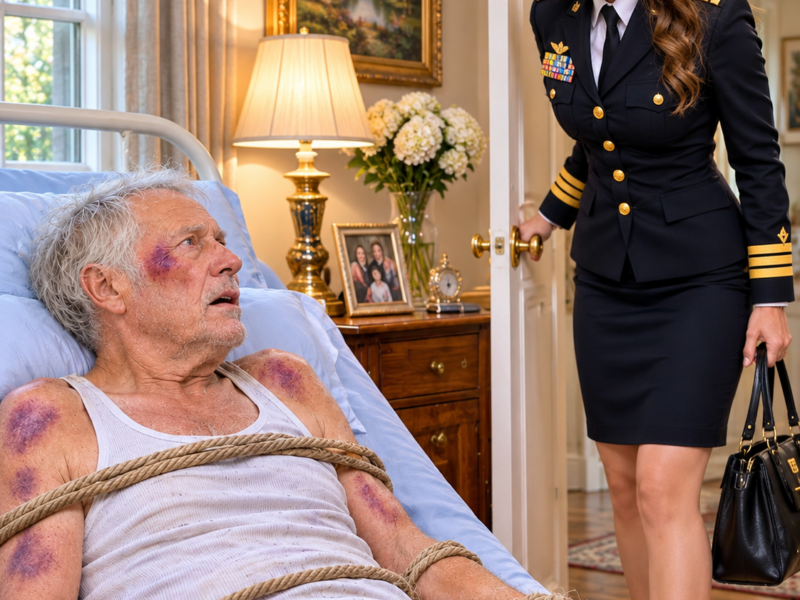
“I had just returned from three years in Ukraine when I found my seventy-one-year-old father chained to a filthy bed in my husband’s family home in Fort Myers
I opened the attached document again, hoping I had misunderstood the name.
But I hadn’t.
The applicant was Kelsey Sterling.
My husband’s younger sister.
For several seconds, I stared at the screen while the sounds of the house seemed to fade into the background.
Kelsey had been the person who sent me birthday messages every year.
She had called me her big sister.
She had even cried during our wedding ceremony.
And according to the insurance application, she had submitted the paperwork using a power of attorney that supposedly gave her permission to act on my behalf.
I looked at Garrett.
“Your sister applied for this policy?”
He glanced at my phone.
Then he looked at Kelsey, who had just appeared at the top of the stairs.
“Let me explain.”
“That’s what you’ve been saying since I walked through the door.”
Kelsey crossed her arms.
“You’re taking this out of context, Sofia.”
I almost laughed.
My father was tied to a bed in a room blocked by furniture, and she was still worried about context.
I turned toward Dad.
His breathing was shallow, and his eyes kept drifting closed.
“How long has he been like this?”
Neither of them answered.
I knelt beside him and gently touched his hand.
“Dad, I need you to tell me what happened. But only if you’re strong enough.”
He swallowed.
“Since… last winter.”
I felt the words settle inside me.
Last winter.
Nearly a year.
“Did they have a nurse?”
He shook his head.
“Sometimes… a woman came. Not often.”
“What happened to your medication?”
“Your husband said… it cost too much.”
Garrett stepped forward.
“That’s not true. We had financial problems, and your father refused to cooperate with the care arrangements.”
I stood.
“Then why was the door blocked?”
“Because he kept trying to get out.”
“And the restraints?”
“He fell twice.”
“So you tied him to a bed?”
“To keep him safe!”
The answer came so quickly that it sounded rehearsed.
Before I could respond, sirens sounded outside.
Kelsey looked toward the staircase.
“Garrett, you said she wouldn’t actually call them.”
I turned toward her.
“You knew?”
She didn’t answer.
Two officers entered the house several minutes later, followed by paramedics.
I showed them the recordings, the restraints, the documents, and the insurance policy.
One officer, a woman named Officer Melissa Grant, asked me to step into the hallway.
“Ma’am, I need you to tell me whether your father has been receiving medical care.”
I looked through the open bedroom door.
“No. I don’t think he has.”
She nodded toward the paramedics.
“We’re getting him to the hospital. Please don’t touch anything else in that room.”
I watched them carefully cut the fabric restraints.
Dad winced when they lifted his legs.
One of the paramedics quietly asked how long he had been unable to walk.
Dad whispered, “I used to walk to the mailbox.”
The paramedic looked at the dried food on the nightstand.
“Sir, when was the last time you had a proper meal?”
Dad looked at me.
I couldn’t bear to hear his answer.
As they carried him downstairs, Diane began crying.
“This is a misunderstanding. We have done everything for this family.”
Officer Grant asked her to step away from the paramedics.
Diane turned toward me.
“Sofia, you’re going to destroy your marriage over this?”
I looked at the woman wearing my mother’s necklace.
“No, Diane. I think you did that yourself.”
At the hospital, doctors discovered severe dehydration, malnutrition, pressure injuries, and an untreated infection.
His hip had not healed properly.
The physician explained that Dad needed immediate treatment and a rehabilitation program.
I sat beside his hospital bed until sunrise.
He slept with one hand resting over mine.
At around six in the morning, he opened his eyes.
“Did you find the papers?”
I nodded.
“Yes, Dad.”
He looked toward the window.
“I was hoping you wouldn’t have to.”
“What did they want me to sign?”
He took a slow breath.
“Everything.”
I pulled my chair closer.
“Tell me.”
Dad closed his eyes briefly, gathering enough strength to speak.
“It started with the money.”
He explained that Garrett had initially brought him to Fort Myers because the house was closer to the physical therapy center.
For the first few months, things had been relatively normal.
A caregiver visited.
Dad received his medication.
He even started walking short distances with a walker.
Then Garrett began asking him to sign financial documents.
The first was supposedly a form authorizing the family to manage medical expenses.
The second concerned the house.
The third was a document granting Kelsey access to certain accounts.
Dad refused.
He wanted to discuss everything with me first.
After that, the atmosphere changed.
Diane stopped speaking to him.
Kelsey began taking his phone.
Garrett told him he was becoming paranoid and that I was too busy in Ukraine to care about his complaints.
Eventually, they moved him into the upstairs bedroom.
The room had originally belonged to visiting relatives.
They told him it was temporary.
Then the visits stopped.
“Why didn’t you call the police?” I asked.
Dad’s eyes filled with tears.
“They said you were sending money because you didn’t want to come home. They said if I caused trouble, you’d lose your job.”
I lowered my head.
“I would have come home, Dad.”
“I know that now.”
He squeezed my fingers.
“At first, I believed them when they said you were too far away to help. Then I realized they were using the distance to make me afraid.”
I wiped my face.
“What about the message?”
He looked at me carefully.
“I recorded it because they wanted me to sign another document. Garrett said it was just an update to your medical authorization.”
“But it was the insurance policy?”
Dad nodded.
“He told me if I didn’t cooperate, you’d never come back.”
I sat silently for a moment.
Then I asked the question I had been avoiding.
“Did you know they were planning something against me?”
Dad turned his face toward me.
“I didn’t know exactly what. But I heard them talking.”
“What did they say?”
He struggled to remember.
“Something about the effective date. Something about making sure you were home before the paperwork went through.”
I felt a chill move through my shoulders.
“Did they say anything about hurting me?”
He shook his head.
“Not directly. I don’t want you to think I know more than I do.”
That answer stayed with me.
Dad wasn’t trying to make his story more frightening.
He was trying to tell me only what he remembered.
And that made me trust him even more.
Later that morning, Valerie arrived at the hospital.
She carried a leather folder and looked as though she hadn’t slept.
I had emailed her photographs of the insurance documents from the ambulance.
She sat beside me.
“Sofia, I had an investigator verify the application.”
“Who submitted it?”
“Kelsey, through an insurance broker she knew.”
“Was it approved?”
Valerie opened the folder.
“The company issued a conditional policy, but there are serious questions about the application. The medical information is inconsistent, and the authorization documents appear to be forged.”
“Why would they insure me?”
“That’s what we’re trying to establish.”
She pointed to the effective date.
“The policy was scheduled to become active two days from now, subject to the remaining requirements. It also includes a medical examination and identity verification that haven’t been completed.”
“So they couldn’t simply collect the money if something happened to me?”
“Not automatically. There are conditions, and the insurer would investigate a claim. But the fact that someone submitted an application in your name without your knowledge is serious.”
I looked at the beneficiary line.
Garrett Sterling.
The man who had kissed me goodbye at the airport.
The man who had promised to care for my father.
The man who had told me he couldn’t wait for me to come home.
Valerie closed the folder.
“We also need to investigate the power of attorney and the money you sent. Do you have the transfer records?”
“I have every single one.”
“Good. Don’t contact them about the documents. Let the authorities handle that.”
I nodded.
Then she said something that changed the direction of the investigation.
“The insurance application isn’t the only suspicious financial record.”
She showed me a spreadsheet.
During the previous fourteen months, several transfers from the account designated for Dad’s care had gone to a company called Sterling Home Solutions.
The company was registered to Kelsey.
I recognized the name.
It was supposedly the business that had installed Dad’s electric hospital bed.
“That bed was never installed,” I said.
Valerie looked at me.
“Are you certain?”
I remembered the stained mattress.
The rusty bedframe.
The plastic plate.
“Completely.”
The amount transferred to the company was $12,800.
There were also payments for medical supplies, transportation, home nursing, and physical therapy.
Together, the questionable transactions exceeded $90,000.
I stared at the figures.
“Where did the money go?”
“That’s what the financial investigators will need to determine.”
I looked toward Dad’s room.
For three years, I had worked nights in Kyiv, cleaning hotel conference rooms after major events and handling guest complaints during the day.
I had eaten cheap meals, shared a small apartment, and sent nearly everything I could spare home.
I remembered buying myself a winter coat only after my old one began leaking rain through the sleeves.
I had believed every sacrifice was helping my father recover.
Instead, someone had turned his suffering into a source of income.
That afternoon, Officer Grant returned to the hospital.
She asked whether Dad was willing to provide a statement when his condition allowed.
He agreed.
Before she left, I asked whether Garrett and his family had been arrested.
“We’re still gathering evidence,” she explained. “Your recordings are important, but we need to establish who was responsible for each act and what happened to the funds.”
I understood.
I didn’t want an arrest that disappeared because someone had failed to verify a document.
I wanted the truth documented properly.
Two days later, Dad was stable enough to begin rehabilitation.
He was weak, but he could sit upright for longer periods.
A physical therapist helped him move his legs over the side of the bed.
His face tightened with pain.
“One more time, Mr. Reyes,” she encouraged.
Dad looked at me.
I nodded.
He tried again.
For the first time in months, his feet touched the floor.
He cried quietly.
I did too.
That evening, I returned to the Fort Myers house with Officer Grant and another investigator to collect some of Dad’s personal belongings.
The family had been instructed not to disturb the property.
The living room looked different now.
The expensive television was off.
The espresso machine had been unplugged.
Diane’s gold necklace was missing.
I went upstairs to Dad’s room.
I couldn’t bring myself to look at the mattress.
Instead, I opened the small closet.
His old shoes were lined up on the bottom shelf.
Beside them was a cardboard box containing birthday cards, photographs, and several unopened letters.
One envelope had my name written across it.
The handwriting was Dad’s.
I opened it carefully.
Inside was a short letter.
My dearest Sofia,
If you’re reading this, I couldn’t get the truth to you in person.
Please don’t blame yourself for being away.
You worked so hard because you loved me.
I know that.
I never wanted you to give up your life to keep me alive.
I just wanted you to know that I never signed anything against you.
I love you.
Dad.
I sat on the floor and held the paper against my chest.
Then I noticed something written on the back.
A date.
The day before the insurance application had been submitted.
And beneath it, four words.
“Ask about the blue folder.”
I searched the closet.
Nothing.
I checked the drawers.
Nothing.
Then I remembered the small storage room behind the kitchen.
I went downstairs.
The door was unlocked.
Inside were old holiday decorations, broken lamps, and several boxes.
On the highest shelf sat a blue plastic folder.
I reached for it.
The first papers were receipts.
The next were bank statements.
Then I found a document titled Temporary Care Agreement.
It listed my father as the recipient of long-term home care.
My name appeared under the section authorizing payment.
But the signature wasn’t mine.
The document had been dated eleven months earlier.
Behind it was a handwritten note.
The writing belonged to Kelsey.
“Once Walter signs the property transfer, we can close the care account. Garrett says Sofia won’t check because she’s still overseas.”
I read the sentence several times.
Then I heard footsteps behind me.
I turned.
Garrett stood in the doorway.
He looked exhausted.
His shirt was wrinkled, and his hair was uncombed.
For the first time, he didn’t look like the confident man who had greeted me in the kitchen.
He looked frightened.
“You’re not supposed to be in here.”
I held up the note.
“Neither was this supposed to exist.”
He glanced at the paper.
Then he rubbed both hands over his face.
“Sofia, please. Let me talk to you.”
“Talk.”
He looked toward the kitchen before speaking.
“My mother and Kelsey handled most of the arrangements. I didn’t know how bad things had gotten.”
I stared at him.
“You lived in this house.”
“I know.”
“You walked past that bedroom.”
He looked down.
“I know.”
“Then how did you not know?”
His jaw tightened.
“I thought he was being cared for.”
“Did you ever go inside?”
He didn’t answer.
I took a step closer.
“Garrett, did you ever go inside?”
“Not recently.”
That answer was worse than a denial.
I felt something inside me settle.
Not anger.
Not shock.
Just a painful understanding that I had been married to a man who could hear his father-in-law calling for help and convince himself it wasn’t his responsibility.
“Why was my name on that insurance policy?”
He looked at the floor.
“Kelsey said it was a financial protection plan.”
“Protection for whom?”
He rubbed his eyes.
“She told me it would help if something happened.”
“To me?”
He swallowed.
“She said you were traveling so much. She said there were risks.”
I couldn’t believe what I was hearing.
“You knew about the policy?”
“I knew there was paperwork.”
“Did you know you were the beneficiary?”
He didn’t respond.
I waited.
Finally, he said, “Yes.”
The room felt smaller.
“Then you knew.”
“I didn’t think it would ever matter.”
I looked at him for a long time.
“That’s what you tell yourself when you don’t want to admit what you’re doing.”
He reached toward me.
I stepped back.
“Don’t.”
His hand fell.
“I loved you, Sofia.”
I looked at the blue folder.
“Maybe you did. But you loved the life my money paid for more.”
He started crying.
I didn’t.
Not because I felt nothing.
Because I had already spent too many nights crying into a phone while he told me everything was fine.
Officer Grant entered the hallway a moment later.
She had been speaking with the other investigator.
I handed her the note and the documents.
Garrett didn’t resist when she asked him to accompany them for further questioning.
As he passed me, he stopped.
“Can we talk later?”
I looked at the wedding ring on my finger.
“There’s nothing left to discuss until the truth is established.”
He walked out.
I stayed in the storage room.
For the first time, the house was quiet.
But I didn’t feel safe there.
I felt like a guest who had finally discovered what everyone else had known.
The investigation continued over the following weeks.
Financial records revealed that much of the money I had sent for Dad’s care had been transferred into personal accounts or used for purchases unrelated to his treatment.
Some payments went toward the home renovation.
Others covered Kelsey’s business expenses.
Several transfers were made to accounts controlled by Diane.
The company that supposedly supplied Dad’s medical equipment had never delivered the equipment listed on its invoices.
The insurance company confirmed that the application had been submitted using documents that appeared to contain unauthorized signatures.
The medical history attached to the application was also inaccurate.
The policy was suspended pending investigation.
No money was ever paid out.
More importantly, investigators found communications between Kelsey and the insurance broker showing that she had been told my identity and authorization needed to be verified before the policy could become active.
She had submitted the application anyway.
The police also recovered messages in which Diane complained that Dad was refusing to sign the property documents.
One message read:
“We can’t keep paying for him if he won’t cooperate.”
Another, sent by Kelsey, said:
“Garrett needs to get Sofia to come home and sign everything.”
That explained the urgency.
They hadn’t simply wanted my father to sign away his rights.
They wanted me home because my presence would make the documents easier to present as legitimate.
I had thought returning home would expose their actions.
I hadn’t understood that my return was part of what they had been waiting for.
The most difficult part came when Dad learned that Garrett had known about the insurance policy.
He was sitting in a rehabilitation chair when I told him.
He didn’t speak for several minutes.
Then he asked, “Did he know I was tied to the bed?”
I looked down.
“He knew you were in that room.”
Dad closed his eyes.
“That’s not the same answer.”
“No,” I whispered. “It isn’t.”
He looked toward the window.
“I wanted to believe he was just careless.”
I took his hand.
“So did I.”
A few days later, Garrett asked Valerie to arrange a meeting.
He wanted to speak with me and Dad.
I wasn’t sure whether I should agree.
Valerie advised me that I had no obligation to see him.
But Dad surprised me.
“I want to hear what he says.”
So we arranged the meeting at the hospital, with Valerie present.
Garrett arrived carrying a small paper bag.
Inside was a photograph of Dad and me taken years earlier at a baseball game.
I remembered the day.
Dad had bought two hot dogs and complained that the team was terrible.
We had laughed until our faces hurt.
Garrett placed the photograph on the table.
“I found this in the living room.”
Dad didn’t reach for it.
Garrett sat down.
“I don’t expect either of you to forgive me.”
I folded my hands.
“Then why are you here?”
He stared at the floor.
“Because I need to tell you something I should have said before.”
He explained that when Dad first moved into the house, things had been manageable.
But after several months, Diane began complaining about the cost of care.
Kelsey had business debts.
The house needed repairs.
Garrett was struggling to keep his construction business operating.
They began taking money from the care account.
At first, he told himself they would replace it.
Then the amounts became larger.
When Dad questioned the missing funds, Garrett told him the transfers were temporary.
When Dad refused to sign the property papers, the arguments became more frequent.
Garrett said he had tried to avoid confronting his mother and sister.
He let them make decisions because it was easier.
Then the situation became something he could no longer ignore.
“Why didn’t you call me?” I asked.
He looked at me.
“Because I knew you’d come home.”
I stared at him.
“And that was a problem?”
He nodded slowly.
“I didn’t want you to see what we’d done.”
The honesty of that answer hurt more than another excuse would have.
Dad finally spoke.
“You let them lock me in a room.”
Garrett’s eyes filled.
“I know.”
“You heard me calling.”
Garrett lowered his head.
“Yes.”
Dad’s voice shook.
“I used to ask you to bring me water.”
“I know.”
“And you told me to stop making trouble.”
Garrett covered his face.
“I’m sorry.”
Dad looked at him for a long time.
Then he said something I will never forget.
“I don’t need you to feel sorry because you got caught. I needed you to be decent when nobody was watching.”
Garrett began to cry.
Dad turned away.
The meeting ended without forgiveness.
I didn’t feel triumphant.
There was no satisfaction in watching someone I had loved fall apart.
There was only the knowledge that an apology couldn’t restore the months Dad had spent alone.
The legal proceedings took time.
Kelsey initially denied everything.
Diane claimed she had only followed Garrett’s instructions.
Garrett admitted that he had known about the unauthorized financial arrangements but disputed the extent of his involvement.
Investigators continued examining the evidence, including the false care invoices, the forged documents, the insurance application, and the recordings from my arrival.
Eventually, the financial investigation established that the family had diverted more than $90,000 intended for Dad’s care.
The case resulted in criminal charges related to financial exploitation, forgery, and neglect.
The insurance company formally canceled the application after confirming that the required authorization had never been valid.
Garrett and I separated.
I filed for divorce.
He sent several letters over the next few months.
I read the first one.
I didn’t open the others.
Not because I wanted to punish him.
Because I had finally understood that I didn’t owe him unlimited opportunities to explain away what he had chosen to do.
Diane sold some of her jewelry to cover legal expenses.
Kelsey’s business closed.
The renovated house was eventually sold.
None of that gave Dad back the months he had lost.
But it meant the people responsible could no longer use the money I had earned to maintain the lives they had built around his suffering.
Meanwhile, Dad began to recover.
The first time he stood without assistance, he held tightly to the physical therapist’s arm.
His knees shook.
His face turned red with effort.
But he stood.
“Look at me, Sofia,” he said.
I was already crying.
“I’m looking.”
“Still got a little fight left.”
I laughed through my tears.
“More than a little.”
Rehabilitation took months.
He learned to use a walker again.
He gained weight slowly.
His hands became steadier.
Some nights were difficult.
He occasionally woke up confused, believing he was still in the locked bedroom.
Whenever that happened, I sat beside him until he recognized where he was.
I never told him to calm down.
I never told him it was all over.
I simply stayed.
Eventually, I found a small single-story house near the water in Cape Coral.
It had two bedrooms, a wide front porch, and enough space for Dad to move around safely.
I hired a licensed home health aide for the hours I needed to work.
I also arranged for regular medical appointments and physical therapy.
This time, every invoice came directly to me.
Every medication was accounted for.
Every visit was documented.
I didn’t make those arrangements because I believed everyone was dishonest.
I made them because Dad had already paid too high a price for my trust being placed in the wrong hands.
About six months after I returned from Ukraine, Dad was able to walk from the living room to the porch using his walker.
He stopped beside the front door and looked at the sunlight spilling across the wooden floor.
“Can we go outside?” he asked.
I opened the door.
The air smelled of salt and freshly cut grass.
A neighbor was watering her flowers.
Somewhere down the street, a dog barked.
Dad stepped onto the porch.
He lowered himself into the chair beside mine and closed his eyes.
For several minutes, neither of us spoke.
Then he reached into his pocket.
“I kept something.”
He handed me a small photograph.
It was the picture Garrett had brought to the hospital.
Dad and I were standing at the baseball stadium, both laughing.
On the back, Dad had written a date.
It was the day before I left for Kyiv.
“I used to look at this when I was upstairs,” he said.
I turned toward him.
“Why?”
“Because I needed to remember what it felt like to be loved without having to earn it.”
My throat tightened.
“Dad…”
He shook his head gently.
“You don’t have to apologize for going away. You were trying to build a better life for us.”
I looked at the photograph.
“I should have come home sooner.”
“Maybe. But you came home when you knew something wasn’t right.”
He rested his hand over mine.
“And when you came home, you listened.”
That was when I finally let myself cry.
Not the desperate kind of crying I had done in airport bathrooms or during midnight calls from Kyiv.
This was quieter.
It was the kind that comes when you realize someone you almost lost is sitting beside you in the sunshine.
A year later, Dad celebrated his seventy-second birthday in our new home.
We invited a few neighbors, his old friend Frank, and the physical therapist who had helped him learn to walk again.
There was a chocolate cake on the table.
Dad insisted on cutting it himself.
His hand shook slightly as he held the knife, but he managed.
Everyone applauded.
He looked embarrassed.
“All right, all right. It’s only cake.”
I laughed.
Later, after the guests had left, I found him sitting on the porch with the old photograph in his hands.
The sunset painted the water a soft orange.
I brought him a blanket.
“Cold?”
“A little.”
I placed it over his shoulders.
He looked up at me.
“Do you ever regret coming back?”
I thought about the job I had left behind, the marriage that had ended, the money we had lost, and the years I could never give back.
Then I looked at my father.
“No.”
He smiled.
I sat beside him.
The world had not returned to the way it was before I left.
Our family was different.
My marriage was over.
Some wounds would take longer than either of us wanted.
But Dad was alive, safe, and free to open his own front door.
For three years, I had sent money across an ocean believing it was enough to protect the person I loved.
Now I understood that love wasn’t measured by the amount of money transferred or the promises made over a phone call.
Sometimes it was measured by whether someone was willing to walk into a room, see the truth, and refuse to look away.
That evening, Dad reached for my hand.
I held it as the porch light came on.
And for the first time in a very long while, neither of us had to wonder whether someone would come when we called.
The End.









