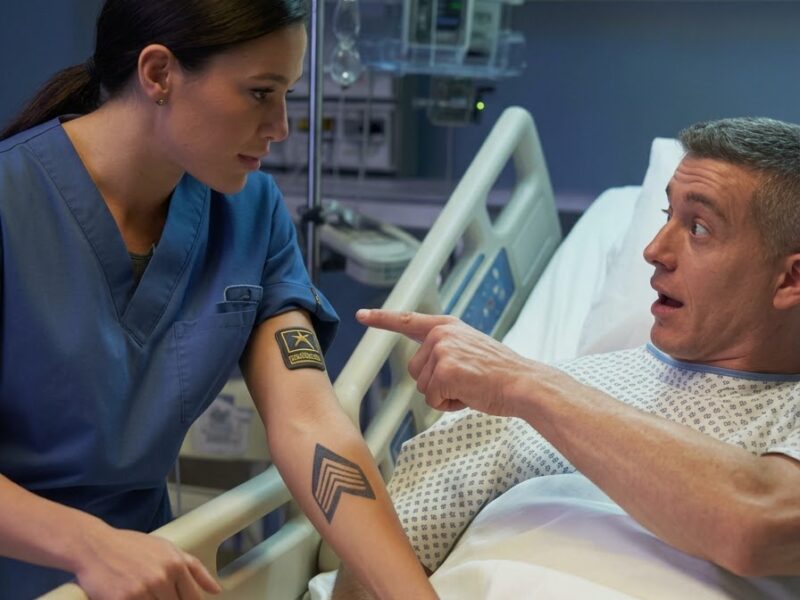
I had hidden my military past for two years, but when a patient grabbed my wrist in a quiet hospital room and stared at the tattoo beneath my sleeve
The cold at St. Jude’s Memorial outside Denver wasn’t just the mountain air leaking through the frame of the old emergency room entrance. It was a chemical cold—the smell of isopropyl alcohol, bleach, and stale coffee that settled into your skin after a twelve-hour shift.
For two years, I had built a life out of that cold. I was Emily Carter. I was quiet. I took the night shifts nobody else wanted, stayed out of staff drama, and never brought up where I had lived before coming to Colorado. The hospital staff knew me as a reliable, light-footed nurse who could handle a arterial bleed without flinching, but who rarely spoke unless spoken to.
Above all, they knew I always wore long sleeves. Even under the sweltering heat of the trauma bay lights, a dark thermal compression sleeve remained pulled tight down to my knuckles on my left arm. If anyone asked, I said it was for a nerve injury from an old car wreck. It was a clean, boring lie.
That lie died on a freezing Thursday night in Room 12.
The paramedics rolled him in at 02:00. He was an unidentified male, found slumped over the steering wheel of a stalled sedan off Route 6. Hypothermic, multiple contusions across his torso, and a ragged laceration along his hairline. He was barely breathing, his blood pressure dropping rapidly into the red zone.
“We need two IV lines, large bore,” Dr. Aris muttered, scanning the crash telemetry. “Emily, grab his left arm. Get the line in before his veins collapse.”
I pulled up a chair, tearing open a fresh IV pack with hands that had spent years staying steady under pressure. I took his left forearm, wiping down the skin with an alcohol swab. The man was older, his hair streaked with silver, his skin weathered like dry leather.
As I reached to stabilize his arm, his eyes snapped open. They weren’t the confused, milky eyes of an overdose or a concussion patient. They were razor-sharp, wide with an intense, instinctual terror.
Before I could react, his hand shot out like a steel trap, clamping around my wrist.
“Sir, calm down, you’re in a hospital—” I started, but his grip tightened until my fingers went numb.
With a sudden, violent jerk, he pulled my wrist toward his face, dragging down the fabric of my thermal compression sleeve. The dark cloth gave way, exposing the pale skin on the inside of my forearm.
There, etched deep into the tissue, was a small, black tattoo, almost completely faded by time. Three parallel lines surrounding a tiny, dense five-pointed star.
The man’s face drained of what little color it had left. His mouth fell slightly open, his chest heaving under the thin white hospital gown.
“Where did you get that?” he whispered, his voice dry and raspy.
I froze. Every muscle in my body slammed into a combat stance I hadn’t used in twenty-four months. My heart didn’t just beat; it dropped like an anvil into my stomach.
“Let go of me,” I said, my voice dropping an octave, completely devoid of the gentle nurse tone I used for patients.
He didn’t let go. He stared at the faded black ink as if he had pulled a ghost out of the mud.
“You were there,” he rasped, his eyes locking onto mine.
“Where?” I asked, my blood turning to ice water.
“Fallujah.”
The word hit the quiet room like a concussion grenade. The ambient noise of the ER—the hum of the monitors, the faint paging over the intercom—seemed to instantly vanish. Fallujah. It was a name I hadn’t heard aloud since I handed over my credentials at Fort Bragg and walked into self-imposed exile.
I ripped my hand free from his grip and aggressively pulled my sleeve down, smoothing the fabric to cover the three lines and the star.
“You have me confused with someone else,” I snapped, reaching for the IV needle again, trying desperately to pretend my hands weren’t beginning to shake. “Dr. Aris, he’s delirious from the head trauma—”
“No,” the man cut me off, shaking his head against the thin pillow. His voice was growing weaker, but his gaze remained pinned on me like a targeting laser. “I’d recognize Beacon anywhere.”
The room shrank to a microscopic point.
Beacon.
It wasn’t a name. It was a callsign. A classified identifier assigned to a single battlefield trauma surgeon attached to Task Force 9-9 during the final black ops sweeps of Operation Phantom Fury. A callsign that had been erased from military personnel records under a Tier-1 non-disclosure directive.
Nobody at St. Jude’s knew that name. Nobody in Colorado knew that name.
I leaned down over the gurney, my face inches from his, dropping all pretense. “Who the hell are you?”
The man reached beneath the neck of his stained hospital gown. With trembling, blood-spotted fingers, he pulled out a worn, silver chain tucked beneath his collar. Dangling from the link was a single metal dog tag, its edges notched and battered.
I looked down at the stamped numbers. My breath caught in my throat.
REED, DANIEL E.
SER: 849-02-119
BLOOD: O POS
My mind fractured. Two years ago, on a pitch-black night in a ruined basement compound outside the Old City of Fallujah, I had watched a structural collapse bury Daniel Reed under three feet of reinforced concrete while enemy mortar rounds tore the LZ apart. My team leader had dragged me into the evacuation helicopter while I screamed his name. Two weeks later, I was handed an official casualty report signed by the Department of the Army confirming his death.
I had spent seven hundred days carrying the guilt of leaving his body behind.
“You died,” I whispered, the words choking in my throat. “I saw the report. You died in the compound.”
Daniel gave me a faint, broken smile, a red trace of blood leaking from the corner of his lip. “That’s what they wanted you to believe. They needed the team dead on paper, Emily.”
Before I could ask him who they were, heavy footsteps echoed down the polished tile hallway outside Room 12.
Daniel’s eyes darted past my shoulder toward the glass sliding doors of the trauma bay. I turned to look.
Two men were moving through the corridors. They weren’t doctors, and they certainly weren’t family members. They wore sharp, dark charcoal suits, despite the snowstorm outside. Their postures were rigid, their hands resting loosely near their jackets in a classic concealed-carry stance. They were scanning every room with methodical, cold precision.
Daniel grabbed my hand again, his fingers digging into my skin with sudden, desperate strength.
“They found me,” he whispered, his pulse racing wildly on the heart monitor beside the bed.
“Who are they, Daniel?” I demanded, my old instincts surging back, drowning out the nurse and bringing the soldier straight to the surface.
He pulled me down until his breath brushed my ear.
“The people who ordered you to forget that night,” Daniel whispered, his voice trembling with an urgent, terrifying certainty. “They didn’t hide the files, Emily. They were waiting for us to surface.”
Outside Room 12, the brass door handle began to slowly, deliberately turn downward.
Daniel squeezed my hand one last time and looked directly into my eyes.
“Emily… your mission never ended.”
The brass handle clicked as the latch disengaged.
In a single fluid motion, I grabbed the heavy mobile ultrasound machine beside Daniel’s bed and shoved it into the track of the sliding glass door just as it began to open. The metal frame slammed hard against the plastic casing of the monitor with a loud crunch, jamming the door three inches open.
“Hey! What are you doing in here?” a voice barked from the hallway.
I didn’t answer. I reached down, unlocked the heavy caster brakes on Daniel’s gurney, and ripped out his blood pressure cuff and pulse oximeter.
“Emily, what’s going on?” Dr. Aris asked, stepping back into the room from the adjoining supply closet with a tray of sterile sutures.
“Get under the desk,” I ordered without looking back.
“What? Emily, who are those men—”
Before Dr. Aris could finish his sentence, the glass door cracked violently. One of the men in the dark suits had drawn a silenced 9mm sidearm and fired a single round through the safety glass, shattering the upper pane into a spiderweb of fracture lines.
Dr. Aris screamed and dropped to the floor, rolling behind the metal supply cabinet.
“We have to go!” I yelled to Daniel.
I slammed my shoulder into the back of the gurney, driving it through the rear utility door of Room 12 that led directly into the hospital’s laundry service corridor. The heavy steel door bounced shut behind us just as a second suppressed round chewed through the drywall.
The utility corridor was narrow, lit by humming yellow industrial tubes overhead, and smelled of steam and hot linen. I pushed the gurney at a full sprint, my rubber-soled nursing shoes tractioning effortlessly against the concrete floor.
“Can you stand?” I shouted over the noise of the squeaking gurney wheels.
“I can walk… if you give me a reason to,” Daniel wheezed, sitting up on the gurney, clutching his bruised ribs with one hand while using the other to detach his IV line.
“The reason is staying alive,” I said. “We hit the loading dock in fifty feet. There’s an emergency transport van parked near the bay.”
“They won’t just follow us, Emily,” Daniel said as I brought the gurney to a sudden stop beside the double metal doors of the loading bay. “They have the hospital’s external cameras tapped. The moment we breach that door, they’ll have team elements moving to cut off the perimeter.”
I paused, my breathing heavy, my mind processing tactical options at a speed I hadn’t used in two years. I pulled a pair of heavy medical shears from my scrub pocket, stepped to the wall-mounted fire suppression box, smashed the glass with the handle, and yanked the manual alarm.
Instantaneously, deafening klaxons began to wail throughout the building. The overhead sprinklers roared to life, drenching the corridor in a deluge of ice-cold water. Alarms blared, strobe lights flashed in rhythmic pulses, and distant screaming began to echo from the ER waiting room as panic took hold.
“That gives us thirty seconds of chaos,” I said, grabbing Daniel under his shoulder and pulling him off the gurney.
He groaned, his legs buckling initially under his weight, but he gritted his teeth and forced himself upright. Despite his injuries, the muscle memory of a veteran infantryman took over. He leaned against me, and together we burst through the loading dock doors into the freezing mountain rain.
The cold air hit us like a slap in the face. Snow was mixing with torrential rain, slushing along the asphalt. Parked near the edge of the dock was a white hospital utility van used for transporting linens between facilities.
I dragged Daniel to the driver’s side, reached under the bumper, and pulled out the magnetic spare key box I knew the facility team kept hidden there. I unlocked the door, shoved Daniel into the passenger seat, slammed it shut, and jumped into the driver’s seat.
I fired up the engine, threw the van into reverse, and slammed the gas pedal to the floor. The tires spun out on the ice before catching traction, throwing up a cloud of wet slush as we burst out of the hospital alleyway onto the dark, deserted mountain highway.
Through the side mirror, I saw two dark sedans pull out of the hospital parking lot, their headlights cutting through the snow, falling into formation three hundred yards behind us.
“They’re on us,” I said, clutching the steering wheel until my knuckles turned white.
Daniel reached into his pocket and pulled out a small, encrypted micro-drive wrapped in heavy electrical tape. He set it on the dashboard between us.
“What is that?” I asked, keeping my eyes locked on the twisting, snow-slick road ahead.
“It’s the reason Task Force 9-9 was buried,” Daniel said, his voice dropping into a harsh rasp. “Two years ago in Fallujah… we weren’t sent to clear an insurgent weapon cache, Emily. We were sent to retrieve a rogue intelligence server owned by a private military contractor named Aegis Security. The server contained names—high-ranking officers in the Pentagon and private defense executives who were funding illegal chemical weapons testing in northern Iraq.”
I stared at him for a fraction of a second, horror dawning over me. “The mortar strike… that wasn’t enemy fire.”
“No,” Daniel said, his face darkening. “It was a friendly air strike. Called in by our own command element to wipe the compound, destroy the server, and bury Task Force 9-9 under five feet of dirt. I survived because I was in the basement vault when the roof came down. Aegis retrieved me from the rubble, kept me in a black site in Jordan for eighteen months, trying to force me to give up the decryption key for that drive.”
“How did you escape?”
“I didn’t escape alone,” Daniel said, turning his head to look back through the rear window at the pursuing headlights closing the distance behind us. “Someone inside Aegis turned asset. They pulled me out three weeks ago and got me to the States. But they told me I had one chance to survive: find Beacon. Find the only person who had the biological key to open this drive.”
I felt the blood drain from my face again. I pulled the van around a dangerous mountain curve, the tires whining against the slick asphalt.
“What biological key?” I asked.
Daniel pointed a trembling finger at my left wrist, hidden beneath the wet thermal sleeve.
“The tattoo,” he whispered. “It’s not ink, Emily. It’s a bio-coded RFID chip implanted into your subcutaneous tissue during your clearance debrief at Fort Bragg. Your blood line is the encryption key.”
Before I could digest his words, a heavy dark SUV surged out of the darkness behind us, slamming hard into the rear bumper of our van. Metal crunched, glass shattered, and the van fishtailed wildly across the icy highway toward the edge of a deep mountain ravine.
I fought the steering wheel, pumping the brakes in rapid, rhythmic succession to keep the heavy utility van from spinning out of control. The tires gripped the slush at the edge of the shoulder just feet away from a steep, three-hundred-foot drop down the rocky ravine.
“Hold on!” I screamed.
I slammed the wheel to the left, using the van’s heavy frame to side-swipe the dark SUV that was attempting to pin us against the guardrail. The impact sent a jarring shockwave through my arms. Sparks erupted into the night air as the SUV’s side panel scraped violently against ours, forcing the pursuer to drop back into the blind spot.
Ahead of us, an unmarked dirt logging road cut steeply into the dense pine forest of the mountain slope.
I cut the van’s headlights, plunging us into near-total darkness, and yanked the emergency brake while cutting the wheel hard to the right. The van slid sideways off the paved highway, tearing through deep snow drifts before smashing through the thin wooden gate of the logging road and plunging into the shadows of the forest.
I drove blindly through the trees for half a mile, relying only on the faint moonlight filtering through the storm clouds, before bringing the battered van to a halt under a dense canopy of pine boughs.
“Did we lose them?” Daniel gasped, clutching his chest, his breathing shallow and rapid.
“For ten minutes, maybe fifteen,” I replied, pulling the keys from the ignition. “Their vehicles are equipped with thermal imaging. As soon as this engine block cools down, they’ll find the heat signature. We walk from here.”
I reached under the van’s passenger seat, pulling out a standard emergency first-aid kit, a heavy flashlight, and a tire iron. It wasn’t an arsenal, but it would have to do.
I helped Daniel out of the van. The cold mountain wind hit us immediately, driving needles of frozen rain into our faces. Daniel was shivering uncontrollably, his hospital gown entirely unsuited for the sub-zero temperature. I took off my heavy winter coat and wrapped it around his shoulders, remaining in my tactical scrubs and wet compression sleeve.
“Where are we going?” he asked, his teeth chattering as we dragged ourselves up a steep, snow-covered incline toward a high ridge.
“My safehouse,” I said, supporting his weight under his arm. “When I left the military two years ago, I didn’t just rent an apartment in Denver. I bought an abandoned hunting cabin three miles up this ridge. Off the grid. No power lines, no cellular footprint, no paper trail.”
We trekked through the deep snow for twenty painful minutes. Every step was a battle against the elements and against time. Daniel’s strength was fading rapidly; his internal injuries were taking their toll, and I had to stop twice to check his vitals in the shelter of large granite boulders. His pulse was weak and thready.
“You’re bleeding internally, Daniel,” I said, examining the dark bruising expanding along his flank. “I need to decompress your abdomen before your pressure drops completely.”
“Just get me… to the cabin…” he gritted out, his face pale and glistening with sweat despite the freezing cold.
Finally, the dark outline of the cabin emerged through the trees. It was a rustic, low-profile timber structure nestled into the cliffside, completely invisible from the main road below.
I led Daniel onto the small porch, reached into the hidden cavity of a hollowed-out log, and retrieved a key. I unlocked the heavy oak door, shoved Daniel inside, and threw the heavy deadbolt shut.
The interior smelled of pine resin, cold hearth, and dry wood. I immediately moved across the dark room, closing the heavy wooden shutters over the windows before lighting a single kerosene lantern on the center table.
“Sit,” I commanded, lowering Daniel into a sturdy wooden chair.
I quickly moved to a storage chest in the corner, pulling out a concealed military-grade trauma kit I had maintained since leaving Fort Bragg. I snapped on a pair of sterile gloves, tore open a pack of surgical tubing, and retrieved a wide-bore chest needle and local anesthetic.
“This is going to hurt,” I warned him.
“I’ve had… worse,” Daniel grunted, forcing a bitter smile.
Working with the cold efficiency that had earned me the callsign Beacon, I prepped his skin, administered the block, and inserted the chest tube to relieve the pressure building in his pleural cavity. Daniel gasped violently as his collapsed lung expanded, taking a long, ragged breath of fresh air as the pressure released.
“Good,” I panted, wiping sweat from my forehead with the back of my arm. “You’re stable for now.”
I turned my attention to the micro-drive resting on the wooden table.
“Now tell me how this works,” I said, stepping toward him.
Daniel pointed to a small, heavy laptop sitting on the shelf—a hardened, air-gapped military-spec terminal I had kept for emergencies. “Connect the drive. It requires a bio-proximity authorization. The RFID chip in your wrist carries a 256-bit cryptographic key encoded into your subcutaneous tissue. When you place your arm over the terminal’s scanner, it completes the circuit.”
I sat down at the table, pulled up my left sleeve, and looked at the faded tattoo. Three lines and a star. For two years, I had thought it was a mark of shame—a reminder of the lives I had failed to save in Fallujah. Now I realized it was a leash.
I plugged the micro-drive into the laptop and powered up the terminal. The screen flickered to life, casting a harsh green light across the room. A single prompt appeared on the black display:
INSERT AUTHORIZATION BIOMETRIC MATRIX
I raised my left forearm and pressed the faded tattoo flat against the laptop’s glass touchpad.
A soft, high-pitched hum emitted from the drive. Inside my wrist, right beneath the scar tissue, a sudden, sharp burning sensation flared, as if a drop of hot oil had been injected under my skin. I winced, but kept my arm pinned to the glass.
The green light on the screen flickered to bright blue. Lines of code began to cascade down the monitor at terrifying speed.
BIOMETRIC VERIFIED: CALLSIGN BEACON
DECRYPTING FILE: AEGIS_PHANTOM_MANIFEST.DAT
File directories expanded across the screen—hundreds of documents, transfer orders, video files, and financial ledgers bearing the seal of Aegis Security and the Department of Defense.
“Look at the top directory,” Daniel said, stepping up behind my chair, leaning over my shoulder.
I clicked the top folder labeled PROJECT CLEAN SWEEP.
My eyes scanned the text, my blood turning to liquid ice.
It wasn’t just a list of chemical testing sites. It was an operational termination manifest. A list of every soldier, doctor, and technician attached to Task Force 9-9. Beside five of the six names was a red stamp: TERMINATED.
Beside the sixth name—CARTER, EMILY (BEACON)—was a pulsing yellow tag: PENDING RECOVERY / DISPOSAL.
“They didn’t just hide the truth, Daniel,” I whispered, staring at my own name on the death ledger. “They’ve been tracking me for two years. They were just waiting for you to surface so you would lead them to the key.”
Before Daniel could answer, a soft, high-pitched beep echoed from my cabin’s external motion sensors.
I looked up at the wall monitor connected to the perimeter infrared cameras.
Four thermal signatures were moving silently through the woods surrounding the cabin, their weapons raised, closing the distance in a textbook tactical breach formation.
And leading them was a man standing near the edge of the treeline, holding a heavy satellite tracking receiver pointed directly at my roof.
“They bypassed the thermal masking,” I said, my voice dead calm as I closed the laptop and jammed the encrypted micro-drive into my tactical belt.
“How many?” Daniel asked, grabbing a heavy iron fire poker from beside the cold hearth, his face grim.
“Four team elements on the ground, likely two more covering the rear egress,” I replied, pulling a hidden panel from behind the cabin’s bookshelf. Inside hung two tactical vests, a suppressed MP5 submachine gun, and three fully loaded magazines—equipment I had stashed two years ago and prayed I would never have to touch again.
I tossed one of the Kevlar vests to Daniel. “Put this on. Stay behind the structural beam in the kitchen.”
“Emily, you can’t take four heavily armed operatives alone,” Daniel argued, strapping the vest around his bruised torso.
“I’m not alone,” I said, checking the action of the MP5 with a sharp, lethal metallic clack. “I have home-field advantage.”
Outside, the wind howled through the pines, but through the heavy timber walls, I heard the faint, distinct crunch of tactical boots on frozen snow. They were moving into position for a simultaneous multi-point breach.
“Thirty seconds,” I whispered, dropping low near the corner of the heavy oak table.
Suddenly, the front window shutters exploded inward under the force of a flash-bang grenade.
A blinding burst of white light and a deafening shockwave shattered the quiet of the cabin. The concussive blast rattled my teeth, filling the air with thick grey smoke and the scent of burnt magnesium.
Before the smoke could clear, the front door was kicked off its hinges, crashing into the room. Two operatives clad in dark grey tactical gear swept into the cabin, their assault rifles raised, scanning the room through night-vision goggles.
I didn’t wait for them to acquire targets.
I rolled out from behind the table, dropping into a low firing stance, and opened fire. Three short, controlled bursts from the suppressed MP5 echoed through the room. The lead operative took two rounds to the center plate of his vest, his momentum halted as he stumbled backward into the doorway. The second operative ducked left, returning fire. A hail of 5.56mm rounds tore through the wooden table, sending splinters flying through the air.
Daniel lunged from the shadows behind the kitchen beam, slamming the heavy iron fire poker down onto the operative’s rifle barrel, forcing the weapon downward. The burst chewed through the floorboards. I stepped forward, driving the butt of my submachine gun into the man’s helmeted face, followed by a swift knee to his midsection, neutralizing him instantly.
“Two down!” I yelled, pulling Daniel back toward the rear utility room.
Before we could breach the back door, a heavy charge detonated against the rear timber wall. The wood spluttered and shattered inward as a third operative stepped through the breach, his weapon raised directly at Daniel’s head.
“Drop it!” the operative roared.
I raised my MP5, but a second voice echoed from the shattered front entrance of the cabin, stopping me cold.
“I wouldn’t do that, Nurse Carter.”
I turned slowly.
Stepping through the ruined front doorway was the tall man in the dark charcoal suit who had led the pursuit at the hospital. He was holding a heavy caliber pistol pointed directly at my chest, his face completely devoid of emotion.
“Call off your weapon,” the man in the suit said smoothly, his voice carrying an icy authority. “You’re out of options, Emily. The perimeter is locked down. You have nowhere to run.”
I held my ground, my submachine gun aimed square at his neck, my muscle memory lock-tight despite the blood dripping down my arm from a sharp wooden splinter.
“Director Vance,” I said, recognizing the face from the encrypted files on the micro-drive. “Former Vice President of Operations for Aegis Security.”
Vance smiled thinly, taking a slow step into the center of the room, stepping over his fallen operative. “So you managed to open the drive. Impressive. We spent eighteen months trying to pull that cryptographic key out of Daniel, only to realize the late Director of Task Force 9-9 had embedded the master key into his favorite field surgeon.”
“You murdered five soldiers in Fallujah to cover up a paper trail,” I said, my grip tightening on the trigger.
“We protected national security interests,” Vance corrected smoothly. “Task Force 9-9 was an acceptable loss. But you… you were supposed to stay quiet. You were supposed to live out your pathetic little life in this hospital, nursing sick old men, pretending you were nobody.”
He raised his weapon an inch higher, aligning his sights with my forehead.
“Hand over the drive, Emily,” Vance commanded. “And I’ll make sure your death is quick. Refuse, and I will let my team spend the next three days tearing Daniel apart in front of you.”
I looked at Daniel. He was pinned against the wall by the third operative, his face pale, but his eyes were burning with raw, unyielding courage.
“Don’t do it, Emily,” Daniel rasped, coughing up blood. “Finish the mission.”
Vance chuckled softly. “She’s a nurse now, Daniel. She takes oaths to save lives. She doesn’t have the stomach for this anymore.”
I looked Vance dead in the eye. The cold nurse persona melted away, replaced entirely by the razor-sharp killer who had survived the bloodiest urban battles of Iraq.
“You forgot one thing, Vance,” I said softly.
He frowned slightly. “What’s that?”
“A nurse knows exactly where to cut to make a man bleed out in thirty seconds.”
Before Vance could pull the trigger, I dropped my MP5, grabbed the medical shears tucked in my belt, and slammed my weight forward into a low tackle, diving beneath his line of sight.
The surprise of my sudden downward strike caught Vance entirely off guard.
His shot went wild, burying itself into the timber ceiling above as I drove my shoulder into his knees, taking him down hard onto the cabin floor. In the same motion, I plunged the razor-sharp heavy metal tip of the medical shears deep into the soft tissue right above his tactical boot, severing his femoral artery with surgical precision.
Vance let out a horrific, blood-curdling scream of agony as hot blood erupted from the wound. He dropped his pistol, clutching his leg in frantic, unadulterated panic.
“God! You crazy bitch!” he howled, thrashing on the floor as his body began to enter hypovolemic shock.
The operative holding Daniel turned his rifle toward me in distraction. That split-second mistake was all Daniel needed. Daniel grabbed the operative’s wrist, twisting the rifle upward, and drove his elbow violently into the man’s throat. The operative collapsed, gasping for air. Daniel grabbed the fallen weapon, rolled to his knees, and fired two suppression bursts into the dark forest outside, forcing the remaining perimeter guards to scatter into the treeline.
“Emily! The drive!” Daniel yelled, shoving the cabin’s rear heavy blast door open.
I snatched the encrypted micro-drive from the table, grabbed Vance’s fallen satellite phone from his coat pocket, and sprinted out the back door into the blinding snowstorm, Daniel right behind me.
We ran two hundred yards down a hidden stone path leading to a high, exposed rocky outcrop that overlooked the entire valley below—a natural communications relay node I had mapped out two years ago.
The snow was falling in dense, heavy sheets, blotting out the stars, but the valley below was illuminated by the flickering lights of Denver in the far distance.
“What are you doing?” Daniel panted, leaning heavily against a granite boulder for support as I powered up the military satellite phone and plugged the micro-drive into its high-speed data port.
“The drive is decrypted,” I said, my fingers flying across the keypad. “Vance’s satellite phone has a direct, hard-encrypted link to the Department of Justice Inspector General’s secure server node—a link Aegis used for internal high-level leaks.”
INITIATING DATA BROADCAST…
TARGET: DOJ_IG_SECURE_RECEPTION
DATA SIZE: 4.2 GB
The progress bar on the satellite phone’s small screen flickered to life: 10%… 25%… 40%…
Footsteps crunched through the heavy snow behind us.
I turned, pulling my sidearm, positioning myself between the cliff edge and Daniel.
Emerging from the treeline were the remaining two Aegis operatives. Their weapons were raised, but they weren’t shooting. They looked terrified, knowing that Vance was dead in the cabin and their entire operation was disintegrating in real-time.
“Stand down!” one of the operatives shouted over the howling wind. “Cancel the transmission or we tear you both to pieces!”
“It’s too late,” I said, holding up the phone screen into the moonlight.
TRANSMISSION COMPLETE: 100%
FILE BROADCAST TO GLOBAL MEDIA / DOJ MATRIX
“It’s done,” I said, my voice cutting through the roar of the mountain storm like a steel blade. “Every file, every name, every order signed by Aegis Security and your command structure has just been delivered to every major news outlet and federal prosecutor in the country. By morning, there won’t be an Aegis executive left unindicted.”
The lead operative stared at the phone screen, his hands trembling slightly on his rifle. He looked at his partner, then back at me. The realization sank in with terrifying speed: the contract was over. The money was gone. There was nothing left to fight for.
Slowly, deliberately, the operative lowered his rifle to his side. He gave me a long, grim look, turned on his heel, and melted back into the shadows of the forest with his partner, disappearing into the storm.
Silence settled over the mountain peak.
The wind died down to a gentle breeze, carrying away the clouds, revealing a vast canopy of clear, cold stars over the snow-covered Rockies.
I turned to Daniel. He was sitting on a flat stone, his back resting against the granite cliff face, his breathing steady but weary. The faint trace of a smile appeared on his battered face as he looked up at me.
“You did it, Beacon,” he whispered softly.
I walked over to him, dropping to my knees in the snow. I pulled my sleeve back down, covering the faded black tattoo—the three lines and the star. But for the first time in two years, I didn’t feel the need to hide it. It wasn’t a mark of shame. It was a testament that I had brought my team home.
“No,” I said, reaching down to grab his hand, squeezing his fingers tight. “We did it.”
In the distance, down the winding mountain highway, the soft red and blue flashing lights of state police cruisers and federal escort vehicles began to stream toward Shadow Ridge, their sirens cutting through the winter air.
Help was finally coming.
I looked down at Daniel, then back out at the horizon, taking a long, deep breath of the cold mountain air.
Emily Carter was gone. The nurse was gone. But for the first time in my life, I didn’t need a fake name to feel whole.
The mission was finally over.
The end.









