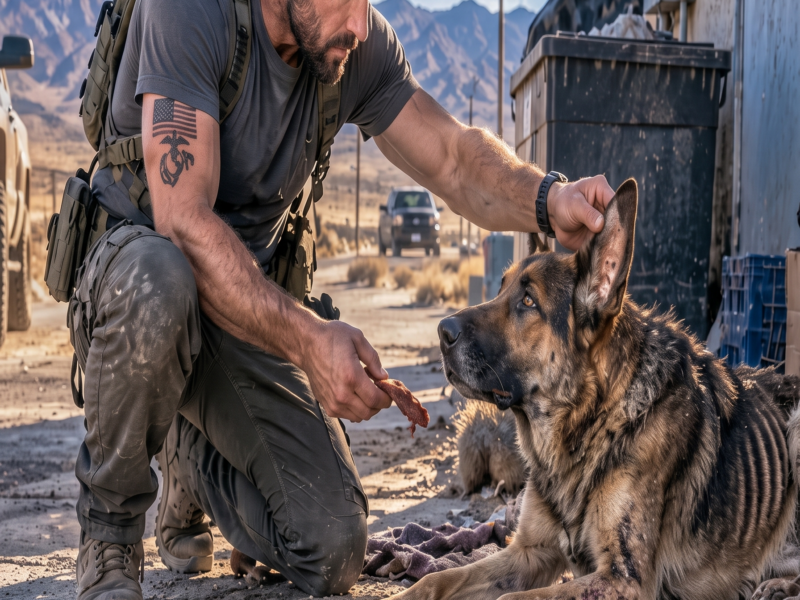
I found the starving K9 chained behind a closed hardware store in Norfolk, Virginia
It was almost midnight when I heard the scratching behind the dumpsters. The coastal wind cutting through Norfolk, Virginia, was thick with the smell of salt, stale beer, and decaying cardboard from the alley behind the closed hardware store. The rain had just started, a cold and unforgiving drizzle that made the neon streetlights bleed across the wet asphalt. I had just finished my shift at the shipyard, my muscles aching, my mind numb, wanting nothing more than a hot shower and the hollow comfort of sleep. But that sound stopped me. It was a desperate, rhythmic scraping against wet brick.
At first, I thought it was a raccoon. The alleys near the shipyards were crawling with them, bloated scavengers fighting over scraps. I turned up my collar against the damp chill and started to walk away. But then a weak whimper slipped through the darkness. It was a sound that did not belong to a wild animal. It was a sound of profound, exhausted defeat. It was the sound of something that had fought until it had absolutely nothing left.
I reached into my pocket, pulling out my tactical flashlight, and stepped cautiously into the narrow gap between the rusted green dumpsters and the brick wall of the hardware store. The beam of light sliced through the shadows, illuminating a pile of discarded lumber and a torn, oil-stained blue tarp. Beneath the tarp, a shape was shivering violently.
I crouched down, keeping my movements slow and deliberate. I pulled the edge of the tarp back. Lying in the mud was a Belgian Malinois.
My breath caught in my throat. The dog was a skeleton wrapped in fur. His ribs protruded sharply against his flanks, his coat was matted with blood, mud, and motor oil, and his paws were torn and bleeding, as if he had run for miles over broken glass. A heavy, rusted chain was fastened to a bolt in the wall, pulling taut against a thick, faded military-grade tactical collar around his neck.
I holstered my flashlight and dropped to my knees, ignoring the freezing mud soaking through my jeans. “Hey, buddy,” I whispered, keeping my voice steady, projecting a calm I did not feel. “You’re safe now. Easy.”
The Malinois tried to lift his head. His eyes, clouded with pain and starvation, locked onto mine. There was no aggression in that gaze, only a terrifying, hollow recognition of violence. He tried to stand, his front legs trembling wildly, but his hindquarters gave out. He collapsed forward, his heavy, scarred head coming to rest against my knee. He let out a long, shuddering sigh and went entirely still, though his heart hammered a frantic rhythm against my leg.
That simple gesture of surrender broke something deep inside me. I had seen that exact kind of unwavering, tragic loyalty overseas. I had served three tours in Afghanistan as a Marine Raider. I knew military working dogs. I knew the kind of animal that would run directly into incoming machine-gun fire simply because his handler had pointed the way.
I reached out, my fingers gently tracing the heavy nylon of his collar to find the clasp of the chain. As I shifted the collar, my thumb brushed against a hard plastic tag woven into the fabric. I twisted it upward to catch the ambient light from the street. There was a faded alphanumeric code stamped into the material.
My stomach dropped into a bottomless void. The world around me seemed to stop spinning. The wind died down, the rain faded into silence, and all I could hear was the rushing of blood in my own ears.
X-Ray-Seven-Four-Bravo.
I knew that number. I had memorized it. I had written it on a casualty report six years ago in a dusty, blood-soaked tent in Helmand Province. It belonged to a tier-one K9 unit attached to my exact detachment. That unit had been listed as completely destroyed during a classified roadside ambush. The blast had supposedly incinerated the lead vehicle. The military had held a closed-casket memorial for my closest friend, Sergeant Daniel Brooks, and a silent salute for his dog, Ghost.
But I was looking at Ghost. He was alive. He was chained to a wall in Virginia, six years after he had been declared dead in the desert.
My hands shook as I pulled my folding knife from my belt and sawed through the heavy nylon strap holding the chain, unwilling to waste time picking the rusted padlock. Once he was free, I scooped his heavy, fragile body into my arms. He groaned but did not fight me. I carried him to my truck, laid him gently in the passenger seat, and turned on the heater.
I sat in the driver’s seat, my hands gripping the steering wheel until my knuckles turned white. I pulled out my phone. There was only one person left alive who had the clearance and the authority over that specific mission. Colonel Thomas Vance. My former commander.
I dialed his private number. It rang once. Twice. Three times.
“Vance,” a gravelly voice answered.
“Colonel. It’s Elias.”
A brief pause. “Elias. It’s late. What is it?”
I looked at the dog breathing shallowly in the passenger seat. “I’m in Norfolk. I just found a dog chained in an alley. A Malinois.” I swallowed hard, the dryness in my throat feeling like sandpaper. “His collar number is X-Ray-Seven-Four-Bravo.”
The silence that followed was absolute. It wasn’t the silence of someone thinking. It was the silence of a predator realizing it had been spotted. It felt colder than the freezing rain outside my windshield.
“That is impossible,” Vance finally said, his voice stripped of all emotion. “That asset was destroyed in action.”
“He’s sitting in my truck, Colonel. It’s Ghost. Daniel’s dog. I need to know what the hell is going on. I need to know how he got here.”
Vance’s voice dropped an octave, carrying the weight of a direct, undeniable order. “Listen to me very carefully, Elias. Step out of the truck. Leave the dog where you found him. Walk away and never speak of this to anyone.”
I stared at Ghost. The dog slowly opened his eyes and looked at me. “Why?” I demanded, my anger flaring.
“Because,” Vance whispered, the malice bleeding through the phone, “some things were buried for a reason. Do not dig them up.”
The line went dead.
I didn’t leave the dog. Instead, I threw the truck into drive and sped away from the alley, constantly checking my rearview mirror for headlights that lingered too long. I took three different detours before pulling into the driveway of my isolated house on the outskirts of the city. It was a modest, single-story ranch backed up against dense woods—a place I had bought precisely because it offered quiet and distance from the rest of the world.
I carried Ghost inside and brought him directly into the spare bathroom. The heat was already on, making the small room feel like a sauna. I laid a thick blanket on the floor and began the agonizingly slow process of cleaning him. With warm water and a soft towel, I washed away the mud, the grease, and the dried blood. Ghost winced when I touched his torn paws, but he never growled. He just watched me with those intelligent, haunted eyes.
When he was clean, I carried him to the living room and laid him on a dog bed I had quickly assembled from old sleeping bags. I boiled some chicken, shredding it into tiny pieces, and fed him by hand. He ate slowly, his body so starved that eating seemed to exhaust him. After a few ounces of water, he laid his head on his paws and fell into a deep, twitching sleep.
For three days, that was our routine. Ghost barely moved. He slept, he ate small amounts, and he followed me with his eyes. By the end of the third day, he managed to stand on his own, his legs shaking, and walked behind me from the kitchen to the living room. We were two ghosts sharing the same space, bound by a war that refused to let us go. I didn’t sleep much either. Vance’s words echoed in my head. Some things were buried for a reason. I kept my Glock 19 loaded and on the coffee table.
Then came the fourth night.
A heavy storm had rolled in from the Atlantic, battering the house with sheets of rain and rattling the windowpanes. It was past two in the morning. I was dozing in the armchair, a book open on my lap.
Suddenly, Ghost was on his feet.
He didn’t bark. Military working dogs on covert assignments are trained to be completely silent unless commanded otherwise. But his posture transformed instantly. The weak, starving animal vanished. In his place stood a coiled spring of muscle and instinct. His hackles were raised, forming a rigid ridge down his spine. His ears were pinned forward, and his lips curled back just enough to show his teeth. He was staring directly at the solid wood of the back door.
A low, vibrating growl rumbled in his chest, so deep I felt it in the floorboards before I heard it.
I was out of the chair in a second. I grabbed the Glock, racking the slide silently as I moved into the shadows of the hallway. I pressed my back against the wall, inching toward the kitchen. Through the small, frosted window of the back door, a shadow moved. It wasn’t the wind. It was deliberate, shifting weight on the wooden porch.
I held my breath, leveling the pistol at center mass through the door. Ghost stood right beside my leg, a silent sentinel waiting for the breach.
A metallic click sounded over the rain—someone was picking the deadbolt.
I raised my boot and kicked the door frame hard. “I’m armed, and I’m aiming at the door!” I shouted into the storm. “Walk away!”
The picking stopped instantly. There was a beat of absolute stillness. Then, the heavy thud of boots sprinting away off the porch and splashing into the muddy grass. By the time I threw the deadbolt, ripped the door open, and swept the yard with my flashlight, there was nothing but rain and swaying trees.
I didn’t sleep the rest of the night. I sat by the door, the gun in my lap, Ghost resting his chin on my foot.
When the grey, watery light of dawn finally broke, I went outside to inspect the perimeter. There were deep boot prints in the mud leading away toward the tree line, confirming it hadn’t been my imagination. But as I walked around to the front of the house, something caught my eye.
Tucked neatly under the windshield wiper of my truck, shielded from the rain by a plastic sleeve, was a plain manila envelope.
I scanned the street, my hand resting on my holstered weapon, before snatching the envelope and retreating inside. I locked the door and sat at the kitchen table. Ghost sat beside me, his nose twitching as he sniffed the plastic.
I tore the envelope open. Inside was a single, glossy photograph.
My breath stopped. I stared at the image, my vision blurring at the edges.
It was a picture of Daniel Brooks. My best friend. The man I had grieved for six years. He looked older, his face weathered, sporting a thick beard and a jagged scar running down his cheek. He was wearing civilian tactical gear, standing in front of a chain-link fence. Sitting perfectly at his side was Ghost, looking healthy and alert.
But it was the background that made my blood run cold. Standing ten feet behind Daniel, speaking to a man in a dark suit, was Colonel Vance.
I flipped the photograph over. Stamped in black ink in the bottom right corner was a date: October 14th. Three months after the ambush that supposedly killed Daniel and Ghost.
Written across the center of the back in hurried, frantic black marker was a single sentence:
You were never supposed to find him.
My hands began shaking uncontrollably. Daniel hadn’t died in that valley. The ambush was a lie. The funeral was a lie. And Colonel Vance knew about it. He had orchestrated it.
Before I could process the magnitude of the betrayal, a frantic sound broke my concentration.
Ghost was in the garage. The rhythmic, desperate sound of his claws tearing against wood echoed through the house.
I shoved the photograph into my pocket, grabbed my gun, and ran to the garage door. I threw it open. The space was dimly lit, smelling of old motor oil and damp concrete. Ghost was in the far corner, near my workbench. He was digging frantically at a section of the raised wooden floorboards I had installed to keep my tools off the damp ground. Splinters were flying as his powerful paws tore at the wood. He was whining—a high, urgent sound.
“Ghost! Stop!” I commanded.
He didn’t stop. He dug harder, his nose shoved into a small crack between the boards. He was smelling something. Something he had been trained to find.
I walked over, holstering my weapon, and grabbed a crowbar from the pegboard. “Back up,” I ordered gently. Ghost immediately obeyed, taking two steps back and sitting, his eyes locked on the floorboards.
I wedged the crowbar into the seam and threw my weight backward. With a loud crack, the old wood splintered and gave way. I ripped away three boards, exposing the dark, dusty space between the joists and the concrete foundation.
Sitting perfectly centered in the dirt was a heavy, matte-black Pelican case. It was secured with a military-grade biometric padlock. It hadn’t been there when I bought the house. Someone had buried it here. Someone who knew my home, knew my habits, and knew how to bypass my security.
I reached down and hauled the heavy case out of the hole. It was covered in a fine layer of dust, but the metal was cold and solid. Ghost stepped forward, sniffing the edge of the case before looking up at me, letting out a soft bark.
Before I could examine the lock, Ghost’s head snapped toward the garage door. His ears swiveled. A second later, I heard it too.
The heavy crunch of gravel under thick tires. A vehicle was pulling into my driveway.
I dropped the crowbar and drew my Glock, moving swiftly to the small, grimy window on the side of the garage. I peered through the dirty glass.
A black, armored SUV had just parked at the end of the driveway, blocking my truck in. The engine was still running, a low, menacing purr. The windows were tinted black, reflecting the morning overcast sky.
I backed away from the window, heart pounding against my ribs. I looked at Ghost. He was standing by the main garage door, not growling, but waiting. His tail gave one slow, deliberate wag.
The driver’s side door of the SUV swung open. A heavy combat boot stepped onto the wet asphalt.
I raised my weapon, aiming at the center of the solid wooden garage door, ready to fire through it if they tried to breach. The footsteps approached slowly, deliberately. The gravel crunched with heavy, measured strides.
“Elias!” a voice called out from the other side of the door.
My finger froze on the trigger. The voice was raspy, damaged, but unmistakable. It was a voice I had heard in my nightmares for six years. A voice I had eulogized.
“Put the gun down, brother. It’s me.”
I couldn’t breathe. My brain refused to process the audio. I stepped forward, my hand shaking violently, and hit the electronic button for the garage door. The motor whined, and the heavy metal door began to roll upward, revealing boots, then tactical pants, then a heavy jacket, and finally a face.
It was the face from the photograph. Older. Scarred. Tired.
Daniel Brooks stood in my driveway.
He looked at me, his eyes wide and desperate, and then he looked down. Ghost let out a sound I had never heard a dog make—a cross between a sob and a howl—and launched himself forward. The massive dog slammed into Daniel’s chest. Daniel fell to his knees on the wet concrete, burying his face in the dog’s neck, his shoulders shaking as he gripped the animal he had lost.
“I’m sorry,” Daniel wept, clutching Ghost’s fur. “I’m so sorry, buddy. I thought they killed you. I thought they killed you.”
I stood frozen, my gun lowered but still in my hand. “Daniel?” I whispered, my voice cracking. “They told me they found your tags in the ashes.”
Daniel looked up, wiping rain and tears from his face. His expression hardened into a grim, exhausted mask. He stood up, keeping one hand on Ghost’s head.
“They put my tags in those ashes, Elias,” Daniel said, stepping into the garage. “Vance put them there. I’ve been a ghost for six years. But we don’t have time for a reunion. If you found the dog, and you found the box…” He pointed to the Pelican case on the floor. “…then Vance’s cleanup crew is already on their way. We have about five minutes before this house gets leveled.”
“Get inside,” I ordered, snapping out of my shock. Survival instinct took over.
Daniel hurried into the house, Ghost glued to his side. I locked the door behind us and pulled the heavy blackout curtains closed. I turned back to Daniel. He looked terrible up close—pale, malnourished, and moving with a stiff limp.
“Talk. Fast,” I demanded, setting the heavy Pelican case on the kitchen island.
Daniel leaned against the counter, breathing heavily. “Six years ago, that ambush wasn’t the Taliban. It was a private military contractor on Vance’s payroll. Vance was running an off-the-books operation, siphoning millions in seized cartel cash and weapons through our logistics lines. I found out. I found the ledger.”
He gestured to the black box. “That box. I hid it in my gear. When Vance realized I knew, he arranged the ambush to wipe my unit out. But the blast threw me clear. I woke up miles away, taken in by locals. Ghost was gone. I thought he died in the blast. I spent two years recovering, trying to find a way back without tipping Vance off. When I finally made it stateside, I went underground. I broke into your house a year ago while you were on deployment and buried the case here. You were the only person I trusted to hold it.”
“Why didn’t you come to me?” I asked, anger mixing with the overwhelming relief of seeing him alive.
“Because if Vance knew I was alive, and knew you were near me, he would have killed you too,” Daniel said firmly. “I’ve been hunting his network. Trying to build a case to take to the Inspector General. But three weeks ago, Vance found out I was alive. He panicked. He started burning evidence.”
Daniel looked down at Ghost, his eyes softening. “Ghost didn’t die in the ambush. Vance’s men found him wandering the desert. Vance recognized him. Instead of putting him down, the sick bastard sold him to an illegal dog-fighting ring in the States. A final insult. Ghost escaped a week ago. He has a homing instinct, Elias. He was trying to find his way to the nearest military installation he remembered. He was trying to get back to me. When Vance’s men realized Ghost was loose in Norfolk, they knew it was only a matter of time before someone ran his tags. That’s why he told you to walk away. He was sending a team to execute the dog and silence you.”
“The guy on the porch last night,” I said, the pieces clicking together.
“A scout,” Daniel confirmed. “I intercepted their comms. I drove through the night to get here. We need to open that box, get the encrypted drives, and get out of here before his hit squad arrives.”
“The box is biometric,” I said. “It needs a print.”
Daniel placed his thumb on the scanner. It flashed red. Access Denied.
Daniel cursed. “My prints were burned off in an explosion two years ago. I can’t open it.” He looked around frantically. “Where are your tools? We have to cut it open.”
Before I could answer, Ghost’s head snapped toward the front window. The dog didn’t growl this time. He went completely silent, dropping his belly low to the floor, adopting a combat crawl position.
Daniel and I exchanged a chilling look. We both knew what that meant.
I sprinted to the security monitor in the hallway. The cameras showed three black, unmarked vans pulling up to the perimeter of my property. Men clad in full tactical gear—black uniforms, suppressed rifles, night vision—were pouring out. They moved with military precision, forming a wedge and advancing on the house. There were at least twelve of them.
“They’re here,” I shouted, sprinting back to the kitchen and tossing Daniel my spare AR-15 from the closet. “Twelve tangos. Heavy gear. No police markings. This is a black ops hit.”
“They aren’t here to arrest us, Elias,” Daniel said, chambering a round. “They’re here to erase us. And the box.”
Glass shattered in the front room as a tear gas canister bounced across the hardwood floor. White smoke began to violently hiss, filling the room in seconds.
“Back door!” I yelled, coughing as the acrid smoke hit my throat. I grabbed the handle of the Pelican case. “We go into the woods!”
As we sprinted for the back door, the wood splintered violently. Two operators kicked the door in, their rifles raised, lasers cutting through the smoke.
Before they could pull the triggers, a blur of fur and muscle launched through the air. Ghost didn’t hesitate. He struck the lead operator in the chest, his jaws locking onto the man’s forearm with bone-crushing force. The man screamed, his rifle discharging wildly into the ceiling as he crashed backward onto the porch.
“Move!” Daniel roared, firing a three-round burst over Ghost’s head, dropping the second operator in the doorway.
I grabbed Ghost’s tactical collar, hauling him off the screaming man before the dog took a bullet. Ghost released his grip and bolted out the door with us. We plunged into the freezing rain, sprinting across the muddy backyard toward the dense tree line.
Suppressed gunfire spit behind us. The wet bark of a pine tree exploded inches from my face as we broke into the thick brush. The woods were pitch black, the rain masking our noise but also making the ground slick and treacherous. I carried the heavy Pelican case in one hand, my rifle in the other, my lungs burning in the cold air.
“Keep moving to the ridge!” I yelled to Daniel over the storm. “There’s a hunting cabin a mile up! We can bottleneck them there!”
We ran like men possessed. Ghost led the way, his night vision far superior to ours, navigating the treacherous terrain effortlessly. Despite his injuries and starvation, the dog was operating on pure adrenaline and training. He was back in the fight with his handler.
We reached the ridge just as the first flashlight beams began piercing the trees behind us. The hunting cabin was a small, reinforced concrete structure built into the side of the hill. We threw ourselves inside, slamming the heavy steel door shut and throwing the deadbolt.
There were no windows, only narrow firing slits. It was a bunker.
Daniel leaned against the wall, gasping for air, sliding down to a seated position. Ghost sat next to him, panting heavily, watching the door. I set the box down and took a firing position at the slit. I could see the tactical lights moving up the hill. They were spreading out, trying to flank us.
“We can’t hold them forever,” I said, keeping my eye on the scope. “They have explosives. They’ll blow the door.”
Daniel looked at the Pelican case. “The evidence in there is the only thing that will stop Vance. It’s the only thing that proves we didn’t betray our country.” He looked at me, a desperate fire in his eyes. “Elias. Ghost is the key.”
I looked back at him, confused. “What?”
“The biometric lock. I didn’t program it to my fingerprint. I knew I might not survive to open it. I programmed it to something Vance could never replicate, something he thought was dead.”
Daniel grabbed Ghost’s right front paw. He looked at the dog. “Good boy, Ghost. Trust me.”
Daniel lifted the dog’s heavy paw and pressed the main digital pad directly onto the biometric scanner of the Pelican case.
The machine beeped. A green light flashed. The heavy latches clicked open with a satisfying clack.
I stared in disbelief. Daniel threw the lid open. Inside were three encrypted hard drives, stacks of physical bank records, and printed communications directly linking Colonel Vance to the cartel arms deals, the stolen money, and the order to ambush our unit. It was the Holy Grail of treason.
“I have a satellite uplink in my pack,” Daniel said, his fingers flying over a ruggedized tablet he pulled from his vest. “I’m plugging the drive in. I have a contact at the Pentagon, a four-star who hated Vance. If I can transmit this data package, Vance’s empire crumbles in five minutes. The FBI and Military Police will swarm his command center.”
“How long for the upload?” I asked, as a bullet pinged off the steel door.
“Three minutes!” Daniel shouted.
“I’ll buy you three minutes,” I said.
A loud voice echoed from outside through a bullhorn. “Elias! Brooks! This is Colonel Vance!”
I peered through the slit. Vance himself had come up the hill, standing behind the cover of a massive oak tree, flanked by his mercenaries.
“It’s over!” Vance yelled over the rain. “There is nowhere to go. Give me the drives, and I’ll make it quick. Resist, and I will burn that bunker down with you and that mutt inside!”
“Go to hell, traitor!” I screamed back, firing a shot that chipped the bark of his tree.
“Blow the door!” Vance commanded.
Two men rushed forward with breaching charges. I dropped one with a shot to the knee, but the second managed to slap C4 onto the steel door before diving away.
“Fire in the hole!”
I threw myself over Daniel and Ghost. The explosion rocked the cabin, deafening us and filling the air with concrete dust and smoke. The steel door was blown off its hinges, crashing to the floor.
Through the dust, tactical lights blinded us. Vance stepped into the doorway, his pistol raised, aimed directly at Daniel’s head.
“Upload complete,” Daniel whispered quietly.
Vance smiled, a cold, empty expression. “Too late, Brooks. Who’s going to arrest me?”
Before Vance could pull the trigger, the sound of heavy rotor blades chopped through the storm. It wasn’t one helicopter; it was three. Black Hawks. The sky above the ridge lit up with searchlights so bright they turned the woods into daylight. The booming voice of a military loudspeaker drowned out the rain.
“COLONEL THOMAS VANCE. THIS IS THE UNITED STATES MARSHALS SERVICE. DROP YOUR WEAPON. YOU ARE SURROUNDED.”
Vance’s face went pale. He looked at the sky, then at us. The realization that his entire operation had just been broadcast to the highest levels of the government washed over him. His mercenaries, realizing they had been exposed as domestic terrorists, immediately dropped their weapons and put their hands on their heads.
Vance slowly lowered his gun. He looked at Daniel, then down at Ghost. Ghost stood up, walked slowly toward the ruined doorway, and let out a single, deafening bark right in the Colonel’s face.
A team of federal agents rushed the bunker, tackling Vance to the mud and slapping cuffs on him.
An hour later, the rain had stopped. The woods were swarming with feds and medics. Daniel and I sat on the tailgate of an ambulance, wrapped in thermal blankets. Ghost was lying between us, a medic carefully bandaging a fresh scrape on his leg. The dog leaned his heavy head onto Daniel’s lap, closing his eyes, finally truly safe.
Daniel looked at me, clapping a hand on my shoulder. “You saved him, Elias. You saved both of us.”
I looked at the beautiful, battered dog breathing softly in the cool morning air. I had answered a whimper in an alley, and it had brought my brother back from the dead.
“No,” I said quietly, watching the sun break over the Virginia coastline. “He saved us.”
The end.









