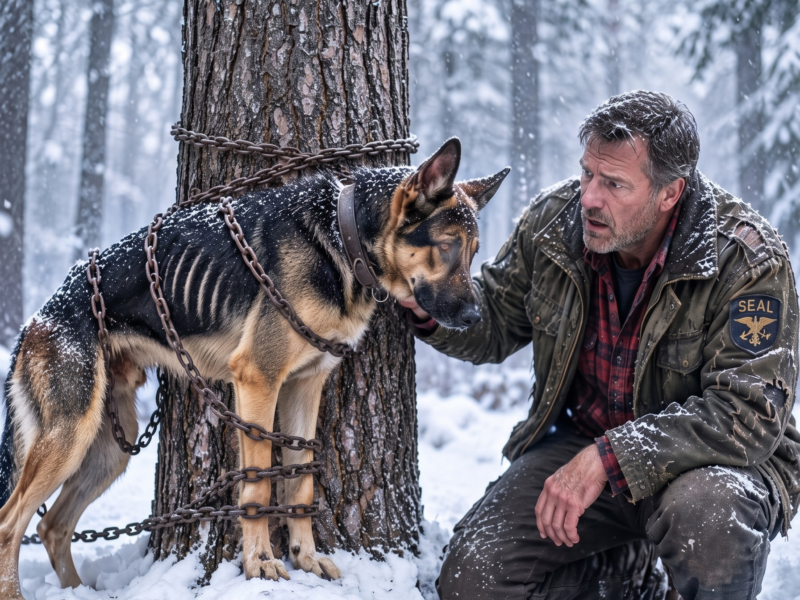
I found the German Shepherd chained behind an abandoned farmhouse in Montana during a blizzard, and when I reached for his frozen collar
The snowstorm swept across the flatlands of eastern Montana like an enraged ghost, swallowing the endless black asphalt of Highway 12 in a blinding haze of white. Zero visibility had slowed us to a crawl. In the passenger seat, I kept my hands clamped tightly over my knees, watching the snow slam against the windshield of the heavy-duty pickup truck.
Beside me, Mark driving was like watching a ghost pilot a machine. Retired Navy SEALs carry a specific kind of stillness—a quiet, watchful presence that never truly turns off, even years after leaving the war behind. Mark had spent twelve years in special operations, surviving ambushes, desert firefights, and close-quarters combat. But in the quiet moments of civilian life, he was a man defined by what he had lost.
Suddenly, Mark slammed his foot on the brake pedal.
The heavy truck skidded slightly, tires grinding hard against the packed ice before grinding to a complete halt in the middle of the empty, wind-scoured road.
“What happened?” I asked, leaning forward, my heart hammering against my ribs. “Did you hit something?”
“Wait,” Mark said. His voice was low, clipped, and instantly focused. He turned off the radio, cutting off the low hum of the weather report. He rolled his side window down an inch.
A wave of freezing air rushed into the warm cab, bringing with it the roar of the wind. At first, I heard nothing. Just the unrelenting howl of the storm whipping through the dry grass along the ditch.
Then came a sound that broke the rhythm of the wind.
It was faint—a weak, raspy, desperate whimper.
Mark didn’t hesitate. He shifted the truck into park, pulled the hood of his heavy coat over his head, and killed the headlights. “Stay here, Sarah.”
“Mark, wait!” I unbuckled my seatbelt and grabbed my heavy jacket anyway. “I’m coming with you.”
We stepped out into the freezing fury of the Montana winter. The snow felt like glass needles against my face. I followed Mark as he climbed over the snowbank at the shoulder of the road, his long strides tearing through knee-deep drifts toward the looming silhouette of an old, abandoned homestead.
Fifty yards off the road stood a collapsed wooden shed, its rusted tin roof groaning under the weight of the snow. As we drew closer, the sound came again—more defined this time. A low, rhythmic shaking of metal chains.
Mark flicked on his tactical flashlight. The sharp beam of light pierced the swirling white fog and landed on the base of a rusted iron pipe beneath the eaves of the ruined structure.
My breath caught in my throat.
Lying in the snow was a German Shepherd.
The animal was severely emaciated—his ribs stood out like sharp ridges beneath a matted, dirt-encrusted coat. He was shivering violently, curled into a tight ball against the frozen earth. A heavy, industrial-grade steel chain was wrapped securely around his neck, padlocked to the pipe. The snow surrounding his paws was stained a dark, frozen crimson where he had spent hours clawing at the icy ground.
“My God…” I gasped, stepping forward. “He’s freezing to death.”
“Easy, Sarah,” Mark murmured. He dropped slowly onto his knees in the snow, reducing his height to avoid frightening the animal. “Hey, big guy. Easy.”
The dog lifted his heavy head with immense effort. His dark brown eyes were clouded with fatigue and pain. But as the flashlight beam caught Mark’s face, something extraordinary happened.
The dog froze.
The low growl dying in his throat evaporated into a ragged gasp. His ears, previously flattened against his skull in defense, rose sharply. His posture shifted from terror to sudden, disbelieving recognition. A long, painful thump sounded against the snow—his tail had hit the ice once, then twice.
Mark stopped breathing. I watched his shoulders go completely rigid.
“No,” Mark whispered. His voice lacked its usual soldierly firmness. It was fragile. Broken. “No, this… this isn’t possible.”
“Mark? What is it?”
He reached out a trembling, gloved hand toward the dog’s neck. He didn’t touch the skin; instead, his fingers brushed against an old, worn leather collar buried deep beneath a layer of packed ice. Attached to the leather was a tarnished metal tag.
Mark scraped the ice away with the edge of his thumb.
Engraved on the scratched metal surface was a single word: RANGER. Below it was an operational unit code that I recognized from Mark’s old military framed commendations.
Mark’s entire frame began to shake. “Ranger…”
The German Shepherd leaned his head heavily against Mark’s gloved chest, letting out a deep, trembling whine that sounded like a long-suppressed sob. Mark wrapped his arms around the dog’s neck, burying his face in the animal’s frozen fur, paying no mind to the snow or the freezing storm.
I stood there in the howling wind, completely stunned. Mark had told me about Ranger only once, during a dark night months ago when the nightmares had kept him awake. Ranger had been his multi-purpose K9 handler partner during his final deployment overseas six years ago. According to the official military incident report, during a chaotic night extraction under heavy enemy mortar fire, Ranger had broken off to intercept an ambush team, saving Mark and his squad. The official report filed by his commanding officers stated that the dog had been killed in action. Mark had carried the crushing guilt of leaving his partner’s body behind for six long years.
“Mark… how is he here?” I whispered, my mind reeling. “How could a military K9 declared dead six years ago in an overseas combat zone end up chained behind an abandoned house in Montana?”
“That dog was declared dead six years ago,” Mark whispered, his eyes hollow as he stared into the dark storm. “His handler’s report said he was killed during extraction. They gave me his shadow box. They gave me a medal for him.”
Before I could answer, Ranger’s body went stiff beneath Mark’s hands.
The dog’s soft whimper vanished. His ears pinned back, and a deep, chest-rattling growl vibrated through his body. He turned his head away from Mark and stared past us—toward the dark, pitch-black shadow of the two-story abandoned farmhouse standing fifty yards away.
He wasn’t growling at the storm. He wasn’t growling at us.
He was growling at the house.
Mark’s tactical instincts kicked in instantly. The grieving civilian vanished, replaced in a split second by the operative. He reached into his coat, drew his concealed sidearm, and checked the sight in one fluid movement.
“Stay behind me,” Mark snapped quietly. He pulled a heavy pair of bolt cutters from his jacket pocket—tools he always carried in his truck—and snapped the lock on Ranger’s chain in one hard squeeze.
The heavy chain fell to the snow with a dull clink. Ranger stood up, swaying slightly on weak, bloodied legs, but his gaze remained locked on the farmhouse’s front porch.
“We need to get him inside, out of the wind,” Mark said. “And I need to see who put him here.”
We made our way through the deep snow toward the dilapidated porch. The front door was slightly ajar, creaking as the storm wind pushed against it. Mark kicked the door open with his boot, his weapon raised, sweeping the dark entryway.
“Clear,” he muttered after a second.
We stepped inside, shutting the heavy door against the screaming wind. The temperature inside was only slightly warmer, but the silence of the enclosed space was suffocating.
My eyes adjusted to the darkness. I expected to find an empty, ruined shell filled with rot and bird droppings.
Instead, the inside of the farmhouse told a horrifyingly different story.
It wasn’t abandoned.
In the center of the dusty kitchen stood a clean, metal folding table. On it sat a fresh, unfrozen bowl of water and a neatly stacked pile of tactical blankets. But what caught my attention—what made the blood run cold in my veins—was the living room wall.
Pinned across the peeling wallpaper were dozens of photographs.
Mark walked up to the wall, his light highlighting picture after picture. Every single photo showed Ranger. Some were old, grainier images from military bases, showing Ranger in his harness alongside Mark in full combat gear. But others were crisp, high-resolution digital prints taken recently.
Photos of Ranger in a cage. Photos of Ranger being fed.
And then, Mark stopped moving altogether. The flashlight beam quivered in his hand.
In the center of the wall was a photograph taken from inside a parked car. It showed the front driveway of Mark’s private home in Helena—taken just three months ago. In the frame, Mark was leaning over his truck, totally unaware that he was being filmed.
Someone had been keeping Ranger alive for six years. And someone had been watching Mark.
“Mark…” I gasped, stepping back toward the front door. “We need to leave. Right now. We need to call the Sheriff.”
Mark didn’t answer. He was staring at the photo of his own home.
Suddenly, Ranger let out a sharp, furious bark. He dragged himself across the hardwood floor toward a heavy oak door at the back of the hallway. The door was secured with a brand-new, heavy brass deadbolt, locked from the outside.
Ranger threw his lean body against the wood, scratching madly at the base of the frame.
“Mark, don’t,” I pleaded.
Mark ignored me. He stepped up to the locked door, lifted his heavy combat boot, and drove it hard into the frame right beside the lock. The wood splintered with a loud crack. He kicked it a second time, and the door swung open into blackness, revealing a steep flight of wooden stairs leading down into a cellar.
“Ranger, stay,” Mark commanded softly.
He pulled a tactical flashlight from his belt, holding his pistol in a firm two-handed grip as he descended into the darkness. I grabbed an iron poker standing by the old fireplace and followed him, refusing to be left alone upstairs.
The basement smelled of damp concrete, old copper, and engine oil. The beam of Mark’s flashlight cut through the dark, sweeping across empty concrete walls until it hit a small wooden workbench in the back corner.
Sitting on top of the workbench was a single, polished wooden box.
Mark approached it slowly. The lid was unlocked. He used the barrel of his pistol to flip the lid back.
Inside lay a neatly folded stack of yellowed paper—Ranger’s official military service records, complete with red classified stamps. Beside the papers lay a small, handwritten index card.
Mark reached out with a trembling hand and picked up the card. He shone his flashlight directly onto the handwriting.
There was only one sentence written on the card:
“Your dog didn’t die because he saved you. He died because you left him.”
Mark’s breathing became ragged. His eyes filled with shock and a rising, terrifying rage.
“Who wrote this?” he muttered. “Who the hell wrote this?”
He turned the index card over. On the back was a second photograph.
It was a picture of Mark, taken from a distance. He was standing in a graveyard—the national cemetery where he went every year on Veterans Day to pay respects at a memorial marker bearing Ranger’s name.
Scribbled beneath the photograph, in red ink, was Mark’s full name, followed by a specific time and date.
The date written on the back of the card was tomorrow’s date. And the time was 06:00 AM.
Before Mark could process the threat, a heavy, metallic THUD echoed from the top of the stairs, followed instantly by the sound of a heavy bolt sliding into place.
The basement door had been slammed shut.
Above us, through the floorboards, we heard the sharp, frantic barks of Ranger—and then, the crunching sound of boots walking slowly across the living room floor directly above our heads.
The sudden darkness of the basement felt absolute. Above us, the heavy wooden door was securely locked, trapped behind a deadbolt that had been thrown from the outside.
“Mark!” I screamed, dropping my iron poker and lunging toward the bottom of the stairs.
“Sarah, stay down!” Mark’s voice was instantly cool, crisp, and commanding. The panic that had touched his face moments ago vanished beneath years of military discipline. He snapped his tactical light back on, illuminating the heavy wooden door at the top of the staircase.
Above us, Ranger was barking with a terrifying, wild intensity. We heard the violent scuffle of his nails digging into the hardwood floor, followed by a heavy, muffled impact—a body being thrown against a wall—and then a low, rough voice cursing in the room above.
“Ranger!” Mark yelled, taking the wooden stairs three at a time.
He slammed his shoulder into the basement door. The thick oak rattled, but the new deadbolt held firm. Mark backed up two steps, raised his pistol, and fired three heavy rounds directly into the door mechanism. The deafening booms echoed through the confined concrete space of the basement, filling the air with the smell of burned gunpowder and splintered wood.
Mark kicked the door with all his weight. The shattered frame gave way, bursting open into the dark hallway.
We rushed into the living room.
The front door of the farmhouse was wide open, letting in a furious gust of freezing wind and blinding snow.
Ranger was lying on his side near the doorway, struggling to stand. His chest was heaving, and fresh blood was dripping from a tear near his ear. He had been struck with something hard.
“Ranger!” Mark dropped his gun to his holster, kneeling beside the dog. He checked the animal’s neck and ribs with expert hands. “He’s alive. He took a hit to the head, but he’s breathing.”
I ran to the open front doorway, peering out into the blizzard. The whiteout was so dense I could barely see the hood of Mark’s truck fifty yards away. But through the swirling snow, I caught a brief, terrifying glimpse: a tall, broad-shouldered figure clad in a heavy black winter parka, running toward an unmarked black SUV parked deep in the tree line behind the shed.
The SUV’s engine roared to life with a deep, throaty rumble. Tail lights flashed red against the snow, and the vehicle tore away onto the unpaved back road, disappearing into the white void within seconds.
“He’s gone!” I shouted over the wind, slamming the heavy door shut and bolting it. “Mark, who was that? Who kept Ranger for six years?”
Mark didn’t answer right away. He lifted the heavy, shivering German Shepherd in his arms, lifting him with effortless strength despite the dog’s seventy-pound weight.
“We can’t stay here,” Mark said, his jaw locked tight. “This place was a setup. He wanted me to find Ranger tonight. He knew we took Highway 12 to get back to the ranch.”
We retreated back out to Mark’s truck. Mark laid Ranger carefully on the wide back seat, covering him with every dry emergency blanket we had in the vehicle. I sat in the back with the dog, gently stroking his head as Mark turned the truck around, punching the accelerator and driving fast through the storm toward his secluded ranch house ten miles outside of town.
Neither of us spoke for the first five miles. The only sound in the cab was the low, painful breathing of the old military dog and the rhythm of the windshield wipers pushing snow aside.
“Mark,” I finally said quietly from the back seat. “You need to tell me what happened six years ago. What really happened during that deployment?”
Mark kept his eyes locked on the white road ahead. His hands gripped the steering wheel so tightly his knuckles turned white.
“It was Operation Fallen Timber,” Mark began, his voice flat and devoid of emotion—the voice a man uses when he is reading a report about someone else’s nightmare. “Eastern Afghanistan, near the border. My squad was sent in to clear a fortified compound in the valley. Ranger was leading the point.”
He paused, taking a slow, heavy breath.
“We got ambushed. High ground, heavy automatic fire, rocket-propelled grenades. It was a kill box. My team leader was hit instantly. I was shot in the shoulder and pinned down behind a ruined clay wall. Ranger was hit by shrapnel—I saw him fall. I saw the blood on his flank.”
“Did you check on him?” I asked softly.
“I tried,” Mark said, his voice cracking slightly. “I started crawling toward him. But then the mortar fire started coming in. My team leader was bleeding out, and the command link ordered an immediate emergency extraction. The team leader’s second-in-command… a guy named Master Sergeant Vance… dragged me back toward the chopper.”
Mark’s eyes darkened as he stared into the storm.
“I yelled at Vance. I told him Ranger was still down there, still moving. But Vance looked me in the eye and said Ranger was dead. He said he saw the dog take a direct hit to the chest. He swore on his life that Ranger didn’t make it. The chopper took off under heavy fire. The whole compound was leveled by air strikes two minutes later.”
I looked down at the dog resting his grey-muzzled snout on my lap. “Vance lied to you.”
“Vance didn’t just lie,” Mark said, his voice dropping to an icy whisper. “If Ranger was left behind alive, it means Vance intentionally abandoned a military asset. Or worse… it means someone went into that compound after the air strikes and dragged Ranger out.”
“Why would anyone do that?”
“I don’t know,” Mark said. “But Vance left the Navy two years after that deployment. Last I heard, he was running a private security contractor firm out of Seattle. A firm that specializes in high-risk asset retrieval.”
Ten minutes later, we pulled into the driveway of Mark’s remote property. The ranch house was built on forty acres of pine forest, isolated from neighboring properties. It had always felt like a sanctuary, but tonight, surrounded by dark woods and a howling blizzard, it felt like a target.
Mark carried Ranger inside, laying him on a soft rug in front of the stone fireplace. I immediately set to work heating water, cleaning the cuts on the dog’s legs, and wrapping his bruised paws with clean gauze. Ranger was exhausted, but his eyes never left Mark. Whenever Mark walked across the room to check a window, Ranger’s eyes followed his every move, letting out a faint whine whenever Mark stepped out of his sight line.
“He still trusts you,” I said, applying antiseptic to a long scrape along Ranger’s flank. “After six years of neglect and isolation, he still looks at you like you’re his entire world.”
Mark sat down on the floor next to the dog, slowly stroking the dog’s scarred fur. “He shouldn’t. I left him.”
“You were ordered onto that helicopter, Mark! You were wounded!”
“It doesn’t matter,” Mark snapped softly. “A handler never leaves his dog. Ever.”
Mark reached into his pocket and pulled out the handwritten card we had found in the basement box. He laid it flat on the wooden coffee table under the lamplight.
“Your dog didn’t die because he saved you. He died because you left him.”
Mark flipped the card over, staring at the photo of himself at the cemetery, and the date written in red ink.
TOMORROW – 06:00 AM.
I looked at the clock hanging above the mantelpiece.
It was 3:15 AM.
We had less than three hours before the deadline specified on the card.
“Mark,” I said, my voice rising with anxiety. “Who took that picture of you at the cemetery? Who knew you went there every year?”
Mark didn’t answer immediately. He stood up, walked over to a heavy steel gun safe in the corner of his study, and punched in a digital code. The heavy safe door clicked open. Inside were his military combat gear, tactical vests, radios, and a heavy sniper rifle housed in a hard case.
“Only three people knew where I went on Veterans Day,” Mark said, pulling out a tactical chest rig. “My team leader who died in Afghanistan. Me. And Vance.”
“Vance?” I gasped. “You think Vance kept Ranger locked up in an abandoned house for six years just to torture you?”
“Vance was a psychopath,” Mark said flatly, adjusting the straps on his vest. “He was brilliant, but he was ruthless. During the war, he ran illicit side-operations. He stole seized cash, weapons, high-value contraband. Right before our final deployment, a shipment of government intelligence drives went missing from our outpost. An internal investigation was opened.”
Mark looked at me, his eyes dead serious.
“I was the one who reported the missing drives to internal affairs. I suspected Vance. But before the investigation could finish, our squad was sent into that valley ambush.”
The realization hit me like a physical blow.
“The ambush wasn’t an accident,” I whispered. “Vance set your squad up.”
“He set us up to cover his tracks,” Mark said. “He declared Ranger dead so he could use the dog’s handler records and microchip to falsify casualty reports. But Vance didn’t kill Ranger. He kept him. He used Ranger as a trophy… and as bait.”
“Bait for what?”
Mark picked up his sniper rifle case and laid it on the table. “For tomorrow morning. Six o’clock. Vance wants to finish what he started six years ago in Afghanistan. He wants to eliminate the only witness left who can tie him to the missing intelligence and the murder of our squad.”
Suddenly, Ranger stood up from the hearth. His ears went flat, and he let out a low, gut-wrenching growl directed toward the large glass windows of the living room overlooking the dark forest.
Outside, above the sound of the wind, came a faint, rhythmic sound.
Click. Click. Click.
The sound of footsteps walking slowly across the wooden planks of our back porch.
“Get down!” Mark barked, reaching out and pulling me hard to the floor behind the heavy brick fireplace just as the large glass bay window shattered into ten thousand tiny shards.
The sound of high-caliber rifle fire shattered the quiet of the night. A series of silenced rounds punched through the drywall, shattering lamps, tearing through books, and ripping into the plaster above our heads.
Ranger barked furiously, standing over me, his body acting as a physical shield between me and the shattered window.
Mark didn’t hesitate. He rolled across the hardwood floor, grabbed his sidearm from the coffee table, and returned fire through the broken window frame, discharging four rapid rounds into the darkness of the snowstorm outside.
A sharp scream of pain echoed from the dark porch, followed by the heavy sound of a body hitting the deck, then scrambling frantically down the wooden stairs toward the tree line.
Silence returned to the room, broken only by the whistling wind blowing snow through the destroyed window and the heavy breathing of the three of us behind the fireplace.
“Are you hit?” Mark demanded, checking me over quickly.
“I’m fine!” I gasped, clutching my chest, my mind spinning in horror. “Mark, they’re already here! It’s not 6:00 AM yet!”
“The date on the card wasn’t an appointment,” Mark said, his voice dropping an octave as his eyes flashed with cold realization. “It was an execution time. He gave us that card to keep us focused on tomorrow morning, so we wouldn’t expect an attack tonight!”
Mark crouched low, checking the magazine of his hand pistol. “He didn’t come alone. That was a scout probing our defense. The main force will be surrounding the house right now.”
As if answering his words, the house’s electrical lights flickered once, twice, and died completely. The hum of the refrigerator ceased. The entire ranch house was plunged into pitch darkness, illuminated only by the faint orange glow of the dying embers in the fireplace.
“They cut the main power line,” Mark whispered. “They’re moving in.”
“What do we do?” I whispered, tears of terror welling in my eyes. “We’re trapped!”
“We’re not trapped,” Mark said, his hand resting reassuringly on my shoulder. “This is my house. I built it. I know every inch of this terrain.” He looked down at the German Shepherd standing at his hip. “Ranger. heel.”
The old dog immediately fell into step beside Mark’s left leg, his posture rigid, his body completely transformed from a sick, dying animal into a trained, combat-ready war dog. Six years of isolation had not erased his training. The bond between handler and K9 was hardwired into his blood.
“Sarah, take this,” Mark handed me a compact flashlight and a small tactical knife. “There is a hidden storm cellar under the kitchen pantry. The door is built into the floorboards under the heavy wooden island. Go down there, lock the hatch from the inside, and do not open it for anyone except me.”
“I’m not leaving you, Mark!”
“You have to,” Mark said, his voice gentle but firm. “If you stay up here, I have to protect you, and I can’t move freely. Go to the cellar. Now!”
Before I could argue, Mark grabbed my hand, leading me low through the dark hallway into the kitchen. He kicked aside a rug, pulled open a small hidden trapdoor in the floor, and helped me lower myself into the small concrete storm shelter below.
“Mark, please,” I cried, looking up at him through the narrow hatch. “Be careful.”
“I’m done running from Afghanistan,” Mark said flatly. “Ranger and I are ending this tonight.”
He slammed the trapdoor shut, and I heard the heavy iron latch lock into place above my head.
Above me, the house descended into an agonizing tactical chess match.
Through the thick floorboards, I listened to every sound with terrified clarity. I heard the soft, deliberate crunch of tactical boots stepping onto the broken glass in the living room. Multiple attackers. At least three, maybe four.
“Sweep the ground floor,” a harsh, gravelly voice echoed from above. It was Vance. I recognized the arrogant tone from the voice recordings Mark had kept in his military files. “Find Mark. Kill the dog on sight.”
A second later, a loud crash shook the living room ceiling.
Mark struck first.
From the darkness of the hallway, Mark launched his counter-attack. A rapid sequence of gunshots erupted—sharp, precise, and controlled. I heard a scream of agony as one of Vance’s operatives was brought down, followed by the heavy sound of a body collapsing onto the floorboards.
“Flank him!” Vance roared from the hallway. “He’s in the master bedroom! Move, move!”
I heard heavy footsteps rushing down the corridor toward the back of the house.
Then came a sound that made my skin crawl: a deep, terrifying guttural roar from Ranger.
The old K9 launched himself through the dark. I heard the sickening crunch of jaws slamming shut on Kevlar armor and flesh, followed by the hysterical screams of an attacker being dragged to the ground. Ranger wasn’t just fighting; he was protecting his handler with every remaining ounce of strength in his battered body.
“Get this damn dog off me!” the man screamed, firing wild shots into the floor. “Shoot it! Shoot it!”
BANG! BANG!
A sharp cry of pain echoed from Ranger—a high-pitched yelp that cut straight through my heart.
“RANGER!” Mark screamed.
The sound of fury that erupted from Mark was unhuman. I heard the heavy thud of hand-to-hand combat—punches landing with terrifying force, bones cracking, bodies crashing through furniture. Mark hit Vance’s men like a wrecking ball, driven by six years of guilt, grief, and rage.
Within sixty seconds, the sounds of shouting and gunfire ceased.
A heavy, suffocating silence fell over the house once more. The storm outside continued to rage, rattling the wooden foundation of the kitchen floor above me.
I held my breath, sitting in the damp darkness of the storm shelter, my heart pounding violently against my ribs.
“Mark?” I called out softly toward the ceiling, keeping my voice as low as possible. “Mark, are you there?”
No answer.
Instead, I heard slow, heavy, dripping footsteps walking across the kitchen floor directly above the trapdoor.
Thud. Thud. Thud.
The footsteps stopped right on top of the wooden hatch.
I clamped both hands over my mouth to stop myself from screaming. I held my breath, staring up at the cracks in the wooden trapdoor. A thin beam of flashlight light shone through the gap in the wood, casting a long shadow across my face.
Then came a slow, metallic scraping sound.
Someone was standing on top of the trapdoor, tapping the barrel of a rifle against the wood.
“He can’t hear you, little lady,” Vance’s harsh, grating voice echoed from above, dripping with sadistic pleasure. “Your hero is bleeding out on his living room rug. And his precious dog is finally dead.”
I felt a cold tear slide down my cheek. Panic seized my lungs.
“You have five seconds to unlock this hatch,” Vance sneered from above, raising his voice. “Or I drop a grenade through the air vent and blow this cellar to hell.”
I gripped the tactical knife Mark had given me, my knuckles turning white, preparing to fight for my life the moment the door opened.
“One…” Vance counted, his voice cold and devoid of human warmth.
“Two…”
I heard the sound of a metal pin being pulled from a grenade above my head.
“Three—”
Before Vance could finish the count, a sound erupted from the living room that shook the entire house to its core.
It wasn’t a gunshot. It wasn’t Mark’s voice.
It was the deep, resonant, unmistakable sound of a military K9 alert bark—a signal used by Navy SEAL K9 units to mark a target for total elimination.
Ranger was still alive.
The sudden, roaring attack of the wounded German Shepherd above was terrifying.
Ranger hit Vance with the speed and trajectory of a missile. The heavy impact threw Vance off the trapdoor, sending his rifle clattering across the hard kitchen tiles. I heard Vance curse violently as he hit the floor, struggling against the full weight of a ninety-pound military combat dog that refused to die.
“Get off me, you damn beast!” Vance roared, tearing at the dog’s collar, punching wildly at Ranger’s wounded flank.
Ranger’s jaws were locked onto Vance’s left forearm, his teeth tearing through the heavy tactical fabric. He didn’t let go. Even after being wounded by gunfire, even after six years of starvation and abuse in a cold shed, the dog held his grip with unbreakable iron willpower.
Above the chaos, I heard the heavy, slow rise of Mark’s boots on the hallway floor.
Mark had been hit—I could hear the uneven, dragging rhythm of his breath and the slight limp in his stride. But as he stepped into the kitchen, his presence was absolute.
“Let him go, Ranger,” Mark commanded, his voice cold as liquid nitrogen.
Ranger instantly released his jaw, stepping back two paces, his teeth bared, dripping blood, guarding Mark’s flank like a legendary sentinel.
I pushed the storm cellar latch open and threw the wooden trapdoor back. I scrambled out of the cellar into the dark, ruined kitchen, holding my knife, ready to help.
The scene was devastating.
The kitchen was lit only by the pale moonlight filtering through the snow-caked windows and the tactical flashlights lying scattered on the floor. Two of Vance’s hired mercenaries lay motionless in the hallway.
Vance was on his knees in the middle of the kitchen floor, clutching his bleeding arm, gasping for air. His face was covered in scratches and sweat, his tactical vest torn to shreds by Ranger’s attack.
Mark stood five feet away from him, holding his sidearm pointed directly at Vance’s chest. Blood was soaking through the left shoulder of Mark’s coat where a bullet had grazed him, but his hand holding the gun didn’t tremble by a single millimeter.
“Look at you,” Vance spat, coughing blood onto the white floor tiles. He looked up at Mark with a twisted, hateful sneer. “The great Navy hero. You always were too soft, Mark. You cared more about a damn animal than the mission.”
“You sold out your country, Vance,” Mark said, his voice flat and deadly. “You took bribes from foreign intelligence actors. You let our squad get ambushed in that valley to cover up your stolen drives. And then you left Ranger to rot.”
Vance let out a dark, raspy laugh. “I didn’t leave him to rot! I saved him! That dog was valuable property! Military intelligence spent half a million dollars training him! I kept him alive for six years waiting for the right moment to use him against you.”
“You chained him in the freezing cold,” I yelled, tears of absolute fury running down my face as I stood beside Mark. “You starved him! You tortured him!”
“He was just a weapon!” Vance barked, glaring at me. “Just a tool! And tonight, he served his purpose. He brought Mark right where I wanted him.”
Vance slowly shifted his right hand behind his back, leaning his weight on his hip.
Mark’s eyes didn’t miss the subtle movement. “Don’t do it, Vance.”
“You won’t shoot me, Mark,” Vance sneered, his fingers creeping toward a hidden backup pistol tucked into his rear waistband. “You’re bound by your precious code. You’re a civilian now. If you kill me in cold blood, you spend the rest of your life in a federal prison.”
“You entered my home,” Mark said quietly. “You threatened my family. And you tried to kill my partner. My code is very clear about what happens next.”
Vance’s eyes flashed with manic rage. He drew his backup pistol with blinding speed, bringing the barrel up to aim directly at Mark’s head.
“Die, you—”
BANG!
A single gunshot echoed through the ruined house.
Vance froze. The pistol slipped from his fingers, clattering loudly onto the floor tiles. He looked down at his chest in disbelief, staring at the small, smoking hole in the center of his tactical vest.
Mark hadn’t pulled the trigger.
Vance collapsed forward onto his face, revealing the figure standing in the shattered frame of the front doorway behind him.
Standing on the front porch, framed by the swirling snow of the blizzard, was a tall man clad in a heavy tactical coat, holding a smoking sniper rifle. As he stepped into the light of the kitchen flashlight, I saw the gold badge pinned to his body armor.
It was Sheriff Miller, accompanied by four armed state troopers.
“Hands where I can see them!” the troopers shouted, sweeping into the house, securing the scene, and disarming Vance’s remaining mercenary in the hallway.
Sheriff Miller lowered his rifle, stepping up to Mark. He looked at the bodies, looked at Vance, and then looked down at the bleeding, exhausted German Shepherd sitting loyally at Mark’s side.
“We caught your emergency signal from the truck’s satellite tracker twenty minutes ago, Mark,” Sheriff Miller said, his voice heavy with respect and shock. “We tracked the black SUV back to that old abandoned property on Highway 12, then followed the tire tracks out here.”
Miller looked down at Ranger, his eyes wide with disbelief. “My God… Mark, is that… is that the dog from your military files?”
“His name is Ranger,” Mark said quietly, holstering his sidearm. “And he’s coming home.”
The paramedics rushed into the house minutes later, setting up emergency medical gear. They tried to evaluate Mark first, but Mark refused to sit on the gurney until the tactical veterinary team—whom the Sheriff had wisely called ahead—had taken care of Ranger.
I sat on the floor beside the old dog as the vet applied bandages to his shoulder wound, administered IV fluids, and wrapped him in warm thermal blankets. Ranger didn’t whine or fight. He lay his heavy head down on my lap, his dark eyes slowly closing as the fatigue of six long years of nightmare finally caught up with him.
“Will he make it?” I asked the vet, my hand trembling as I petted the soft fur behind Ranger’s ears.
The vet looked up at me and smiled gently. “He’s tough as nails, ma’am. He’s malnourished, he has severe scar tissue, and he took a flesh wound to the shoulder, but his heart is strong. He fought through six years of hell to get back to his handler. He’s not going to give up now.”
Mark sat down on the floor right beside us, leaning his back against the kitchen cabinets, exhausted, bloody, but finally at peace.
He reached out and placed his hand over mine, touching Ranger’s fur.
For the first time in the three years I had known Mark, the cold, distant look in his eyes was gone. The ghost that had haunted him since Afghanistan had finally been laid to rest.
Six months later.
The harsh Montana winter had finally melted away, giving way to the brilliant, warm sunshine of late spring. The vast rolling hills surrounding Mark’s ranch were covered in vibrant green grass and wild yellow sunflowers, stretching out as far as the eye could see beneath the clear blue sky.
The damaged living room and kitchen had been fully restored. The dark memories of that frozen blizzard night had been replaced by the quiet, peaceful rhythm of daily ranch life.
On the front porch, sitting on a soft leather bed beneath the shade of the wooden overhang, lay Ranger.
His coat had grown back thick, glossy, and healthy, hiding the dark scars beneath. His ribs were no longer visible, and his eyes were clear, bright, and alert. Though he walked with a slight limp in his left hind leg—a permanent reminder of his injuries—he was strong, content, and deeply loved.
A car pulled up the long gravel driveway, kicking up a light cloud of dust.
It was a sleek, black government sedan bearing official Department of Defense plates.
Mark stepped out onto the porch, dressed in his crisp, dark Navy blues dress uniform—a uniform he hadn’t worn since the day he was discharged from service. I stood beside him, holding his hand, smiling as two high-ranking military officers stepped out of the vehicle.
At the head of the arrival was Rear Admiral Thomas, a decorated veteran who had overseen Mark’s old operational command in Afghanistan.
“Master Sergeant,” Admiral Thomas said, stepping up the porch stairs and delivering a sharp, formal military salute.
Mark returned the salute with crisp precision. “Admiral.”
“We’re long overdue for this, Mark,” Admiral Thomas said softly, his eyes turning to the German Shepherd lying on the porch.
Ranger lifted his head, his ears rising sharply as he recognized the authoritative posture of the officers. He stood up slowly, walked over to Mark’s side, and sat down in perfect military alignment beside Mark’s left leg, looking up at the officers with calm dignity.
“Six months ago, the Department of the Navy completed its full investigation into the events of Operation Fallen Timber,” Admiral Thomas announced, pulling a black velvet box from his coat pocket. “The treasonous actions of former Master Sergeant Vance have been exposed, and his co-conspirators have been brought to justice. But more importantly… an injustice committed against a decorated hero was corrected.”
The Admiral opened the velvet box. Inside rested the Animals in War Dickin Medal—the highest international honor awarded to military animals for conspicuous gallantry and devotion to duty—alongside a newly commissioned Military Working Dog Service Medal.
“For extraordinary heroism, unwavering loyalty, and surviving six years behind enemy lines to protect his handler,” Admiral Thomas read aloud from the official certificate. “The United States Navy proudly bestows these honors upon Military Working Dog Ranger.”
The Admiral knelt down on one knee in front of the dog. Ranger didn’t pull back. He held his head high as the Admiral carefully attached the silver medal to Ranger’s new leather collar.
“Thank you for your service, buddy,” the Admiral whispered, gently stroking Ranger’s muzzle. “Welcome home.”
Ranger let out a soft, low bark—a single, clear note that echoed across the quiet, sunny valley.
After the officers left, Mark and I walked out onto the wide green pasture behind the house, with Ranger trotting happily beside us. The summer breeze pushed through the tall grass, carrying the sweet scent of pine and wild clover.
Mark knelt down in the grass, pulling a red rubber ball from his coat pocket—Ranger’s favorite toy from his old service days, which the Navy team had recovered and returned to him.
“Ready, boy?” Mark asked, a bright, genuine smile breaking across his face.
Ranger’s tail wagged furiously against the grass. His posture was eager, youthful, and full of joy.
Mark threw the ball far across the pasture.
Ranger took off like a shot, running through the tall grass, his limp barely noticeable as he leaped through the air, catching the ball seamlessly before trotting proudly back toward us.
He dropped the ball at Mark’s feet, sat down, and leaned his head heavily against Mark’s knee, looking up at him with absolute, unconditional love.
Mark wrapped his arm around the dog’s neck, pulling him close, resting his forehead against Ranger’s soft head.
“I promised you I’d never leave you again,” Mark whispered softly into the breeze. “And I never will.”
Ranger let out a long, contented sigh, closing his eyes beneath the warm Montana sun.
The battle was finally over. The soldier and his dog were finally home.
The end.









