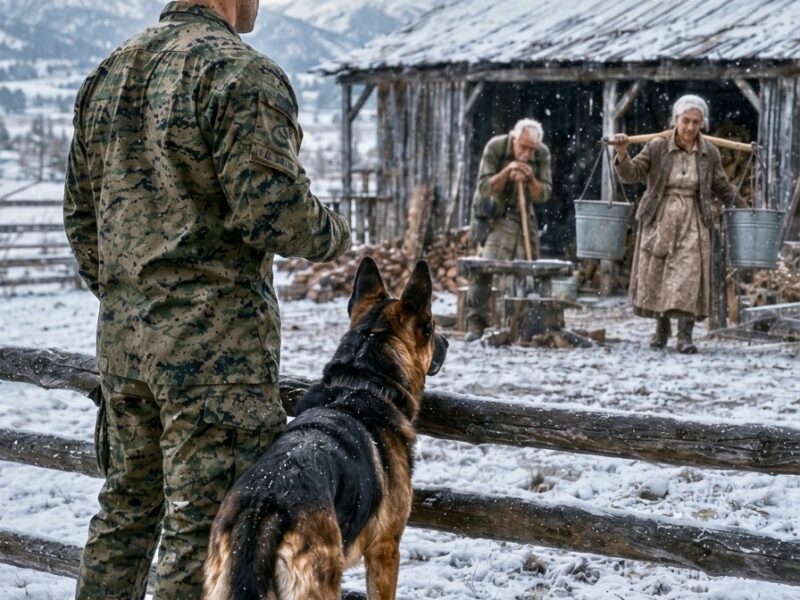
I found my elderly parents shivering inside their abandoned farmhouse in rural Virginia
The cold hits you long before you reach the front porch of the old Montgomery homestead. It isn’t the clean, biting chill of the Blue Ridge winter air; it is the stagnant, heavy frost of a house that has given up on warmth.
I pushed the creaking wooden screen door open, my combat boots crunching over a thin glaze of ice that had formed across the porch floorboards. Beside me, Rex pressed his heavy shoulder against my thigh. The fourteen-year-old Belgian Malinois was slowing down—his muzzle was a frost of white fur, and his hips stiffened whenever the temperature dropped—but his posture remained as rigid as the day we pulled out of the Helmand Province.
“Mom? Dad?” I called out, my voice raspy from eight months of breathing desert sand and military transport exhaust.
The living room was dark. Thick wool blankets had been nailed over the windows to block the draft, plunging the interior into a murky, twilight gloom. In the corner, sitting beside a dead oil heater that hummed with a hollow, useless rattle, sat my mother. She was wrapped in three mismatched quilts, her hands tucked deep inside the sleeves of a worn sweater.
Across the room, my father was struggling to lift a brown paper grocery bag onto the rickety kitchen table. His knuckles were white, his fingers swollen from arthritis, and inside the bag sat three cans of off-brand soup and a loaf of stale bread.
“Son,” Mom whispered. Her jaw trembled as she forced a frail, heartbreaking smile. “You… you should have called first, Marcus.”
I dropped my sea bag onto the floorboards with a heavy thud. I stepped across the room in two strides, kneeling beside her chair, taking her paper-thin hands in mine. They felt like ice.
“Why is it so cold in here?” I asked, my voice tightening. “Where is the oil delivery? Why isn’t the furnace running?”
I looked around the room, taking in details that made my stomach churn. The refrigerator in the kitchen corner stood with its door slightly ajar, its interior light dead, housing little more than a half-empty jug of water and a tub of margarine. On the small wooden dining table sat a cluster of scattered orange prescription bottles—every single one of them completely empty.
I had been deployed overseas for nearly eight months on a specialized joint-reconnaissance assignment in the Middle East. Before I left, I had handed over the responsibility of my parents’ care to my older brother, Daniel.
Daniel had always been the successful one. He owned Montgomery Development Corp, drove a ninety-thousand-dollar European SUV, and lived in a gated estate less than forty-five minutes away in Charlottesville. When I left, he had stood on the tarmac, clapped my shoulder, and sworn on our family name that he would handle their property taxes, their groceries, their heating oil, and their medical appointments.
“Why didn’t you tell me?” I asked, turning to my father. “I gave Daniel access to my auxiliary military pay account before I shipped out. He was supposed to be paying the utilities.”
Dad lowered his eyes, unable to meet my gaze. He smoothed a wrinkle in his faded flannel shirt with shaking fingers. “We didn’t want to bother you while you were down range, Marcus. You had a job to do. Daniel said… Daniel said money was tight all over.”
“Money tight?” I stood up, my pulse quickening into a hard, rhythmic thud against my ribs. “He bought a second boat last summer, Dad! Look at this house!”
Beside the pantry, Rex suddenly lowered his nose to the floorboards. His ears cupped forward, his tail pointing straight out as his nostrils flared, drawing in the draft coming up through the floor seams. He began sniffing methodically along the baseboard, moving past the kitchen stove toward the back wall.
“Rex, what is it, boy?” I asked, my tactical instincts overriding my anger for a split second.
Rex ignored me. He stopped beside the old wooden pantry cabinet, his nose pressed against the seam of a loose floorboard. He raised his right paw, hesitated for a second, and scratched the wood.
Scritch.
He scratched it a second time, then let out a low, mournful whine, turning his cloudy brown eyes up to mine.
I knelt beside him, running my fingers over the tongue-and-groove pine planks. One of the boards sat slightly higher than the rest, its nails pulled free and replaced with small, unpainted brass screws. I pulled my combat folding knife from my pocket, flipped the blade, and wedged it under the edge of the plank.
With a sharp crack, the wood popped loose.
Beneath the floorboard, resting in the dusty joist space between the first floor and the crawl space, sat a small, fireproof metal security box wrapped in heavy plastic.
I pulled the box out, slice-cutting the plastic wrapping. It wasn’t locked; the latch flipped open with a dull snap.
Inside lay a stack of thick paper envelopes: bank statements, land transfer deeds, power-of-attorney forms, and reverse-mortgage notices. Every document carried my parents’ signatures at the bottom in blue ink.
My hands trembled as I leafed through the pages. The top document was a deed transfer executed four months after my deployment began. It effectively conveyed the entire seventy-acre Montgomery farm—a property that had been in our family for three generations—directly to Montgomery Development Corp for a purchase price of ten dollars.
Below that were bank statements from my parents’ lifelong retirement fund. Over a hundred and eighty thousand dollars had been drawn down through cashier’s checks made out directly to Daniel’s corporate account. The remaining balance on the statement read: $14.22.
I stared at the papers, my mind spinning into a dark, terrifying void.
“Dad…” My voice was barely a whisper. “Did you sign these?”
My father’s hands began to shake uncontrollably. He opened his mouth, but no sound came out. My mother buried her face in her hands, her shoulders heaving with silent, agonizing sobs.
Outside, the heavy rumble of a high-performance V8 engine tore through the quiet rural lane. Bright halogen headlights flashed across the living room window, casting long, frantic shadows against the wall.
A minute later, the heavy front door slammed open, and Daniel stepped into the entryway. He wore a plush cashmere coat over a tailored suit, his leather dress shoes clicking against the cold floorboards. He was holding an expensive leather briefcase, a slick, professional smile plastered across his face.
That smile vanished the second his eyes met mine, then dropped to the metal box sitting open on the kitchen floor.
“Marcus,” Daniel said, adjusting his collar, his voice laced with forced composure. “I didn’t expect you back until next week. What’s going on here?”
I stood up slowly, the stack of land deeds held tightly in my right hand.
“Explain this, Daniel,” I said, stepping between him and my parents. “Explain why our mother is freezing, why our father has no medicine, and why their land is registered under your company’s name.”
Daniel glanced at the box on the floor, then looked down at Rex, who was standing beside my leg, a deep vibration beginning to rumble in the dog’s chest.
“That damn dog has always been trouble,” Daniel spat, his eyes hardening into something sharp and ugly. “You shouldn’t be digging into things you don’t understand, Marcus.”
Mom let out a ragged sob from her chair.
Daniel turned his head toward her, his face twisting into a cold, contemptuous mask. “Mom, please don’t start crying. We discussed this.”
Something inside me—a boundary built over a lifetime of military discipline and familial loyalty—snapped into dust.
“Start what, Daniel?” I took a step toward him, my body coiling into a combat stance. “Start explaining how you robbed your own parents while I was five thousand miles away?”
My father finally raised his head. Tears trailed down his weathered cheeks into his gray beard.
“He… he told us it was a tax protection document, Marcus,” Dad whispered, his voice cracking. “He said he was going to take care of everything while you were gone. He said if we didn’t sign, the state was going to take the farm to pay for our medical debts.”
Daniel shook his head, taking a slow step back toward the open doorway. “They were confused! They’re old, Marcus! They can’t manage their own affairs anymore! I was restructuring their assets to protect them!”
“By draining their savings down to fourteen dollars?!” I shouted, throwing the bank statements into his chest. The papers fluttered through the freezing air like white leaves, scattering across the cold floorboards.
Daniel didn’t answer. His silence hung in the cold room like a death sentence.
Rex suddenly moved again. Ignoring the shouting, the dog trotted past Daniel, his nose pressed to the lower baseboard beneath the sink cabinets. He shoved his head into the dark gap beneath the wooden frame, let out a sharp, urgent bark, and began scratching frantically at the back panel.
Rex’s claws tore into the thin plywood backing of the lower cabinet, sending splintered wood flying across the linoleum.
“Rex, back!” I commanded, stepping forward.
The dog instantly backed off three inches, his body vibrating with tension, his gaze locked on a dark cavity exposed behind the ruined panel.
I reached deep into the gap behind the plumbing pipes. My fingers brushed against a thick, moisture-resistant plastic pouch taped to the interior of the brick foundation wall. I pulled it free, snapping the old electrical tape holding it in place.
Inside the pouch sat a second legal envelope, sealed with red wax, and a small, faded photograph.
Across the front of the envelope, written in my mother’s neat, looping cursive, were five words:
To Marcus — If I don’t survive.
My fingers trembled as I broke the wax seal. I pulled out three handwritten pages and began reading the frantic, shaky script.
“My dearest Marcus,
If you are reading this letter, it means you have returned from your deployment, and it means your father and I were right not to trust the man your brother has become.
Daniel found out three months ago that your father kept duplicate records of the original land contracts. He threatened to put us in an assisted care facility three counties away if we ever spoke to you or your military command. But there is something worse, Marcus. Something he did six years ago—the reason why your brother pushed so hard for you to take that overseas contractor assignment…”
I stopped reading. The air in the room felt suddenly scarce. I looked up from the page, my eyes locking onto my father.
“Dad,” I whispered. “What is this? What happened six years ago?”
Dad’s face had drained of all color. He looked smaller, frailer, like a ghost sitting in the corner of his own home. With trembling hands, he reached inside his thick wool sweater, pulled out a worn, leather-bound pocket journal, and pulled a small, yellowed photograph from its pages.
He held it out toward me.
I took the photograph. It was a polaroid shot, slightly blurred around the edges. It showed Daniel standing on the steps of the First National Bank in downtown Richmond. Beside him stood a man in a dark overcoat holding a leather binder—a man I recognized instantly.
It was Victor Vance. The disgraced real estate developer who had been indicted four years ago for a massive land-fraud scheme across the Commonwealth of Virginia.
On the back of the photograph, in my father’s precise hand, was a date: OCTOBER 14, 2020.
The exact week my younger sister, Clara, had vanished from this farm.
Six years ago, the official police report stated that Clara had left the farm in the middle of the night following an argument with my father, packed her bags, and boarded a bus for the West Coast. Her car had been found abandoned at a bus terminal in Roanoke. We had searched for her for two years before the authorities officially classified her as a voluntary missing person.
My blood turned to absolute ice in my veins.
“Dad…” My hands were shaking so hard I could barely hold the photo. “Why is Daniel standing with Vance on the day Clara disappeared?”
Dad closed his eyes, tears streaming freely down his face. “There was no argument that night, Marcus,” he sobbed. “Clara found out that Daniel had taken out a two-million-dollar private development loan using this farm as collateral—without our knowledge. She was going to the Sheriff the next morning.”
“And you kept this?” I turned toward Daniel, who was backed up against the front doorframe, his face pale, his knuckles white against his briefcase. “You knew? You knew where she went?!”
“She left, Marcus!” Daniel yelled, his voice rising into a panicked, frantic pitch. “She took her money and she left! You think I had something to do with that?! You’ve been gone playing soldier while I had to carry the financial burden of this goddamn family!”
Suddenly, the high-pitched chime of an incoming phone call echoed through the silent room.
The sound didn’t come from Daniel’s pocket. It came from my own jacket pocket.
I pulled out my phone. The screen flickered, displaying an incoming call from an UNKNOWN NUMBER.
I glanced at Daniel. His hands were nowhere near his phone.
I pressed answer and brought the receiver to my ear. I didn’t speak.
A quiet, synthesized voice came through the speaker—low, cold, and electronically distorted.
“Get your parents out of that house, Captain Montgomery,” the voice said.
I froze. “Who is this?”
“Look at your brother, Marcus,” the voice continued, smooth and unhurried. “Look at his face. Ask him what is sitting in the concrete vault beneath the root cellar floor. Ask him why he built that new concrete foundation six years ago.”
I turned my head slowly toward Daniel. His eyes were wide with sheer terror. He was staring at my phone as if it were an explosive device.
“You spent eight years tracking targets overseas, Captain,” the voice whispered through the receiver. “But the deadliest enemy you ever had was sleeping in the bedroom across the hall from you.”
“Who are you?!” I demanded into the phone.
“A friend of Clara,” the voice replied softly. “Open the basement door, Marcus. Look beneath the third foundation pier. Learn who your brother really is.”
The line went dead with a harsh, abrupt click.
Beside me, Rex suddenly dropped into a low, aggressive stance. His upper lip curled back, exposing his sharp teeth as a fierce, guttural growl vibrated through his chest.
He wasn’t staring at Daniel.
He was standing in front of the padlocked wooden door at the back of the kitchen—the door that led down into the dark, stone-walled root cellar beneath the farmhouse.
And then, from deep within the earth beneath the basement floor, came three slow, heavy thuds.
KNOCK.
KNOCK.
KNOCK.
The sound echoed through the hollow floorboards like a heartbeat underground.
My mother let out a sharp scream, covering her ears with her hands. My father sat paralyzed, his jaw slack, staring at the heavy wooden basement door as if a demon were about to break through the frame.
Daniel didn’t wait for another second. He spun on his heel, threw the front door open, and sprinted down the icy porch steps toward his SUV.
“Rex! Hold!” I shouted.
Rex launched forward like a brown bolt of lightning, clearing the doorway in a single leap. He didn’t bite; he hit Daniel from behind with ninety pounds of pure muscle, driving him face-first into the snowbank beside his vehicle.
I ran down the steps, grabbed Daniel by his cashmere collar, and hauled him to his feet, slamming him back against the side of his SUV. His nose was bleeding, his eyes wild with a mixture of rage and sheer terror.
“Key,” I growled, holding my combat knife three inches from his throat. “Give me the key to the basement padlock.”
“Marcus, listen to me!” Daniel choked out, his hands clawing at my grip. “You don’t know what’s down there! You don’t know what Vance did! If you open that door, it destroys everything! The company, the family name, all of it!”
“The key, Daniel!” I slammed him against the SUV door again. “Or I break your jaw right here!”
With trembling fingers, Daniel reached into his jacket pocket, pulled out a small brass skeleton key, and dropped it into the snow.
I grabbed the key, dragged Daniel by his collar back up the porch steps, and threw him into the living room floor.
“Dad,” I said, turning to my father. “Stay here. Keep Mom inside.”
I picked up an emergency LED work light from the kitchen counter, clicked it on, sending a beam of harsh white light across the room, and stepped up to the basement door.
Rex stood at my left knee, his tail straight, his ears pinned back, his chest vibrating with a continuous, low warning growl.
I inserted the brass key into the heavy iron padlock on the cellar door. The lock was cold, covered in a fine layer of oil. I turned it.
CLICK.
The heavy iron latch dropped open.
I pulled the door back. A wave of freezing, damp air—smelling of old dirt, lime, and wet stone—rushed up into the warm kitchen. The wooden stairs descended into absolute blackness.
I began my descent, my tactical boots pressing firmly onto each wooden step, my right hand holding the LED light while my left hand rested on the grip of my knife. Rex moved beside me, taking two steps at a time, his nose extended toward the darkness below.
The cellar was an old Virginia root cellar—stacked fieldstone walls, dirt floor, heavy oak ceiling joists holding up the kitchen above. In the back corner stood a modern addition: a poured concrete foundation pier that Daniel’s construction company had installed six years ago, ostensibly to support the sagging kitchen joists.
I walked across the damp dirt floor, my light cutting through the hanging cobwebs and floating dust motes.
Rex trotted straight to the base of the concrete pier.
He didn’t scratch. He didn’t whine. He sat down heavily on his hips, raised his head toward the top edge of the concrete wall, and gave a single, mournful howl that sent shivers down my spine.
I stepped closer, bringing the LED light up to inspect the concrete face.
The concrete pier was roughly four feet high and six feet wide. But near the bottom edge, where the concrete met the dirt floor, the surface was discolored. Someone had used fresh hydraulic cement to patch a large rectangular opening in the wall—a patch that had been smoothed over with a trowel, but never properly finished.
Engraved into the wet cement before it had cured six years ago was a single set of initials: C.M.
My hand went numb. The light shook in my grip.
Clara Montgomery.
She hadn’t boarded a bus to Roanoke. She hadn’t abandoned our family. She had never left this farm.
“Daniel…” I turned around, my voice a hollow, terrifying whisper in the cold basement air.
Behind me, at the top of the basement stairs, a shadow blocked the light from the kitchen.
Daniel was standing on the top step, holding a heavy 12-gauge hunting shotgun he had taken from the wall rack in the living room.
His face was completely devoid of emotion. The scared, panicking brother was gone, replaced by a cold, calculating monster who had spent six years hiding a murder beneath his parents’ floorboards.
“I told you not to open that door, Marcus,” Daniel said down into the darkness, his voice echoing off the stone walls. “I told you that you didn’t understand.”
I stood forty feet below him at the bottom of the narrow stairs, illuminated only by the white beam of my LED light. Rex stood beside my knee, his eyes fixed on the silhouette at the top of the staircase.
“You killed her,” I said. The words didn’t feel like my own; they felt like heavy iron weights dropping onto the cold dirt floor. “Your own sister.”
“It was an accident!” Daniel yelled, his hands tightening on the stock of the shotgun. “She came down here six years ago while Vance’s crew was pouring the structural piers! She had the loan documents in her hand! She was screaming that she was going to the State Police, that she was going to put me in prison for fraud!”
“So you struck her?” I took a slow, deliberate half-step to the left, angling my body behind the fieldstone support column.
“I tried to grab the papers from her!” Daniel’s voice cracked into a jagged, hysterical scream. “She tripped, Marcus! She fell back against the uncured concrete forms! She hit her head on the iron rebar! By the time Vance and I reached her… she wasn’t breathing!”
“And instead of calling an ambulance, instead of calling the police… you poured three tons of concrete over her body?”
“Vance told me my life was over if I called the cops!” Daniel shouted, tears finally breaking through his cold mask. “I had a company! I had a reputation! Vance said we could seal the pier, finish the pour, and tell everyone she ran away! We parked her car at the Roanoke bus station the next morning!”
“And then you waited six years,” I said, my voice dropping to an icy, lethal tone. “You waited until I was deployed overseas, then you came back to take the farm so you could tear this house down and bury the evidence forever.”
“I didn’t have a choice!” Daniel raised the shotgun, leveling the barrel directly at my chest. “You think I wanted to starve Mom and Dad?! I had to keep them quiet! I needed them off the land so I could bring in demolition crews before the state environmental inspectors came through next spring!”
“Lower the weapon, Daniel,” I commanded.
“I can’t let you leave this basement, Marcus,” Daniel whispered, his finger tightening against the trigger curve. “If you walk out of here with those papers, I lose everything. I’m sorry. I really am. I’ll tell Mom and Dad you were killed in a home invasion… just two more victims of a dark world.”
Beside me, Rex didn’t need a command. He didn’t need a hand signal.
In our three combat tours together, Rex had learned to read the shift in an enemy’s body language long before the weapon was fired. The sudden drop of Daniel’s elbow, the shift of his center of gravity—Rex recognized the strike sequence.
Rex didn’t charge up the middle of the narrow staircase.
He launched himself sideways, leaping onto an old wooden work table stacked beside the stone wall, using the elevation to bound violently onto the wooden stair railing above.
BOOM!
The 12-gauge shotgun roared inside the enclosed basement. The blast shattered the wooden stairs three feet above my head, spraying sharp splinters and lead shot into the stone wall.
The muzzle flash briefly illuminated the entire room in a blinding yellow burst.
In that fraction of a second, Rex cleared the gap.
He hit Daniel in the chest at full speed, his ninety-pound frame driving the larger man backward off the top landing, crashing hard onto the linoleum floor of the kitchen above.
The shotgun flew from Daniel’s hands, clattering across the floorboards toward the living room.
I sprinted up the ruined stairs three at a time, clearing the splintered gap, and burst into the kitchen.
Daniel was on his back, frantically punching at Rex’s shoulders, trying to push the heavy Malinois off his body. Rex’s jaws were locked around the heavy sleeve of Daniel’s cashmere coat, holding him pinned to the floor with terrifying efficiency.
“Rex! Hold!” I bellowed.
Rex held his grip, his eyes wild, his low growl vibrating through Daniel’s chest, but he did not bite deeper.
I stepped forward, kicked the shotgun away under the refrigerator, and knelt on Daniel’s throat with my combat boot, pinning his head against the cold floor.
“It’s over, Daniel,” I panted, my heart hammering like a machine gun in my ribs. “It’s over.”
Suddenly, the front screen door was thrown open once again.
Standing in the doorway, framed by the pale morning light filtering through the winter trees, stood three armed men wearing tactical windbreakers marked with gold letters: VIRGINIA STATE POLICE – MAJOR CRIMES UNIT.
Behind them stood a tall, slender woman with short dark hair, wearing an investigator’s badge around her neck, holding a satellite communications unit in her hand.
She looked at me, then at Daniel pinned beneath my boot, and finally at Rex.
“Captain Marcus Montgomery?” she asked, her voice calm, authoritative, and completely steady.
“Yes,” I answered, keeping my foot firmly on my brother’s throat.
She stepped into the room, pulling a set of heavy steel handcuffs from her belt. “I’m Special Agent Sarah Vance. State Police Internal Affairs and Major Crimes.”
I stared at her. “Vance? Are you related to Victor Vance?”
She smiled bitterly, stepping forward to kneel beside Daniel. “Victor Vance was my father. He’s been running land-fraud operations across this state for two decades. I’ve spent four years building an undercover case to dismantle his entire network from the inside.”
I took a deep breath, realization washing over me like ice water. “You… you were the one who called my phone ten minutes ago.”
“We’ve had your brother’s communications wiretapped for three months, Captain,” Agent Vance said, snapping the steel cuffs onto Daniel’s wrists with two sharp clicks. “We knew he was planning to clear this property. We knew about Clara. But we needed your father’s original records and a military search warrant to breach this private perimeter without destroying the chain of evidence.”
She looked down at the floorboards, then down at Rex, who finally released his grip on Daniel’s sleeve and sat back on his hips, his tail giving a single, tired thud against the wood.
“Your dog did what a whole team of state investigators couldn’t do in six years, Marcus,” she said softly. “He found the truth.”
The state police forensic units arrived an hour later.
By noon, the quiet rural lane outside the old Montgomery homestead was lined with emergency vehicles, crime scene vans, and heavy excavation equipment. The cold winter air was filled with the steady hum of diesel generators and the flashing blue lights of state cruisers.
Inside the house, the paramedics had set up a mobile warming unit. My mother sat in a soft leather armchair, wrapped in clean thermal blankets, sipping hot broth while an EMT checked her blood pressure. My father sat beside her, holding her hand, his eyes staring out the window at the team of forensic archaeologists working in the basement below.
It was painful, devastating work, but for the first time in six years, a heavy, suffocating shadow had been lifted from their shoulders. The mystery of their daughter’s disappearance was finally solved. The truth was out in the open, clean and unyielding.
Daniel was led away in the back of a state police cruiser, facing charges of grand larceny, elder abuse, conspiracy, and second-degree murder. His corporate assets were frozen by court order, and the process of reversing the fraudulent land transfers had already begun under the supervision of state legal aid.
I stood on the front porch, the cold wind blowing through my hair, a warm cup of coffee held in my hands.
Agent Vance walked up the porch steps, pulling a set of official state documents from her leather folder. She handed them to me.
“The state prosecutor has already signed the emergency protective orders, Marcus,” she said. “Your parents’ farm is fully restored to their names. All back taxes and utility debts incurred by your brother’s company have been dismissed under the Victims of Fraud Act. The state has arranged for a full restoration of their heating systems and medical deliveries starting this afternoon.”
I took the documents, my eyes reading over the official seals. “Thank you, Agent Vance. For everything.”
“Don’t thank me, Captain,” she said, looking down at the porch floorboards where Rex lay resting his heavy head across my combat boots. “Thank him. If he hadn’t marked those floorboards, if he hadn’t kept digging… my father and your brother would have cleared this land by spring, and no one would have ever known what happened to Clara.”
She squeezed my shoulder gently, turned, and walked down the steps to join the team of investigators near the forensic van.
I lowered myself onto the wooden porch steps, sitting down beside Rex.
The old dog was exhausted. The morning’s exertion had taken a heavy toll on his aging body. His breathing was slow and deep, his gray muzzle resting against the cold leather of my boot.
I reached out, running my hand through his thick, soft fur, scratching him behind his ears in the exact spot he loved most.
“You did it, buddy,” I whispered into his ear. “You completed the mission.”
Rex opened one cloudy brown eye, looked up at me, and let out a long, contented sigh that formed a small white cloud of steam in the freezing mountain air. He didn’t bark. He didn’t move. He simply leaned his heavy body against my leg, letting his weight rest completely in my care.
The sun finally broke through the heavy gray clouds over the Blue Ridge Mountains, casting a warm, brilliant golden light across the snow-covered fields of the farm.
The cold was still there, biting and sharp, but as I looked out over the land that my family had worked for generations—land that was finally safe, finally free from lies—I felt a warmth spreading deep inside my chest.
My deployment was over. The battle was won. And as I sat on that old porch with my dog by my side and my parents warm inside, I knew that the long, soundless winter of our lives was finally coming to an end.
The end.









