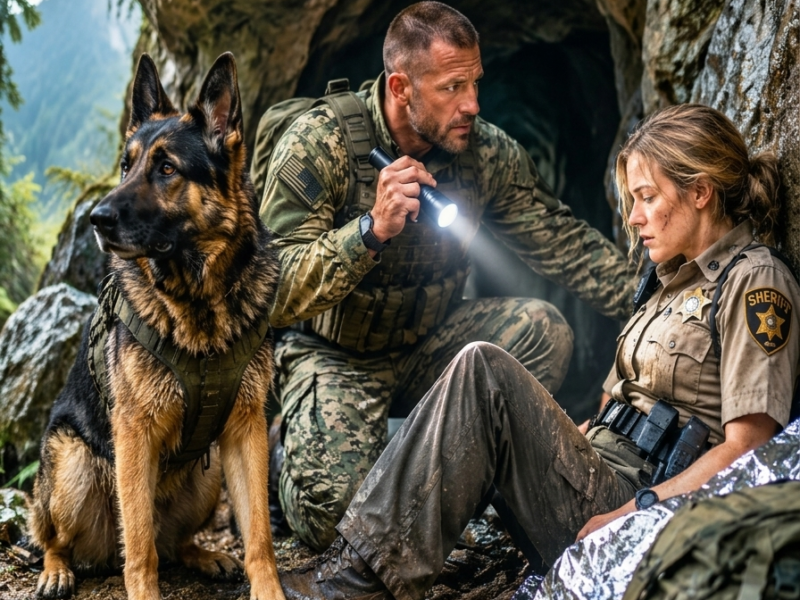
I found a wounded deputy sheriff curled beneath a bloodstained blanket inside a remote mountain cave in Colorado, but when I reached for my radio
I found a wounded deputy sheriff curled beneath a bloodstained blanket inside a remote mountain cave in Colorado, but when I reached for my radio, my German Shepherd suddenly blocked the entrance and growled at the sound of approaching footsteps, because the man bleeding in front of me had just whispered the one name that could get us both killed.
The air inside the cave was frigid, carrying the damp, sharp smell of pine resin and old iron. Out here in the rugged backcountry of Summit County, six miles off the nearest marked trail, winter was already creeping down from the peaks. I had taken an honorable discharge from the Navy SEALs eight months ago, seeking peace in a timber cabin near Breckenridge, accompanied only by my military working dog, Ranger. Peace, however, was a fragile illusion in these mountains.
“Please,” the deputy rasped, gripping my sleeve with trembling, dirt-caked fingers. “Don’t… don’t let them take me back.”
I knelt beside him in the dirt, my military instincts taking over instantly. My hands moved with quiet, practiced efficiency as I pulled back the frayed edges of the wool blanket. Across his lower left ribcage was a ragged, deep laceration—a bullet graze that had torn open skin and muscle, burning white-hot with inflammation.
“I’m a Navy SEAL,” I told him, keeping my voice steady to ground him. “You’re not dying in this cave.”
My dog, Ranger, paced near the entrance, his ears rigid and his black-and-tan nose pointed toward the narrow trail winding through the pines below. Something was coming. Ranger’s posture wasn’t that of a house pet hearing a squirrel; it was the tense, coiled stance of a tactical working dog scenting human intrusion.
I pulled a compressed trauma dressing from my pack and pressed it firmly against the deputy’s wound. He gasped, his jaw clenching until his teeth squeaked.
“What’s your name?” I asked.
“Daniel… Daniel Brooks,” he whispered, his eyes unfocused as he fought the pain. “Summit County Sheriff’s Office.”
His brass badge lay in the dirt beside his elbow, bent violently down the center and streaked with dried mud and oxidized blood.
“What happened to you, Brooks?”
He closed his eyes, his breathing shallow. “I found something… something I wasn’t supposed to find. A file in the basement archive. A list of missing person cases marked ‘closed’ before the searches even started.”
Before I could ask another question, the low, distant rumble of a high-displacement V8 engine echoed through the granite canyons. The sound was muffled by the thick forest, but to a trained ear, it was unmistakable.
Daniel seized my wrist, his grip surprisingly desperate for a man losing blood. “They told everyone I was killed in a hunting accident three days ago. They issued a press release, man. My wife… she thinks I’m dead.”
“Who did?”
He looked directly at me, his eyes wide with a cold, hollow terror. “People wearing badges.”
The words chilled me more than the mountain air whistling through the cave mouth. I’d served twelve years in Special Warfare, surviving night raids in Helmand and maritime boarding operations in the Red Sea. I knew what fear looked like. But this wasn’t the fear of an enemy soldier or a man facing physical death. It was the absolute, crushing horror of a man who had realized that the oath he took had been hijacked—that the very people sworn to protect him had become his hunters.
I helped Daniel sit upright against the curved rock wall while Ranger returned to my side, leaning his heavy chest against my knee and whining softly.
“Can you walk?” I asked, checking his pulse. It was fast and thready.
“Not far,” he admitted. “Legs feel like lead.”
“Then we move slowly,” I said, slinging my pack over one shoulder. “I’ve got a cabin four miles east. It’s off the grid.”
I had barely lifted him by his armpits when Ranger suddenly turned his back on the entrance, dropped his head low, and barked toward the dark rear of the cave.
I turned, expecting a second tunnel exit or perhaps a mountain lion. Instead, my tactical flashlight caught a narrow vertical crack behind a fallen shelf of granite, almost invisible beneath the deep shadows of the cave wall.
Daniel stared at the crack, his face turning completely pale. “No,” he whispered, his voice dropping to a trembling murmur. “No… they found it.”
“Found what?”
I stepped around him, shoved the heavy stone shelf aside, and reached into the darkness behind the rock. My fingers brushed against hard, molded plastic. I pulled out a heavy-duty, waterproof Pelican case wedged tight into the stone seam.
I popped the heavy latches. Inside lay several encrypted flash drives, a hand-drawn topographical map of the surrounding wilderness marked with red coordinates, and a glossy photograph of three men standing beside an unmarked dark blue police vehicle.
One of them was Daniel, looking younger, smiling in a crisp uniform.
The second was Sheriff Robert Miller, a man whose face was plastered on billboards all across the county.
The third was a man I recognized immediately. His regal, sharply tailored appearance was burned into my memory. He had stood beside me at a military memorial service in Arlington two years earlier, shaking my hand, looking me dead in the eye, and thanking me for my service to the nation.
His name was Senator Richard Cole.
I looked down at Daniel, the flashlight beam reflecting off the photo. “What does a United States Senator have to do with a mountain sheriff’s department?”
Daniel swallowed hard, a stray tear cutting a clean trail through the dust on his cheek. “Those drives… they contain ten years of records. Missing hikers, falsified search-and-rescue death reports, and illegal offshore wire transfers paid to deputies who made sure nobody ever came back from those upper peaks.”
A terrible, suffocating silence settled inside the cave.
Then Daniel pointed a trembling finger at the photograph. “They weren’t looking for me because I stole money from the evidence room,” his voice broke, harsh and ragged. “They were looking for me because I found the coordinates. I found where they buried the people who saw what they were shipping through these mountains.”
A sharp, metallic crack echoed through the trees outside—the distinct sound of a high-powered rifle round slamming into a boulder fifty yards down the slope.
Ranger lunged toward the cave entrance, his dark fur standing on end, barking furiously at the treeline. Through the narrow opening, I saw three pairs of high-intensity halogen headlights cutting through the darkening pines.
Three heavy vehicles. No emergency lights. No sirens. Just men who knew these trails, knew the terrain, and knew exactly where we were.
I dragged Daniel behind the heavy rock shelf, pulled my tactical handheld radio from my belt, and set the frequency to the emergency band. But before I could key the microphone to broadcast a Mayday signal, the speaker crackled to life with sharp static.
A calm, middle-aged voice came through the speaker, crisp and devoid of emotion.
“Petty Officer Blake,” the voice said. “This is Sheriff Miller.”
I froze, my thumb hovering over the push-to-talk button. He knew my rank. He knew my name. He had my location pinned down to the meter.
And then the sheriff said something that made the blood in my veins turn to ice.
“We have your complete military service record, Blake. We have your home address in Breckenridge, your sister’s address in Denver, and we know your German Shepherd’s name is Ranger. Stand down.”
Ranger pressed his flank against my leg, his body quivering, sensing the deadly shift in the room before I could fully process it.
The radio speaker static hissed again. “Leave Deputy Brooks in the cave and walk out with your hands up, Petty Officer. Or your family becomes part of an ongoing federal investigation. You know how easily people disappear in the Rockies.”
Daniel gripped my arm so hard his fingernails dug through my sleeve. “Don’t listen to him,” he begged softly. “If you walk out there, they’ll execute you both and burn this ridge.”
I stared at the narrow cave opening as the heavy V8 engines groaned to a halt directly outside the lower trail. The bright beams of searchlights swept across the cliff face, turning the gray granite blindingly white.
Then Ranger suddenly stopped barking.
He didn’t turn back to the vehicles outside. His ears swiveled backward, his dark eyes wide, staring past us into the absolute, pitch-black darkness of the deeper tunnel behind the rock shelf.
And from somewhere deep inside the bowels of the mountain, where no light reached, a small, terrified child’s voice whispered through the stone:
“Please… don’t let them find me too.”
The child’s voice drifted through the narrow stone fissure like a ghost, soft and tremulous, nearly drowned out by the howling wind outside and the heavy hum of idling engines.
My mind raced. A child? In an uncharted cavern system beneath a mountain where a corrupt sheriff was executing missing persons?
“Did you hear that?” I breathed, my hand instantly dropping from the radio to my sidearm—a custom SIG Sauer P226 I’d carried since my days in SEAL Team Three.
Daniel looked up, his face twisted in disbelief and horror. “It can’t be… Jesus, Mary, and Joseph. The Miller girl…”
“Who?” I demanded, leaning over him.
“Sheriff Miller’s niece, Maya,” Daniel gasped, his chest heaving as he fought the internal bleeding. “She vanished six days ago from a campsite near Echo Lake. Miller told the press she was taken by a mountain lion. He closed the entire valley to public search teams. He said it was a recovery operation!”
The reality hit me like a physical impact. Miller hadn’t closed the mountain to look for his niece; he had closed it to keep anyone from finding out what she had seen. Whatever illicit operation Cole and Miller were running through these remote passes—whether human trafficking, illegal weapon shipments, or drug corridors—the girl had stumbled into it, and she had run into the only place she could hide.
Outside, the harsh crack of a bullhorn shattered the air.
“Blake! You have thirty seconds to step out into the light!” Sheriff Miller’s voice echoed off the canyon walls. “After that, my boys drop tear gas and thermite into that hole! You don’t get a second warning!”
I turned to Daniel. “Can you crawl?”
“If I have to,” he said, setting his teeth.
“Ranger, watch the front,” I ordered softly.
The Shepherd dropped into a low crouch near the cave mouth, his lips pulled back over teeth white as bone, monitoring the entrance with deadly concentration. I turned to the narrow crack behind the rock shelf where the Pelican case had been stashed. It was barely eighteen inches wide—a tight squeeze for a broad-shouldered man wearing a tactical vest, but passable if I moved sideways.
I grabbed the Pelican case, shoved it into my rucksack along with my medical kit, and pulled my night-vision monocular from a side pocket, strapping it onto my helmet mount.
“Daniel, you’re going first,” I commanded softly. “I’ll push you from behind. When you get through, stay down.”
I hauled the deputy to his feet. He groaned, a sound of absolute agony, but he didn’t scream. He squeezed himself sideways into the dark stone crevice, his boots scraping against the sharp granite edges. I stayed right behind him, my hand resting on his belt to guide him through the pitch blackness.
“Ranger! Fall back!” I barked.
The dog spun around on his hind legs and bounded into the narrow gap, squeezing past my legs with smooth agility.
Behind us, a metallic canister smashed against the rocks at the cave entrance. Within seconds, a thick, white hiss filled the front chamber as CS tear gas expanded rapidly, burning the back of my throat with its acrid, chemical sting.
“Keep moving!” I hissed, shoving Daniel forward.
We scrambled through twenty feet of suffocatingly tight stone until the passage suddenly opened up into a towering subterranean cavern. The air here was dramatically colder, smelling of subterranean dampness and ancient, undisturbed mineral dust. I clicked on my night-vision monocular; the world transformed into a sharp, phosphor-green landscape of massive stalactites and plunging abyssal drops.
“Help…” the tiny voice cried out again, closer now, coming from behind a cluster of shattered rock pillars thirty yards deeper into the chamber.
“Maya?” I called out softly, keeping my voice low so it wouldn’t echo back toward the entrance. “Maya Miller?”
A small figure huddled beneath a shelf of limestone shuffled forward. She couldn’t have been more than nine years old, wearing a torn pink winter coat covered in dark cave mud. Her lips were blue, her eyes wide with unimaginable terror.
“Are you… are you with the bad men?” she sobbed, holding a small wooden stick like a weapon.
I dropped to one knee, removing my tactical goggles so she could see my eyes in the faint ambient light. “No, sweetheart. My name is Sam. I’m a Navy veteran, and this is my dog, Ranger. He’s a good boy.”
Ranger approached her slowly, dropping his head low and offering a soft, friendly nose-nudge against her shivering hand. The dog’s instinctive empathy broke through her shock; she buried her face in Ranger’s thick neck fur, her shoulders shaking violently.
“They… they shot a man outside,” she wept. “They put him in a hole in the ground. I ran in here to hide, but the dark was so scary…”
“You’re safe now,” I promised, reaching into my pack to pull out an emergency thermal foil blanket, wrapping it snugly around her tiny shoulders. “I’m going to get you back to your mother.”
Behind us, a loud bang echoed through the narrow fissure we had just squeezed through.
“They’re coming through the gap!” Daniel warned, leaning weakly against a limestone column, his hand pressed firmly against his blood-soaked side. “They’ve got gas masks and night-vision gear, Blake!”
I looked back. Bright white flashlight beams were already strobing through the dust of the narrow crevice. Men were coming through—trained tactical shooters equipped with modern gear. Miller wasn’t playing games; he had brought a full strike team of corrupt deputies and private contractors.
I looked ahead into the green-hued darkness of the cavern. The floor sloped steeply downward into a massive underground riverbed, the sound of rushing water roaring softly in the distance.
“Daniel, take Maya’s hand,” I ordered, slinging my rifle across my chest. “We go down to the river. In a system like this, underground water always finds an outlet on the lower valley face.”
“And if it plunges over a waterfall?” Daniel asked grimly.
“Then we adapt,” I said. “Because staying here means an execution.”
I drew two flashbang grenades from my vest, pulled the pins on both, and tossed them precisely through the narrow stone gap into the front chamber just as the first intruder squeezed his torso into the opening.
BANG! BANG!
The double pressure wave slammed through the rock like thunder, accompanied by a blinding flash that shattered the darkness. Screams of disorientation echoed through the stone.
“Move!” I barked, grabbing Maya under one arm and supporting Daniel with the other as Ranger led the way down the slick, dark descent toward the roar of the subterranean river.
The descent was an ordeal of pure willpower. The floor of the subterranean canyon was coated in a treacherous sheen of wet algae and sharp quartz gravel. Every step Daniel took was accompanied by a suppressed groan of agony, his boots slipping on the incline, his entire body weight leaning heavily against my left shoulder.
Behind us, the disoriented shouts of Miller’s strike team echoed down the cavern, rapidly gaining distance as they recovered from the flashbangs.
“Spread out!” a voice shouted from above—it was Miller’s lieutenant. “Watch the drop-offs! Shoot anything that moves! Senator Cole wants that drives package destroyed before daylight!”
We reached the edge of the underground river. It was thirty feet wide, churning violently over gray granite boulders, its dark waters fed by the snowmelt of the upper peaks. The water temperature couldn’t have been more than thirty-five degrees Fahrenheit; five minutes in that torrent without gear meant severe hypothermia, ten minutes meant death.
“There’s no ledge,” Daniel gasped, sinking to his knees on the slick gravel bank. “It’s a dead end, Blake. The water goes right under the mountain face.”
I swept my night-vision optic along the river’s edge. Fifty yards downstream, the river plunged beneath a low, arched overhang of solid granite—a natural siphon where the ceiling dipped completely into the fast-flowing water.
“It’s a sump,” I muttered, my heart tightening. A siphon meant the water ran under the rock wall for an unknown distance before surfacing somewhere outside.
“We can’t swim that,” Daniel said, looking at little Maya, who was trembling violently under the thermal blanket, clinging to Ranger’s back. “She’ll freeze instantly. She won’t survive the submersion.”
Flashlight beams swept across the high stalactites behind us, casting long, menacing shadows down the slope. The strike team was less than two hundred yards away now, descending the rocky slope in a coordinated fire team wedge.
“Blake!” Miller’s voice boomed from the darkness above. “You’re at the river! There’s nowhere left to run! Give us the girl and the flash drives, and I’ll let you take the dog and walk out!”
“Liar!” Daniel shouted back, his voice echoing off the cavern roof. “You killed Deputy Vance! You killed those three hikers from Utah! We know about the graveyard at Black Ridge!”
A heavy burst of automatic gunfire answered him. Bullets chipped violently into the stone wall above our heads, sending sharp rock splinters raining down like shrapnel.
I pushed Maya behind a massive limestone boulder and turned to Daniel. “I need you to listen to me carefully. Is there an abandoned mining shaft near this lower ridge?”
Daniel blinked, trying to focus through the haze of blood loss. “The… the Old Sentinel Mine. It was abandoned in the fifties. It connects to the upper drainage… Jesus, Blake. The drainage pipe empties into the river’s overflow tunnel!”
“Where is the access shaft?”
“Above us!” Daniel pointed up toward a dark, square timber support structure embedded high in the cavern wall, twenty feet above the riverbank. “It’s an old ventilation hatch! But the ladder rusted away forty years ago!”
I looked at the timber frame. Twenty feet up. Straight rock wall.
“Ranger, fetch!” I whispered, reaching into my rucksack and pulling out forty feet of lightweight, high-tensile Kevlar climbing cord equipped with a steel grappling hook I always kept in my mountain pack.
I swung the hook in a tight circle, building momentum, and launched it upward toward the wooden frame. The steel prongs slammed against the aged oak beams, spun twice, and locked firmly into place with a solid, metallic bite.
I pulled on the line with my full body weight. It held.
“I’ll carry Maya up first,” I told Daniel. “Then I’ll hoist you up with a harness pulley.”
“No time,” Daniel grunted, drawing his service weapon—a glock with three rounds left in the magazine. “They’re on top of us, Sam. If you try to haul my dead weight up that wall, they’ll catch us both on the rope. Take the girl and the evidence. Get to the Senator’s press conference in Breckenridge tomorrow morning.”
“I don’t leave men behind, Brooks,” I snapped, my eyes cold. “Not in the desert, and not in a cave.”
Before he could argue, a tactical point-man in full black armor rounded the corner of the limestone pillars, his rifle raised.
Ranger didn’t wait for a command. The Shepherd exploded forward off the riverbank like a black streak, hitting the operator full in the chest before the man could bring his weapon to bear. They both crashed into the freezing, violent current of the river.
“Ranger!” I screamed.
The operator thrashing in the current discharged his rifle wildly into the air before the swift water swept them both toward the roaring siphon downstream. Ranger broke the surface ten feet out, fighting the violent current with powerful strokes, his eyes locked onto me as the dark water dragged him toward the submerged tunnel overhang.
“Ranger! Swim left!” I roared, sprinting along the bank.
The dog lunged against the torrent, his paws scrambling frantically against a submerged rock ledge, his teeth gripping the exposed roots of an ancient tree that had been swept into the cavern years ago. He pulled his head above the rushing water, choking, shivering, but holding his position against the current.
I raised my rifle, acquired the second strike team member rushing down the slope, and fired three controlled shots into his center mass. The man crumpled onto the gravel path.
“Daniel! Strap this around your chest!” I threw the harness loop over his shoulders, pulled the cinch tight, and handed the loose end of the Kevlar line to Maya. “Hold this line with everything you’ve got!”
I grabbed the climbing rope, dug my boots into the slick vertical granite wall, and hauled myself up the vertical shaft in four explosive, hand-over-hand pulling motions. I reached the wooden timber frame, hoisted my body over the lip, and jammed my boots against the ancient oak supports.
“Hauling up!” I bellowed.
Using a mechanical ascender locked onto the line, I hauled Daniel’s body up the face of the rock, my shoulders burning with intense physical strain. He reached the ledge, gasping for air, his consciousness slipping. I pulled him inside the narrow timber shaft, then dropped the rope back down.
“Maya! Loop it under your arms!” I called down.
The little girl didn’t hesitate. She looped the cord beneath her arms, stepped off the gravel bank, and I hauled her up in three smooth pulls, bringing her safely into the narrow mine tunnel.
“Now for the dog,” I growled, looking down at the river.
Ranger was still clinging to the tree root, the freezing water lapping at his nose, his eyes fixed on the timber ledge twenty feet above him.
“Ranger, LEAP!” I shouted, dropping the rope low.
The Shepherd let go of the root, used the rushing current to propel his body upward off the submerged rock, and lunged toward the bank. I swung the grappling cord like a lasso, snagging his tactical harness handle with the steel hook as he broke the surface. With one massive, adrenaline-fueled pull, I dragged seventy pounds of soaking-wet working dog up the cliff face, pulling him into the wooden ventilation shaft just as a volley of submachine-gun fire pulverized the rock wall where we had stood seconds before.
I reached out, pulled the main wooden support beam of the ventilation shaft, and dropped a twenty-pound explosive breach charge onto the timber frame.
“Cover your ears!” I yelled.
I detonated the charge. The ancient wooden supports shattered into a mountain of dust and falling rock, collapsing forty tons of granite ceiling directly over the mine shaft entrance, sealing the tunnel shut behind us in an avalanche of deafening stone.
The dust in the abandoned mine shaft was thick, tasting of old copper, sulfur, and pulverized granite. The sudden silence that followed the explosion was deafening, broken only by the ragged sound of our collective breathing and the steady dripping of groundwater from the rotted wooden timbers above.
I pulled my flashlight from my belt and clicked it on. The beam illuminated a narrow, low-ceilinged haulage tunnel stretching straight into the mountain gloom. The explosion had completely sealed the entrance behind us; Miller’s men would need heavy earth-moving equipment to clear the debris.
“Is… is everyone alive?” Daniel rasped from the dirt floor, his face gray beneath the coating of mineral dust.
“We’re alive,” I said, dropping beside him to re-examine his side.
The movement from the climb had reopened his wound. Bright red blood was seeping steadily through the trauma dressing, pooling beneath his lower back. His skin was dangerously cold to the touch—the early stages of hypothermic shock brought on by the damp air and blood loss.
“Daniel, stay with me,” I commanded, tapping his cheek firmly. “Look at me. What’s your wife’s name?”
“Sarah…” he murmured, his eyelids fluttering. “She… she thinks I’m dead, Sam. They gave her a folded flag… they had a ceremony…”
“She’s going to see you walk through the front door tomorrow,” I said, pulling an emergency thermal space-blanket from my pack and wrapping it tightly around his torso. “Maya, come here.”
The little girl crept closer, shivering violently in her pink coat. Ranger immediately moved beside her, curling his heavy, damp body around her feet to share his body heat. The dog was exhausted, his paws raw from the sharp rocks, but his eyes remained sharp, watching the dark tunnel ahead.
“Maya, I need you to hold this light,” I said, placing a small LED flashlight in her small, trembling hands. “Keep it pointed at Daniel’s face. If he closes his eyes, I want you to talk to him. Tell him about your favorite books. Don’t let him sleep.”
“Okay,” she whispered, her voice tiny but resolute. She leaned over the deputy. “Mr. Daniel? Do you like horses?”
A faint, ghostly smile touched Daniel’s pale lips. “I… I used to have one, kiddo…”
While Maya kept Daniel conscious, I pulled the Pelican case from my rucksack and sat on an upturned wooden ore crate. Using my tactical knife, I pried open the secondary sealed compartment at the bottom of the case.
Inside lay three heavy-duty, military-grade encrypted thumb drives, a physical ledger bound in black leather, and a folded map of Summit County marked with precise GPS coordinates.
I opened the black ledger. The first page was dated six years ago, written in crisp, precise handwriting. It contained names, dates, license plate numbers, and bank account routing codes corresponding to offshore accounts in the Cayman Islands.
My eyes scanned the pages. It wasn’t just a corruption ring—it was an organized criminal syndicate operating under the cover of law enforcement. Senator Richard Cole had used his federal oversight position to secure millions in border security grants and advanced surveillance equipment for the Summit County Sheriff’s Office. In exchange, Sheriff Miller used the vast, rugged wilderness of the Rockies as a dark transit corridor for untraceable high-value contraband and illegal arms shipments heading west.
Anyone who stumbled into their routes—hikers, hunters, campers, or honest deputies like Daniel—was eliminated. Falsified autopsy reports were generated by a compromised county coroner, claiming the victims had suffered fatal falls or animal attacks.
“They’re holding a public press conference tomorrow morning at nine,” Daniel whispered from the floor, his voice barely audible over the dripping water. “At the… at the Breckenridge Community Center. Senator Cole is announcing a multi-million dollar federal expansion for Miller’s department. He’s bringing the Governor…”
I looked at my watch. The digital display read 03:45 AM. Five hours until sunrise.
“How far does this haulage tunnel go?” I asked Daniel.
“It runs… twelve hundred yards west,” he gasped. “Empties out at the old Sentinel processing mill on Route 9. Just above the highway.”
“That’s two miles from my cabin,” I said, calculating the distance in my head. “My truck is parked in a concealed timber shed behind the property. It’s an old diesel Ford—no computer chips, no GPS, untraceable by their digital gear.”
“They’ll have men watching your cabin,” Daniel warned. “Miller knows who you are.”
“Let them watch,” I said, my voice hardening into cold steel. “They think I’m trapped in a cave five miles up the mountain. They don’t expect a Navy SEAL to come back down the ridge from behind them.”
I stood up, slinging my rucksack onto my shoulders and checking my weapon. I had two full magazines left for the SIG Sauer, five 12-gauge shotgun shells in my vest pocket, and my combat knife. It wasn’t an arsenal, but in the hands of a trained operator fighting for survival, it was more than enough.
“Can you stand, Daniel?”
With my help, Daniel gritted his teeth and pulled himself upright, leaning heavily against the old timber walls of the mine. His face was devoid of color, but the fire in his eyes hadn’t burned out.
“I’m not dying in a mine shaft,” he gritted out. “Not until I see Miller in chains.”
“That’s what I wanted to hear,” I said. “Ranger, point.”
The Shepherd stood up, shook his coat, and stepped into the darkness ahead of us, his nose low, leading our small, battered unit down the long, forgotten haulage shaft toward the western face of the mountain.
At 8:15 AM, a heavy mountain mist hung low over the town of Breckenridge. The sun was a pale gold coin struggling to break through the thick layer of morning clouds, reflecting off the snow-capped peaks surrounding the valley.
Outside the Breckenridge Community Center, dozens of local news vans, police cruisers, and state trooper vehicles lined the parking lot. A polished wooden podium had been erected on the wide stone steps, adorned with the seals of the State of Colorado and the United States Senate.
Dozens of reporters, local citizens, and uniformed officers crowded around the steps, shivering in the crisp autumn air.
Sheriff Robert Miller stood behind the podium, impeccably dressed in his dark green class-A dress uniform, his gold star badge shining brilliantly in the morning light. Standing right beside him was Senator Richard Cole, wearing a tailored charcoal suit and an American flag lapel pin, smiling warmly as he waved to the camera crews.
“Thank you, everyone,” Senator Cole began, stepping up to the microphone, his voice smooth, resonant, and practiced. “We are gathered here today not only to announce an unprecedented twenty-million-dollar federal infrastructure grant for the Summit County Sheriff’s Office, but also to honor the brave men and women who keep these majestic mountains safe.”
In the back of the crowd, standing beside an old, mud-splattered diesel pickup truck parked near the tree line, I watched through a pair of high-powered binoculars.
Beside me in the truck cabin sat little Maya, wrapped in a dry sleeping bag, eating an apple from my cabin’s emergency pantry. Daniel was lying across the back seat, his side freshly bandaged with clean gauze, a saline drip I’d scavenged from my combat kit taped to his arm. Ranger sat quietly in the bed of the truck, his dark eyes fixed on the stage.
“It’s time,” I said softly, looking back at Daniel.
“Give ’em hell, Sam,” Daniel rasped, holding up a thumbs-up.
I pulled on my dark canvas jacket, tucked the heavy Pelican case beneath my arm, and opened the truck door. “Ranger, heel.”
The Shepherd leaped silently out of the truck bed, dropping into a precise, disciplined heel position at my left hip. Together, we walked away from the treeline, stepping onto the manicured lawn of the community center, cutting directly through the crowd of unsuspecting civilians and reporters.
On the podium, Senator Cole was continuing his speech. “…and so, as we remember the tragic loss of young Deputy Daniel Brooks earlier this week in a terrible hunting accident, we reaffirm our commitment to law, order, and…”
“You might want to hold that thought, Senator!” my voice cut through the air like a whip crack.
The entire crowd gasped, turning around in unison. Reporters adjusted their camera lenses, zoom microphones swinging toward the back of the lawn.
Sheriff Miller’s face instantly transformed from smooth politician to a mask of absolute, unadulterated horror. His hand instinctively twitched toward his holstered sidearm, but he froze when he saw the icy, absolute calmness in my stride.
“Who are you?” a local news reporter shouted, thrusting a microphone toward me. “Sir, this is a live broadcast!”
I didn’t answer the reporter. I walked straight up the center aisle, Ranger moving beside me like a shadow of silent thunder, until I stood at the bottom of the podium steps, ten feet from the Senator and the Sheriff.
“My name is Sam Blake,” I spoke loudly, my voice carrying clearly across the silent crowd and into the live television microphones. “Former Chief Special Warfare Operator, United States Navy.”
Senator Cole cleared his throat, forcing a tight, nervous smile as he stepped toward the edge of the stage. “Mr. Blake… this is a private state ceremony. If you have a veteran’s grievance, my office will be happy to schedule…”
“I’m not here about a grievance, Senator,” I interrupted, stepping up the first three stone stairs. “I’m here to return something your strike team lost in the mountains last night.”
I lifted the heavy, waterproof Pelican case and slammed it onto the wooden podium directly in front of Senator Cole.
“Inside this case,” I proclaimed, turning to face the row of news cameras, “are the complete financial ledgers, encrypted flash drives, and illegal transaction records documenting ten years of organized crime, extortion, and systemic murder conducted by Sheriff Robert Miller and funded by Senator Richard Cole!”
The crowd exploded into chaos. Whispers, gasps, and shouts erupted from the audience. Photographers began flashing pictures rapidly.
“He’s insane!” Sheriff Miller yelled, drawing his sidearm from his holster. “He’s a mentally disturbed veteran! Security, take him down!”
Before Miller could raise his barrel, I moved with the lightning speed of a close-quarters combat specialist. I stepped inside his reach, grabbed his wrist, twisted it violently upward, and disarmed him in a single fluid motion. The Sheriff’s handgun flew through the air, clattering harmlessly across the stone steps.
I slammed Miller face-first onto the wooden podium, pinning his arm behind his back with my knee.
“Ranger, WATCH COLE!” I commanded.
The German Shepherd launched himself onto the stage, placing his massive front paws on Senator Cole’s chest, pinning the terrified politician back against the state banner, letting out a low, chest-vibrating growl that froze Cole in place.
“This is crazy! You can’t do this!” Cole shrieked, his face pale as paper, his hands raised in absolute terror. “I’m a United States Senator!”
“You’re a traitor to your oath,” I said coldly, pulling pair of heavy steel handcuffs from Miller’s own belt and snapping them tightly around the Sheriff’s wrists.
At that exact moment, a secondary convoy of dark state trooper vehicles and marked FBI SUVs roared into the parking lot, their blue and red lights flashing furiously, tires screeching against the asphalt.
A dozen Federal agents in windbreakers rushed onto the lawn, weapons drawn.
“FBI! Don’t move!” a lead special agent shouted.
“Agent!” Senator Cole yelled frantically from beneath Ranger’s paws. “Arrest this man! He’s attacking public officials!”
I didn’t move. I slowly raised my hands, keeping my palms flat and visible, and looked the lead FBI agent in the eye.
“Agent,” I said calmly. “Check the rear passenger seat of the blue Ford truck parked near the trees. You’ll find Deputy Daniel Brooks—alive—and Sheriff Miller’s missing niece, Maya.”
The lead agent hesitated, looking from me to the Pelican case on the podium, then motioned to two of his officers. “Check that truck!”
Ten seconds passed in agonizing, breathless silence. The entire town of Breckenridge seemed to hold its breath.
Then, an FBI officer called out from the edge of the lawn, his voice trembling with emotion: “WE HAVE THEM! It’s Deputy Brooks! The girl is safe! Repeat, Maya Miller is secured and uninjured!”
A collective gasp swept through the crowd, followed by an explosion of applause and shocked shouts from the local residents.
The lead FBI agent lowered his weapon, stepped up the podium stairs, and looked down at the Pelican case. He picked up the black leather ledger, opened the first page, and scanned the signatures.
He looked up at Senator Cole, his face hardening into absolute contempt.
“Senator Richard Cole, Sheriff Robert Miller,” the agent spoke clearly into the podium microphone. “You have the right to remain silent. Anything you say can and will be used against you in a court of law.”
As the federal agents stepped forward to place Senator Cole in handcuffs and drag Sheriff Miller away, the crowd erupted into cheers. Cameras flashed continuously, recording the downfall of two of the most powerful men in the state.
I stepped back down the podium stairs, whistling softly. “Ranger, off.”
The Shepherd released Cole, trotted back down the steps, and sat at my side, his tail giving a single, calm wag.
Through the parting crowd, a stretcher was being wheeled toward an awaiting ambulance. Daniel lay on the gurney, an oxygen mask over his face, holding his wife’s hand as she wept tears of overwhelming joy beside him. Little Maya was wrapped in a dry yellow blanket, sitting in the front seat of a paramedic vehicle, waving her tiny hand at me through the glass.
Daniel caught my eye as the paramedics lifted his stretcher into the ambulance. He pulled off his oxygen mask for a brief second and looked at me, his eyes full of quiet, unpayable gratitude.
“Thank you, Chief,” he whispered.
I gave him a sharp, respectful nod. “Welcome home, Deputy.”
The ambulance doors closed, and the vehicle pulled away, its sirens wailing softly into the morning air.
I looked down at Ranger, reaching down to scratch him behind his ears. The mountain mist was finally clearing, revealing the brilliant, vast blue sky over the Rockies. The fight was over. The truth had won.
“Come on, boy,” I said softly, turning back toward the quiet timber trails. “Let’s go home.”
The end.









