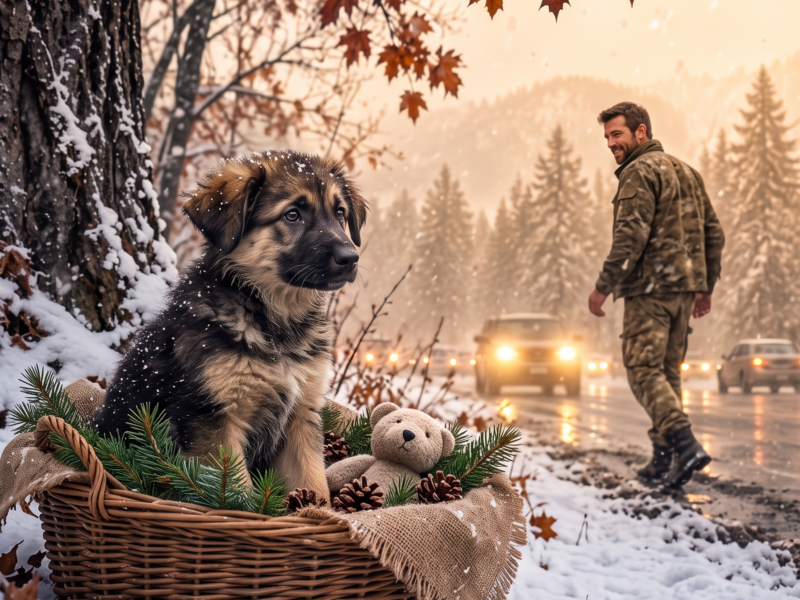
I found a sick puppy trembling beneath a pine tree outside a small Oregon town, and when I called for help
It was just after sunrise when I saw the cardboard box beneath the sprawling branches of a massive Douglas fir. The morning mist hung heavy and low over the damp earth of the Oregon wilderness, chilling the air and soaking the collar of my jacket. I had been walking this isolated stretch of road for an hour, trying to clear my head, listening only to the crunch of wet gravel beneath my boots. The box looked out of place, partially crushed and dark with absorbed rainwater. At first, I thought someone had carelessly dumped their trash on the edge of the forest line. I almost walked right past it.
Then I heard the faintest whimper.
It was a fragile, broken sound, barely audible above the rustling of the wind through the pine needles. I stopped, my heart suddenly hammering against my ribs, and approached the tree. I dropped to my knees in the wet grass and pulled open the damp flaps of the cardboard.
Inside was a tiny German Shepherd puppy. He was soaked to the bone from the freezing rain, his ribs pressing sharply against his matted dark fur. He was barely breathing, his chest rising and falling in shallow, rapid stutters. But what made my blood run cold were his paws. They were tightly wrapped in dirty, blood-stained medical tape, bound so precisely that it could not have been an accident. Someone had done this to him intentionally.
I knelt beside him, taking off my heavy jacket. “You’re not dying alone,” I whispered, my voice trembling with a mixture of rage and sorrow. I gently gathered his frail, shivering body into the warmth of the fleece lining. He felt lighter than a bag of sugar.
I carried him toward the dirt road, holding him close to my chest to share my body heat. That was when the heavy wooden door of a nearby log cabin creaked open. An old man stepped out onto the porch. He wore a faded flannel shirt and held a mug of coffee. His face was weathered, lined with deep creases, and his eyes were cold, gray, and completely devoid of surprise.
He stared down at the bundle in my arms. “Put him back,” the old man said, his voice like grinding stones.
I froze, tightening my grip on the jacket. “He’s sick,” I shot back, stepping away from the porch. “He needs a vet immediately.”
The old man’s face hardened, his jaw setting tightly. “He’s supposed to be.”
There was something in his voice that made the cold morning feel even colder. It was not malice, but a deeply ingrained, terrifying resignation. It was the voice of a man who knew a deadly secret and had accepted its consequences. I refused to leave the dog to freeze to death. Without another word, I turned my back on the cabin and sprinted down the road toward my truck. The old man did not try to stop me. He just walked back inside and closed the door.
I drove like a madman to the only veterinary clinic in the small town, twenty miles away. The vet, a sharp-eyed woman named Sarah, took one look at the puppy and rushed him to the back. For two agonizing hours, I sat in the empty waiting room, staring at the rain lashing against the window. When Sarah finally emerged, her expression was tight with concern and confusion.
She told me the puppy was suffering from severe dehydration, malnutrition, and a badly infected wound on his hind leg. But that was not the strange part.
“When I cut away the medical tape,” Sarah said, lowering her voice, “I found this buried deep in the fur around his neck. It was woven directly into a thin wire collar.” She handed me a tiny, blackened metal tag, no larger than a dime.
I turned it over in my hand. Stamped into the metal were two letters: “R.S.”
Sarah looked at me strangely. “You know what those mean?”
I shook my head, my thumb rubbing the engraved metal.
“I’ve treated hunting dogs and police K9s for twenty years,” she said softly. “I have never seen a tag like that. It’s not a standard tracker. Someone wanted this dog identified, but only by someone who knew exactly what to look for.”
That night, I sat at my kitchen table with my laptop, searching every local database, missing pet forum, and regional registry I could access. Nothing matched. No missing German Shepherds, no unusual breeders in the area. Then I remembered the old man at the cabin. He had known the dog was there. He had known the dog was sick.
I grabbed the metal tag, got back into my truck, and drove out to the woods under the cover of darkness.
The cabin was unlit, except for a single lantern glowing on the porch. The old man was sitting in a rocking chair, staring out into the pitch-black woods as if he was waiting for the trees to move.
I walked up the wooden steps. He didn’t look at me. I held up the tiny metal tag. “Who is R.S.?”
The old man’s hands, resting on the arms of the chair, began to shake. It was a subtle tremor, but it betrayed the stone-cold facade he projected. After a long, agonizing silence, he finally spoke.
“My son.”
His name was Arthur Sullivan. He was a retired Navy SEAL. His son, Ryan Sullivan, had followed in his footsteps, joining the same elite tier-one teams. But Ryan had died overseas eight years earlier during a mission that had never appeared in the news, never been acknowledged by the Pentagon, and never received a public funeral.
Arthur spoke with a hollow, distant tone. He told me Ryan had been a handler for a highly classified military working dog named Scout. Scout disappeared the same night Ryan was killed. The military told Arthur that the dog had perished in the same explosion that took his son. Everyone assumed the bloodline was gone forever.
Until three days ago, when Arthur woke up and found the cardboard box beneath the pine tree.
I looked at Arthur, my brow furrowing in confusion. “That puppy can’t be Scout. Scout would be nearly ten years old by now.”
Arthur shook his head slowly, his eyes fixed on the darkness. “No. That’s not Scout.” He took a deep, ragged breath. “But Ryan had a second dog. A female. Secretly.”
My heart tightened in my chest. “What do you mean secretly?”
Arthur reached into the breast pocket of his flannel shirt and pulled out a worn, faded photograph. He handed it to me. By the light of the lantern, I saw a younger man in desert camouflage kneeling beside a massive, beautiful German Shepherd. In his arms, he held a newborn litter of puppies. But my eyes immediately locked onto one specific puppy in the picture. It had a distinct, jagged white mark across its chest—shaped almost like a lightning bolt.
It was the exact same white mark the puppy currently sleeping in the veterinary clinic had.
Arthur’s voice dropped to a terrified whisper. “Ryan told me before his last deployment to never let anyone find this bloodline. He said if they ever found out about the puppies, they would wipe them off the face of the earth.”
Before I could ask him who “they” were, a bright flash of light cut through the trees. Headlights appeared, bouncing aggressively over the unpaved dirt road. A massive black SUV slammed on its brakes, coming to a halt directly outside the cabin.
Arthur’s face went completely pale. He stood up, knocking the rocking chair backward. “They’re here.”
The heavy doors of the SUV opened. A tall man in a dark trench coat stepped out into the rain. He looked at Arthur, calling the old man’s name with chilling familiarity. Then, the man turned his gaze slowly and deliberately toward me.
“Where did you find the dog?” the man asked, his voice entirely devoid of emotion.
I stood my ground, my fists clenching at my sides. I said nothing.
The man smiled. And somehow, that perfectly polite, empty smile scared me more than any weapon ever had.
The rain began to fall harder, beating a relentless rhythm against the tin roof of the cabin. The man in the trench coat took a slow, measured step toward the porch. The headlights from his SUV cast long, distorted shadows across the muddy yard. Behind him, the silhouettes of three other men remained inside the vehicle, waiting in heavy silence.
“I won’t ask again,” the man said smoothly. “The animal you picked up this morning. Where is it?”
Before I could open my mouth, a low, guttural growl vibrated through the air.
I spun around. Standing in the open doorway of the cabin was the puppy. Sarah, the vet, had warned me to keep him warm and confined, but I had brought him in a heavy travel crate and left him inside by the fireplace while I spoke to Arthur. Somehow, the tiny, sickly animal had forced his way out. He was shaking violently, his bandaged paws struggling to find traction on the wooden floorboards, but his teeth were bared. He was staring directly at the man in the coat.
The man stopped dead in his tracks. The polite smile vanished, replaced by a look of sheer, unfiltered disbelief.
“Impossible,” the man whispered, staring at the puppy’s white chest mark.
That was when I realized this wasn’t about rescuing a sick puppy anymore. This was an execution squad. Someone had spent eight years trying to make sure Ryan Sullivan’s legacy was eradicated, and now they knew I had interfered.
“Run,” Arthur hissed, grabbing the collar of my jacket and shoving me toward the side of the porch.
“Arthur, wait—” I started, but the old SEAL was already moving with a terrifying, calculated speed that belied his age. He reached behind the porch railing and pulled out a hidden, short-barreled shotgun. He didn’t aim at the man in the coat; he aimed directly at the blinding headlights of the SUV.
The blast shattered the night. The headlights exploded in a shower of sparks and glass, plunging the yard into immediate darkness.
“Grab the dog and go into the tree line!” Arthur roared, racking the pump of the shotgun. “Do not stop until you reach the old logging road!”
I scooped the puppy off the floorboards, tucking him securely inside my jacket. The dog let out a sharp whine but buried his nose into my chest, instantly trusting me. I vaulted over the side railing, my boots hitting the soft mud. Behind me, suppressed gunfire began to pop—sickeningly quiet thwips that tore through the wooden walls of the cabin.
I sprinted blindly into the dense Oregon pine forest. The branches whipped against my face, scratching my cheeks and tearing at my clothes. The darkness was absolute, illuminated only by occasional flashes of lightning that pierced the canopy. I could hear men shouting behind me, heavy boots crushing the underbrush as they gave chase.
I ran until my lungs burned and my legs felt like lead. The terrain grew steeper, the ground giving way to jagged rocks and slippery moss. After what felt like hours, I stumbled and slid down a steep embankment, crashing into a shallow ravine hidden beneath overgrown ferns. I clamped a hand over my mouth, forcing myself to breathe silently.
The puppy in my jacket remained completely still. He didn’t whimper. He didn’t move. It was as if the animal instinctively understood the concept of noise discipline.
Ten minutes later, the ferns rustled above me. I grabbed a heavy rock, bracing myself to fight. A shadow slid down the embankment, landing softly in the mud next to me. It was Arthur. He was clutching his left shoulder, dark blood seeping through his fingers.
“They’re sweeping the lower ridge,” Arthur gasped, leaning against the damp earth. “We have a window, but not a big one.”
I moved toward him in the dark. “You’re hit. Let me look—”
“Leave it,” he commanded, swatting my hand away. “It’s a through-and-through. We need to keep moving. There’s an old logging bunker three miles north. We can secure ourselves there.”
I helped the old man to his feet. “Arthur, what is happening? Who are those men? Why do they want a puppy dead?”
Arthur looked at me, his face pale in the faint moonlight filtering through the trees. “Ryan wasn’t just a dog handler. He was part of Project Apex. A black-book program exploring genetic enhancement in military working dogs. They wanted animals with heightened sensory perception, increased pain tolerance, and absolute loyalty. They bred Scout to a female with the same genetic markers. The puppy you’re holding is the culmination of millions of dollars of illicit research.”
My mind raced, trying to process the magnitude of what he was saying. “So they just want their property back?”
“No,” Arthur said bitterly, limping forward into the brush. “Project Apex was shut down by Congress because it was deemed inhumane. But the contractor running it, a private security firm called Blackwood, didn’t want to lose their investment. They kept it going off the books. Ryan found out they were planning to sell the dogs to foreign paramilitaries. He tried to blow the whistle. That’s why he was killed. They staged a mission, wiped out his unit, and claimed the dogs died with him.”
“But they didn’t,” I said, feeling the warm weight of the puppy against my chest.
“Ryan hid the pregnant female before the ambush,” Arthur explained. “Blackwood has spent eight years hunting the bloodline, eliminating every trace to ensure their illegal program stays buried. Whoever dropped this puppy at my cabin was trying to send me a message, or desperately trying to save it. Either way, Blackwood found out. Now, we are the only things standing between them and a cover-up.”
A distant snap of a branch echoed through the woods. It was faint, but unmistakable.
“They have thermal optics,” Arthur whispered, pulling a flare from his pocket. “They’ll find our heat signatures soon. Come on. We need to reach the bunker.”
We moved as fast as Arthur’s injury would allow. The storm raged on, washing away our tracks but freezing us to the bone. Every shadow looked like a mercenary, every gust of wind sounded like a suppressed rifle.
Finally, the trees broke, revealing a jagged rock face. Built directly into the stone was a heavy, rusted iron door. The logging bunker.
Arthur typed a code into an old mechanical keypad hidden beneath a rock. The door shrieked open. We slipped inside, shoving it closed just as the sweep of a high-powered flashlight cut through the trees where we had been standing moments before.
We were in absolute darkness, trapped in a concrete box, with an army of killers closing in outside.
The bunker smelled of stale air, oxidized metal, and damp earth. Arthur flipped a switch on a massive, archaic breaker box. A series of dim, yellowed emergency lights hummed to life, casting long, menacing shadows against the reinforced concrete walls. The space was small, originally meant to house explosives for clearing logging roads decades ago. Now, it was littered with military surplus gear, MREs, and old communications equipment.
Arthur collapsed onto a wooden crate, his face ashen. He pressed a blood-soaked rag hard against his shoulder. “Lock the deadbolts,” he ordered through gritted teeth.
I rushed to the iron door and threw the three heavy steel latches into place. It sounded like a bank vault sealing shut. I turned back to Arthur, gently pulling the puppy from my jacket. The dog was shivering again, his energy entirely spent. I found an old wool blanket on a cot and wrapped him in it, placing him carefully on a dry patch of concrete.
“I need to clean that wound,” I told Arthur, rummaging through a green medical footlocker in the corner. I found gauze, antiseptic powder, and a roll of heavy bandages.
“Make it fast,” Arthur grunted. “That door will stop small arms fire, but if Blackwood brings breaching charges, we’re done.”
As I worked on his shoulder—thankfully finding the bullet had passed cleanly through the muscle without shattering the collarbone—my mind raced. “You knew they might come one day. You’ve been preparing this place.”
Arthur nodded slowly, wincing as I poured the antiseptic over the wound. “After Ryan died, I couldn’t let it go. The official report said improvised explosive device. But Ryan’s gear was sent back to me. His watch was still intact. An IED that incinerates a man leaves nothing behind. They lied. I spent years digging, setting up secure comms, trying to find proof of Project Apex. But I never found the smoking gun.”
He looked over at the sleeping puppy. “Until now.”
I paused, holding the roll of bandages. “The dog? Arthur, he’s just an animal. A genetically modified one, maybe, but he can’t testify. He’s not proof of treason.”
“No,” Arthur said softly, reaching into his pocket with his good hand. He pulled out a small, metallic tool that looked like a precision jeweler’s screwdriver. “But the collar is.”
Arthur gestured for me to bring the puppy over. I carried the bundled dog to him. Arthur carefully examined the thick medical tape that still clung to the dog’s left front paw.
“The vet said she found a metal tag woven into the collar,” Arthur murmured. “Where is it?”
I pulled the tiny tag marked “R.S.” from my pocket and handed it to him.
Arthur didn’t look at the letters. He turned the tag sideways. With the precision screwdriver, he jammed the tip into a microscopic seam along the edge of the metal. He twisted hard.
With a tiny click, the tag popped open like a locket.
Inside was a micro-SD card, no larger than a fingernail.
My breath caught in my throat. “What is that?”
“Ryan didn’t just hide the dogs,” Arthur said, his eyes burning with a sudden, fierce light. “He downloaded Blackwood’s entire encrypted mainframe before they killed him. The ledgers, the foreign buyers, the internal emails ordering the assassination of his unit. He hid it in the one place he knew they would eventually look, but only when they found the bloodline. Whoever has been hiding this dog all these years finally decided it was time to play the trump card.”
Arthur pointed to a bulky, archaic-looking computer terminal resting on a metal desk in the corner. “That’s a direct, hardwired microwave transmitter. It bounces a signal off a secure satellite relay I bought years ago. If we can upload that drive, it goes directly to the Inspector General of the Department of Defense. Blackwood’s executives will be in federal custody by sunrise.”
I rushed to the terminal and hit the power button. The machine whirred to life, a green cursor blinking on a black screen. I took the micro-SD card from Arthur, inserted it into an adapter, and plugged it into the console.
Lines of code immediately began scrolling across the screen. A prompt appeared: ENCRYPTED FILE DETECTED. INITIATING SECURE UPLOAD.
A progress bar appeared on the screen. 1%… 2%…
“How long will this take?” I asked, watching the slow crawl of the numbers.
“Too long,” Arthur replied grimly.
Before I could ask what he meant, a massive explosion rocked the bunker. The concrete walls shuddered, dust raining down from the ceiling. The heavy iron door groaned, the steel deadbolts screaming against their brackets.
Blackwood had found us. And they brought explosives.
“They blew the outer rock face!” Arthur shouted over the ringing in our ears. He stood up, grabbing an M4 rifle from the rack on the wall and tossing it to me. “Do you know how to use that?”
I caught the weapon, checking the safety and the magazine by instinct. I had spent four years in the Rangers before I moved to Oregon to find peace and quiet. I hadn’t touched a rifle in a long time, but the muscle memory was instant.
“Yeah,” I said, taking cover behind the metal desk. “I know how to use it.”
“Good,” Arthur said, racking a round into his shotgun.
Another massive blast slammed into the door. The top hinge gave way, shearing off with a violent screech of metal. Smoke poured into the room through the widening gap.
The progress bar on the screen read 14%.
We were out of time.
The iron door violently buckled inward as a third explosive charge detonated, blowing the remaining hinges entirely. The heavy metal slab crashed to the concrete floor, kicking up a blinding cloud of smoke and pulverized rock.
Through the haze, the bright, harsh beams of tactical flashlights pierced the darkness.
“Suppressing fire!” a voice yelled from the tunnel outside.
Automatic gunfire erupted, the deafening roar bouncing off the concrete walls. Bullets sparked against the floor and shredded the wooden crates near the entrance. I kept my head down behind the heavy metal desk, shielding the computer terminal with my body. Arthur returned fire with his shotgun, the booming blasts temporarily halting the mercenaries’ advance.
“Keep them out of the room!” Arthur yelled over the chaos. “If they hit the terminal, the upload dies!”
I leaned around the side of the desk, raised the M4, and squeezed the trigger in controlled, three-round bursts. The muzzle flash illuminated the doorway, revealing two Blackwood operatives in heavy body armor trying to push through the smoke. My rounds caught the lead man in the chest plate, knocking him backward into his partner. They scrambled back out of the fatal funnel of the doorway, retreating into the tunnel.
“Upload status?” Arthur demanded, slamming a fresh shell into his shotgun.
I glanced back at the screen. 32%…
“A third of the way there!” I shouted. “We just have to hold them off!”
“They won’t keep rushing the door,” Arthur said, his eyes scanning the ceiling. “They’re professionals. They’ll use gas or frags next.”
As if on cue, a small, metallic cylinder bounced through the doorway, clattering across the floor.
“Flashbang!” I screamed, closing my eyes and covering my ears.
The grenade detonated with a blinding flash and a concussive shockwave that stole the breath from my lungs. My ears rang with a high-pitched whine, and for a terrifying second, my vision went entirely white.
Through the disorientation, I saw three operatives surge into the room.
Arthur fired blindly, hitting one in the leg, but another operative raised his rifle, aiming directly at the old man.
Suddenly, a blur of dark fur shot across the room.
The puppy, despite his sickness, despite his bandaged paws and frail frame, launched himself from the cot. With a terrifying, instinctual ferocity that defied his size, he latched his small teeth directly onto the operative’s wrist. It wasn’t enough to cause serious damage, but the sheer shock of the attack made the man flinch. His shot went wide, burying itself into the concrete wall inches from Arthur’s head.
I recovered my vision, leveled my rifle, and fired twice, dropping the operative. The third man panicked, laying down a wall of blind fire as he dragged his wounded comrade out of the bunker.
The room fell silent again, save for the hum of the computer and our ragged breathing.
Arthur crawled over to the puppy, who had retreated beneath the cot, shaking violently once more. The old man scooped the dog up with his good arm, tears mixing with the dust on his face. “Good boy,” he whispered. “You’re a Sullivan, alright. Good boy.”
I checked the magazine in my rifle. I had less than half left. I looked at the terminal. 68%…
“They’re regrouping,” I said, moving to the side of the doorway to check our flank. “They know we’re trapped. They’ll just wait us out or bring something bigger to level this whole cave.”
“They don’t have to,” a calm, chilling voice echoed from the tunnel outside.
It was the man in the trench coat. The one who had smiled at the cabin.
“My name is Thorne,” the voice echoed smoothly down the corridor. “You fight well, Mr. Sullivan. But this is a mathematics problem, and you are out of numbers. We have C4 rigged to the structural supports of this bunker. You have sixty seconds before I collapse this mountain on top of you.”
Arthur looked at me, his face grim.
“The data upload is at eighty percent,” Thorne called out. “I can see the microwave transmission spiking on our scanners. You are trying to send Ryan’s files. It’s a noble effort, but ultimately futile. Walk out now, leave the dog and the drive, and I give you my word you will live. Stay, and you die for a ghost.”
I looked at Arthur. “Is he bluffing?”
“Blackwood doesn’t bluff,” Arthur said quietly. He looked at the terminal. 75%…
“We need more time,” I muttered, looking around the bunker for anything we could use.
“I’ll buy you the time,” Arthur said, his voice terrifyingly calm. He set the puppy down on the desk next to the computer. He picked up his shotgun and walked toward the doorway.
“Arthur, no!” I grabbed his arm. “It’s a suicide run!”
“Ryan died to get this truth out,” Arthur said, looking me dead in the eyes. “I am not letting this data die in the dark. Make sure the upload finishes. Keep the dog safe.”
Before I could stop him, Arthur Sullivan stepped out into the doorway, racking the shotgun one final time, and charged into the smoke of the tunnel.
“Arthur!” I screamed, but the deafening roar of gunfire immediately drowned out my voice.
The tunnel lit up with strobe-like flashes of muzzle fire. Arthur’s shotgun boomed repeatedly, a rhythmic thunder that pushed back against the rapid chatter of Blackwood’s suppressed rifles. I heard men shouting in panic, boots scrambling on the loose rock. The old SEAL was fighting with the ferocity of a man who had absolutely nothing left to lose and everything to protect.
I stood frozen by the terminal, my finger hovering over the trigger of my empty M4. The progress bar on the screen crawled forward with agonizing slowness.
89%… 91%…
Outside, the gunfire suddenly stopped. A heavy, terrifying silence fell over the tunnel.
“Arthur?” I called out, my voice cracking.
No answer.
Footsteps approached the doorway. Slow, deliberate, heavy footsteps.
Thorne stepped into the bunker. His trench coat was covered in dust, and a thin line of blood trickled down his cheek. In his right hand, he held a sleek, suppressed pistol. He looked at me, then at the terminal, and finally at the puppy shivering on the desk.
“He fought bravely,” Thorne said, his voice entirely devoid of inflection. “But as I said, a mathematics problem.”
Thorne raised the pistol, aiming it directly at the computer screen.
I didn’t think. I dropped the empty rifle and lunged at him.
Thorne fired, but my sudden movement threw his aim off. The bullet shattered the casing of the monitor, sending sparks flying, but the hard drive tower remained intact. I slammed into Thorne, driving my shoulder into his chest. We crashed to the concrete floor in a tangle of limbs.
He was incredibly strong, his movements calculated and precise. He slammed an elbow into my jaw, the world spinning in a flash of white pain. I scrambled to pin his gun hand, my fingers desperately grasping his wrist. He rolled, pressing his weight onto my chest, the barrel of the pistol slowly turning toward my face.
“You should have left the box under the tree,” Thorne whispered, his eyes cold and dead.
Suddenly, a sharp, piercing bark echoed in the small room.
The puppy, standing on the edge of the desk, barked again—a fierce, demanding sound that belonged to a much larger animal.
Thorne’s eyes flicked to the dog for a fraction of a second. It was the only distraction I needed.
I twisted my hips violently, buckling Thorne forward, and drove my knee upward into his ribs with everything I had. He grunted, his grip loosening just enough. I wrenched the pistol from his hand, scrambled backward, and aimed the weapon directly at his chest.
Thorne froze, kneeling on the floor, his hands slowly rising. He looked at the gun in my hand, then at the terminal behind me.
“It doesn’t matter,” Thorne said, a smug, dark smile creeping across his face. “The C4 is armed. The timer is out.”
He reached into his pocket and pulled out a small electronic detonator. His thumb hovered over the red trigger.
BEEP.
The sound didn’t come from the detonator. It came from the computer terminal.
I glanced back. The screen read: 100%. TRANSMISSION COMPLETE.
“It’s gone,” I said, breathing heavily. “The files are with the Department of Defense. Blackwood is finished.”
Thorne’s smile vanished. He stared at the screen, the realization washing over him that an eight-year cover-up had just been undone by a civilian and a sick puppy.
Before Thorne could press the detonator, a terrifying sound tore through the night sky outside. The deep, heavy thumping of helicopter rotors, incredibly low and incredibly fast. The ground shook violently as the aircraft hovered just outside the bunker entrance, the wash from the blades blowing smoke and debris into the room.
Over a massive loudspeaker, a voice boomed, drowning out the storm.
“FEDERAL AGENTS! DROP YOUR WEAPONS AND STEP OUT WITH YOUR HANDS ON YOUR HEADS! THE PERIMETER IS SECURED!”
Thorne looked at the detonator in his hand. He looked at me, his eyes empty. He slowly set the device on the floor and put his hands behind his head. The war was over.
Within minutes, armed federal agents swarmed the bunker. They dragged Thorne away in handcuffs. I dropped the pistol and rushed out into the tunnel.
I found Arthur sitting against the rock wall near the entrance. He was bleeding from multiple wounds, surrounded by three incapacitated Blackwood operatives. Medics were already rushing toward him.
I slid into the mud next to him, holding the puppy in my arms. Arthur looked up, his face pale but his eyes bright.
“Did it go through?” he wheezed, clutching his chest.
“100 percent,” I smiled, tears blurring my vision. “It’s all over, Arthur. You did it. Ryan did it.”
The old man closed his eyes, a profound look of peace washing over his weathered face. He reached out with a trembling hand and gently stroked the puppy’s head. The dog leaned into his touch, letting out a soft sigh.
“He’s a good boy,” Arthur whispered.
Six months later, I sat on the porch of the cabin. The Oregon morning was crisp and clear, the sun breaking over the towering pine trees. Arthur was sitting in his rocking chair, a cane resting against his leg, drinking coffee.
The news had been relentless for weeks. Blackwood had been dismantled, its executives facing federal treason and conspiracy charges. The truth about Project Apex had been brought to light, and Ryan Sullivan had finally received the posthumous honors he deserved.
A heavy thud on the wooden steps pulled me from my thoughts.
A massive, beautiful German Shepherd bounded up onto the porch. He was strong, fast, and radiating health, his coat shining in the morning sun. Across his chest was a jagged white mark, shaped like a lightning bolt.
He dropped a heavy stick at my feet and sat, looking at me with intelligent, soulful eyes.
I smiled, scratching him behind the ears. I had found a dying puppy beneath a tree, and in return, I had found a family.
“Good boy, Scout,” I said.
The dog barked happily, and together, we watched the sun rise over the forest.
The end.









