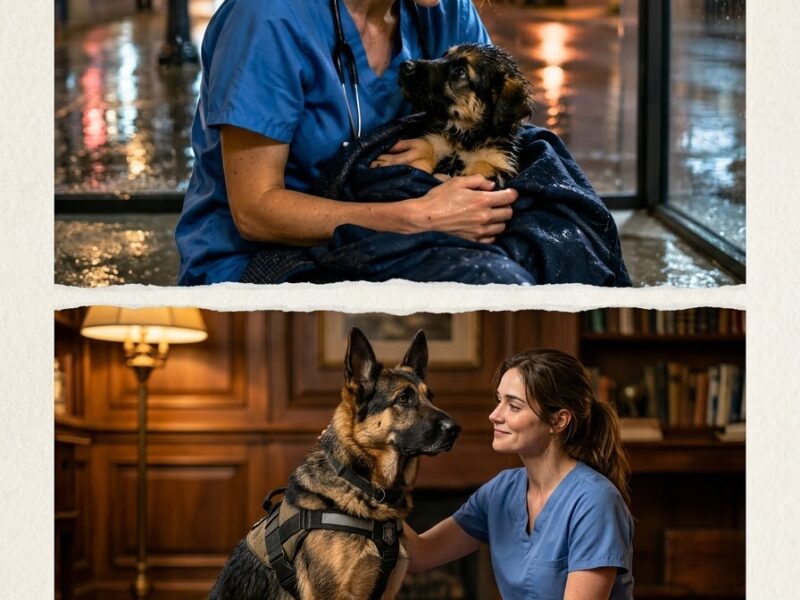
I found a shivering K9 puppy abandoned behind the emergency entrance of a Chicago hospital
The cold in Chicago doesn’t just bite; it carves into your bones. It was mid-January, precisely 3:14 a.m., when the rain turned into sleet, plastering sheets of ice across the slick concrete of the Cook County Memorial Emergency entrance. I was twenty-two years old, barely six months into my job as an ER orderly, surviving on lukewarm coffee and three-hour stretches of sleep.
The loading dock was a place where nobody lingered. It smelled of exhaust, biohazard bins, and damp cardboard. I had stepped out through the heavy metal doors to huddle beneath the narrow overhang and pull a breath of crisp air into my burning lungs. That’s when I heard it.
Scratch. Scratch.
It was a brittle, wet sound. At first, I assumed it was one of the local alley cats rummaging through the overturned recycling bins near the bio-waste compactor. But then came a sound that made my chest tighten—a tiny, high-pitched whimper that sounded uncannily like a crying infant.
I pulled my thin cotton jacket tighter around my scrubs and stepped out into the freezing sleet. My rubber-soled shoes slid across the black ice as I navigated around the towering metal dumpsters. In the furthest, darkest corner of the dock, half-buried beneath an upturned, waterlogged Appliance Depot cardboard box, something was moving.
I dropped to my knees, ignoring the icy water soaking through my pants. I lifted the corner of the dripping cardboard.
Lying on his side in a puddle of slush was a German Shepherd puppy. He couldn’t have been more than six or seven weeks old. His black and tan fur was matted into sharp, icy spikes, clung tightly to a body so emaciated that every individual rib stood out like the rings of a ladder. His front paws were raw, bleeding from where he had desperately tried to claw through the frozen paper. His breathing was shallow—a faint, frantic rattle that barely registered in the freezing air.
“Hey… hey, little guy,” I whispered, my own breath blooming in heavy white clouds between us.
He didn’t have the strength to lift his head. But as my shadow fell over him, his dark, glassy eyes rolled toward me. His tail didn’t wag, but his body gave a tiny, involuntary twitch—a instinctual plea for comfort from a creature that had known nothing but cruelty.
I didn’t think about hospital regulations. I didn’t think about the strict biohazard protocols or the swift termination policies for unauthorized animals on medical premises. I unzipped my heavy winter jacket, unbuttoned my scrub top, and peeled off my warm undershirt. I wrapped the shivering, damp pup gently in the thermal fabric, tucked him deep against my bare chest, and zipped my jacket back up over us both. His body felt like an icicle against my skin.
I rushed back through the automatic glass doors into the blinding light of the ER intake bay.
Dr. Marcus Vance, the night-shift attending physician—a man whose compassion had long since been incinerated by twenty years of inner-city trauma—was standing at the central nursing station, reviewing a digital chart. He smelled of stale espresso and antiseptic.
“Miller,” Vance barked without looking up. “Room 3 needs a full sanitize. We’ve got a multi-car collision coming off the I-90 in ten minutes.”
“Dr. Vance,” I said, my voice shaking as I unzipped my jacket just enough to reveal the tiny, black-muzzled face resting against my collarbone. “I found him on the dock. He’s freezing. His core temp is bottomed out and his breathing is obstructed. I need some warming packs and normal saline.”
Dr. Vance stopped typing. He looked at the puppy, then looked at me, his eyes dead, unblinking, and cold.
“Put it back outside, Miller.”
“What?” The word escaped my throat in a strangled gasp. “He’s dying, Doctor. He won’t survive another twenty minutes out there.”
“This is an emergency medical facility for human beings, not a stray animal shelter,” Vance said, his voice flat, devoid of anger or empathy. “We don’t have the resources, we don’t have the sanitary clearance, and I am not risking an infection protocol audit for a mutt someone dumped in the trash. Take it outside or call municipal animal control.”
“Animal control won’t dispatch until 8:00 a.m.!” I shouted, stepping closer. “He’ll be dead by then!”
“Then he dies,” Vance snapped, turning back to his monitor. “Leave him there, or turn in your badge before the sun comes up. That’s an order, orderly.”
My hands tightened around the bundle beneath my jacket. I could feel the puppy’s faint, erratic heartbeat against my ribs—thump… thump… pause… thump. It was a faint rhythm, a dying embers of life begging for fuel.
I looked Vance dead in the eye. “Understood, Doctor.”
I didn’t put the dog back outside. Instead, I walked straight into the abandoned supply closet beneath the rear stairwell—a dark, windowless room filled with boxes of sterile drapes and expired saline IV bags. I locked the heavy door behind me. I laid the puppy down on a bed of warm, heated blanket wraps I had sneaked from the blanket warmer in the recovery ward.
For the next three hours, while the emergency room roared with the screams of incoming ambulances and screeching gurneys, I spent every stolen minute in that dark closet. I filled rubber gloves with scalding water to act as heat packs around his shivering frame. I used a plastic syringe to drop tiny droplets of warm glucose solution into his dry, unresponsive mouth.
I sat on the cold tile floor, cradling his small, trembling head in my palms. “Stay with me,” I whispered into his soft, wet ears, warming his skin with my own breath. “You don’t give up. Do you hear me? You’re not alone anymore.”
Around 5:30 a.m., his shivering slowly began to subside, replaced by a deep, genuine warmth. His tail gave a tiny, involuntary flick against the heated blankets. When I looked down, his dark brown eyes were open, no longer glassy, but focused entirely on my face with an intensity that chilled me to the bone.
I named him Scout.
When my shift ended at 7:00 a.m., I tucked Scout deep inside my oversized duffel bag, walked right past Dr. Vance without saying a word, and carried him out into the morning light of Chicago.
Over the next six months, my tiny, cramped studio apartment in Pilsen became a sanctuary. Scout’s recovery was nothing short of miraculous. The emaciated pup transformed into a thick-boned, broad-chested German Shepherd with dark, intelligent eyes and a striking black coat marked by deep mahogany sable around his chest and paws.
But it wasn’t just his physical recovery that astonished me; it was his mind.
Scout didn’t behave like normal dogs. He didn’t chew furniture or bark at stray squirrels. He watched everything with a sharp, calculating silence. If I dropped a set of keys behind a closed door, he wouldn’t just whine—he would hook his paw under the frame and work the latch until it opened. When I came home exhausted from my double shifts at the hospital, he would instantly position himself at my side, pressing his heavy head against my knee, resting there until my breathing slowed down.
When Scout was ten months old, I took him to a local industrial park near the Chicago River to let him run. Sitting on a wooden bench nearby was an elderly man named Jim Sterling. Jim was a burly man with silver hair cut in a tight military high-and-tight, missing two fingers on his right hand, accompanied by a retired Belgian Malinois service dog resting quietly at his feet. Jim was a legendary figure in the Midwest—a retired US Marine Corps Master Sergeant and former chief K9 instructor for federal search-and-rescue teams.
Jim watched Scout for twenty minutes. He watched how Scout moved—not aimlessly chasing birds, but sweeping the perimeter of the field in methodical, overlapping search patterns, his nose constantly sampling the wind, his ears pivoting at every distant sound.
Jim stood up, walked over, and tossed a small, unmarked wooden block deep into a patch of dense, knee-high brush fifty yards away. He hadn’t let Scout see him toss it.
“Find it,” Jim said softly, looking at the dog.
Scout didn’t look at me for permission. He didn’t look confused. He hit the treeline like a bullet, sweeping low, working the crosswind. Ninety seconds later, he emerged from the deep brush, holding the wooden block gently in his jaws, and walked straight to Jim, dropping it cleanly at the old instructor’s boots.
Jim looked at the block, then looked up at me, his weathered face dead serious.
“Where did you get this dog, son?” Jim asked.
“Found him under a cardboard box behind Cook County ER,” I replied.
Jim shook his head slowly, kneeling down to run his heavy hand over Scout’s deep chest. “Someone made a terrible mistake leaving this one behind. That dog wasn’t born to sit on a sofa, kid. He was born for something big.”
Jim Sterling didn’t just train Scout; he adopted us both. For the next three years, my life was divided into two distinct worlds. By day, I worked my way through nursing school, rising from an orderly to a registered nurse, eventually earning a permanent position in the very same Cook County ER trauma center where I had found Scout. By night and on weekends, I was at Jim’s tactical facility in rural Indiana, watching Scout transform into an absolute force of nature.
Scout was certified in scent tracking, cadaver recovery, and tactical personal protection. He excelled at human stress detection—a rare ability where a dog picks up the microscopic spikes of cortisol and adrenaline secreted through human sweat during moments of extreme aggression or fear. He could identify an aggressive individual in a crowd of five hundred people before the person even pulled a weapon.
Years melted away. Scout grew into a ninety-pound masterpiece of muscle, intelligence, and unwavering loyalty. He was my shadow, my anchor, and my family.
It was a cold, rainy Tuesday evening in November. I was thirty-one years old now, a charge nurse running the evening shift. It was nearly 11:30 p.m. when I finally stamped my timecard and stepped out of the hospital’s rear staff exit. The sky was pouring rain, sweeping heavy sheets of cold water across the concrete structure of the hospital’s multi-level parking garage.
Because the main parking deck was under renovation, staff had been instructed to park on Level 3 of the old west garage—a dimly lit, cavernous concrete space where half the overhead fluorescent lights flickered or had burned out completely, leaving vast pockets of deep, cold shadows.
Scout was waiting for me in the back of my SUV, as he often did when I worked late shifts. Jim had trained him to stay comfortably in his custom tactical crate inside the vehicle, equipped with environmental climate control.
I walked down the long, empty concrete ramp of Level 3. My rubber-soled nursing clogs squeaked loudly against the damp floor. The sound echoed off the low concrete ceiling, mixing with the rhythmic drip… drip… drip of rainwater leaking through the expansion joints.
Clack.
I froze. It was a sharp, distinct sound—the heel of a heavy boot striking the concrete thirty feet behind me.
I turned around quickly. “Hello?” I called out, my voice sounding thin against the vast structure.
Nothing. Just the flickering yellow light of a dying fluorescent tube over an empty parking bay. The rows of parked sedans and pickup trucks sat silent, bathed in shadows.
“Probably just an officer on rounds,” I muttered to myself, shaking my head. I turned back around and quickened my pace toward my SUV parked near the far wall.
I was ten feet from my car when a hand suddenly locked around my throat from behind.
The grip was iron-hard, choking off my air instantly. A thick, rain-slicked arm wrapped around my chest, dragging me backward off my feet into the dark space between two large delivery vans.
“Don’t move, and don’t make a sound,” a low, gravelly voice hissed into my ear. The smell of stale tobacco, unwashed skin, and damp leather hit my nose. I caught the metallic glint of a six-inch hunting knife rising toward my ribs in the dark.
Terror spiked through my blood like liquid fire. My hands clawed desperately at the thick wrist choking me, but I couldn’t break the seal on my windpipe. Black spots began dancing across my vision.
CRASH!
The reinforced safety glass of my SUV’s rear side window didn’t just break—it exploded inward.
Scout hadn’t waited for me to unlock the doors. The moment he smelled the sudden, violent spike of my adrenaline and heard the muffled gasp from my throat, he had thrown his entire ninety-pound body directly through the tempered glass window of the vehicle.
A roaring growl—a sound so gut-wrenching and predatory it sounded like a dying motor—echoed through the concrete garage.
Before my attacker could even turn his head, ninety pounds of airborne black-and-tan muscle struck him in the torso.
The force of the impact ripped the man completely off me. We both crashed hard to the cold concrete, but while I scrambled backward, gasping frantically for air, Scout was already engaged.
Scout didn’t bark. He didn’t hesitate. He locked his jaws around the attacker’s right forearm—the arm holding the knife—with a terrifying, crushing crunch. The steel hunting knife clattered noisily across the floor, spinning into the dark.
The attacker screamed—a raw, terrifying shriek of absolute agony that echoed off the concrete walls. He tried to strike Scout with his free left fist, but Scout absorbed the blow without flinching, driving his body forward, pinning the heavy man flat on his back against the wet floorboards, his jaws locked like a hydraulic clamp.
“Call him off! Call him off! He’s breaking my arm!” the man shrieked, his eyes wide with wild, unadulterated terror.
I scrambled to my feet, clutching my bruised throat, my heart hammering like a trapped bird against my ribs.
“Scout! Hold!” I commanded, my voice trembling but clear.
Instantly, Scout stopped shaking his head, but he didn’t release his bite. He stayed pinned atop the man’s chest, his deep brown eyes fixed on the attacker’s face, a low, continuous rumble vibrating through his massive chest. If the man shifted an inch, Scout’s grip tightened just enough to draw a fresh howl of pain.
Footsteps roared up the concrete ramp. Two uniformed hospital security guards came sprinting around the corner, weapons drawn, their flashlights cutting through the dark.
“Over here!” I yelled, waving my hand.
The guards rushed in, taking in the scene—the broken car window, the knife on the floor, the bleeding man pinned beneath a massive German Shepherd, and me clutching my neck.
“Get him cuff’d!” the lead guard yelled into his radio.
It took both guards to pull the heavy attacker over and secure his hands behind his back in steel handcuffs. Only when the steel clicked shut did I look at Scout.
“Scout, out,” I whispered.
Scout released his hold instantly, stepping back two paces, his body aligned perfectly at my hip, his shoulder resting against my leg. I collapsed to my knees right there on the wet concrete, throwing my arms around his broad, thick neck, burying my face in his damp fur.
“Good boy… good boy,” I sobbed, tears finally breaking through my shock. “You saved me. You saved my life.”
Scout didn’t lick my face. He leaned his heavy weight directly into my torso, pressing his skull firmly beneath my chin, giving a deep, ragged sigh that vibrated through my ribs.
“Nurse Miller, are you alright?” the security guard asked, shining his light on my face.
“I’m fine,” I rasped, rubbing my bruised neck. “Just… get him down to intake. Call the CPD.”
The guards hoisted the bleeding attacker to his feet. But as they began dragging him toward the elevators, Scout suddenly pulled away from my embrace.
His ears went completely flat against his skull. His head lowered, his nose pointing straight down the long, dark corridor toward the main ER entrance doors at the end of the elevated walkway.
He didn’t growl. He didn’t bark. He began to tremble—a deep, violent shivering that started at the base of his spine and rattled through his entire frame.
I had never seen Scout do this. Not during his intense tactical training, not during high-stress search operations, not even five seconds ago when he had jumped through a glass window to fight an armed attacker.
“Scout?” I asked, rising to my feet, reaching for his tactical harness. “What is it, boy? What do you see?”
Scout didn’t look back at me. He broke into a fast, purposeful trot, his nose low to the floor, heading straight for the double glass doors of the ER trauma intake bay.
I hurried after Scout, my nursing clogs slapping against the wet tiles as we passed through the double sliding doors into the roaring chaos of the ER intake bay. It was midnight now, and the night shift was in full tactical surge. Rain was pouring off the clothes of paramedics, radios were squawking with incoming trauma alerts, and the sharp smell of iron, ozone, and rubbing alcohol hung heavy in the warm air.
Scout ignored the chaos, the flashing lights, and the nurses dodging around him. He moved with a terrifying, razor-focused alignment, his nose sweeping two inches off the floor, tracking a scent trail that seemed to cut straight through the middle of the room.
“Hey! No dogs in the active bay!” Dr. Vance’s voice barked from the central command desk. He was ten years older now, his hair completely silver, holding a clipboard like a shield. “Miller, is that your dog? Get him out of here before I call sanitation!”
I didn’t answer Vance. I couldn’t. I was watching Scout.
At Trauma Bay 2, a paramedic team was furiously pushing a high-visibility orange stretcher through the plastic curtains. The patient on the gurney was an elderly man, wrapped in blood-soaked trauma blankets, an oxygen mask strapped tightly over his pale, sunken face. His clothes were torn, caked in black mud and dried grease—he looked like a homeless veteran who had been struck by a hit-and-run vehicle in the industrial rail yards near the river.
“We got a Male Black-70, blunt force trauma to the torso, severe hypothermia, arterial bleed in the left thigh!” the lead paramedic yelled over the noise. “BP is 80 over 50 and dropping! We need two units of O-negative right now!”
Scout didn’t pause. He walked directly into Trauma Bay 2, pushing past a resident doctor who tried to step in his way.
“Scout, heel!” I called out, reaching for his harness.
Scout ignored my command for the first time in his life. He stepped up to the side of the metal gurney. He raised his front paws, placing them gently on the edge of the aluminum frame, bringing his broad black nose inches from the unconscious man’s limp, cold left hand.
The man’s arm was hanging off the side of the mattress. His sleeve was torn open to the shoulder. Etched into the weathered, scar-riddled skin of his inner forearm was a dark, faded tattoo—a classic US Marine Corps Eagle, Globe, and Anchor emblem, encircled by a faded tactical unit designation: 3rd Recon Battalion – 1988.
Scout didn’t bite. He didn’t growl. He placed his warm, wet nose directly against the palm of the man’s bleeding hand and gave two soft, high-pitched whines—a sound of profound, devastating grief that I had never heard him utter before.
The unconscious man’s chest heaved. His heart monitor, which had been chiming a flat, sluggish fifty beats per minute, suddenly spiked to ninety.
His eyes, heavy and bloodshot, flickered open beneath the harsh fluorescent lights. He looked down at the massive German Shepherd resting his head against his chest.
A single tear cut through the black grease on the old man’s cheek.
His trembling, blood-stained fingers lifted slowly, inch by painful inch, and buried themselves deep into the thick sable fur of Scout’s neck. His thumb reached out, gently feeling the base of Scout’s left ear—where a distinct, tiny, horseshoe-shaped scar sat hidden beneath the fur.
“Scout…” the old man rasped. His voice was a ruined whisper, choked with blood and fluid, but the name was unmistakable.
I froze. The room around me seemed to tilt on its axis. The roar of the ER, the shouting doctors, the buzzing lights—everything faded into a deafening silence.
“How… how do you know his name?” I stepped forward, my hands trembling violently as I looked at the dying man on the bed. “Who are you?”
The man slowly turned his head toward me. His eyes were dark brown, surrounded by deep, weathered lines of sun, rain, and unimaginable pain. But beneath the dirt and blood, I saw something in those eyes that made my heart drop into a bottomless abyss.
I was looking at my own eyes.
The shape of the jaw, the curve of the brow, the high cheekbones—it was like looking into a distorted mirror of my own face forty years into the future.
The old man tried to speak, but a dry cough shook his frame, bringing fresh blood to his lips. He pulled off his oxygen mask with a weak, trembling hand. He stared directly into my eyes, his chest rising and falling in ragged, shallow gasps.
He pointed a shaking finger at Scout, then looked at me.
“I left him… under the box… for you,” the man choked out, his voice breaking into a wet sob. “I knew… you worked the night dock…”
My knees buckled. I had to grab the edge of the crash cart to keep from falling to the floor. “What… what are you talking about?”
The paramedic who brought him in stepped forward, pulling a wet, leather-bound notebook from a plastic evidence bag. “We found this in his jacket, Nurse Miller. He didn’t have an ID, but he had a photograph inside.”
The paramedic opened the plastic bag and handed me a small, waterlogged photograph.
It was a picture taken thirty years ago. In it was a young Marine in dress blues, holding a tiny, newborn baby girl outside a hospital building. On the back, written in faded black ink, were the words: My little Clara. Forgive me.
“Dad?” The word escaped my mouth before my brain could even comprehend it.
My father—Arthur Miller—had disappeared from my life when I was four years old. My mother had told me he died in an overseas training accident, but as I grew older, I found official records indicating he had simply vanished into the dark world of severe PTSD, military discharge, and homeless vagrancy. I had spent my entire life believing he had abandoned me because he didn’t care.
“He’s… he’s your father, Clara,” the dying man rasped, his eyes turning to Scout, who was licking the blood gently from the old man’s cheek. “I tracked… your unit… for years. I saw you… working the dock… that night.”
“You…” I choked out, tears blinding my vision. “You dumped Scout in the rain?”
“I didn’t dump him!” Arthur cried out, a sudden, desperate strength filling his voice as he tried to lift his head from the pillow. “I found him… in a dogfighting ring in Gary… three months before. I bred his line in the Corps… I knew what he was. But I was dying, Clara… my lungs were failing… I couldn’t protect you anymore from the street…”
He reached out, his bloody hand grabbing my wrist with a desperate, iron grip.
“I couldn’t come near you,” Arthur wept, his chest heaving. “I was a broken monster… a disgraced vet… I would have ruined your life. But I knew… if I left him where you’d find him… he would grow up to be the shield… I couldn’t be.”
The medical bay shattered into chaotic action. The heart monitor connected to Arthur Miller’s chest began to emit a long, continuous, terrifying tone—a flatline alert.
“He’s in V-Fib!” Dr. Vance yelled, shoving past me, his hands instantly charging the defibrillator paddles. “Clear the bay! Get that dog out of here now! Miller, step back! That’s an order!”
“No!” I screamed, grabbing the side of the bed. “No! Don’t you dare touch him!”
Scout let out a sharp, thunderous bark, stepping between Dr. Vance and the gurney, his lips pulled back over his teeth in a terrifying display of pure, protective rage. He wasn’t going to let anyone touch the man who had given him life, nor the woman who had raised him.
“Clara…” Arthur whispered, his vision rolling back into his head, his hand losing its grip on my wrist. “The drive… in his tactical vest… page… 104…”
His head fell back onto the white pillow. His eyes closed.
“Scout, DOWN!” I commanded, my voice slicing through the chaos.
Scout dropped instantly to the floor, his head resting against my boots, his eyes fixed on my father.
I stepped into my role as a trauma nurse. Twenty years of medical training took over my body, burying the sudden, violent storm of personal grief. I picked up the bag-valve mask, strapped it over my father’s face, and began pumping oxygen manually into his lungs.
“Start CPR!” I shouted at the resident doctor. “Get two milligrams of epinephrine into the central line! We are NOT losing him tonight!”
For forty-five agonizing minutes, we fought for Arthur Miller’s life. Three shocks from the defibrillator, sixteen rounds of compressions, and four doses of cardiac stimulants finally brought a faint, erratic rhythm back to his heart monitor.
Thump… thump… pause… thump.
It was the exact same weak, struggling rhythm Scout had possessed under that cardboard box eleven years ago.
“We have a pulse,” Dr. Vance said, wiping sweat from his forehead, looking at me with a strange, complex expression in his eyes—a mixture of profound shock, respect, and deep embarrassment. “He’s stable for transport to ICU. But Miller… he’s in end-stage pulmonary fibrosis. He has days, maybe hours.”
They wheeled Arthur up to the Intensive Care Unit on the fourth floor. Because of my status as charge nurse and the extraordinary circumstances of the evening, the hospital administration granted a temporary exemption: Scout was allowed to remain in the room.
It was 4:00 a.m. now. The room was dark, lit only by the rhythmic blue light of the ventilator and the green trace of the heart monitor. Arthur lay in a deep, medically induced coma, his chest rising and falling under the machine’s rhythm.
Scout lay curled tight against the side of Arthur’s bed, his head resting on the old man’s boots, which I had placed under the frame.
I sat in the plastic chair beside the bed, holding the heavy leather-bound notebook the paramedics had recovered from Arthur’s jacket. Beside it lay Scout’s original heavy-duty tactical harness—the one Jim Sterling had built for him when he passed his master certification.
I remembered what Arthur had whispered right before his heart stopped: The drive… in his tactical vest… page 104…
My hands shook as I picked up Scout’s old tactical vest. I turned it over, examining the double-stitched ballistic nylon. Inside the rear handle lining—a hidden pocket designed for emergency medical ID tags—was a tiny, flat, rectangular object wrapped tightly in waterproof black electrical tape.
I pulled it out and peeled away the tape.
It was a small, high-capacity encrypted USB flash drive, stamped with a federal military logistics seal.
I pulled my personal laptop from my work bag, set it on my knees, and inserted the drive into the USB port. The screen flickered to life, asking for a password or decryption key.
I looked at the leather notebook in my lap. I opened it to page 104.
Written in faded, precise military handwriting were daily logs spanning over fifteen years. My father hadn’t abandoned me and disappeared into thin air. He had been living less than four miles away from my apartment for over a decade, residing in an abandoned trailer near the industrial docks, working covertly to keep track of every person who entered my life.
On page 104, there was a single line written in red ink:
Key: 0314-COOK-COUNTY-SCOUT
I typed the sequence into the prompt.
The security lock vanished. A massive directory of PDF files, photographic records, and legal affidavits flooded the screen.
My jaw dropped as I began reading the documents.
My father hadn’t just been a homeless veteran. He was a former senior investigator for the Department of Veterans Affairs Criminal Investigative Service. Fifteen years ago, while investigating black-market medical supply rings in the Midwest, he had discovered a massive, multi-million-dollar fraud scheme operating directly out of three major Chicago hospitals—including Cook County Memorial.
The ring was stealing high-grade surgical supplies, experimental pharmaceuticals, and organ transportation priority slots, selling them to private overseas buyers.
And at the very top of the local distribution manifest—signed on over two hundred illegal shipping orders—was the name of the man who had authorized the sales.
Dr. Marcus Vance.
My blood ran cold. The man who had ordered me to put a dying puppy back out in the freezing rain eleven years ago was the same man my father had been investigating. The same man who had spent a decade trying to find the missing drive that my father had hidden inside the puppy’s harness before going dark.
Suddenly, the silent air of the ICU room was shattered by the soft, metallic click of the door lock behind me.
I didn’t turn around immediately. I slowly closed the laptop lid half an inch, my heart hammering like a war drum against my ribs.
Behind me, the quiet hum of the ICU’s medical equipment was punctuated by the sharp, deliberate sound of dress shoes stepping over the linoleum floor.
“I always knew Arthur was smarter than he looked,” a cold, smooth voice said from the dark.
I turned slowly. Dr. Marcus Vance was standing near the door. He was no longer wearing his blood-stained lab coat; he was dressed in a dark wool overcoat, his hands clad in thin leather surgical gloves. In his right hand, rested naturally at his side, was a pre-filled syringe with a long, gleaming stainless-steel needle.
“Dr. Vance,” I said, keeping my voice utterly level, forcing my hands to remain still on the laptop. “You’re off shift.”
“I was,” Vance replied softly, taking a slow step toward the bed. “Until Security reported that an old vagrant brought into Bay 2 had a US Marine Corps tattoo and was carrying a dog with a military harness. I knew Arthur’s signature. I’ve been looking for that drive for twelve years, Clara.”
Scout didn’t make a sound. He didn’t rise to his feet with a dramatic roar. He simply stood up, lowering his center of gravity, his dark brown eyes locked onto Vance’s right hand—the hand holding the syringe.
“He was dying, Vance,” I said, pointing toward my father’s motionless form on the bed. “He has pulmonary fibrosis. He has hours left to live. You didn’t need to do this.”
“I couldn’t risk him waking up and talking to federal prosecutors,” Vance said, his eyes flicking coldly to the laptop on my knees. “And I certainly can’t risk you walking out of this building with that drive. Do you have any idea what’s on that disk, Clara? It’s not just my name. It’s the names of three federal judges, two hospital board members, and the chief of municipal logistics. If that drive goes public, my life is over.”
Vance stepped closer, raising the syringe. “Potassium chloride,” he whispered, gesturing to the needle. “A simple three-milliliter injection into his central IV line. His heart stops within forty seconds. It looks like a natural cardiac arrest given his trauma. And then… you are going to hand me that laptop, Clara. Or I will ensure you meet your father before the sun comes up.”
“You took everything from him,” I said, tears of pure, burning rage welling in my eyes. “You turned him into a ghost. You left him to freeze in the street.”
“I offered him a cut of the profits fifteen years ago!” Vance snarled, his composure finally slipping, his face twisting into a grotesque mask of greed. “He chose his stupid military honor over money! He ruined his own life! And now… he’s finishing yours.”
Vance lunged forward, reaching out with his left hand to grab my laptop while aiming the syringe toward Arthur’s IV line with his right.
He forgot about the dog.
He thought Scout was just a pet—an old German Shepherd resting at a dying man’s feet. He didn’t know about Jim Sterling’s facility in Indiana. He didn’t know about the three years of tactical stress-response conditioning. He didn’t know that Scout had been bred, trained, and delivered into my life for this exact microsecond.
“Scout! TAKE HIM!” I roared.
Scout moved like a strike of lightning.
He didn’t bark. He drove off his hind legs, launching his ninety-pound frame through the narrow space between the bed and the crash cart.
His jaws slammed shut around Vance’s right wrist with absolute, bone-shattering force.
The syringe shattered against the floorboards, spraying the clear liquid harmlessly across the tile. Vance let out a high-pitched, pathetic shriek as Scout dragged him violently to the ground, slamming the doctor flat on his back against the floor.
Scout didn’t tear at his throat. He pinned Vance’s right arm to the floor, his massive paws planted firmly on the doctor’s chest, his lips pulled back to reveal massive, gleaming teeth hovering two inches from Vance’s eyes. A deep, guttural growl vibrated through Vance’s chest, so intense that the glass water pitcher on the nightstand rattled.
“Call him off! Call him off!” Vance screamed, his face white as a sheet, tears of terror streaming down his cheeks into his ears. “He’s going to kill me!”
“He won’t kill you,” I said coldly, standing up and picking up my phone from the bedside table. “He’s a trained service dog, Dr. Vance. He has far more discipline than you ever had.”
I dialed the three-digit emergency sequence for the Chicago Police Department federal task force number written on page 104 of my father’s notebook.
“This is Charge Nurse Clara Miller at Cook County Memorial ICU,” I said clearly into the receiver. “I have Dr. Marcus Vance restrained in Room 412. I am holding the master encryption key for the 2014 VA Procurement Fraud case. Send federal marshals immediately.”
Ten minutes later, the ICU hallway was flooded with armed federal agents and uniformed Chicago police officers.
Dr. Vance was pulled from the floor in heavy steel handcuffs, his face covered in sweat, his medical license stripped the moment the federal agent verified the contents of the encrypted flash drive on my laptop. As they dragged him past the doorway, he couldn’t even look at me. He looked down at the floor, terrified of the massive German Shepherd standing silently at my hip.
By 6:00 a.m., the rain outside had finally stopped. The first rays of winter sunlight broke through the heavy gray clouds over Lake Michigan, casting a warm, golden light through the window of ICU Room 412.
The room was quiet now. The federal agents had taken the drive, leaving two protective guards outside the door.
I sat on the edge of the bed, holding my father’s cold, rough hand in mine.
His heart rate monitor was slowing down, the green line becoming gentler, weaker, as his body finally reached the end of its long, painful journey. But his eyes were open. He was looking at me, clear and conscious, free from the heavy sedation.
“Clara…” he whispered, his voice faint, light as a feather. “Did… did he protect you?”
I looked down at Scout. The heavy German Shepherd had his front paws resting on the edge of the bed, his dark brown eyes fixed on my father with a warmth that filled the entire room.
“He saved my life, Dad,” I said, wiping a tear from my cheek, smiling through the pain. “Every single day. He was the best shield you could have ever given me.”
A soft, serene smile broke across my father’s weathered face. The decades of pain, guilt, fear, and exile seemed to evaporate from his eyes, leaving behind only the pure, unconditional love of a father who had fulfilled his final duty.
He lifted his trembling fingers one last time and rested them gently on Scout’s black nose.
“Good boy, Scout,” Arthur whispered. “Job… well… done.”
Arthur Miller closed his eyes. The heart monitor held a long, peaceful, steady tone as his chest gave its final, quiet breath.
Scout didn’t whimper. He didn’t bark. He lifted his head, looked out the window at the golden morning sun rising over the Chicago skyline, and let out a long, quiet sigh.
I fell to my knees, wrapping one arm around my father’s motionless body and the other around Scout’s thick, warm neck.
I had lost my father, but he had never truly left me. He had left his heart under a cardboard box in the freezing rain, waiting for me to pick it up and carry it home.
The end.









