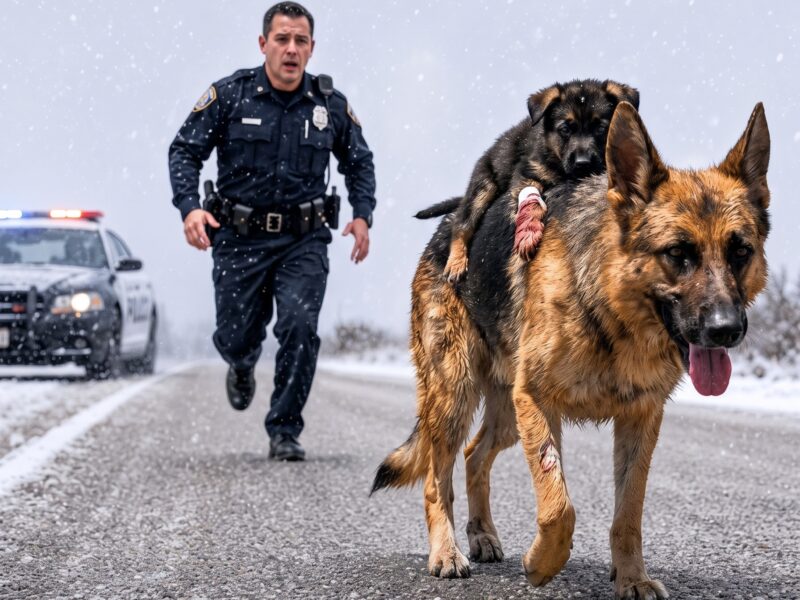
I found a German Shepherd limping through a freezing Chicago alley with a tiny puppy clutched desperately in her mouth
The Chicago wind off Lake Michigan carried the kind of brutal, needle-sharp cold that turned motor oil to sludge and made a man’s lungs ache with every drawn breath. It was past two in the morning in early January, and the Back of the Yards industrial district was a wasteland of salt-crusted asphalt, shuttered meatpacking plants, and towering brick warehouses that had stood abandoned since before I was born. Snow had been falling without pause for five hours, burying the potholes and laying down a pristine, deceiving blanket over the broken glass and rusted rebar of the alleys.
I sat in my patrol cruiser with the heater roaring, blowing dry, lukewarm air against my stiff fingers. Badge number 4182 sat pinned to my heavy winter parka, cold against my ribs. I had worn that badge for four years, ever since graduating from the academy, but the metal itself was far older than my career. It had belonged to Sergeant Michael Bennett—my father—who had carried it through thirty years of patrol before dying in an attic blaze on 47th Street, pulling two foster children from the smoke while the rafters collapsed beneath his boots. Eight years had passed since that night, but every time I looked down at the brass eagle and the stamped numerals, I felt the phantom weight of a man whose shadow I could never quite outrun.
My radio clicked on with a burst of static. “Unit forty-two, report of suspicious movement near the old rail spur off Loomis. Private security called it in. Probably squatters looking for shelter from the frost.”
“Forty-two, copy,” I said into the mic. “I’m two blocks out. I’ll check it out on foot.”
I clipped the radio back to my vest, grabbed my heavy halogen flashlight, and stepped out into the blizzard. The cold hit me like a slap across the mouth. My boots crunched through six inches of fresh powder as I rounded the corner of a three-story brick structure that once housed a refrigerated storage depot. Most of the windows were covered with rotting plywood, but near the rear loading dock, several sheets had been pried loose.
That was when I heard it: a frantic, rhythmic scratching against corrugated iron, followed by a low, shuddering whimper that barely carried over the whistle of the wind.
I drew my beam upward. The white halogen cut through the swirling snow, reflecting off discarded pallets, rusted barrels, and grease-stained gravel. Beneath the yellow glow of a flickering municipal streetlight whose casing was half-shattered, a shape stood shivering in the dark.
It was a German Shepherd.
She was emaciated, her ribs showing distinctly beneath a coarse, dirt-caked coat of black and tan. One of her front paws was lifted off the frozen ground, dark crimson drops blooming into the fresh snow beneath her. Ice was crusted thick along her muzzle, and her ears—torn and notched along the edges from past fights or jagged wire—were pinned flat against her skull in sheer, unadulterated terror.
Yet she did not run.
Dangling gently from her jaws was a tiny bundle of dark fur. A newborn puppy, its eyes still sealed shut, held by the scruff of its neck with an exquisite, heartbreaking delicacy that defied the animal’s violent trembling.
My hand instinctively moved away from my duty belt. I had dealt with feral dogs in these rail yards before; usually, they were aggressive, territorial, and half-mad from hunger. But there was no snarl in this dog’s throat. Her eyes were wide, luminous, and filled with a desperation so human it made my chest tighten.
“Easy, girl,” I murmured, lowering the flashlight beam so it didn’t blind her. I kept my voice low, dropping to one knee in the snow to appear smaller, less threatening. “Easy now. Nobody’s going to hurt you.”
The shepherd backed away half a step, her injured paw brushing against a rusted steel drum. She looked left, then right, scanning the dark alley as if searching for something—or someone—who might be pursuing her through the storm. Then she looked back at me. Her dark eyes locked onto my face, then drifted down to the silver shield pinned to my chest.
A low, trembling whine escaped her throat, around the tiny body in her mouth.
She took one careful step forward. Then another. Her limp was severe; the front leg shook under her weight, and she left a dark trail of blood across the white snow. She reached the toe of my boot, lowered her head with infinite gentleness, and placed the puppy directly onto the frozen leather between my feet.
The little pup barely moved. It let out a weak, breathy squeak, its skin cold as river ice.
My heart sank into my stomach. Without thinking about protocol, germs, or the feral nature of street dogs, I pulled off my heavy outer gloves, unzipped my duty parka, and lifted the puppy. It was no larger than a grapefruit. I tucked it inside the warmth of my wool uniform shirt, pressing its tiny body flat against my thermal undershirt, right over my heartbeat.
The moment the puppy left the snow, the mother let out a long, ragged sigh that sounded like air escaping a deflated tire. Her hind legs gave out. She collapsed onto her side against my shins, her ribcage heaving, her wet nose pressing hard against my knee as if anchoring herself to the only solid object in a world that was freezing to death.
I reached out with a bare, trembling hand and placed it gently on her matted flank. Her fur was drenched in freezing water and smelled faintly of copper and woodsmoke. “You’re okay,” I whispered, though my own hands were shaking. “You did it. I’ve got him.”
I reached for my shoulder mic with my left hand to call dispatch. “Dispatch, Unit forty-two, I need animal control and an emergency vet transport out to Loomis and 48th. I have a severely injured canine and—”
Before I could finish the sentence, the mother’s head snapped up.
She didn’t growl. She didn’t bark. But her jaws closed firmly over the heavy canvas cuff of my right sleeve. She didn’t bite down to break skin; she clamped her teeth into the fabric with a desperate, unyielding pressure, pulling my arm away from the radio.
Her eyes were fixed on mine, burning with an urgency that paralyzed me.
“What is it, girl?” I asked.
She released my sleeve, pushed herself up on three trembling legs with an effort that clearly cost her immense pain, and turned toward the dark corridor between the warehouse and the retaining wall of the elevated train tracks. She took three steps, stopped, looked over her shoulder, and whined—a high, sharp note that cut straight through the roaring wind.
She wasn’t looking for shelter for herself. She was ordering me to follow.
I pushed myself up from the snow, keeping one hand pressed against my chest where the tiny pup was beginning to warm, squirming faintly against my skin. “Show me,” I said.
The dog limped forward into the darkness, navigating a narrow gap between two stacks of rotten shipping pallets. I switched my flashlight back to full power, following the crimson trail of her blood. At the rear of the loading dock, beneath an overhang where the snow hadn’t completely drifted, was a massive mound of soaked, discarded cardboard boxes and dirty fiberglass insulation.
The mother stopped beside the pile and nudged a soggy sheet of cardboard with her nose.
I stepped forward and swept the cardboard aside.
There, tucked into a nest made of shredded newspaper and an old wool car blanket, were three more puppies. Two of them were pressed together in a tight, shivering knot, their tiny mouths searching the air blindly, whimpering with faint, reedy cries.
The third puppy, a little female with a white patch on her chest, lay completely still on the frozen concrete. Her body was stiff, rimmed with frost.
A knot formed in my throat so thick I could hardly swallow. I knelt in the dirt, gently touching the cold, lifeless pup with two fingers before pulling the other two living ones into the crook of my arm. The mother watched me, her sides shuddering, but she made no move to stop me. She accepted the reality with the silent, stoic grief of an animal that had already lived through too many horrors.
“How long have you been out here alone?” I whispered, my voice cracking in the dark alley.
The shepherd stepped closer. She lowered her head until her forehead rested against my shoulder, breathing in the scent of my neck, my collar, my badge.
And that was when the flashlight beam caught the circle of worn leather around her throat.
I had thought she was a stray, an abandoned mutt dumped in the yards by someone who couldn’t afford to feed her. But buried beneath the thick, matted ruff of her neck was an old, heavy-duty utility collar made of black bridle leather. Riveted to the center of the leather was an oval brass tag, scratched and tarnished with age.
I reached out with numb fingers, brushing away the ice that encrusted the brass.
There was no pet name. There was no phone number.
Stamped into the center of the metal were four digits, followed by three letters:
4182 – CPD
I stopped breathing. The wind howling through the rafters of the loading dock seemed to vanish into absolute, ringing silence.
My badge number.
Not just any badge number—the exact number pinned to my chest at that very moment. The number that had belonged to Sergeant Michael Bennett until the night he perished in the fire eight years ago.
I stared at the dog, my mind spinning into a sickening vertigo. A dog this young—she couldn’t have been more than four or five years old—could never have served on the department while my father was alive. My father had been dead for nearly a decade.
“Where did you come from?” I breathed, my hand trembling against the brass tag. “Who gave this to you?”
The German Shepherd didn’t answer with a sound. She simply pulled her head away from my shoulder, turned her body toward the far end of the service alley where the tracks curved toward the residential streets of Englewood, and began to limp forward into the blinding white snow.
The storm was reaching its peak. Snow swirled in dizzying, blinding vortices between the silent brick factories, erasing the city skyline and turning the street ahead into a tunnel of gray whiteout. The temperature had plunged past ten below, with the wind chill making it feel closer to thirty below zero. My fingers were losing sensation despite the adrenaline surging through my blood, and the two puppies cradled in my left arm were crying steadily now, their small bodies warming against the wool of my uniform. Inside my jacket, the first puppy nuzzled against my chest, its faint heartbeat fluttering like a trapped moth.
“Girl, stop! Wait!” I shouted, struggling to keep pace as the mother shepherd limped forward.
She didn’t stop. She moved with a strange, mechanical certainty, her injured paw held clear of the ground, hopping along the narrow service path that ran parallel to the elevated commuter tracks. Every twenty yards, she would pause, turn her head through the falling snow to make sure the beam of my flashlight was still behind her, and then push onward through the drifts.
She was leading me south, away from the industrial sprawl and toward an older, decaying residential pocket where the city had demolished half the houses during the highway expansion of the late nineties. These were streets where the streetlights were routinely shot out, where half the lots were overgrown with sumac and choked with rusted car chassis, and where nobody walked after dark even in the dead of summer.
After four grueling blocks, the shepherd turned sharply down an unplowed residential lane. She stopped before a narrow, two-story frame house that sat sagging between two vacant, snow-buried lots. The windows on the ground floor were covered with heavy sheets of plywood secured with rusted wood screws. The front porch steps had rotted through in the center, and yellow municipal condemnation stickers, faded and weather-beaten, were plastered across the front door.
I knew this street. My heart slammed against my ribs with sudden, violent force.
This was 49th and Hermitage.
Thirty years ago, this had been my father’s first beat as a rookie patrolman. He used to talk about this neighborhood around the dinner table when I was a boy, calling it “the forgotten pocket.” He had maintained a small, unofficial off-the-books storage space somewhere around here—a garage where he kept old tools, spare parts, and files he didn’t want cluttering the precinct lockers. But that was decades ago. The city had bought out the block years before he died.
The shepherd climbed the rotted porch steps with agonizing slowness, testing each board with her good front paw before putting her weight down. She walked directly to the far corner of the porch, where an old metal milk crate sat overturned beneath a rusted tin overhang.
She nuzzled the crate aside with her nose.
Behind it, resting on a flat piece of slate that kept it off the damp floorboards, sat an old green metal ammunition box. It was sealed with a heavy rubber gasket, the kind my father used to store hunting supplies and fishing tackle in our basement.
The dog lay down beside the box, curling her body against the cold wood, her breath coming in ragged, shallow wheezes. She rested her muzzle on the steel lid and looked up at me with eyes that seemed to say: Open it.
My boots groaned against the porch boards as I knelt beside her. I shifted the two puppies carefully into the deep pockets of my parka, zipping the fleece up around their necks so only their noses poked out into the air, protected from the wind. With trembling, frost-bitten fingers, I flipped the heavy wire latches on the ammunition can.
The rubber seal parted with a soft hiss.
Inside, protected completely from the moisture and rot of eight Chicago winters, lay a collection of objects that made the breath catch in my throat.
On top was an envelope of heavy manila paper, wrapped tightly in two layers of plastic kitchen wrap. Beneath it lay a spare key on a brass ring, a leather-bound notebook with water-damaged edges, and an old five-by-seven black-and-white photograph in a simple silver-plated frame.
I pulled out the photograph first, angling my flashlight down to illuminate the glass.
The picture had been taken in the courtyard of the CPD K-9 training facility in Des Plaines. In the foreground knelt my father, Michael Bennett, twenty years younger, his hair still thick and dark brown, laughing with a wide, open smile as he wrestled with a magnificent, barrel-chested German Shepherd who had his jaws playfully locked around my father’s leather training sleeve.
On the back of the photograph, written in my father’s distinctive, sprawling engineer’s script, were words written in faded black ink:
K-9 “Goliath” – Badge 4182. The bloodline doesn’t forget. For the day she needs someone.
I stared at the picture, then down at the dog lying at my feet.
Goliath had been my father’s patrol dog when I was in elementary school. I remembered that dog. He was a legend in the Eighth District—responsible for tracking down missing children in the forest preserves, finding illegal weapons hidden behind dry-wall, and once pulling an unconscious transit worker off the electrified third rail on the Red Line. Goliath had died of cancer when I was twelve years old, and my father had spent three days in the garage by himself, refusing to speak to anyone, burying his partner beneath the apple tree in our backyard.
This female shepherd wasn’t Goliath. She was too young.
She was his granddaughter.
My father had bred Goliath’s line before the dog passed. He had given the pups to fellow handlers, to trainers, to people he trusted across the county. He had always believed that a truly great working dog wasn’t just a collection of instincts, but an inheritance—a lineage of courage and memory that passed down through the blood.
I looked at the brass tag on her collar again. 4182.
My father had never retired that number. When Goliath died, Dad kept the dog’s brass tag on his own key ring until the day he died in that fire. Someone had taken that tag and put it on this dog.
Suddenly, the dog stiffened.
Her ears, which had been drooping with exhaustion, snapped backward. She raised her head from the wooden deck, her nostrils flaring as she tasted the freezing air blowing off the street. A low, vibrating growl started deep in her chest—not the whine of pain she had made before, but a warning. A combat alert.
I clicked off my flashlight instantly. The porch plunged into shadow.
Through the curtain of falling snow, out on the dark asphalt of 49th Street, a set of headlights flickered to life. A dark, unmarked sedan had turned the corner without its running lights, creeping slowly along the curb, its tires crunching softly against the fresh snow.
It wasn’t a police cruiser. It was an older model sedan with tinted glass, moving at walking speed, its engine idling with a low, throaty rumble that sounded like an animal hunting in the dark.
The car stopped directly in front of the rotting house.
The driver’s side window slid down two inches. The orange glow of a lit cigarette flared in the interior darkness, illuminating the outline of a heavy jaw and a dark wool cap. The man inside wasn’t looking at the houses on the left or the right. He was staring straight at the rotted porch, his gaze tracking the fresh set of boot prints and the crimson drops of dog blood that led from the alley straight up our steps.
Beside me, the shepherd didn’t move an inch. Her body was locked like cold iron, her lips pulling back over yellowed teeth, completely silent.
The car door began to click open.
The metallic click of the car door was like a gunshot in the frozen silence of the block. I didn’t wait to see who stepped out into the blizzard. My training took over—the muscle memory drilled into me through four years of patrol in the city’s roughest sectors.
I reached down with my right hand, grabbed the green ammunition can, and slid my left arm under the shepherd’s sunken chest. “Up, girl,” I hissed into her ear. “Move!”
She didn’t hesitate. Despite her shattered paw, she scrambled to her feet, staying low to the floorboards as I guided her toward the rear of the wraparound porch. The wood gave way beneath my left boot with a sharp crunch, but I caught myself against the rotted balustrade, hauling the dog with me as we slipped over the back railing and dropped into four feet of powdery snow in the rear courtyard.
Behind us, a heavy voice called out into the wind: “Hey! Who’s on that porch?”
Footsteps crunched violently up the front steps. Then came the sound of a heavy boot kicking through the rotten plywood covering the front door.
We didn’t look back.
I hauled the shepherd by her leather collar, supporting half her body weight with my hip as we plowed through the waist-deep drifts filling the narrow alleyway behind the house. The puppies in my pockets squirmed against my ribs, whimpering faintly, but the mother kept her muzzle shut tight, focusing every ounce of her remaining strength on putting one foot in front of the other.
We navigated three interconnected service lanes, turning through broken chain-link fences and overgrown back lots until the sound of the idling sedan faded into the muffled roar of the storm.
My squad car was parked four blocks north, sitting dark beneath the overpass on Loomis. When we finally reached it, I hit the remote unlock. The lights flashed amber once through the snow. I opened the rear door, lifted the exhausted mother onto the vinyl backseat, and gently transferred the two puppies from my pockets, laying them beside their sibling who was still resting against my thermal shirt.
The mother immediately curled her long body around all three of them, tucking them beneath her flank, her rough tongue licking their wet faces with frantic, desperate strokes.
I slammed the door, jumped into the driver’s seat, and locked all four doors.
My hands were shaking so violently from the cold and the adrenaline that I fumbled the ignition key twice before the V8 engine roared to life. I turned the heater to maximum, blasted the defroster against the frosted windshield, and reached for my radio handset.
I stopped.
The man in the sedan hadn’t been an ordinary squatter or a neighborhood lookout. He had been tracking this dog. He had followed the blood trail directly to an abandoned house that had been off the city records for twenty years—a house connected to my father’s early career.
I looked at the green ammunition box sitting on the passenger seat.
I picked up the manila envelope wrapped in plastic. With a pocketknife from my duty belt, I slit the tape and pulled out the contents. Inside was a thick, handwritten incident report on yellow legal paper, dated October 14, 2016—two days before my father died in that warehouse fire on 47th Street.
Attached to the top of the report was an official CPD evidence receipt, stamped with a case number that had been crossed out in red grease pencil.
I began to read under the amber glow of the dome light.
Memo to file: Sgt. M. Bennett #4182.
Subject: Arson investigation / 8th District commercial properties.
For the past six months, private salvage firms operating under contract with the municipal port authority have been clearing properties in the Back of the Yards corridor. The official reports list these fires as structural decay, faulty wiring, or vagrant heating accidents. They are not.
They are controlled burns.
Accelerants were found at three separate sites: the old cold storage facility on Loomis, the rail maintenance shed on 49th, and the commercial laundry on Racine. In each case, the properties had been insured three months prior by an offshore holding company registered to Marcus Vance & Associates. Vance is buying up the entire corridor using city demolition subsidies, then using contracted teams to clear the land before the new transit line extension is announced next spring.
I lowered the paper, the cold air inside the car suddenly feeling suffocating.
Marcus Vance.
The name hit me like a physical blow. Vance wasn’t just a private developer; he was a political powerhouse in Cook County, a man who dined with judges, sat on the regional transportation board, and whose private security firms employed dozens of retired and off-duty police officers. He was untouchable.
I turned back to the paper.
I took Goliath’s line—the third litter from his daughter, Freya—to train for scent detection of synthetic industrial accelerants. One pup showed extraordinary aptitude: a female we tagged as ‘Echo.’ She can detect trace elements of nitrocellulose-based accelerants that standard municipal sniffers miss completely.
Yesterday, Echo alerted on three empty barrels behind Vance’s private storage yard on 48th. Before I could file the official warrant request with the state’s attorney, Lieutenant Miller called me into his office. He told me to drop the investigation. He said the property was outside our district’s purview. He warned me that my pension wouldn’t survive another year if I kept digging around Vance’s contracts.
I am hiding Echo at the safe house on Hermitage with Miller’s former handler, Joe Kovic. If anything happens to me, the evidence is logged in the secondary locker at the old municipal waterworks intake station on 8th Street. The key attached to this file opens the maintenance hatch.
Echo has the blood. She knows the scent. If they come for her, she will run to the badge.
My father’s handwriting ended there.
I looked up through the rearview mirror.
In the backseat, beneath the warm glow of the interior light, the dog lay watching me. Her breathing had slowed, but her dark, intelligent eyes were fixed on the reflection of my face in the glass.
Her name wasn’t just a stray’s name. It was Echo.
She wasn’t an eight-year-old dog; she was the daughter of the pup my father had hidden with Joe Kovic eight years ago. Kovic must have kept the breeding line alive, keeping the dogs hidden, training them, preserving the work my father had started before the fire took him.
And something had happened to Kovic tonight.
I reached out and picked up my cell phone, bypassing the police dispatch radio entirely. I dialed the private desk number of Captain Sarah Hayes—my father’s former patrol partner, now the commanding officer of the neighboring ninth district, and the only person on the force my father had ever told me to trust with my life.
The phone rang four times. Then a groggy, gravelly voice answered: “Hayes.”
“Captain, it’s Lucas Bennett,” I said, my voice dropping to an intense, urgent whisper. “I need your help. And I need you not to log this call.”
There was a long pause on the other end of the line. The rustle of bedsheets, then the sound of a woman sitting up, instantly alert. “Lucas? Where are you? Your patrol unit isn’t showing up on the district GPS grid.”
I looked at the dashboard. The blue light on my terminal was off. Someone at dispatch had remotely toggled my unit’s transponder off-line.
“I’m at Loomis and 46th,” I said. “Captain… my father didn’t die in an accidental house fire.”
Before Hayes could answer, a violent metallic crunch shattered the rear window of my squad car.
The world exploded into flying safety glass and blinding headlights.
A heavy steel bull-bar had slammed into the rear bumper of my cruiser with enough momentum to shove the two-ton vehicle ten feet forward across the icy asphalt. My head snapped back against the headrest, stars bursting behind my eyes, while from the backseat came a terrified yelp from the puppies and a ferocious, deafening roar from Echo.
Through the shattered rear window, the dark sedan I had seen on 49th Street sat idling, its front radiator grille pushed against my trunk. Two men in black tactical gear were already stepping out into the snow, their faces concealed by dark balaclavas, automatic pistols drawn and held low against their thighs.
“Lucas!” Hayes’s voice screamed through the phone lying on the floorboards. “Lucas, talk to me! What was that?”
I dropped the phone, slammed the gear shift into drive, and stomped the accelerator to the floor.
The tires spun wildly against the sheet ice, throwing up plumes of slush, before catching the rough pavement. The cruiser rocketed forward, swerving violently as I fought the wheel. Behind us, three rapid gunshots cracked through the storm, the rounds punching clean holes through the trunk lid and blowing out the remaining shards of the rear window.
In the backseat, Echo surged up despite her shattered paw. She planted her front legs on the wire-mesh security divider separating the front and rear compartments, her jaws snapping inches from my ear, her eyes locked on the mirrors with a savage, protective rage that matched my own.
“Stay down, girl! Protect them!” I bellowed over the roar of the engine.
She obeyed instantly, dropping her massive frame directly over the three tiny puppies, shielding them with her entire body as another round clipped the passenger side mirror, sending plastic and glass spinning into the night.
I whipped the cruiser around the corner onto 47th Street, cutting through the red light at Ashland Avenue. The storm was an ally now; the swirling snow swallowed the cruiser’s red taillights, making it almost impossible for the chase vehicle to track us through the whiteout. I flicked off the headlights, running on the dim amber glow of the city streetlamps, navigating the grid by memory.
I grabbed the phone from the floorboards. “Hayes! They ambushed me. Unmarked sedan, two shooters, full tactical gear. They tapped my patrol GPS.”
“Listen to me, Lucas,” Hayes’s voice was sharp, cutting through the panic with twenty-five years of command experience. “Do not go to the Eighth District station. Lieutenant Miller is on the duty desk tonight. He’s been in Marcus Vance’s pocket for a decade. My father warned your dad about him eight years ago.”
“My dad left a file,” I said, gasping for breath as I took a sharp left into the narrow alleys behind the meatpacking plants. “He proved Vance burned down the entire corridor for the transit buyout. And he used Echo’s bloodline to prove the accelerants.”
“Echo?” Hayes’s voice caught. “You found the dog? Lucas, Joe Kovic was murdered three hours ago in his home in Cicero. His kennel was burned to the ground. They’ve been hunting that dog all night because she was with Kovic when he pulled the backup drives from Vance’s private terminal.”
The puzzle pieces snapped together with horrifying clarity.
Kovic hadn’t just been hiding the dogs. He had been continuing my father’s investigation, gathering the digital evidence to corroborate the physical survey ledgers my father had hidden. When Vance’s hit team hit Kovic’s home tonight, Echo had escaped with her newborns, carrying them through miles of frozen industrial corridors, driven by an instinct older than human law—running toward the only scent she had been trained to seek when everything else was burning: the scent of the man who wore badge 4182.
She hadn’t found my father. She had found his son.
“Where do I go, Captain?” I asked, watching my rearview mirror as headlights appeared two blocks back, closing the distance fast. “They have faster engines and they don’t care about collateral damage.”
“The old waterworks pumping station on 8th Street,” Hayes said immediately. “It’s decommissioned, but the backup generators are tied into the federal transit grid. I’m calling the FBI field office right now. Special Agent Miller on the public corruption task force has been building a RICO indictment against Vance for six months, but they lacked the chain of custody for the original physical ledgers your dad hid. If you have that key, you get inside that vault. I am fifteen minutes out with six units from the Ninth District who don’t answer to downtown.”
“Make it ten,” I said. “They’re on my bumper.”
I hung up, threw the phone onto the seat, and cut through the rail yards toward the river.
The old municipal waterworks sat on a triangular spit of land where the south branch of the Chicago River curved beneath the expressway overpasses. It was a fortress of nineteenth-century red brick and limestone, surrounded by high wrought-iron fencing and rusted security gates.
I hit the rusted padlock on the outer gate with the steel push-bumper of my patrol car at forty miles an hour. The chain snapped with a shower of sparks, the iron gates swinging wide as the cruiser skidded into the snow-drifted courtyard of the facility.
I slammed the brakes, bringing the car to a halt before the massive arched wooden doors of the main intake building.
“Out! Out!” I shouted, kicking my door open.
I threw open the rear door. Echo stood waiting, her coat bristling, her teeth bared toward the courtyard. I scooped the three puppies into the heavy front pouch of my patrol parka, zipped it securely, and then caught Echo under the chest, helping her drop into the snow.
Across the open courtyard, the black sedan tore through the shattered gates, its tires throwing up dirty slush as it slid to a halt thirty yards away.
Two car doors flew open. Muzzle flashes lit up the falling snow like strobe lights.
“Move!” I yelled, pulling Echo behind the massive stone buttress of the doorway.
Rounds chewed into the ancient limestone, spraying sharp stone chips across my face. I pulled my service weapon—a Glock 17—from its holster, leaned around the stone corner, and fired four rounds in rapid succession. One round struck the radiator of the chase car, sending a geyser of white steam hissing into the freezing air, forcing the gunmen to take cover behind their open vehicle doors.
I turned to the heavy oak door. Beside the rusted brass handle was a heavy iron escutcheon plate covering an antique tumbler lock.
I pulled the spare key from my father’s green ammunition can. The bronze key was notched with five deep grooves, stamped with the letters MWD-1954.
My fingers were trembling so violently from cold and fear that I couldn’t align the keyway. The gunmen were moving forward, laying down covering fire that splintered the oak door above my head.
Beside me, Echo pressed her shoulder hard against my thigh, leaning her entire weight into me, steadying my trembling body with her solid, unyielding presence.
“Easy, girl,” I whispered, her warmth bleeding through my trousers.
I took a deep, freezing breath, centered the key, and pushed it into the lock.
It turned with a heavy, industrial thunk that echoed deep inside the foundation of the building.
I threw my weight against the door. The oak groaned, parted from the frame, and swung inward into pitch-black darkness. I pulled Echo inside, grabbed the iron ring on the inside of the door, and hauled it shut just as a burst of automatic fire shredded the exterior wood.
I threw the interior deadbolts—three-inch solid steel bars that slid into the stone frame with the finality of a prison cell door.
Outside, a heavy fist hammered against the wood, followed by a voice that dripped with cold venom.
“Lucas Bennett! You open this door or we burn this station to the ground with you and that animal inside—just like we did to your old man!”
The silence inside the pumping station was vast, cold, and smelled of century-old motor oil, river silt, and drying lime. Outside, the muffled pounding against the reinforced oak doors continued, but those three-inch steel deadbolts had been designed during the labor riots of the 1920s to withstand mob violence; short of military-grade C-4 explosives, nothing was coming through that entryway.
I switched on my flashlight, its beam sweeping across an immense, cathedral-like hall filled with silent, green-painted cast-iron steam pumps the size of two-story houses. Above us, catwalks of rusted steel latticework crisscrossed the shadows like spiderwebs.
Beside me, Echo collapsed onto the stone floor, her chest heaving in violent, ragged spasms. The trail of blood from her front paw had stopped flowing, clotted by the bitter cold, but her breathing was shallow and wet. The three puppies nestled inside my parka were squirming, their faint mews echoing off the iron machinery.
“You did it, girl,” I whispered, sinking to my knees beside her. I pulled off my outer gloves, gently lifted each puppy from my coat, and laid them against her warm belly.
Despite her near-total collapse, the mother immediately curled her spine around them, her head dropping low to nudge each tiny body with her nose, breathing her warm life into them. When she looked up at me, her amber eyes were clouded with pain, but the wild terror that had consumed her in the alley was gone. She looked at me with a profound, unshakeable trust that made tears burn behind my eyes.
“Hold on,” I told her, my voice thick. “Help is coming. I swear to God, you’re not dying tonight.”
I picked up the green ammunition can and stood up. According to my father’s handwritten notes, the secondary storage locker wasn’t on the main floor. It was in the lower valve gallery—beneath the water level of the river basin.
I found the narrow spiral staircase tucked behind the secondary generator housing and descended into the damp chill of the subterranean vault. At the end of a narrow brick corridor stood a heavy steel security cage marked ARCHIVES & FLOW RECORDS.
The smaller brass key on my father’s ring slid easily into the padlock.
Inside the cage sat a gray metal filing cabinet. I pulled open the bottom drawer. Resting beneath a stack of yellowed water-meter ledgers from 1974 was an unsealed municipal evidence bag. Inside it lay two items: a high-capacity encrypted USB hard drive bearing the official seal of the Cook County State’s Attorney, and a thick, bound ledger with my father’s signature across the title page.
I opened the ledger under the flashlight beam.
Every page was a masterpiece of old-school police work. Hand-drawn maps of the Back of the Yards corridor, parcel numbers, municipal tax records, and chemical analysis sheets detailing the exact composition of the accelerants used in eleven separate fires between 2014 and 2016. On the final page, taped neatly to the paper, were photocopies of wire transfers totaling four million dollars from an offshore account controlled by Marcus Vance directly into a blind trust registered to CPD Lieutenant Donald Miller.
Miller hadn’t just protected Vance. He had helped plan the fires.
And the night my father died in that warehouse on 47th Street, Miller had been the incident commander who ordered the search teams to pull back from the roof, claiming the structural integrity had failed—leaving Michael Bennett to suffocate in the crawlspace while the evidence burned around him.
A heavy vibration shook the concrete walls of the pumping station.
Upstairs, the sound of glass shattering echoed down the spiral stairwell, followed by the deep, thunderous wail of police sirens cutting through the blizzard.
I bolted up the stairs, the ledger and the hard drive clutched tightly in my left hand, my service weapon drawn in my right.
As I reached the main turbine hall, red and blue emergency strobe lights were flashing through the high arched clerestory windows, painting the iron machinery in brilliant shades of crimson and cobalt. The heavy oak doors at the front of the station remained locked, but through the shattered windows of the maintenance office, half a dozen figures in heavy tactical body armor were moving with practiced, coordinated precision.
“CPD! Federal Marshals! Drop your weapons!” a voice boomed through an exterior megaphone.
In the courtyard outside, the gunfire had stopped. Through the iron grates of the maintenance window, I could see two men in black tactical gear pinned flat against the frozen snow, their hands zip-tied behind their backs, surrounded by heavily armed tactical officers from Captain Hayes’s district squad. Beside the unmarked sedan, a third man was being hauled out from the driver’s seat—his mask pulled off, his face pale and twisted in rage under the flashing light bars.
It was Lieutenant Donald Miller.
The small side security door of the intake station was kicked open from the outside. Captain Sarah Hayes stepped into the hall, her service weapon held in a two-handed low-ready position, her breath pluming white under the high rafters. Behind her walked two agents in federal jackets marked FBI – PUBLIC CORRUPTION TASK FORCE.
“Lucas!” Hayes called out into the shadows. “Lucas, are you in here?”
I stepped out from behind the massive cast-iron turbine housing, lowering my weapon. “I’m here, Captain.”
Hayes stopped, her eyes taking in my torn uniform, the blood on my hands, and the heavy leather ledger tucked under my arm. Her stern, battle-hardened face softened into an expression of profound relief. She holstered her weapon, walked across the freezing stone floor, and placed a heavy, gloved hand on my shoulder.
“You look just like him,” she said softly, her voice cracking slightly in the cold. “God help me, Lucas… you look just like your dad.”
“I have the files, Captain,” I said, handing her the heavy evidence bag. “All of them. The land deeds, the accelerant tests, the money trail to Miller and Vance. Everything my father died for.”
One of the FBI agents stepped forward, carefully taking the bag, his eyes widening as he flipped through the first three pages of the ledger. “This is the primary chain of custody we needed,” the agent said, looking up at Hayes. “The arrest warrant for Vance is being executed in Gold Coast right now. He’s done.”
A soft, low whimper drifted from the dark corner beneath the steam pipes.
I turned instantly. “Captain, I need a medic. Now. And an emergency veterinary team.”
Hayes nodded to the second agent, who sprinted out the door toward the waiting ambulances in the courtyard.
I knelt back down beside Echo. She was lying flat on her side now, her head resting on her front paws, her ribs barely rising and falling. Her coat was dry now from the radiant heat of the patrol car earlier, but her body was burning with fever from the infection in her torn paw. Yet despite her agony, her eyes followed my face, and when I touched her cold nose, her tail gave two faint, rhythmic thumps against the ancient stone floor.
Beneath her belly, the three puppies were warm, dry, and sleeping in a tight, breathing pile.
Within three minutes, two Chicago Fire Department paramedics and a veterinary specialist from the city’s emergency tactical canine unit rushed through the side entrance carrying trauma kits and a thermal transport kennel.
They worked with quiet, dazzling efficiency. An IV line was taped to Echo’s front leg, pumping warm saline into her dehydrated veins, while her torn paw was cleaned, disinfected, and wrapped in thick sterile dressings. The puppies were gently transferred one by one into a climate-controlled transport bassinet lined with synthetic sheepskin.
When they lifted the bassinet toward the door, Echo made a frantic effort to rise, her paws scrabbling against the stone, her eyes wide with panic.
“Easy, girl,” I said, kneeling down and wrapping my arms around her neck, pressing my cheek against her rough, scarred ear. “I’m right here. I’m going with you. Nobody is taking them away from you ever again.”
She relaxed against my chest, her heavy head resting over the silver badge pinned to my coat—the brass numbers 4182 pressing into the thick fur of her neck.
We rode together in the back of the emergency tactical van, through the waking streets of Chicago. By the time we crossed the river, the snowstorm had passed, leaving behind a sky of pale, crystalline blue. The rising sun caught the snow on the roofs of the city, turning the gray concrete into dazzling sheets of gold.
The federal prosecutor’s office held an emergency press conference at nine that morning, announcing thirty-two felony indictments against Marcus Vance, four municipal commissioners, and three high-ranking police officials. The land in the Back of the Yards was returned to the city trust, slated for a massive public park and community memorial dedicated to the fallen first responders of Cook County.
Two days later, after thirty-six hours of non-stop debriefs, federal depositions, and medical evaluations, I finally walked back into the Eighth District station.
The precinct was subdued. Miller’s office was padlocked, sealed with yellow federal evidence tape. Several older officers looked away as I passed, their heads down, but many more—the patrolmen who walked the cold beats, the guys who had known my father—stepped out from their desks to shake my hand in silence, their grips firm and their eyes filled with unspoken respect.
On my desk sat a plain manila envelope, unmarked except for my name written in Captain Hayes’s precise handwriting.
I sat down in my chair, the morning light streaming through the frosted window blinds, and pulled the envelope open.
Inside was a single folded sheet of aged stationary, yellowed at the creases. It wasn’t an official report. It was a letter my father had left in Hayes’s private bank safety deposit box eight years ago, with strict instructions to deliver it to me only if his work was ever brought into the light.
I unfolded the paper with trembling fingers.
There were only six words, written in my father’s sprawling black ink:
She will come when she needs you.
A soft, familiar scratching sounded against the frosted glass of the precinct’s side entrance.
I stood up, walked to the window, and pulled back the blinds.
Sitting outside on the shoveled concrete steps, her front paw wrapped in a clean white bandage, her head held high and proud beneath the morning sun, was Echo.
Beside her sat a junior officer from the canine unit, holding the leash loosely in his hand, a warm smile on his face. In a fleece-lined crate resting on the bench beside them, three tiny black-and-tan puppies were squirming in the sunlight, safe, warm, and alive.
Echo turned her head. Her dark, brilliant eyes looked straight through the plate glass, locking directly onto mine.
She wasn’t a stray running from the cold anymore. She wasn’t an abandoned weapon from an old war. She was family, carrying the soul of a man who had never stopped watching over his city—and for the first time in eight years, as I reached for the door handle to bring her inside, the badge on my chest didn’t feel heavy anymore. It felt like home.
The end.









