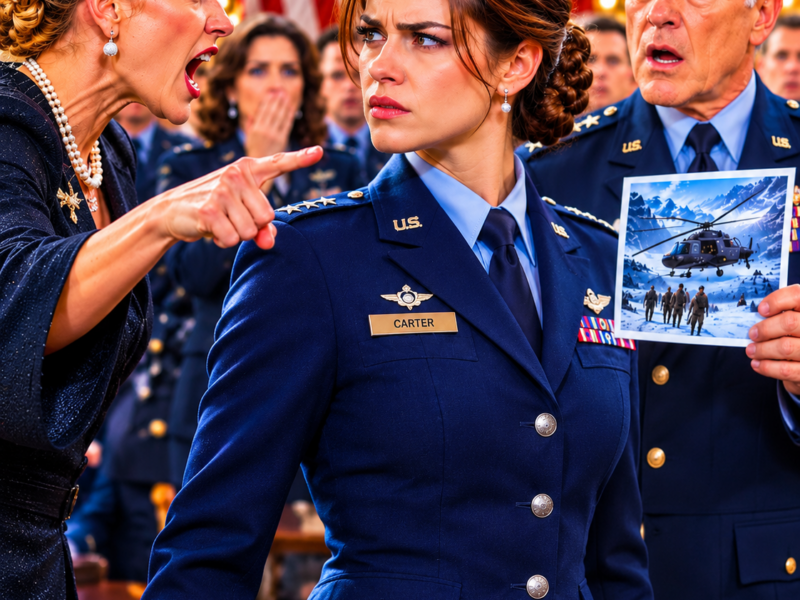
“‘I don’t believe you’re really a captain,’ the woman said, looking me up and down in front of the entire command staff.
The room fell silent.
The woman stared at me as if she were waiting for someone to tell her that she had misunderstood.
“Your husband?” I asked quietly.
She nodded, but her expression had changed completely.
“My husband was one of the soldiers involved in a helicopter crash five years ago. He told me they were rescued during a terrible snowstorm. But he never told me the pilot’s name.”
I looked down at the photograph.
The faces in it brought back memories I had spent years trying to put away.
Eight soldiers.
One damaged helicopter.
A mountain valley buried beneath snow.
And a decision that had nearly cost my crew and me our lives.
“Yes, ma’am,” I finally said. “I was the pilot on that rescue mission.”
Her lips parted, but no words came out.
The general placed the photograph on the table.
“Before anyone makes another judgment about Captain Carter, I think everyone in this room deserves to understand what happened that day.”
He turned toward the briefing room.
“Captain, would you be willing to tell us?”
I glanced at my mission folder.
Today’s operation was still waiting.
But I knew this conversation could not simply be ignored.
“Yes, sir. I can explain.”
The woman slowly pulled a chair away from the wall.
Her son stood beside her, looking embarrassed by what had happened earlier.
I took a breath.
“Five years ago, I was assigned to a rescue aviation unit operating out of a remote military airfield. We received an emergency transmission from a transport aircraft carrying eight American soldiers through a mountain corridor.”
The general nodded.
“The aircraft had lost control during a severe storm,” I continued. “It struck a ridge and went down in a narrow valley. The surviving soldiers managed to transmit their approximate location before the radio failed.”
“Were they injured?” the younger man asked.
“Some were. One had a serious leg injury. Another had a head wound. They had very little food, limited medical supplies, and no reliable shelter.”
The woman pressed her hands together.
“Was my husband among them?”
I looked at her.
“I don’t want to give you the wrong information. I remember the names from the rescue report, but I would rather confirm them before I say anything.”
The general opened a folder.
“That’s understandable. We’ll verify the mission record.”
He paused.
“But I remember the weather that day. Every available report advised against flying into that valley.”
He was right.
The storm had been one of the worst recorded in that region.
Winds were shifting unpredictably between the mountain walls.
Snow was reducing visibility to almost nothing.
And the temperature was dropping fast.
Our operations commander had gathered the available pilots.
“Ladies and gentlemen, we have eight personnel stranded in the northern valley. The aircraft is destroyed. Their emergency beacon is intermittent. We have a limited window before conditions make survival unlikely.”
He pointed to the weather map.
“No aircraft will be cleared to enter the valley unless the conditions improve.”
No one spoke.
I studied the terrain.
There was one narrow approach between two ridgelines.
It was dangerous even under normal conditions.
In that storm, it looked almost impossible.
The commander continued.
“We’re requesting volunteers for a rescue attempt. Understand that this is not a routine extraction. If the aircraft loses stability inside that pass, there may be no room to recover.”
I looked at the photograph of the eight soldiers attached to the briefing report.
They were young.
They had families.
Somebody was waiting for every one of them to come home.
I stood up.
“Sir, I’ll take the rescue mission.”
The commander looked at me.
“Captain, you understand what you’re volunteering for?”
“Yes, sir.”
“The weather is deteriorating. We have no guarantee of a safe landing, and the return route may be closed before you get back.”
“I understand.”
He studied me for several seconds.
“Why are you willing to take that risk?”
I remembered the answer I had given him.
“Because those soldiers are still alive, sir. We cannot leave them behind.”
The commander looked toward the other officers.
Then he signed the mission authorization.
“Your mission is approved. Bring every one of them home.”
I nodded.
“I won’t let your trust go to waste, sir.”
Within minutes, my crew was preparing the helicopter.
My copilot, Daniel Brooks, climbed into the cockpit while the rescue medic checked the medical equipment.
Daniel had flown with me before.
He knew when I was confident.
He also knew when I was worried.
That morning, he looked at the weather report and shook his head.
“This is going to be a rough one.”
“It’s already a rough one,” I replied.
He gave a brief smile.
“Then let’s make sure we come back.”
I checked the instruments.
Fuel levels.
Hydraulic pressure.
Engine temperature.
Navigation equipment.
Emergency systems.
Every detail mattered.
“Rescue team ready?” I asked over the intercom.
“Ready, Captain.”
“Daniel?”
“Ready.”
I took one final look at the weather display.
“Then let’s get those soldiers home.”
The helicopter lifted from the airfield.
At first, the flight was manageable.
The clouds were thick, but the instruments gave us enough information to maintain our route.
As we approached the mountains, the turbulence became stronger.
The aircraft shook.
Snow struck the windshield.
Daniel adjusted the navigation display.
“Captain, the wind is changing direction.”
“I see it. Keep monitoring the crosswind.”
“Visibility is dropping.”
“Stay on instruments. Don’t chase what you can’t see.”
The radio crackled.
“Rescue aircraft, this is command. Weather conditions are worsening. Confirm your status.”
I pressed the transmission switch.
“Command, this is Captain Carter. We’re approaching the mountain corridor. Aircraft remains stable. Continuing toward the emergency beacon.”
There was a pause.
“Captain, you are authorized to abort if conditions exceed safe operating limits.”
“Understood.”
I knew that authorization was important.
The mission mattered, but so did the lives of my crew.
A rescue that created more casualties would help no one.
We continued carefully, monitoring every change.
Then Daniel leaned forward.
“Captain, I think I see an emergency signal.”
“Confirm its location.”
He adjusted the display.
“Signal is intermittent. Bearing matches the reported crash site.”
I checked our position.
“We may have found them.”
A few seconds later, the rescue team spotted movement near the wreckage.
“Captain, I can see personnel on the ground.”
“How many?”
“Eight. I can see all eight survivors.”
I felt a wave of relief.
“Keep the helicopter steady. We’re bringing them out.”
The landing area was extremely narrow.
A ridge rose on one side, while broken rocks and a steep drop occupied the other.
The snow made the surface difficult to assess.
Daniel studied the approach.
“Captain, there’s barely enough room.”
“I know. We’ll make one controlled approach. If the landing area isn’t stable, we pull away and reassess.”
The aircraft descended slowly.
The wind pushed against the helicopter.
I corrected our position while Daniel called out the distance.
“Ten feet.”
“Five.”
“Three.”
The skids touched the ground.
For one second, the helicopter rocked sharply.
Then it settled.
“Landing confirmed,” Daniel said.
I released a breath.
“Open the cabin door. Move the survivors quickly.”
The rescue team rushed out.
The soldiers were exhausted.
Their uniforms were covered in snow and dirt.
One had his arm wrapped in a makeshift bandage.
Another was leaning against a piece of wreckage.
A medic began checking their condition.
“Captain, we have seven soldiers moving toward the aircraft.”
“Keep them together. Check everyone before loading.”
A rescue specialist approached me.
“Captain, one of our men is still trapped near the wreckage.”
I looked toward the crash site.
“Where?”
He pointed toward a section of the damaged transport aircraft.
“He was helping another soldier when part of the structure collapsed. We saw him moving a few minutes ago, but we can’t reach him.”
Daniel came over the radio.
“Captain, the weather is getting worse. We should leave now.”
I looked at the seven soldiers waiting beside the helicopter.
Then I looked at the wreckage.
“How long has he been trapped?”
“Approximately twenty minutes.”
“Is he still alive?”
“We believe so.”
Daniel spoke again.
“Captain, we don’t have much time.”
I understood his concern.
The aircraft was already being pushed around by the wind.
The safest choice was to take the seven survivors and return.
But one soldier was still out there.
I looked at the rescue specialist.
“Show me where he is.”
Daniel came closer.
“Emily, the helicopter may not be able to remain here much longer.”
“I know.”
“If we lose the aircraft, we lose our way out.”
I met his eyes.
“We’re not leaving him.”
For a moment, Daniel said nothing.
Then he nodded.
“Understood. I’ll keep the aircraft ready.”
I took a small rescue team toward the wreckage.
The snow was falling harder.
Every step was difficult.
We moved carefully around the broken metal and unstable ground.
Then I heard a faint voice.
“Help!”
I stopped.
“Where are you?”
“Over here!”
We followed the sound to a section of the transport aircraft that had partially collapsed against the rocks.
A soldier was trapped underneath a heavy metal panel.
His face was pale.
One of his legs was pinned.
He looked at me with exhausted eyes.
“I thought nobody was coming back for me.”
I crouched beside him.
“I told you nobody gets left behind.”
The rescue specialist examined the panel.
“Captain, it’s too heavy to move alone.”
“Then we don’t move it alone.”
We positioned ourselves around the metal.
“On three,” I said. “One, two, three.”
We pushed.
The panel shifted slightly.
The soldier cried out.
“Stop! My leg!”
We released the pressure.
The medic checked him.
“His leg is injured, but he’s conscious. We need to free him without making it worse.”
I looked at the structure.
Another section of metal was resting against the panel.
If we lifted the wrong side, the entire piece could shift.
“Get the support brace,” I ordered.
The rescue specialist retrieved it.
We placed the brace underneath the unstable section.
Then we tried again.
The panel moved enough to create space.
The soldier pulled his injured leg free.
“Got him!” the medic shouted.
We began moving toward the helicopter.
Then the ground shook.
At first, I thought it was another strong gust of wind.
But the sound grew louder.
The rescue specialist looked toward the mountain.
“Captain!”
I turned.
A mass of snow was moving down the slope.
An avalanche.
“Move! Get everyone away from the wreckage!”
The soldier could barely walk.
The medic and I supported him while the rescue specialist cleared the path.
“Captain, I can’t move any faster!”
“Keep going. We’re almost at the safe area!”
The snow surged behind us.
We reached a narrow section of rock just as the avalanche swept across the wreckage.
The force sent a cloud of snow over the valley.
For several seconds, I could see nothing.
Then the air cleared.
We were still standing.
The soldier was still with us.
The medic checked him immediately.
“We made it.”
I looked toward the helicopter.
“Let’s get him aboard.”
When we reached the aircraft, Daniel was waiting at the open cabin door.
“Emily, we need to leave. Now.”
I helped the injured soldier inside.
“That’s everyone.”
Daniel counted the survivors.
“One, two, three…”
He stopped.
“Captain, I have eight.”
I looked around the cabin.
“Confirm it.”
“Eight survivors. All accounted for.”
I returned to the cockpit.
“Command, this is Captain Carter. We have all eight soldiers. Request immediate medical evacuation.”
The radio responded through heavy static.
“Captain Carter, your signal is breaking up. Confirm your condition.”
I looked at the instrument panel.
A warning light had appeared.
Daniel saw it too.
“Hydraulic pressure is dropping.”
I checked the readings.
The helicopter had taken damage during the landing and the return from the wreckage.
“Switch to emergency procedures,” I said.
“Understood.”
The aircraft began drifting toward the mountain.
I corrected the controls carefully.
“Stay with me, Daniel.”
“I’m here.”
The wind pushed us sideways.
For several moments, the helicopter struggled to maintain its heading.
Then the warning became more serious.
“Captain, we’re losing more pressure.”
“Keep the emergency system engaged. Monitor the remaining controls.”
Daniel worked through the checklist.
I focused on stabilizing the aircraft.
We were carrying eight injured soldiers.
There was no room for another mistake.
“Brace yourself,” I said.
The helicopter shook violently.
“Hold tight. We’re putting it down.”
I identified a relatively level clearing ahead.
It was not ideal, but it offered the best chance of keeping the aircraft upright.
The descent was rough.
The skids struck the ground.
The helicopter slid several feet before stopping.
“Everyone out!” I shouted. “Move away from the aircraft!”
The rescue team helped the soldiers exit.
The medic began checking their injuries.
Daniel climbed out last.
“Captain, are you hurt?”
I looked down and noticed blood running from a cut near my arm.
I hadn’t even felt it.
“It’s nothing serious. Check the survivors.”
He looked unconvinced.
“Emily, you need medical attention.”
“After the soldiers.”
I reached for the radio.
The signal was weak, but it was still working.
“Command, this is Captain Carter. Emergency landing completed. We have eight survivors. Aircraft is no longer airworthy. Request immediate ground rescue and medical evacuation.”
Static filled the channel.
Then a voice answered.
“Captain Carter, we have your transmission. Ground teams are moving toward your position. Remain together and conserve heat.”
I looked at the soldiers.
Eight men.
Eight lives.
All of them breathing.
One of them reached toward me.
“Captain.”
I turned.
“Thank you for coming back.”
I knelt beside him.
“I gave you my word.”
He looked down, struggling to hold back tears.
“I thought we were going to die out there.”
“You’re going home now.”
The ground rescue team reached us later that day.
Every soldier was evacuated.
Every one received medical attention.
My crew and I were also taken for treatment.
The injury to my arm required several stitches.
Daniel suffered a bruised shoulder.
The rescue specialist had a fractured wrist.
But we were alive.
And so were the eight soldiers.
When I finished telling the story, the briefing room was silent.
The woman who had questioned my rank was sitting with both hands resting on her knees.
Her eyes were wet.
The general opened the mission report.
“Captain Carter, I have the official record here.”
He read through the names.
Then he stopped.
“Sergeant First Class Michael Whitmore.”
The woman suddenly covered her mouth.
“That was my husband.”
I nodded slowly.
The general continued.
“Sergeant Whitmore was the eighth soldier recovered from the wreckage. He suffered a serious leg injury but survived.”
The woman began crying quietly.
Her son placed a hand on her shoulder.
“Mom, that’s Dad.”
She looked at me.
“You saved my husband?”
“I was part of the team that brought him home,” I said. “There were several people involved. My crew, the rescue specialists, the medics, and the ground teams. I didn’t do it alone.”
“But you went back for him.”
I didn’t answer immediately.
The memory of that day was still clear.
The metal panel.
The avalanche.
The radio warning.
The injured soldier looking at me as if he had already accepted that nobody was coming.
“Yes, ma’am. We went back.”
She lowered her head.
“I didn’t know.”
I could hear the regret in her voice.
The general gently closed the report.
“Your husband survived because Captain Carter and her team refused to abandon him.”
The woman wiped her eyes.
“I owe you an apology.”
I shook my head.
“You don’t owe me anything.”
“Yes, I do.”
She stood.
“I questioned your rank. I questioned whether you belonged here. I said you weren’t qualified, and I did it without knowing anything about you.”
I looked at her.
“I understand that you wanted to protect your family. But the uniform doesn’t always tell you someone’s whole story.”
She nodded.
“I was wrong.”
Her son looked at me.
“Captain, I’m sorry too. I should have stopped her earlier.”
“You tried,” I replied. “That’s enough.”
The general glanced at the clock.
“We have a mission briefing to complete.”
I picked up my folder.
“Yes, sir.”
But before we entered the room, the woman asked one more question.
“Captain Carter, may I ask something?”
“Of course.”
“Did my husband ever say anything about his family during the rescue?”
I thought for a moment.
I remembered the injured soldier asking whether his family would know he was alive.
I remembered how carefully he had held a small photograph while the medic treated his injuries.
“He asked us to make sure his family knew he was coming home.”
The woman began crying again.
“He never told me that.”
“He was worried about you,” I said. “He wanted to get back to you.”
She looked down at her hands.
“I wish I had known what he went through.”
“I’m sure he would rather tell you himself.”
She gave a small, emotional smile.
“I hope I get that chance.”
The general opened the briefing room door.
“Captain, we’re ready.”
I nodded and walked inside.
The mission awaiting us that morning was serious.
A remote team had lost communications during a dangerous operation in difficult terrain.
Their exact position was uncertain.
The weather was changing, and the rescue window was limited.
The command staff needed a pilot who could assess the risks, coordinate the available aircraft, and make decisions under pressure.
I took my place beside the operations map.
The general introduced me to the team.
“Captain Emily Carter will lead the aviation portion of this mission. She has the required qualifications and operational experience. I expect everyone to give her the cooperation this assignment requires.”
No one questioned my rank.
No one asked whether I belonged.
We began the briefing.
I studied the map, reviewed the weather information, and asked the team to identify the safest possible approach.
I did not assume the previous rescue made me invincible.
Five years earlier, I had learned that courage without preparation could become recklessness.
I wanted every person involved in this mission to return safely.
As the briefing continued, the younger man from the hallway approached me.
“Captain, may I speak with you?”
“Of course.”
He glanced toward his mother, who was waiting near the door.
“My father still walks with a cane because of his injury. But he’s here because of what you did.”
I nodded.
“I’m glad he’s home.”
“He’s going to want to meet you.”
“I’d be honored.”
He hesitated.
“There’s something else. My mother has spent years worrying about losing him. I think that’s why she reacted the way she did. It doesn’t excuse what she said, but I wanted you to know.”
“I understand.”
He shook my hand.
“Thank you for giving him another chance to come home.”
I watched him return to his mother.
Then I looked down at the mission folder.
The past had found me in an unexpected way.
But the people waiting for help today mattered just as much as the eight soldiers had mattered five years ago.
The operation proceeded.
We established contact with the missing team, coordinated the rescue aircraft, and identified a safe extraction route.
The weather remained challenging, but the conditions were within the approved operating limits.
Our crew completed the mission without losing anyone.
By late afternoon, every member of the team had been accounted for.
The general met me outside the operations center.
“Well done, Captain.”
“Thank you, sir.”
He handed me a document.
I looked at the heading.
It was an official recognition package for the rescue mission five years earlier.
“Sir, what’s this?”
“Your previous rescue was reviewed again. The records confirm the risks you and your crew accepted, the lives you saved, and the decisions you made under pressure.”
I read the first few lines.
“Your command has approved a formal ceremony to recognize the mission.”
I looked up.
“Sir, I don’t need a ceremony.”
“I know. But recognition isn’t always about the person receiving it. Sometimes it’s about making sure the people who served alongside them are remembered.”
That changed my answer.
“My crew should be included.”
“They will be.”
“And the rescue specialists?”
“Everyone listed in the mission report will be recognized.”
I nodded.
“Then thank you, sir.”
A few weeks later, the ceremony took place at the military installation.
The room was filled with service members, families, and senior officers.
My crew from the rescue mission stood in the front row.
Daniel was there.
The rescue specialist who had helped free Sergeant Whitmore was there too.
I felt more nervous standing in front of that audience than I had felt during the mountain rescue.
The general stepped to the podium.
“Today, we recognize extraordinary courage and devotion to duty. Five years ago, during a severe winter storm, eight American soldiers were stranded in a remote mountain valley. The weather made the rescue extremely dangerous. Yet a crew volunteered to go in, and when seven soldiers had been recovered, they returned for the eighth.”
He paused.
“That decision was not made by one person alone. It required teamwork, discipline, and a commitment to the principle that no service member should be abandoned when there is still a reasonable chance to bring them home.”
He turned toward me.
“Captain Emily Carter, please come forward.”
I walked to the front.
The general read the citation.
“For extraordinary heroism, exceptional judgment, and unwavering devotion to the lives of fellow service members during a dangerous rescue operation.”
He presented the medal.
I saluted.
“Thank you, sir. I was doing my duty.”
The audience applauded.
But I looked toward Daniel and the rescue team.
They deserved to stand there too.
The general invited them forward.
“This recognition belongs to the entire crew.”
We stood together as the applause grew louder.
Then I noticed someone near the back of the room.
The woman from the hallway.
She was standing beside her husband.
He walked slowly with a cane.
His hair had turned gray, and he looked older than the soldier in the photograph.
But I recognized his face.
Sergeant First Class Michael Whitmore.
He approached carefully.
“Captain Carter?”
I stepped down from the platform.
“Yes, Sergeant.”
He extended his hand.
“I’ve wanted to meet you for five years.”
I shook it.
“I’m glad you’re here.”
He looked at my medal, then at Daniel.
“I remember that day. I remember the sound of the helicopter. I remember thinking nobody would come back because the weather was too bad.”
He paused.
“Then I heard your voice.”
I remembered the moment.
He had been trapped beneath the wreckage, barely able to move.
“You told me we weren’t leaving anyone behind,” he continued. “I held on to those words.”
I felt my throat tighten.
“You did the hard part, Sergeant. You survived.”
He shook his head.
“You came back for me. That’s something I’ll never forget.”
His wife stood beside him.
She looked at me with tears in her eyes.
“I owe you more than an apology.”
I gently shook my head.
“Your husband is standing here. That’s enough for me.”
She looked toward him.
“He told me everything after he saw the photograph in the command center. He told me about the storm, the wreckage, and how you returned when the helicopter was already in danger.”
She took a breath.
“I was so focused on protecting him that I forgot to respect the people who had protected him before I ever met them.”
I listened.
“I judged you because I thought experience had a certain appearance. I thought I could recognize an officer by looking at one.”
She lowered her eyes.
“I was wrong.”
I looked at her.
“People don’t always know what someone has faced. That’s why it’s important to ask before deciding.”
She nodded.
“I’ll remember that.”
Sergeant Whitmore reached into his jacket.
“My daughter asked me to give you something.”
He handed me a folded letter.
I opened it carefully.
The handwriting was uneven, but the message was clear.
Dear Captain Carter,
I was too young to understand what happened when my father was rescued. I only knew that one day he was gone, and then he came home.
I grew up hearing that a brave pilot had flown through a storm to bring him back.
I don’t know if you remember him, but I want you to know that because you came back for him, I got to grow up with my father.
Thank you for giving our family more years together.
I read the letter twice.
For a moment, I couldn’t speak.
The woman beside him touched my arm gently.
“That’s our daughter. She’s in college now.”
I looked at the letter again.
I had remembered the eight soldiers.
I had remembered the weather, the aircraft, and the difficult decisions.
But I had never fully understood how far the consequences of that mission had reached.
I had not simply helped eight soldiers survive.
I had helped eight families continue.
I folded the letter and held it carefully.
“Please tell her I am grateful she wrote to me.”
Sergeant Whitmore smiled.
“She wants to meet you one day.”
“I would like that.”
The general approached us.
“Captain, I believe there is one more thing you should know.”
I turned toward him.
“Sir?”
He held a second document.
“Your crew’s actions during the rescue have been submitted for additional recognition. The review board has also recommended that your experience be incorporated into our aviation rescue training program.”
I looked at the document.
“Sir, I hope they include the mistakes and the difficult decisions too. People need to understand that the mission was dangerous. They should learn how to evaluate the risks, not simply repeat the story.”
The general smiled.
“That is exactly why we want your input.”
I nodded.
“Then I’ll be happy to help.”
Later that evening, I returned to my quarters.
I placed the medal on the desk and set the letter beside it.
The medal represented a moment of recognition.
The letter represented something much larger.
It reminded me that every mission had a human story behind it.
Every name on a rescue report belonged to someone who was loved, missed, and expected home.
I thought about the woman who had questioned my qualifications.
At first, her words had angered me.
But I understood something now.
I didn’t need to spend my life proving myself to every person who doubted me.
My responsibility was to prepare, to serve, to make sound decisions, and to protect the people entrusted to my care.
The uniform was not a promise that I would never be questioned.
It was a responsibility to keep earning the trust placed in me.
The following morning, I visited the flight line.
Daniel was already there, inspecting an aircraft.
He looked up when he saw me.
“Morning, Captain.”
“Morning.”
He glanced at the medal ribbon in my hand.
“Still getting used to that?”
“A little.”
He laughed.
“You know, I think the best part wasn’t the ceremony.”
“What was it?”
“Seeing Whitmore walk into that room with his family.”
I nodded.
“That was the best part.”
We stood quietly for a moment, watching the aircraft crews prepare for the day’s work.
Then Daniel turned toward me.
“Ready for the next mission?”
I looked toward the hangar.
“Always prepared. Never careless.”
He smiled.
“That’s the Captain Carter I know.”
I put the letter safely inside my folder.
The day before, someone had questioned whether I was a real captain.
I could have answered with my rank, my records, or my medal.
But none of those things mattered as much as the eight soldiers who had returned home.
And none of them mattered as much as the families who had been given another chance to be together.
I had not flown into that frozen valley to become a hero.
I had gone because eight people needed help.
And when one of them was still missing, turning back was never an option.
Because the greatest measure of a uniform is not how impressive it looks.
It is what the person wearing it is willing to do when someone else’s life depends on them.
THE END.









