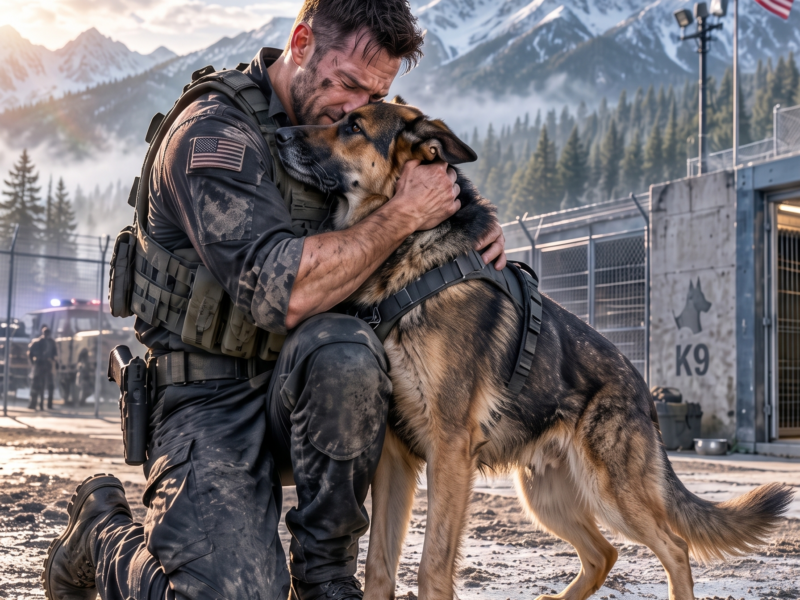
I collapsed on the wet pavement outside a Seattle animal shelter when I saw my missing dog sitting behind the glass
The rain in Seattle did not fall in discrete drops; it hung in the air like a silver curtain, heavy and ice-cold, soaking through the canvas of my field jacket until the chill reached my ribs. I had driven six hours through the pitch-black highway from eastern Washington, the engine of my worn pickup whining against the mountain passes, powered by nothing more than three cups of black gas station coffee and a photo sent to my phone by an anonymous number at midnight.
The photo had been blurry, taken through a rain-streaked window under harsh neon light. But I didn’t need a high-resolution image. I knew the angle of those ears. I knew the deep, silver-dusted chest. Most of all, I knew the jagged, inch-long white scar cutting through the black fur just above the left eye—a souvenir from a jagged piece of shrapnel in the Helmand Province that had missed my skull because a nineteen-month-old black German Shepherd had lunged and pulled me into a ditch a split second before the mortar landed.
I slammed the truck door and walked up the concrete steps of the King County Animal Care facility. The building was a brutalist block of pale concrete tucked between an industrial park and an overgrown marsh. The air inside smelled of industrial bleach, wet fur, and the quiet, heavy misery of forgotten animals.
I didn’t stop at the front desk. I followed the low, echoing sound of distant barking through a set of double doors leading into the long-term holding ward.
And there he was.
He was behind the thick safety glass of Kennel 104. He was thinner than he had been three years ago—his hip bones jutted slightly against his dark coat, and the muzzle that had once been coal-black was now heavily frosted with gray. But he wasn’t asleep. He was sitting perfectly erect, his dark brown eyes locked onto the double doors the moment I pushed them open.
My knees buckled. I didn’t mean to fall, but three years of grief, sleepless nights, and endless, dead-end searches hit me like a physical blow. I collapsed onto the wet linoleum floor, my palms scraping against the cold surface.
“Ranger,” I choked out, the sound barely escaping my throat.
The dog’s ears flattened slightly, then snapped upright. He stood up in a single fluid movement. He didn’t bark. He walked up to the glass, placed his broad black nose directly against the cold surface, and exhaled a small patch of steam. Then, he began to whine—a high, sharp, heartbreaking sound that rose above the ambient noise of the shelter.
I dragged myself up and pressed my palm against the glass right where his nose was. “I’m here, buddy. I’m here.”
He slammed his forepaws against the glass, his tail thumping hard against the concrete wall behind him. The grief that had settled into my marrow since the day I came home from deployment to an open front door and an empty leash began to fracture. For three years, I had believed he was dead, or sold into some cruel dog-fighting ring, or dying alone on the side of a highway.
“Step away from the glass, sir.”
The voice was flat, sterile, and devoid of warmth.
I turned around. Standing at the end of the aisle was a woman in her late fifties wearing a dark green shelter smock. Her badge read Evelyn Vance – Shelter Director. Her hair was pulled back into a tight, neat bun, and her hands were tucked deep into her pockets. Her face was set in a rigid line that seemed far too defensive for a simple shelter worker.
“He’s my dog,” I said, my voice shaking as I stood up, wiping the rain and sweat from my forehead. “His name is Ranger. He was taken from my house in Tacoma three years ago.”
“That animal is not available for adoption,” Vance said, her eyes skipping past me to look directly at the dog. “You need to step back into the lobby.”
“I’m not adopting him,” I said, pulling out my wallet with trembling fingers. I pulled out my dog’s old rabies certificate, his microchip registration card, and a folded, worn photograph of him sitting on the hood of my Humvee in Afghanistan. “I’m reclaiming him. I have his papers. I have his chip number. Look at him! He knows me.”
Ranger slammed against the glass again, letting out a sharp, demanding bark.
Vance didn’t even look at the papers I held out. She kept her hands in her pockets and took a single step forward, positioning her body between me and the kennel door. “I don’t care what papers you have, Mr. Mercer. That dog belongs to someone else now. He is under a hold.”
“A hold?” I stared at her, feeling a hot spike of anger cutting through my exhaustion. “What kind of hold? I am his legal owner. He was stolen!”
“You need to leave the premises,” she repeated, her voice rising just enough to signal finality. “If you do not leave, I will call county security.”
“Call them,” I snarled, stepping closer to her. “Call the police. Call whoever you want. I am not leaving this building without my dog.”
Before she could answer, Ranger let out another bark. But the tone changed instantly. It wasn’t the joyful, frantic whining he had made when he recognized me. It was a low, guttural, rhythmic growl that vibrated through the glass—the exact warning sequence he was trained to give when an unrecognized threat entered a secure perimeter.
I froze. I knew that bark better than my own voice.
I turned back to the glass. Ranger wasn’t looking at me anymore. He wasn’t looking at Director Vance either. He was staring down at his own chest, rubbing his neck frantically against the corner of the low steel feeder bowl built into the wall. He scratched at his neck with his left hind paw, tearing at something around his throat.
I looked closer. Beneath the thick, matted black fur of his neck, under the standard shelter nylon strap, there was a second collar. It was a thin band of heavy-duty black Kevlar webbing. Hanging from it wasn’t a standard brass tree-leaf tag or a rabies clip.
It was a small, rectangular piece of brushed steel, no larger than a thumb drive.
I leaned closer to the glass, ignoring Vance’s sharp intake of breath. The steel tag had no name. It had no phone number. Stamped deep into the metal were two lines of text:
PROPERTY OF US GOVT – CLASSIFIED MATERIEL
REF: 04-8819-K9
My blood went instantly cold.
Those last four digits—8819. They were burned into my memory. They weren’t a dog license number. They were the last four digits of the operational file code for Operation Winter Viper—the final, catastrophic recon mission my unit had carried out in the Korengal Valley. The mission where my spotter and closest friend, Chief Petty Officer Marcus Kane, had been killed in action.
I slowly turned back to look at Director Vance. Her face had drained of all color. The rigid, professional posture she had maintained seconds ago was gone, replaced by a subtle, terrified tremor in her lower lip.
“Where did you get him, Vance?” I whispered, my voice flat and dangerous. “The text message I got said he was brought in as a stray from the highway. That’s a lie, isn’t it?”
She swallowed hard, her eyes darting past my shoulder toward the heavy metal door at the far end of the hallway—the door that led to the administrative offices and the private loading dock.
“He wasn’t found,” she whispered, her voice barely audible over the hum of the ventilation system.
“Then how did he get here?”
The heavy metal door at the end of the hallway clicked. The lock disengaged with a loud, hydraulic hiss.
“He was delivered,” a voice called out from the dark corridor beyond.
A man stepped through the door into the fluorescent light of the kennel ward. He wore a crisp, dark grey suit with no tie. His hair was cut in a tight, military fade, sprinkled with salt-and-pepper gray at the temples. He moved with the quiet, deliberate grace of someone who had spent decades in small rooms making decisions that ended lives.
I recognized him in less than a second.
Major Vance Miller. Three years ago, he had been Lieutenant Commander Miller—the senior intelligence officer attached to Special Operations Task Force 17 in Jalalabad. He was the man who had sat across from me in a dimly lit debriefing room, handed me a folded American flag, and told me that Marcus Kane’s body had been incinerated by an enemy RPG, leaving nothing behind to bring home.
He was also the man who had come to my off-base housing in Tacoma two months after I was discharged, looked at my empty living room, and told me with a cold, sympathetic smile that my dog had likely been stolen by local junkies looking for a quick sale.
Miller stood ten feet away from me, his hands loosely clasped in front of his waist. He looked at me, then looked at Ranger behind the glass.
“You always were too stubborn for your own good, Sergeant Mercer,” Miller said softly. “You should have stopped searching.”
The silence in the kennel ward was absolute, broken only by the rhythmic, shallow breathing of the dog behind the glass.
I didn’t lower my hands. My knuckles were still clenched into fists, the fingernails biting into my palms. “Miller,” I said, the name tasting like ash in my mouth. “What is this? Why is my dog wearing a military asset tag? Why did you tell me he was stolen?”
Miller didn’t answer right away. He turned his head slightly toward Director Vance. “Evelyn. Lock the front doors. Clear the staff out of the building. Tell them there’s a gas leak line check. I want this facility clear in five minutes.”
Vance didn’t hesitate. She didn’t ask for authorization or paperwork. She simply nodded, her face pale, and hurried back toward the front desk.
“Why?” I repeated, stepping directly into Miller’s line of sight, blocking him from the kennel door. “Why is Ranger here?”
“Because your dog wasn’t stolen, John,” Miller said, his tone infuriatingly calm, like a doctor explaining a terminal diagnosis to a patient. “He was recalled.”
“Recalled?” I let out a harsh, disbelieving laugh. “He was my personal animal! I bought him from a breeder in Montana before I was deployed. I trained him! The military didn’t own him!”
“The military funded his specialized cross-training when you were assigned to Task Force 17,” Miller corrected gently. “And when Marcus Kane’s mission went sideways in the valley, Ranger was the only asset on the ground that returned with uncompromised telemetry. We didn’t take him to hurt you, John. We took him because he was carrying something we couldn’t risk leaving in the hands of a civilian suffering from severe Post-Traumatic Stress.”
“You broke into my house,” I said, the realization settling into my gut like lead. “You raided my home, took my dog, and let me spend three years thinking he was dead or suffering.”
“We did what was necessary for national security,” Miller replied without a trace of remorse. “And frankly, we thought the dog was clear. He was kept at a secure facility in Fort Lewis for two years while we cleared the data. He was supposed to be euthanized last week after his secondary scans were completed. But someone inside the facility had a conscience. They loaded him into a transport, dropped him off here under a false intake form, and sent you that text message.”
Miller reached into his jacket pocket. I tensed, my muscles locking, ready to lung, but he simply pulled out a sleek, black encrypted satellite phone. “The person who texted you was arrested an hour ago, John. And I am here to secure the asset before it leaves this room.”
Behind the glass, Ranger suddenly stopped growling.
He dropped to his front elbows, his chest flush against the cold floor. He began furiously scratching at the seam where the concrete floor of his kennel met the reinforced glass wall. His heavy black claws made a metallic, screeching sound as he dug into the corner.
Miller’s eyes flicked to the dog. For the first time, his calm composure cracked. His eyebrows pulled together in a tight, sharp line. “What is he doing?”
“He’s searching,” I whispered.
I knew that behavior. It was his specialized search-and-index routine. When Ranger was deployed in the field to locate concealed electronic equipment or hidden caches, he didn’t bark when he found the primary target. He dug until he reached the primary housing, then laid his snout flat over the spot.
Ranger tore at a loose piece of hard rubber seal at the base of the glass. The rubber gave way, rotting from years of moisture and bleach exposure. Beneath the rubber, buried deep in a gap in the hollow concrete base of the frame, was a small, rectangular object wrapped tightly in green military electrical tape.
“Step away from the glass, John,” Miller said, his voice losing its calm tone, replaced by the sharp authority of a commanding officer. He reached inside his jacket again—this time, his hand didn’t come out empty. The matte-black frame of a suppressed 9mm pistol cleared his holster.
“You’re going to shoot me in a county shelter?” I asked, turning my body slightly to cover the glass panel behind me.
“No one is going to shoot anyone if you follow orders,” Miller said, leveling the weapon at my chest. “That dog was brought to this specific shelter because the person who stole him knew this facility used to be a Navy communications relay station in the seventies. That room behind him isn’t just a kennel ward, John. It’s a hardened vault. That drive he’s digging up isn’t old military data. It’s what Kane left behind.”
My heart stopped. “Marcus?”
“Kane didn’t die in the RPG blast, John,” Miller said softly, his finger resting lightly against the trigger guard. “We told you he died because the truth was significantly more complicated. Marcus went rogue. He took three terabytes of unredacted intelligence regarding illegal cross-border operations and disappeared into the tribal areas. We spent two years hunting him. We thought he was dead. But three weeks ago, Ranger was brought into Fort Lewis for a routine scan, and our techs found a secondary micro-transponder embedded in his shoulder—one that didn’t belong to us.”
Ranger gave a sharp, triumphant yip behind the glass.
With a loud snap, he pulled the object out of the concrete gap with his teeth and dropped it onto the floor right against the glass.
It wasn’t just a drive. It was a military-grade, waterproof, hardened micro-SSD drive, sealed in clear resin. Taped to the back of the resin was a small piece of faded green paper.
On the paper, written in messy, unmistakable block print, were six words:
JOHN – DON’T TRUST THE MAJOR.
I stared at the writing. It was Marcus’s handwriting. I had seen it on a hundred mission logs, on greasy napkin maps in dirt-floor barracks, on letters he wrote to his sister back home.
“Drop to your knees, John,” Miller said, taking two steps forward, raising the pistol directly at my face. “Hand me the drive through the feeding slot, and you walk out of here alive. You get to go back to your quiet life. You forget you ever had a dog. You forget you ever heard the name Marcus Kane.”
I looked at Miller. I looked at the dark muzzle of the suppressed pistol. Then I looked at Ranger.
The dog was looking directly at me through the glass, his tail giving a single, quiet thump against the floor. He knew what was happening. He had been through this before—in dirt alleys in Kandahar, in frozen pine forests in North Carolina. He was waiting for my command.
“Ranger,” I said, my voice dropping to a low pitch. “Red line.”
The dog didn’t bark. He didn’t jump. He threw his entire seventy-pound body violently against the quick-release lock on the interior feeder door.
The heavy steel feeding hatch snapped open with a violent metallic clang.
The hatch was designed to slide heavy rubber bowls into the kennel without opening the main door, but Ranger had spent eighteen months as a breach-support dog. He knew exactly how to use his body weight as a lever. The moment the hatch latch failed under his weight, he shoved his broad head through the opening, hit the external latch with his snout, and sent the door swinging wide.
Miller swung the suppressed pistol toward the opening, but I moved faster.
Three years of civilian life hadn’t erased ten years of infantry muscle memory. I lunged forward, grabbing Miller’s wrist with both hands and twisting it violently downward. The gun discharged with a quiet, muffled pop, the bullet slamming uselessly into the reinforced linoleum floor between my feet.
Miller slammed his left elbow into my jaw. Pain exploded behind my eyes, the metallic taste of blood filling my mouth, but I held onto his wrist, driving my shoulder into his chest and slamming him against the concrete wall of the kennel aisle.
Ranger burst through the open feeding door like a black bolt of lightning.
He didn’t go for Miller’s throat. He was a disciplined military working dog; he went for the threat vector. His heavy jaws locked onto Miller’s right forearm, the teeth crushing through the expensive suit fabric and biting deep into the muscle beneath.
Miller screamed, dropping the pistol. The gun skittered across the wet floor, coming to a stop under the metal bench near the front entrance.
“Off!” I yelled, pulling Ranger back by his tactical collar. “Ranger, heel!”
The dog instantly released his grip, stepping back to my side, his shoulder pressed firmly against my thigh, his breath coming in hot, ragged gasps, his lips peeled back in a silent, lethal snarl.
Miller fell to his knees, cradling his bleeding arm, his face twisted in shock and rage. “You idiot,” Miller choked out, squeezing his arm to stop the blood. “You have no idea what you’re stepping into. If you take that drive out of this building, every federal asset within three hundred miles will be hunting you by sunrise!”
“They’ve been hunting me for three years, Miller,” I said, snatching the resin-sealed drive from the floor where Ranger had dropped it. “They just didn’t know it.”
I grabbed the heavy metal door handle of the administrative corridor, shoved Ranger through first, and slammed the door shut behind us, throwing the manual deadbolt into place.
We were in a narrow, windowless hallway that led to the shelter’s back utility rooms. The air was thick with the smell of old paper and damp concrete. My heart was hammering against my ribs like a trapped bird. My hands were shaking so badly I could barely hold the resin drive.
“Come on, boy,” I whispered, patting Ranger’s side. He looked up at me, his eyes bright, his tail giving a swift, confident wag despite the chaos. He was back in his element. And God help me, so was I.
I ran down the hallway until I found a small janitor’s office with a desk, a dusty computer monitor, and a heavy wooden door that locked from the inside. I ducked inside, threw the lock, and wedged a metal mop bucket under the handle.
I sat down in the squeaky office chair and pulled out my rugged field laptop from my backpack—the one piece of gear I always carried in my truck. My hands were bloody from the scrape on my jaw, but I wiped them on my jeans and plugged the resin drive into the laptop’s external adapter port.
The computer screen flickered. A security prompt appeared, demanding a 256-bit encryption key.
I stared at the blinking cursor. What was the key? Marcus wouldn’t have used a standard military cipher—he knew the agency could break those. He would have used something personal. Something only we knew.
I looked down at Ranger. He sat beside my chair, resting his heavy gray-muzzled head on my knee, his dark eyes fixed on mine.
“What did he leave for us, Ranger?” I murmured.
I looked at the piece of faded paper again: JOHN – DON’T TRUST THE MAJOR.
Below those words, written in tiny, almost invisible pencil marks, was a string of coordinates: 34.8819, 71.1248.
The Korengal Valley. The exact grid location of Outpost Restrepo where Marcus and I had spent six months sleeping in the dirt under sniper fire.
I typed the coordinates into the password field, followed by Ranger’s military tattoo number: 348819711248-8819.
I hit Enter.
The screen went black for two agonizing seconds. Then, a green progress bar flooded across the monitor, followed by the sudden, sharp appearance of a file directory containing dozens of encrypted video files, mission logs, and audio recordings.
At the very top of the list was a single video file named: OPERATOR_KANE_STATEMENT_FINAL.MOV.
My breath caught in my chest. My fingers hovered over the trackpad.
Outside the office, I heard the distant, echoing sound of a heavy boot slamming against the steel corridor door down the hall. Miller’s men were already inside the building.
I plugged a thumb drive into the laptop, initiated a rapid transfer of all files, and double-clicked the video.
The screen flickered to life.
The video was low-resolution, shot on a handheld thermal tactical camera under the harsh, green glow of night-vision lighting.
The background was a cramped, rough-cut stone hut—the kind built by local shepherds high in the Hindu Kush mountains. Rain was pouring outside, the heavy thrumming sound leaking through the camera’s cheap microphone.
Sitting on a low wooden crate in the center of the frame was a man.
He was wearing a torn, dirt-caked combat uniform with the nametape torn off. His left arm was wrapped in heavy medical gauze, stained dark with dried blood. His beard was long, matted, and streaked with gray, his cheeks hollow from starvation.
But those eyes—bright, fierce, and piercingly blue—were unmistakable.
Marcus.
I let out a shaky breath, pressing my hand against the warm laptop screen. “Marcus… you son of a bitch.”
Ranger heard the voice from the laptop speakers. His ears snapped forward instantly. He stood up, whining softly, and placed his paws on the edge of the desk, staring at the screen with intense, quivering focus.
“John,” Marcus’s voice came through the laptop’s tiny speakers. It was raspy, dry, and punctuated by a shallow, painful cough. “If you’re watching this… it means Ranger did his job. It means the old boy found you.”
Marcus took a shaky breath and leaned closer to the lens.
“I don’t have much time. The satellite link is unstable, and Miller’s contractor teams are closing in on my position in the valley. They told you I died in the RPG attack at Grid 8819. That was a lie. The RPG was fired by our own support element—a private military company working directly under Miller’s personal authority.”
My skin crawled. I leaned closer to the screen, my blood running colder with every word.
“Operation Winter Viper wasn’t an intelligence mission, John,” Marcus continued, his voice dropping to a harsh whisper. “It was a cleanup operation. Miller was running an unauthorized black-budget logistics network through northern Pakistan, moving seized weapons and unregistered narcotics using military transport assets. We stumbled into their staging area by mistake. When Miller realized I had captured the manifest data on my tactical drive, he ordered the strike on our position.”
Marcus pulled a small, silver dog tag from around his neck and held it up to the camera. It was stained with dark grease.
“I survived the blast because Ranger dragged me out of the burning rubble before the second bird swept the area,” Marcus said, a faint, bitter smile touching his lips on the screen. “He stayed with me in the caves for four days, keeping me warm, fighting off wild dogs, until I could get to a local village that owed me a favor. But I couldn’t bring him with me when I went underground. He was too recognizable. So I hid the core data drive in his sub-dermal harness tracking casing and turned him loose near an ODA outpost, hoping the military would route him back to the States.”
Marcus paused, turning his head as if listening to something outside the stone hut. A series of distant, muffled explosions echoed through the video’s audio feed.
“Miller intercepted him before he ever reached you,” Marcus said, looking back at the camera, his eyes burning with absolute desperation. “They kept Ranger locked up in a black site, trying to extract the encryption key from his tracking unit without triggering the hard-wipe protocol I programmed into it. They didn’t realize that Ranger’s internal key was linked to you, John. To your voice. To your presence.”
Marcus leaned back, resting his head against the stone wall behind him.
“I’m moving north toward the Tajik border,” Marcus whispered. “I’m sick, John. The shrapnel in my side is infected, and I’m running out of antibiotics. But I’m not dying in these mountains. Not until Miller stands in front of a court-martial.”
The screen flickered violently as a heavy concussion wave rocked the stone hut in the video. Dust rained down over Marcus’s head.
“If you get this drive, take it directly to General Vance at Joint Base Lewis-McChord,” Marcus said, his voice rising over the static sound of the dying transmission. “Don’t trust anyone in civilian law enforcement. Don’t trust the agency. Go straight to the General. Tell him… tell him the Ghosts of Winter Viper are coming home.”
The video cut to static.
A sudden, violent crash echoed from the hallway outside the janitor’s office.
The wooden door frame splintered with a loud CRACK as a heavy boot slammed into the lock. The metal mop bucket wedged beneath the handle slid across the floor with a deafening screech.
“He’s in here!” a voice shouted from the hall. “Break the door down!”
I slammed the laptop shut, ripped the thumb drive out of the USB port, and shoved it deep into the front pocket of my tactical vest. I grabbed my laptop, stuffed it into my backpack, and looked around the small room.
There were no windows. Only a narrow ceiling air vent covered by an old metal grate.
“Ranger,” I whispered, pointing to the desk. “Up!”
The dog didn’t hesitate. He leaped gracefully onto the desk, his claws clicking on the laminate surface, his head reaching right toward the ceiling grate.
I grabbed a metal screwdriver from a open tool rack on the wall and jammed it into the corner of the air grate, twisting with all my strength. The rusted screws snapped like dry twigs, and the heavy metal grate tumbled down, crashing onto the desk.
“Up, boy! Go!” I ordered.
Ranger sprang upward with incredible agility, his powerful hind legs pushing off the desk as he pulled his chest through the narrow opening into the dark aluminum air duct above.
The office door gave way with a final, violent splintering sound. The wooden frame burst open, and two men in tactical gear with unflagged carbines shoved their way into the room.
I didn’t wait for them to raise their weapons. I grabbed the heavy metal mop bucket full of dirty water and bleach and hurled it straight into the face of the first man. He went down with a harsh cry, his weapon discharging wildly into the drywall.
I jumped onto the desk, grabbed the edges of the open ceiling duct, and hauled myself upward just as a volley of suppressed gunfire chewed through the desk surface beneath my feet.
The air duct was cramped, dusty, and freezing cold, smelling of rain and old grease. I crawled on my belly through the dark metal tube, following the sharp, rhythmic sound of Ranger’s paws digging into the metal ahead of me.
“Keep moving, Ranger!” I shouted over the sound of shouting down below.
We crawled twenty feet through the ceiling space until the duct terminated at a louvered metal vent on the exterior wall of the building. I slammed my heavy boot against the vent frame three times until the rusted metal gave way, bursting outward into the cold Seattle rain.
We tumbled out onto the wet gravel of the shelter’s rear loading dock, landing hard in a puddle of muddy water.
The rain was coming down even harder now, washing the blood from my face and the dust from my jacket. Across the gravel yard, my old Ford pickup was idling where I had left it, its exhaust blowing white steam into the freezing night air.
“Go! Go!” I yelled, sprinting toward the truck.
Ranger bounded beside me, his long strides clearing the water-filled potholes in the asphalt like a black shadow. He reached the passenger door first, leaping straight through the open window I had cracked six hours earlier.
I threw myself into the driver’s seat, slammed the truck into reverse, and stomped on the gas pedal just as Major Miller stepped out onto the loading dock platform.
He wasn’t holding his gun anymore. He was standing under the yellow security light, his suit jacket soaked with rain, his bleeding arm wrapped tightly in a white dish towel from the shelter kitchen.
He stared at me through the rain-streaked windshield as I spun the truck around, the tires screaming against the wet pavement, spraying gravel against the concrete wall.
He didn’t run. He didn’t try to stop me. He simply raised his functional left hand, holding his satellite phone to his ear, his lips moving as he gave orders to whoever was waiting on the other end of the line.
I slammed the truck into drive and tore out of the parking lot, hitting the main road at fifty miles an hour, the engine roaring as we accelerated into the dark, rain-drenched highway leading south toward Joint Base Lewis-McChord.
The highway was a black ribbon cutting through the endless, towering pine trees of the Pacific Northwest. The rain slammed against the glass in heavy sheet waves, but inside the cab, the heater was humming, blowing warm air across our feet.
I pulled off my heavy tactical glove and reached across the bench seat.
Ranger didn’t stay on the passenger side. He leaned his heavy body across the console, pressing his warm shoulder firm against my side, resting his graying chin directly on my thigh.
I let my fingers sink deep into the thick, coarse fur behind his ears. The small Kevlar collar with the government tag was gone—I had ripped it off in the duct and thrown it into the dark. On his neck was only his old, worn leather strap with the fading brass tag I had bought him when he was six months old.
“We got him, buddy,” I whispered, my voice thick with emotion as tears finally mixed with the rain on my cheeks. “We got the proof. We’re coming for him.”
Ranger let out a long, deep sigh, his eyes closing slowly as the steady warmth of the truck cab washed over him. For three years, he had carried the weight of a secret war on his shoulders. He had been captured, caged, hunted, and hidden. But he had never forgotten his training. He had never forgotten his duty.
And most importantly, he had never forgotten his way back to me.
I glanced down at the illuminated dashboard clock. It was 3:42 AM. Joint Base Lewis-McChord was forty miles south down Interstate 5. In two hours, General Vance would have the drive. In three hours, the federal warrants would be issued.
And somewhere six thousand miles away, high in the frozen, unforgiving stone peaks of the Hindu Kush mountains, a ghost in a torn uniform was sitting in the dark, waiting for the sound of an American helicopter coming to bring him home.
I pressed down on the gas pedal, holding my dog close, as we drove straight into the storm.
The end,









