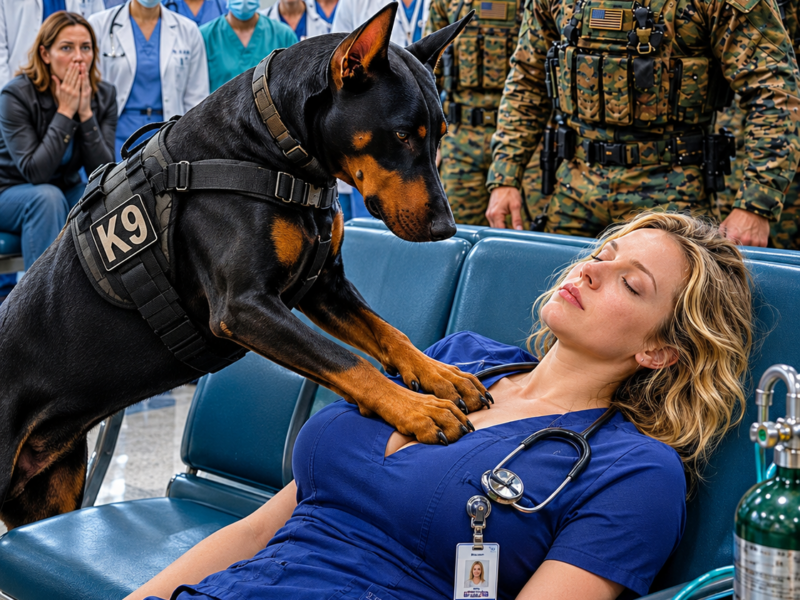
“I collapsed in the middle of the emergency room, and while my coworkers stood around wondering whether I was having a seizure
I looked at Whitfield as he reached for his radio.
“How far is the crash site?”
“About twelve miles. Interstate 285, near the western interchange. Hazmat is on the way, but the first units are already reporting multiple casualties.”
“How many?”
“Three vehicles involved. One tanker. At least six injured.”
I swung my legs off the examination bed.
Whitfield noticed immediately.
“You’re not going anywhere until the doctor clears you.”
“I am a doctor,” Feld interrupted from behind him. “And she’s not cleared for anything.”
I looked at him.
“Then send someone else.”
He frowned.
“Excuse me?”
“Send someone else to treat the casualties. Someone who has experience with major trauma, chemical exposure, and field triage. If you have them available, I’ll stay right here.”
Nobody answered.
Feld glanced toward the hallway, where nurses were already pulling emergency equipment from storage.
He knew the staffing situation as well as I did.
“You’re barely standing,” he said.
“Then give me five minutes to drink some water.”
Whitfield watched the exchange without interrupting.
Ranger sat beside my bed, his eyes moving between me and the open doorway.
Finally, Whitfield spoke.
“I can take her to the scene. She won’t be handling explosives. She’ll be assisting with medical response.”
Feld shook his head.
“You’re a police officer, not her supervisor.”
“No,” Whitfield replied. “But I’m responsible for the safety of my K9 unit, and right now my dog seems to have made a decision about her that I’d like to understand.”
I almost smiled.
“Your dog has questionable judgment.”
For the first time that night, Whitfield laughed.
“He’s usually better at reading people than I am.”
Twenty minutes later, I was sitting in the passenger seat of Whitfield’s response SUV.
Ranger was behind us, secured in his transport compartment.
My medical bag sat between my feet.
I had drunk two bottles of water, eaten half a protein bar, and allowed a resident to check my blood pressure.
It wasn’t exactly a medical clearance, but it was enough to convince me that I could walk without falling over.
The rain had turned into a fine mist.
Red and blue lights reflected across the highway as we approached the crash site.
I could see the tanker before we reached the roadblock.
It lay on its side across two lanes, its silver body torn open near the rear.
A strange yellowish sheen spread across the wet pavement.
Several firefighters were working near the guardrail.
Two ambulances stood with their rear doors open.
People were shouting over one another.
Whitfield parked well outside the immediate response area.
“Stay behind me until we know what we’re dealing with.”
I nodded.
Then I stepped out and smelled something that made my stomach tighten.
Not gasoline.
Not diesel.
Something sharper, almost sweet, with a chemical bitterness that caught at the back of my throat.
I pulled on my protective equipment.
“What’s the cargo?” I asked.
“Manifest says industrial cleaning compound. Hazmat is still confirming the exact contents.”
“Industrial cleaning compound isn’t specific enough.”
“That’s what I told them.”
A paramedic approached, carrying a medical kit.
“Sergeant, we’ve got two trapped in the sedan and a teenager thrown from the third vehicle. One of the firefighters thinks the tanker is still leaking.”
“Where’s your decon area?”
“Being established on the north side.”
“Move it farther upwind,” I said.
The paramedic looked at me.
“Who are you?”
“Someone who doesn’t want you treating contaminated patients before you’ve been decontaminated yourself.”
He looked toward Whitfield.
Whitfield nodded.
“Listen to her.”
That was all it took.
The first patient was a man in his fifties, trapped behind a collapsed dashboard.
His face was pale.
His breathing was shallow, and blood was pooling beneath his legs.
I knelt beside the open driver’s door.
“Sir, can you hear me?”
He nodded weakly.
“My wife,” he whispered.
“Where is she?”
“Other car.”
I looked toward the second vehicle.
A firefighter was already moving in that direction.
“We’re going to help her. Right now, I need you to keep looking at me.”
I assessed his injuries and called for pelvic stabilization equipment.
The paramedic beside me shook his head.
“We don’t have enough supplies for a proper field setup.”
“Then bring me a folded blanket and two lengths of webbing.”
He hesitated.
“That’s not standard.”
“Neither is leaving him to bleed.”
We stabilized his pelvis as carefully as we could and prepared him for extraction.
I guided the paramedic’s hands toward the source of the bleeding.
“Pressure here. Don’t move your hand until I tell you.”
His breathing steadied slightly.
The man reached for my wrist.
“Please find my wife.”
I looked into his eyes.
“We will.”
I meant it.
For the next twenty minutes, the scene became a series of decisions.
A teenager with a suspected femur fracture needed immobilization.
A woman with a scalp wound needed assessment.
A firefighter with chemical exposure needed immediate decontamination.
I moved between them, giving instructions, checking vital signs, and keeping the less experienced responders focused.
The younger nurse, Ramirez, arrived with another medical team.
She looked at me as though she were seeing a different person.
“Charlie?”
“Glad you made it. I need you at the triage line.”
“You shouldn’t even be here.”
“That’s an excellent conversation for another night.”
She almost laughed.
Then a shout came from near the tanker.
“Dog alert!”
I turned.
Ranger was standing near the wreckage.
Whitfield held the leash loosely, but the dog’s body had gone rigid.
His nose was directed toward a dented steel drum partially buried beneath the tanker’s rear frame.
Ranger sat.
He didn’t bark.
He didn’t scratch.
He simply stared.
I knew that alert.
Whitfield’s expression hardened.
“That’s not on the cargo manifest.”
I looked at the drum.
“Are you sure?”
“Completely. The tanker manifest lists four sealed compartments. That drum isn’t supposed to be there.”
I looked at the wreckage again.
The drum was tucked beneath the undercarriage, partly concealed by twisted metal.
It hadn’t fallen there accidentally.
Someone had placed it there.
“Sergeant, get everyone back.”
Whitfield glanced at me.
“How far?”
“At least fifty feet immediately. Let the bomb technicians determine the final distance.”
“You’re saying it’s an explosive?”
“I’m saying we don’t know what it is, and nobody should be standing next to it while we find out.”
He keyed his radio.
“All units, expand the perimeter. Move personnel upwind. Keep civilians back. We have a possible secondary device.”
A firefighter started arguing.
“We’ve still got someone trapped in that sedan!”
I pointed toward the ambulance.
“And he’s not going to survive if you create another casualty. Get him out through the western approach.”
Whitfield repeated the order.
This time, everyone moved.
I returned to the medical line, but my attention remained on the drum.
There was something about its position that bothered me.
It wasn’t simply hidden.
It had been placed where the tanker’s weight would hold it against the pavement.
I crouched behind the safety barrier and studied it from a distance.
A thin black cable disappeared beneath a section of twisted metal.
I couldn’t see where it led.
My mouth went dry.
“Whitfield.”
He approached.
“What?”
“Don’t let anyone move the tanker until EOD examines that cable.”
His face tightened.
“You think it’s connected?”
“I think assuming it isn’t could get people killed.”
He relayed the warning.
Then he turned toward me.
“Charlie, I need you to tell me something.”
“Not now.”
“Have you seen something like this before?”
I looked at the steel drum.
Six years earlier, I’d been kneeling beside Duke on a dusty road overseas.
The dog had stopped.
His ears had shifted.
His body had become perfectly still.
I’d known something was wrong, but the convoy commander had been impatient.
We were behind schedule.
The road had already been checked once.
I had argued for another inspection.
I had lost that argument.
Duke had alerted again.
Then the explosion came.
I closed my eyes for one second.
When I opened them, Whitfield was still waiting.
“Yes,” I said.
His expression changed.
“Where?”
“Afghanistan.”
He didn’t ask anything else.
Not then.
A radio crackled.
“EOD is ten minutes out. Maintain the perimeter.”
Ten minutes.
It felt like an hour.
I continued treating patients from the safe side of the road.
The trapped driver was finally extracted.
His wife was alive, though badly injured.
When I told him she was in the second ambulance, he began crying.
He reached for my hand.
“Thank you.”
I squeezed his fingers.
“Stay with us. You’ve still got someone to argue with when you get home.”
He gave a weak smile.
Then the paramedics loaded him into the ambulance.
For a moment, I let myself breathe.
Then Ranger began barking.
Not his usual alert bark.
This was different.
Three sharp barks, followed by a sudden pull toward the eastern edge of the scene.
Whitfield tightened his grip.
“Easy, boy.”
Ranger pulled again.
His eyes were fixed beyond the roadblock, toward a dark service road running parallel to the interstate.
I followed his gaze.
A white utility van stood near the trees.
Its headlights were off.
A man was sitting behind the steering wheel.
I couldn’t see his face.
But when the police lights swept across the vehicle, he immediately started the engine.
“Whitfield,” I said.
He turned.
“What?”
“That van.”
He looked toward it.
The vehicle reversed suddenly, then accelerated down the service road.
Whitfield grabbed his radio.
“Unit three, white utility van leaving the east access road. Stop that vehicle. Possible connection to the secondary device.”
Two patrol cars moved.
The van disappeared around a bend.
Ranger continued barking.
Whitfield looked at me.
“You recognized something?”
“No.”
“Then why are you staring at it?”
“Because that man wasn’t watching the accident.”
I pointed toward the roadblock.
“He was watching the responders.”
Whitfield’s expression became serious.
He called in the vehicle description and requested additional units.
Then he looked back at the drum.
For the first time that night, I wondered whether the tanker crash had been an accident at all.
And whether someone had expected the first responders to discover the device.
Someone who might have been waiting for them to get close enough.
The EOD team arrived shortly afterward.
Two technicians approached the perimeter in protective equipment while another established a remote observation position.
Whitfield briefed them.
I stood behind the barrier with Ranger beside me.
One of the technicians examined the drum through specialized equipment.
After several minutes, he turned toward his team.
His voice came over the radio.
“Confirmed. We’re dealing with a live device.”
The words seemed to drain the remaining sound from the road.
Whitfield looked at me.
I didn’t look back.
I was watching the technician point toward the cable.
The device was positioned beneath the tanker’s rear frame, close to the area where the firefighters had been working.
If we’d continued moving the tanker, if we’d allowed another crew to approach without expanding the perimeter, the consequences could have been catastrophic.
A second technician spoke over the radio.
“We need the immediate area completely clear. No movement near the vehicle.”
Whitfield acknowledged.
Then he turned toward me.
“Your call bought us time.”
“Ranger’s alert bought us time.”
He looked down at his dog.
Ranger was watching me again.
Whitfield shook his head slightly.
“I’ve worked with him for two years. He doesn’t respond to strangers like that.”
I knelt beside the dog.
He moved closer and rested his head against my knee.
There was something about the familiar weight that made my throat tighten.
“Duke used to do that,” I whispered.
Whitfield heard me.
“Your dog?”
I nodded.
“He was my partner.”
I didn’t say anything more.
Not yet.
By dawn, the last patient had been transported.
The explosive device remained in EOD custody, and investigators had taken over the tanker scene.
The white van had been found abandoned several miles away.
Its driver was gone.
Police discovered that its registration plates had been stolen.
There were no immediate answers.
But the investigation had changed from a traffic accident into a possible criminal operation.
Whitfield sat beside me on the open tailgate of his SUV.
Someone had given me a blanket.
My hands were wrapped around a paper cup of coffee that had gone cold.
Ranger lay at my feet.
“Can I ask you something?” Whitfield said.
“Depends.”
“Who taught you that hand signal?”
I stared at the road.
“An Army instructor. Military working dog training. I was a handler.”
He waited.
“Explosive detection?”
“Yes.”
“How long?”
“Six years. Two deployments.”
He looked toward Ranger.
“That’s why he listened.”
“Maybe.”
“No, Charlie. I watched him ignore my command and respond to you. That’s not a maybe.”
I rubbed my thumb over the scar on my knuckle.
“I worked with a dog named Duke. He was a Malinois. Best partner I ever had.”
“What happened?”
The coffee cup trembled slightly in my hands.
“An improvised explosive device. Route-clearance mission. Six years ago.”
Whitfield lowered his eyes.
“I’m sorry.”
I nodded.
“He alerted. He did everything right. I knew something was wrong, but the convoy kept moving. We were under pressure to finish the route.”
I swallowed.
“After the explosion, I couldn’t find him.”
The words came out quieter than I expected.
“I searched until they made me stop.”
Whitfield didn’t interrupt.
“They eventually recovered him. I was already in the hospital.”
I looked down at Ranger.
“After that, I couldn’t work with another dog. Every time I heard a bark, I expected the sound of the explosion to follow.”
“So you left?”
“I left the military. I became a nurse.”
“Why nursing?”
“Because people still needed help. And I knew how to give it.”
I looked at my hands.
“I just couldn’t bear the thought of another partner depending on me.”
Whitfield nodded slowly.
“Ranger has been looking for someone like you.”
I frowned.
“What does that mean?”
“He’s a good dog. Excellent detection work. But he’s unusually selective about people. He watches handlers, studies them, and sometimes becomes restless around unfamiliar medical personnel.”
“That sounds inconvenient.”
Whitfield smiled faintly.
“It can be.”
He scratched Ranger behind the ears.
“But tonight, when you fell, he didn’t see a stranger. He saw someone he recognized.”
I looked at the dog.
For six years, I’d convinced myself that losing Duke meant I had lost the right to work beside another animal.
Maybe I had been wrong.
But I wasn’t ready to say that aloud.
Not yet.
A vehicle pulled into the parking area.
Feld climbed out, still wearing his hospital coat.
He looked exhausted.
He approached us slowly.
“Charlie.”
I looked up.
“Doctor.”
He glanced at Whitfield, then at Ranger.
“I’ve been hearing things about tonight.”
“Most of them are probably exaggerated.”
“Apparently, you identified a dangerous device before the bomb squad arrived.”
“Ranger alerted. I recognized the warning.”
Feld nodded.
Then he looked at my hands.
“I also heard about the patient in the sedan.”
“He survived extraction.”
“The paramedics said your stabilization technique kept him alive long enough to reach surgery.”
I didn’t respond.
Feld rubbed his forehead.
“I called you fragile tonight.”
I remembered the words.
I remembered the hallway.
The empty IV bag.
The way he’d spoken about me as though I were a malfunctioning piece of equipment.
“Yes,” I said.
“I was wrong.”
He looked uncomfortable saying it.
But he didn’t avoid my eyes.
“I’ve spent years assuming that the people who don’t complain are the people who can handle more work. I never stopped to consider what I was asking them to carry.”
I watched him carefully.
“Are you apologizing because you feel bad, or because you finally understand?”
He took a breath.
“Both, probably.”
It was the most honest thing I’d heard from him.
“I’m sorry, Charlie.”
I nodded.
“Thank you.”
He looked toward Whitfield.
“Sergeant, I understand you’ve been discussing a joint response program with the hospital.”
Whitfield raised an eyebrow.
“Word travels quickly.”
“Apparently.”
He turned back to me.
“We’ve been trying to establish a coordinated response system for major incidents involving hazardous materials and explosives. We have trauma specialists, but very few people who understand the operational side of those scenes.”
I already knew where the conversation was going.
“You’re asking me to help?”
“I’m asking whether you’d consider leading the medical training component.”
I looked at Whitfield.
He nodded.
“That’s what I wanted to discuss with you.”
Feld continued.
“You’d remain an ER nurse. But we’d work with the police department to develop protocols for K9-supported emergency medical response.”
I stared at the coffee cup.
For years, I’d built a life around avoiding exactly this kind of responsibility.
Not because I lacked the skills.
Because I was afraid of what those skills would remind me of.
“What about the dogs?” I asked.
Whitfield smiled.
“We have options.”
“I don’t want to borrow Ranger.”
He looked surprised.
“Why not?”
“Because he’s your partner. I won’t interfere with that.”
Ranger lifted his head as if he recognized his name.
Whitfield scratched his neck.
“Fair enough.”
“And if I do this, I want my own partner.”
“That’s possible.”
I hesitated.
“Not Duke.”
Whitfield’s expression softened.
“I understand.”
I looked down at the dog beside me.
“Duke deserves to remain Duke. I don’t want another dog carrying his name just because I can’t let go.”
Whitfield nodded.
“Then we’ll find a new name.”
I didn’t answer immediately.
The sky was beginning to lighten over the interstate.
For the first time in six years, I wasn’t looking at the sunrise and wondering what I had failed to do.
I was thinking about what I might still be able to do.
Three weeks later, I walked into the hospital’s administrative conference room carrying a folder thick enough to stop a door.
The joint-response proposal had been approved for review.
Whitfield sat across from me.
Feld was beside the hospital administrator.
Ramirez and Okafor had also been invited.
I looked around the table.
It was strange seeing people who had known me for years suddenly treating me as though there was more to learn.
The administrator opened the meeting.
“We’ve reviewed the proposal. The hospital is willing to fund the initial training program, provided the police department contributes equipment and operational support.”
Whitfield nodded.
“We can do that.”
“Dr. Feld?”
“I support it.”
He glanced at me.
“Entirely.”
The administrator turned another page.
“There’s one more thing. We’d like the program to include training for nurses who may be deployed to mass-casualty scenes. We don’t want this to become dependent on one individual.”
I smiled.
“Good. Because that’s exactly what I asked for.”
After the meeting, Ramirez caught up with me in the hallway.
“Charlie?”
I turned.
“What’s up?”
She hesitated.
“Can I ask you something?”
“Sure.”
“Why didn’t you ever tell us?”
I knew what she meant.
I leaned against the wall.
“Because I didn’t want to be the person who had to explain why she couldn’t sleep when a truck backfired outside her apartment.”
Ramirez looked down.
“I thought you just liked keeping to yourself.”
“I did. At first.”
I paused.
“Then it became easier to let people believe that was all there was.”
She nodded slowly.
“I used to think you were distant.”
“Sometimes I was.”
“Well, I hope you know we don’t think you’re weak.”
I smiled.
“That’s good. Because I’m beginning to think I might be difficult to work with.”
She laughed.
“Now that sounds like the Charlie I know.”
That afternoon, Whitfield took me to the police department’s K9 training facility.
The place smelled of wet grass, leather equipment, and dog food.
Several shepherds worked through obedience exercises while their handlers called commands.
I stood near the fence, watching.
My hands were cold.
Whitfield noticed.
“Take your time.”
A young Belgian Malinois came trotting toward us.
He was lean, energetic, and clearly convinced the entire world existed for his entertainment.
His handler approached.
“This is Scout,” Whitfield said.
The dog looked at me.
Then he walked closer and sat.
I crouched slowly.
“Hello, Scout.”
He tilted his head.
I held out my hand.
He sniffed my fingers, then pressed his nose against my palm.
Something inside me shifted.
Not the same feeling I’d had with Duke.
Something quieter.
Something new.
Whitfield watched from a few feet away.
“He hasn’t done that with anyone else here.”
I looked at the dog.
“Maybe he just likes the smell of hospital coffee.”
Whitfield laughed.
“Could be.”
Scout leaned against my knee.
I rested my hand on his shoulder.
For a brief moment, I remembered Duke.
His muddy paws.
His impatient barking.
The way he used to sit beside me after long missions, waiting for me to finish checking his equipment.
I missed him.
I would always miss him.
But for the first time, the memory didn’t make me pull my hand away.
“I’d like to work with him,” I said.
Whitfield smiled.
“I was hoping you’d say that.”
The next several months were not easy.
Scout needed training.
I needed certification updates.
The hospital needed new protocols, and the police department needed to learn how medical teams actually worked under pressure.
There were disagreements.
There were mistakes.
There were days when I returned home too tired to take off my boots before falling asleep.
But we kept going.
Scout learned to recognize medical equipment.
I learned his alerts, his habits, and the small changes in his breathing that told me he had noticed something before I did.
And slowly, I stopped measuring every working dog against the one I’d lost.
Ranger continued working with Whitfield.
He still visited the hospital during certain joint training exercises.
Every time he saw me, his tail began moving before Whitfield had even opened the transport door.
Feld changed, too.
Not overnight.
Not perfectly.
But he started asking nurses whether they needed help instead of assuming they could simply work harder.
He stopped treating exhaustion as a character flaw.
And whenever a new nurse joined the ER, he made a point of introducing them to the team rather than throwing them into the busiest shift without warning.
One evening, nearly six months after the tanker accident, I was finishing a late shift when my phone rang.
It was Whitfield.
“Charlie, we’ve got a call.”
I looked toward Scout, who was resting beside my chair.
“What kind?”
“Vehicle accident. Possible hazardous material exposure. Two ambulances already responding.”
I stood and reached for my jacket.
“Where?”
“Near the western interchange.”
For a second, the room seemed to become very quiet.
The same stretch of highway.
The same wet roads.
The same place where Ranger had first alerted.
Whitfield must have heard my silence.
“You’re not required to come.”
I looked down at Scout.
His ears had lifted.
He was waiting.
I remembered Duke.
I remembered the day I’d left the military.
I remembered every night I’d spent convincing myself that staying away from working dogs was the only way to survive.
Then I picked up Scout’s lead.
“I know,” I said.
“That’s why I’m choosing to.”
When we arrived, the scene was already under control.
The chemical leak had been contained.
Two drivers had been transported.
There were no suspicious objects, no hidden cables, and no reason to expand the perimeter.
Scout completed his inspection and returned to my side.
Whitfield approached with Ranger.
The two dogs sniffed one another before settling beside their handlers.
I crouched and checked Scout’s harness.
Everything was in place.
Whitfield watched me.
“You all right?”
I looked toward the road.
For years, I’d believed that being strong meant never allowing myself to return to the places that reminded me of what I’d lost.
Now I understood something different.
Sometimes strength meant being able to return without pretending the past hadn’t happened.
“I’m all right,” I said.
And for once, I didn’t mean that I was simply managing to get through it.
I meant it.
A few minutes later, Whitfield’s radio crackled with an update.
The injured drivers were stable.
The scene was clear.
No further assistance was needed.
He switched off the radio.
“Looks like we’re done.”
I nodded.
Scout sat beside me, waiting for the next command.
I rested my hand against his shoulder.
Somewhere in my memory, Duke was still running ahead of me on a dusty road, ears lifted, doing the job he had been born to do.
I couldn’t bring him back.
I couldn’t change the day I lost him.
And I would never stop missing him.
But I no longer believed that loving another partner meant betraying the one I’d lost.
Scout leaned his head against my knee.
I looked down and smiled.
“All right, partner,” I whispered. “Let’s go home.”
And this time, when I walked away with a dog beside me, I didn’t spend the journey waiting for the sound of an explosion.









