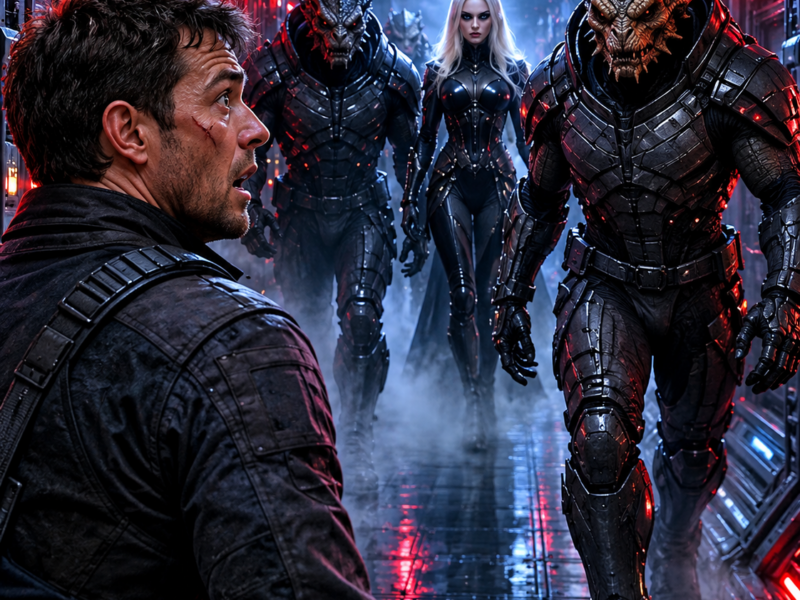
I accidentally called the galaxy’s most terrifying alien vampire beautiful during a diplomatic interrogation on the warship Obsidian Crown
“Because, my dear human, I remember Earth before humanity existed.”
The words hung in the cold, ozone-heavy air of the audience chamber like a blade suspended over a throat.
Around me, the elite Varkhian guards didn’t merely kneel—they pressed their foreheads against the obsidian deck plates as if trying to fold themselves into the shadows. Their armor plates clinked softly in the sudden, suffocating stillness. Even the red klaxons pulsing along the vaulted ribs of the Obsidian Crown seemed to lose their urgency, drowned out by the sheer gravity of what Seraphine Voss had just claimed.
I stood frozen, my fingers still tingling from where her cool, pale hand had tilted my chin up moments ago.
“Before humanity existed,” I repeated, my voice barely louder than a rasp. “Your Majesty, with respect… Earth has humans. That’s kind of our whole thing.”
Seraphine’s crimson eyes narrowed slightly, though there was no anger in them—only a sharp, dissecting amusement that made my spine prickle. She took a slow step back from me, her silver hair catching the low crimson glow of the holographic tactical display still hovering in midair.
“You speak as though your species were carved into the bedrock on the first morning,” she murmured, turning her gaze back toward the floating projection. “You are loud, Daniel Carter. You are brief. And you are remarkably fond of drawing lines across maps and calling the dirt inside them history.”
On the holo-screen, a cluster of wedge-hulled vessels with battered white-and-ochre markings was pushing steadily past the outer sensor buoys of the Varkhian border. They didn’t have the sleek, predatory sweep of Varkhian dreadnoughts or the utilitarian blocky lines of standard Terran freighters. They looked like deep-space salvage cruisers—heavy, scarred, built to survive radiation storms and hull breaches rather than fleet engagements.
And beneath every registry code blazed the same stark block lettering: RECOVER THE EMPRESS.
“I don’t know who those ships belong to,” I said quickly, holding my hands slightly away from my sides as the guards’ tension spiked again. “I’m a civilian survey pilot from New Halifax. My navigation core threw a cascade fault near the sector line, and my emergency beacon locked onto the nearest hull with enough power to pull me out of drift. I swear on my mother’s grave, I didn’t know Earth had a fleet anywhere near Varkhian space, let alone one looking for… for you.”
Seraphine didn’t answer right away. She walked slowly toward the raised dais of her throne, her dark cloak trailing like spilled ink across the polished stone. When she reached the steps, she stopped and looked over her shoulder at me.
“A civilian,” she said softly. “From New Halifax. Tell me, Daniel—what is the oldest ruin your people have found on Earth?”
“Uh.” My brain scrambled through half-remembered history courses and late-night sci-fi podcasts. “Göbekli Tepe? Jericho? Or do you mean deep-sea stuff, like the Yonaguni formations?”
“Cute,” she said, though there was no warmth in the word now. “Your historians measure civilization in fired clay and bronze blades. They dig in the dirt for ten thousand years and congratulate themselves on finding the dawn of man. They never think to ask what was walking through the ferns while the continents were still pulling apart.”
She tapped a sleek, dark-metal console built into the armrest of her throne. Instantly, the holographic projection shifted. The incoming salvage vessels shrank to the upper corner of the display, replaced by a high-resolution astronomical scan of a red-and-gold nebula three parsecs away—and, overlaid beside it, an archival star chart that looked wrong in a way I couldn’t quite name. Constellations were skewed by tens of thousands of years of drift. Stars that had died in supernovae centuries ago burned bright in ancient ink.
“Twelve thousand years is what the Varkhian chronicles claim,” Seraphine said, her voice dropping into a low, resonant cadence that vibrated in my teeth. “They count from the night I arrived in this sector aboard a dying vessel, starving and half-mad from a void-sickness no mortal mind was meant to survive. They saw what I became when I fed to stay alive, and they gave me a crown of blood because terror is easier to govern than mystery.”
“And… Earth?” I asked, taking a cautious step closer despite every survival instinct screaming at me to back toward the blast doors.
“Before the first city rose from the mud,” Seraphine said, looking straight at me, “there were things in the dark that drank starlight and memory alike. Most burned away when the sun flared. One remained in the deep trenches, sleeping beneath tectonic plates while apes learned to sharpen sticks.” She tilted her head, a fraction of that strange, lopsided smile returning to her lips. “When the first primitive tribes painted beasts on cave walls, I watched them from the ridge. They called the hunger in the night a spirit. Later, when iron came, they called it a curse.”
“Vampire,” I said quietly.
“A word invented by frightened men to explain why a creature did not age, did not rot, and did not need their gods,” she replied smoothly. “Tell me, Daniel Carter—if your ancestors knew enough to write ‘Recover the Empress’ into their oldest bloodlines or archival protocols, what else did they leave behind?”
“I honestly don’t know!” I said, throwing my hands up. “Earth’s archives are a mess! Half the pre-expansion records were lost during the Resource Wars, and the rest are buried under corporate patents and colonial charters. If there’s a secret family vault or an ancient Earth order out there, nobody put it on my flight manifest.”
A sharp chime echoed from the bridge speakers connected to the chamber. A raspy, metallic voice announced that the lead Earth salvage vessel—christened Aegis-Prime in faded stencil—had ignored three warning hails and was matching velocity with the Obsidian Crown’s outer docking ring.
“They’re not firing,” I pointed out, trying to keep my voice steady. “Look at their weapons telemetry. Their gunners are powered down. If they wanted a fight, they wouldn’t have sent salvage tugs.”
Seraphine watched the display for a long moment. Her crimson eyes flickered with rapid micro-movements, as if she were reading lines of code invisible to me.
“Humans are rarely subtle when they want something,” she mused. “Or when they are afraid of losing it.”
She turned back to the kneeling guards. “Rise.”
The Varkhians scrambled to their feet with disciplined precision, though none of them met her eyes.
“Commander Varek,” Seraphine said to the largest of the guards, whose breastplate bore the etched crest of the Imperial Household. “Bring the human vessel’s flight recorder to my quarters. And place a perimeter around the lower hangar—not to fire unless fired upon, but to keep our eager guests from boarding uninvited.”
“At once, Blood Empress,” Varek rumbled, bowing stiffly before motioning to two subordinates to escort me.
“Leave the human,” Seraphine said before I could be marched out.
The guards hesitated, glancing between their Empress and me.
“Did I stutter?” Her tone didn’t rise an inch, yet the temperature in the room seemed to drop ten degrees.
“No, Your Majesty.” Varek snapped a salute, backing toward the doors with his squad in tow. Within seconds, the heavy obsidian doors slid shut with a resonant thud, leaving only Seraphine, me, and the quiet hum of the warship’s reactors.
I let out a breath I felt like I’d been holding since my shuttle’s thrusters died. “Okay. So. Just to clarify—am I still on the ‘usually die’ list, or did calling your lighting beautiful buy me a temporary stay of execution?”
Seraphine descended the steps of the dais, moving with a fluid, unhurried grace that looked almost weightless. She stopped a few paces away, studying me with an intensity that made me feel like a specimen under a magnifying glass.
“You told me everyone else looks at you like a monster,” she said softly. “It was an insolent thing to say to a sovereign.”
“I was panicking.”
“And yet it was true.” She walked past me toward a tall viewport overlooking the void, where the dark silhouette of the Aegis-Prime hung suspended against a field of distant stars. “For twelve thousand years, Daniel, I have been an instrument of fear. When my fleets arrive, planets surrender before a single drop-pod launches. When I walk a corridor, generals choke on their own breath. Power isolates you in a way no prison ever could. After a few millennia, even a whisper of genuine humanity starts to sound like a strange, half-forgotten song.”
“That’s… actually really heavy,” I said, rubbing the back of my neck. “Most people just complain about space taxes.”
A faint, genuine laugh escaped her—that same soft, unfamiliar sound from earlier. She looked over her shoulder at me, her silver hair catching the starlight from the viewport. “You have no idea what you are walking into, do you?”
“Honestly? No. Three hours ago I was trying to figure out why my port gyro was screaming. Now I’m standing next to a twelve-thousand-year-old space vampire while an Earth salvage fleet parks outside her front door.”
“Sit,” she said, gesturing toward a low black-stone bench near the edge of the dais. “Since your shuttle is currently being towed into the auxiliary bay, you are my guest until we understand why your government has decided to play hero.”
I sat, mostly because my knees were starting to feel the adrenaline crash. “Do you really think they’re here for you?”
“Look at the transponder signature,” Seraphine said, walking back toward the holo-table. “That vessel isn’t military, as you noted. Its hull plating is reinforced against deep-crust pressure and high-energy radiation. Its crew quarters are sparse, and its cargo holds are retrofitted with stasis cradles. Whoever built that ship didn’t come to conquer the Varkhian Empire. They came to haul something heavy out of the dark.”
She zoomed in on the hull markings of Aegis-Prime. Beneath the worn paint, a faint, geometric emblem was barely visible—a circle bisected by a vertical line, with three small stars arranged like a crown above it.
My stomach gave a strange, hollow lurch.
“Wait,” I said, leaning forward. “Zoom in on that symbol. Right above the airlock seam.”
Seraphine adjusted the magnification. The mark sharpened into focus.
“I’ve seen that,” I murmured, a cold prickle running down my arms. “Not on a military ship. My grandfather had an old brass compass locked in a cedar chest in his study. Nobody knew what it meant—we always thought it was some weird Masonic or maritime trinket from the nineteenth century.”
Seraphine turned slowly to face me, her crimson eyes locking onto mine. “And what happened to that compass, Daniel?”
“When he passed away, my dad put it in a safety deposit box in Geneva,” I said, my voice growing quieter as pieces started clicking together in a way that made no sense. “He told me once—when we were drunk on a fishing trip—that our family didn’t just migrate from Europe to North America. He said we were ‘keepers of the ledger,’ though I thought he was just quoting some old book.”
“A ledger,” Seraphine repeated, a dark, contemplative edge entering her voice. “Long before humanity had nations or history, there were those who bound themselves to watch the sleeping places of the old world. Not to worship them. To contain them—or to call them back when the sky grew dark enough.”
Before I could ask what she meant by call them back, the comm console on the dais chimed again. This time, it wasn’t an automated alert. An incoming audio-visual channel was requesting clearance from the Aegis-Prime.
Seraphine looked at me, an eyebrow raised. “Shall we see what your ‘keepers’ have to say?”
“If they shoot at us, I’m blaming my grandfather,” I muttered.
She tapped the console. The main holo-display flickered, cleared, and resolved into the bridge of the Aegis-Prime.
The room on the other end was cramped, lit by amber emergency strips and crowded with consoles. Standing near the center was a man in his late fifties wearing a faded dark-blue flight suit with no rank insignia. His hair was silver-streaked, his face lined with exhaustion and fierce determination, and around his neck hung a heavy brass compass on a leather cord.
Beside him stood a woman in a tactical harness, her eyes scanning sensor readouts with practiced calm.
When the screen showed Seraphine standing beside her throne—and me sitting a few paces away looking entirely out of place—the older man froze. For three full seconds, nobody on either ship breathed.
“Seraphine,” the man said at last. His voice carried across the comm link with a quiet, iron certainty that didn’t sound like a salvage captain at all. “Twelve thousand years is a long time to stay out past curfew.”
Beside me, Seraphine didn’t flinch. Her posture straightened, the ancient regal stillness settling back over her shoulders like armor. “You are bold, little mortal, to hail the Blood Empress on an open channel without tribute.”
“I’m not here for tribute,” the man replied, stepping closer to his pickup camera. “I’m here because the telemetry from the outer rim lit up a wake signature that hasn’t been seen since the last solar cycle shift. And because a kid named Daniel Carter accidentally drifted into your lap.”
I blinked at the screen. “Wait a second. You know me?”
The man’s gaze shifted to me, softening just a fraction. “Your dad called me two years ago when the Geneva vault pinged an anomaly, Daniel. Told me if anything ever happened to him, to keep an eye on you. Didn’t expect you to go joyriding into Varkhian space.”
“My navigation core glitched!” I protested. “And honestly, if you know my dad, why didn’t you tell me we’re part of some secret ancient order?!”
“Because the first rule of the Order of the Pale Dawn is that you don’t drag kids into a war with apex predators until they can hold their own,” the woman beside him said dryly.
Seraphine let out a low, amused breath that sounded dangerously close to a chuckle. “A secret society. How charmingly human. You build little clubs in the dark, hoard trinkets, and convince yourselves you are the masters of ancient things.”
“We’re not masters, Your Majesty,” the older man said evenly. “We’re caretakers. And right now, your Varkhian admirals have three battlecruisers spooling up plasma lances on our port flank. If we’re going to talk about why we came all this way—and what’s waking up in the deep trenches of Earth—we’d appreciate it if you told them to stand down.”
Seraphine looked at the tactical readout on her console. Sure enough, three sleek Varkhian warships had moved into firing positions outside the hangar bay, their weapons glowing with charging energy.
“They are protective,” Seraphine said, almost lightly. “For twelve millennia, they have believed I am a god of wrath. To see strange ships arrive demanding my recovery… well. It hurts their pride.”
“Tell them if they fire, we drop the stasis beacon,” the man on the screen said quietly. “And you know what happens if that beacon goes active in this sector.”
For the first time since the alarms started, the air in the audience chamber felt genuinely tense. Seraphine’s crimson eyes narrowed to slits, staring into the camera as if trying to see through the hull of the Aegis-Prime itself.
“You wouldn’t dare,” she whispered. “You don’t even know what it would attract.”
“We know enough,” he countered. “The long night isn’t just a myth, Seraphine. Something beneath the Pacific shelf moved six months ago. Whatever shares your bloodline—or whatever you were running from when you crashed into this galaxy—is starting to wake up.”
Silence fell over the chamber again, heavy and absolute.
I looked from the older man on the screen to Seraphine, whose jaw had tightened so sharply a faint muscle ticked beneath her pale skin.
“Wait,” I said slowly. “What do you mean, something else is waking up on Earth? I thought she was the first vampire.”
“I was the first to survive the crossing,” Seraphine said softly, her gaze still locked onto the screen. “Not the only thing that fell into the dark.”
She tapped a sequence of commands on her console. Outside the viewport, the glowing weapons signatures on the three Varkhian battlecruisers dimmed and flickered out.
“Your ships may dock in the secondary bay,” Seraphine said to the screen, her voice ringing with royal authority. “Bring your compass. Bring your records. And if you lie to me, little mortal, I will remind you why the stars fear the night.”
“Fair enough,” the man said. “Aegis-Prime out.”
The holographic transmission dissolved into the calm blue glow of the ship’s default display.
I sat on the stone bench for a long moment, staring at the empty space where the bridge of the salvage ship had been. My head was spinning so hard I felt like I was still tumbling through a gravity well.
“So,” I said, looking up at Seraphine. “Am I getting off this ship anytime soon, or did I just accidentally become the diplomat for whatever weird cosmic soap opera this is?”
Seraphine walked slowly back toward me. She stopped right in front of the bench, looking down with those impossibly old crimson eyes. The terrifying edge was still there—she was still a creature of myth and blood and ancient power—but the cold, hollow distance I’d seen at the very beginning seemed just a little less absolute.
“You called me beautiful in front of a room full of killers, Daniel Carter,” she said quietly. “And then you didn’t run when the alarms screamed. You stood there, terrified out of your mind, and asked questions like a stubborn child who refuses to be impressed by monsters.”
“I was too confused to run,” I admitted honestly.
“Whatever the reason,” she said, a faint, genuine smile curving her lips at last, “you have already proven far more interesting than the diplomats who come begging for mercy. Stay close when your people board. Ancient things are waking up—and I have a feeling I am going to need someone who isn’t afraid to tell me the truth.”
Outside the viewport, the heavy salvage hull of the Aegis-Prime glided smoothly toward the waiting docking clamps of the Obsidian Crown, while deep across the light-years, beneath a quiet blue ocean, something ancient stirred in the dark.
The end.









