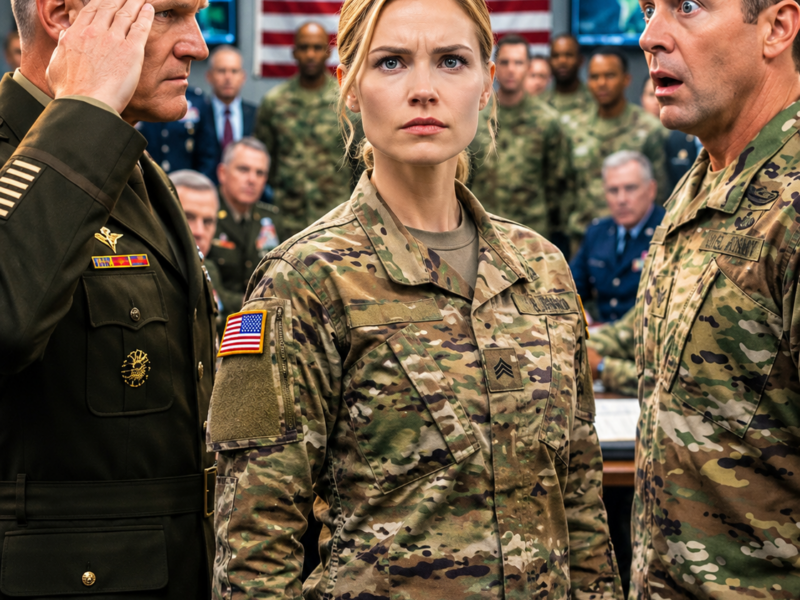
“Hey, stop right there. That seat is reserved for senior command staff.”
“Hey, stop right there.”
The voice cut through the noise of the military reception hall.
Lieutenant Commander Evelyn Carter paused just inside the entrance. She held a dark folder beneath one arm and an official invitation in her hand.
A captain in a perfectly pressed uniform stepped in front of her.
“That seat is reserved for senior command staff.”
Carter glanced toward the seating arrangement. Several officers were already taking their places. A name card sat on a chair near the front.
Her name.
“My name is on the seating assignment,” she said.
The captain looked at the card, then at her.
“I don’t think you understand. This section is reserved for senior command.”
“I understand the seating arrangement, Captain. I received an official invitation.”
A few people nearby turned to watch.
The captain gave a short laugh.
“An invitation doesn’t mean you can sit wherever you want.”
Carter remained composed.
“Please return my folder, Captain.”
He had taken it from her when he first approached, apparently assuming she was carrying documents that needed to be checked. Now he held it at his side.
“Learn your place, soldier.”
A couple of people laughed.
Others looked uncomfortable, but no one intervened.
Carter didn’t raise her voice. She didn’t threaten him with her position or demand that he read her identification.
She simply waited.
The captain finally handed the folder back.
“Someone will direct you to the appropriate seating area.”
“Thank you,” she replied.
She stepped aside, allowing the other guests to pass.
The captain seemed satisfied. He turned back toward the room, convinced he had corrected a problem.
He had no idea who he had just insulted.
And he was about to find out.
***
The reception was being held to recognize officers and personnel who had contributed to a new operational readiness initiative.
The base had spent months preparing for the program. Its purpose was to improve coordination, strengthen emergency response, and ensure that military personnel were better prepared for unexpected situations.
Senior officers from several departments had gathered for the announcement.
Captain Reynolds had been assigned to help manage the reception. He took the responsibility seriously, though he seemed more interested in appearances than in the people attending.
He had already corrected the seating arrangements twice and complained about a few junior personnel standing too close to the command table.
When he saw Carter, he assumed she was another junior soldier who had wandered into the wrong section.
He hadn’t checked the invitation.
He hadn’t asked her name.
He hadn’t even considered that the woman carrying a folder might have more authority than he did.
His judgment had been made before she said a word.
A senior officer entered the hall a few minutes later.
The conversations quieted.
“Lieutenant Commander Carter.”
Carter turned.
“Yes, sir.”
The officer approached her with a respectful nod.
“I’m glad you made it. We were waiting for you.”
Reynolds turned around.
His expression changed.
The senior officer continued.
“Ladies and gentlemen, I want to introduce the officer selected to lead our new operational readiness initiative: Lieutenant Commander Evelyn Carter.”
The room became quiet.
Reynolds stared at Carter.
“Sir…” he began. “You’re saying she’s in command?”
The senior officer looked at him.
“Yes, Captain. She is.”
Reynolds seemed unable to find another word.
Carter could have reminded him about the invitation, the folder, and his instruction to learn her place.
She could have made the entire room listen to an account of what had happened.
Instead, she looked toward the audience.
“Disrespect is not a military protocol, Captain. Respect should never depend on someone’s rank or appearance.”
Her voice was calm, but the words carried.
The senior officer nodded.
“That’s one of the reasons she was selected.”
Carter took her place near the front.
The captain returned to his position, but the confidence he had displayed moments earlier was gone.
***
When the formal introductions were complete, Carter stepped to the podium.
She looked across the room at the officers, enlisted personnel, and support staff.
“Today, I want to discuss something more important than equipment and medals.”
She paused.
“Leadership is revealed when nobody important is watching.”
The room settled.
“It’s easy to show respect when a general enters a room. It’s easy to be polite when someone has the authority to affect your career. But the real measure of a leader is how that person treats the soldier carrying equipment, the mechanic working late, the junior officer asking a difficult question, or the person whose name they don’t recognize.”
She looked toward the back of the hall.
“Every person in this uniform has a responsibility. Every person deserves to be treated with dignity.”
She did not mention Reynolds again.
She didn’t need to.
After the presentation, the captain approached her.
“Commander Carter?”
She turned.
“Yes, Captain?”
He stood a little straighter.
“I owe you a sincere apology.”
Carter waited.
“I judged you without knowing who you were. I assumed you didn’t belong in that section. I shouldn’t have spoken to you that way.”
“No, you shouldn’t have.”
He nodded.
“I was wrong.”
“I accept your apology, Captain.”
His shoulders relaxed slightly.
Then she added, “Make sure the next soldier you meet never has to earn your respect.”
Reynolds looked down for a moment.
“I will, ma’am.”
Carter gave a small nod and continued speaking with the other guests.
She had accepted his apology.
But she expected him to change.
***
Later that afternoon, Carter walked through the main corridor toward the operations building.
A young soldier was struggling with a stack of equipment cases. One of the cases had shifted, and he was trying to keep everything from falling while making his way through the doorway.
Carter stopped.
“Need a hand, soldier?”
The young man looked up, surprised.
“Thank you, ma’am. I really appreciate it.”
She helped him steady the load and moved one case into a safer position.
He looked at her insignia.
“Ma’am, have you always been this respected in the military?”
Carter smiled faintly.
“Respect isn’t something you receive. It’s something you earn.”
He considered that.
Then he noticed another insignia on her uniform.
“What does that one mean?”
Carter glanced down.
“It reminds me of the people who never made it home.”
The soldier’s expression became serious.
“I’m sorry, ma’am.”
“Don’t be. Remember them. That’s what matters.”
She adjusted the folder under her arm and continued down the corridor.
The young soldier watched her leave.
He had just learned more about leadership from a brief conversation than he had from several formal speeches.
But Carter had little time to reflect on the encounter.
Her radio came alive.
“Commander Carter, we need you in the command center immediately.”
She stopped walking.
“What’s happened?”
“We’ve lost communication with the entire training unit.”
Her expression changed.
“I’m on my way.”
***
The command center was already crowded when Carter arrived.
Several officers were gathered around the main display. Communication personnel were reviewing equipment and trying to determine why the training unit had gone silent.
A senior officer approached her.
“Commander Carter, I’m glad you’re here.”
“Sir, tell me what happened.”
“We lost contact with the entire training unit. The last confirmed signal came in earlier, and we’ve been unable to establish communication since.”
“When did the last confirmed signal arrive?”
The officer gave her the time.
Carter looked toward the communication station.
“Show me the communication records from the previous hour.”
“Yes, ma’am. Pulling them up now.”
A screen filled with system activity.
Carter studied the entries.
“Bring up the configuration history.”
An officer beside her frowned.
“Commander, we don’t have time for unnecessary theories. We need to restore the signal.”
“And we don’t have time to ignore something important.”
She pointed to a section of the record.
“What’s this configuration?”
The communication specialist leaned closer.
“I’m not sure, ma’am.”
“Check the authorization.”
He examined the entry.
His expression changed.
“Commander, this configuration shouldn’t be active.”
Carter looked at him.
“Why not?”
“It changes the communication settings used by the training unit. It shouldn’t have been enabled under the current operational plan.”
“Who authorized this system change?”
The specialist began checking the record.
“I’ll trace it.”
Carter turned toward the senior officer.
“This threat is coming from inside the base.”
The room fell quiet.
The senior officer considered the information for a moment.
“Commander Carter, you’re leading this investigation.”
“Understood, sir. I won’t leave until we know what happened.”
***
Carter moved to the central workstation.
“I want every system record from the last 24 hours. Access logs, configuration changes, authorization records, and communication activity.”
“Yes, ma’am.”
“Preserve the original records. No one should modify or overwrite anything while we review it.”
The specialists began working.
Carter studied the communication timeline.
There were several changes, but one pattern stood out.
Someone had accessed the system more than once.
“Commander,” an officer said, “one name appears repeatedly in the access history.”
Carter turned.
“Show me.”
The officer brought up the record.
Carter read the name.
Daniel Brooks.
For a moment, she said nothing.
“That’s impossible,” another officer remarked. “He was removed from this program years ago.”
Carter continued looking at the screen.
“Commander, are you certain about what you’re seeing?” the senior officer asked.
“I worked with him during my previous assignment.”
The senior officer studied her.
“Then you understand how serious this could be.”
“I do.”
He hesitated.
“Why didn’t you tell us about this earlier?”
Carter turned toward him.
“Because I came here to do my duty, not discuss my past.”
She returned her attention to the screen.
The name had appeared repeatedly, but she needed more than a name. She needed evidence of what had happened and how the communication system had been changed.
“Continue the review,” she ordered. “I want the full access history.”
***
Daniel Brooks was not a stranger to Carter.
Years earlier, he had worked as a systems director on a program connected to one of her previous assignments.
He had been knowledgeable, confident, and deeply familiar with the systems that connected military personnel in the field.
Carter remembered working with him.
She also remembered that his name had eventually disappeared from the program.
She had not expected to see it again.
The circumstances surrounding his departure were not something she intended to discuss in the command center. Whatever had happened in the past, the current investigation had to stand on the evidence.
She reminded herself of that.
A familiar name could create suspicion.
It could also create assumptions.
She would not allow either to replace facts.
“Commander,” one of the specialists called.
Carter turned.
“We’ve received a message from the missing unit.”
“Put it on the main screen immediately.”
The screen changed.
A soldier appeared, his image interrupted by static.
“Command center, can anyone hear me?”
Carter moved closer to the microphone.
“This is Commander Carter. We’re listening. Tell us your situation.”
The response came through in fragments.
“Someone inside the facility changed our communication settings.”
Carter looked at the system records.
“Can you confirm whether your team is safe?”
“We’re together. We have not been able to maintain normal communication.”
“Understood. Stay calm. We are working to restore contact with your team.”
There was a pause.
Then the soldier spoke again.
“Commander Carter… I was wrong to question your judgment.”
Carter didn’t react to the apology.
“We can discuss that later. Right now, those soldiers need us.”
She turned toward the specialists.
“Continue working on restoring communication. Keep the channel open and establish the strongest available connection.”
The soldier on the screen looked exhausted.
Carter addressed him again.
“We have your message. We know where you are, and we’re working to get you back into contact with command. Keep your team together and follow your established procedures.”
“Understood, ma’am.”
The connection weakened.
Then the screen went dark.
Carter stared at it for a moment.
The team had made contact, but the problem was not solved.
They needed to restore reliable communication and understand how the system had been compromised.
“We need to protect that team before the situation gets worse,” she said.
The senior officer stepped beside her.
“You have my full support, Commander.”
***
The access review continued.
The specialists narrowed the activity to a series of actions that had originated from within the command building.
Carter studied the results.
“Commander, the access came from this building.”
“Then the person responsible is standing somewhere in this room.”
A tense silence followed.
Carter looked around.
“Nobody leaves this command center until we find the truth.”
She turned to the security team.
“Check every access record. Nobody is above investigation.”
The officers began reviewing the records again.
One name appeared in the immediate access history.
Lieutenant Mark.
Carter noticed his expression before she spoke.
“Lieutenant Mark, why are you looking so nervous?”
He straightened.
“I’m not nervous, Commander. I haven’t done anything wrong.”
“Your identification appears in the access history.”
Mark frowned.
“Someone must have used my account without permission.”
Carter did not accuse him.
“That’s possible. We need to establish what happened.”
The communication specialist checked the record again.
“Commander, the access was made using Lieutenant Mark’s credentials.”
“Show me the security camera recording from that time.”
The security team brought up the footage.
The video showed a person entering the relevant area.
Carter leaned toward the screen.
“Pause the recording.”
The image froze.
She studied the uniform.
“I recognize that uniform.”
One of the officers looked at her.
“Commander, who is that person?”
Carter’s face became serious.
“That’s Daniel Brooks, our former systems director.”
The room went silent.
“He was the one who worked with my old unit.”
The senior officer stepped closer to the display.
“Are you certain?”
“Yes, sir.”
Carter pointed toward the image.
“Preserve the recording. I want the original footage secured and the access records matched against it.”
The security team acknowledged the order.
“Locate Daniel Brooks,” she continued. “No one should confront him without authorization. We need to establish exactly what he did and why.”
***
Daniel was brought in for questioning.
He entered the room with a guarded expression.
Carter stood near the central table.
“Daniel.”
He looked at her.
“Commander Carter.”
“Why did you interfere with the communication system?”
His expression hardened.
“You have no idea what you’re accusing me of.”
“Then help us understand the records.”
“You’re looking at access information that doesn’t tell the whole story.”
“That’s why we’re asking questions.”
Daniel looked toward the senior officer.
“Are you really going to let her question me like this?”
The officer answered evenly.
“Commander Carter is leading the investigation. You’ll answer her questions.”
Daniel turned back toward her.
“You know how these systems work. You know that an access record doesn’t prove who was physically at the console.”
“That’s why we have the security footage.”
His jaw tightened.
Carter continued.
“Your name appears in the system history. Your former role gave you knowledge of the configuration. And the security footage shows someone wearing your uniform accessing the area.”
“You’re making assumptions.”
“No. I’m establishing a timeline.”
Daniel looked away.
Carter didn’t raise her voice.
“Why was the communication configuration changed?”
He did not answer.
“Who authorized it?”
Silence.
“Did you understand that changing those settings could isolate an entire training unit from command?”
Daniel finally looked at her.
“You think you understand everything because you were there years ago.”
“I understand that soldiers lost communication with their command center. I understand that the change originated inside this facility. And I understand that we need the truth.”
He shook his head.
“You don’t know what happened.”
“Then explain it.”
Daniel remained silent.
The senior officer signaled to the security personnel to preserve all relevant materials and continue the formal process.
Carter stepped back.
The questioning would continue, but she would not invent a conclusion before the evidence supported one.
There was still an entire unit of soldiers to account for.
That was her priority.
***
The communication team finally reported progress.
“Commander Carter, we’ve established a stable connection.”
“Can we confirm the training unit’s status?”
“Yes, ma’am. We have a direct communication channel.”
“Put them through.”
The main screen lit up.
A soldier appeared.
“Command center, this is the training unit. Can you hear us?”
“This is Commander Carter. We can hear you. Confirm the status of your team.”
“All personnel are accounted for. The team is safe.”
Carter exhaled.
“Understood. Continue following your established procedures. We’re maintaining contact.”
The senior officer looked relieved.
“Commander Carter, our entire team is safe.”
“That’s what matters,” she replied. “Bring every soldier home.”
The command center began to settle.
The immediate crisis had been contained.
But Carter knew the investigation was not finished.
The system change still needed to be fully understood. Daniel’s actions needed to be examined through the proper process. The records needed to be secured, and the base needed to understand how an internal change had disrupted communication with an entire unit.
A successful recovery did not erase the failure that had made it necessary.
***
By the following day, word had spread throughout the base.
The training unit had been found safe.
The communication system had been restored.
And Commander Carter had led the investigation that uncovered the unauthorized access.
The same officers who had once overlooked her now wanted to know more about her.
At a gathering later that day, a senior officer addressed the assembled personnel.
“Ladies and gentlemen, today we witnessed extraordinary leadership.”
He turned toward Carter.
“Commander Carter has served with courage in some of our most difficult assignments. Many of you may not know the full extent of her service.”
Carter looked uncomfortable with the attention.
“Sir, I only did what any responsible officer should do.”
The senior officer continued.
“During one difficult mission, she refused to leave a fellow soldier behind. She has repeatedly demonstrated that leadership is not about personal recognition. It’s about responsibility for the people who depend on you.”
Carter looked down briefly.
“I was never alone,” she said. “My team gave me the courage to keep going.”
The room applauded.
Captain Reynolds stood among the other officers.
He had heard the stories. He had seen the footage of the command center and learned how Carter had handled the crisis.
He was beginning to understand how little he had known about the woman he had tried to send away from the senior seating area.
When the gathering ended, he approached her again.
“Commander Carter?”
She turned.
“Yes, Captain?”
“I judged you before I even knew your story.”
Carter said nothing.
“That is a mistake no officer should make.”
He paused.
“I sincerely apologize for the way I treated you.”
Carter looked at him for a moment.
“I accept your apology, Captain.”
He nodded.
“Thank you, ma’am.”
“Let your actions prove that you’ve learned.”
“I will.”
***
A few days later, the senior officer called Carter into his office.
She entered and stood before his desk.
“Commander, have a seat.”
“Thank you, sir.”
He opened a folder.
“I’ve been reviewing the response to the communication incident and the work you’ve done since taking command of the readiness initiative.”
Carter listened.
“You identified a problem in the records, organized the investigation, and kept the priority where it belonged: the safety of the training unit.”
“Thank you, sir.”
“I want you to lead our new leadership and readiness program.”
Carter looked at him.
“Sir?”
“We need someone who understands that readiness is more than equipment and procedures. It also depends on trust, accountability, and the way people work together.”
He closed the folder.
“You’ve demonstrated those qualities.”
Carter took a moment before responding.
“It would be an honor, sir. I accept.”
The senior officer smiled.
“Good. I expect you to build a program that reaches every level of this base.”
“I will.”
***
The announcement was made during the next formal gathering.
Carter stood at the front of the room as the senior officer introduced her as the leader of the new leadership and readiness program.
There was applause.
But Carter’s attention was on the people standing behind the senior officers.
The junior soldiers.
The technicians.
The support personnel.
The people who often did the work without receiving much attention.
She stepped forward.
“A uniform does not make someone a great leader,” she said.
The room became quiet.
“The way you treat others shows the kind of leader you truly are.”
She looked across the audience.
“Rank gives us responsibilities. It does not give us permission to disrespect the people who serve beside us.”
She paused.
“Leadership isn’t demonstrated only during an emergency. It is demonstrated in ordinary moments. When someone asks a question. When a soldier needs help. When a junior officer brings forward a concern. When nobody important is watching.”
Captain Reynolds listened from the side of the room.
This time, he did not look away.
Carter continued.
“If you want people to trust you when things become difficult, you must show them respect before the difficult moment arrives.”
She let the words settle.
“People should not have to suffer, prove themselves, or save someone’s life before they are treated with dignity.”
The applause that followed was louder than before.
***
After the ceremony, a young soldier approached her.
“Ma’am?”
Carter turned.
“Yes, soldier?”
“I hope one day I can become a leader like you.”
She smiled.
“Start by respecting every person standing beside you.”
He nodded.
“I’ll remember that.”
A few steps away, Captain Reynolds noticed another soldier struggling with a piece of equipment.
He hesitated for a moment, then walked over.
“Here, soldier. Let me help you with that.”
The young man looked surprised.
“Thank you, Captain. I appreciate it.”
Reynolds helped him steady the equipment.
Carter watched from a distance.
She didn’t interrupt.
She didn’t praise him in front of everyone.
She simply continued walking.
It was a small moment, but it mattered.
Because an apology was only the beginning. A person proved they had learned by changing how they treated others when there was nothing to gain.
***
Later that afternoon, the senior officer joined Carter outside the operations building.
“Commander, you reminded this base what leadership means.”
Carter looked toward the personnel moving through the courtyard.
“I hope they remember that respect is never earned through suffering.”
He nodded.
“That’s a lesson worth teaching.”
She glanced down at the insignia on her uniform.
The people who had never made it home were still with her.
She thought about the missions she had survived, the teammates who had stood beside her, and the responsibility that came with every decision.
She knew that not every problem could be prevented.
Not every mission would end perfectly.
But people deserved leaders who listened, who took responsibility, and who never confused authority with superiority.
That was what she wanted the readiness program to teach.
Not just how to respond when a crisis began.
How to build a team strong enough to face one together.
As she walked back toward the command building, she passed the same corridor where she had helped the young soldier with his equipment.
Another soldier greeted her.
“Good afternoon, ma’am.”
“Good afternoon.”
He moved aside to let her pass.
No one stopped her to question whether she belonged.
No one asked her to prove she deserved to be there.
And that was exactly how it should have been from the beginning.
Captain Reynolds had learned that a reserved seat did not define a person’s worth.
The command center had learned that leadership required listening before a crisis.
And the base had been reminded that the people wearing the same uniform were not competitors for respect.
They were a team.
Commander Carter had never needed to humiliate anyone to establish her authority.
She had simply done her duty, protected the people under her responsibility, and treated others with dignity.
Because the strongest leader in the room is not necessarily the one with the highest rank.
It is the one who understands that every person matters.
And respect should never depend on someone’s appearance, position, or ability to prove their value.
It should be there from the very beginning.
The end.









