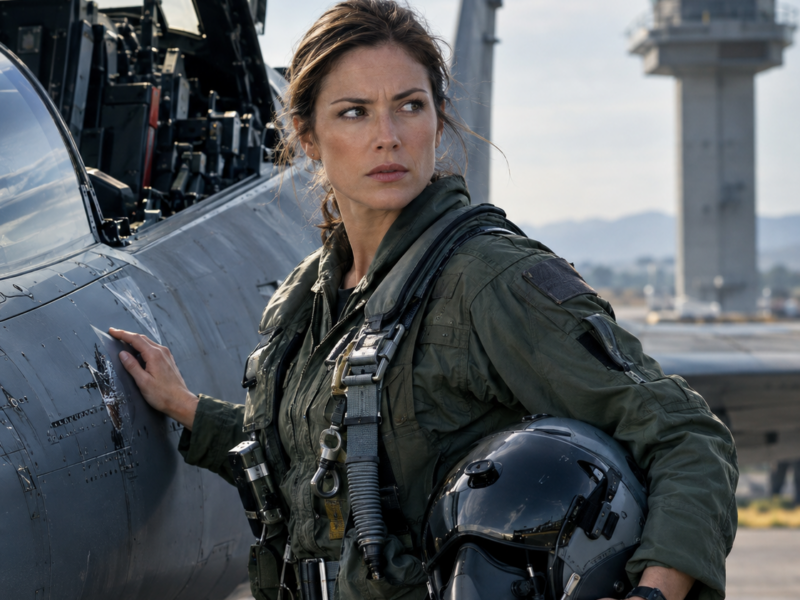
HER JET WAS SABOTAGED BEFORE TAKEOFF — THEN SHE SPOTTED WHO WAS WATCHING FROM THE CONTROL TOWER
Colonel Daniel Hayes publicly grounded Captain Rebecca Carter after mocking her suspicions about her sabotaged F-16—but when she spotted the dead pilot watching from the control tower, the colonel seized the emergency phone, ordered the runway sealed, and every armed guard on the flight line suddenly received an order they had never expected.
The morning sun burned white across the Nevada desert, turning the tarmac at Nellis Air Force Base into a shimmering sheet of heat. The air smelled of JP-8 fuel, hot rubber, and the metallic tang of machinery that had been running since before dawn. Beyond the hangars, the low-frequency rumble of Pratt & Whitney engines rolled across the flight line as a pair of F-16s taxied toward the active runway.
Captain Rebecca Carter walked toward her assigned aircraft with her helmet tucked beneath one arm.
Her olive flight suit was faded at the knees. A strip of gray duct tape covered a fraying edge on her equipment bag, and her flight boots bore the pale dust of the Nevada desert. She had eleven years of military aviation behind her, including missions that had taught her to recognize danger long before an instrument confirmed it.
But none of that stopped people from underestimating her.
To some of the men in her squadron, Rebecca was still the quiet woman who had somehow earned a seat at a table where they believed she didn’t belong.
Captain Ryan Mitchell was especially fond of reminding her.
“Morning, Carter. Try not to scratch the runway on your way up.”
His two companions laughed beside a fuel cart.
Rebecca didn’t turn around.
“Keep an eye on your own landing gear, Mitchell.”
The laughter stopped for half a second.
Then Ryan grinned, pretending the exchange had amused him.
“That’s the spirit. Maybe today you’ll finally give us a mission worth remembering.”
Rebecca continued toward her aircraft.
She had no interest in winning arguments on a flight line. The aircraft didn’t care who had the loudest voice, the highest opinion of himself, or the most friends in the squadron. It responded to physics, maintenance, and the decisions made by the person in its cockpit.
And physics never laughed.
Her F-16 sat beneath the morning sun, its gray fuselage reflecting a faint bronze sheen. Ground crew members moved around nearby aircraft, checking tires, removing safety pins, and connecting equipment. A technician knelt beside a landing gear assembly while another inspected a weapons station.
Rebecca paused three feet from her jet.
Something looked wrong.
She couldn’t have explained it immediately to someone who had never spent hundreds of hours studying the same aircraft from every angle. The left-wing maintenance panel sat a fraction out of alignment. Its rear edge caught the sunlight differently from the surrounding skin.
She moved closer.
The panel’s locking seal had been broken.
Rebecca crouched, resting two fingers against the edge without touching the exposed fittings. A maintenance panel could sit unevenly after routine servicing, but this one showed a fresh disturbance around the fasteners. One screw carried a bright crescent where a tool had slipped. The others bore the dull marks of older work.
Someone had opened it recently.
And someone had wanted the evidence to disappear beneath the aircraft’s shadow.
“Chief!”
Staff Sergeant Marcus Bell looked up from a nearby equipment trolley. He was in his forties, with a weather-beaten face and the careful movements of a man who had spent most of his adult life keeping aircraft safe.
Rebecca pointed at the panel.
“Who opened this compartment?”
Bell approached, wiping his hands on a rag. His expression changed when he saw the broken seal.
“That shouldn’t be open.”
“Was this aircraft serviced overnight?”
“Routine checks only. Nothing that required this panel.”
“Who signed off on the final inspection?”
Bell examined the seal more closely.
“One of my night-shift technicians. But I haven’t seen this before.”
Rebecca stood.
“Don’t touch anything else. I want maintenance control and the safety officer here. Now.”
Bell studied her face, saw no sign of uncertainty, and reached for his radio.
Across the flight line, Ryan Mitchell had stopped laughing.
He watched Rebecca speak with the ground crew chief, then shook his head as though witnessing another example of what he considered her excessive caution.
“What’s the problem now?” he called. “A loose screw?”
Rebecca ignored him.
Within minutes, the maintenance supervisor arrived with two technicians. They photographed the disturbed panel, checked the maintenance records, and began a controlled inspection of the affected area. Rebecca stepped back while they worked, her gaze moving between the aircraft and the mission schedule displayed on a nearby terminal.
Her assigned sortie was scheduled to depart in less than thirty minutes.
The mission package involved a simulated high-threat interception exercise. The flight plan, weather data, and tactical timing had been approved the previous evening. A delay would disrupt the schedule for an entire formation.
Someone might be counting on that pressure.
Or they might be counting on the opposite: that Rebecca would launch before anyone looked closely enough.
The supervisor emerged from beneath the wing with a tablet in his hand.
“Captain, the aircraft is grounded pending a full technical investigation.”
“Have you identified the problem?”
“Not completely. But we’ve found evidence of unauthorized access to a flight-control-related assembly. We need the maintenance records, physical inspection, and an independent sign-off before we can say exactly what was done.”
“Could it affect the aircraft in flight?”
He hesitated.
“That’s why you’re not flying it.”
Rebecca felt the muscles between her shoulders tighten.
She had made the correct decision. That should have been reassuring.
Instead, she found herself staring at the tower.
Behind its tinted upper windows, a figure stood motionless.
Colonel Daniel Hayes.
Her commanding officer had been observing the flight line since the first aircraft began taxiing. Even at this distance, she recognized his rigid posture and the way he held his hands behind his back.
He wasn’t looking at the maintenance crew.
He was looking directly at her.
Then another figure stepped into view beside him.
A man in a dark civilian jacket.
Rebecca narrowed her eyes against the glare.
The stranger leaned toward the glass.
For one impossible second, the years between past and present collapsed.
The shape of his face. The angle of his jaw. The small scar near his left eyebrow.
Her fingers went numb around her helmet.
Major Ethan Cole.
Three years earlier, Rebecca had watched his F-16 disappear from her radar during a night training exercise over the Nevada desert. She had heard his voice break through the radio static, heard him report a catastrophic emergency, and then listened to silence where his next transmission should have been.
The official investigation concluded that a mechanical failure had caused the crash. No recoverable remains had been identified, but the military had declared him dead after the search was terminated.
Rebecca had attended his memorial.
She had stood beside his family while an officer presented a folded flag over an empty coffin. She had listened to people describe Ethan as a courageous pilot and a devoted friend.
She had never told anyone about the last sentence he transmitted to her.
Whatever happens, don’t trust the debriefing.
For three years, she had tried to believe those words were the confused fragments of a dying man.
Now Ethan Cole was standing inside the control tower.
Alive.
Rebecca took one step toward the building.
The stranger leaned back from the glass.
A second later, he was gone.
Her radio crackled against her shoulder.
“Captain Carter, report to the command building immediately.”
Colonel Hayes’s voice was clipped and cold.
Rebecca glanced toward the grounded jet, then at the maintenance supervisor.
“Secure the aircraft. Restrict access to the affected compartment, preserve every photograph and maintenance record, and don’t authorize any further work without the safety officer present.”
“Understood, Captain.”
She turned toward the command building.
Ryan Mitchell approached as she passed.
“Guess your big mission is canceled.”
Rebecca kept walking.
“You’re welcome.”
His smile faltered.
She crossed the rain-stained concrete between the hangars and entered the operations building. The air-conditioning hit her face, carrying the dry chill of a room designed to protect sensitive equipment. Inside the tactical center, classified telemetry displays glowed above workstations. Officers spoke in low voices over encrypted communications while a large digital map tracked aircraft movements across the training range.
Everything appeared normal.
That frightened her more than chaos would have.
If someone had deliberately tampered with her aircraft, the person might have had access to maintenance systems, security procedures, and mission schedules. If Ethan was alive, the official account of his death was either incomplete or deliberately false.
And if Colonel Hayes knew she had seen him, Rebecca needed to understand why.
Hayes waited in his office.
His uniform was immaculate, his silver hair perfectly combed, and his expression suggested that her presence had interrupted something far more important than a potentially sabotaged aircraft.
“You’ve caused a significant disruption this morning, Captain.”
“Someone tampered with my aircraft.”
“An allegation you have yet to substantiate.”
“The maintenance team found evidence of unauthorized access to a flight-control-related assembly.”
“Maintenance discrepancies happen.”
“Broken security seals don’t happen by themselves.”
Hayes stood and moved behind his desk.
“Your mission was time-sensitive. You were expected to follow the approved schedule, not turn a routine preflight into a criminal investigation.”
Rebecca placed a photograph of the damaged seal on his desk.
“Then you should have no objection to an independent investigation.”
For the first time, his eyes dropped to the photograph for longer than a second.
His jaw tightened.
“Where did you get that?”
“From the maintenance supervisor.”
“Who authorized you to photograph a controlled aircraft?”
“The person responsible for ensuring it didn’t leave the ground in an unsafe condition.”
Hayes’s expression hardened.
“Be careful, Captain. There are consequences for making accusations against senior officers.”
“I’m not accusing anyone. I’m reporting evidence.”
“Your clearance is suspended pending review. You’re relieved of flight duties until further notice.”
Rebecca didn’t move.
“Is this about the aircraft or something else?”
Hayes stared at her.
For a moment, the office seemed to lose all its background noise. Beyond the door, distant footsteps echoed through the corridor. The ventilation system hummed above them.
Then a secure telephone rang.
Hayes looked at the display before answering.
“Hayes.”
He listened.
The color slowly drained from his face.
“No,” he said quietly. “That wasn’t supposed to happen.”
Rebecca watched his right hand tighten around the receiver.
Another pause.
“Seal the runway. Immediately. No departures, no arrivals, and no exceptions.”
He replaced the receiver.
“What happened?” Rebecca asked.
Hayes opened a drawer and removed a thin black folder.
“You are to remain in this office until security arrives.”
“Why?”
“Because I said so.”
He placed a photograph on the desk and slid it toward her.
It showed Ethan Cole standing beside her F-16.
The timestamp in the corner read 02:17 that morning.
Rebecca stared at the image. Ethan was wearing the same dark jacket she had seen through the tower window. His face was turned toward the camera, his expression unreadable.
On the back of the photograph, someone had written a message in thick black ink.
SHE KNOWS WHAT HAPPENED THREE YEARS AGO. STOP HER BEFORE SHE REMEMBERS.
Rebecca looked up.
Hayes had already moved toward the office door.
Before she could speak, an emergency alarm erupted through the building.
Red warning lights flashed overhead. The tactical center outside erupted into overlapping voices as every large screen switched to a live runway camera.
A black SUV had stopped beside the perimeter road.
Its headlights were off.
The driver’s door opened.
A man stepped out wearing a dark civilian jacket.
Ethan Cole.
Even through the grainy camera feed, Rebecca recognized the scar above his eyebrow.
He walked toward the camera, stopped, and raised a small object between two fingers.
A military identification card.
Rebecca’s breath caught.
The camera zoomed in.
The photograph was old, its edges worn white, but the face was unmistakable.
Her father.
Colonel James Carter had supposedly died fifteen years earlier in a classified aviation accident. Rebecca had been a teenager when the official notification arrived. She had grown up believing that the military had given her father a hero’s funeral and buried every secret surrounding his final mission.
Now Ethan stood beside a sabotaged fighter, holding her father’s identification card.
Three words had been written beneath the photograph in fresh black ink.
YOUR FATHER SURVIVED.
Behind Rebecca, Hayes seized the emergency telephone.
“Lock down the entire flight line,” he ordered. “Nobody approaches that vehicle. Nobody speaks to the man outside.”
Then Ethan lifted his face toward the camera.
His lips moved.
The control room audio crackled, and a voice emerged from the speakers—a voice Rebecca had spent three years believing she would never hear again.
“Rebecca, if you can hear me, don’t trust Hayes.”
The colonel froze.
Ethan leaned closer to the camera.
“Your father is alive. And the person who sabotaged your aircraft is standing right beside—”
The transmission died.
On the central screen, the runway lights turned red as the base lockdown took effect.
Rebecca looked at Hayes.
For the first time since she had entered the building, her commanding officer looked genuinely afraid.
Then a security officer’s voice burst through the tactical center speakers.
“Control tower, this is perimeter security. We have visual confirmation of the suspect. Requesting identification and authorization to apprehend.”
Hayes reached for the microphone.
Rebecca moved first.
She pressed the transmit switch on the open console beside her.
“Perimeter security, hold your position. Do not approach the suspect until you verify his identity against the original personnel records.”
Hayes spun toward her.
“Get away from that console!”
She didn’t look at him.
The radio hissed.
Then the voice of the base’s senior operations officer came through, sharp with disbelief.
“All stations, stand by. Confirming identity now.”
A second voice interrupted, coming from a secure command channel that had been silent for three years.
“Authentication complete. Major Ethan Cole is alive.”
The entire tactical center fell silent.
The senior officer continued.
“All personnel, this is a direct order. Captain Rebecca Carter is to be granted immediate access to the command channel.”
A pause followed.
Then came the words that made every pilot, armed guard, and senior officer in the room straighten as if an invisible hand had pulled them upright.
“Her callsign is PHANTOM. Repeat: PHANTOM is back on the net. All stations, render honors.”
Chairs scraped against the floor.
Gloved hands rose in salute.
And Colonel Hayes, standing beneath the red emergency lights, stared at the woman he had just ordered confined—because the pilot whose legend had been buried with a dead man was now the only person on the base who might know why he had returned.
For three seconds, nobody inside the Nellis operations center moved.
Then the tactical room erupted.
Phones rang. Officers scrambled between encrypted terminals. Armed security personnel hurried toward the command corridor, their boots striking the polished floor in sharp, synchronized beats. On the main display, the black SUV remained motionless beside the perimeter road, its headlights dark beneath the harsh Nevada sun.
Captain Rebecca Carter stood beside the communications console, her right hand resting on the edge of the desk.
She had heard her callsign spoken in combat zones, emergency exercises, and classified briefings that never appeared in official records. But she had never heard it announced with that particular combination of urgency and disbelief.
PHANTOM.
Three years earlier, the Air Force had officially closed the investigation into Major Ethan Cole’s disappearance. The last surviving member of his flight had been Rebecca. His aircraft had vanished from radar during a classified night exercise, and the official report had attributed the loss to catastrophic mechanical failure.
The classified appendix, which Rebecca had never been permitted to read, had apparently contained something else.
Something that had made the command staff afraid of a man who was supposed to be dead.
Colonel Daniel Hayes recovered first.
“Who authorized her access to this console?”
No one answered.
He turned toward the communications officer.
“Lieutenant, disconnect that station and revoke Captain Carter’s access immediately.”
The lieutenant hesitated, glancing at the flashing authentication indicator.
“Sir, the command channel has issued a direct authorization.”
“I’m aware of what the channel issued.”
“Then I need a countermand from the originating authority, sir.”
Hayes stepped closer.
“Are you refusing a direct order?”
The young officer swallowed.
“No, sir. I’m following the authentication protocol.”
Rebecca watched the exchange without expression. Hayes wasn’t angry because she had touched a console. He was angry because, for the first time that morning, his authority had encountered something it couldn’t simply intimidate into silence.
She pressed the communications switch.
“Perimeter security, this is Captain Carter. Maintain visual observation of the individual beside the SUV. Do not approach him, and do not allow anyone to remove the vehicle. Preserve the scene exactly as it is.”
Hayes slammed his palm against the desk.
“Captain, you are not in command of this operation.”
Rebecca finally looked at him.
“Then explain why you ordered the runway sealed before the control tower reported a security incident.”
His mouth tightened.
“An unidentified vehicle was inside a restricted area.”
“That vehicle appeared after the transmission identifying Major Cole as alive. Your lockdown order preceded the formal confirmation.”
“I made a precautionary decision.”
“Then you won’t object to having the time stamps preserved.”
She turned back to the console.
Hayes stared at her as if he were seeing someone entirely different from the captain he had summoned to his office ten minutes earlier.
The room’s main doors opened.
Brigadier General Miriam Voss entered with two security officers behind her. She was a compact woman in her late fifties, with close-cropped silver hair and the kind of controlled expression that made experienced officers reconsider their next sentence.
She took in the room in a single glance: the armed guards, the red warning lights, the communications console, and Rebecca standing beside it.
“Someone had better explain why an active lockdown has turned my operations center into a courtroom.”
Hayes stepped forward.
“General, Captain Carter has interfered with a security response and accessed a restricted communications channel without authorization.”
Voss looked at Rebecca.
“Is that accurate?”
“I used an authenticated command station to prevent the premature apprehension of a potentially critical witness, ma’am.”
“Potentially critical?”
“The man on the perimeter camera is Major Ethan Cole. He was declared dead three years ago. He claims my father survived an accident that supposedly killed him fifteen years ago. My aircraft was tampered with this morning, and Colonel Hayes ordered the runway sealed before Major Cole’s identity was formally confirmed.”
Nobody spoke.
Voss turned slowly toward Hayes.
“Is any part of that account incorrect?”
“The situation is more complicated than she understands.”
“Then you should have no difficulty explaining it.”
Hayes opened his mouth, but the secure telephone on the central desk rang again.
The communications officer answered, listened, and turned pale.
“General, the individual outside is requesting a direct conversation with Captain Carter.”
Voss looked at Rebecca.
“Can he authenticate his identity?”
“He used a challenge phrase from our last mission together. It was never included in the public accident report.”
“What phrase?”
Rebecca’s eyes remained on the camera feed.
“‘The desert keeps no secrets.'”
Voss’s expression changed.
She knew something about that phrase.
Rebecca saw it immediately.
“General, you recognize it.”
Voss didn’t answer at once.
Instead, she looked toward the security officers.
“Escort Colonel Hayes to the adjacent conference room. He is not under arrest, but he is not to leave the command building until I say otherwise.”
Hayes stiffened.
“General, this is an extraordinary overreaction.”
“Then you’ll welcome the opportunity to clarify your decisions.”
“You’re making a mistake.”
Voss held his gaze.
“That remains to be seen.”
The security officers approached. Hayes looked toward Rebecca as they took positions on either side of him.
His expression had changed again. The anger was still there, but beneath it lay something colder.
Recognition.
“You have no idea what you’re reopening, Carter.”
Rebecca met his eyes.
“Then tell me.”
He leaned closer as the guards guided him toward the door.
“Ask yourself why Cole waited three years to come back.”
The door closed behind him.
Rebecca watched it for a moment, then turned toward General Voss.
“Ma’am, I need to speak with Ethan.”
“Not yet.”
“With respect, General, someone sabotaged my aircraft, and a man who has been officially dead for three years is standing outside our perimeter holding my father’s identification card. I believe we’ve passed the point where waiting improves the situation.”
Voss studied her for several seconds.
Then she nodded to the communications officer.
“Establish an authenticated audio channel. No video, no external network connection, and record everything. Captain Carter will speak with the witness under my supervision.”
The officer began working.
Rebecca pulled a chair toward the console but didn’t sit. Her hands were steady now. Fear had given way to the cold concentration she remembered from the final seconds of a dangerous flight, when every unnecessary thought had to be discarded.
The speaker clicked.
Static hissed.
Then a familiar voice filled the room.
“Rebecca?”
She closed her eyes for half a second.
“Ethan.”
A long silence followed.
When he spoke again, his voice was rougher than she remembered.
“You shouldn’t have come to the base today.”
Rebecca almost laughed, but there was no humor in it.
“My aircraft was scheduled to fly. Someone opened a secured panel and interfered with a flight-control-related component. Did you arrange that?”
“No.”
“Did you know it would happen?”
“I suspected someone would try to stop you from leaving the ground.”
“That’s not an answer.”
“It’s the only one I can give you until I know who’s listening.”
Rebecca looked toward General Voss.
“You’re on a secure, recorded command channel. General Voss is present.”
Ethan inhaled sharply.
“Miriam?”
Voss leaned toward the microphone.
“Major Cole, this is General Voss. Authenticate your identity using the secondary challenge associated with Operation Night Glass.”
Silence.
Then Ethan spoke six words.
The communications officer’s fingers stopped above the keyboard.
Voss’s face became unreadable.
“That challenge was retired three years ago,” she said.
“I know.”
“Only four people knew it.”
“I know that, too.”
Rebecca turned toward the general.
“What was Operation Night Glass?”
Voss looked at her, and for the first time, the older officer seemed reluctant to meet her eyes.
“It was a restricted flight evaluation. Your father participated in an earlier phase. Major Cole was assigned to a later phase.”
“My father was a test pilot.”
“Among other responsibilities.”
“What responsibilities?”
Voss hesitated.
Before she could answer, Ethan’s voice returned through the speaker.
“Rebecca, do you still have the flight recorder from your last mission with me?”
Her thoughts snapped back to the night over the Nevada desert.
She remembered the vibration through the control stick, the sudden flicker of Ethan’s telemetry, and the strange discrepancy between his reported engine condition and the flight data appearing on her display. She remembered trying to direct him toward the emergency recovery corridor while an unfamiliar controller repeatedly ordered her to break away.
Most of all, she remembered the final transmission.
Whatever happens, don’t trust the debriefing.
“The recorder was collected after the investigation,” she said.
“No. I’m asking whether you kept a copy.”
Rebecca said nothing.
Three years earlier, after the accident, she had reviewed her personal mission notes and noticed a discrepancy between her memory of Ethan’s final flight parameters and the official summary. The report described a gradual engine failure. Her notes recorded abrupt changes in several independent readings within a fraction of a second.
She had requested the raw telemetry.
The request had been denied.
She had then saved a limited export of her own aircraft’s recorded data before her access was revoked. It wasn’t a complete flight recorder, and it couldn’t establish the cause of the crash by itself. But it preserved enough information to show that the official timeline didn’t match what she had seen in the air.
She had kept the file on an encrypted storage device, telling no one.
“Why are you asking me this now?” she said.
“Because your father discovered the same discrepancy before his accident.”
The room seemed to grow colder.
Rebecca looked directly at Voss.
“You told me my father’s aircraft suffered a fuel-system failure.”
“That was the official finding.”
“Was it true?”
Voss’s silence lasted too long.
Ethan spoke again.
“Your father wasn’t killed by the accident, Rebecca. He survived it. But someone needed the world to believe he hadn’t.”
Rebecca’s jaw tightened.
“Where is he?”
“I don’t know his current location.”
“You expect me to believe that?”
“No. I expect you to verify everything I tell you.”
A burst of interference interrupted the channel.
The communications officer frowned at his display.
“General, we’re receiving an unauthorized access attempt against the maintenance archive.”
Voss straightened.
“From where?”
“The request originated inside the base network. It’s targeting the records associated with Captain Carter’s aircraft.”
Rebecca moved to the adjacent workstation.
“Don’t block the request yet.”
The officer stared at her.
“Captain?”
“Preserve the connection metadata and duplicate the relevant access logs under the investigation’s evidence protocol. If someone is trying to erase a record, I want to know which record they’re afraid of.”
Voss nodded once.
“Do it.”
The display refreshed.
A list of access attempts appeared. Most were routine maintenance queries, but one stood out: a privileged account had accessed Rebecca’s aircraft file at 02:11, six minutes before the photograph of Ethan was taken.
The account belonged to a senior maintenance authorization group.
Rebecca leaned closer.
“Open the audit trail.”
The officer did.
A series of entries appeared, followed by a warning that the account had attempted to delete the service history associated with the affected assembly.
Then a new message appeared on the screen.
REMOTE SESSION ACTIVE.
The communications officer’s face went white.
“Someone is still inside the archive.”
Rebecca scanned the audit trail. The account had not simply accessed the aircraft file. It had attempted to alter the release documentation, changing the time of a maintenance inspection and replacing the original authorization record.
The attempted modification had failed.
For now.
“Freeze the affected records,” she said. “Notify the independent cyber-investigation team, and do not confront the account holder until the access trail has been preserved.”
Voss gave the order.
The officer complied.
Then Rebecca noticed another entry at the bottom of the screen.
A request had been made to retrieve an archived personnel file.
CARTER, JAMES A. — STATUS: DECEASED.
The request had been submitted thirty seconds earlier.
Rebecca felt the floor shift beneath her feet.
Someone wasn’t merely trying to erase evidence of the sabotage.
They were looking for her father.
“Ethan,” she said into the microphone. “Someone just accessed my father’s personnel file.”
“I know.”
Her eyes narrowed.
“How could you know?”
“Because I didn’t come here alone.”
Every armed guard in the room turned toward the main doors.
Voss reached for her radio.
“Security, report your positions.”
The response came immediately.
“Security team one at the command entrance. Security team two at the east corridor. No movement observed.”
Then another voice broke through, breathless and strained.
“General, we have a breach at the vehicle checkpoint. A maintenance truck has bypassed the inspection lane and is moving toward the flight line.”
Voss looked at the central screen.
The camera feed switched.
A white maintenance truck was accelerating along the service road toward the hangars. Its roof-mounted warning light flashed amber, and its driver appeared to ignore the security personnel signaling it to stop.
Beyond the truck, Rebecca’s grounded F-16 sat inside a cordoned maintenance area.
The truck was heading straight toward it.
“Stop that vehicle!” Voss ordered.
Security personnel sprinted toward the road. The truck swerved around a barrier and continued forward.
Rebecca studied the screen.
The driver wasn’t taking the fastest route out of the base.
He was heading toward the aircraft.
Toward the panel that had been opened that morning.
Toward the evidence someone had failed to remove.
“Ethan,” she said, “whoever sabotaged my jet is trying to destroy the evidence.”
His reply came so quietly she almost missed it.
“No, Rebecca.”
A pause.
“They’re trying to finish the job.”
On the screen, the truck braked hard beside her F-16.
The driver’s door opened.
A figure in a maintenance uniform climbed out, looked directly toward the nearest security camera, and raised a small black device in one gloved hand.
Then every screen in the operations center went dark.
The lights flickered once.
A heavy explosion thundered across the flight line.
And through the sudden darkness, Rebecca heard Ethan’s final words before the communications channel died.
“Get away from the aircraft. Your father is here.”
The explosion shook the windows of the Nellis operations center, and every screen went black.
For one terrible second, the room was silent.
Then emergency lighting flooded the corridor in crimson.
“All personnel, remain at your stations!”
General Miriam Voss’s voice cut through the confusion, but the command center had already begun to unravel. Phones rang unanswered. Technicians shouted over one another. Somewhere beyond the reinforced walls, an alarm wailed across the flight line.
Captain Rebecca Carter was already moving.
She seized a handheld emergency radio from the communications desk and checked the channel selector.
“Security, this is Carter. Report the condition of the aircraft maintenance area.”
Static.
She switched frequencies.
“Flight-line control, respond.”
A burst of interference followed.
Then a man’s voice broke through.
“Control to operations. We’ve got a fire near the western maintenance shelter. Emergency crews are responding. Communications network is partially down.”
“Any casualties?”
“Unknown at this time.”
Rebecca looked toward the central display. Its backup power indicator flickered, but the screens remained dark.
The explosion had not merely damaged equipment. Someone had deliberately disrupted the systems connecting the command center to the flight line.
That meant the maintenance truck might have been a distraction.
Or the real attack had only just begun.
General Voss stepped toward the secure communications station.
“Get me the base commander. I want a complete security sweep, and I want every gate locked until we understand what happened.”
Rebecca checked the handheld radio again.
“Ma’am, I need to get to the flight line.”
Voss turned sharply.
“Absolutely not.”
“My aircraft is at the center of the incident. The maintenance records are being targeted, the communications network has been disrupted, and Major Cole just told me my father is here.”
“Which is precisely why you are staying where I can protect you.”
Rebecca met her gaze.
“With respect, General, whoever is doing this knows our procedures. They know where my aircraft is parked, when my mission was scheduled, and which systems to disable. If we wait for every network to come back online, they’ll control the next move.”
Voss’s expression hardened.
“And what do you propose to do?”
“Find out what they were trying to destroy.”
Before Voss could answer, a security officer rushed into the room.
“General, the maintenance shelter is burning. The truck’s driver has disappeared. We have two injured personnel, both conscious, and the fire crew is approaching the aircraft area.”
“Where is Captain Carter’s F-16?”
“Still in the maintenance zone, ma’am. The blast damaged the equipment shelter but apparently missed the aircraft.”
Rebecca exhaled slowly.
The jet might still be intact.
But someone had already demonstrated a willingness to risk lives to reach it.
Voss looked at Rebecca for several seconds.
“Two security officers will accompany you. You will not touch the aircraft, enter a restricted area, or issue operational orders without my authorization.”
“Understood.”
“And Captain?”
Rebecca paused at the door.
“If I discover that you’ve concealed anything relevant to this incident, I will personally suspend your clearance.”
Rebecca’s expression didn’t change.
“Then I suggest we both start telling the truth.”
She stepped into the corridor.
Behind her, General Voss said nothing.
The Nevada sun had disappeared behind a wall of smoke.
Rebecca emerged onto the flight line to the smell of burning insulation, scorched rubber, and aviation fuel. Fire engines stood beside the western maintenance shelter, their red lights flashing through the haze. Ground crews were evacuating the nearest hangar while security personnel established a perimeter around the damaged area.
The familiar rumble of aircraft engines had vanished.
In its place came the uneven roar of emergency generators and the sharp hiss of firefighting equipment.
Rebecca pulled her radio closer.
“Where’s Sergeant Bell?”
“Last reported at the maintenance shelter, Captain.”
She found him beside an ambulance, a strip of gauze wrapped around his forehead. His flight-line vest was blackened along one shoulder, but he was standing.
“Captain Carter,” he said, surprised. “You shouldn’t be out here.”
“Neither should you, apparently.”
He managed a tired smile.
“The fire crew says the blast knocked me off my feet. I’ve had worse falls getting out of a truck.”
Rebecca examined his face.
“Did you see who drove the vehicle?”
“Only briefly. Maintenance uniform, dark gloves. He didn’t look at anyone. Just got out and went straight toward your aircraft.”
“Did he reach it?”
Bell shook his head.
“Security intercepted him before he got to the wing. Then the lights went out, and everything went sideways.”
“Where is he now?”
“That’s the strange part.”
Bell lowered his voice.
“When the emergency lights came on, the truck was empty. One of the guards swears he saw someone running toward the hangars, but nobody saw him leave the perimeter.”
Rebecca glanced toward the maintenance zone.
Her F-16 remained beneath a portable work light, surrounded by security tape. Its nose pointed toward the runway, the canopy reflecting the flashing lights of the emergency vehicles.
She noticed something else.
A ground-support cart had been moved from its normal parking position. Its wheels pointed toward the aircraft, and a disconnected cable trailed across the concrete.
Small details.
But details had saved her life before.
“Did anyone authorize movement of that cart?”
Bell followed her gaze.
“No. We were supposed to have the whole area locked down.”
Rebecca looked at the nearby security officer.
“Preserve the cart’s position. Don’t let anyone move it until the investigators photograph everything.”
The officer nodded.
She turned back to Bell.
“Did you notice anything unusual during the night shift?”
He hesitated.
“What kind of unusual?”
“Someone asking questions about my sortie. Maintenance timing. Access codes. Anything that didn’t fit the normal schedule.”
Bell’s eyes moved toward the command building.
“There was a man in civilian clothes near the hangar shortly after midnight. He had a visitor badge, but he didn’t look like a contractor.”
“Did you see his name?”
“No. But he was talking to someone from the maintenance authorization office.”
“Who?”
Bell swallowed.
“Chief Warrant Officer Paul Mercer.”
Rebecca knew the name.
Mercer had worked in aircraft maintenance administration for years. He had access to inspection records and the systems used to authorize servicing. He wasn’t assigned to her squadron, but his signature appeared on several documents connected to her aircraft.
“Where is Mercer now?”
Bell looked around.
“I haven’t seen him since the explosion.”
Rebecca raised the radio.
“Security control, locate Chief Warrant Officer Paul Mercer. Do not approach him alone. Preserve all access logs associated with his account.”
A crackle answered.
“Copy, Captain.”
Then another voice came through.
“Captain Carter, this is perimeter security. We have a vehicle approaching the north gate. The driver claims to be delivering a classified package for General Voss.”
Rebecca stopped moving.
“What’s the vehicle description?”
“Black SUV. No visible base markings.”
Her grip tightened around the radio.
“Do not admit the vehicle until its occupants and authorization have been verified directly with the general.”
“Copy.”
She looked toward the control tower.
The windows were dark now.
For the first time that morning, Rebecca wondered whether Ethan had ever been inside it at all—or whether the figure she had seen through the tinted glass had been someone wearing his face to draw her attention.
Then she remembered the identification card.
Her father’s identification card had been real.
She had recognized the tiny crease in its lower corner, the mark left when she had dropped it on a kitchen floor as a child.
No one could have reproduced that detail from a photograph.
Unless someone had been inside her family’s home.
“Captain!”
A young security specialist ran toward her.
“We’ve recovered something from the maintenance truck.”
He held up an evidence bag.
Inside lay a small electronic device with a damaged casing.
Rebecca studied it without touching the bag.
“Have the investigators identified it?”
“Not yet. But it appears to be associated with the truck’s electrical system.”
“Then leave it to the specialists. I want to know who owned the vehicle, who authorized its entry, and how it passed the checkpoint.”
The specialist nodded and hurried away.
Rebecca looked once more at her F-16.
The aircraft had been grounded before takeoff, exactly as the safety procedures required. Yet the people who had tampered with it had returned with explosives, a stolen vehicle, and a plan to erase evidence.
Whatever they feared was hidden in that aircraft.
She intended to find out what it was.
Twenty minutes later, General Voss arrived at the flight line with two investigators and a security escort.
“The base commander has authorized a limited technical examination,” she said. “The aircraft remains grounded. No flight operations will resume until the incident commander clears the area.”
Rebecca nodded.
“Understood.”
Voss glanced at the damaged shelter.
“We’ve identified the maintenance truck. It was stolen from a contractor’s storage facility yesterday afternoon. The vehicle’s entry credentials were cloned.”
“Can we identify who cloned them?”
“Not yet. The system that recorded the gate transaction was compromised during the outage.”
Rebecca looked toward the tower.
“Convenient.”
Voss’s eyes narrowed.
“Choose your words carefully, Captain.”
“I’m choosing them very carefully, ma’am.”
The general held her gaze, then turned toward the investigators.
“Proceed with the examination.”
The team approached the F-16, photographing the landing gear, wing surfaces, and surrounding equipment before moving closer to the damaged maintenance panel.
Rebecca watched their movements.
One investigator crouched beside the left wing. Another examined the fasteners with a handheld light. A third checked the aircraft’s maintenance records on a secure tablet.
Then the first investigator straightened.
“General, we have something.”
Voss approached.
“What is it?”
“There’s evidence that the panel was opened and resealed. The physical marks don’t match the last recorded inspection.”
Rebecca leaned forward slightly.
“Check the documentation against the actual fastener sequence. Don’t rely on the digital release record alone.”
The investigator looked at her, then nodded.
A minute later, he turned back.
“She’s right. The recorded inspection doesn’t correspond to the physical condition.”
Voss’s expression became grim.
“Can you determine what was altered?”
“Not without a more detailed examination, ma’am. But the discrepancy is significant.”
Rebecca looked at the panel.
Whoever had opened it had made a mistake.
Not a large one. Not something that would immediately attract attention from a hurried crew.
A small, almost invisible inconsistency.
The kind that could slip through when everyone trusted the paperwork more than the aircraft in front of them.
“Preserve every component and record,” Voss ordered. “I want an independent engineering team here before anything is disturbed.”
Rebecca stepped away from the aircraft.
Then she heard a voice behind her.
“Still checking every screw, Rebecca?”
She froze.
The voice had come from the shadow between two parked support vehicles.
A man stepped into the light.
He wore a dark civilian jacket, dusty trousers, and a baseball cap pulled low over his forehead. His face was thinner than Rebecca remembered, and a pale scar crossed his left eyebrow.
But the eyes were the same.
Ethan Cole.
For one heartbeat, the world narrowed to the space between them.
Rebecca’s hand moved instinctively toward the radio on her shoulder.
Ethan raised both hands.
“Don’t.”
She stared at him.
“You have exactly ten seconds to explain why I shouldn’t call security.”
“Because if they take me inside, you’ll never find your father.”
“Where is he?”
“I don’t know.”
“Then you have nothing to bargain with.”
Ethan’s expression tightened.
“I know who has been looking for him. I know why your aircraft was sabotaged. And I know what happened during my final flight.”
Rebecca took one step closer.
“You told me not to trust the debriefing.”
“I was trying to keep you alive.”
“You disappeared for three years.”
“I was trying to keep you alive.”
“You let me attend your memorial.”
His eyes dropped.
For the first time, the composure slipped from his face.
“I know.”
Rebecca felt anger rise, sharp and sudden.
“You don’t get to come back from the dead and expect me to accept that answer.”
“I’m not asking you to accept anything.”
He reached inside his jacket.
The nearest security officer immediately raised his weapon.
“Hands where I can see them!”
Ethan stopped.
Slowly, he withdrew a folded piece of paper between two fingers.
“Tell her to look at the time stamp.”
Rebecca took the paper from him after signaling the guard to hold position.
It was a printed maintenance access report.
The document showed that someone had entered the aircraft’s service record at 02:11. A second entry, six minutes later, indicated an attempted change to the inspection authorization.
At the bottom of the page was a name.
PAUL MERCER.
Rebecca looked up.
“Where did you get this?”
“From the person who tried to warn me.”
“Who?”
Before Ethan could answer, a shot cracked across the flight line.
The nearest security officer dropped behind a support cart. Another shouted for everyone to take cover.
Rebecca grabbed Ethan by the jacket and pulled him down behind the concrete barrier beside the aircraft.
A second shot struck the metal structure above them.
The sharp impact rang through the air.
“Where’s the shooter?” Rebecca shouted.
“Tower!”
Rebecca looked upward.
A dark shape moved behind the control tower’s upper windows.
Then the glass flashed white.
A third shot punched into the concrete inches above Rebecca’s head.
Ethan shoved her lower behind the barrier.
“They know I’m here!”
Rebecca drew her radio.
“Security control, shots fired near the maintenance area. Lock down the tower and identify the firing position. Do not send personnel into exposed ground without cover.”
The response came through a storm of overlapping voices.
She glanced at Ethan.
“How many people are involved?”
“More than you think.”
“Names.”
“I can give you one.”
“Give it to me.”
He looked directly into her eyes.
“Your father.”
Rebecca went completely still.
Before she could respond, every light along the flight line went out.
The emergency generators failed.
Darkness swallowed the aircraft, the hangars, and the figures moving between them.
Somewhere nearby, an engine started.
Rebecca heard the rising whine of a turbine and recognized the sound immediately.
An aircraft was powering up.
Her aircraft.
The F-16 that had been grounded, secured, and placed under investigation was coming alive in the dark.
Rebecca stared toward the faint silhouette of its nose.
“That’s impossible.”
Ethan shook his head.
“No. That’s what they wanted.”
A faint glow appeared beneath the canopy.
Someone was inside the cockpit.
And the jet’s engine was beginning to roar.
The F-16’s engine screamed into the darkness.
Captain Rebecca Carter crouched behind the concrete barrier, watching the faint glow beneath the canopy as the aircraft’s turbine climbed toward operating speed. Emergency lights flickered along the distant hangars, but the flight line remained largely black. Somewhere above her, a gunman had fired three shots from the control tower. Somewhere inside her aircraft, an unidentified person was preparing to take off in a jet that had been grounded for suspected sabotage.
And beside her, Major Ethan Cole had just told her that her father was involved.
Rebecca turned toward him.
“Start talking.”
Ethan shook his head.
“Not here.”
“You’re running out of places to hide.”
A warning tone sounded from the aircraft.
Rebecca recognized the cadence. It wasn’t the steady rhythm of a normal startup sequence. Something in the cockpit was demanding attention, and whoever occupied the seat was either ignoring the warning or didn’t understand what it meant.
The engine note rose.
Rebecca glanced toward the control tower. A silhouette moved behind the glass, then vanished.
“Security, this is Carter. The grounded F-16 is powering up without authorization. Stop all movement near the runway and establish visual contact with the cockpit.”
Her radio crackled.
“Captain, we have no confirmation of the pilot’s identity. Aircraft power is fluctuating. We cannot establish a reliable link with its systems.”
“Understood. Keep the runway clear.”
She looked at Ethan.
“Who is in my jet?”
“I don’t know.”
“You’re telling me someone sabotaged my aircraft, tried to kill us, and now you have no idea who’s sitting in the cockpit?”
“I told you what I know.”
Rebecca stared at him for one cold second.
Then she ran.
“Rebecca!”
Ethan followed her.
She crossed the service lane in a crouch, keeping the aircraft between herself and the tower. The hot wind carried the smell of exhaust and burning insulation. Loose papers skittered across the concrete as the engine’s vibration intensified.
A ground crew member emerged from behind an equipment shelter.
“Captain! You can’t go near that aircraft!”
“Get everyone clear of the taxi lane!”
“The engine isn’t responding to the normal shutdown procedure!”
Rebecca stopped.
“What do you mean?”
“The cockpit controls aren’t answering the ground crew’s commands. We tried the authorized shutdown request, but nothing changed.”
Rebecca looked at the F-16.
The canopy was closed. The aircraft’s external lights had begun to illuminate, one after another, revealing the familiar lines of the fuselage.
She noticed the nose wheel begin to turn.
The jet was moving.
Slowly at first, then with increasing momentum as it rolled away from the maintenance area.
“Everyone clear!” she shouted.
The ground crew scattered behind the protective barriers.
Rebecca sprinted toward the nearest security vehicle.
“Get me the flight-line supervisor!”
The driver leaned across the seat and opened the passenger door.
“Captain, the supervisor is at the western shelter. Communications are still down.”
“Then get me to the command post.”
She climbed inside.
The vehicle surged forward, following the aircraft at a safe distance along the service road. Ethan climbed into the rear seat just before the driver accelerated.
Rebecca twisted toward him.
“Why are you still here?”
“Because if that aircraft reaches the runway, someone is going to die.”
“Then tell me how to stop it.”
Ethan looked toward the jet.
“You may not be able to.”
Rebecca turned forward.
The F-16 was approaching the taxiway intersection. Its engine thundered against the hangars, and the sound rolled across the base like a warning siren.
She studied the aircraft’s movement.
It wasn’t following a normal taxi pattern.
The turn toward the runway was too early.
The nose wheel corrected, then overcorrected, as though the person controlling the aircraft was struggling to maintain directional control.
Rebecca leaned forward.
“That isn’t an experienced pilot.”
Ethan said nothing.
“Whoever is in that cockpit is fighting the aircraft.”
The jet crossed the intersection.
Its left wing dipped slightly as it passed over a seam in the concrete. The aircraft corrected, but the movement came late.
Rebecca felt a cold certainty settle over her.
The pilot wasn’t merely stealing her aircraft.
He was trying to get airborne in a jet whose condition he didn’t fully understand.
“Can the runway be blocked?” she asked the driver.
“Security is trying to clear the area. They don’t have authorization to put vehicles in front of an aircraft at speed.”
“Good. Nobody should attempt that.”
She reached for the radio.
“Flight-line control, this is Carter. Establish a clear perimeter and keep all personnel away from the aircraft’s path. I want the emergency response teams positioned outside the taxiway.”
Static.
Then a voice answered.
“Copy, Captain.”
The jet turned toward the runway.
Its engine note climbed again.
Rebecca looked at the darkened tower. The gunman had fired at her and Ethan, yet the aircraft was moving in the opposite direction, toward the open runway.
Two separate actions.
Two objectives.
Unless they were connected.
“Ethan, why did you come here tonight?”
He stared at the aircraft.
“To retrieve something.”
“What?”
“The original flight recorder from my final mission.”
Rebecca’s eyes narrowed.
“The Air Force recovered the aircraft wreckage.”
“That’s what the report says.”
“You’re telling me they never recovered the recorder?”
“I’m telling you that the recorder they analyzed wasn’t the one installed in my aircraft.”
The vehicle hit a rough patch of concrete. Rebecca steadied herself against the dashboard.
“How do you know?”
“Because I saw the original.”
“Where?”
“Your father had it.”
The words landed harder than the explosion.
Rebecca turned toward him.
“You said you didn’t know where he was.”
“I don’t.”
“But you know he had the recorder.”
“I know he took it before he disappeared.”
The jet reached the runway threshold.
Its landing lights illuminated the concrete ahead.
Rebecca looked at the aircraft’s silhouette and felt the last piece of the puzzle slide into place.
Someone had tampered with her F-16 to keep her from flying the scheduled mission. When that failed, someone had tried to destroy the aircraft or the evidence associated with it. Now a second person was taking the jet toward the runway, possibly intending to remove it from the base before investigators could examine it.
The sabotage had never been about preventing a flight.
It had been about controlling what happened after the aircraft left the ground.
“Driver, stop here.”
The vehicle braked behind a concrete barrier.
Rebecca opened the door and stepped out.
The F-16 was already accelerating.
Its engine roar swallowed the surrounding noise. The aircraft raced along the runway, its landing gear still extended, its control surfaces moving in small, uncertain corrections.
Rebecca raised her radio.
“Unidentified aircraft, this is Captain Carter on the emergency ground channel. Abort takeoff immediately. Your aircraft has not been cleared for flight.”
No response.
“Unidentified pilot, acknowledge.”
The jet continued accelerating.
Rebecca watched the nose begin to rise.
For one brief instant, she thought the aircraft might lift cleanly into the air.
Then the nose dropped.
The jet veered slightly left.
Its landing gear struck the runway hard enough to send a shower of sparks beneath the fuselage.
Rebecca’s stomach tightened.
“Abort! Abort now!”
The aircraft’s nose lifted again.
This time, the front wheels left the concrete.
The F-16 surged into the air, climbing unsteadily above the runway lights.
It was airborne.
But it wasn’t flying well.
Rebecca could see the aircraft rolling a few degrees to the left, then correcting too sharply. Its climb angle fluctuated, and the exhaust trail shimmered unevenly in the night air.
The aircraft was fighting its pilot.
She raised the radio again.
“Unidentified F-16, you are not in a safe flight condition. Declare your status and prepare to return to the runway.”
A voice finally answered.
It was male, strained, and unfamiliar.
“Who is this?”
“Captain Rebecca Carter. Identify yourself.”
A burst of static followed.
Then the man laughed.
“You should have taken the day off, Captain.”
Rebecca’s fingers tightened around the radio.
“Your aircraft is unstable. You need to return immediately.”
“My aircraft?”
The man laughed again.
“Not anymore.”
The F-16 banked sharply.
Rebecca watched its navigation lights sweep across the clouds.
Then the aircraft’s transponder disappeared from the ground display.
The radio went silent.
For several seconds, no one spoke.
Then Ethan stepped beside her.
“He’s going to the western range.”
Rebecca looked at him.
“How do you know?”
“Because that’s where my aircraft went down.”
A cold wind swept across the runway.
Rebecca looked toward the dark desert beyond the perimeter fence. Low clouds were gathering over the mountains, and distant lightning flickered behind the ridgeline.
The stolen F-16 was heading directly toward them.
“What’s out there?” she asked.
“The original test range. The place where the first Night Glass flight was conducted.”
“Why would he go there?”
“Because the records aren’t the only thing buried out there.”
Rebecca looked at him.
“What else?”
Ethan hesitated.
Then he said the words she had dreaded hearing.
“Your father’s aircraft.”
General Voss reached the runway as the stolen F-16 vanished into the darkness.
She was followed by a security team and two operations officers carrying portable communications equipment. Her face was tight with anger.
“Captain Carter, report.”
“An unidentified individual took my aircraft without authorization. The jet is airborne and heading west. The pilot has refused identification and is not responding to further instructions.”
Voss looked toward the radar unit.
“Can we track him?”
“Intermittently, ma’am. The aircraft’s transponder has disappeared, but we have a partial radar return.”
“Alert the regional control center. Request authorized military interception support and coordinate with the appropriate airspace authorities.”
The operations officers moved immediately.
Rebecca watched the distant sky.
“General, I need access to a serviceable aircraft.”
Voss turned toward her.
“Absolutely not.”
“The stolen jet is unstable. Whoever is flying it doesn’t understand the aircraft’s condition, and if he reaches the western range, he may destroy the evidence.”
“Your own aircraft was tampered with.”
“Then assign me another one that has passed inspection.”
“Captain, this is no longer a routine flight operation. We have a suspected saboteur, an active security breach, and an unknown aircraft heading into restricted airspace.”
“Exactly. And every minute we wait gives him more time.”
Voss’s expression hardened.
“You are not taking off tonight.”
Rebecca didn’t argue.
She looked beyond the general, toward a row of hangars illuminated by the backup generators.
A pair of F-16s stood inside the nearest shelter. Their canopies were open, and ground crews were conducting inspections under portable lights.
One of the aircraft belonged to a pilot who had been reassigned earlier that week.
Rebecca knew its maintenance history.
She knew its flight-control configuration, its fuel status, and the name of the crew chief responsible for its last inspection.
She also knew that a decision made in anger was still a bad decision, even when the person making it was right.
So she waited.
Three minutes later, an operations officer hurried toward Voss.
“General, the regional control center confirms the unidentified aircraft is entering the western training corridor. The pilot has not responded to repeated identification requests.”
“Any sign of a mechanical emergency?”
“Unable to confirm, ma’am. We have intermittent radar returns and a possible engine-parameter discrepancy from the aircraft’s last transmitted data.”
Rebecca stepped forward.
“What discrepancy?”
The officer checked his tablet.
“Fluctuating engine indications. The source is not yet verified.”
Rebecca felt her pulse slow.
The aircraft had been damaged before takeoff. Now its pilot was pushing it into a remote training area under worsening weather conditions.
If the engine failed, the pilot might not have enough time or altitude to reach a suitable landing site.
And if he ejected, the aircraft could crash into the desert, taking the evidence with it.
Voss looked at Rebecca.
“You have two minutes to tell me why I should authorize you to fly.”
Rebecca met her gaze.
“Because I know the aircraft’s condition, I know the terrain, and I know the man in that cockpit is trying to reach the place where Major Cole supposedly died. I’m not asking to chase him into combat. I’m asking to identify him, maintain contact, and help bring the aircraft down safely if the situation permits.”
Voss studied her.
“And if the aircraft is beyond recovery?”
“Then I will follow the emergency procedures and protect people on the ground. I won’t sacrifice a pilot to preserve a piece of evidence.”
For several seconds, the only sound was the wind moving across the runway.
Then Voss turned toward the operations officer.
“Prepare the spare F-16 for an emergency sortie. Independent maintenance inspection, full documentation, and a second pilot on standby. No shortcuts.”
Rebecca nodded.
“Understood.”
“And Captain?”
She paused.
“If you find Major Cole’s aircraft, you will not engage a target based on suspicion alone. You will maintain communications, follow the authorized mission parameters, and return when directed.”
Rebecca looked toward the western mountains.
“Yes, ma’am.”
Voss lowered her voice.
“Bring that aircraft back. Bring yourself back. And if Ethan Cole is telling the truth, don’t let anyone convince you that the truth is worth more than your life.”
Rebecca turned toward the hangar.
For the first time that night, she felt something close to hope.
Then the secure radio crackled.
A transmission came through on an old military frequency that had not been used in three years.
The voice was weak, buried beneath interference, but Rebecca recognized it immediately.
“Phantom, this is Ghost Two.”
She stopped walking.
Ethan stared at the radio in her hand.
The transmission repeated.
“Phantom, if you’re receiving this, your father is alive. Do not approach the western ridge. It’s a trap.”
Rebecca lifted the radio.
“Ghost Two, identify yourself.”
Static.
Then a second voice answered.
Older. Tired. Familiar.
“Rebecca?”
Her knees nearly buckled.
She knew that voice.
She had heard it in childhood recordings, in old cockpit tapes, and in the final message delivered to her family fifteen years earlier.
Her father’s voice.
“Rebecca, listen carefully. They have your aircraft. They have Ethan. And now they’re coming for you.”
A sharp burst of interference drowned out the rest.
Then the transmission returned for one final second.
“Do not trust the aircraft they give you.”
The radio went silent.
Rebecca slowly turned toward the hangar, where the spare F-16 waited beneath the emergency lights.
And for the first time in eleven years of flying, she wondered whether the aircraft she was about to enter had been chosen to save her life—or to make sure she never came back.
The warning from her father echoed through Captain Rebecca Carter’s headset long after the transmission died.
Do not trust the aircraft they give you.
Beyond the hangar doors, the Nevada desert stretched beneath a sky bruised with storm clouds. Lightning flickered over the western mountains, illuminating the runway in brief flashes of white. Ground crews moved around the spare F-16, checking its exterior while portable work lights threw long shadows across the concrete.
Rebecca stood beside the aircraft with her helmet beneath one arm.
For eleven years, she had trusted three things without hesitation: her training, her instruments, and the men and women who maintained her aircraft.
Now someone had compromised all three.
General Miriam Voss approached, carrying a secure communications tablet.
“We’ve received another transmission from the western range.”
Rebecca turned.
“From my father?”
“We can’t confirm that. The signal originated near the old Night Glass test corridor, but the transmission was too brief to establish a reliable location.”
“Did he mention the spare aircraft?”
“No.”
Rebecca looked at the F-16.
“Then I want an independent inspection before I enter the cockpit. Every relevant maintenance record, every access entry, and a physical examination by a crew chief who wasn’t involved in today’s incident.”
Voss nodded to the waiting maintenance supervisor.
“Make it happen.”
The supervisor assigned two technicians to the inspection while a third retrieved the aircraft’s maintenance documentation. Rebecca watched the process closely, asking questions whenever a recorded entry didn’t match the physical condition of the aircraft.
She wasn’t looking for a dramatic failure.
She was looking for something ordinary that had been made to look trustworthy.
A few minutes later, the senior crew chief approached her.
“Captain, the aircraft has passed the independent inspection. No discrepancies have been identified that would prevent the planned sortie. All required release documentation is complete.”
“Who authorized the last maintenance release?”
The crew chief checked his records.
“I did, ma’am. At 04:40.”
“Did anyone access the aircraft afterward?”
“Two authorized technicians conducted the scheduled preflight preparation. Their access records match the work orders.”
Rebecca studied the documents, then looked at the crew chief.
“Any unusual requests? Anyone asking you to alter the inspection sequence or skip a check?”
“No, ma’am.”
She nodded.
“Thank you. Keep the records available for the investigators.”
The crew chief stepped away.
Voss watched her.
“Are you satisfied?”
“I’m satisfied that the inspection was completed and documented. That’s as much certainty as the evidence gives us.”
“Good. Because we’re running out of time.”
The general handed her the tablet.
The display showed an intermittent radar track moving over the western training range. The unidentified F-16 had climbed, descended, and changed direction several times. Its latest reported position placed it near a remote valley surrounded by rugged terrain.
Rebecca studied the track.
“The pilot is trying to reach the old test corridor.”
“Can you determine why?”
“Not from the radar plot alone. But the flight path suggests he’s following a planned route rather than simply trying to escape.”
She looked up.
“If my father transmitted from that area, the stolen aircraft may be attempting to locate him.”
“Or eliminate him,” Voss said.
Rebecca slipped the tablet into her flight vest.
“Then we need to get there before either happens.”
Voss held her gaze.
“Your orders are to establish contact, identify the aircraft, and assist with recovery if conditions permit. You are not authorized to initiate an attack. If the aircraft becomes unsafe to approach, you will disengage and return.”
“Understood.”
“And Captain, if you receive another transmission from your father, you will report it immediately.”
Rebecca paused.
“Yes, ma’am.”
Voss studied her expression.
“You don’t believe you can trust me.”
“I believe trust is earned through actions, General. Right now, I’m following your orders because they’re reasonable.”
For a moment, Voss looked almost amused.
“Fair enough. Bring yourself home.”
Rebecca climbed the ladder.
Inside the cockpit, the world narrowed to familiar shapes and familiar sounds. She settled into the ejection seat, connected her equipment, and secured her harness. The canopy remained open while the ground crew completed the final checks.
The air smelled of warm electronics, aviation fuel, and the faint chemical odor of cockpit materials heated by the desert sun.
She checked her displays, confirmed the planned configuration, and reviewed the emergency procedures appropriate to the mission.
Then she paused.
A warning appeared briefly on one display before disappearing.
Rebecca leaned closer.
It might have been a transient indication caused by the aircraft’s systems initializing. It might have meant nothing.
But after everything that had happened, she wasn’t willing to dismiss it without verification.
“Ground crew, hold the start sequence.”
The crew chief responded immediately.
“Copy, Captain. What do you see?”
Rebecca described the indication.
The crew chief consulted the maintenance documentation and requested a systems check. A technician connected the appropriate test equipment while Rebecca remained in the cockpit, monitoring the display.
After several minutes, the supervisor returned.
“Captain, the indication appears to have been generated during initialization. The relevant checks are complete, and the system is operating within the approved parameters.”
Rebecca examined the confirmation.
“Record the discrepancy and the test results. I want it included in the sortie documentation.”
“Already done, ma’am.”
She nodded.
Only then did she authorize the sequence to continue.
The canopy lowered.
The cockpit sealed around her with a soft mechanical hiss, and the pressurized air settled against her face. The engine started, its low rumble deepening into a powerful roar that vibrated through the seat and the soles of her boots.
Rebecca checked her instruments one last time.
“Control, Phantom One. Ready for taxi.”
The response came through clearly.
“Phantom One, taxi approved. Runway is clear. Wind and weather information transmitted. You are cleared to proceed in accordance with your assigned mission.”
Rebecca eased the aircraft forward.
The hangar lights slipped behind her. The runway stretched ahead, silver beneath the emergency illumination.
She had spent three years wondering whether Ethan Cole’s final flight had been an accident.
Now she was heading toward the place where the answer might finally be waiting.
The F-16 lifted into the Nevada night.
Rebecca kept her climb within the approved profile, monitoring the aircraft’s performance as the desert fell away beneath her. The ground lights of Nellis shrank behind her, and the mountains emerged as dark silhouettes against the storm.
She established contact with the designated control frequency and confirmed her position.
“Control, Phantom One. Airborne and proceeding toward the western corridor.”
“Phantom One, radar contact established. Maintain assigned heading. Weather is deteriorating along the western ridge.”
“Copy.”
Rebecca watched the cloud tops ahead.
The storm was moving faster than the earlier forecast had suggested. Lightning illuminated the interior of the cloud bank, revealing towering formations that obscured the terrain beyond.
She adjusted her attention between the instruments and the developing weather.
The unidentified aircraft appeared on radar for several seconds, then vanished again.
“Control, Phantom One. Request updated information on the unknown aircraft.”
“Negative reliable track. Intermittent returns only. Continue under current clearance.”
Rebecca frowned.
The aircraft was somewhere ahead, but the radar picture was too incomplete to support a confident interception.
Then the emergency frequency crackled.
“Phantom One, this is Ghost Two.”
Rebecca’s hands tightened around the controls.
“Ghost Two, Phantom One. Identify yourself.”
Static swallowed the first response.
Then her father’s voice returned.
“Rebecca, you’re closer than you think.”
Her throat tightened.
“Confirm your identity using the family challenge.”
A pause followed.
Then he gave the answer.
The private phrase was one he had used when she was a child, a promise between a father and daughter who had spent too many nights waiting for him to return from the flight line.
Rebecca closed her eyes for a fraction of a second.
“Where are you?”
“Near the western ridge. I can’t stay here much longer.”
“Why?”
“Because they’re coming.”
“Who?”
“The people who buried Night Glass.”
A burst of interference interrupted him.
Rebecca glanced at the radar display.
A new return appeared ahead and slightly to her right.
The stolen F-16.
Its track was erratic, with rapid changes in altitude and direction. Rebecca could not determine the aircraft’s precise condition from the radar picture, but the movement suggested the pilot was having difficulty maintaining a stable flight.
“Unknown aircraft, this is Phantom One. Identify yourself and state your intentions.”
No response.
She tried again.
“Unknown aircraft, you are operating in a restricted training area. Acknowledge this transmission.”
A voice answered.
“Still following orders, Carter?”
Rebecca recognized the man immediately.
Colonel Daniel Hayes.
“Colonel, you are aboard an aircraft that was grounded after evidence of unauthorized tampering was discovered. Declare your condition and prepare to return under control.”
Hayes laughed.
“You think a maintenance report makes you the hero of this story?”
“No. I think the aircraft’s condition makes your next decision important.”
“You always did have a talent for making a simple situation complicated.”
“And you have a talent for avoiding direct questions.”
His voice hardened.
“You have no idea what your father did.”
“Then explain it.”
“Your father built a program that could make an aircraft disappear from the systems designed to track it. Night Glass was supposed to prove the concept under controlled conditions. Instead, he discovered that the program was being used to conceal unauthorized flights.”
Rebecca stared at the instruments.
“Who authorized those flights?”
“People who understood the value of secrecy.”
“Names.”
“You think names will change anything?”
“They’ll change what the investigators know.”
Hayes laughed again, but the sound was strained.
“Your father tried to expose them. Cole helped him. The official accident reports were rewritten, the evidence was buried, and anyone who knew too much became a liability.”
“Why sabotage my aircraft?”
“Because you were about to fly a mission that would have brought you into contact with a record you weren’t supposed to find.”
Rebecca felt the pieces moving into place.
The compromised maintenance records. The stolen aircraft. The explosion. Ethan’s return.
All of it had been intended to prevent the Night Glass evidence from reaching investigators.
“Where is the original recorder?” she asked.
Hayes said nothing.
Then her father’s voice broke into the channel.
“Rebecca, don’t let him reach the ridge!”
The radar return for Hayes’s aircraft shifted abruptly.
Rebecca looked ahead.
A narrow break had opened in the storm, revealing the dark outline of the western mountains. Lightning flashed behind the ridge, illuminating a small airstrip in the valley below.
A second aircraft sat beside a hangar.
Older. Smaller. Almost invisible against the terrain.
Her father’s aircraft.
The one the official report said had been destroyed fifteen years earlier.
Rebecca’s breath caught.
“Control, Phantom One. I have a possible visual on an aircraft at the western test facility. Request confirmation of ownership and status.”
“Phantom One, no registered aircraft are authorized at that location. Exercise caution and maintain your assigned clearance.”
Hayes’s voice interrupted.
“Look carefully, Rebecca. That’s where your father died.”
“He didn’t die.”
“No. He made the mistake of surviving.”
The stolen F-16 turned toward the valley.
Rebecca followed at a safe distance, keeping the other aircraft in sight while monitoring the worsening weather and the intermittent communications link.
Then Hayes made his move.
The stolen aircraft banked sharply toward the old airstrip, descending toward the valley in an unstable profile.
Rebecca saw the nose drop, then rise. The aircraft appeared to correct again, but the movement was uneven.
“Hayes, your aircraft is showing signs of an abnormal flight condition. You need to discontinue the approach.”
“You’re not going to stop me.”
“Your aircraft’s condition is deteriorating. Return to a safe recovery profile.”
“You should have stayed on the ground.”
The transmission ended.
Rebecca’s radar return flickered.
Then it disappeared.
“Control, Phantom One. Lost radar contact with the unknown aircraft. Request updated tracking.”
“Negative contact. Weather interference is increasing. Phantom One, you are approaching the limits of your authorized operating area. Recommend returning to base.”
Rebecca looked toward the valley.
The old airstrip lay beneath the storm, its lights barely visible through the rain.
Then she heard her father again.
“Rebecca, listen to me. The aircraft you’re following isn’t the only one out here.”
She scanned the sky.
Nothing.
“Where is the second aircraft?”
“Behind you.”
Rebecca turned her head and searched the dark sky through the canopy.
A flash of lightning illuminated the clouds.
For one instant, she saw another aircraft’s silhouette above the ridge.
Then it vanished into the storm.
Her radio erupted with overlapping transmissions.
“Phantom One, multiple unidentified contacts reported near the western corridor.”
“Phantom One, return to base immediately.”
“Rebecca, do not trust the transponder!”
The last voice was her father’s.
Then a new transmission came through on the command frequency.
It was General Voss.
“Phantom One, this is command. Abort the mission and return immediately. Repeat, abort and return.”
Rebecca looked at the old airstrip.
The stolen F-16 was descending toward the valley. The second aircraft was somewhere behind her. Her father was alive, but his location remained uncertain.
And someone had just ordered her to abandon the only place where the evidence might still exist.
“Command, Phantom One. I have visual contact with a suspected unauthorized aircraft at the old test facility. Request permission to maintain observation while coordinating a safe recovery.”
“Negative. Return immediately.”
Rebecca studied the storm.
Then she noticed a small discrepancy on her navigation display. The coordinates transmitted for the old test facility didn’t match the location of the airstrip she could see below.
Someone had deliberately provided an incorrect position.
She checked the raw navigation information and compared it with the visual landmarks.
The discrepancy was unmistakable.
The mission briefing had been compromised before she ever entered the cockpit.
She keyed the radio.
“Command, I have a navigation discrepancy affecting the western test facility. I am maintaining a safe distance while I verify my position.”
“Phantom One, that is an order. Return immediately.”
Rebecca looked toward the mountains.
Then the voice she had waited fifteen years to hear spoke once more.
“Rebecca, if you leave now, they’ll erase everything. But if you stay, you may discover why I had to disappear.”
She stared into the storm.
For eleven years, she had followed orders because she believed the people issuing them were working toward the same purpose she was.
Tonight, she had learned that obedience and duty were not always the same thing.
She took a slow breath.
“Ghost Two, I hear you.”
The stolen F-16 vanished into the clouds above the valley.
A moment later, a brilliant flash lit the mountainside.
Rebecca watched the glow spread across the clouds, then fade.
“Hayes, respond.”
Silence.
“Unknown aircraft, respond.”
Nothing.
Her radar display showed no reliable return.
Then the emergency frequency crackled.
A voice whispered through the static.
“Phantom One, this is Ghost Two. I have visual confirmation of the crash site.”
Rebecca’s pulse quickened.
“Is the pilot alive?”
A long pause followed.
Then her father’s voice answered.
“Yes.”
Rebecca exhaled.
“But Rebecca, there’s something you need to know before you land.”
“What?”
“The man you saw in the control tower wasn’t Ethan Cole.”
She stared at the instruments.
“What are you talking about? I spoke to him. I saw him.”
“I know. And the man who stole your aircraft wasn’t Daniel Hayes.”
Rebecca felt the cockpit grow cold.
“Then who was it?”
Her father’s reply came through clearly, without static or hesitation.
“Your commanding officer died three years ago. The man wearing his uniform tonight is the person who ordered my disappearance.”
Rebecca stared into the darkness.
The aircraft she had been following was gone.
The man she had believed was Hayes might never have been Hayes at all.
And somewhere beneath the storm, a living witness to fifteen years of lies was waiting for her.
Her radio crackled one final time.
“Rebecca, you have to trust me. The real operation begins when you land.”
The transmission ended.
Rebecca turned toward the distant runway lights of Nellis, then back toward the hidden airstrip beneath the western ridge.
For the first time in her career, she understood that the most dangerous part of a mission might not be the flight.
It might be what waited on the ground.
And this time, she intended to find out who was really giving the orders.
THE END.









