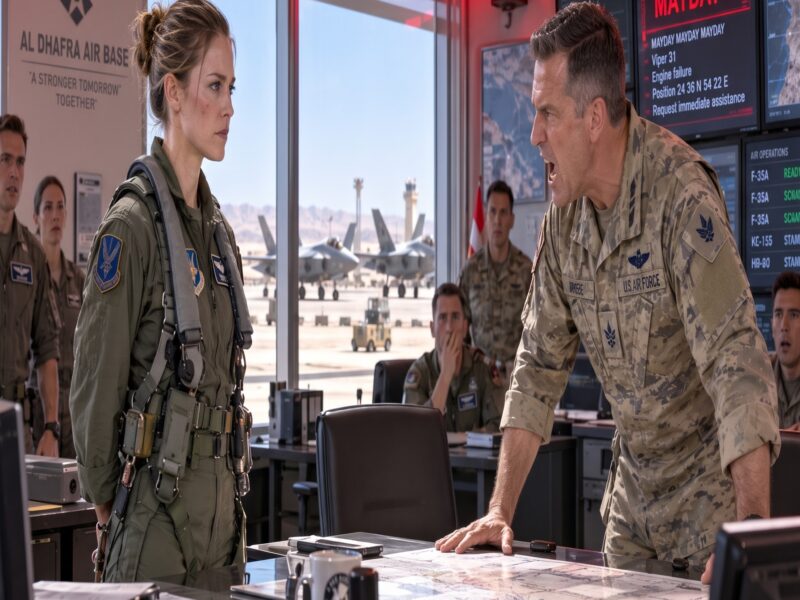
Her commander snarled, “You’ll never fly again,” as he stripped her wings from her uniform in front of the entire squadron
The halogen hangar lights hummed overhead with a brutal, relentless glare, casting long shadows across the concrete floor of the forward operating base.
I stood motionless at rigid attention while Colonel Marcus Vance held my silver aviator wings between two fingers, his face twisted into an expression of unadulterated disgust. The silence inside Hangar 3 was suffocating. Surrounding us were forty pilots, technicians, and flight crew members from the 104th Fighter Squadron—people I had flown alongside, shared meals with, and trusted with my life. Not a single person moved. Not a single person spoke up to defend me.
“You’ll never fly again, Captain Hayes,” Colonel Vance declared, his voice booming off the corrugated steel walls so everyone could hear. He didn’t just unpin my wings; he ripped them from the fabric of my flight suit, tearing two small threads that hung loose over my heart. He tossed the silver metal onto the concrete, where it landed with a sharp, hollow clink.
“You disobeyed a direct vector order during an active airspace sweep,” Vance continued, stepping uncomfortably close, his breath smelling of stale coffee and cigar smoke. “You broke formation, endangered your wingman, and brought shame to this unit. You’re reckless, insubordinate, and unfit for a cockpit.”
I didn’t blink. I didn’t let my hands shake. To the pilots standing in the shadows, I was a rogue officer who had let adrenaline override protocol. They didn’t know what I had seen on my secondary tactical display three hours ago over the northern mountains.
It wasn’t a glitch. Three unidentified aircraft signatures had materialized on my radar for precisely twelve seconds—flying in a tight, hyper-advanced Delta-V formation—before vanishing without a trace into the dead space over Grid 9. I knew that exact flight profile. I had seen it once before, nine years ago, on the worst night of my life. The night my flight instructor’s jet plunged into the icy waters of the North Sea during a classified black-budget testing exercise.
“Get off my flight line,” Vance ordered coldly, pointing toward the heavy sliding doors that led to the administrative quarters. “Surrender your clearance badge to the watch officer and pack your gear.”
I didn’t argue. I knew that arguing with a man whose pride was larger than his strategic intelligence was a waste of breath. I turned on my heel and began walking across the vast floor toward the exit.
I had taken no more than six steps when the high-pitched, warbling scream of the primary emergency klaxon shattered the air.
The sudden noise hit the room like an electrical shock. Conversations stopped instantly. Mechanics dropped their wrenches. Pilots instinctively looked toward the ceiling monitors.
A junior radar technician burst through the side door of the operations center, his face pale, his breath coming in frantic hitches. “Colonel! Emergency signal from Patrol Vector Echo! We have two aircraft dark!”
My heart sank into my throat. “Which ones?” I demanded, turning around before Vance could even react.
The technician looked at me, startlingly panicked. “Falcon Lead and Falcon Two! Lieutenant Miller and Lieutenant Chen! Their primary transponders went cold!”
He gave the precise GPS coordinates over the intercom. Hearing those numbers made my blood run cold.
Grid 9. The exact same corridor. The exact same low-altitude entry vector. The exact same twelve-second radar gap.
“They’re running a sweep through the mountain cut,” I said out loud, running back toward the command center pit.
Colonel Vance blocked the doorway, his massive frame filling the frame, his eyes blazing with fury. “I gave you a direct order, Hayes! You are grounded! Step away from the operations deck!”
I grabbed the lapel of his uniform jacket, staring straight into his eyes without an ounce of fear left in my body. “Then let me save them from the ground, Colonel! If those jets hit the wall in Grid 9, their blood is on your hands!”
Vance hesitated, caught off guard by the sheer intensity in my voice.
Behind him, the central radar display flashed a bright, angry orange. One of the missing F-35s momentarily reappeared on the screen—its altitude plummeting at four hundred knots—before vanishing again. A second later, Chen’s jet followed the same terrifying trajectory.
A young intelligence officer seated at the main terminal covered her mouth with both hands. “They’re gone… Both targets splashed into the terrain…”
“They’re not gone!” I shouted, pushing past Vance and sliding directly into the master controller’s seat.
Vance slammed his hand down on the console beside my head. “How the hell would you know that, Hayes? You’re looking at dead radar sweeps!”
“Because they aren’t crashing! They’re flying inside the shadow!” I pointed a steady finger at the topographical terrain overlay on the main screen. “Look at the ridge lines! There is a narrow, natural blind spot between Peak 4 and Peak 7 where ground-based radar beams reflect off the iron-ore deposits in the granite! If an aircraft drops below six hundred feet in that specific notch, our sweep passes right over them! They’re trapped in a blind corridor!”
The room fell dead silent. The senior officers stared at the topographical map, suddenly realizing that the terrain geometry matched my warning down to the exact meter.
Vance slowly pulled his hand back, his mouth open, unable to speak.
I didn’t waste another second. I grabbed the master radio headset, pulled the microphone close to my lips, and slammed the transmit switch to the guard frequency.
“Falcon Two, this is Captain Hayes! Do you read me? Falcon Two, climb immediately! Pull up to ten thousand feet!”
Nothing came back except the flat, rushing hiss of white noise.
I adjusted the frequency dial manually, bypassing the automated digital signal cleaner to use raw, analog radio waves. “Chen! Miller! If you can hear my voice, pull back on your sticks and climb NOW! You are heading straight for the canyon wall!”
For four agonizing seconds, the silence in the room was heavy enough to crush a stone.
Then, a faint, heavily distorted voice crackled through the overhead speakers—strained, gasping, and accompanied by the deafening roar of an over-torqued jet engine.
“Nellis… Ops…” Lieutenant Chen’s voice gasped over the static. “Who… who is this?”
I closed my eyes tightly, feeling a cold bead of sweat roll down my temple. “It’s Hayes. The pilot your commander just grounded. Listen to me, Chen, you need to execute a vertical climb!”
A terrible pause hung over the radio.
“We… we can’t climb, Captain,” Chen whispered, her voice dripping with sheer, unadulterated terror.
My stomach tightened into a knot. “Why can’t you climb? What’s wrong with the flight controls?”
“Our digital flight bus is completely frozen!” Miller’s voice cut in from the secondary channel, screaming over the ambient cockpit alarms. “Our stick inputs aren’t registering! The automated system is holding our noses down at four hundred feet! We’re locked in a descent!”
I stared at the raw data monitor beside the radar scoop. Suddenly, a third radar signature appeared on the secondary frequency—flying directly behind the two trapped F-35s. It was sitting right in their wake, completely invisible to our early-warning sensors, but casting a distinct electronic shadow across their telemetry feeds.
Someone else was inside that canyon notch. Someone who shouldn’t have been anywhere near a domestic training corridor.
Colonel Vance leaned over my shoulder, his face completely drained of color as he looked at the third signal. “That’s impossible… No unauthorized aircraft can enter this airspace without triggering the regional defense grid!”
“It’s not an accident, Colonel,” I said softly, my eyes narrowing at the electronic signature. “It’s deliberate. They’re using a short-range, directional electromagnetic pulse beam to fry the digital flight control processors of our jets from behind.”
Before Vance could respond, the primary radio channel cleared abruptly. The static vanished, replaced by a smooth, low, terrifyingly calm voice that echoed through every speaker in the command center.
“Tell Captain Hayes to stop interfering,” the voice commanded.
Everyone in the room froze as if struck by lightning.
Colonel Vance slowly turned his head toward me, his eyes wide with profound shock and growing suspicion. “Hayes… how does that pilot know who you are?”
I didn’t answer him. I couldn’t.
My breath caught in my throat, and my fingers locked onto the edges of the plastic console. I would have recognized that voice anywhere in the world. It was deep, precise, with a slight gravelly inflection on the sibilants—the voice that had taught me how to handle a stick, how to recover from a flat spin, and how to survive in the dark.
It belonged to Major Viktor Vance—Colonel Vance’s older brother, my former mentor, and the elite test pilot who had been officially declared dead nine years ago when his experimental prototype exploded over the North Sea.
And now, his ghost was flying an active combat vector, coming straight for us.
The silence in the operations room was broken only by the steady, rhythmic ping of the primary radar dish tracking the empty space above Grid 9.
Colonel Vance backed away from my desk as if he had seen a phantom. His face was ash-grey, his lips trembling. “That… that’s not possible. Viktor died in 2017. I saw the casualty report myself. I signed the military death certificate!”
“He didn’t die, Marcus,” I said, my voice barely louder than a whisper as I stared at the third blip holding its position behind the two paralyzed F-35s. “He ejected before the prototype hit the water. He staged the explosion, cleared his records, and took the black-budget flight software with him.”
“Hayes! This is Lieutenant Chen!” Chen’s panicked voice shattered the room’s shock. “The unknown aircraft is closing distance! It’s fifty yards off my wingtip! My cockpit displays are turning red! What do we do?”
I grabbed the microphone, forcing my voice to remain rock-steady. “Chen, Miller, listen to me very carefully. Your fly-by-wire computer is locked because it’s receiving spoofed altitude data from that black jet’s electronic warfare array. You have to cut off the digital processing unit entirely.”
“Cut off the DPU?” Miller yelled over the speaker. “Captain, if we cut the main computer, we lose automated flight stabilization! These jets aren’t designed to fly on raw manual inputs!”
“They will fly if you trim the mechanical control surfaces manually!” I fired back. “Reach down to your right pedestal panel. Flip the red switch labeled ‘HYDRAULIC DIRECT-LINK’. It bypasses the digital flight computer and connects your stick straight to the hydraulic actuators on your tail fins. It’s going to feel like driving a ten-ton truck with no power steering, but it will break his control lock!”
For three agonizing seconds, no one spoke on the radio.
Then, a violent mechanical clunk echoed over the radio feed, followed by the sound of heavy, agonizing physical strain as Chen fought her flight stick.
“Direct-link active!” Chen gasped, her voice strained as she pulled against thirty pounds of raw hydraulic resistance. “I have mechanical pitch control! Pulling up… pulling up NOW!”
On the main wall monitor, Chen’s and Miller’s F-35s suddenly broke out of their forced descent, pitching their noses skyward and soaring out of the narrow canyon notch, clearing the jagged granite peaks by less than fifty feet.
“Radar contact re-established!” the junior technician shouted, jumping out of her chair. “Falcon Flight is out of the shadow! Altitude four thousand feet and climbing!”
“They broke the lock!” Vance breathed, letting out a ragged sigh of relief.
“They’re not safe yet,” I warned, pointing at the screen.
The third signature didn’t retreat. Instead, the unidentified black jet accelerated with terrifying speed—reaching Mach two-point-four in a flat horizontal line—and climbed straight out of the canyon behind them, sweeping into an offensive attack position.
“Hayes,” Viktor’s voice came back over the open guard frequency, cool and entirely unbothered by the fact that his trap had been foiled. “You always were my brightest student. You remembered the hydraulic override protocol from the old simulator manuals.”
I pressed the transmit button, my jaw set, my eyes cold. “Why are you here, Viktor? Why hunt two junior pilots who don’t even know who you are?”
A short, dark chuckle echoed through the headset. “I didn’t come for those children, Captain. I came for the payload sitting in the hardened storage vault beneath Hangar 7. And I knew that if I put two of your squadron’s jets in danger, Marcus would lock down the perimeter and bring every asset onto the flight line—giving me the exact window I needed.”
Before anyone in the bunker could process his words, a massive, ground-shaking explosion rocked the command center.
The concrete floor beneath our feet lurched violently. Lights flickered and died, replaced instantly by the harsh, flashing red glow of the emergency battery system. Heavy dust rained down from the ceiling tiles, covering the consoles in white powder.
“Report!” Vance screamed, stumbling against the main terminal. “What was that explosion?”
A security officer ran into the room, his uniform covered in soot. “Sir! A high-explosive missile just struck the perimeter power substation! The base’s primary grid is down! The automated security doors on Hangar 7 have defaulted to manual override!”
“He isn’t alone,” I realized, standing up from the console. “He has a ground team on the base.”
On the backup tactical screen, Viktor’s black delta-wing jet was banking in a wide, graceful circle at fifteen thousand feet over the base, acting as an airborne command center and jamming station, completely blinding our surface-to-air missile batteries while his ground operatives moved toward Hangar 7.
“Vance, get your security forces to Hangar 7 right now!” I ordered, turning toward the door.
“Wait!” Vance yelled, grabbing my arm. “What are you doing?”
“I’m going to a cockpit,” I said, shoving his hand off my sleeve.
“You can’t!” Vance shouted, his voice cracking with desperation. “Every F-35 on the flight line is bricked! Their digital startup protocols are tied to the main base server, which just went down with the power substation! None of our modern jets can start their engines without the digital umbilical link!”
I stopped at the heavy blast door and looked back at him, a cold, bitter smile touching my lips.
“Then it’s a good thing we haven’t scrapped the old interceptor in Hangar 4 yet,” I said.
Without waiting for his response, I slammed open the emergency exit door and sprinted out into the dark, smoke-filled night toward the far end of the flight line.
The night air outside was thick with the smell of burning transformer oil, ozone, and jet fuel. Black smoke billowed into the dark Nevada sky from the destroyed power substation near the main perimeter fence. Emergency sirens wailed across the base, their sharp, mechanical screams mixing with the distant sound of small-arms fire near Hangar 7.
I ran down the concrete taxiway, my flight boots pounding against the asphalt, my mind focused entirely on a single target at the edge of the base.
Hangar 4 was the oldest structure on the installation—a weathered, rusted steel arch structure built during the Cold War. Unlike the modern glass-and-steel bays housing the F-35s, Hangar 4 didn’t have electronic smart-locks or automated climate controls. It was where the wing kept its historical displays and retired maintenance hulks.
I threw open the heavy side access door and stepped inside.
Standing in the dim, dusty interior, surrounded by wooden crates, old hydraulic carts, and spare engine casings, was an F-15C Eagle—an old double-tailed air-superiority fighter that had been pulled from active service eight years ago. Its grey paint was faded, its unit markings scratched, but its steel-and-titanium frame was intact.
Most importantly, it was an analog machine. It didn’t rely on cloud-connected base servers, satellite updates, or digital umbilical links to start its twin Pratt & Whitney engines. It required three simple things: high-pressure air, jet fuel, and a pilot willing to pull the mechanical start handles.
“Captain Hayes?” a voice called out from the dark corner of the hangar.
An elderly master mechanic—Chief Petty Officer Brody—stepped out from behind a tool bench, holding a heavy wrench in his grease-stained hands. “What the hell is going on out there? The whole base is shaking!”
“Brody! Connect the mechanical air starter unit to the left engine intake!” I yelled, throwing off my torn uniform jacket and climbing up the access ladder into the cramped cockpit. “We’re taking the Eagle up!”
Brody stared at me like I had lost my mind. “Captain, this airframe hasn’t flown an operational sortie in six years! The fuel tanks were flushed last month, and the analog radar array uses vacuum tubes!”
“Is there JP-8 fuel in the auxiliary belly tank?” I demanded, strapping the heavy mechanical harness across my chest and pulling the leather flight helmet over my head.
“Well… yeah, about three thousand gallons in the belly cell, but…”
“Then spool the starter cart!” I roared, snapping my oxygen mask firmly over my face.
Brody looked toward the open hangar door, hearing the sound of another explosion near the administrative building. His eyes hardened, his doubts vanishing in an instant. He turned on his heel, grabbed a heavy yellow air hose, and shoved the brass connector directly into the F-15’s lower engine bay.
“Air pressure coming online!” Brody screamed, hitting the manual lever on the diesel starter cart parked outside the door.
WHIRRRRRRRR-CLICK!
A high-pitched, mechanical whine vibrated through the cockpit floor, rising into a deafening roar as compressed air forced the left engine’s turbine blades to spin. I reached down to the left console, flipped the battery isolation switch, and yanked the fuel flow lever wide open.
BOOM-ROAR!
A violent cloud of dark smoke erupted from the F-15’s left tailpipe as raw jet fuel ignited inside the combustion chamber. The RPM gauge spun clockwise, its mechanical needle flickering into the green operational zone. Hydraulic pressure surged through the control lines, making the flight stick between my knees stiffen and come to life.
“Right engine start!” I shouted, flipping the secondary ignition toggle.
The second engine caught fire with a thunderous roar that shook the entire steel hangar, blowing dust, old rags, and wooden pallets thirty feet across the floor.
I reached up with my gloved hand and pulled down the heavy acrylic canopy, locking the manual steel latch with a sharp, metallic CLACK.
“Base Ops, this is Aggressor Zero-One,” I said into my mask, switching the analog radio to the battery-backed emergency channel. “I am rolling out on Taxiway Bravo.”
In my helmet speakers, Colonel Vance’s voice came back, laced with disbelief and sudden, desperate hope. “Hayes… you actually got that museum piece started?”
“She isn’t a museum piece, Colonel,” I replied, shoving both throttle levers forward into full military power. “She’s an interceptor.”
The F-15 shot out of Hangar 4 like a missile leaving its tube, its heavy tires screaming against the concrete as I turned the nose straight onto the main runway.
Above the base, high in the moonlit clouds at fifteen thousand feet, Viktor’s black delta-wing jet was hovering like a dark bird of prey, its electronic warfare array continuing to blanket the base in high-density radio static.
I slammed the throttles past the military detent and shoved them into full afterburner.
BOOM!
Two massive, forty-foot shafts of blinding orange flame erupted from the Eagle’s tail nozzles, illuminating the dark runway in a brilliant glow. The sudden, violent acceleration slammed me back into the seat with four Gs of force. The airspeed needle swept past one hundred, two hundred, two hundred and fifty knots in seconds.
I pulled back hard on the stick.
The F-15’s nose pitched up sharply, its twin wings biting into the night air as it tore off the runway, climbing into the sky at a seventy-degree angle, roaring straight toward the black shadow waiting in the clouds.
The transition from the dark, chaotic ground to the freezing, moonlit expanse of the upper atmosphere was instantaneous.
At twelve thousand feet, the thick blanket of smoke covering the base vanished, replaced by a crystalline sky lit by a full silver moon. Below me, Nellis Air Force Base looked like a collection of dark, silent buildings surrounded by flashing red emergency lights.
“Aggressor Zero-One, this is Nellis Ops,” Vance’s voice crackled through my headset, distorted by heavy background noise. “Target is currently at sixteen thousand feet, holding a defensive orbit directly above your vector. His electronic warfare array is still active!”
“He can jam digital microprocessors all day, Colonel,” I said, reaching over to the center instrument panel and pulling the heavy brass toggle switch that powered the old analog APG-63 radar. “He can’t jam raw electromagnetic radiation.”
A high-pitched electrical hum vibrated through the cockpit floor as the old mechanical radar dish behind the nose cone began to physically sweep back and forth, emitting a high-power, crude radar beam through the sky ahead of me.
On the round, green glass radar scoop in the center of my dashboard, a chaotic wave of green static flashed. Then, suddenly, a sharp, solid black shadow cut through the noise—a distinct, unmistakable return signal.
Viktor’s black jet was right ahead.
“I have visual and radar contact,” I announced, my thumb sliding over the red weapon-select switch on the flight stick.
Instantly, my radar warning receiver began to scream—a continuous, high-pitched tone indicating that Viktor’s aircraft had detected my analog radar sweep and was locking its optical targeting system onto my nose.
“Hayes,” Viktor’s voice cut back into my helmet, sounding genuinely amused. “You launched a thirty-year-old airframe against an autonomous fifth-generation stealth platform? You really are as stubborn as your father was.”
“My father didn’t turn his back on his country for a defense contractor’s paycheck, Viktor!” I growled, pulling the stick hard to the right and dropping my left wing to set up a high-side gun tracking pass.
“Country?” Viktor scoffed over the radio. “This country threw me away the second my prototype suffered a software glitch! They declared me dead to avoid a political scandal! Aegis Recon Systems gave me the resources to build a machine that makes human pilots obsolete!”
“Then let’s see how smart your machine really is!” I shouted, slamming the throttles into full afterburner and diving straight down on his tail.
The black delta-wing jet didn’t roll or bank like a normal aircraft. Utilizing three-dimensional thrust-vectoring nozzles, it executed an instantaneous vector change, flipping its nose around one hundred and eighty degrees in mid-air without losing altitude—a maneuver that would have crushed a human pilot’s spine under twenty-five Gs of physical force.
It fired a burst from its forward 20mm cannon. A stream of glowing green tracer rounds sliced through the night air, passing inches above my cockpit canopy and tearing two jagged holes through my left vertical stabilizer.
The violent shockwave slammed my aircraft sideways, greyout threatening the edges of my vision as five Gs of force pulled the blood from my brain.
“Warning! Structural damage to port stabilizer!” the mechanical voice in my helmet chattered.
“Quiet!” I snapped, fighting the heavy mechanical stick as the F-15 groaned in structural agony.
Viktor’s jet banked sharply, sliding onto my tail with terrifying speed, setting up its high-power microwave beam to fry my remaining hydraulic actuators.
“He’s on your six, Hayes!” Vance screamed from the ground station. “Break left! Break left!”
“If I break left, he cuts the corner and takes the shot!” I grunted through clenched teeth, my muscles straining as I pulled against the heavy hydraulic resistance.
I did the one thing Viktor’s flight-computer algorithms would never predict a rational pilot doing.
Instead of turning away, I pulled both throttle levers completely back to flight idle and extended the heavy mechanical speed brakes along the F-15’s upper fuselage.
The massive fighter decelerated violently, its nose pitching up as its airspeed dropped from seven hundred knots to under one hundred and fifty in a matter of two seconds.
The black drone, moving at supersonic speed and programmed to track a high-speed evasive maneuver, was completely caught off guard by the sudden, dramatic loss of velocity. The black delta wing shot directly past my canopy, overshooting my nose by less than twenty yards.
For a brief, frozen fraction of a second, the two aircraft were flying canopy-to-canopy in the moonlit sky.
Through the dark-tinted composite glass of the enemy cockpit, I saw the internal control housing. There was no human seat. No flight stick. Just a cold, glowing blue processing core pulsing in the center of the frame.
Viktor wasn’t sitting inside the jet. He was controlling it remotely from a ground station near Hangar 7.
“Got you,” I whispered.
I slammed my throttles back into full afterburner, pulled the optical sight reticle directly over the drone’s glowing central core, and squeezed the red cannon trigger on my stick.
BRRRRRRRRRRRRRRRRRRRRRRP!
The F-15’s internal 20mm Vulcan cannon roared to life, spewing a continuous stream of one hundred high-explosive armor-piercing shells per second.
The high-explosive rounds ripped through the black drone’s composite skin, shattering its internal processing units, severing its fuel lines, and detonating its central power core in a brilliant, blinding fireball that illuminated the clouds for ten miles in every direction.
Shockwaves from the explosion slammed into my F-15, shattering my front windscreen glass and showering my helmet in tiny acrylic fragments, but the heavy mechanical frame held together.
I pulled up sharply, soaring through the burning cloud of black smoke into the clear, quiet air above.
Below me, the burning wreckage of the black drone tumbled uselessly through the night, falling straight down into the desert floor far outside the base perimeter.
Silence returned to the radio channel.
I leaned back against my headrest, gasping for oxygen, my chest heaving, my hands trembling violently as the cold adrenaline began to fade.
“Target destroyed,” I breathed into my mask, my voice raspy and raw. “Target destroyed. Aggressor Zero-One returning to base.”
For five long seconds, no one spoke over the radio.
Then, the voice of Colonel Vance came through, thick with emotion and an overwhelming sense of profound humility.
“Copy that, Captain Hayes,” Vance said softly. “Runway Zero-Three is cleared for your landing. Welcome back to the flight line, son.”
By sunrise, the desert sky over Nellis Air Force Base had turned a brilliant, peaceful shade of gold and pale blue.
The small-arms fire near Hangar 7 had ended hours ago. A specialized team of Air Force Security Forces, alerted by my radio reports, had surrounded the vault building at 0400 hours, capturing Viktor Vance’s ground operatives before they could extract the classified software payload.
Major Viktor Vance himself was taken into federal custody three miles outside the base perimeter, apprehended inside a mobile command trailer equipped with satellite uplinks.
The public news reports released later that morning made no mention of black-budget drones, rogue test pilots, or electromagnetic weapons. They spoke briefly of a “successful multi-service anti-terrorism readiness exercise conducted over the Nevada range.”
In our world, the greatest battles were always fought in the shadows, far away from the eyes of the public.
I stood on the tarmac outside Hangar 4, watching the morning sun reflect off the scarred, blue metal skin of the old F-15C Eagle. Mechanics were already at work around the aircraft, carefully wiping down its panel lines and inspecting its battle-damaged stabilizer with quiet, respectful care.
The heavy footsteps of two people approached from behind.
I turned around to see Colonel Marcus Vance walking toward me, accompanied by Lieutenant Chen and Lieutenant Miller. Both young pilots were wearing their flight suits, looking at me with a mix of awe, gratitude, and deep respect.
“Captain,” Chen said, stepping forward first and executing a sharp, perfect military salute. “If you hadn’t stayed on that radio console… if you hadn’t known that mechanical override… neither of us would have made it out of that canyon.”
“You did the flying, Lieutenant,” I said, returning her salute warmly. “You held onto that stick when the controls got heavy. That’s what makes a pilot.”
Miller smiled, reaching out to shake my hand firmly. “We owe you our lives, sir. Any time you want to step into a simulator with us, the coffee is on me.”
“I’ll hold you to that, Miller,” I replied.
The two young pilots rendered one final salute and walked back toward the squadron building, leaving Colonel Vance and me standing alone on the quiet tarmac.
Colonel Vance stood silently for a long moment, looking down at his polished boots, looking noticeably older and far less imposing than he had twenty-four hours ago. The arrogance that had defined his command was gone, replaced by a quiet, heavy burden of realization.
He reached into his uniform pocket and pulled out a small, velvet-lined wooden box.
He opened it, revealing a pair of brand-new, polished silver aviator wings—far brighter and far more immaculate than the ones he had torn from my chest the previous morning.
“I spoke with Air Combat Command forty minutes ago,” Vance said, his voice quiet, devoid of any official bluster. “The grounding order issued against you yesterday has been officially rescinded and stricken from your military service record.”
He stepped closer, holding the wooden box out toward me.
“Furthermore,” Vance continued, looking me directly in the eye, “General Thomas has appointed you as the new Chief Flight Instructor for the 57th Wing’s Advanced Tactics Division.”
I looked down at the silver wings resting inside the velvet box, feeling a warm, quiet pride rise inside my chest.
“Chief Flight Instructor?” I asked softly.
“We need someone in that position who knows what happens when the screens go dark, Hayes,” Vance said, his voice trembling slightly with emotion. “I spent ten years relying on digital manuals and administrative protocols. I forgot that at the end of the day, an Air Force is built on the courage and instincts of the men and women sitting in those cockpits. You reminded me of that last night.”
He took the silver wings out of the box, stepped forward, and pinned them firmly over my left breast pocket, carefully smoothing down the torn fabric beneath the metal clasps.
“It is an honor to serve with you, Captain Hayes,” Vance said, snapping his head back and executing the crispest, most respectful salute I had ever seen him perform.
I stood tall, raised my right hand to the brim of my flight cap, and returned the salute.
“Thank you, Colonel,” I replied.
From the runway behind us, the thunderous roar of jet engines shattered the morning quiet as a four-ship formation of F-35s took off into the bright blue sky, their afterburners glowing like miniature suns as they climbed together into the clouds.
I adjusted my flight cap, turned toward the flight line, and walked toward the sky where I belonged.
The end,









