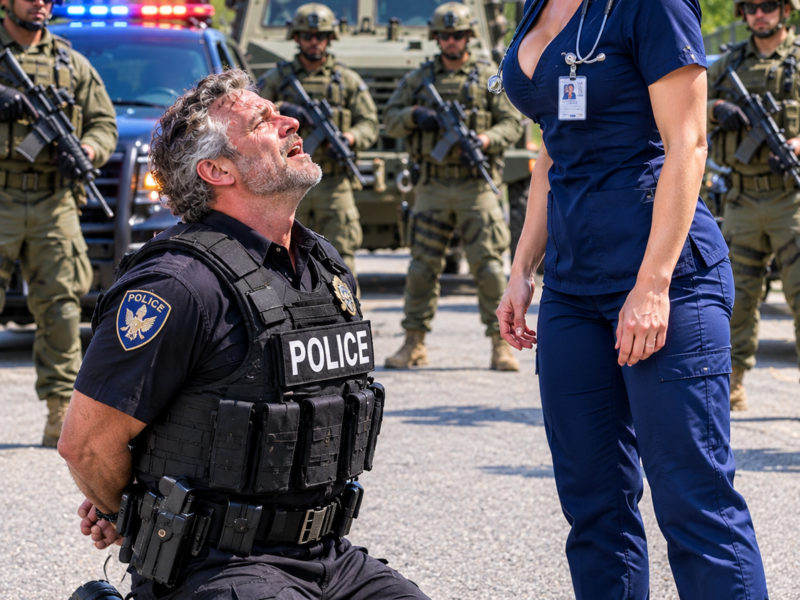
““Get this nurse out of my command briefing,” Colonel Richard Hayes snapped, ordering military police to escort me from the room
Turner kept his hand resting on the photograph.
“Six weeks ago, a medical team found Major David Reynolds alive in a remote clinic outside Kandahar,” he said. “He had been living under another name. He was injured, but he was conscious. The first thing he asked when he could speak clearly was whether you were still at Fort Liberty.”
I stared at him.
“Why would he ask for me?”
“Because he says you were the only person who knew what really happened that night.”
“That’s impossible. I read the report. I signed it.”
“I know, ma’am.”
“Then you know I watched them lower an empty casket into the ground.”
Turner’s expression tightened.
“I know.”
Colonel Hayes stepped closer to the counter.
“This conversation is over.”
Turner didn’t move.
“Sir, with respect, the conversation has barely started.”
Hayes looked at the two military police officers.
“Lieutenant Carter, remove Sergeant First Class Turner from this medical center. Then escort Colonel Mitchell to the command building.”
Lieutenant Carter hesitated.
“Sir, Sergeant Turner hasn’t violated any orders.”
“I gave you an order.”
Before Carter could answer, Brooks groaned from the bed.
The sound was weak, but it changed everything.
Dr. Grant rushed to his side.
“His blood pressure is dropping again.”
I turned toward the monitor.
The numbers were falling faster than they should have been.
“Dr. Grant, check his medication line.”
She examined the IV tubing, then the chart.
“What are you looking for?”
“The medication listed on the transfer paperwork. Compare it with what was actually administered.”
She flipped through the chart.
Her expression changed.
“This dosage isn’t what I ordered.”
“Who entered it?”
She checked the signature.
“Dr. Aaron Whitcomb.”
“Was he part of the transport team?”
“No. He’s an orthopedic surgeon. He wasn’t even on duty this morning.”
I looked at Hayes.
“That’s the discrepancy I was trying to tell you about.”
Hayes folded his arms.
“You are making accusations based on a clerical error.”
“Then explain why the medication was signed out twenty minutes before the ambulance left the base.”
Dr. Grant looked up.
“Sarah, are you saying someone altered his medication?”
“I’m saying we need to find out before anyone moves him.”
Hayes stepped between us and the patient.
“Colonel Mitchell, you are no longer responsible for this case.”
I met his eyes.
“Then let the doctor be responsible. She has already told you that transporting him could kill him.”
For several seconds, nobody spoke.
Then Turner reached inside his uniform and removed a folded document.
“Sir, I think you should see this.”
Hayes didn’t take it.
“What is it?”
“An authorization for an internal medical investigation. It was issued this morning.”
“By whom?”
“Brigadier General Elaine Porter.”
The name landed heavily in the room.
Hayes’ jaw tightened.
“General Porter has no authority over this facility’s daily operations.”
“She has authority over the investigation into Major Reynolds.”
Turner unfolded the document.
“And according to this authorization, any medical incident involving personnel connected to that investigation must be preserved as potential evidence.”
Dr. Grant looked from Turner to me.
“Brooks is connected to Reynolds?”
“I don’t know,” I said.
But something in me had already begun to connect the pieces.
The medication discrepancy.
The unexplained order to transfer an unstable patient.
The name of a doctor who hadn’t been present.
And Hayes’ sudden interest in getting me out of the room.
I turned to Lieutenant Carter.
“Lieutenant, I need you to secure the medication record and the original transport paperwork. No one alters or removes anything.”
He looked toward Hayes.
Hayes gave him a cold stare.
“You will follow my orders.”
Carter swallowed.
Then he looked at Turner.
“Sergeant, is that authorization authentic?”
Turner handed him the document.
“Verify it yourself.”
Carter read the first page.
His shoulders straightened.
“Sir, the authorization is valid.”
Hayes’ face became almost expressionless.
“Fine. Secure the records. But nobody leaves this facility.”
I looked at him.
“That’s not your decision anymore.”
For the first time, he didn’t answer.
Dr. Grant and I turned back to Brooks.
The next twenty minutes were the longest of my life.
We stabilized his breathing, adjusted the medication, and brought his blood pressure back into a safer range.
Dr. Grant refused to leave his bedside.
I stayed beside her, watching every change on the monitor.
When Brooks finally opened his eyes, he looked confused and frightened.
“Where am I?”
“Fort Liberty Medical Center,” Dr. Grant said gently. “You’re safe. Don’t try to move.”
His eyes drifted toward me.
“Ma’am?”
I leaned closer.
“I’m Sarah. You’re going to be all right.”
He tried to speak, but his throat was dry.
“Did they…”
He stopped and swallowed.
“Did they get the package?”
The room went quiet.
Dr. Grant glanced at me.
“What package?”
Brooks looked at the doorway.
His eyes found Hayes.
The colonel stood perfectly still.
“I don’t know what you’re talking about,” Hayes said.
Brooks’ breathing quickened.
I gently placed a hand on his shoulder.
“Daniel, don’t force yourself. You’re in a hospital. We need you to rest.”
He shook his head.
“Don’t let them take it.”
“Take what?”
His eyes moved toward the small belongings bag beside the cabinet.
“My wallet.”
I retrieved it and showed it to him.
“Your wallet is safe.”
“No. The other thing.”
He tried to lift his hand, but his arm trembled.
“Inside the lining.”
I looked at the wallet.
The photograph of his daughter was still visible through the transparent sleeve.
I turned it over.
The leather lining along one edge looked slightly uneven.
“Dr. Grant, can you stay with him?”
She nodded.
I took the wallet to the counter and examined the seam.
A tiny memory card had been tucked beneath the loosened lining.
I didn’t remove it.
Instead, I called Turner over.
“Sergeant, I think this belongs to the investigation.”
He looked at the card.
His face went pale.
“That’s not good.”
“Do you recognize it?”
“I’ve seen one like it before. Major Reynolds used to carry one in his field notebook.”
Hayes moved toward us.
“Give that to me.”
Turner stepped in front of him.
“No, sir.”
“I am ordering you to hand over government property.”
“Then you can request it through the investigators.”
Hayes’ voice dropped.
“You have no idea what you’re interfering with.”
Turner held his ground.
“I think I’m beginning to understand.”
A few minutes later, General Porter arrived with two investigators from the Army Criminal Investigation Division.
She was a compact woman in her early sixties, with silver hair and a calm expression that made people lower their voices without being asked.
She entered the room, looked at Brooks, then at me.
“Colonel Mitchell.”
I stood.
“General.”
She glanced at the photograph on the counter.
“So you found each other.”
“Not exactly,” I said. “Sergeant Turner found me.”
Her eyes moved to Hayes.
“And Colonel Hayes appears to have found a reason to be here.”
Hayes straightened.
“General, this is a medical matter. My concern is the welfare of an injured soldier.”
“Then I’m sure you won’t object to an independent review of his treatment.”
“I have already requested a transfer.”
“Without the attending physician’s approval?”
“He is a military patient.”
“He is also a human being whose condition makes transport dangerous.”
Dr. Grant spoke from Brooks’ bedside.
“That’s correct, General.”
Porter nodded.
“Then he stays here.”
Hayes looked as if he wanted to argue, but the two investigators had already approached him.
“Colonel Hayes,” one said, “we need you to accompany us for a formal interview.”
“On what grounds?”
“Your name appears in an investigation involving falsified medical records and the disappearance of a serving officer.”
Hayes turned toward me.
“You have no idea what you’re doing.”
I held his gaze.
“Then explain it.”
He didn’t.
Instead, he walked out with the investigators.
General Porter waited until the door closed.
“Sarah, I need to ask you something. Did you ever receive a message from David after his reported death?”
“No.”
“Did you ever authorize a change to the evacuation records?”
“No.”
“Did you recognize the name Aaron Whitcomb?”
I shook my head.
“Only from the medication signature.”
She nodded slowly.
“Then there’s something you need to know before you see David.”
I felt my stomach tighten.
“What?”
“His disappearance was not a simple case of a missing officer.”
She pulled a chair closer.
“Four years ago, your unit was assigned to escort a medical evacuation team after a convoy was attacked. The official report stated that Major Reynolds was killed when the helicopter was struck and destroyed.”
“That was the report I signed.”
“Yes. But the original incident report contained a second set of coordinates. They placed the helicopter several miles away from the location listed in the final report.”
I stared at her.
“Why wasn’t that information included?”
“Because the coordinates were changed before the report reached your desk.”
“By whom?”
“We’re still establishing that.”
“General, I signed the report.”
“You signed the version you were given. The original was replaced.”
I remembered the night with painful clarity.
The dust.
The screaming.
The burning wreckage.
The radio cutting in and out.
And David’s voice, telling me to keep moving.
I had been a lieutenant colonel then, responsible for coordinating the medical evacuation under fire.
David had been the officer leading the ground team.
We had been separated when the helicopter went down.
I had searched until the area became too dangerous.
When command ordered us to withdraw, I had believed there was nothing left to recover.
“Why did he disappear?” I asked.
Porter looked toward the closed door.
“Because someone wanted the records he had collected.”
“What records?”
“Evidence that supplies intended for medical evacuation units had been diverted. Medical equipment, trauma supplies, and controlled medications were being moved through unauthorized channels. Some shipments were disappearing before they reached the units that needed them.”
I thought of Brooks.
The wrong medication.
The forged signature.
The transport order.
“David discovered it?”
“He found irregularities and started documenting them. He believed the diversions were connected to a group of contractors and military personnel who had access to logistics and medical procurement.”
“Was Hayes involved?”
“We believe he helped protect the operation.”
My hands tightened.
“And the false death report?”
“David survived the crash. He was taken to a field clinic by local civilians. He tried to contact his chain of command, but the people he trusted had already been compromised. His communications were intercepted.”
“Why didn’t he come home?”
“He was told that his family would be in danger if he did. He was also told that you had approved the withdrawal that left him behind.”
I stared at her.
“That’s a lie.”
“We know that now.”
“Did he believe it?”
Porter didn’t answer immediately.
“Long enough to stop trying to reach you.”
The room seemed to grow smaller.
I had spent four years wondering whether I had abandoned him.
He had spent four years believing I had chosen to leave him.
Neither of us had known the truth.
“What changed six weeks ago?” I asked.
“He reached a medical team through a local contact. He had kept copies of some of the evidence. When he learned that the investigation had reopened, he agreed to come back.”
“Why wait to see me?”
“Because he wanted to know whether the people responsible had been identified. He didn’t want to put you in danger again.”
I looked toward Brooks.
“And this soldier?”
“Brooks was assigned to a logistics support team that recently discovered a discrepancy in a shipment record. We believe he copied information before the records were altered.”
The memory card in the wallet suddenly felt heavier than it looked.
“Did he know what was on it?”
“Apparently enough to hide it.”
Porter lowered her voice.
“Sarah, I need you to understand that this investigation is not over. If the card contains what we think it contains, there may be people who will do almost anything to keep it from becoming public.”
I looked at the door Hayes had walked through.
“Then we should stop giving them time.”
Porter nodded to the investigators.
They took possession of the memory card, photographed the wallet, and documented the chain of custody.
Dr. Grant remained with Brooks.
Turner stood near the doorway, watching the corridor.
I approached him.
“Michael.”
He turned.
“Yes, ma’am?”
“Why did you say you thought I was dead?”
He looked down at the photograph.
“After Major Reynolds disappeared, I kept asking questions. I was told the investigation was closed and that you had retired because you couldn’t handle what happened.”
“I retired because I was tired of watching people get hurt while paperwork decided what mattered.”
“I know.”
He hesitated.
“Then I heard there had been an accident involving a vehicle you were traveling in. Nobody could confirm anything. Your name disappeared from the unit updates. After a while, I thought…”
He stopped.
“I thought they had taken you too.”
I looked at the scar near my eyebrow.
The one he had recognized before anyone else in that room.
“I’m still here.”
His eyes softened.
“Yes, ma’am. You are.”
General Porter returned shortly afterward.
“We have a location for Major Reynolds.”
I felt my heart begin to pound.
“Where?”
“He’s staying at a secure recovery facility outside the main base. He asked to see you.”
I couldn’t move.
After four years of imagining what I would say if I ever saw him again, I suddenly had no words.
“Is he well enough?”
“He’s recovering. He can walk, but he’s still weak.”
I glanced at Brooks.
“Can I see him after we know Daniel is stable?”
Porter nodded.
“That’s the right priority.”
For the next hour, I stayed with the young sergeant.
His condition improved gradually.
When Dr. Grant finally said he was stable enough for a short conversation, I sat beside his bed.
“Daniel, I need to ask you about that memory card.”
He looked nervous.
“Did they take it?”
“It’s secured with the investigators. Nobody can access it without a documented process.”
He relaxed slightly.
“Good.”
“Why did you hide it in your wallet?”
He looked at the photograph of his daughter.
“Because they searched my equipment. They searched my locker. They even checked my phone. But nobody thought to look inside a wallet with a little girl’s picture.”
“Who gave you the card?”
He hesitated.
“A man named Reynolds.”
I felt my breath catch.
“Major David Reynolds?”
He nodded.
“He came to our logistics office a few weeks ago. He didn’t look like an officer. He was thinner, older. But he knew things nobody else could know.”
“What did he tell you?”
“That some of the shipment records were being changed. He said I should keep a copy of the original files because someone was going to try to make the discrepancies disappear.”
“Did you know he was supposed to be dead?”
“Yes, ma’am. That’s why I didn’t believe him at first.”
“What happened after that?”
“Two days later, my supervisor told me I was being transferred. Then someone changed my medication order before the training exercise.”
His voice shook.
“I don’t know if they meant to kill me. But I knew something was wrong.”
I glanced at Dr. Grant.
She had been listening carefully.
“Did you see who changed it?”
“No. But I heard my supervisor talking to someone on the phone. He said the problem would be handled before the audit.”
“Do you remember the other person’s name?”
Brooks closed his eyes, trying to remember.
“Hayes.”
The name hung between us.
I thanked him and told him to rest.
When I stepped into the corridor, General Porter was waiting.
“The investigators have enough to bring Hayes in for questioning,” she said. “But we need more than suspicion. The records on that card may give us what we need.”
“Then what are we waiting for?”
“Digital forensics is working on it.”
I looked at the clock.
“Can I see David now?”
Porter studied my face.
“Yes.”
She escorted me to a small building near the medical center.
It had no obvious security markings, just a keypad beside the door and two soldiers standing outside.
Inside, the hall smelled faintly of disinfectant and coffee.
A nurse opened the door to a private recovery room.
And there he was.
David Reynolds sat beside the window in a gray sweatshirt, one hand resting on a walking cane.
His hair was almost completely gray.
There was a scar along his jaw, and his face was thinner than I remembered.
But his eyes were the same.
For a moment, neither of us spoke.
Then he stood.
“Sarah.”
I stopped just inside the doorway.
“David.”
He took one step toward me, then paused as if he wasn’t sure I wanted him close.
I crossed the room.
The first thing I noticed was how carefully he moved.
The second was that his hands were shaking.
I reached for him.
He held me tightly, and for a moment I was back beside that damaged helicopter, hearing his voice through the radio.
Then the years caught up with us.
I pulled away enough to look at him.
“You were alive.”
He nodded.
“I was.”
“I buried you.”
His face crumpled.
“I know.”
“I went to your memorial. I stood beside your wife. I watched your son put flowers on an empty casket.”
“I know, Sarah.”
“Do you have any idea what that did to us?”
He lowered his eyes.
“I’ve thought about it every day.”
I turned away, trying to steady my breathing.
“You let me believe I abandoned you.”
“I didn’t know what to believe.”
“You could have contacted me.”
“I tried once.”
I looked back.
“What?”
He moved slowly toward the chair.
“About a year after the crash, I managed to get a message through to someone I thought I could trust. I asked them to tell you I was alive.”
“Who?”
“Colonel Hayes.”
My stomach turned.
“He told you?”
David shook his head.
“He sent a message back. It said you had confirmed the withdrawal and that you wanted no further contact with the operation.”
I felt the blood drain from my face.
“I never said that.”
“I know.”
He reached into a drawer and removed a small envelope.
Inside was a printed message with my name at the top.
I read it once.
Then again.
It was written in language that sounded almost like mine.
But I had never seen it.
“I didn’t send this.”
“I know that now.”
“Why did you believe it?”
“Because it came through the official channel. Because I was exhausted. Because I had spent months hiding in places where I didn’t know whether the person bringing me food would return the next day.”
He looked at me.
“And because I couldn’t bear the thought that you had decided I wasn’t worth saving.”
My throat tightened.
“I never stopped looking for you.”
“I know.”
“No, David. You need to hear this. I never stopped.”
He nodded, his eyes shining.
“I should have trusted you.”
We sat in silence for a while.
Then I asked the question I had been carrying for four years.
“What happened after the crash?”
He took a slow breath.
“The helicopter went down after the evacuation route was compromised. I was thrown clear. Two local men found me before the second strike. They took me to a clinic in a nearby village.”
“Why didn’t you send a location?”
“I did. My first radio transmission was intercepted. The response came from someone using our own command frequency.”
He looked toward the window.
“They told me the recovery team had been diverted and that the area was too dangerous. When I asked for another extraction, they told me your unit had withdrawn.”
I closed my eyes.
“That was true. We were ordered to withdraw after the second attack.”
“I know. But I didn’t know who had made that decision or why.”
He continued.
“I had copies of the shipment records with me. I knew the diversions were connected to people with access to our logistics system. I also knew the crash wasn’t random.”
“You think they deliberately sent the helicopter into the compromised route?”
“I can’t prove that. But the route change appeared in the system after I filed a warning.”
He paused.
“Someone wanted the medical shipments to disappear. When I started asking questions, the records began disappearing too.”
“And Hayes?”
“Hayes was the officer who approved the route change.”
I stared at him.
“Why didn’t you report him?”
“I tried. But the first two people I contacted were connected to the same network. After that, I stopped trusting official channels.”
“You could have trusted me.”
He looked at me with a sadness that made it difficult to stay angry.
“I should have.”
I sat down.
“David, what happened to your family?”
His expression changed.
“My wife was told I had died. She raised our son alone. I was able to get a message to her once, but I was warned that any direct contact would expose her.”
“Does she know you’re alive now?”
“Yes. She knows.”
“And your son?”
“He’s ten now.”
I remembered the little boy at the memorial, clutching his mother’s hand.
“Does he remember you?”
“Some things. A few stories. The way I used to read to him before bed.”
David’s voice broke slightly.
“He thinks I came back from the dead.”
I looked down.
“I suppose, in a way, you did.”
He smiled faintly.
“Not the way I wanted.”
The door opened.
General Porter stepped inside.
“I’m sorry to interrupt. We have the first forensic results.”
David straightened.
“What did they find?”
“The memory card contains copies of original shipment manifests, payment records, and communications between several people involved in the diversion scheme.”
She placed a folder on the table.
“One of the communications is particularly important.”
She opened it.
The message was dated four years earlier.
It referred to the helicopter route, the false casualty report, and a plan to prevent the missing officer from being located.
There was a signature at the bottom.
Richard Hayes.
I stared at it.
David looked away.
“That’s the message I was afraid they’d destroy.”
Porter turned another page.
“There is also a record of the altered medical order given to Sergeant Brooks. The medication was entered under Dr. Whitcomb’s credentials, but the access log shows that the order came from a terminal assigned to Colonel Hayes’ office.”
I felt a chill.
“So Hayes knew Brooks had the evidence.”
“We believe he suspected it.”
“Was the medication intended to kill him?”
“We don’t know yet. The dose was dangerous, but the investigation has to establish intent.”
David leaned forward.
“Then you have enough to arrest him.”
“We have enough to detain him pending formal proceedings,” Porter replied. “But there are other people involved. We need to know who approved the payments and who altered the records.”
She looked at me.
“Sarah, there’s one more thing.”
I waited.
“Your name appears in a second communication.”
I felt the room tighten around me.
“What does it say?”
Porter placed another page on the table.
It was an internal note dated three months after David’s disappearance.
It described me as a potential witness who had been given an incomplete version of the incident report.
The final line read: “If Mitchell continues requesting original records, transfer her from the assignment and close all related inquiries.”
I read it twice.
“They were watching me.”
“Yes.”
“That’s why my requests were denied.”
“Yes.”
I remembered the months I had spent asking for the original flight data.
The missing pages.
The unanswered messages.
The senior officers who had told me to stop reopening a closed case.
I had thought I was failing to accept David’s death.
Now I understood that someone had been working to make sure I never found the truth.
“Did they cause me to leave the Army?”
Porter shook her head.
“We haven’t established that. Your retirement was approved through the normal process. But your concerns were deliberately minimized, and your access to the records was restricted.”
I looked at David.
“They wanted us separated.”
He nodded.
“And they almost succeeded.”
The investigation moved quickly after that.
Hayes was formally detained.
His office was searched.
The investigators recovered deleted messages, altered medical records, and a series of financial transfers connected to the contractors David had identified.
Dr. Whitcomb was placed under investigation after denying any knowledge of the medication order.
The digital records eventually showed that his credentials had been used without his authorization.
He had been careless with his access information, but there was no evidence that he had knowingly participated in the scheme.
Brooks recovered steadily.
When the investigators interviewed him, he gave a clear account of the conversation he had overheard before the training exercise.
He also identified the supervisor who had ordered his transfer.
That supervisor was questioned and later suspended.
The evidence did not reveal every person involved, but it was enough to establish that the operation had been protected from inside the command structure.
A month later, I was asked to attend a formal hearing.
I sat at a long table beneath the Army seal, with General Porter beside me and David seated across the room.
Hayes entered wearing his uniform.
He looked older than he had in the medical center.
When he saw me, he gave a brief, humorless smile.
“Colonel Mitchell.”
I didn’t respond.
The hearing officer asked him to explain why he had ordered an unstable patient transferred against medical advice.
Hayes spoke about operational security, command authority, and the need to protect sensitive information.
Then the investigators presented the medication records.
They showed the false signature.
The access log.
The altered transport paperwork.
And finally, the message authorizing the false report about David.
Hayes’ explanation became less convincing with every page.
When he was asked why he had told David that I wanted no further contact, he said he couldn’t remember.
David stood.
“I remember.”
The room fell silent.
“You told me Sarah had approved the withdrawal and wanted me forgotten. You told me my family would be safe if I stayed away. You told me there was nothing left to return to.”
Hayes stared at him.
“You were not in a position to understand the situation.”
David’s voice remained steady.
“I was in a position to understand a lie.”
The hearing officer asked whether Hayes had any further response.
He looked at me.
“You should understand that I was trying to protect the command.”
I finally spoke.
“From what?”
He said nothing.
“From embarrassment? From an investigation? From the truth about a medical evacuation that never should have been compromised?”
His face hardened.
“You don’t know the pressures involved.”
“I know what it means to stand beside an injured soldier and be told his life is less important than someone’s reputation.”
I leaned forward.
“And I know what it means to send a family an empty casket because people in uniform decided a missing man was easier to explain as dead.”
Hayes looked down.
For the first time, he had no answer.
The hearing continued for several hours.
At the end, the investigators recommended formal charges related to falsification of records, obstruction, and abuse of authority.
Additional proceedings would determine the full extent of the conspiracy.
It wasn’t the kind of ending that happened in a movie.
There was no single dramatic confession.
No perfect speech that made four years disappear.
There were documents, interviews, sworn statements, and long days of waiting for decisions.
But the truth was finally on the record.
And that mattered.
Two weeks later, I visited David at the recovery facility.
He was standing near the entrance when I arrived, leaning lightly on his cane.
“You’re walking better,” I said.
“I’m trying.”
We sat outside beneath a row of trees.
For a while, we watched people crossing the courtyard.
Then he asked, “Do you think you’ll ever forgive me?”
I considered the question.
“I don’t know.”
He nodded.
“I understand.”
“But I don’t think forgiveness is the first thing we need.”
“What is?”
“Time.”
He looked at me.
“And the truth.”
I smiled slightly.
“We have that now.”
He rested his hands on the cane.
“I thought coming home would make everything feel normal again.”
“It won’t.”
“I know.”
“But it can become something new.”
He looked toward the distant medical center.
“Have you spoken to Brooks?”
“Yesterday. He’s doing well. He’s been asking when he can see his daughter.”
David smiled.
“Good.”
“He asked me to tell you thank you.”
“For what?”
“For trusting him with the truth.”
David looked down.
“I didn’t do enough.”
“You gave him a chance to protect himself. That’s something.”
He was quiet for a moment.
Then he said, “I want to see my son.”
“You should.”
“I’m afraid he won’t know what to say.”
“Then don’t ask him to say anything. Just show up.”
David nodded.
A week later, his wife brought their son to the recovery facility.
I wasn’t there for their first meeting.
That moment belonged to them.
But David called me that evening.
He told me his son had stood in the doorway for almost a minute before asking whether he could hug him.
David said he had never been more afraid of anything in his life.
Then he laughed.
A real laugh.
The kind I hadn’t heard in four years.
I kept working at the medical center.
I had no desire to return to the Army.
My life had become quieter, and I had learned that quiet did not mean meaningless.
Dr. Grant and I reviewed the incident procedures and helped create a stronger process for verifying emergency medication orders.
The medical center introduced an independent check for transfers involving unstable patients.
Lieutenant Carter later told me that the experience had changed how he understood command.
He said he had learned that following orders and doing the right thing were not always the same.
I told him that was a lesson worth learning early.
Brooks eventually returned to his family.
Before he left, he brought me a small envelope.
Inside was a photograph of him holding his daughter outside the hospital.
She was wearing a pink jacket and smiling with both hands wrapped around his neck.
On the back, he had written:
“She gets to have her daddy because somebody refused to look away.”
I kept the photograph in my locker.
Not because I needed to be reminded that I had done something extraordinary.
Because I needed to remember that the smallest decisions could matter.
A few months later, David sent me another photograph.
It showed him sitting at a kitchen table with his son beside him, both of them holding a stack of old picture books.
On the back, he had written:
“First bedtime story. We made it to the last page.”
I looked at that photograph for a long time.
Then I placed it beside Brooks’ picture.
Two families.
Two different kinds of waiting.
And two reminders of what happens when someone refuses to let a person become just another line in a report.
I still think about the morning Hayes walked into the medical center and ordered me removed.
He saw a quiet nurse in ordinary clothes.
He saw someone he believed had no rank, no authority, and no reason to question him.
He was wrong about all three.
But the part I remember most isn’t the salute Turner gave me.
It isn’t the moment Hayes realized who I had been.
It’s the moment Daniel Brooks opened his eyes and asked whether his daughter would still have her father.
Because that was the question that mattered.
Not who had the highest rank.
Not who controlled the room.
Not whose name appeared at the bottom of an order.
A uniform can tell you what someone has been trusted to do.
It cannot tell you whether they will do it when the truth becomes inconvenient.
And sometimes, the person with the least power in the room is the one who refuses to let everyone else forget what matters.
THE END.









