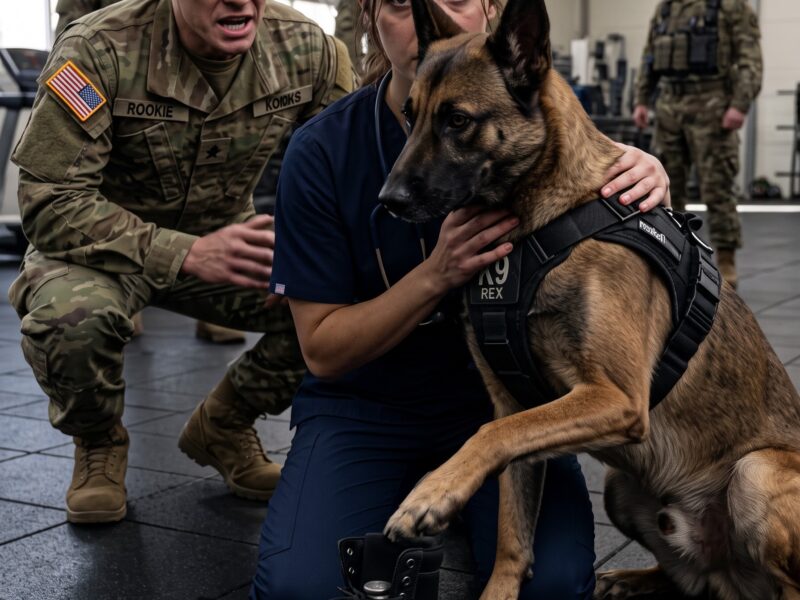
“Get the rookie away from that K9!” the commander shouted as the massive Belgian Malinois broke formation, crossed the training room
The training hall at Fort Campbell was an echo chamber of cold industrial violence. High overhead, exposed steel rafters supported rows of buzzing sodium-vapor lamps that cast a sickly, jaundiced glare over the rubberized flooring. The air hung thick and greasy with the combined stench of vulcanized mats, sour sweat, CLP gun oil, and the dry, coppery tang of adrenaline.
I stood shoulder-to-shoulder with twelve other newly arrived medical specialists along the eastern reinforced wall, my back pressed flat against the damp cinder block. My hands were clasped rigidly behind my spine in parade rest, the stiff canvas of my brand-new Operational Camouflage Pattern uniform scratching against the nape of my neck. My nametape read simply: VALDEZ.
To everyone in the 160th Special Operations Aviation Regiment’s support battalion, I was Specialist Maya Valdez: a quiet, unremarkable twenty-three-year-old combat medic transferred from a sleepy clinic in Fort Sam Houston. I had kept my head down during in-processing. I had signed the standard non-disclosure agreements with a steady hand. I had eaten alone in the dining facility, never staying long enough to invite small talk, never answering questions about my family or why my service record showed a bizarre, unexplained eighteen-month gap between basic training and my clinical rotation.
I needed to be invisible. Because if anyone discovered why I had specifically engineered my transfer to Campbell—if anyone connected my mother’s maiden name on my dog tags to Chief Warrant Officer Marcus Vance—I wouldn’t just be reassigned. I would be silenced.
In the center of the hall, forty yards away, the tactical working dog unit was running advanced bite-and-hold drills.
At the front of the formation stood Rex.
He was a ninety-pound Belgian Malinois with a coat the color of burnt mahogany and a muzzle as black as pitch. A jagged, hairline scar cleaved through the fur running from behind his left ear down to the titanium reinforcement caps covering his lower canines. His body was a coiled spring of corded muscle, twitching with the unnatural, hair-trigger intensity that came from Tier-One tactical breeding.
His handler, Staff Sergeant Cross, was leaning forward, gripping the thick nylon agitation harness with both hands, shouting commands in sharp, guttural Dutch. “Hier! Rex, hier!”
Rex ignored him.
The dog’s head had snapped upright. His ears, cupped forward like acoustic collectors, twitched once, twice, and then locked dead center on the row of medics lined up against the wall.
I felt the hairs on the back of my neck stand on end.
“Watch your spacing,” the medical detachment sergeant hissed down our line. “Eyes front. Don’t look the animals in the eyes.”
I dropped my gaze to the floor, staring intently at the scuffed rubber seams near my boots. Don’t look, I told myself, my heart hammering a frantic rhythm against my ribs. He’s gone through two years of frontline kinetic deployments. He’s suffered concussions, shrapnel trauma, blast waves. He doesn’t know you. He can’t possibly know you.
A sharp, violent metallic snap echoed across the room.
The braided lead had slipped from Cross’s fingers.
“Rex, loose!” Cross yelled, lunging forward. “Rex, halt!”
The dog didn’t sprint. He didn’t drop his head into a predatory attack posture. He moved across the cavernous room with a slow, deliberate, terrifying cadence, his heavy claws clicking rhythmically against the floor. Every conversation among the dozens of operators, trainers, and support personnel died instantly. The room fell into a heavy, suffocating silence, punctuated only by the distant hum of the ventilation units.
“Nobody move,” someone muttered down the line. “Stay frozen.”
I watched through the bottom of my field of vision as the black-tipped paws came to a stop directly in front of my boots.
The Malinois stood entirely motionless for three long seconds. I could feel the intense, radiated heat rising from his muscular body, smelling the familiar, distinct musk of his coat—a scent mixed with cedar bedding, zinc ointment, and the faint, sweet trace of dried pine needles.
Slowly, Rex lowered his haunches. He sat down squarely on the rubber mat, his chest brushing against my shins.
Then, with an agonizing gentleness that shattered every protocol of a trained combat patrol dog, he lowered his snout and pressed it firmly into the inner leather crease of my left combat boot.
My throat closed up. My hands remained locked behind my back, but my fingers began to shake uncontrollably.
“Get the rookie away from that K9!”
The voice ripped through the hall like a whip.
Major Thomas Vance strode across the mats, his polished boots striking the floor with aggressive precision. He was a man built like a concrete pillar, with iron-gray hair cropped tight to his skull and cold, predatory eyes that had watched men die without flinching for twenty-five years. He was the commander of the regiment’s special activities detachment—and he was also my estranged uncle, a man who hadn’t spoken my brother’s name since the day Marcus’s body was reported lost to an explosion over the Syrian border.
“Cross, control your weapon,” Vance commanded, stepping between the dog and me, his hand resting casually near the retention holster of his Glock 19. “What is this animal doing? This dog is cleared for active breach operations. Why is he breaking containment for a non-tactical enlistee?”
“I don’t know, sir,” Cross stammered, rushing up with the spare lead, his face flushed red with embarrassment. “He’s never broken a stay command in his life. He locked onto her scent the second she walked into the hall.”
“Get her away from him,” Vance repeated, his eyes fixing on my face for the first time. There was no recognition in his stare—only the cold, dismissive contempt of a high-ranking officer dealing with an inconvenient subordinate. “Medic, take five paces back. Fall out to the corridor.”
I tried to step backward.
The moment my boot moved an inch, Rex let out a low, vibrating whine. It wasn’t an aggressive growl; it was a desperate, mourning sound that vibrated straight through the soles of my shoes. He raised his heavy right paw and laid it flat over the top of my laces, anchoring my foot to the floor.
“Easy,” I whispered under my breath, completely involuntarily. The word slipped out before I could choke it down.
Rex’s ears flattened against his skull. He looked straight up into my eyes, his amber iris reflecting the harsh overhead lights, and in that split second, the four-year-old illusion I had built around my life tore wide open.
I wasn’t in Fort Campbell anymore. I was back in the rusted sheet-metal barn behind our family’s rural property outside of Clarksville, Tennessee.
Four years ago, before Marcus’s final, fatal deployment, he had brought an unauthorized, unregistered young Malinois puppy home in the back of his truck. For ninety days, while Marcus worked through black-budget pre-deployment certifications, I was the one who had fed that dog by hand. I had run him through the timberland trails, taught him to retrieve hidden scents, and stitched up his torn pads when he cut himself on old wire fencing. Marcus had called him Ghost back then.
When Marcus deployed with Task Force 9, the military re-badged the dog as an official multi-purpose canine and renamed him Rex. Six months later, Marcus’s MH-60 Black Hawk was officially shot down over the Euphrates River valley. The Department of Defense declared Marcus KIA—body unrecovered due to a catastrophic fuel air explosion. His dog, the report claimed, had perished inside the wreckage.
Yet here was the dog. Alive. Wearing a military property tag with a falsified service history.
And he was pawing at my boot.
“Staff Sergeant Cross,” Vance barked, his voice hardening into steel. “What is that dog alerting to? Does that soldier have unauthorized food, narcotics, or chemical compounds on her person?”
“He’s not giving a passive narcotics sit, sir,” Cross said, crouching down on one knee beside the animal. He reached out to inspect my ankle. “He’s scratching. He’s indicating a mechanical recovery payload. What the hell do you have in your gear, Specialist?”
“Nothing, Sergeant,” I lied, my voice wavering.
Rex whined louder, his claws hooking into the leather eyelets of my boot. He wouldn’t leave it. He pressed his wet nose harder into the inner lining, sniffing frantically at the structural seam where the rubber sole met the upper leather.
“Take the boot off, Valdez,” Vance ordered. His posture shifted; his hand snapped the retention strap off his holster. The atmosphere in the room shifted from confusion to an armed standoff in the span of a single heartbeat. “Right now. Place it on the mat and step back.”
Every medic along the wall backed away from me as if I were carrying an unpinned grenade.
I swallowed the dry lump in my throat, bent down, and unlaced the left boot. My fingers were numb. I pulled my foot free, standing with one sock resting on the cold rubber floor, and set the heavy boot down between Vance and the dog.
Cross grabbed the boot by the collar and inverted it. He pulled the cushioned insole out. Nothing. He ran his tactical knife down along the inner tongue.
Then his blade hit something hard embedded deep within the hollowed-out heel counter.
Cross frowned. He sliced through the heavy stitching. With a sharp flick of his wrist, a tiny, cylindrical aluminum capsule fell onto the mat. It was no larger than a standard 9mm casing, sealed with threaded brass caps and wrapped in clear plastic to prevent scent leakage. But four years of moisture had degraded the seal just enough for a dog with forty times human olfactory sensitivity to catch the trace of what lay inside.
The silence in the hall was absolute.
Vance knelt, scooped the capsule off the rubber mat, and unscrewed the threaded cap with his thumb.
He tilted the metal cylinder into his palm. A single, tightly rolled piece of high-gloss photographic paper slid out, followed by a faint, chemical smell of dried fixing salts.
Vance flattened the paper between his thick, scarred fingers.
I leaned forward just enough to see it.
It was an informal, grainy photograph taken under green night-vision filters. Marcus stood in full desert combat gear against the tail rotor of a helicopter, his arm thrown around the neck of a younger, leaner Rex. Both of them were looking directly into the lens, Marcus’s trademark crooked grin clearly visible beneath his dust goggles.
Vance’s face went dead white. The color drained from his lips so fast it looked as if his heart had stopped.
He flipped the small square over.
On the back of the photograph, written in dark, permanent grease pencil in Marcus’s unmistakable, angular handwriting, were six words:
TRUST THE DOG, NOT THE COMMANDER.
Vance’s jaw twitched. His eyes darted from the paper to my face, and for the first time, I saw the veil drop. He didn’t see an anonymous medic anymore. He saw Marcus’s eyes. He saw the sister Marcus had spent his entire career trying to protect from the shadow games of the 160th.
Rex suddenly rose to his feet.
The hair along the dog’s spine stood straight up like a line of bayonets. His ears flattened completely, and from deep within his barrel chest came a low, vibrating growl that rattled against the concrete floor. The sound was directed squarely at Vance’s throat.
Nobody moved. The entire hall was paralyzed.
“Cross,” Vance said, his voice terrifyingly calm, though a vein was throbbing at his temple. “Restrain this animal. Now.”
“Sir, he’s… he’s completely fixated,” Cross stuttered, reaching for the collar.
Vance slowly raised his left hand toward the tactical radio clipped to his shoulder epaulet. His eyes never left mine. “Tactical Operations Center, this is Vance. Lock down Sector Four. We have an operational security breach in Training Hall Bravo. Detain the medical personnel and—”
Rex didn’t wait for him to finish the transmission.
With an explosive, ear-splitting bark, the Malinois lunged forward, snapping his jaws inches from Vance’s outstretched arm.
“Down! Rex, down!” Cross screamed, throwing his entire weight across the dog’s shoulders, wrapping his arms around the animal’s neck as another trainer dove in to grab the rear legs. The struggle was violent, rubber mats sliding and screeching as the dog fought with savage, frantic desperation to tear his way through to the commander.
Vance took three rapid steps backward, his hand finally clearing the holster, bringing the black barrel of his pistol up toward the dog’s skull.
“Don’t shoot him!” I screamed, breaking formation and lunging forward, my single-booted foot slipping on the mat. “Don’t you dare touch him!”
Vance looked at me, his finger hovering over the trigger, his expression shifting from shock into a dark, murderous resolve.
At that exact second, the heavy black smartphone in my tactical cargo pocket vibrated violently against my thigh.
A single buzz.
Then another.
I froze, stumbling back against the wall as the trainers finally managed to pin Rex to the floor with a padded catch pole.
Trembling, I pulled the phone from my pocket.
There was no caller ID. The notification came from an encrypted routing server through an internal base intranet relay.
The first message read:
YOUR BROTHER DIDN’T DIE IN SYRIA.
My breath caught in my chest. The world seemed to tilt beneath my feet, the sound of the shouting soldiers and the barking dog fading into a distant, underwater roar.
Before my brain could process the words, the screen lit up with a second message:
HE’S BEEN WATCHING YOU FROM INSIDE THIS BASE FOR THREE DAYS.
Instinctively, wildly, my head jerked upward toward the soundproof glass observation deck that overlooked the second-story mezzanine of the training hall. The room was supposed to be empty; the lights inside were completely dark.
Yet there, standing directly behind the tinted double-pane glass, illuminated for a fraction of a second by the sweep of a vehicle headlight from the street outside, stood a silhouette.
Broad shoulders. A tall, slightly slouched combat stance.
The figure pressed a gloved hand flat against the glass pane, four fingers extended, thumb folded—the silent tactical call sign of the Ironwood reconnaissance cadre.
Then, with a deafening metallic clack that sounded like a breaker tripping in a power station, every light in the training hall died.
The room was plunged into pitch-black, suffocating darkness.
A collective shout rose from fifty throats. The emergency sirens failed to engage. The ventilation fans ground to a screeching halt, leaving only the sound of heavy breathing, shuffling boots, and the metallic clicks of multiple sidearms being unholstered in the dark.
From the floor ten feet away, Rex let out a single, piercing bark that cut through the panic like a blade.
And then, right behind my left ear, feeling the heat of human breath against my cold skin, a voice whispered through the dark.
“Keep your head down, little sister. We’re getting out of here.”
The whisper was not a ghost’s memory. It was warm, physical, and smelled of mint tobacco and the metallic bite of gun bore solvent—the same scent that had lingered on Marcus’s jacket every time he returned from a high-altitude HALO qualification jump.
Before I could turn, a heavy, gloved hand clamped down firmly over my mouth, and an arm like an iron band wrapped around my torso, hoisting me off my feet.
“Do not make a sound,” Marcus breathed into my ear. His voice was lower than I remembered, rough around the edges, scarred by time and smoke, but the cadence was unmistakably his. “Step into the blind spot behind the locker bulkhead. Now.”
The training hall was descending into total chaos.
Flashlights flickered to life across the floor—narrow, piercing white beams cutting through the gloom, slicing through floating dust and illumination flares. Shouts bounced off the cinder-block walls in disjointed waves.
“Stand fast! Secure the exits!” Vance’s roar cut through the noise. “Nobody leaves this deck! Security team, seal doors Alpha and Charlie! Harris, get the auxiliary generators online!”
“Where’s the dog?” Cross was yelling, his voice frantic. “I lost the lead! The dog broke the catch pole!”
A sudden, sharp scuffle broke out ten yards to our right. The beam of a tactical light swung erratically across the floor, catching the blurred, low-slung silhouette of Rex moving like a black streak beneath the rows of steel bleachers. A soldier screamed as the dog slammed into his legs, knocking him flat, before vanishing into the shadows of the secondary storage bay.
Marcus pulled me deeper into the narrow maintenance corridor behind the electrical distribution panels. The space was barely two feet wide, choked with heavy conduit pipes and thick bundles of black fiber-optic cables that smelled of scorched rubber.
He released his grip on my mouth and dropped to one knee, keeping his silhouette below the height of the waist-high utility crates.
I fell against the damp brick wall, gasping for air, staring down at him in the darkness. My night-adapted vision could only make out the sharp contours of his face: a tactical balaclava pulled down around his neck, high cheekbones, a thick growth of dark stubble, and a long, jagged scar that ran from the corner of his left eye down into his collar—a horrific mirror of the scar Rex carried on his skull.
“Marcus?” My voice was barely a thread of sound, trembling so violently it felt like it would tear in my throat. “You’re… they gave us a casket. They gave us an empty flag and a bronze star.”
“They gave you a lie to keep you from asking questions that would get you buried in an unmarked ditch,” he whispered, his eyes never leaving the illuminated cracks between the locker banks where search beams were sweeping the floor. He reached into his assault vest, pulled out a small tactical penlight, and clicked it on against his palm, letting only a tiny sliver of crimson light bleed through his fingers.
He looked up at me. His blue eyes, once so bright and reckless, were hard, cold, and hollowed out by four years of living in the dark.
“I didn’t want you here, Maya,” he said, his voice tightening with a mixture of anger and desperate protective instinct. “Why did you come to Campbell? Why did you use Mom’s maiden name to falsify your deployment transfer?”
“Because I knew you weren’t dead,” I said, tears burning the corners of my eyes as I crouched beside him, my bare foot throbbing against the freezing concrete floor. “The crash report didn’t make sense. The flight telemetry was wiped from the regional servers at Bagram. And then three weeks ago, someone accessed our childhood medical records through an unlisted DOD terminal in Oak Ridge. The only person who knew that password was you.”
Marcus let out a grim, humorless breath through his nose. “That was a mistake. A digital trace caught me before I could scrub the logs. That’s how Vance knew the perimeter was compromised. He’s been sweeping the garrison for three days looking for an outside infiltrator.”
“Vance?” I asked, my heart skipping a beat. “Our uncle? He was the one who signed your death certificate. He spoke at your memorial service. He held Mom’s hand while she cried!”
Marcus’s jaw hardened into granite. “He didn’t sign the certificate to honor me, Maya. He signed it to erase me. The mission in Syria wasn’t a counter-terrorism sweep. We weren’t hunting insurgents. Task Force 9 was sent to recover four crates of modified neurological research compounds developed under a covert black-budget program called Project Cerberus. The compounds weren’t supposed to exist. When my team secured the site, Vance ordered an airstrike on our own extraction bird to sanitize the evidence.”
The air left my chest in a cold, nauseating rush. “He tried to kill you.”
“He killed everyone else,” Marcus said, his voice dropping into a register of quiet, lethal hatred. “Miller, Jackson, Hayes… they all died in the fire. I crawled out of the burning airframe into the marsh grass with Rex. The dog took two pieces of shrapnel to the shoulder dragging me into a drainage culvert while Vance’s cleanup crew poured thermite over the wreckage.”
“Then why didn’t you go to CID? Why didn’t you go to the federal authorities?”
“Because Vance isn’t acting alone,” Marcus said, leaning in close, his fingers gripping my shoulder with bruising intensity. “Cerberus wasn’t an isolated rogue unit. It is backed by private defense contractors and high-ranking assets inside the Pentagon’s special operations directorate. The chemicals they recovered from Syria weren’t destroyed. They brought them right here to Campbell. They are storing them beneath the subterranean weapons bunkers in Sector Six, testing the aerosol delivery vectors on military working dogs to refine the lethality.”
My mind flashed back to the training hall—to Rex’s trembling posture, the titanium teeth, the frantic, desperate way he had smelled my boot.
“Rex was a test subject,” I whispered, the horror choking me.
“Rex was the only survivor,” Marcus said. “His neurological profile resisted the synthetic compound. Vance’s research team kept him alive under a false serial number to harvest his blood serum, trying to isolate the neutralizing antibodies so they could synthesize a vaccine for their own personnel before selling the vector on the black market.”
Before I could speak, the harsh metallic slam of a door echoed from the end of the maintenance hallway.
“Check the utility chase!” a soldier shouted from thirty feet away. The beam of a fifty-caliber weapon-mounted light cut through the gloom, illuminating the thick black pipes right above our heads. “The breaker was bypassed from the sub-panel! Someone’s in the wiring corridor!”
Marcus didn’t hesitate.
He reached down to his belt, unhooked an unmarked polymer smoke grenade, and pulled the pin with his teeth. He hurled it underhanded toward the opening of the corridor.
A muffled pop was followed instantly by a violent, hissing roar. A wall of thick, sulfurous white smoke billowed into the narrow passage, expanding outward into the training hall like an avalanche of opaque fog.
Coughing and shouting erupted immediately.
“Contact! We’ve got smoke in Sector Charlie!”
“Hold your fire! Watch your fields of fire!”
Marcus grabbed my tactical harness, pulling me upright. “Move! Stay behind me, keep your hand on my belt!”
He stepped out of the maintenance space directly into the blinding cloud of white smoke. Even without a respirator, Marcus moved through the haze with fluid, terrifying muscle memory, navigating the layout of the building as if he had designed the blueprints himself.
We rounded the corner into the secondary logistics bay. The smoke was thinner here, illuminated only by the faint green glow of the emergency exit signs.
Ten feet ahead, standing near the heavy steel blast door that led to the vehicle maintenance yard, stood Captain Harris—Vance’s direct executive officer—his Beretta drawn, tracking the doorway with trembling hands.
“Stop right there!” Harris yelled, leveling the weapon at Marcus’s chest. “On the ground! Down on your—”
A dark, heavy shape dropped from the top of an eight-foot storage crate like an artillery shell.
Rex hit Harris from behind with devastating kinetic force. The impact drove the officer violently into the concrete floor, his pistol skittering away into the darkness under a pallet of hydraulic fluid. Before Harris could scream, Rex’s jaws closed tight around his forearm, pinning the limb to the floor with bone-crushing pressure.
“Rex, aus!” Marcus snapped.
The dog instantly released the hold, backing off two paces, his eyes locked on Marcus, his tail giving one tight, frantic twitch. He didn’t bark. He dropped his snout, touched Marcus’s knee with his wet nose, and fell into a tight heel position on his left flank.
“Good boy,” Marcus muttered, his hand dropping to rest on the Malinois’s scarred neck for half a second.
Harris groaned on the floor, clutching his bleeding arm, staring up at Marcus through the green emergency light. His eyes widened in absolute, paralyzing disbelief.
“Vance… Chief Vance?” Harris wheezed, blood dripping between his fingers. “You’re… you’re dead. The crash report…”
“Tell the commander I’m coming for the ledger in Sector Six, Harris,” Marcus said, his voice as flat and merciless as a winter sky.
He kicked the emergency release bar on the blast door.
The heavy steel door swung open, letting in a torrential blast of freezing rain and howling wind. The storm had broken over the Kentucky-Tennessee border with full fury, sheets of black water hammering against the asphalt of the motor pool.
“Take this,” Marcus said, thrusting an extra pair of tactical boots from a nearby storage bin into my chest. “Put them on. We have four minutes before Vance overrides the perimeter gate security.”
I pulled the boots onto my feet, wrenching the laces tight with cold, shaking fingers. “Where are we going?”
“The underground pipeline beneath the runway,” Marcus said, pulling his balaclava back over his face until only his pale blue eyes were visible. “The only route into the bunker that doesn’t trigger the seismic sensors.”
He turned to look at me, his hand resting on the frame of the open door.
“Once we cross that perimeter fence, Maya, there is no going back. You won’t be a medic anymore. You’ll be an enemy of the state.”
I looked down at Rex, who was looking up at me, waiting for my signal. I looked back at the smoke-filled corridor where Vance’s men were shouting, hunting us down like animals.
“I stopped being a medic the second you whispered my name,” I said.
Marcus nodded once—a sharp, grim movement.
“Then run.”
We plunged out into the freezing deluge, the black storm swallowing us whole as the sirens of Fort Campbell began to scream into the night.
The storm turned the tarmac into a sheet of black, wind-whipped glass.
Searchlights mounted on thirty-foot security towers swept through the sheets of rain in massive, intersecting arcs, their beams catching the spray and turning the deluge into blinding curtains of white light. Sirens wailed across the flightline—high-pitched, mechanical shrieks that rose and fell in time with the low, rhythmic thrum of twin-engine Chinooks idling on the distant aprons.
Marcus led us low, moving in a crouch along the concrete drainage swale that bordered the southern edge of the runway. Rex ran pressed against Marcus’s left hip, his black coat soaked flat against his ribs, his movements silent, fluid, and perfectly synchronized with his handler’s stride.
I ran behind them, my lungs burning with the raw, metallic cold of the rain, my fingers gripping the compact polymer frame of the service pistol Marcus had stripped from Captain Harris in the maintenance bay. Every instinct from my basic medical training screamed at me to stop, to find shelter, to report to a commanding officer. But every instinct from my childhood—from the years spent watching Marcus navigate the ruthless terrain of special operations—told me that the uniform had become the disguise, and the fugitive was the only soldier left upholding his oath.
We reached a circular steel manhole cover set into a concrete apron fifty yards short of the inner perimeter wire.
Marcus didn’t use a pry bar. He knelt in the rushing runoff, reached into the small utility pouch on his vest, and pulled out a heavy magnetic key card encased in hardened resin. He pressed it against a concealed sensor plate recessed into the concrete collar.
A dull hydraulic clunk sounded beneath the grate.
Marcus gripped the iron rim with one hand and wrenched the heavy lid back. A blast of humid, chemically treated air rushed out of the opening, smelling of stale freon, industrial bleach, and copper.
“Rex, in,” Marcus commanded.
The Malinois dropped his front paws over the lip without a second’s hesitation, sliding down an eight-foot aluminum access ladder into the darkness below.
“You next, Maya,” Marcus said, his hand gripping my shoulder. “Keep three points of contact. The rungs are coated in industrial lubricant.”
I swung my legs over the opening and descended into the shaft. The cold rain was instantly cut off, replaced by the suffocating, enclosed heat of the subterranean utility corridor. I dropped the last two feet onto a wet steel catwalk that ran down the center of an eight-foot-wide concrete tunnel.
Marcus followed an instant later, pulling the heavy cover down behind him. It clicked into place with an airtight, locking thud that sealed us off from the storm above.
Silence slammed down on us, heavy and unnatural.
The only sound was the steady, rhythmic dripping of condensation from the overhead pipes and the deep, low-frequency hum of high-voltage transformers running behind the walls.
Marcus clicked on his tactical light, setting the diode to a dim, amber spectrum that wouldn’t reflect off the condensation-sheened concrete.
The tunnel stretched endlessly in both directions, lined with heavy black conduit bundles, yellow gas lines, and high-pressure fire suppression manifolds marked with red stencils: RESTRICTED ACCESS – LEVEL THREE CLEARANCE ONLY.
“This is the secondary maintenance artery for Sector Six,” Marcus said, keeping his voice to a low, gravelly whisper. “It runs beneath the old Cold War munitions bunkers. It was abandoned in ninety-eight, but when Vance’s task force took over Project Cerberus, they refurbished the lower tier with an independent power grid and air filtration systems. If you don’t have the biometric keys, the ventilation system floods the main chambers with halogen gas within forty seconds.”
“How are we getting in?” I asked, wiping water from my eyes, my hand trembling against the cold steel of the catwalk railing.
“The air intakes,” Marcus replied, gesturing with his light toward a massive circular shaft fifty yards ahead where three industrial intake fans sat motionless behind heavy steel debris screens. “The storm knocked out the primary power station on the airfield. The emergency generators have an eight-minute diagnostic cycle where the intake fans run on secondary battery trickle before full torque engages. We have less than five minutes before those blades start spinning at twelve hundred RPM.”
Rex was already moving down the catwalk, his claws clicking lightly on the perforated steel. He stopped at the base of the intake housing, his nose working the narrow space between the structural louvers.
Suddenly, the dog let out a sharp, muted whine. His ears pinned back flat against his skull, and his entire body went rigid.
“He smells it,” Marcus said, his face hardening as he approached the grating.
“Smells what?”
“The vector,” Marcus replied. He unhooked a multi-tool from his belt and wedged the heavy pry-blade into the corner of the intake screen. With a violent, grinding jerk of his shoulder, the rusted security rivets sheared off with a sound like gunshots. “Cerberus isn’t just an incapacitating gas, Maya. It’s a synthetic neuro-pathogen designed to target the autonomic nervous system. It triggers massive, uncontrollable cardiac arrhythmias within two minutes of aerosol exposure. It leaves no chemical residue in the blood. It looks like an acute heart attack, even under full forensic autopsy.”
He wrenched the heavy wire screen aside, creating an eighteen-inch gap beneath the massive aluminum fan blades.
“Through here,” Marcus ordered. “Rex, take point.”
The dog squeezed through the narrow gap, vanishing into the dark interior of the air plenum.
I crawled through after him, my knees scraping against the jagged sheet metal. The air inside the intake duct was freezing, smelling intensely of ozone and the same sweet, rotten almond scent that had clung to the photograph in the training hall.
Marcus slipped through behind me, pulling a suppressed MP5 submachine gun from his sling as he dropped onto the concrete floor of the interior bunker.
We were standing in a vast, vaulted subterranean laboratory.
The walls were finished in smooth, sterile white epoxy, lit by the eerie crimson glow of battery-powered emergency illumination strips that ran along the floorboards. In the center of the room sat four large, cylindrical containment units made of reinforced ballistic glass, surrounded by racks of stainless-steel centrifuges, refrigeration lockers, and banks of high-end computing terminals.
Three of the containment units were shattered, their heavy glass walls cracked and smeared from the inside with dark, dried stains that looked horrifyingly like arterial blood.
The fourth unit was sealed, glowing with a soft, pale-blue UV disinfection lamp.
Inside it sat a heavy, olive-drab Pelican transport case, secured to the floor with heavy steel cables. On its lid, stenciled in bright yellow lettering, was the project code: CERBERUS-ALPHA // BATCH 09.
“There it is,” Marcus whispered, his eyes narrowing. “The final viable batch from the Syrian cache. Everything else they tried to synthesize domestically was unstable.”
“Where is the staff?” I asked, looking around the empty, cavernous room. The silence was wrong. There were no technicians in bio-hazard suits, no armed security guards, no administrative personnel. Only half-eaten trays of food on the workbenches, open binders with pages fluttering in the weak airflow, and a row of overturned swivel chairs.
“They evacuated when the perimeter alarm sounded,” Marcus said, stepping cautiously toward the central console. “Vance wouldn’t risk civilian contractors or non-cleared personnel being in the bunker if a firefight broke out. He would order a full personnel purge to the surface.”
“Or,” a voice echoed through the overhead PA speakers, “he would simply draw the rat directly into the trap.”
The mechanical clatter of magnetic locks engaging echoed through the walls.
Every steel blast door leading into the laboratory slammed shut simultaneously, the massive locking pins driving into the concrete frames with the finality of a tomb.
At the far end of the room, twenty feet above the laboratory floor behind a bank of double-pane observation windows, the lights flickered on.
Major Thomas Vance stood behind the glass, flanked by six private security contractors dressed in sterile black tactical uniforms, all armed with short-barreled automatic rifles. Vance had removed his service cap. His face was entirely devoid of emotion, his eyes flat and merciless as he stared down at us through the glass.
Beside him, strapped to an interrogation chair with heavy nylon restraints, was Captain Harris, his face bruised and bloody, his uniform torn.
“You always were predictable, Marcus,” Vance’s voice crackled through the intercom system, rich with cold, calculated disgust. “You survived a thermite strike in the desert, crawled two thousand miles across the Syrian border, lived like a scavenger in the timberland for four years… all to bring your little sister into the exact slaughterhouse she spent her whole life avoiding.”
“Let her walk out of here, Thomas,” Marcus said, raising his weapon toward the observation glass, though we both knew the ballistic polycarbonate could stop an armor-piercing fifty-caliber round. “This is between you and me. She knows nothing about the operation. She was transferred here by chance.”
“There are no chances in this regiment, nephew,” Vance sneered, resting his palms on the console overlooking the floor. “Her transfer flag crossed my desk three weeks ago. I approved it. Do you really think you managed to access those Oak Ridge medical files without triggering my alarms? I let you look. I needed a tether to pull you out of the mountains. A ghost cannot be hunted unless he has something left to love.”
Vance reached down to the desk in front of him and rested his fingers on a large, red manual override toggle.
“You should have died in the Euphrates, Marcus,” Vance said softly. “The market for Cerberus was finalized yesterday. Three hundred million dollars in non-sequential bearer bonds from an offshore consortium. All I needed was the final neutralization antibody from that animal’s blood to complete the delivery package.”
He looked at Rex, who was standing beside my legs, his lips pulled back in a silent, trembling snarl.
“And now,” Vance smiled, “you’ve brought the animal directly to the harvest.”
Vance pulled the red toggle downward.
A deafening, pressurized hiss erupted from the ceiling vents. A thick, pale-amber mist began to cascade downward into the chamber like a heavy waterfall, settling over the white epoxy floors.
“The air filters!” I screamed, grabbing Marcus’s sleeve. “It’s the gas!”
“It’s not gas,” Marcus said, his voice dropping into cold, horrifying clarity as he looked at the vents. “It’s the aerosol vector. He’s venting the raw strain directly into the room.”
From behind the observation glass, Vance reached into his holster, pulled his sidearm, and pressed the muzzle against Captain Harris’s temple.
“Loose ends, nephew,” Vance said into the microphone.
A sharp crack echoed through the intercom. Harris’s body went limp in the chair.
Then Vance turned and walked toward the rear exit of the observation deck, his contractors falling into step behind him, leaving us alone on the floor as the amber mist rose toward our knees.
The amber mist was not like ordinary chemical smoke. It did not billow or rise in turbulent thermal plumes; it was heavy, dense, and unnaturally cold, clinging to the contours of the floor like liquid nitrogen, rolling over the rubber floor mats and pooling around the legs of the steel lab tables.
The air took on an immediate, suffocating taste—a sickening mixture of scorched sugar, bitter almonds, and metallic iron that coated the back of my throat after a single shallow breath.
“Masks!” I shouted, reaching frantically for the emergency respirator pouches mounted on the laboratory wall ten feet away.
Marcus caught my wrist, his grip iron-hard, stopping me in my tracks.
“They’re empty,” he said, nodding toward the plastic cases. The seals had been ripped open, the filters removed. “Vance sanitized the room before he brought us down here. Standard containment respirators won’t scrub this compound anyway. The particles are engineered below three microns. They penetrate charcoal filters in ninety seconds.”
Beside us, Rex let out a short, hollow cough.
The sound tore through me like a physical blow. The Malinois was trembling violently, his muscular legs bowing outward as he fought to keep his footing on the slick epoxy floor. His amber eyes were wide, dilated with sudden pain, his black tongue hanging out as thick, frothy saliva dripped from his lips onto the concrete.
“Marcus, he’s suffocating!” I cried, dropping to my knees beside the dog, completely forgetting the toxic mist that was now swirling around my own waist. My medical training took over, stripping away the terror. I pressed my fingers against the femoral artery inside Rex’s hind leg; his pulse was erratic, fluttering like a trapped bird, beating at over two hundred beats per minute. “His heart is going into ventricular tachycardia! He’s arresting!”
“He’s not arresting,” Marcus said, kneeling beside me, his hands moving with rapid, mechanical efficiency as he tore open his tactical medical kit. “His immune system is mounting a localized cytokine storm. That’s how his blood defeated the pathogen in Syria. His body produces a massive surge of natural neutralizing antibodies, but the reaction triggers systemic shock before the antibody can bind to the receptor sites.”
“Then he’s going to die of heart failure before the antibodies can work!”
“Not if we stabilize the myocardial load,” Marcus said. He pulled a heavy stainless-steel autoinjector from his kit. The glass barrel was filled with a clear, golden fluid. “This is an experimental beta-blocker mixed with synthetic epinephrine. It stabilizes the sinus rhythm long enough for the immune response to complete the synthesis cycle.”
He shoved the needle through the heavy fur of Rex’s neck and drove the plunger home.
The dog let out a sharp, agonized yelp, his body convulsing once before going entirely limp against my lap. His head fell back against my shins, his breathing shallow, rapid, and raspy.
“Now,” Marcus said, looking up at me, his eyes bloodshot and watering from the ambient mist. “The human respiratory system doesn’t have his genetic mutation. In four minutes, that aerosol will cross our alveoli. Our heart tissue will begin to fibrillate within six.”
I could already feel it.
A dull, crushing weight was pressing down against the center of my sternum, like an iron anvil being slowly lowered onto my chest. My vision began to fringe with dancing white static, and a sharp, high-pitched ringing filled my ears, drowning out the low hum of the ventilation shafts.
“We need the antibodies,” I gasped, looking at the unconscious Malinois in my lap. “His blood.”
“You’re the medic, Maya,” Marcus said, pulling a sterile eighteen-gauge field transfusion catheter and a transfer tube from his pack, slamming them onto the table beside us. “Can you do an emergency whole-blood direct filtration in an unpressurized environment?”
“Without a centrifuge?” I coughed, a line of dark blood flecking my own lip. “Without cross-matching? Interspecies whole-blood transfer triggers fatal hemolytic transfusion reactions in ninety-nine percent of patients! The canine red blood cells will cause massive, widespread intravascular coagulation! It will kill us faster than the nerve agent!”
“We don’t take the red cells,” Marcus said. He pointed toward a tabletop ultra-filtration device sitting on the central workbench—a portable, battery-powered diagnostic separator used to isolate field samples. “The Cerberus antibody isn’t bound to the cellular matrix. It floats freely in the blood serum. If you run his blood through that diagnostic separator on a plasma-fractionation cycle, you can pull fifty milliliters of pure, cell-free hyperimmune serum in two minutes.”
“Fifty milliliters isn’t enough for two people,” I whispered, the crushing weight in my chest growing heavier with every agonizing second. My vision was tunneling, the white walls of the laboratory blurring into a swirling smear of red and gray. “It’s barely enough for one adult dose.”
Marcus paused. He looked down at the transfusion lines in his hand, then at me.
His face was completely calm. The frantic, desperate intensity that had driven him across the base was gone, replaced by the quiet, absolute serenity of a soldier who had already made his peace with the grave four years ago.
“Then it goes to you,” Marcus said softly.
“No!” I choked out, grabbing his combat vest. “No, Marcus! We didn’t survive four years of lies just for you to die on a concrete floor in Campbell! We take half each! We split the dose!”
“Half a dose won’t neutralize the vector, Maya,” he said, his voice gentle, stripping away every ounce of the hardened operator he had pretended to be. He reached out and touched my cheek with his rough, scarred thumb, just as he had done on the tarmac the day he shipped out for his first combat tour. “I died in Syria. You understand that? My life ended in that burning helicopter. The only reason I crawled out of that swamp was to make sure Vance never turned his weapons on this country, and to make sure you were safe.”
“Marcus, please—”
“Set the line, Specialist Valdez,” he commanded, his voice suddenly snapping back into the hard, unyielding authority of a Chief Warrant Officer. “That is an order from your senior officer. Set the line, or neither of us leaves this room.”
Tears streamed down my face, hot and salty, cutting through the bitter chemical film on my skin.
My hands were shaking violently, but four years of clinical muscle memory took over. I wiped the inner vein of Rex’s left foreleg with an alcohol prep pad, slid the large-bore needle cleanly into the cephalic vein, and connected the tubing to the diagnostic separator on the table.
The machine hummed to life with a high-pitched, mechanical whine.
Dark, crimson canine blood began to flow through the clear plastic tube, coiling into the spinning rotor of the separator. The digital display flashed in rapid, amber numbers: SEPARATION PROTOCOL ACTIVE // CELLULAR REMOVAL: 99.8% // PLASMA YIELD: OPTIMAL.
Beside us, the heavy ventilation grates on the ceiling gave a violent shudder.
The emergency exhaust cycle was engaging. The automated system, sensing the critical density of the aerosol, was preparing to purge the contaminated air directly into the subterranean outflow conduits—the same conduits that led to the airfield drainage systems.
If the vector escaped into the storm above, the high winds would carry the aerosol cloud straight across the base housing areas, the barracks, and into the residential neighborhoods of Clarksville five miles downwind.
Vance wasn’t just covering his tracks. He was creating a catastrophic diversion so vast that no federal agency would ever look for an extraction team slipping away in the chaos.
“The outflow,” I wheezed, my chest burning as if I had inhaled crushed glass. “He’s… he’s venting the whole tank to the surface.”
Marcus looked up at the ceiling grates. Then he looked at the central control terminal beneath the shattered observation window.
The manual abort valve for the main chemical tanks sat behind a locked steel cage on the far wall, secured with a four-digit mechanical tumblers and an emergency override lever.
“The serum is ready,” Marcus said, pointing to the separator.
The machine let out three sharp chimes. A sterile collection vial had filled with fifty milliliters of clear, pale-straw colored fluid—pure, concentrated neutralizing antibodies.
Marcus grabbed the vial, snapped a sterile injection needle onto the hub, and before I could move or pull away, he jammed the needle directly into the deltoid muscle of my left arm and slammed the plunger down.
A cold, icy fire shot through my shoulder, racing through my bloodstream with the velocity of an electric shock.
My heart gave a massive, violent thud against my ribs—so hard it felt as if my sternum would fracture. The crushing pressure in my chest snapped like a broken cable. The gray static at the edges of my vision vanished in an instant, replaced by a crystalline, hypersensitive clarity that left me gasping for air on the cold floor.
“Marcus…”
Marcus dropped the empty syringe onto the floor.
He was already stumbling. His lips had turned a terrifying, deep shade of violet, and dark, venous blood was leaking slowly from his right nostril. He fell against the corner of the lab table, his breath coming in ragged, wet, rattling gasps that sounded like drowning.
“The abort valve…” he whispered, his eyes rolling back toward the ceiling, his fingers clawing at the edge of the steel table for support. “Maya… you have to… drop the… gate.”
He collapsed onto his knees, his forehead striking the floorboards beside the sleeping dog.
I stood up.
My body was vibrating with the synthetic adrenaline and the alien antibodies surging through my veins, but my mind was completely, terrifyingly still.
I looked at Marcus, lying motionless on the epoxy floor.
I looked at Rex, whose breathing had finally smoothed out into a deep, rhythmic rise and fall of his scarred chest.
Then I picked up the suppressed MP5 from the floor, racked the charging handle with a sharp, metallic snap, and turned toward the observation stairs.
“Nobody dies today, Marcus,” I whispered.
I raised the weapon, aimed directly at the glass hinges of the observation room door above, and pulled the trigger.
The heavy polymer door shattered inward under the sustained burst of nine-millimeter rounds, the safety glass falling like a sheet of ice onto the mezzanine stairs.
I didn’t feel the cold. I didn’t feel the burning in my throat. The neutralizing serum had stabilized my system with terrifying efficiency, sharpening my focus until every breath, every heartbeat, and every mechanical hum of the bunker registered with microscopic clarity.
I bounded up the stairs two at a time, keeping my muzzle lowered, clearing the corners with the fluid, sweeping motion Marcus had taught me on our farm when I was just a girl holding an air rifle.
The observation deck was a graveyard of abandoned military electronics. Computer monitors flickered with error codes; tactical displays showed the perimeter fence around Fort Campbell lighting up in flashing amber sectors. On the floor near the command console, Captain Harris lay dead in a widening pool of dark blood, an execution that left no doubt about Vance’s willingness to burn every human bridge behind him.
I lunged across the platform to the primary chemical distribution board.
The digital pressure readout for the underground tanks was flashing in critical crimson: VENT SEQUENCE 82% COMPLETE // ATMOSPHERIC EXHAUST ACTIVE.
On the central conduit pipe behind the panel sat the manual shut-off: a massive, cast-iron wheel painted bright red, locked in place by a heavy steel security chain.
I didn’t waste time looking for a key. I brought the barrel of the MP5 against the shackle of the padlock and fired two rapid shots. The lock shattered into fragments.
I grabbed the iron wheel with both hands, planted my boots against the steel decking, and threw my entire body weight into the rotation.
The metal groaned against years of dried grease and corrosion. A screech of grinding iron echoed through the pipes.
Turn.
Turn.
With a dull, shuddering thump that reverberated through the concrete foundation of the bunker, the main valve seated into its housing.
The digital display flickered, then flashed green: EXHAUST SEALED // CONTAINMENT RESTORED TO SUB-TIER.
The atmospheric vent had closed. The two million civilians in the towns surrounding Fort Campbell would wake up to nothing more than a passing thunderstorm.
A sudden, sharp metallic click sounded directly behind my ear.
“Very impressive, Specialist Valdez,” Vance’s voice purred from the shadows of the rear exit corridor. “You have your brother’s reflexes. But you lack his understanding of battlefield contingencies.”
I froze, the cold muzzle of a pistol pressing firmly into the hollow behind my right ear.
“Drop the weapon,” Vance ordered softly. “Two fingers. Lower it to the deck.”
I slowly opened my fingers. The submachine gun clattered against the perforated steel floor.
“Step away from the console. Turn around slowly.”
I turned, keeping my hands raised at shoulder height.
Vance stood five feet away, dressed in a clean, dry field jacket, his sidearm leveled dead center at my forehead. His face was entirely devoid of fear or panic; he had the cold, bureaucratic detachment of a surgeon cutting away diseased tissue. Behind him, resting on a rolling equipment dolly, was the olive-drab Pelican transport case containing the final viable canisters of the Cerberus pathogen.
“You really thought I would leave the payload down here?” Vance said, a faint, condescending smile touching the corners of his mouth. “The atmospheric vent was never the plan, Maya. It was the fuse. It was designed to keep the garrison occupied with decontamination protocols while I moved the product out through the secondary drainage tunnel to an awaiting transport.”
“You killed your own men,” I said, my voice dead and steady, staring directly into his pale, soulless eyes. “You killed your nephew’s entire unit. You murdered Captain Harris.”
“I managed an operational necessity,” Vance replied smoothly. “In this business, personnel are expendable line items. Ideals like loyalty and honor are fairy tales we tell eighteen-year-old enlistees so they will jump out of airplanes into machine-gun fire. Marcus never understood that. He was a brilliant soldier, but an absolute failure as an operator.”
He shifted his weight, his finger tightening slightly on the trigger of his Glock.
“And now, you and your brother will officially be recorded as the perpetrators of this tragedy. Rogue enlistees who infiltrated the base, attempted to steal classified biochemical material, and detonated the storage facility in an act of domestic sabotage. A tragic, domestic family breakdown. The brass will believe it before the sun comes up.”
“You forgot one thing, Uncle Thomas,” I said quietly.
Vance’s eyes narrowed slightly. “And what is that?”
“You forgot the dog.”
From the bottom of the observation stairs, a sound rose that made the hair on the back of Vance’s neck stand on end.
It wasn’t a bark. It wasn’t a growl.
It was the deep, rhythmic, heavy click of claws striking steel grating at forty miles an hour.
Vance’s eyes widened in sudden, visceral horror. He snapped his pistol away from my forehead, swinging the weapon toward the stairwell opening.
He was a fraction of a second too late.
Rex cleared the top of the stairs in a single, terrifying leap.
The ninety-pound Malinois did not go for the arm. He did not go for the weapon. Driven by four years of combat conditioning and an innate, primal instinct to protect the lineage that had raised him, Rex struck Vance dead center in the chest with the kinetic force of a battering ram.
Vance screamed as the dog’s titanium-capped teeth clamped down into the meat of his right shoulder, the momentum carrying both of them over the steel railing of the observation deck.
They crashed twelve feet down onto the epoxy floor of the laboratory with a sickening, bone-shattering impact.
The pistol fired once into the ceiling, the round ricocheting harmlessly off an overhead beam, before skittering across the floor into the shadows.
Vance shrieked in agony, his left hand desperately clawing at Rex’s throat, trying to break the crushing bite that had severed his collarbone. “Get him off! Shoot him! Shoot him!”
Rex didn’t release. He shook his massive head with savage, calculated violence, pinning the commander’s upper torso to the floor with his front paws, his eyes locked in cold, merciless fury.
I rushed down the stairs, jumping the last four steps, scooping up Vance’s fallen pistol from the floor.
I strode across the room and stopped directly over Vance.
I pressed the barrel of the weapon between his eyes.
“Rex, aus,” I commanded softly.
The dog froze.
Slowly, reluctantly, Rex released the crushing hold on Vance’s shoulder. He stepped back two paces, his mouth dripping with blood, his chest heaving, his amber eyes never leaving the wounded commander. He sat down squarely beside my knee, his body leaning against my leg, steady and immovable.
Vance lay in his own blood, groaning, his right arm twisted at an unnatural angle, his face pale and slick with shock. He looked up at the black muzzle of the gun, then into my eyes.
“Do it,” Vance wheezed, blood bubbling at the corner of his lips. “Pull the trigger, Maya. You’re… you’re Vance blood. You have it in you.”
“No,” I said, my voice cutting through the hum of the bunker like a winter wind. “I’m a Vance. But I’m not you.”
I lowered the hammer of the pistol with my thumb and slammed the heavy polymer grip across his jaw, knocking him into instant, merciful unconsciousness.
I turned around.
Marcus was sitting against the base of the central workbench, his face pale, his breathing still shallow, but his eyes open and alert. The direct application of the pure plasma antibodies through my improvised transfusion had done its work; the localized arrhythmias had broken, his skin returning to a pale, natural tone.
He looked at Vance’s limp body on the floor.
Then he looked at Rex, who walked over and gently pressed his snout into Marcus’s open, trembling palm.
Marcus closed his eyes, his scarred fingers burying themselves deep into the thick, coarse fur of the dog’s neck. A single, silent tear carved a clean path through the grime and dried blood on his cheek.
“Good dog,” Marcus whispered, his voice cracking with four years of buried grief. “Good boy.”
Twenty minutes later, the screech of hydraulic rescue saws tore through the reinforced steel blast doors of Sector Six.
A full strike team from the Federal Bureau of Investigation’s Critical Incident Response Group, accompanied by two platoons of United States Army Military Police from Fort Knox, flooded into the laboratory with weapons raised and searchlights cutting through the thinning mist.
They didn’t find rogue saboteurs.
They found Major Thomas Vance bound with heavy industrial zip-ties to a support column, the intact Pelican case of Cerberus canisters secured beside him, and a complete digital recording of the commander’s voice confessing to the entire conspiracy playing on a continuous loop through the laboratory’s public address system.
Standing on the tarmac above, in the cold, clean gray light of an autumn dawn, the storm had finally passed.
The clouds had broken over Kentucky, revealing a pale blue sky stretching endlessly toward the eastern mountains.
An unmarked black government sedan sat idling near the edge of the runway, its doors open. An assistant director from the Department of Justice stood beside the rear fender, holding two sets of freshly minted passports and sealed administrative discharge papers that completely erased the names Marcus and Maya Vance from every military database on earth.
“You’re dead, Chief,” the agent said, handing the thick manila envelope to Marcus. “Both of you. The official report states that Marcus Vance’s remains were finally identified and interred with full military honors, and Specialist Maya Valdez died of an acute respiratory exposure during an accidental industrial leak on the base.”
Marcus took the envelope, weighing it in his hand for a moment. He was dressed in clean civilian denim, a heavy wool jacket covering the scars on his arms.
“And the dog?” Marcus asked, his eyes never leaving the agent’s face.
The agent looked down at Rex, who stood between Marcus and me, wearing a simple leather civilian collar without tags or numbers.
“The military working dog known as Rex was destroyed in the containment breach,” the agent said, a faint, respectful nod tipping his head. “According to the official paperwork, he doesn’t exist anymore either.”
The agent turned and walked toward the administrative building, leaving us alone on the vast, empty concrete apron.
Marcus looked down at me, the morning wind ruffling his dark hair. The tension, the paranoia, the cold, hollow emptiness that had haunted his eyes for four long years had vanished. For the first time since we were children, my brother smiled—his trademark, crooked, reckless grin.
“Where do we go now, Maya?” he asked softly.
I looked down at Rex, who looked up at me, his tail giving two slow, confident thumps against the concrete.
“Somewhere with a barn,” I said, reaching down to scratch the dog behind his scarred ears. “Somewhere with trees, open fields, and no commanders.”
Marcus laughed—a deep, clean sound that echoed across the quiet runway.
He opened the door of the truck parked beside the hangar.
“Rex,” Marcus said, gesturing toward the open passenger seat. “Huis.”
The dog leaped into the cab in a single, effortless bound, resting his heavy chin on the open windowsill, sniffing the cold, fresh air blowing in from the mountains.
Marcus climbed into the driver’s seat. I slipped into the passenger side, closing the door behind me with a solid, final click.
As the truck rolled past the main gate of Fort Campbell, leaving the barbed wire, the watchtowers, and the secrets behind us forever, I looked in the side mirror.
The base was shrinking into the distance, vanishing beneath the rising sun.
And on the back seat between us, Rex closed his eyes and finally went to sleep.
The end.









