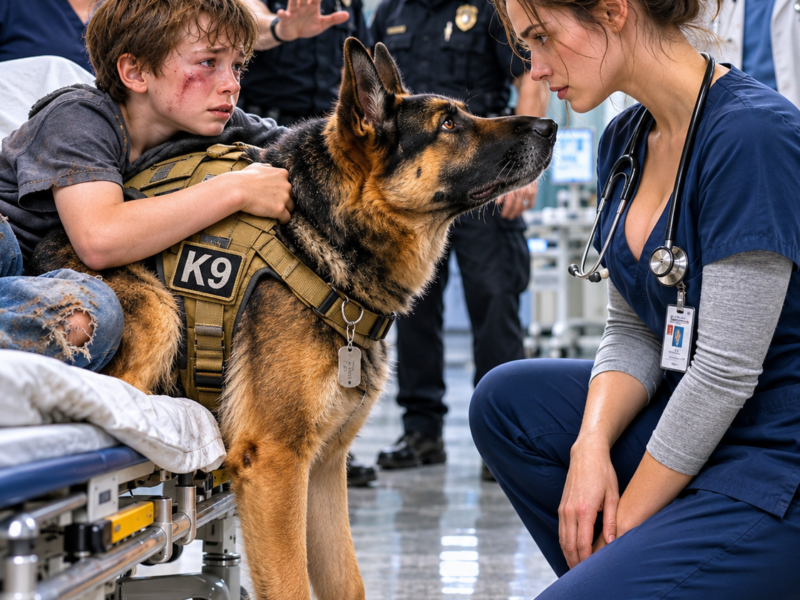
“Get the rookie away from that dog!”
The emergency lights flickered on, painting the corridor in a dim red glow.
Behind me, someone shouted that smoke was coming from the veterans’ wing.
I turned toward the sound.
“Margaret, keep Ulisses in the lobby. Don’t let anyone take him or the dog outside until we know what’s happening.”
“But Lorraine—”
“I know what I’m doing.”
The words came out sharper than I intended. Margaret stared at me, perhaps hearing something in my voice that didn’t belong to a rookie nurse who had been on the job for barely twelve days.
Valor stood beside me, his ears forward and his body tense.
I looked down at him.
“Stay close.”
He moved immediately.
That was when I knew there was no point pretending anymore. Whatever happened in the next few minutes, I would have to trust the instincts that had once kept soldiers alive.
The smoke was thickening near the veterans’ rooms. Staff members were trying to move patients toward the emergency exit, but the blackout had left several electronic doors locked.
“Manual release!” I shouted. “Use the emergency levers. Move the patients who can walk first. Keep the wheelchairs together. Nobody goes back alone!”
A security guard hurried toward me.
“There’s someone missing. Calvin Brooks. His room is at the end of the west corridor.”
“Has anyone checked?”
“He was there before the lights went out. We can’t reach him.”
I looked toward the smoke.
“Then we’ll find him.”
The guard grabbed my arm.
“You can’t go in there.”
I looked at his hand until he released me.
“I’m not going in alone.”
Valor was already standing at the corridor entrance.
I crouched beside him.
“Search.”
He moved forward, nose low, pulling against the lead just enough to guide me through the haze. I followed his movements, keeping one hand against the wall.
We found Calvin near his room. He had fallen beside his bed, one arm trapped beneath a metal side table. He was conscious but struggling to breathe.
“Calvin, it’s Lorraine. We’re getting you out.”
He coughed.
“Can’t… my leg.”
“I see it. Don’t move.”
The smoke was becoming heavier. I checked the table and realized I couldn’t lift it safely by myself.
I looked at Valor.
“Hold.”
The dog stayed beside Calvin, watching him closely while I pulled a folded blanket from a nearby emergency cart. I wrapped it around Calvin’s upper body and secured it into a broad strap, keeping pressure away from his injured leg.
“I’m going to pull you toward the doorway. Valor will stay beside you. Don’t fight the movement.”
Calvin managed a weak nod.
I pulled carefully, inch by inch. Valor walked beside him, occasionally looking back at me as if checking that we were still together.
When we reached the corridor, two staff members appeared through the smoke.
“Take his shoulders,” I ordered. “Keep his leg straight.”
Together, we moved him toward the exit.
A moment later, the fire alarm began to sound.
We had barely reached the safe area when Margaret ran toward us.
“Lorraine!”
She looked at Calvin, then at me, then at Valor.
“Are you hurt?”
“No. Check Calvin’s breathing. Get him oxygen and have someone assess his leg.”
Margaret nodded and immediately called for help.
Then she lowered her voice.
“Lorraine, the hospital director wants to know why you were giving orders like that.”
I glanced at the dog.
“Because people needed help.”
“That isn’t what I mean.”
I knew exactly what she meant.
Before I could answer, a military liaison arrived with two security officers. He had been contacted after staff noticed the unusual markings on Valor’s identification tags.
His eyes moved from the dog to my face.
“Lorraine Reed?”
“Yes.”
“I’m Captain Harris. We need to talk about this animal’s service history.”
I looked at Valor’s tags.
The narrow triangle. The two short lines.
I had hoped never to see that symbol again.
Captain Harris noticed my expression.
“You recognize it.”
“I do.”
“Where?”
I hesitated.
“An Army medical recovery unit. I served with one.”
Margaret stared at me.
“You were in the Army?”
I didn’t answer her. My attention was on the captain.
“Where did you get this dog?”
“His name is Valor. He was assigned to a military working team under Sergeant Nathan Carter.”
My throat tightened.
“Nathan Carter?”
“Yes. His handler was injured during an operation overseas. The dog was transferred after the incident.”
“Was Nathan evacuated?”
Captain Harris paused.
“He survived the initial evacuation. His later medical history is being reviewed.”
I closed my eyes for a moment.
I remembered the dust, the shouting, the blood on the ground. I remembered a young handler refusing to let go of his dog even as the medics prepared to move him.
I remembered telling him that Valor would be safe.
I had never known whether he made it home.
“Does his son know?” I asked.
Captain Harris glanced toward the lobby.
“Ulisses?”
I nodded.
“He’s been asking about his father.”
The captain looked at me carefully.
“Then perhaps you should speak with him.”
Ulisses was sitting on a bench when I returned.
Valor went straight to him, placing his head against the boy’s knee.
Ulisses wrapped both arms around the dog’s neck.
“Are they taking him away?”
I sat beside him.
“Not tonight.”
“But they might?”
I didn’t want to lie.
“The military needs to review his records. They have to make sure he’s safe and that everyone understands his history.”
Ulisses looked down.
“He’s all I have left from my dad.”
I swallowed.
“Your father talked about you.”
The boy’s head lifted.
“He did?”
I nodded.
“During an operation, I met him while he was being treated for an injury. He was worried about getting home. He told us he had a son waiting for him.”
Ulisses’s eyes filled.
“Did he say my name?”
“I don’t remember him saying it. But I remember how he talked about you. He wanted to get back to you.”
For a moment, Ulisses said nothing.
Then he pressed his forehead against Valor’s.
“Dad told me Valor would always protect me.”
The dog gave a quiet sound and leaned closer.
I placed a hand gently on Ulisses’s shoulder.
“He’s been doing exactly that.”
The boy looked at me.
“Were you one of my dad’s soldiers?”
“I was a medic. I helped wounded people get out of dangerous places.”
“Were you there when he got hurt?”
I took a breath.
“Yes.”
“Did you save him?”
“I helped get him to the people who could treat him. That’s all I know for certain.”
Ulisses considered that answer.
Then he nodded, as if he understood that some questions didn’t have easy answers.
The hospital evacuation ended without any patients being lost.
The fire was contained to a maintenance area, and the damage was limited. Calvin Brooks was treated for smoke inhalation and his injured leg. By morning, the corridors were quiet again.
But my life at the hospital had changed.
The director asked me to explain my military background. I told him what I could without discussing restricted operations or details that weren’t mine to share.
He listened carefully.
“You should have told us you had this experience.”
“I came here to be a nurse,” I said. “I didn’t want my past to be the first thing people saw.”
He looked toward the damaged corridor.
“Perhaps we should have asked more questions before deciding what you were capable of.”
I didn’t argue.
Margaret approached me later that afternoon.
“I owe you an apology,” she said.
I looked at her.
“For what?”
“For assuming you were inexperienced just because you were new here.”
“You weren’t entirely wrong. I’m still learning this hospital.”
She gave a small, tired smile.
“So am I, apparently.”
For the first time since I had arrived, I felt that she was speaking to me as a colleague rather than a problem she had to supervise.
Over the following weeks, the military reviewed Valor’s service record and his connection to Nathan Carter.
There were questions about whether he could remain with Ulisses. His history made the decision complicated, and the hospital couldn’t make it on the military’s behalf.
Ulisses was frightened.
Every time an officer visited, he held tighter to Valor’s collar.
I spoke with the military liaison and explained what I had witnessed: Valor’s behavior around the boy, his response to commands, and the way he remained calm when Ulisses was near.
I didn’t ask anyone to ignore the rules.
I asked them to consider the bond between them.
A few days later, Captain Harris returned with an update.
“Valor’s status is still under review,” he told Ulisses. “But we’re exploring the possibility of keeping him with you under an approved arrangement.”
Ulisses looked at him cautiously.
“Does that mean he can stay?”
“It means we’re working toward that.”
The boy hugged Valor.
It wasn’t a final answer, but it was enough to let him breathe again.
Three weeks after the blackout, Ulisses came back to the hospital for a follow-up appointment.
Valor walked beside him, wearing a temporary identification harness.
I was finishing my shift when I saw them in the lobby.
“Hey, you two.”
Ulisses smiled.
“Valor wanted to see you.”
I crouched to greet the dog. He sniffed my hand, then sat beside me.
Some habits survived everything.
Ulisses held up a small metal tag.
“It’s my dad’s.”
I recognized it immediately.
The edges were worn, and the surface had scratches from years of use.
“Where did you get it?”
“It was in his things. My aunt gave it to me.”
He turned it over in his palm.
“Can I ask you something?”
“Of course.”
“Do you miss being a soldier?”
I looked at the tag for a moment.
“Sometimes I miss the people. Sometimes I miss knowing exactly what I was supposed to do. But I don’t miss the fear, or the nights when I couldn’t stop thinking about the people we couldn’t save.”
“Do you still think about my dad?”
“Yes,” I said. “I do.”
He nodded.
“I’m glad you knew him.”
I looked at Valor, who had settled quietly beside the boy.
“So am I.”
Margaret passed through the lobby and stopped when she saw us.
“Lorraine, your next patient is waiting.”
“I’ll be right there.”
She looked at Ulisses and smiled.
“Good to see you again.”
After they left, Margaret stood beside me for a moment.
“You know,” she said, “when you first arrived, I thought you were going to struggle here.”
“I did struggle.”
“But you stayed.”
I watched Ulisses and Valor disappear through the glass doors.
“I had a reason to.”
That evening, I returned to the veterans’ ward.
The hospital was quiet. The lights were steady. The emergency doors had been repaired, and the smell of smoke was gone.
I checked on Calvin, who was recovering well. I adjusted his blanket, reviewed his chart, and reminded him to call if he needed anything.
Then I walked past the room where the evacuation had begun.
For a moment, I could almost hear the alarm again.
I could see the smoke, feel the weight of the blanket strap in my hands, and remember the sound of Valor moving beside me.
I had spent years believing that the past was something I had to keep locked away.
But that night had taught me something different.
My past didn’t have to control my future. It didn’t have to be the first thing people knew about me, and it didn’t have to be something I was ashamed to carry.
I could honor the people I had served beside without living forever in the worst moments we had shared.
I could be a nurse.
I could help people recover.
And sometimes, when the world became frightening, I could still find the courage to step forward.
A few days later, I received a short message from Captain Harris.
Valor’s placement with Ulisses had received provisional approval, subject to continued review and the required support arrangements.
It wasn’t a promise that nothing would ever change.
But it gave them time together.
That was enough for now.
I put the message away and returned to my patients.
Somewhere beyond the hospital walls, a ten-year-old boy was learning that he wasn’t alone. A military dog was beginning a new chapter. And a former Army medic was finally learning that saving lives didn’t always mean running toward gunfire.
Sometimes it meant staying.
Sometimes it meant listening.
And sometimes it meant helping someone feel safe enough to believe in tomorrow.
I had come to the hospital thinking I was starting over.
Now I understood.
I wasn’t leaving my past behind.
I was finally learning how to live with it.
THE END.









