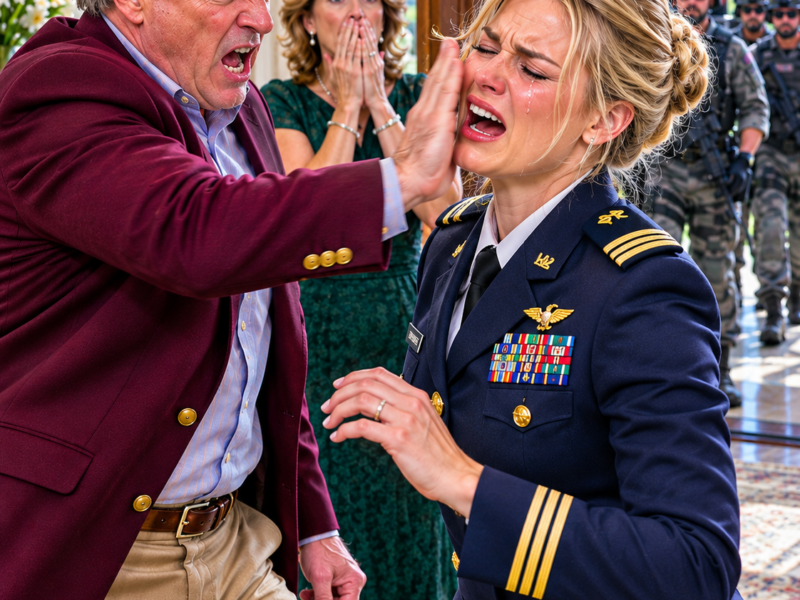
“Get out, b*tch.” My father said it so loudly that the neighbors probably heard him through the windows.
The first person to speak was my father.
“What bank transfer?”
His voice had changed. A few minutes earlier, he had been shouting at me in front of the entire neighborhood. Now he sounded cautious, almost frightened.
Commander Mitchell didn’t answer immediately. He looked at Jason.
“Mr. Carter, eleven days before your mother’s death, approximately $48,000 was transferred from an account associated with her estate into a private account registered under your name. Can you explain that?”
Jason laughed nervously.
“This is a family matter. You don’t have jurisdiction over our finances.”
“That’s not what I asked.”
My brother looked at Dad.
“Tell them, Dad.”
My father frowned. “Tell them what?”
“That Mom wanted me to handle her money.”
I stared at him.
“You told Dad I stole that money.”
Jason’s jaw tightened.
“Emily, don’t start.”
“You told him I withdrew it.”
“I said you had access to the account.”
“Because Mom gave me access to pay her medical bills.”
Commander Mitchell raised one hand.
“Let’s slow down. We aren’t here to conduct a financial investigation on the sidewalk. We have information that may be relevant to a matter Mrs. Carter reported before her death.”
My father’s face went pale.
“Reported to whom?”
“The Navy.”
My father looked as if he hadn’t understood the words.
“Margaret never had anything to do with the Navy.”
Mitchell opened the folder again.
“Your wife worked as a civilian intelligence analyst supporting Naval Special Warfare operations. Her work involved reviewing logistics, financial irregularities, and procurement records connected to sensitive programs.”
I looked at the photograph again.
My mother.
The woman who used to leave handwritten notes in my lunch bag.
The woman who remembered every birthday and always kept extra blankets in the car.
The woman who told me her office job was boring.
She had lived an entire professional life I knew nothing about.
“Why didn’t she tell us?” I whispered.
The commander softened his voice.
“Some of her work was protected. But she also wanted to keep you and your brother away from it.”
He paused.
“Especially after she discovered something she believed could put her family at risk.”
Jason took a step backward.
“This is insane. I’m leaving.”
One of the officers moved—not aggressively, just enough to make it clear the conversation wasn’t over.
“Sir, nobody is detaining you. But we’d appreciate it if you stayed while we clarify a few things.”
My father turned toward me.
“Emily, what is this? What did your mother get involved in?”
I shook my head.
“I don’t know. I’m finding out at the same time you are.”
I opened the envelope.
Inside was a letter, folded twice, with my name written across the top.
The handwriting was unmistakably hers.
My hands trembled as I unfolded it.
My darling Emily,
If you’re reading this, then the people I trusted have finally reached you. I wish I could be there to explain everything myself.
First, I need you to know that I loved you. I loved your brother too, even when I worried about the choices he was making.
There are things I couldn’t tell you while I was alive. I discovered that someone had been moving money through accounts connected to a Navy support contractor. At first, I believed it was ordinary fraud. Then I found evidence that the transfers were connected to classified equipment purchases.
I made copies of the records. I gave the original evidence to someone I trusted, and I arranged for the remaining documents to be released only after my death.
Emily, the money you used for my treatment was yours. I knew that. I watched you sacrifice your savings to keep me comfortable. You never stole from me.
I stopped reading.
My eyes blurred.
My mother knew about the money.
She knew I’d paid the bills.
She knew what Jason had been saying.
I continued.
Jason came to me asking for money. He said he was in trouble. I helped him once. Then I discovered he had been using my name to request additional transfers.
I confronted him. He told me he was being pressured by someone he owed money to. I wanted to believe he would stop.
I don’t know how far he has gone. But I know he was not working alone.
If your father is with you, be careful what you assume. He knows less than he thinks. And if Jason tells you he was only trying to help me, ask him who gave him the account number.
I lowered the letter.
The yard was silent.
Jason stared at me.
“That’s not what happened.”
I looked at him.
“Then explain it.”
He opened his mouth.
Nothing came out.
My father reached for the letter.
“Let me see that.”
I handed it to him.
He read the first few paragraphs quickly, then slowed down.
When he reached the section about Jason, his face changed.
“Jason?”
My brother shook his head.
“Dad, she’s twisting this. Mom was sick. She was confused.”
Commander Mitchell spoke calmly.
“Mrs. Carter’s records were reviewed by medical personnel before her statement was accepted. She was assessed as mentally competent when she submitted the information.”
Jason’s eyes flashed.
“So you just believe whatever she wrote?”
“No,” Mitchell replied. “We verify evidence. That’s why we’re here.”
The third SEAL, who had barely spoken, stepped closer.
“Commander, the liaison has confirmed the file is ready.”
Mitchell nodded.
He turned to me.
“Ms. Carter, there’s another part of your mother’s instructions. She requested that you receive a copy of the records in person, with two witnesses present.”
He opened the black case.
Inside was a small encrypted storage device, a sealed packet, and a photograph.
The photograph showed my mother at a desk, sitting beside a man I didn’t recognize.
Behind them was a whiteboard covered with names and numbers.
One name had been circled.
Jason Carter.
My brother stared at it.
Then he whispered, “She wasn’t supposed to have that.”
Everyone heard him.
My father turned slowly.
“What did you just say?”
Jason looked around as if searching for an exit.
“I meant… she wasn’t supposed to be involved in any of this.”
Commander Mitchell placed the storage device back in the case.
“Mr. Carter, who gave you the account information?”
Jason’s face hardened.
“I don’t have to answer that.”
“You’re right. Not here.”
Mitchell nodded to the younger officer, who wrote something down.
“However, we do need to inform you that the financial records your mother preserved have already been provided to the appropriate investigators.”
My father grabbed Jason’s arm.
“What have you done?”
“Let go of me.”
“Did you steal from your mother?”
“I didn’t steal anything!”
“You told me Emily took the money!”
Jason yanked his arm away.
“Because she was the one with access! What was I supposed to say?”
“The truth!” I shouted.
The word came out louder than I intended.
Jason turned toward me.
“You think you’re better than me because you spent all that time playing nurse? You think Mom loved you more?”
I stared at him.
“This was never about who Mom loved more.”
“You always got everything!”
I almost couldn’t believe what I was hearing.
“I gave up my apartment to move back and help Mom. I used my savings. I took unpaid leave. I sat beside her while you were out telling everyone you were building a company.”
“You don’t know what I was dealing with.”
“Then why didn’t you tell me?”
He looked away.
That was the first honest thing he’d done all afternoon.
My father sat down heavily on the porch steps.
He was holding my mother’s letter, but he wasn’t reading it anymore.
“Jason,” he said quietly. “Tell me the truth.”
For a long moment, my brother didn’t move.
Then his shoulders dropped.
“I borrowed money.”
“How much?”
Jason didn’t answer.
“How much?”
“More than I could pay back.”
My father rubbed his face.
“And Mom’s account?”
Jason stared at the ground.
“I used it to cover part of what I owed.”
“Without her permission?”
“She was sick. I thought I could put it back.”
I closed my eyes.
“Then why did you blame me?”
He looked at me.
“Because I was scared.”
That was all.
No elaborate explanation.
No dramatic confession.
Just fear.
Fear of losing the money.
Fear of being exposed.
Fear of disappointing the father who had spent his life defending him.
And because I had always been the one who could take a hit and keep standing, Jason had decided I could take this one too.
My father looked up at him.
“You let me hit your sister.”
Jason’s face went blank.
“I didn’t tell you to—”
“You stood there.”
“I was trying to protect myself.”
My father looked at me.
His eyes moved to the red mark on my cheek.
For the first time, I saw him understand what he’d done.
“Emily…”
I didn’t answer.
He stood slowly.
“I’m sorry.”
The words were quiet.
Almost swallowed by the sound of the helicopter’s rotors winding down in the distance.
I wanted to hear them.
For years, I had wanted my father to stand up for me. To believe me. To look at the evidence before deciding I was guilty.
But now that he was finally saying the words, they didn’t repair what had happened.
“You slapped me,” I said.
His eyes filled.
“I know.”
“You called me a thief without looking at one piece of evidence.”
“I know.”
“You told me my mother would be ashamed of me.”
He looked down.
“I was wrong.”
I nodded slowly.
“I’m glad you understand that.”
He took a step toward me.
“Can we talk? Just you and me?”
“Not today.”
He stopped.
I turned back toward Commander Mitchell.
“What happens now?”
“Your mother’s evidence will be reviewed by the relevant authorities. Any financial misconduct will be handled through the proper legal process. We also have an independent contact who can explain the documents she left.”
“Who?”
Mitchell glanced at the photograph.
“Captain Robert Hayes. He worked with your mother for years. He’s retired now, but he was the person she trusted to preserve the original records.”
I looked at the photograph again.
“Is he here?”
“He’s waiting at the landing site.”
I glanced toward the field.
A fourth man stood beside the helicopter. He wore civilian clothes, a navy-blue jacket, and held a walking cane.
He looked to be in his late sixties.
When he saw me, he lifted one hand.
“Emily?”
I nodded.
He approached slowly.
“I’m Robert Hayes. Your mother and I worked together for seventeen years.”
He looked at the letter in my hand.
“She told me you’d probably be angry.”
I gave a small, broken laugh.
“That’s one word for it.”
“She also told me not to let anyone rush you into making decisions.”
He gestured toward the storage case.
“Your mother left you the right to decide what happens to her personal records. The operational records remain under Navy control. You don’t have to do anything today.”
I looked at him.
“Why did she keep all this from us?”
He considered the question.
“Because she believed the people she was investigating might use her family to pressure her. She thought keeping you outside her work was the safest way to protect you.”
I looked toward my father and brother.
It hadn’t worked.
Not completely.
But perhaps it had bought us time.
Hayes continued.
“She was proud of you, Emily. She spoke about you constantly. She said you were the person who could be trusted to do the right thing even when nobody was watching.”
My throat tightened.
“She never told me any of this.”
“She didn’t want you to carry it.”
He paused.
“But she wanted you to know that she saw what you did for her.”
I looked down at the letter.
For months, I had wondered whether Mom knew how much I had given up.
Now I had my answer.
She knew.
And she had made sure the truth survived her.
The commander asked whether I wanted to accompany them to a nearby Navy facility to review the documents with the designated liaison.
I agreed.
Before leaving, I turned toward my father.
He stood on the porch, looking older than he had that morning.
“Emily,” he said. “Please don’t leave like this.”
I looked at him.
“I didn’t choose this.”
He nodded.
“I know.”
“You chose to believe Jason without hearing me. You chose to hit me. You chose to throw me out.”
He looked as if every sentence had landed physically.
“I know.”
“I need space.”
He didn’t try to stop me.
Jason stood behind him, staring at the ground.
I walked toward the field with Commander Mitchell and the other officers.
Behind us, I heard my father call my name once more.
I didn’t turn around.
At the helicopter, Robert Hayes opened the passenger door for me.
Before I climbed in, he handed me a small photograph.
It was a picture of my mother standing with the three men from the first photograph. This time, she was smiling.
On the back, she’d written a date and a sentence.
For the people who never let the truth become another casualty.
I held it against my chest.
Then I climbed aboard.
The helicopter lifted from the field, rising above the neighborhood where I had grown up.
From the window, I could see my father’s house getting smaller.
The porch.
The front yard.
The people still standing outside.
I thought about how many times I had driven home believing that no matter what happened in the world, that house would always be a safe place.
I knew now that a building could be familiar without being safe.
And family could share your blood without earning your trust.
At the Navy facility, the records took hours to review.
My mother’s files contained evidence of a fraudulent contracting arrangement involving a private logistics company. Several payments had been routed through shell accounts, and the money had eventually reached individuals connected to the contractor.
Jason had been used as an intermediary.
He had knowingly provided access to the family account and had moved money without authorization. He had also concealed the transfers by telling my father I was responsible.
But the records revealed something else.
Jason hadn’t been the person who started the scheme.
He had been approached by a former business associate who knew he was in debt. The man had promised to help him recover financially if Jason allowed certain payments to pass through accounts he controlled.
At first, Jason had believed it was a temporary arrangement.
Then the amounts grew.
When Mom discovered the transfers, she confronted him and ordered him to stop.
He didn’t.
Instead, he tried to convince her that she was misunderstanding the transactions.
When she refused to back down, he began telling people that her illness had affected her judgment.
The evidence she preserved ultimately helped investigators identify the wider scheme.
The Navy’s role was to protect its records and ensure that the operational information was handled correctly. Civilian authorities would address the financial crimes.
I was asked to provide a statement about the family account and the money I’d used for Mom’s care.
I gave them every receipt.
Every bank statement.
Every hospital invoice.
By the end of the week, my name had been cleared of any suspicion connected to the missing money.
Jason, meanwhile, had to answer questions about his own actions.
He eventually admitted what he had done.
The legal consequences were handled through the proper process. He repaid what he could, entered an agreement to resolve the remaining financial loss, and accepted responsibility for the unauthorized transfers.
It wasn’t a heroic redemption.
It was accountability.
And I learned that those were two very different things.
My father called me every day for the first two weeks.
At first, I didn’t answer.
Then he began leaving messages.
He apologized without asking me to forgive him. He admitted that he’d favored Jason for years and that he’d mistaken my independence for a lack of need.
He told me he had found the hospital receipts in the envelope I’d dropped on the living room floor.
He said he’d sat at the kitchen table and read every single one.
I listened to the messages.
I didn’t call back.
Not yet.
Three months later, I met him at a small coffee shop halfway between our homes.
He arrived early.
When I walked in, he stood up, then seemed unsure whether he should hug me.
So he didn’t.
He simply pulled out the chair across from him.
“I brought something,” he said.
He placed a small box on the table.
Inside was Mom’s old watch.
The one she used to wear when she took me to school.
“I found it in her jewelry drawer,” he said. “She wanted you to have it.”
I touched the glass.
“Thank you.”
He looked at me for a long time.
“I don’t expect you to forgive me.”
“Good.”
He nodded.
“I just want you to know that I understand what I did.”
I took a breath.
“Dad, I don’t know if we’ll ever have the relationship we had before.”
He looked down.
“I understand.”
“But I might be willing to build something different. Slowly. If you can respect my boundaries.”
He nodded again.
“I can do that.”
I didn’t promise him anything more.
And he didn’t ask.
As for Jason, I kept my distance.
He sent one message saying he was sorry.
I replied that I hoped he would use the opportunity to become someone who could be trusted.
I didn’t offer him money.
I didn’t offer to fix his problems.
I didn’t pretend everything was fine because we shared a childhood.
For the first time, I understood that forgiveness didn’t require me to hand someone the keys to my life again.
A year after that afternoon, Commander Mitchell invited me to a small ceremony at a Navy facility.
It wasn’t a public event.
There were no cameras, no reporters, and no speeches about secret missions.
The purpose was to formally recognize my mother’s civilian service and present me with a copy of the commendation she had received years earlier.
I stood in the front row while Commander Mitchell read the citation.
He spoke about her professionalism, her integrity, and her determination to protect the people who depended on her work.
Then he handed me a framed document.
“Your mother was an extraordinary woman,” he said.
I looked at the photograph displayed beside the podium.
Mom was smiling again.
For years, I had thought of her as the person who held our family together.
Now I understood that she had been holding together something much larger, too.
After the ceremony, the three SEALs from the helicopter came over to speak with me.
Commander Mitchell shook my hand.
“Your mother would be proud.”
I smiled through my tears.
“I hope so.”
The older officer, the one who had first noticed my bruised cheek, nodded toward the framed commendation.
“She made us promise we’d find you.”
“You kept that promise.”
“We did.”
He paused.
“And for what it’s worth, Ms. Carter, you didn’t need a helicopter to prove your worth to anyone.”
I looked at him.
He continued.
“Your mother knew who you were long before we arrived.”
That sentence stayed with me.
Later that evening, I went home and placed the commendation beside Mom’s photograph.
Then I sat at my kitchen table and read her letter one more time.
I stopped at the final paragraph.
Whatever happens, Emily, don’t let the people who hurt you convince you that being kind was your mistake. You were never foolish for loving your family. Just remember that love should never require you to abandon yourself.
I folded the letter carefully.
For a long time, I had believed that being a good daughter meant staying quiet.
That being a good sister meant cleaning up Jason’s messes.
That being a good family member meant accepting whatever my father said because he was my father.
I didn’t believe that anymore.
My mother had left me more than documents, evidence, or a hidden piece of her life.
She had left me permission to stop carrying what was never mine.
I placed her letter in the box with her watch and the photograph from the helicopter.
Then I turned off the kitchen light.
The day my father slapped me, I thought I’d lost my family.
But what I had really lost was the illusion that I could keep everyone together by sacrificing myself.
The Navy helicopter hadn’t come to rescue me from my father’s house.
It had come because my mother had made sure the truth would find me.
And when it finally did, I was strong enough to walk away from the people who refused to see it.
I still loved my father.
I still missed my brother sometimes.
But I no longer confused love with permission to hurt me.
That was the inheritance my mother had wanted me to have.
And it was worth more than anything in that sealed envelope.
The end.









