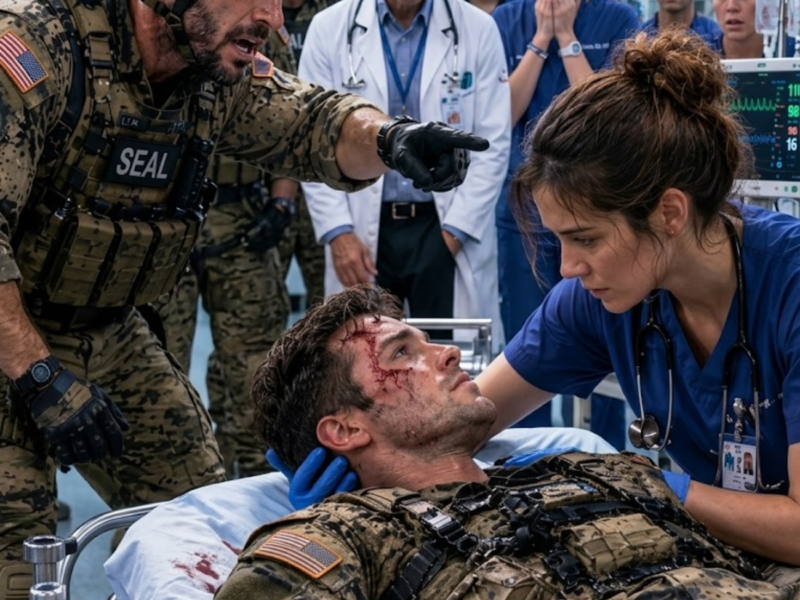
“Get away from him!” the SEAL leader barked as I knelt beside the wounded operator on the hospital floor
The harsh fluorescent lighting of the hospital stairwell buzzed with a low, mechanical hum that seemed to vibrate directly inside my skull. Blood, warm and metallic, was still drying on the palms of my hands and staining the sleeves of my light blue scrubs.
I stood frozen on the concrete landing, sandwiched between Captain Marcus Cole—whose jaw was clamped so tight the muscles in his cheek twitched—and the pale, swaying figure of the wounded SEAL, Lieutenant Miller. Miller was clutching his bandaged abdomen, leaning heavily against the heavy steel doorframe, his hospital gown soaked in fresh red stains where his sutures were tearing under the strain of moving.
His eyes weren’t looking at me. They weren’t looking at Cole either. They were locked in sheer, unadulterated terror on the far end of the dim corridor beyond the open door.
“Too late,” Miller whispered again, his breath whistling through his teeth.
I turned my head slowly. At the end of the long service hallway, illuminated by a single flickering overhead panel, stood a man. He wore an outdated, faded Desert Digital NWU Type II uniform—the exact pattern worn by elite Naval Special Warfare units during the early 2010s. The fabric was torn at the elbow and dusted with fine gray alkali grit, the distinct dust of the high desert. Pinched above his left chest pocket was a faded fabric nametape.
HAYES.
My breath hitched in my throat. My knees wobbled, knocking together beneath my thin scrub pants.
Lucas.
Five years ago, two officers in dress whites had stood on my mother’s porch in Ohio to tell us that Petty Officer First Class Lucas Hayes had been lost at sea during a classified night insertion off the coast of Iran. They gave us an empty casket, a neatly folded flag, and a posthumous Navy and Marine Corps Medal. I had spent half a decade crying myself to sleep, nursing a hollow ache in my chest that no amount of time or work could heal.
Now, the silhouette standing twenty yards away moved. He didn’t walk with the limp of a ghost or the hesitation of a phantom. He stepped forward with the heavy, deliberate heel-toe stride of an operator clearing a kill house.
“Lucas?” My voice came out as a fragile, pathetic rasp.
“Emma, don’t move!” Captain Cole roared. In a flash, Cole reached into his jacket, unholstered a suppressed SIG Sauer P226, and raised it, pointing the barrel straight at the man wearing my brother’s name. “Identify yourself! Stand down or I swear to God I’ll put a round in your center mass!”
The man in the faded uniform didn’t stop. He stepped out of the shadow into the yellow glare of the flickering panel.
It wasn’t Lucas.
The face belonged to a man in his late thirties, covered in deep, jagged shrapnel scars across his jawline and neck. His eyes were cold, sunken, and entirely bloodshot. But what sent a wave of icy paralysis down my spine was what he was holding in his right hand.
It wasn’t a pistol or a rifle. It was a heavy, military-grade detonator unit wired to a thick, black tactical vest wrapped tightly around his chest. The red digital timer on the casing was pulsing: 03:00… 02:59… 02:58…
“Captain Cole,” the scarred man said, his voice sounding like two dry stones grinding together. “You should have left the nurse out of this. The Overseer wants the drive back.”
“Vance sent you,” Cole growled, shifting his body to place himself directly between me and the bomber. “Where is Hayes? Where is Lucas?”
The bomber let out a short, hollow laugh that turned into a wet cough. “Hayes is in Nevada, captain. Right where you left him five years ago. Buried under six feet of alkali salt and classified red tape.” He looked past Cole’s shoulder, his bloodshot eyes locking directly onto mine. “Hand over the plastic card, Nurse Hayes. Or this whole floor goes up.”
Miller, slumping against the doorframe beside me, slid his hand into my scrub pocket. His fingers were freezing, sticky with blood. He pressed a small, cold object—a USB flash drive disguised as an encryption key—into my palm and pushed me hard toward the emergency exit behind us.
“Run, Emma,” Miller gasped, his voice collapsing into a choked cough. “The coordinates… on the back of the photo… go to Nevada…”
“Miller, no!” I screamed.
“GO!” Cole yelled, turning his head for a split second.
Before I could process what was happening, Cole threw his weight forward, lunging at the suicide bomber. A single suppressed shot cracked through the concrete stairwell, followed immediately by the dull, sickening sound of two heavy bodies colliding.
Miller grabbed my collar with his remaining strength and shoved me through the heavy fire door into the dark, narrow service shaft behind the stairwell.
“Lock it!” Miller grunted, slamming the iron latch into place from the inside just as a deafening explosion shattered the concrete behind us.
The force of the blast slammed into the heavy steel door, bowing the iron inward and sending a blinding wave of heat, dust, and shrapnel roaring down the shaft. The floor gave a terrifying shudder, lights shattering overhead, dropping us into absolute, pitch-black silence.
The air in the narrow utility shaft was suffocating, thick with the sharp smell of burnt copper, pulverized drywall, and scorched insulation. My ears were ringing with a continuous, high-pitched whine that drowned out every sound except the heavy, ragged gasps coming from my own throat.
“Miller?” I whispered, dropping to my hands and knees in the dark.
My hands slid across cold, cracked concrete until they brushed against the rough canvas of a hospital gown. Miller was lying on his side, his body shuddering violently.
“Miller! Stay with me!” I fumbled frantically in the dark, pulling a small penlight from my scrub pocket and clicking it on.
The narrow beam of yellow light illuminated a nightmare. The heavy iron door behind us was scorched black and warped, completely jammed into its steel frame. Miller’s face was gray, his lips tinged with blue. The blast wave had torn open his surgical incision, and dark blood was pooling rapidly on the floor beneath him.
“Emma…” Miller’s voice was barely a breath, his fingers clutching my wrist with a weak, frantic grip. “The card… the card in your pocket…”
I pulled out the plastic card he had thrown at me earlier in the trauma bay. In the dim yellow light of the penlight, I stared at my brother’s face. It was a standard Department of Defense contractor ID badge, but across the front, someone had scratched out the official seal with a knife. On the back, written in sharp black marker, were two sets of GPS coordinates and that terrifying instruction: Ask Captain Cole what happened in Nevada.
Beside the coordinates was a small, three-digit number: 752.
“752nd EOD,” I whispered, my brain piecing together the fragments. “That was my brother’s unit designation.”
“It’s not an EOD unit…” Miller choked out, his eyes rolling back slightly as shock set in. “It was… a black budget protocol. Operation Archangel. Your brother didn’t die at sea, Emma. He found… he found a buried storage depot in the Nevada desert. Tons of uncataloged weapons… sold off by higher-ups in the Defense Intelligence Agency.”
My stomach churned. “Who sold them?”
“General Vance… and Cole,” Miller rasped, his eyes widening with sudden, desperate clarity. “Cole was part of it. He took the money five years ago. But Lucas… Lucas refused to sign the manifest. He took the evidence and disappeared.”
I felt as if the ground beneath me had dropped into an abyss. Captain Cole? The man who had spent the last twenty minutes trying to ‘protect’ me?
“Then why did Cole fight that bomber?” I asked, my voice shaking.
“Because Cole… isn’t trying to save you…” Miller whispered, a trickle of dark blood leaking from the corner of his mouth. “He’s trying to… find Lucas first. If Cole gets to Nevada before you… he’ll finish what he started five years ago.”
Miller’s hand suddenly went limp, slipping off my wrist and thudding softly against the floor. His head slumped sideways, his breathing stopping entirely.
“Miller? Miller!” I slammed my hands onto his chest, starting CPR, counting the rhythm out loud in the dark shaft. “One, two, three, four… come on! Don’t do this! Stay with me!”
A heavy, metallic thud echoed from the other side of the jammed iron door. Then another.
Someone was using a hydraulic spreader on the warped steel.
“Emma!” Captain Cole’s voice boomed through the cracked frame, rough and laced with coughing fits from the smoke. “Emma, are you in there? Step back from the door!”
I stopped CPR. I looked down at Miller’s lifeless face, then at the USB drive clenched tightly in my hand.
I was just a trauma nurse. Three days ago, my biggest worry had been managing patient shift rotations and making sure the IV pumps were calibrated correctly. But standing in that dark shaft, surrounded by dust and blood, Emma Carter died. Sergeant Lucas Hayes’ sister took her place.
I slipped the plastic card and the USB drive into my breast pocket, zipped my scrub jacket tightly over my chest, and turned away from the jammed door.
At the far end of the service shaft was a small, square ventilation hatch leading to the underground parking structure. I unscrewed the rusted latch with my nurse’s shears, kicked the metal grate open, and crawled out into the dark, damp belly of the hospital’s subterranean garage.
Ten minutes later, I was behind the wheel of my sedan, accelerating out of the hospital exit ramp into the rain-slicked streets of San Diego. The radio was buzzing with frantic police dispatches about an explosion at the Naval Medical Center.
I reached down and adjusted the GPS unit on my dashboard, punching in the first set of coordinates from the back of the photograph.
The screen calculated the route, a blue line cutting across the desert state line.
DESTINATION: NYE COUNTY, NEVADA. DISTANCE: 380 MILES.
“I’m coming, Lucas,” I whispered to the empty car. “I’m coming.”
The high desert of southern Nevada at 3:00 AM was a vast, terrifying void of cold sand, jagged mountain silhouettes, and endless black sky.
My sedan’s headlights cut weak yellow beams through the swirling alkali dust blowing across State Route 375. I had been driving for five hours without stopping, watching the fuel gauge drop steadily while my eyes burned from exhaustion and dried salt.
According to the coordinates on the card, the destination wasn’t a town, a military base, or a landmark. It was a point eight miles off the paved highway, deep inside an abandoned mining sector known on old territorial maps as Sinking Well.
I turned the sedan off the highway, the tires crunching loudly over dry gravel and sagebrush. The car bounced violently over deep ruts in the dirt track, the engine straining as we climbed a low, barren ridge.
At the top of the ridge, the dirt track ended abruptly at a rusted chain-link fence topped with concertina wire. A sun-bleached metal sign dangled from a single bolt on the gate: DANGER – U.S. GOVERNMENT PROPERTY – NO TRESPASSING – USE OF DEADLY FORCE AUTHORIZED.
I pulled the car to a stop beneath the shadow of a decaying wooden mine derrick.
I killed the engine and turned off the headlights. The sudden darkness was absolute, heavy, and freezing cold. The temperature had plunged to near freezing, and the wind howled through the rusted steel frame of the derrick like a grieving woman.
I grabbed my flashlight, a heavy iron lug wrench from the trunk, and stepped out into the night.
Ranger—or rather, the ghost of my brother’s training—seemed to guide my hands. I moved along the fence line until I found a section where the wire had been cut near the bottom and tied back with rusty wire. Someone had maintained an entrance here.
I slipped through the gap, my sneakers sinking into the loose, chalky soil.
Beyond the fence lay an underground concrete bunker structure built into the side of the limestone ridge—an old Cold War-era ammunition storage vault. The heavy blast doors had been pried open by a hydraulic jack that was still rusted in place between the iron frames.
I clicked on my flashlight, holding the beam low, and stepped inside.
The air inside the bunker was bone-dry, smelling of ozone, stale engine grease, and old explosives. The walls were lined with heavy steel shelving units, most of them empty, but scattered across the concrete floor were hundreds of wooden crates stamped with green stencil text: PROPERTY OF DEFENSE LOGISTICS AGENCY – SITE 14.
I walked slowly down the central aisle, the beam of my light dancing over crates of advanced optical sights, shoulder-fired missile tubes, and sealed tactical communication units.
This wasn’t an official government supply depot. This was an illegal staging ground. A multi-million-dollar black-market warehouse sitting unnoticed in the middle of the desert.
“Looking for something, Nurse Hayes?”
The voice echoed from the darkness at the far end of the vault.
I spun around, raising the lug wrench in front of me, the flashlight beam sweeping across the gloom until it hit a tall figure sitting on a wooden crate.
He wore a dark canvas jacket and heavy boots. His hair was long, streaked with gray, and his face was covered in a thick, unkempt beard. But those eyes—clear, sharp, storm-gray eyes—were unmistakable.
The flashlight beam trembled in my hand.
“Lucas?” I breathed.
My brother stood up slowly. He limped heavily on his left leg, leaning on a rough wooden walking stick. He looked fifteen years older than the bright, laughing twenty-four-year-old soldier who had hugged me goodbye on our porch in 2021.
“You shouldn’t have come, Emma,” Lucas said, his voice deep, hollow, and worn ragged by five years of isolation. “I told Miller to keep you away.”
“Miller is dead, Lucas!” I shouted, tears finally breaking through my frozen shock, spilling hot down my dust-covered cheeks. “He died in the stairwell at San Diego! They blew up the hospital floor trying to get this card!”
Lucas froze. A shadow of profound, crushing grief crossed his scarred face. He closed his eyes for three long seconds, his jaw working under his beard.
“Miller…” Lucas whispered softly. “I’m sorry, brother.”
“Why did you lie to us?” I stepped closer, my hands shaking so hard I dropped the lug wrench onto the concrete floor with a loud clang. “Why did you let Mom die thinking you were at the bottom of the ocean? Do you have any idea what you did to us?”
Lucas looked up, his storm-gray eyes locking onto mine with an intensity that made me step back.
“Because if I came home, Emma, Vance would have killed you and Mom within forty-eight hours,” Lucas said, his voice flat and hard. “I found this vault five years ago during a joint EOD disposal exercise. General Vance and Marcus Cole were using our unit to cover up the diversion of seized overseas weapons. When I refused to alter the inventory logs, Cole put a bullet in my back and threw me down a mine shaft.”
My breath hitched. “Cole shot you?”
“I crawled out of that shaft two days later,” Lucas continued, taking a limping step toward me. “I spent five years in the dark, gathering the digital manifests, waiting for the right moment to pull the plug on their entire network. But Cole found out I was alive three weeks ago. He’s been hunting me ever since.”
From outside the bunker’s iron blast doors, the sudden, sharp crunch of heavy tires over gravel shattered the quiet of the desert.
Multiple high-beam headlights illuminated the entrance of the vault, cutting through the darkness like blinding white blades.
Lucas picked up a heavy tactical rifle leaning against the crate beside him, his fingers moving with practiced, lethal speed as he charged the weapon.
“He followed you, Emma,” Lucas said softly, looking at me with a mix of fierce pride and deep sorrow. “Cole is here.”
The bright halogen headlights cut through the dusty air of the bunker entrance, casting long, menacing shadows down the concrete aisle.
The heavy, rhythmic thud of combat boots echoed off the limestone walls. Four men in unmarked tactical gear stepped through the blast doors, carrying suppressed rifles at high ready. Behind them stepped Captain Marcus Cole.
Cole’s jacket was scorched from the hospital explosion, his right arm bound in a tight sling, but his face was set in a mask of absolute, unyielding stone. In his left hand, he held a heavy tactical pistol.
“Drop the rifle, Lucas!” Cole’s voice boomed through the subterranean space, echoing like thunder. “It’s over! You’ve got nowhere to run!”
Lucas didn’t lower his rifle. He stepped sideways, placing his body firmly between Cole’s men and me, his index finger resting light and ready on the trigger.
“Five years, Marcus,” Lucas said, his tone shockingly calm. “You’ve been living in a nice house in Coronado on blood money while my team took the fall for your off-book sales.”
Cole stopped twenty feet away, his tactical team fanning out into firing positions behind the wooden crates.
“It wasn’t blood money, Lucas! It was funding!” Cole shouted, his eyes darting toward me for a fraction of a second before returning to my brother. “The Department of Defense slashed our unit budget by forty percent after Iraq! How do you think we bought advanced drone telemetry? How do you think we paid for specialized medical care for our wounded guys when the VA turned them away? We sold surplus gear to private contractors who were going to buy it from foreign dealers anyway!”
“You sold shoulder-fired missiles to Blackwall contractors, Cole!” Lucas spat back, his knuckles white against the rifle frame. “Two of those missiles were used against an American supply convoy in Syria two years ago! You murdered your own brothers for a line item on a spreadsheet!”
Cole’s jaw tightened, a flash of genuine, bitter shame flickering across his features before he hardened his grip on the pistol.
“You don’t understand the big picture, Hayes,” Cole said softly. “You never did. You were always too rigid. Too clean.” He shifted his eyes directly to me. “Emma… give me the flash drive Miller gave you. I don’t want to hurt you. You’re Lucas’s sister. I gave you every chance to walk away at the hospital.”
“You let a suicide bomber blow up an entire floor of my hospital, Captain,” I said, stepping out from behind Lucas, my chest heavy with cold, burning rage. “You let Miller die in a dark shaft.”
“Miller made his choice!” Cole snapped. “He broke chain of command!”
“He chose the truth!” I pulled the blue-lit USB flash drive from my pocket, holding it high between my thumb and forefinger so the halogen lights caught its metallic edge. “Everything is on here, Cole. The serial numbers, the bank accounts in the Cayman Islands, the digital signatures from Vance’s office. It’s already synced to my phone.”
Cole’s eyes narrowed. “You can’t upload anything out here, Nurse Hayes. There’s no cellular tower within twenty miles.”
“There is if you have an active satellite uplink,” Lucas said with a cold, terrifying smile.
Lucas raised his left hand, revealing a small, thumb-sized remote detonator. He didn’t hesitate. He slammed his thumb down on the red toggle switch.
High above us on the roof of the derrick tower, a secondary charge detonated with a sharp, deafening CRACK.
The blast didn’t collapse the bunker; it blew open a heavy metal hatch on the ceiling of the vault, dropping a solar-powered, high-gain satellite array directly through the opening on a steel winch cable. The array struck the concrete floor, its green status lights blinking rapidly as it automatically acquired an orbital lock.
“The drive is auto-syncing, Cole!” Lucas yelled over the mechanical hum of the satellite receiver. “In thirty seconds, forty gigabytes of DIA manifests will hit the Inspector General’s server, the FBI crime division, and every major news desk in Washington!”
“KILL THEM!” Cole screamed, raising his pistol.
Gunfire erupted inside the concrete vault.
The deafening roar of automatic weapons fire inside the enclosed concrete space was absolute agony. Concrete splinters and metal shrapnel whistled through the air like lethal hail, tearing through wooden crates and shattering fluorescent light tubes overhead.
Lucas fired back with terrifying precision, dropping the lead tactical contractor with a three-round burst before diving behind a row of steel shelving units, pulling me down by my jacket collar.
“Emma! The drive!” Lucas roared over the thunderous gunfire. “Is the transfer complete?”
I looked down at my phone connected via short-range Bluetooth to the satellite array on the floor. A red progress bar was sliding rapidly across the screen: 88%… 92%… 96%…
“Four seconds!” I screamed back, pressing my back flat against the concrete floor as a hail of bullets punched holes through the steel shelf above our heads.
A heavy grenade bounced across the concrete floor, rolling to a stop three feet from my knees.
“Cover!” Lucas yelled.
My brother didn’t hesitate. He threw his whole body over mine, pinning me flat against the ground under his heavy tactical vest just as the concussion grenade exploded.
The shockwave slammed into us like a freight train, knocking the air completely out of my lungs and filling my mouth with the taste of chalk and iron. The world spun in violent circles, my vision blurring into streaks of gray and yellow light.
When the smoke cleared slightly, Lucas was lying heavy on top of me, his breathing shallow and rattling. Blood was soaking through the back of his canvas jacket where two pieces of shrapnel had torn through the fabric.
“Lucas… Lucas!” I choked out, trying to push him up.
“Finish it… Em…” he wheezed, his storm-gray eyes locking onto mine with desperate strength. “Finish… it…”
I scrambled out from beneath him, grabbing my phone from the dust.
The screen flashed bright green: UPLOAD COMPLETE. TRANSMISSION VERIFIED BY DEPARTMENT OF JUSTICE INSPECTOR GENERAL.
“It’s done,” I whispered. “Lucas, it’s done!”
A heavy shadow fell over us.
Captain Cole stood in the middle of the smoking aisle, his tactical team lying dead or incapacitated behind him. His left arm was dripping blood, his face covered in soot and sweat, but he was still holding his pistol pointed directly at my head.
“You ruined twenty years of service, Emma,” Cole said, his voice trembling with a mix of exhaustion and psychotic rage. “You ruined everything.”
“No, Marcus,” a deep, booming voice echoed from the entrance of the bunker. “You ruined yourself.”
Cole turned his head in shock.
Stepping through the blast doors, flanked by a dozen heavily armed FBI Hostage Rescue Team operators in full tactical gear, was a senior officer in Navy Dress Whites—Rear Admiral James Vance, the younger brother of General Vance, carrying a federal warrant in his gloved hand.
“Drop the weapon, Captain Cole!” Admiral Vance ordered, his voice echoing with absolute authority. “The Inspector General received the upload three minutes ago. General Vance has been taken into custody in Washington. Your entire network is exposed.”
Cole looked from the admiral to the green-lit satellite array on the floor, then down at Lucas and me. The absolute finality of his defeat settled over him like a heavy shroud. His hand began to shake violently.
The heavy tactical pistol slipped from his fingers, clattering uselessly against the concrete floor.
Two FBI operators lunged forward, slamming Cole face-down onto the concrete and ratcheting heavy plastic zip-ties around his wrists.
I dropped to my knees beside Lucas, pulling my nurse’s shears and trauma gauze from my jacket pocket. I packed the shrapnel wound on his shoulder, pressing down hard to stem the bleeding, tears streaming freely through the dust on my face.
“Stay with me, Lucas,” I sobbed, my hands covered in his blood. “You don’t get to die now. Do you hear me? You don’t get to leave me again!”
Lucas looked up at me, a weak, painful laugh escaping his lips as he reached up with his trembling hand and wiped a tear from my cheek.
“I’m not going anywhere, Em,” he whispered softly, his breathing steadying under my hands. “I’m done running.”
Six months later, the afternoon sun was warm and bright over the Pacific coastline at Sunset Cliffs in San Diego.
The ocean waves crashed gently against the golden sandstone rocks below, sending fine white mist drifting up into the clear blue sky.
I stood near the edge of the cliff, wearing a simple white summer dress, holding two paper cups of hot coffee. Ranger, the military shepherd who had been officially retired from service and adopted by our family, sat quietly at my side, his tail sweeping rhythmically across the dry dirt.
Footsteps sounded behind me—a slow, steady stride without a limp.
Lucas walked up beside me, taking one of the coffee cups with a smile. His beard was trimmed short, his face looked full and healthy, and the heavy dark circles beneath his eyes were finally gone. He wore a simple flannel shirt and jeans, looking like a man who had finally stepped out of a dark tunnel into the sunlight.
“The federal court wrapped up the final sentencing arguments this morning,” Lucas said, taking a sip of coffee. “General Vance got life without parole at Leavenworth. Cole got thirty years.”
I looked out over the endless blue horizon of the ocean. “And Operation Archangel?”
“Scrubbed from existence,” Lucas said softly. “The weapons were recovered from the desert vault, and every soldier whose name was smeared by Vance’s network has been fully exonerated.”
He reached into his pocket and pulled out a small velvet case, handing it to me.
I opened it. Inside lay two new silver dog tags. Engraved on the front were the words: LUCAS HAYES – BROTHER, SOLDIER, SURVIVOR. And on the back: TRUTH NEVER DIES.
“I had a set made for you, too,” Lucas said, pulling a matching chain from beneath his collar.
I looked up at my brother, the cool ocean breeze blowing my hair across my face. For five years, I had lived with the crushing weight of a ghost, carrying a grief that felt permanent and unyielding. Now, the sun was warm on my skin, my brother was standing beside me, and the ocean seemed vast, open, and full of promise.
“So,” I smiled, reaching down to run my fingers through Ranger’s soft fur. “What does a former ghost and a trauma nurse do now?”
Lucas looked out over the Pacific, a deep, peaceful smile spreading across his face.
“We live, Emma,” he said softly. “We finally live.”
The end.









