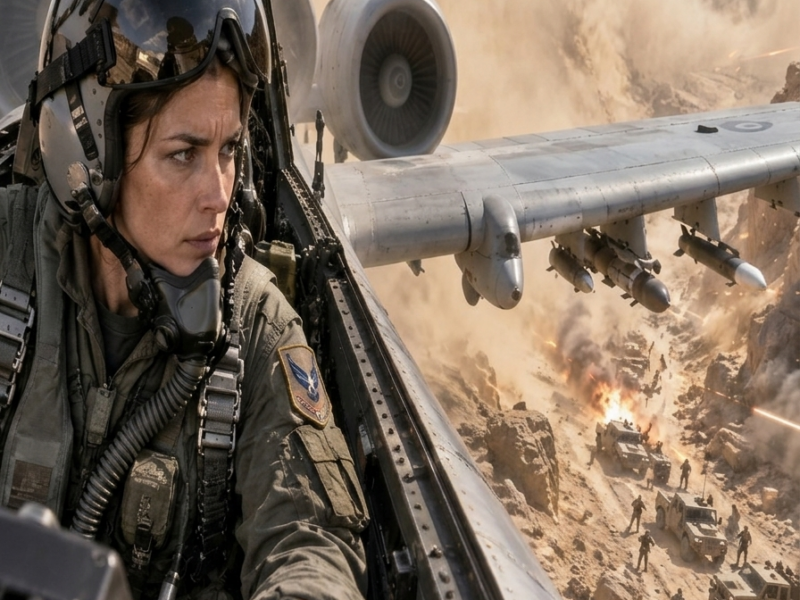
Fourteen months after being branded a coward and stripped of her wings, Captain Nora Caldwell heard twenty American soldiers begging for air support
The radio crackled as Captain Nora Caldwell struggled to keep the crippled A-10 Warthog level.
“Clear the runway. I’m coming in.”
Inside the tactical operations center at Forward Operating Base Phoenix, nobody moved.
On the main screen, a small green symbol representing Hog 1-1 crawled across the digital map. Its flight path was unstable, its altitude fluctuating, and its telemetry looked like something that should have belonged to a wreckage investigation rather than an aircraft still in flight.
Major Clive Donovan stood directly in front of the display.
For fourteen months, he had regarded Nora Caldwell as an example of what happened when a pilot allowed fear to overcome judgment. He had questioned her decision, challenged her explanations, and supported the removal of her flight status.
Now he was watching her fight to keep an aircraft airborne that most experienced pilots would have considered beyond recovery.
“She has no hydraulics,” he whispered.
Colonel Thomas Strickland stood beside him, listening to the radio.
“But she’s still flying.”
Outside, the desert storm continued to hammer the base.
The sky had turned almost completely black. Sand struck the reinforced windows, and the wind howled through the gaps around the hangar doors. Emergency crews had positioned fire trucks and rescue vehicles near the runway, but even they were struggling to remain in place.
Somewhere beyond the perimeter, a damaged A-10 was trying to find its way home.
And the woman flying it had almost nothing left.
The aircraft that refused to fall
Nora’s forearms were burning.
Her shoulders felt as though someone had driven metal rods through the joints. Every movement of the flight stick required an extraordinary amount of effort.
The A-10’s manual reversion system had restored a direct mechanical connection between her controls and the aircraft’s control surfaces. But that solution came at a price.
Without hydraulic assistance, the controls were brutally heavy.
She had to physically force the aircraft to respond.
The right engine was dead. The left engine was still running, but it was producing less than ideal performance. The damaged right wing created additional drag, constantly pulling the aircraft toward an unwanted roll.
Nora kept pressure on the left rudder pedal.
Her right hand gripped the stick while her left hand worked the throttle.
Every few seconds, the aircraft lurched as another violent gust struck its damaged airframe.
“Come on,” she muttered. “Just a little farther.”
The canyon was behind her now.
The team she had been sent to rescue had confirmed that they were moving toward the extraction point with the three hostages. Master Sergeant Brody Miller had reported that the enemy’s main firing positions were neutralized.
That meant the mission was accomplished.
But Nora wasn’t thinking about medals, commendations, or even the men she had saved.
She was thinking about landing.
She had already survived one catastrophic ejection. She had spent fourteen months wondering whether she had made the wrong decision that night over Afghanistan.
She couldn’t afford to lose another aircraft.
More importantly, she couldn’t let the men at Phoenix believe she had died trying to prove something.
She wasn’t out there to prove she was fearless.
She was out there because people needed her.
A fresh warning flashed across the instrument panel.
FUEL PRESSURE LOW.
Nora glanced at the remaining fuel indication.
The damaged wing had likely compromised more than one fuel line. The remaining engine was consuming what little reserve she had left.
She calculated the distance to the base.
Then she looked at the altimeter.
There was no room for another mistake.
“Phoenix, Hog 1-1. Fuel is critical. Request immediate approach guidance.”
Colonel Strickland grabbed the microphone.
“Hog 1-1, Phoenix Actual. We have you on radar. You’re approximately five miles from the runway. Winds are severe, but we’re clearing the approach. Maintain your present heading.”
“Copy.”
“Captain, listen carefully. We’re going to bring you in on a ground-controlled approach. You follow my instructions. Don’t chase the instruments unnecessarily. Make small corrections.”
Nora almost smiled.
Small corrections.
That was easy advice to give when someone else wasn’t wrestling a thirty-thousand-pound aircraft with both arms.
“Understood, sir.”
Strickland looked toward the radar operator.
“Get me the runway alignment. I want every available sensor tracking that aircraft.”
The operator adjusted the display.
“Radar contact confirmed. Signal is fluctuating because of the storm.”
“Keep tracking it.”
Strickland returned to the microphone.
“Hog 1-1, adjust two degrees left. Descend to five hundred feet.”
Nora pushed the nose down slightly.
The aircraft responded reluctantly.
“Two degrees left. Descending.”
“You’re holding your heading. Keep it there.”
For several seconds, the only sounds inside the cockpit were the engine, the rushing wind, and the alarms.
Then Strickland spoke again.
“Captain, how are you feeling?”
Nora didn’t immediately answer.
Her nose was bleeding. Sweat ran beneath her helmet, and her hands had begun to tremble from exhaustion.
“Still flying, sir.”
“Good. Keep doing that.”
The last three green lights
The runway was somewhere ahead.
Nora couldn’t see it.
The storm had swallowed everything beyond the canopy. Even the faintest outline of the surrounding structures had disappeared.
Her entire world had become a collection of glowing instruments.
Altitude.
Heading.
Engine temperature.
Air speed.
She checked each one repeatedly.
Then she remembered the landing gear.
Under normal circumstances, the A-10’s hydraulic system would lower the landing gear. But her hydraulic system was destroyed.
She had another option.
An emergency pneumatic system could use compressed nitrogen to force the landing gear into position.
It was a last-resort procedure, but it was designed for exactly this kind of emergency.
“Phoenix Actual, I need to deploy the landing gear using the emergency pneumatic system.”
“Understood. Go ahead when ready.”
Nora reached down toward the emergency release.
Her right arm screamed in protest as she shifted her grip on the flight stick.
She steadied the aircraft as best she could, then pulled the release handle.
A violent mechanical thump echoed through the cockpit.
The aircraft shuddered.
For one terrible second, nothing happened.
Nora stared at the landing gear indicators.
One light.
Then another.
Then the third.
“Three green,” she announced.
She had never been so relieved to see three small lights.
“Gear down and locked. Phoenix, I am configured for landing.”
In the operations center, Strickland exhaled.
“Copy, Hog 1-1. Three green confirmed. You’re cleared to continue.”
Major Donovan stepped closer to the communications console.
“Colonel, she has no hydraulic brakes. Even if she touches down, she won’t be able to stop.”
Strickland didn’t look at him.
“I know.”
“She could overrun the runway.”
“I know that too.”
“Then why are we letting her land?”
Strickland finally turned.
“Because the alternative is watching her run out of fuel over the desert.”
Donovan fell silent.
The colonel returned to the microphone.
“Captain Caldwell, emergency crews are positioned. The runway is clear. Do you understand?”
“Understood, sir.”
“Your primary objective is to get the aircraft onto the concrete. Don’t worry about anything else until you’re down.”
Nora looked through the dark canopy.
She couldn’t see the concrete.
She couldn’t see the runway lights.
She couldn’t even see the ground.
But she could hear Strickland’s voice.
And for now, that was enough.
“Crossing the threshold,” she said.
A landing nobody expected
“Fifty feet.”
Nora tightened her grip.
“Thirty feet.”
She began pulling back on the stick.
“Twenty feet.”
The A-10 descended through the final layer of dust.
“Flare.”
She pulled harder.
For one brief moment, the runway appeared beneath the aircraft.
A narrow strip of concrete emerged from the darkness.
Then the wheels struck.
The impact was brutal.
The landing gear absorbed the force as the A-10 bounced once, slammed back onto the runway, and began skidding forward.
Nora’s helmet struck the headrest.
Her entire body jolted.
But the aircraft was down.
“Touchdown!” someone shouted inside the operations center.
The room erupted in cheers.
Then the radar operator noticed something.
“She’s still moving.”
The celebration stopped.
The A-10 was racing down the runway at approximately 140 knots.
Nora pushed the throttle forward enough to use the remaining engine’s reverse-thrust capability.
The damaged aircraft howled.
She tried to keep it centered using the rudder, but the lack of hydraulic braking made the landing roll terrifyingly long.
The runway markings blurred beneath her.
The control tower passed on her left.
Then the hangars.
The perimeter wall was approaching.
“Come on. Come on!”
The tires screamed against the concrete.
Smoke rose from the landing gear.
The A-10 veered slightly, and Nora fought to bring it back toward the center.
She had no room to correct a major mistake.
Fifty feet.
Forty.
Thirty.
The aircraft finally began to slow.
With one last violent shudder, it lurched to a stop.
The nose remained pointed toward the reinforced perimeter wall.
The distance between the aircraft and the barrier was barely fifty feet.
For several seconds, nobody spoke.
Then the operations center erupted.
People shouted. Some clapped. Others simply stared at the screen, unable to believe what they had just witnessed.
Colonel Strickland lowered the microphone.
“She’s down.”
Major Donovan remained motionless.
On the runway, Nora Caldwell sat inside the cockpit.
Her hands were still wrapped around the controls.
She stared at the instrument panel, waiting for another alarm, another warning, another reason to believe the ordeal wasn’t over.
But the aircraft wasn’t moving anymore.
The engine wound down.
The wind continued to howl.
And for the first time in what felt like hours, Nora allowed herself to breathe.
She had brought it home.
The pilot who climbed out
The crash rescue team reached the aircraft within minutes.
Firefighters approached cautiously, their protective equipment covered in blowing sand.
The A-10 was in terrible condition.
Its right wing had been shredded. The fuselage was scarred by shrapnel, and dark fluid streaked along the underside.
The right engine was damaged beyond repair.
Smoke drifted from the rear section.
A rescue technician climbed the boarding ladder and knocked against the canopy.
“Captain Caldwell! Can you hear me?”
Nora slowly turned her head.
She raised one hand.
The technician worked to open the canopy.
When it finally lifted, the desert wind rushed into the cockpit.
“Easy, Captain. We’ve got you.”
Nora tried to stand.
Her legs nearly gave way.
Two rescuers caught her beneath the arms and helped her descend.
Her flight suit was soaked with sweat. Engine soot covered her face, and a thin trail of blood ran from her nose.
She looked at the destroyed aircraft.
For a moment, she said nothing.
Then she touched the side of the boarding ladder.
“Good job, old girl.”
The rescue crew exchanged glances.
They had seen pilots climb out of damaged aircraft before.
But there was something different about this one.
Nora wasn’t celebrating.
She looked exhausted.
Almost bewildered.
As though she had spent so long expecting to lose everything that she didn’t quite know what to do now that she had survived.
A familiar voice came from behind her.
“Captain Caldwell.”
She turned.
Colonel Strickland approached with several officers.
Major Donovan was walking beside him.
Strickland stopped a few feet away.
“How do you feel?”
Nora considered the question.
“Like I need a shower and about twelve hours of sleep, sir.”
A few people laughed.
Strickland smiled.
“Medical team is waiting for you.”
“Understood.”
Then Donovan stepped forward.
His eyes moved from Nora to the ruined A-10.
For once, the man who always seemed to have an answer had nothing to say.
Finally, he spoke.
“You actually brought it back.”
Nora looked at him.
“Yes, Major.”
He glanced at the damaged wing.
“With one engine.”
“Yes.”
“And no hydraulics.”
“That’s correct.”
Donovan swallowed.
He looked as though he wanted to say something else, but the words weren’t coming.
Nora didn’t wait for him.
She turned toward the medical team.
She had spent fourteen months listening to people explain why she didn’t deserve to fly.
She wasn’t going to stand on the runway waiting for one of them to change his mind.
The men in the canyon
While medical personnel examined Nora, another radio transmission came through.
“Phoenix Actual, this is Vanguard 7. We are approaching the extraction zone.”
Strickland immediately returned to the communications console.
“Vanguard 7, this is Phoenix Actual. Confirm your status.”
Master Sergeant Brody Miller’s voice came through.
“All surviving personnel accounted for. Three hostages secured. We have wounded, but we’re moving. Enemy positions have been neutralized.”
A wave of relief passed through the room.
“Any additional casualties?” Strickland asked.
There was a short pause.
“We lost two personnel during the initial ambush. Several others are wounded. But the remaining team is mobile.”
Strickland closed his eyes briefly.
“Understood. Continue to the extraction point. Phoenix will coordinate your recovery.”
Miller responded.
“Copy that.”
Then he added something that made the entire room quiet again.
“Sir, I want to make something clear. If Hog 1-1 hadn’t come through that canyon, none of us would be talking to you right now.”
Strickland looked toward Nora, who was being escorted toward the medical station.
“Message received, Sergeant.”
Miller continued.
“That pilot flew into a storm nobody else would touch. She came down low enough that we could hear the cannon over the enemy guns. Then she stayed after taking a missile hit.”
His voice became rougher.
“She didn’t leave us.”
Nobody in the operations center interrupted.
For fourteen months, Nora Caldwell had been known by a single reputation.
The pilot who punched out.
Now an entire rescue team was telling command something very different.
She had stayed.
And she had brought them home.
The silence after the storm
Nora spent the next several hours in the base medical facility.
Doctors treated her for dehydration, exhaustion, and minor injuries sustained during the violent flight and landing.
Her muscles were badly strained. Her shoulders were swollen from fighting the manual controls, and her hands were trembling from the physical effort.
She was advised to remain under observation.
She didn’t argue.
For once, there was nowhere she needed to be.
Outside, the storm eventually began to weaken.
The sky slowly returned to its normal desert color. Sand covered the runway, the hangars, and almost every exposed surface at the base.
The damaged A-10 remained where it had stopped.
Maintenance personnel had begun inspecting the aircraft, though there was little doubt that its combat career was over.
It had absorbed tremendous punishment.
But it had completed its mission.
That evening, Colonel Strickland entered the medical facility.
Nora was sitting upright on her bed, holding a paper cup of water.
“How are you doing, Captain?”
“Better, sir.”
He pulled a chair beside the bed.
“I’ve spoken with the extraction team. They’re safe. The hostages are being transferred for medical evaluation, and the wounded are receiving treatment.”
Nora nodded.
“That’s good to hear.”
Strickland watched her for a moment.
“You did something extraordinary today.”
“I did my job, sir.”
“Most people would have considered that job impossible.”
Nora looked down at her hands.
“Those men didn’t have anyone else.”
The colonel nodded.
Then he reached into a folder and removed several printed documents.
“I also spoke with headquarters. Your actions today will be included in an official operational report.”
Nora looked at the papers.
“Sir, I don’t need a ceremony.”
“This isn’t about a ceremony.”
He placed the documents on the bedside table.
“Your flying status was suspended following the Zabul incident. Today’s mission has raised serious questions about whether that decision was justified.”
Nora remained silent.
Strickland continued.
“I’m ordering a formal review of your case.”
She looked up.
“Why?”
“Because I believe the board may have reached its conclusion without understanding the full circumstances of that night.”
Nora’s expression changed.
For fourteen months, she had wanted someone to ask that question.
But now that it was finally being asked, she wasn’t sure what to feel.
“Sir, I thought that case was closed.”
“Administrative decisions can be reviewed. Especially when new operational information gives us reason to reconsider them.”
Nora stared at the folder.
Then she asked the question she had carried for more than a year.
“Do you think I made the right decision over Zabul?”
Strickland didn’t answer immediately.
He knew that a simple reassurance would mean very little to someone who had spent fourteen months questioning herself.
Finally, he spoke.
“I think a pilot has to make decisions based on what she can reasonably know in the moment. I wasn’t in that cockpit, Captain. I won’t pretend I know exactly what you saw.”
Nora nodded slowly.
“But I do know what you did today,” he added. “And I know twenty people are alive because you refused to abandon them.”
He stood.
“Get some rest. We’ll talk again when you’re ready.”
As he reached the door, Nora spoke.
“Colonel?”
He turned.
“Thank you for letting me fly.”
Strickland gave a small nod.
“You earned the opportunity.”
Then he left.
The man in the wheelchair
The following morning, Nora received an unexpected visitor.
A medical transport had arrived at the base, bringing several personnel for follow-up evaluations.
Among them was First Lieutenant Toby Renaw.
Nora recognized him immediately.
He was sitting in his wheelchair, wearing a casual military shirt. His face looked thinner than she remembered, but his eyes were the same.
For a few seconds, neither of them spoke.
Then Toby smiled.
“Well, look who’s finally back in the sky.”
Nora let out a quiet laugh.
“Toby.”
He moved closer.
“I heard about yesterday.”
She looked away.
“News travels fast.”
“Apparently, you took an A-10 into a sandstorm, flew through the Devil’s Anvil, destroyed several enemy positions, lost an engine, lost your hydraulics, and somehow landed the thing.”
“Something like that.”
Toby shook his head.
“You always did have a problem with doing things the easy way.”
Nora smiled, but the expression quickly faded.
She looked at his wheelchair.
For a long time, she had associated that chair with the worst moment of her career.
She remembered dragging him across the rocky ground after their F-15 went down. She remembered his pain, the cold, and the terrible uncertainty of whether rescue would arrive in time.
Most of all, she remembered the inquiry.
The way Donovan had used Toby’s injuries as evidence against her.
“I should have done more,” she whispered.
Toby’s smile disappeared.
“Nora.”
She didn’t look at him.
“I’ve thought about that night every single day.”
“I know.”
“If I’d stayed in the aircraft longer—”
“Stop.”
His voice wasn’t angry, but it was firm.
Nora finally met his eyes.
Toby leaned forward slightly.
“You didn’t put me in that wheelchair.”
She swallowed.
“The ejection system—”
“Malfunctioned. You know that.”
“But I made the decision to eject.”
“Because the aircraft was burning.”
Nora said nothing.
Toby continued.
“I remember the impact. I remember the pain. I remember you dragging me into that cave when you were injured yourself. You could barely stand, and you still kept moving.”
His expression softened.
“Do you know what I remember most?”
Nora shook her head.
“You sitting beside me in the dark, telling me the rescue team was coming. You didn’t know whether they would find us. You didn’t know whether either of us would survive. But you stayed.”
Nora’s eyes filled with tears.
Toby continued.
“That night, you saved my life. Yesterday, you saved another twenty people. Don’t let a board of officers convince you that one terrible night defines everything you’ve done.”
She lowered her head.
For fourteen months, she had believed that Toby’s injuries were proof that she had failed him.
Now the man himself was telling her that he didn’t blame her.
And somehow, that was harder to accept than the punishment.
“I’m sorry,” she whispered.
Toby shook his head.
“You’ve said that enough.”
He reached for her hand.
“Welcome back, Captain.”
Nora held his hand for a moment.
Then, for the first time since the crash over Zabul, she allowed herself to cry.
The investigation reopened
Three days later, headquarters received the preliminary operational report from FOB Phoenix.
The document included radar recordings, aircraft telemetry, communications transcripts, and statements from the rescued personnel.
It also included photographs of the damaged A-10.
The images showed the severity of the missile strike, the shredded wing, the destroyed hydraulic lines, and the damage to the aircraft’s control systems.
Investigators who reviewed the report immediately noticed something important.
Nora had managed to fly the aircraft through an environment that had forced every other available aircraft to remain grounded.
She had then continued operating after a missile strike destroyed critical systems.
Finally, she had returned to base and completed a landing without normal hydraulic braking.
None of that automatically proved her original ejection decision had been correct.
But it demonstrated something the previous board had questioned.
Her judgment under extreme pressure.
Her understanding of aircraft systems.
Her willingness to accept responsibility for difficult decisions.
And her ability to protect the lives of others.
The review board requested the original flight data from the F-15 incident.
Much of the aircraft had been destroyed in the crash and subsequent fire. The recovered telemetry remained incomplete.
However, investigators also examined the testimony of rescue personnel who had reached the wreckage site.
They reviewed photographs taken during recovery operations and interviewed the medical personnel who treated Nora and Toby.
The inquiry had originally focused heavily on the fact that one engine had remained operational.
The new review examined the broader circumstances surrounding the aircraft’s condition.
The possibility of fire spreading beyond the damaged engine compartment.
The potential damage to the wing structure.
The uncertainty created by the loss of critical sensors.
And the limited time available to make an ejection decision.
The central question was no longer whether the aircraft could theoretically have remained airborne.
It was whether remaining inside it had been a reasonable risk.
Meanwhile, at FOB Phoenix, Nora returned to limited administrative duties.
She wasn’t immediately reinstated as a fighter pilot.
There were procedures to follow, medical evaluations to complete, and a formal review that could take weeks.
But something had changed.
The whispers had stopped.
People who had previously avoided her now approached to ask about the mission.
Several young pilots requested copies of the operational report.
Not because they wanted to hear a story about a spectacular rescue, but because they wanted to understand how a pilot could manage an aircraft after losing its primary flight-control system.
Nora answered their questions without exaggerating.
She explained what she had done, what had gone wrong, and what she would have approached differently.
She refused to describe herself as a hero.
To her, the mission had been a responsibility.
Nothing more.
Donovan’s apology
One afternoon, Major Donovan appeared at the communications office.
Nora was reviewing a set of flight records when she noticed him standing in the doorway.
“Captain Caldwell.”
She stood.
“Major.”
Donovan stepped inside.
For a moment, he seemed uncertain about what to say.
Then he closed the door.
“I owe you an apology.”
Nora looked at him carefully.
She had imagined this moment many times.
In some versions, she had confronted him. In others, she had simply walked away.
But now that he was standing in front of her, she felt surprisingly little anger.
“What for, sir?”
Donovan looked uncomfortable.
“For the way I treated you after the Zabul incident. For the things I said during the inquiry. And for assuming that the decision you made that night was proof that you lacked courage.”
Nora remained silent.
He continued.
“I reviewed the recordings from your mission. I watched the footage from the A-10’s targeting system. I listened to the communications with Vanguard 7.”
He paused.
“I also read the statements from the rescue team.”
Nora folded her arms.
“And?”
Donovan looked directly at her.
“I was wrong to reduce your entire career to one decision.”
It wasn’t a dramatic confession.
He didn’t suddenly become a different person.
But it was an admission he had been unwilling to make before.
Nora took a breath.
“Major, I don’t expect everyone to agree with every decision I make. That’s part of the job.”
Donovan nodded.
“But I do expect people to understand that we don’t always have perfect information when we’re flying. Sometimes the instruments fail. Sometimes the aircraft is damaged in ways nobody can see. Sometimes you have seconds to choose between two terrible options.”
She looked at him.
“That night, I believed staying in the F-15 would kill both of us. I made the decision I thought would keep my crew alive.”
Donovan lowered his eyes.
“I understand that now.”
Nora didn’t offer him a reassuring smile.
She didn’t tell him everything was forgiven.
She simply nodded.
“Thank you for saying it, sir.”
Donovan stood there for another moment.
Then he left.
Nora returned to her work.
For the first time, she realized that she no longer needed his approval to believe in herself.
The official decision
Six weeks after the Devil’s Anvil mission, Nora was ordered to report to headquarters.
The review board had completed its examination.
She entered the same type of inquiry room where her career had effectively ended fourteen months earlier.
The polished mahogany table was still there.
The flags were still positioned behind the senior officers.
And Major Clive Donovan was seated among the members of the panel.
But this time, the atmosphere was different.
Colonel Strickland sat at the far end of the room as an operational witness.
A senior investigator opened the meeting.
“Captain Caldwell, the board has completed its review of the October 14th incident over Zabul Province.”
Nora stood straight.
“Yes, sir.”
“The board has examined the available telemetry, maintenance records, witness statements, rescue reports, and subsequent operational evidence.”
He paused.
“While certain details of the aircraft’s condition remain impossible to reconstruct conclusively, the board recognizes that the surviving flight data did not provide a complete picture of the damage sustained during the missile strike.”
Nora’s jaw tightened.
The investigator continued.
“The board further recognizes that your ejection decision was made under circumstances involving severe aircraft damage, multiple system warnings, and a credible threat to the lives of both crew members.”
He looked down at the document.
“The previous finding that your decision constituted an unjustified abandonment of a recoverable aircraft is therefore withdrawn.”
Nora felt her chest tighten.
For a moment, she wasn’t sure she had heard correctly.
Then came the sentence she had waited fourteen months to hear.
“Your flight status suspension is rescinded, subject to the standard medical and flight qualification requirements.”
She stood perfectly still.
The investigator continued reading.
“Your subsequent actions during the Devil’s Anvil rescue mission have also been recognized as demonstrating exceptional courage, technical competence, and commitment to the protection of personnel under your operational responsibility.”
The meeting concluded with a formal recommendation for recognition of her actions.
Nora thanked the board.
She didn’t celebrate.
She didn’t make a speech.
She simply walked out of the room.
In the hallway, Colonel Strickland was waiting.
He smiled.
“Congratulations, Captain.”
Nora looked at him.
“Thank you, sir.”
“You’ll need to complete your medical clearance and refresher training before returning to operational flight duties.”
“I understand.”
He extended his hand.
She shook it.
“Welcome back.”
Those two words meant more to her than any award.
Returning to the cockpit
The medical evaluation took several days.
The physical exertion of the A-10 mission had left Nora with strained muscles and inflammation in her shoulders.
The doctors cleared her for flight training once she completed a gradual rehabilitation program.
Her return wasn’t immediate.
She began with simulator sessions.
The first time she entered the cockpit simulator, she sat quietly for several minutes.
The familiar arrangement of instruments brought back memories of her former life.
She placed her hands on the controls.
The instructor watched from the monitoring station.
“Ready when you are, Captain.”
Nora nodded.
The simulator started.
She completed the first sequence smoothly.
Then the instructor introduced an engine malfunction.
Nora responded.
A second system failure followed.
She adjusted.
Then came a simulated missile warning.
For a fraction of a second, her breathing changed.
The old memory returned.
The flashing warning.
The smoke trail.
The sound of the explosion.
But this time, she didn’t freeze.
She followed the emergency procedure, maintained control, and completed the exercise.
When the simulator stopped, the instructor looked at her performance report.
“Excellent recovery.”
Nora removed her helmet.
“Thank you.”
He smiled.
“You’re a natural.”
She shook her head.
“No, sir. I’m practiced.”
The distinction mattered to her.
Courage wasn’t something that magically appeared when danger arrived.
It was built through preparation, experience, and the willingness to keep learning from mistakes.
Several weeks later, she was assigned to a supervised training flight.
The aircraft was an A-10.
Not the same machine she had flown into the Devil’s Anvil, but another Warthog from the base’s operational fleet.
Nora approached it slowly.
The ground crew had completed their inspections.
The engines were ready.
The boarding ladder stood beneath the cockpit.
She placed one hand on the aircraft’s fuselage.
For a moment, she remembered the destroyed machine that had brought her home.
Then she climbed aboard.
The canopy closed.
The engine started.
And fourteen months of silence finally gave way to the familiar sound of aviation.
She taxied toward the runway.
“Phoenix Tower, this is Hog 2-1. Request permission for takeoff.”
The tower responded.
“Hog 2-1, cleared for takeoff.”
Nora advanced the throttle.
The aircraft accelerated.
The nose lifted.
And the ground fell away beneath her.
She was flying again.
The men who remembered
Several months later, a small ceremony was held at FOB Phoenix.
The base commander had arranged for representatives of the rescue team to attend.
Master Sergeant Brody Miller arrived with several members of Vanguard 7.
The three rescued humanitarian workers were represented by a message of gratitude sent through the coordinating organization.
Nora stood in her dress uniform.
She had received recognition for her actions during the rescue, including the successful close-air-support mission and the recovery of the damaged aircraft.
But the moment that stayed with her came after the formal proceedings.
Miller approached her.
“Captain Caldwell.”
She turned.
“Sergeant.”
He extended his hand.
“On behalf of the team, thank you.”
Nora shook it.
“You guys did the hard part. I just gave you some breathing room.”
Miller shook his head.
“Respectfully, ma’am, you did a little more than that.”
He looked toward the other members of the team.
One of them stepped forward.
“Captain, I was the guy behind those rocks when the cannon opened up. I honestly thought we were finished.”
Another soldier nodded.
“We heard you coming before we saw anything. That sound was the best thing I’ve ever heard.”
Nora smiled.
“I’m glad you made it.”
Miller then handed her a small folded note.
“What is this?”
“Something the team wanted you to have.”
She opened it.
Inside were the names of the personnel who had survived the mission.
Below them was a short message:
You came when nobody else could. We made it home because you stayed.
Nora read it twice.
Then she folded the paper carefully and placed it inside her uniform pocket.
She didn’t need another medal.
That note was enough.
What courage really meant
Later that evening, Nora stood outside the hangar and watched the sun disappear beyond the desert horizon.
The air was cooler now.
The storm had passed, leaving the landscape covered in fine layers of sand.
In the distance, aircraft engines could be heard as another mission prepared to depart.
Nora thought about Zabul.
She thought about Toby.
She thought about the inquiry, the humiliation, and the long months when she had believed her career was over.
She also thought about the Devil’s Anvil.
Twenty soldiers trapped in a canyon.
Three hostages who needed rescuing.
A storm that had grounded every other available aircraft.
And a damaged Warthog that had somehow made it home.
For a long time, she had believed that courage meant never being afraid.
That was the standard she had tried to live up to as a young fighter pilot.
But experience had taught her something different.
Courage wasn’t the absence of fear.
It was the ability to make the best decision you could while fear was still there.
Sometimes that meant staying in the aircraft.
Sometimes it meant pulling the ejection handle.
Sometimes it meant admitting that a mission couldn’t be completed.
And sometimes it meant climbing into a cockpit when the entire world had already decided you were finished.
Nora reached into her pocket and touched the folded note.
Then she looked toward the runway.
A young pilot was walking toward an aircraft, carrying his helmet beneath one arm.
He noticed her and stopped.
“Captain Caldwell?”
“Yes?”
“Ma’am, I heard about your mission in the Devil’s Anvil.”
Nora smiled.
“I imagine everyone has by now.”
The young pilot hesitated.
“Can I ask you something?”
“Go ahead.”
“How did you know you could do it? Fly through that storm, I mean.”
Nora considered the question.
Then she looked back at the aircraft.
“I didn’t know.”
The young pilot frowned slightly.
“Then why did you go?”
“Because the people on the ground didn’t have the luxury of waiting for someone who was certain.”
He nodded slowly.
Nora continued.
“You train for the things that can go wrong. You study your aircraft. You listen to the people who know more than you. And when the moment comes, you make the best decision you can with the information you have.”
She paused.
“Just remember something. Being brave doesn’t mean ignoring danger. It means understanding the danger and deciding what responsibility requires of you.”
The young pilot thanked her and continued toward the flight line.
Nora watched him climb into his aircraft.
Then she turned and walked back toward the operations building.
She had a new mission briefing to review.
There would always be another flight.
Another challenge.
Another moment when someone on the ground would need help.
And this time, when Nora Caldwell looked toward the sky, she no longer saw the place where her career had ended.
She saw where it had begun again.
The pilots at Phoenix would remember the damaged A-10 that returned through the sandstorm.
They would remember the aircraft that landed with one engine, no normal hydraulic controls, and almost no stopping distance.
They would remember the soldiers who made it out of the Devil’s Anvil.
But Nora hoped they would remember something else, too.
A pilot should never be defined entirely by the worst moment of her career.
Not by one aircraft lost.
Not by one decision made in seconds.
And certainly not by the opinions of people who weren’t there.
Fourteen months earlier, the world had told Nora Caldwell she would never fly again.
The desert had given her another chance.
And when twenty people needed her, she answered.
She had once been remembered as the pilot who ejected.
Now she would be remembered as the pilot who came back.
The end.









