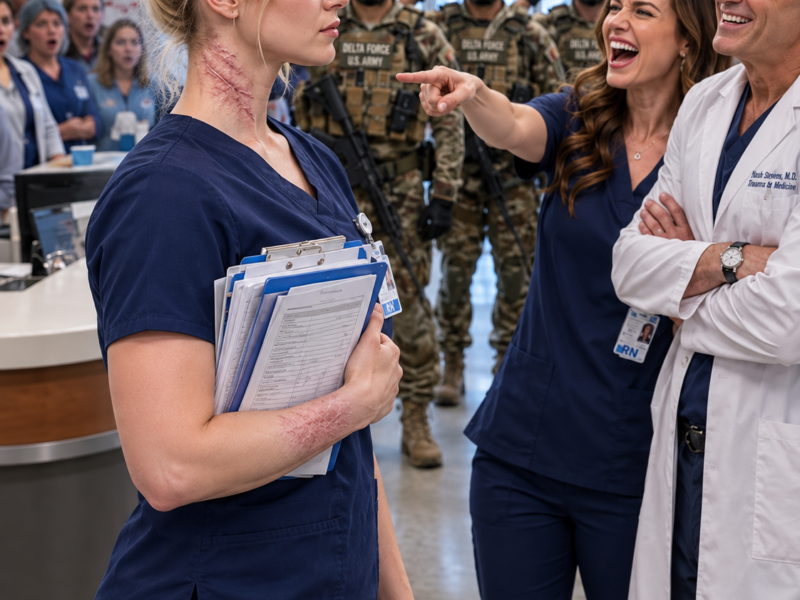
For three years, everyone at St. Jude’s Medical Center had a theory about Avery Parker’s scars
For three years, Avery Parker had learned how to become invisible.
At thirty-two, she was one of the most capable nurses at St. Jude’s Medical Center in Chicago. She could recognize trouble before a monitor sounded, keep her voice steady when a room filled with panic, and make decisions under pressure that left more experienced staff hesitating.
But most of her colleagues never noticed those things.
They noticed her sleeves.
Even in the middle of summer, Avery wore long-sleeved undershirts beneath her scrubs. She kept her arms close to her body and rarely changed clothes in the staff locker room. When someone asked about the fabric beneath her uniform, she offered a polite smile and changed the subject.
The few people who had glimpsed her scars had turned them into a private mystery.
And in a hospital, where people were supposed to know better than to judge what they couldn’t understand, that mystery became gossip.
Khloe Bennett was especially fond of it.
Khloe was a senior nurse who knew how to make a cutting remark sound like a joke. She could deliver an insult with a smile and then act surprised when someone took offense.
“Have you ever wondered what happened to Parker?” she asked one afternoon at the nurses’ station.
Avery was across the room, reviewing a medication order.
Dr. Gregory Lawson glanced up from his tablet. “What about her?”
“Those sleeves. Every single day. Even when it’s ninety degrees outside.”
Lawson gave a small shrug. “Maybe she doesn’t like showing her arms.”
Khloe leaned closer, lowering her voice just enough to make the conversation feel confidential.
“Or maybe there’s a reason.”
A couple of people laughed.
Avery kept reading.
She had learned that responding only gave people more material. She had also learned that silence could be mistaken for weakness, but she preferred that misunderstanding to explaining her past to people who had already decided what they thought of her.
Her scars were not a story she wanted to tell in the break room.
They were not a conversation starter.
They were the remains of a life she had fought very hard to survive.
At work, she wanted to be a nurse.
Nothing more.
Nothing less.
That afternoon, an ambulance brought in a patient struggling to breathe after a serious accident. The trauma team moved quickly. The man’s oxygen level was falling, and the room filled with the clipped commands and urgent movements that accompanied a deteriorating patient.
Avery was at the bedside.
She assessed the situation, listened to the team’s instructions, and recognized that the patient was becoming increasingly difficult to manage. His condition required immediate intervention, and every unnecessary second increased the risk.
She moved with practiced precision, helping the team position and stabilize him so the physician could proceed.
“Hold there,” she said, her voice calm.
The patient shifted.
Avery adjusted her position and maintained control while the team worked. She did not raise her voice. She did not look around for approval. She watched the patient, the equipment, and the people working beside her.
Within minutes, the intervention was completed. The patient’s breathing improved, and the numbers on the monitor began moving in the right direction.
One of the physicians exhaled.
“He’s stabilizing.”
Avery stepped back and checked the next set of observations.
She had done her job.
But Dr. Lawson was not looking at the patient.
He was looking at her.
“That was unnecessarily aggressive,” he said.
Avery turned. “The patient was deteriorating.”
“I saw that.”
“Then you saw why I acted.”
Lawson’s expression tightened. “You don’t make decisions outside your role.”
“I didn’t. I supported the intervention and followed the clinical direction.”
“Next time, wait for instructions.”
Avery looked at him for a moment.
Then she nodded once.
“Understood.”
She returned to the chart.
Khloe, standing near the doorway, watched with a faint smile.
Later, when Avery went to retrieve a set of patient records, the folder she needed was missing. She searched the station, checked the printer, and finally asked Khloe whether she had seen it.
Khloe barely looked up.
“Maybe you misplaced it.”
“I left it right here.”
“Then maybe you should be more careful.”
Avery said nothing.
Over the following weeks, the pattern continued. The most difficult assignments seemed to find her. Records disappeared from places where she had left them. Small mistakes made by others became questions about her performance. When she asked for clarification, she was told she was being defensive.
She documented what happened and kept working.
Her patients continued to receive careful attention. Her colleagues continued to underestimate her.
Then came the coffee.
It happened during a crowded morning shift. Avery was standing near the medication station, reviewing a chart, when Khloe approached with a cup in her hand.
“You’re always so serious, Parker,” Khloe said.
“I’m working.”
“Of course you are.”
Khloe stepped closer.
The cup tipped.
Hot coffee splashed across Avery’s uniform.
She jerked back, instinctively brushing at the wet fabric. The heat stung her skin through the clothing, and the dark stain spread across her chest and down one side.
“Oh, my God,” Khloe said, though her expression suggested she was not particularly sorry. “I’m so clumsy.”
Avery looked at her.
For several seconds, neither woman spoke.
“That was hot,” Avery said quietly.
“Well, I said I was sorry.”
Avery went to the locker room to change.
Her spare scrubs were gone.
So were the extra undershirts she kept folded in her locker.
She checked the shelf again, then the bottom compartment. Nothing.
She returned to the locker room doorway and stood still.
The only clean uniform available was a short-sleeved, V-neck surgical set.
She had no other choice.
Avery changed.
When she stepped back onto the unit, the scars were visible.
They crossed her arms and extended toward her shoulders. Some were pale and raised. Others were uneven, darker patches of skin where severe burns had healed. There were surgical marks and the unmistakable patterns of injuries that had required extensive reconstruction.
The scars were not neat.
They were not small.
They told a story that no one in that hallway had ever bothered to ask about.
The nurses’ station went quiet.
Khloe looked up first.
Her eyes widened, then narrowed.
“Well,” she said. “That explains a few things.”
Avery stopped walking.
Lawson glanced over. His gaze moved across her exposed arms before settling on her face.
“Is that really necessary?” he asked.
Avery’s expression did not change.
“My uniform was ruined. My replacement clothes are missing.”
“You could have found something more appropriate.”
“This is the only clean uniform available.”
Khloe gave a short laugh.
“People are going to have questions.”
Avery looked at her.
For three years, she had swallowed remarks like that. She had accepted the whispers, the assumptions, the looks that followed her down corridors. She had allowed people to mistake her restraint for permission.
But standing there, with her scars exposed and the people around her waiting for an explanation, she felt something settle inside her.
She straightened her shoulders.
“I encountered a hostile work environment,” she said.
Her voice was calm.
Not loud. Not trembling.
Just clear.
Then she walked away.
No one followed her.
No one apologized.
The shift continued.
And then the emergency alert sounded.
It was not an ordinary hospital alarm.
A Code Black announcement came over the public-address system, followed by instructions for staff to secure designated areas and prepare for an incoming tactical emergency.
The atmosphere changed immediately.
People moved toward their assigned positions. Security personnel appeared in the corridors. The emergency department began clearing space.
Avery was near the trauma bay when the doors opened.
Several tactical officers entered with a stretcher. Behind them came four men in civilian tactical gear. Their clothing was dusty, their faces tense, and their movements carried the unmistakable urgency of people who had come directly from a dangerous situation.
The patient on the stretcher was in critical condition.
Blood had soaked through the dressings around his abdomen. His face was pale, his breathing strained, and the monitor showed signs of severe instability.
“Gunshot wound,” one of the men reported. “High-velocity. We need surgical intervention now.”
Avery stepped forward.
“How long since injury?”
“Approximately forty minutes.”
“Any treatment en route?”
The man gave her a rapid report.
Avery listened, then turned toward the trauma team.
“Let’s move. We need the massive transfusion protocol activated. Get the blood bank on the line and alert the operating room. I want the surgical team ready.”
Her voice cut through the confusion.
A nurse moved to carry out the orders.
Another began preparing equipment.
Avery leaned toward the patient, assessing what she could while the physician joined the bedside.
“What’s his name?” she asked.
“Call sign is enough for now,” one of the tactical men answered.
“Then tell me what I need to know about his injuries.”
The man gave her the information.
Avery turned to Lawson as he entered.
“We have a critical abdominal injury with signs of major internal bleeding. The operating room needs to be ready immediately.”
Lawson glanced at the patient, then at the monitors.
“I’ll assess him.”
“Please do. We don’t have time to lose.”
For once, Lawson did not argue.
The trauma team moved into action.
Avery helped coordinate the next steps, communicating with the nurses, keeping the patient’s condition in view, and ensuring that the team had what it needed. The room was crowded, but she seemed to create order simply by knowing what had to happen next.
Khloe stood near the edge of the room, holding supplies.
She watched Avery closely.
The nurse she had mocked for years was no longer quiet.
She was not asking for permission to be useful. She was not shrinking away from the room or waiting for someone to recognize her.
She was focused entirely on the man whose life was slipping away.
The patient was moved toward surgery.
Avery continued working alongside the team, helping manage the emergency and communicate the urgency of the situation. The physicians took over the surgical care, and the team worked to control the bleeding.
Outside the operating area, the four tactical men waited.
One of them was older than the others. His posture was rigid, his face marked by exhaustion. He wore the insignia of a senior enlisted leader, and the others deferred to him without needing to be told.
His name was Sergeant Major Thomas Reed.
He had been watching Avery.
At first, he had only noticed the scars.
Then he saw the way she moved.
The way she assessed a room.
The way she gave instructions without wasting words.
He stared at her arms again.
His expression changed.
He took one step closer.
“Ma’am?”
Avery turned.
“Yes?”
Reed looked at her face, then at the scars crossing her shoulder.
For a moment, he seemed unable to speak.
Then he said one word.
“Angel?”
Avery went very still.
The room around them continued moving, but something in her expression changed. The professional distance she had maintained through the emergency gave way to a look of startled recognition.
“Sergeant Major,” she said quietly.
Reed’s eyes widened.
He looked at her again, as if checking that the person standing in front of him was truly the one he remembered.
“Captain Parker?”
Avery gave a small nod.
“That’s not my rank anymore.”
Reed shook his head.
“I know exactly who you are.”
The men behind him turned.
One looked from Reed to Avery.
“Wait. Captain Parker?”
Another stared at the scars.
“You’re the medic?”
Avery lowered her eyes briefly.
“That was a long time ago.”
Reed’s expression hardened, not with anger at her, but at the idea that anyone could have forgotten what those scars meant.
“Seven years,” he said. “It’s been seven years.”
Avery said nothing.
The emergency continued behind them. The patient was still in surgery, and no one had yet been told whether he would survive.
Reed looked at her arms again.
“I wondered if you were still alive.”
Avery swallowed.
“I’m here.”
He nodded slowly.
Then he turned toward Lawson and Khloe, who had been listening from a few feet away.
“Do you know who you’re standing in front of?”
Lawson frowned.
“She’s one of our nurses.”
Reed’s eyes narrowed.
“No. She’s Captain Avery Parker. She served as a medevac flight medic with the 160th. And if she hadn’t been there seven years ago, some of us would never have made it home.”
The hallway fell silent.
Avery looked at Reed.
“Sergeant Major, this isn’t the time.”
“It is exactly the time.”
He turned back to Lawson.
“You’ve been treating her like she’s a problem?”
Lawson did not answer.
Reed’s voice grew sharper.
“Look at her.”
Avery’s jaw tightened.
“Please.”
But Reed was no longer speaking only for himself.
He was speaking for men who had carried memories of a burning aircraft, a ravine, and a medic who had refused to leave them behind.
“Seven years ago, in Kunar Province, our helicopter went down.”
He paused.
“An RPG hit us. We crashed in a ravine. The aircraft was burning, and four of my men were trapped.”
Avery looked away.
She remembered.
She had never forgotten the sound.
The sudden violence of the impact.
The smoke.
The heat.
The shouting over the radio.
And the knowledge that people were still alive inside the wreckage.
Reed continued.
“We were pinned down. The area was still hostile. We couldn’t get everyone out, and the fire was spreading.”
He looked at Avery.
“She came in anyway.”
The memories returned with painful clarity.
Seven years earlier, Avery had been serving as a medevac flight medic with the 160th Special Operations Aviation Regiment. She was young, experienced, and trained to make decisions in circumstances most people would never encounter.
When the call came from the downed aircraft, she understood the risks.
The helicopter had crashed in a ravine after being struck by an RPG. The wreckage was burning. The crew and passengers were in danger, and hostile forces were still active in the area.
There were men trapped inside.
Avery went in.
She fast-roped into the firefight and moved toward the wreckage, doing what she had been trained to do: locate the wounded, assess who could be moved, and get people out.
Three men were pulled from the aircraft.
But one radio operator remained.
Avery reached him as the fire spread.
She shielded him when the fuel tank exploded.
The blast struck her with brutal force.
Heat tore across her neck and shoulder. Pain exploded through her arm. The aircraft structure shifted, and part of the fuselage collapsed, crushing her arm beneath the wreckage.
She was injured.
She was bleeding.
And the men she had come to rescue were still in danger.
She applied a tourniquet to herself.
Then she kept going.
For forty-five minutes, she held her position and fought to keep the remaining men alive until extraction became possible. She helped hold off twelve insurgents while the team waited for a way out.
By the time help reached them, Avery’s injuries had changed the course of her life.
She had saved Reed’s men.
But she had lost the career she had built.
Her arm required extensive treatment. The burns across her neck and shoulder needed reconstruction. The damage was severe enough that she underwent fourteen reconstructive surgeries.
She had to relearn how to use her hands.
Simple tasks became difficult. Movements she had once performed without thinking required concentration and patience. Her recovery was measured in small victories that no one outside the rehabilitation room could fully understand.
And eventually, she left military service.
The scars remained.
So did the memories.
Reed’s voice brought her back to the hospital corridor.
“She got three of my men out,” he said. “She protected our radio operator when the fuel tank went. And when the aircraft came down around her, she still kept fighting.”
He looked at Avery.
“We waited forty-five minutes for extraction. Forty-five minutes. And she kept us alive.”
No one spoke.
Khloe’s face had lost its color.
Lawson looked at Avery’s arms again, but this time his expression was different. He was no longer looking at something he found uncomfortable.
He was looking at the evidence of a sacrifice he had never bothered to understand.
Reed continued.
“Those scars aren’t something she should have to explain to you. They’re what she carried home after saving people who were supposed to die in that ravine.”
Avery’s eyes shone, but she held herself steady.
“Sergeant Major, the patient is still in surgery.”
Reed nodded.
“You’re right.”
Then he turned to Lawson.
“Where’s your vascular team? Get them ready if the surgeons need them. Do whatever that patient needs. And thank God she was here.”
Lawson did not argue.
He moved immediately to make the necessary calls.
The hours that followed were long.
The patient remained in surgery while the team worked to manage his injuries. Avery stayed involved in the emergency, helping wherever she was needed and keeping the focus on the man whose life still depended on the people inside that operating room.
Reed and the others waited.
Nobody joked.
Nobody whispered.
Nobody asked Avery to explain her scars.
When the surgical team finally emerged, the news was cautious but hopeful. The patient had survived the operation. He remained critically ill, and the next hours would matter, but the immediate crisis had been addressed.
Reed closed his eyes.
For the first time since entering the hospital, his shoulders lowered.
“Thank you,” he said.
Avery nodded.
“He’s not out of danger yet.”
“I know.”
Reed looked at her for a long moment.
“Still saving people.”
She gave him a tired, restrained smile.
“That’s the job.”
He shook his head.
“No, Captain. That’s who you are.”
The tactical men gathered behind him.
One by one, they stood straighter.
Then Reed raised his hand in salute.
The others followed.
Four men in tactical gear stood in the hospital corridor and saluted the nurse whose scars had been a source of gossip only hours earlier.
Avery froze.
She had not expected it.
For a moment, she looked as though she might step away. The old instinct to avoid attention was still there, deeply rooted after years of keeping her past to herself.
But then she straightened.
Her shoulders squared.
Her hand rose.
She returned the salute.
It was not a performance.
It was not a demand for recognition.
It was a quiet acknowledgment between people who understood what those scars had cost.
The corridor remained silent.
Khloe stood near the nurses’ station, staring at the floor.
Lawson looked as though he wanted to speak but could not find the words.
Avery lowered her hand and turned back toward the patient-care area.
She did not ask anyone to apologize.
She did not tell the staff what they should have known.
She simply returned to work.
But the hospital had changed.
The whispers stopped.
The jokes stopped.
The looks that once followed her down the hallway were replaced by something else: respect, embarrassment, and the uncomfortable realization that the people they had judged most harshly might have been carrying more than anyone could see.
Later, Lawson approached her near the nurses’ station.
“Avery.”
She looked up from the chart.
“Yes, Doctor?”
He hesitated.
“I owe you an apology.”
She waited.
“I made assumptions about you. I questioned your judgment. And I allowed things to happen on this unit that should never have happened.”
Avery looked at him steadily.
“Yes.”
Lawson glanced down.
“I was wrong.”
“Yes,” she said again.
He seemed to expect something more. Perhaps reassurance. Perhaps a quick acceptance that would allow him to move on.
But Avery returned her attention to the chart.
The apology had been made.
What happened next would be determined by what he did.
Khloe approached later, looking uncomfortable.
“Avery…”
Avery turned.
Khloe opened her mouth, then closed it.
“I’m sorry about the coffee,” she finally said.
Avery studied her.
“You said it was an accident.”
Khloe looked down.
“I know.”
Avery did not raise her voice.
“My uniform was ruined. My spare clothes were missing. You made comments about my scars in front of the staff. You knew what you were doing.”
Khloe’s eyes filled.
“I didn’t know.”
“You didn’t ask.”
There was nothing cruel in Avery’s tone. That somehow made the words harder to hear.
Khloe nodded, unable to meet her eyes.
Avery returned to her work.
She did not need the room to understand every detail of her past.
She did not need admiration.
She did not need people to look at her scars and imagine a hero.
She had never asked for any of that.
She had only wanted to be treated like a colleague.
Like a nurse.
Like a person.
And now, finally, the people around her were beginning to understand how badly they had failed at something so simple.
Near the end of the shift, Avery passed the trauma bay.
The tactical patient was still being monitored. His condition remained serious, but the immediate emergency had passed. Reed stood near the doorway, speaking quietly with one of the officers.
When he saw Avery, he stepped forward.
“Captain.”
She gave him a tired smile.
“Sergeant Major.”
“Thank you for today.”
Avery glanced toward the patient.
“Your man did the hard part.”
Reed shook his head.
“You know that’s not what I meant.”
She understood.
For a moment, neither spoke.
Then Reed said, “I never got to tell you what it meant to us. After you left, the men talked about you all the time. They wanted to know where you went. Whether you were recovering. Whether you ever got your arm back.”
Avery looked down at her hand.
“It’s different now.”
“But you can use it.”
“Most days.”
Reed nodded.
“That’s something.”
She looked back toward the patient-care area.
“I had good people helping me.”
“And you fought hard.”
Avery did not answer.
Reed’s expression softened.
“You don’t have to hide what happened.”
She took a breath.
“I’m not hiding it from myself.”
He seemed to understand.
After a moment, he offered his hand.
She shook it.
Then he stepped back, allowing her to return to her shift.
Avery walked down the corridor beneath the bright hospital lights. Her short sleeves still exposed every scar. The marks across her arms had not changed. They had not become less visible because people finally knew what they meant.
But for the first time in a long while, she did not feel the need to pull her sleeves down.
She had spent years believing that if she kept her past private, she could leave it behind.
That morning had shown her something different.
She could not erase what happened in Kunar Province. She could not undo the injuries or the surgeries. She could not return to the life she had once imagined for herself.
But she could decide what those scars meant to her now.
They were not proof that she was broken.
They were proof that she had survived.
And the next time someone looked at them, she would not feel obligated to explain.
At St. Jude’s, people would remember the day the tactical team came through the emergency doors. They would remember the critically wounded operator, the urgency of the trauma response, and the moment Sergeant Major Reed recognized the nurse everyone else had underestimated.
They would remember the salute.
But Avery would remember something else.
She would remember that the patient had made it through surgery.
That the team had done its job.
That four men who had once been trapped in a burning ravine had come back to find her.
And that, after all those years, one of them had looked at her scars and recognized the person beneath them.
The next morning, Avery arrived for her shift in the same short-sleeved uniform.
She walked through the entrance, greeted the staff, and checked the assignment board.
No one made a joke.
No one whispered.
Khloe kept her eyes on her work. Lawson greeted Avery professionally and moved on.
Avery did not wait for anyone to praise her.
She picked up her chart and went to see her patients.
Because the truth was that she had never needed a room full of people to call her a hero.
She had needed them to see her as a nurse.
And that was exactly what she had been all along.
The end.









