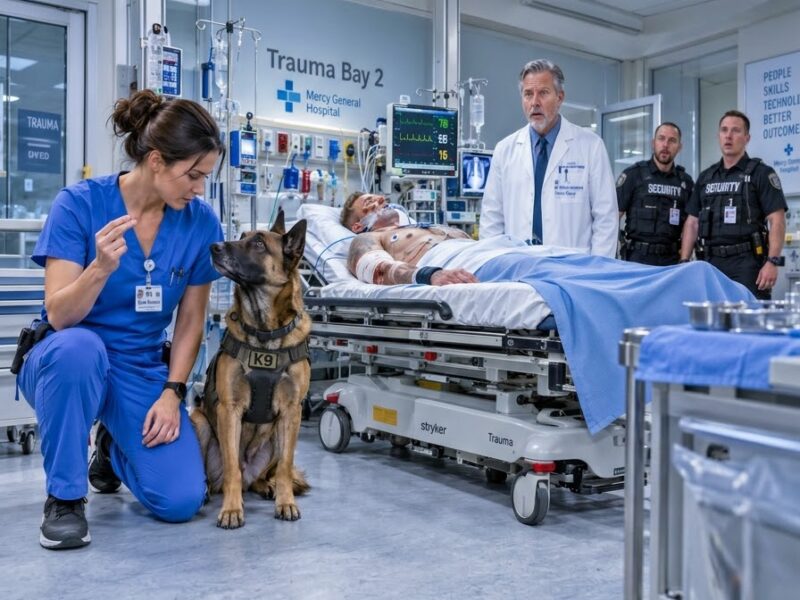
For five years, I was a ghost walking among the living. I was the silent nurse in faded blue scrubs at the Veterans Affairs hospital in San Diego
For five years, I was a ghost walking among the living. I was the silent nurse in faded blue scrubs at the Veterans Affairs hospital in San Diego—the woman who emptied bedpans, changed soiled dressings, monitored flickering heart monitors, and held the trembling hands of dying old men while their families whispered their final goodbyes. I arrived before the sunrise and left long after twilight, moving through the fluorescent-lit corridors with a deliberately hushed step. I spoke only when spoken to, kept my eyes lowered, and learned the art of absolute invisibility. Nobody asked about my past, my background, or why a woman in her late twenties had no social media footprint, no family photos on her locker door, and no life outside the sterile walls of the oncology ward.
That was precisely how I needed it to be.
To the world, I was Maya Lin, a quiet, overly dedicated civilian nurse. But beneath the soft fabric of my uniform, hidden under long sleeves even during the sweltering heat of Southern California summers, lay a intricate network of faded silver surgical scars. They were constant, physical reminders of a life I had sworn to bury—a life filled with Kevlar, dusty foreign roads, the acrid smell of burning cordite, and the deafening roar of rotor blades.
It was a bright autumn Tuesday morning when the illusion shattered. The hospital was hosting its annual Veterans Day memorial ceremony in the central courtyard. Rows of folding chairs were occupied by elderly men with medals pinned to their blazers, local dignitaries, active-duty military personnel, and hospital staff. Banners fluttered in the ocean breeze, and a brass quintet played softly near the fountain.
I was carrying a heavy plastic tray loaded with morning medication cups across the brick courtyard, attempting to skirt the edges of the crowd to reach the western wing. I wasn’t supposed to be part of the ceremony; I was just doing my rounds.
Then, the air shifted.
A sharp, authoritative bark echoed across the courtyard, instantly cutting through the solemn chatter. Down near the main podium stood a tall, heavily muscular German Shepherd wearing a tactical service vest. The dog was accompanying a young, decorated K-9 handler from the local military police unit.
The moment the dog turned his head and locked his dark brown eyes onto me, his body went rigid. His ears flattened slightly, his nostrils flared, and before his handler could react, the dog let out a low, guttural whine that turned into a frantic pull against his heavy leather leash.
“Ranger, heel!” the handler snapped, pulling back on the lead.
But Ranger was beyond command. With a sudden, explosive burst of power, the five-year-old German Shepherd lunged forward, snapping the heavy steel clip from his handler’s tactical harness. The crowd gasped as the massive animal sprinted at full speed straight toward me.
Panic surged through my chest, cold and violent. My instincts, drilled into me through years of tactical combat medicine, screamed at me to brace, drop my center of gravity, and protect my throat. But the civilian nurse in me froze.
The heavy dog slammed into my chest. The plastic tray slipped from my hands, sending dozens of tiny paper cups and hundreds of white, yellow, and red pills scattering across the sunlit concrete like plastic hail. I tumbled backward, hitting the ground hard, the breath forced out of my lungs in a harsh gasp.
“Get that dog away from her! Someone help!” a voice screamed from the crowd. Bystanders shouted, chairs scraped against the pavement, and security guards began rushing forward.
I scrambled backward on my hands and knees, my heart hammering like a trapped bird inside my ribs. I lifted my arms to shield my face, expecting sharp teeth, a jaw locking down on my flesh.
Instead, the attack never came.
Ranger dropped to his front paws, whining hysterically. He didn’t bite. He didn’t growl. Instead, he thrust his cold, wet snout directly against my left wrist, right over the jagged scar where my watch sat. He sniffed frantically, his body trembling with intense, desperate excitement. He began to lick my skin, letting out high-pitched, heartbroken whines that sounded almost human.
I stared down at the dog, my blood running ice-cold. My left wrist carried a distinct scent—a mixture of an old chemical burn from a phosphorus detonation and a specific ointment I had used for years to dull the nerve pain. But more than that, dogs trained in high-level military intelligence unit operations were trained to recognize specific human pheromones and familiar scents long after humans forgot them.
Sergeant Miller, the handler, sprinted up, his hand hovering over his holster before seeing the dog’s posture. He grabbed Ranger’s tactical collar, hauling the dog back with considerable effort. Ranger resisted violently, digging his claws into the mortar between the bricks, keeping his eyes locked on mine with an expression of profound, agonizing recognition.
“I am so sorry, ma’am! Are you okay?” Miller panted, looking at me with a mix of shock and total confusion. “He’s never done anything like this. He’s a highly trained patrol and tracking asset. He doesn’t just break contact like that.”
“I… I’m fine,” I stammered, my voice shaking uncontrollably. I scrambled to gather the scattered medication cups, my hands trembling so hard I could barely pick them up. “It’s fine. It was just a surprise.”
Miller knelt beside his whining dog, staring intently at my face, then down at my left wrist where my sleeve had ridden up, exposing the deep, jagged silver scar.
“Have you ever worked with military working dogs, ma’am?” Miller asked softly, his tone shifting from frantic apology to a quiet, sharp curiosity.
I pulled my sleeve down instantly, covering the scar. I forced a polite, vacant smile onto my face—the same smile I had used on patients for five years.
“No, sir,” I lied cleanly. “Never. I’m just a civilian nurse.”
Miller looked at me for a long, heavy moment. He looked down at Ranger, who was still trembling, his nose reaching out toward me.
“That’s strange,” Miller whispered, his eyes narrowing. “Because Ranger doesn’t react to civilian scent signatures. He only reacts to personnel from his former deployment sector. And Ranger knew you.”
By seven o’clock that evening, the sun had dropped below the horizon, plunging the hospital grounds into deep shade. I had spent the remainder of my shift moving like a ghost through the corridors, terrified that every footstep behind me belonged to military police or federal authorities. I was in my small breakroom lockers, changing out of my scrubs into my civilian jeans and sweater, when the door creaked open.
My supervisor, Nurse Director Eleanor Vance, stepped inside. Behind her stood a tall man wearing a dark charcoal suit, a military-style haircut, and an ID badge clipped to his lapel that bore the seal of the Department of Defense Inspector General.
“Maya,” Eleanor said softly, her face pale and strained. “Could you step into my office for a moment? This gentleman needs to clarify a few administrative details regarding your employment file.”
My stomach coiled into a tight, hard knot. I slowly closed my locker door, feeling the cold steel under my fingertips. “Is something wrong, Director?”
“Just a routine check, Ms. Lin,” the man in the suit replied calmly. His voice lacked any heat. “I’m Agent Vance. Please, follow us.”
The Director’s office was quiet, illuminated only by a desk lamp and the ambient light of the city through the window. Agent Vance didn’t offer me a seat. He walked straight behind the desk, pulled a manila folder from his briefcase, and laid a single gloss-finish photograph onto the blotter.
“We need to ask you some questions,” Vance said softly.
“About what?” my voice sounded thinner than I wanted it to be.
“About your employment application from five years ago,” he said, gesturing to the photograph. “You marked ‘No’ under the box asking for prior military service, government agency contract work, or classified operations involvement.”
I looked down at the desk. The photograph was slightly washed out, faded by bright sunlight and desert dust. It showed a younger woman—her face smudged with dirt, soot, and camouflage paint, wearing lightweight tactical armor, combat boots, and a beige headscarf. Beside her stood a jet-black Belgian Malinois with intelligence shining in its eyes. The background showed a destroyed mud-brick compound somewhere in the arid mountains of Helmand Province, Afghanistan.
The woman in the tactical gear, looking fierce, exhausted, and intensely alive, was me. Seven years earlier.
Before the hospital. Before the quiet, anonymous life in San Diego. Before I legally erased my own identity.
“You told us you had no military experience,” Agent Vance stated, his eyes studying every tiny micro-expression on my face.
I stared at the photograph, feeling the heavy, buried past crawling back out of the deep grave where I had buried it. The memory of explosive heat, screeching metal, and screaming men flashed across my mind.
“I never said I didn’t serve,” I whispered, my eyes fixed on my twenty-two-year-old self. “I just didn’t write it down.”
“You signed an employment affidavit under penalty of perjury denying any prior service,” Vance countered sharply.
My hands began to shake inside the pockets of my jacket. “Because I was given a direct order by a Task Force Commander never to speak about my unit, my designation, or my presence in that country. If I put that service down on a public hospital background check, my clearance flags would have alerted federal tracking databases within four hours. I was told to disappear. So I disappeared.”
The office fell into a thick, uncomfortable silence. Eleanor Vance looked between me and the agent, her mouth slightly open in disbelief.
Before Agent Vance could ask his next question, the door behind us clicked open. Sergeant Miller walked into the office. He was no longer holding Ranger’s leash, but in his gloved hands, he held a thick, yellowed envelope stamped with red wax and heavy security seals.
“Ranger recognized her scent signature from the 75th Ranger Regiment Special Reconnaissance Detachment,” Miller said, looking directly at me with a profound, solemn respect. “He didn’t forget you, Specialist Lin. Or should I call you Lieutenant Lin?”
“I don’t hold a rank anymore,” I said, my voice barely audible. “I haven’t held one since the mission in the Shahi-Kot Valley was scrubbed from the record.”
Miller pulled a second, smaller faded photograph out of the yellowed envelope and laid it side-by-side with the first picture.
My breath caught violently in my throat. The room seemed to spin, the walls pressing in on me.
The second photograph was a candid shot taken behind an armored vehicle. It showed a tall, rugged man with light blue eyes, a dusty beard, and a crooked, infectious smile. He had his arm thrown casually over the shoulders of the same Belgian Malinois from my photo.
It was Corporal Daniel Hayes.
My partner. My primary tactical operator. My best friend. And the man whose warm blood had soaked through my gloves, my uniform, and my boots as I tried desperately to seal his shattered chest cavity inside a burning, downed Blackhawk helicopter five years ago.
“Where did you get that?” I whispered, my hand reaching out involuntarily toward the photograph before I pulled it back, trembling. “Daniel died. He died in the valley. The extraction team couldn’t get to us. The helicopter burned. I watched the fuel tank detonate.”
“Daniel didn’t die, Maya,” Sergeant Miller said quietly.
“That’s impossible!” I shouted, dropping my professional composure, tears suddenly burning behind my eyes. “I was there! I applied the tourniquets! I performed the field tracheotomy! I was dragged away by the secondary rescue unit while he was still trapped inside the burning fuselage! I filed the death report myself!”
Agent Vance slid a thick white medical dossier across the desk. It bore the crest of a highly classified military neurological rehabilitation facility in Bethesda, Maryland.
“He didn’t die,” Vance explained, his voice losing its cold edge and turning grim. “A local anti-insurgent militia dragged him from the burning wreckage twenty minutes after your team evacuated. He was alive, but barely. He had suffered massive head trauma, deep shrapnel wounds, and extreme retrograde amnesia. He was kept in a private, high-security medical facility under deep cover for five years. His identity was kept dark because the intelligence team he belonged to was involved in high-level black ops.”
I grabbed the medical report, my hands flying across the pages. Brain scans. Surgical reconstruction records. Physical therapy logs.
“For five years,” Vance continued softly, “he knew nothing about who he was. He didn’t know his name, his rank, or his hometown. But six months ago, after a secondary brain surgery removed a piece of bone fragment pressing against his temporal lobe, his speech came back. And with it, a single, recurring memory.”
Tears spilled over my eyelashes, running down my cold cheeks. “What memory?”
“A woman,” Miller said, his eyes filled with emotion. “A combat medic who stayed in a burning wreckage, using her own body to shield him from enemy small-arms fire while she stitched his carotid artery. A woman who kept whispering, ‘Stay with me, Daniel. Keep breathing.’ For five years, the only thing that kept Daniel Hayes fighting through physical torture and memory loss was trying to remember the name of the woman who saved his life.”
I pressed my hand over my mouth, a loud sob escaping my chest. Five years of hiding. Five years of carrying the crushingly heavy guilt of leaving him behind in that burning valley, believing I had abandoned my best friend to the flames.
Suddenly, the landline phone on Eleanor’s desk chimed with a sharp, loud ring. Eleanor jumped, quickly reaching down to press the speakerphone button.
“Yes?” Eleanor asked.
“Director Vance,” the head security guard’s voice boomed through the speaker. “We have an urgent situation in the main ground-floor transport corridor. An ambulance transport from the military airfield just arrived under high-priority escort. They’re bringing an patient into the secure rehabilitation wing, but the transport coordinator says he’s refusing to enter the room until he sees the nurse on duty.”
My heart stopped. I stared at Miller, then at Vance.
“He’s here?” I whispered.
I couldn’t move. My legs felt like they had been poured full of wet lead. The air in the director’s office felt impossibly thick, suffocating. Five years of carefully constructed silence, five years of running from the night that fractured my soul, was collapsing around me in a matter of seconds.
“Maya,” Sergeant Miller said, placing a gentle hand on my shoulder. “You need to walk down there.”
I didn’t answer. I turned and practically ran out of the office, my rubber-soled nursing shoes squeaking against the polished linoleum floor. I sprinted down the grand staircase, past astonished staff members and bewildered visitors, straight toward the heavy double doors of the East Wing secure transport corridor.
When I burst through the doors, the scene before me felt like a surreal fever dream.
Standing in the center of the brightly lit, sterile hallway was a small group of heavily armed military escorts. In the center of the group sat a man in a high-backed mechanical wheelchair.
He was thinner than I remembered. His once-broad shoulders were narrow, his skin possessed the pale, translucent quality of someone who hadn’t seen natural sunlight in years, and a long, jagged silver surgical scar ran from his right temple, down behind his ear, and vanished beneath the collar of his gray tracksuit. His left arm sat limp in a supportive sling.
But his eyes—those striking, pierced-blue eyes—were identical to the eyes in the photograph on the desk upstairs.
Daniel.
He was alive. He was sitting thirty feet away from me, breathing the same air.
At the sound of the double doors slamming open, Daniel lifted his head slowly. His pale face was tight with physical pain, his brow furrowed as if he were trying to pull a hazy dream into clear focus. His clear blue eyes swept across the corridor, past the guards, past the medical staff, until they locked onto me standing frozen by the doors in my faded blue scrubs.
A profound, shattering silence fell over the entire wing. No one moved. No one spoke. The hum of the air conditioning sounded like a roaring waterfall in my ears.
Slowly, painfully, Daniel’s lips parted. His voice was hoarse, raspy, and cracked from years of disuse, carrying the heavy weight of forgotten years and endless physical agony.
“Maya…” he whispered.
The sound of my real name—my true name, spoken in his distinct, familiar voice—broke something deep inside my chest. A violent sob tore through me, and I took three shaky steps forward.
“Daniel,” I choked out, dropping to my knees on the hard floor right in front of his wheelchair, reaching up with trembling hands to gently wrap my fingers around his good right hand. His skin was warm. He had a pulse. He was real. “Daniel, oh God… you’re alive. I thought… I thought you burned in the valley. I thought I left you behind.”
Daniel stared down at me. His fingers twitched, closing weakly around mine. For three beautiful, agonizing seconds, tears welled in his blue eyes, and a look of deep, overwhelming peace spread across his worn face.
“Maya,” he repeated softly, his thumb gently brushing across my knuckles, feeling the familiar calluses of a former field medic. “It’s really you. You’re here.”
“I’m here,” I sobbed, resting my forehead against his knee. “I’m right here. I’m so sorry, Daniel. I’m so sorry I couldn’t get you out.”
“You tried,” he rasped softly. “I remember the red light of the flare. I remember the smell of jet fuel. I remember your hands.”
Sergeant Miller, Agent Vance, and Director Eleanor came rushing down the corridor, stopping a few feet behind us. Miller was leading Ranger on a tight lead. The moment Ranger saw Daniel and me together, the dog stopped whining, sat down calmly, and rested his heavy chin on Daniel’s foot, letting out a long, contented sigh.
Agent Vance stepped forward, pulling a digital recorder from his pocket. “Corporal Hayes,” Vance said with firm, official clarity. “Can you formally confirm for the record that this woman, Maya Lin—formerly Lieutenant Maya Lin—is the individual who served as your unit medic during Operation Red Harvest in the Shahi-Kot Valley?”
Daniel turned his head slowly toward Agent Vance. His expression shifted. The warm, emotional recognition in his eyes suddenly evaporated, replaced by a cold, distant, and terrifyingly sharp confusion.
His eyes traveled slowly from my face down to my left arm. He stared at my wrist, where the long, jagged silver scar peeked out from beneath my sleeve. Then his eyes drifted to my shoulders, my face, and the exact shape of my jawline.
A sudden, violent tremor ran through Daniel’s body. He pulled his hand back out of my grip as if my skin had suddenly turned to red-hot iron.
I blinked, stunned. “Daniel?”
Daniel squeezed his eyes shut, pressing his good right hand against his temple, groaning in sheer agony as if a sudden spike had been driven into his brain.
“No…” Daniel gasped, his breath becoming ragged, shallow, and panicked. He rocked back and forth in his wheelchair, his monitor sensors beginning to beep erratically as his heart rate spiked to dangerous levels.
“Corporal Hayes, what’s wrong?” Agent Vance demanded, taking a step closer.
Daniel opened his eyes. They were wide, terrified, and staring at me not with love or relief, but with horror. He pointed a trembling finger at my chest, his voice echoing loudly off the hard tile walls of the corridor.
“She’s not the one who saved me,” Daniel choked out, his voice rising in sheer panic. “She’s the one who shot me.”
The corridor went instantly, terrifyingly quiet. The loud, rhythmic beep-beep-beep of Daniel’s cardiac monitor echoed like gunshot cracks against the sterile walls.
I froze on my knees, my heart dropping straight into a cold, dark abyss. The air left my lungs completely. I stared up at Daniel, my hands hovering uselessly in the air between us.
“Daniel… what are you saying?” I whispered, my voice barely a squeak. “I’m Maya. I was your medic. I treated you in the chopper. I fought off the insurgents while the fuel lines were leaking!”
“No!” Daniel roared, a sound of pure, unadulterated agony tearing from his throat. He pulled his body as far back into the wheelchair as he could, trying frantically to put distance between us. “The helicopter didn’t crash because of an enemy RPG! The fire… the explosion… it didn’t come from the ground!”
Agent Vance’s entire posture changed in an instant. His hand moved smoothly inside his charcoal jacket, resting on the grip of his concealed firearm. He stepped between me and the wheelchair, his eyes cold and deadly.
“Sergeant Miller, secure the medic,” Vance ordered sharply.
“Wait!” I screamed, scrambling backward on the floor as Miller instinctively stepped forward, his face pale with shock. “He’s confused! He has severe brain trauma! You saw the medical reports—he has retrograde amnesia, temporal lobe damage! His memories are fractured!”
“I am not confused!” Daniel screamed, tears streaming down his pale, pain-racked face. He gripped the armrests of his wheelchair so hard his knuckles turned ghostly white. “The memories came back two days ago! The fire didn’t start from an external strike! We were transporting a classified intelligence drive out of the valley! A drive containing the names of high-level intelligence assets within the foreign ministry!”
Daniel leaned forward, his blue eyes burning with a terrifying, absolute clarity that chilled me to the very bone.
“Our unit medic… Maya… she wasn’t just a combat medic,” Daniel rasped, his voice shaking with furious intensity. “She was cleared for Black Ops Recon. And when the extraction chopper lifted off, she didn’t upload the intel to command headquarters. She tried to wipe the server. When I caught her at the terminal inside the cabin, she drew her sidearm!”
“That’s a lie!” I shouted, tears blinding me. “I loved you! You were my partner!”
“You shot me in the shoulder!” Daniel yelled, pointing at his collarbone. “The bullet hit the fuel line behind me! That’s what caused the explosion! That’s why the chopper crashed in the valley! You didn’t stay behind to save me—you stayed behind to find the drive in the burning wreckage before the extraction team arrived!”
“Agent Vance, don’t listen to him!” I begged, looking up at the federal officer. “I survived that crash with third-degree burns! I spent six months in an isolation unit! Why would I work as a basic nurse for five years making thirty dollars an hour if I was an operative who stole state secrets?”
“Because the drive was encrypted,” Vance said quietly, his voice dropping into a terrifyingly calm register. “And the decryption key required two physical biometric signatures to unlock. Yours… and Corporal Hayes’.”
Vance didn’t look surprised. He didn’t look shocked by Daniel’s outburst.
Slowly, Vance reached inside his briefcase and pulled out a small, metallic silver device no larger than a USB drive. It bore two thumb-sized glass scanners on its surface.
“Five years ago,” Vance explained, staring down at me like a hawk watching its prey, “a high-density intelligence drive went missing from the crash site in the Shahi-Kot Valley. The military intelligence community spent half a decade searching for it. We knew Lieutenant Maya Lin had survived. We knew she went dark, changed her name through an unauthorized witness protection loophole, and took a job at this specific VA hospital.”
“Why?” I gasped, my mind racing, terror knotting my throat. “If you thought I was a traitor, why didn’t you arrest me five years ago?”
“Because without Corporal Hayes alive, the drive you stole was useless,” Vance said, a cold, predatory smile spreading across his lips. “You needed his live biometric thumbprint and retinal scan to decrypt the files and sell them on the black market. But you thought he was dead. So you hid here, in this hospital, waiting and watching the national VA casualty database every single day, waiting to see if his file ever reactivated.”
“No… no, no, no!” I shook my head violently, scrambling backward until my back hit the hard corridor wall. “That’s wrong! That’s not what happened! I don’t have the drive! I’ve been living a quiet life! I care for these patients!”
“Search her locker,” Vance commanded Sergeant Miller.
“Sir?” Miller hesitated, looking deeply disturbed and conflicted. “She’s been a civilian nurse here for five years with an flawless record…”
“Search her locker, Sergeant! That’s a direct order from the Inspector General!” Vance barked.
Miller stepped toward the breakroom doors, but before he could reach them, a loud, heavy mechanical thud echoed through the corridor.
The magnetic emergency fire doors at both ends of the hallway suddenly slammed shut, locking with a high-pitched electronic chime. The bright overhead fluorescent lights flickered twice and died, plunging the entire corridor into eerie, blood-red emergency backup lighting.
“What the hell?” Vance grunted, pulling his sidearm from his shoulder holster.
From the ceiling speakers, a soft, digitized tone chimed, followed by the sound of a cool, calm female voice—a voice that was completely identical to my own, echoing through the speakers with perfect, terrifying clarity.
“System override engaged,” the voice automated. “Biometric match confirmed. Target: Corporal Daniel Hayes. Initiating local file extraction.”
I looked at the speakers, then at Daniel, whose face had gone completely drained of blood.
The security system of the hospital hadn’t been triggered by Vance. It had been triggered by Daniel’s presence.
The red emergency lights cast long, twisted shadows down the narrow hallway. The air turned freezing cold as the central HVAC system slammed shut, sealing the secure wing from the rest of the facility.
“What did you do?!” Agent Vance shouted, spinning around and pointing his 9mm pistol directly at my head. “Override the doors! Now!”
“I didn’t do anything!” I screamed, holding my hands up in the air. “I don’t have access to the hospital’s central security mainframe!”
“She’s telling the truth,” a quiet, chilling voice spoke up.
We all turned.
Corporal Daniel Hayes was no longer trembling. He was no longer slumping in his wheelchair. The weak, confused, trauma-ridden veteran had vanished.
Slowly, with smooth, terrifyingly graceful athletic power, Daniel stood up out of the mechanical wheelchair. He unclipped his left arm from the supportive sling, moving it with perfect, fluid motion. His pale face was completely devoid of pain, his blue eyes stone-cold and dead.
Ranger, the German Shepherd, didn’t bark. He didn’t whine. He simply walked over to Daniel’s side, sitting down next to his leg in absolute, disciplined silence.
“Daniel…” I whispered, my heart dropping through the floor. “Your injuries… your arm…”
“There was no retrograde amnesia, Maya,” Daniel said, his voice flat, emotionless, and impossibly sharp. “There was no brain trauma. There was no five-year recovery in Bethesda.”
Agent Vance stared at Daniel in absolute horror, lowering his gun slightly. “Hayes? What are you talking about? Your medical records—”
“—Were fabricated by my team five years ago,” Daniel interrupted calmly. He reached behind his back, pulled a small, sleek electronic transmitter from his waistband, and pressed a button.
The magnetic locks on the wall panels clicked. A hidden compartment behind the corridor’s fire extinguisher popped open, revealing a compact tactical server unit that had been spliced directly into the hospital’s fiber-optic infrastructure months ago.
“Five years ago in the valley,” Daniel said, walking slowly toward me with measured, deadly steps, “our unit wasn’t hit by insurgents. And Maya didn’t shoot me. Maya was the only one in our team who had a conscience. When she discovered that our team—my team—was planning to sell the intelligence drive containing the identities of three hundred covert agents to a foreign syndicate, she tried to destroy it.”
The truth hit me like a physical blow. The suppressed memories—the ones I had spent five agonizing years burying under mountains of trauma, fear, and self-doubt—came rushing back in a deafening, blinding flood.
The burning helicopter. The smoke. Me, holding a fire extinguisher, trying desperately to burn the server bank inside the cabin.
And Daniel… standing in the doorway, shooting me through the shoulder, dragging the black drive out of the fire, and leaving me to die in the flames.
“You…” I gasped, my voice choking on my own tears. “It was you. You were the traitor.”
“I wasn’t a traitor, Maya,” Daniel said softly, standing over me like a shadow. “I was a businessman. That drive is worth forty million dollars on the international market. But when you tried to fry the system, you locked the drive with a secondary bio-metric encryption key linked to your personal medical profile.”
He knelt down beside me, his cold blue eyes inches from mine.
“For five years, you hid so well that even the Department of Defense couldn’t find you,” Daniel whispered, reaching out to gently touch the silver scar on my wrist. “I knew if I hunted you down myself, your survival instincts would kick in and you’d destroy the key. I needed you to feel safe. I needed you to build a quiet, predictable life as a gentle nurse.”
He glanced up at Agent Vance, who was standing frozen in shock.
“I used Vance and his Inspector General team to track down every unknown civilian nurse with matching physical descriptors across the VA network,” Daniel continued, a faint, dark smile touching his lips. “And today, when Ranger brought you down in the courtyard, it wasn’t an accident. Ranger was trained to target your specific nerve-pain ointment. You fell right into the trap.”
“You monster,” I spat, staring into the eyes of the man I had once considered my brother in arms.
“I’m just finalizing the contract, Maya,” Daniel said softly. He grabbed my left wrist with a grip of solid steel, hauling my arm toward the metallic silver scanner device he had pulled from his pocket. “Once your thumbprint and my thumbprint hit this scanner, the forty million dollars clears into my offshore account, and the data uploads to the buyer.”
“I’ll die before I let you touch that scanner,” I snarled, pulling against his grip with all the strength left in my body.
“You don’t have to die,” Daniel whispered, his thumb pressing hard into the nerve cluster on my arm, causing a searing spike of pain to shoot up my shoulder. “You just have to hold still for three seconds.”
Agent Vance suddenly raised his pistol, aiming it directly at Daniel’s back. “Hayes! Put her down! Step away from the device or I will open fire!”
Daniel didn’t even turn around. “Ranger. Take.”
The German Shepherd didn’t hesitate. With a terrifying, guttural roar, the heavy dog lunged across the narrow corridor, launching his eighty-pound frame straight at Vance. The gun discharged with a deafening BANG, the bullet ricocheting harmlessly off the concrete ceiling before Ranger’s heavy jaws locked onto Vance’s forearm, dragging the agent to the ground in a spray of blood and chaos.
Sergeant Miller drew his weapon, but Daniel drew a suppressed pistol from his jacket with lightning speed, firing two precise rounds into Miller’s tactical vest. Miller collapsed backward with a heavy thud, gasping for air as his body armor absorbed the brutal impact.
“It’s just you and me now, Maya,” Daniel said, turning back to me, his cold blue eyes shining under the red emergency lights. He forced my shaking thumb toward the glowing green glass of the biometric scanner.
Five millimeters.
Three millimeters.
One millimeter.
The red light on the scanner flickered, turning amber as it began to read my skin patterns.
“Accessing secondary bio-key,” the automated voice chimed overhead. “Print recognized. Awaiting primary match.”
“Five years of waiting,” Daniel breathed, a look of insane, triumphant euphoria washing over his face as he raised his own thumb to complete the transaction. “Finally.”
I looked down at the scanner, then up into the face of the man who had destroyed my life, who had made me live as a ghost for five long years.
A quiet, cold calm suddenly settled over my heart. The fear vanished. The doubt vanished.
“You forgot one thing, Daniel,” I whispered softly.
Daniel paused, his thumb hovering a fraction of an inch above the glass. “What?”
“I was the lead medical officer of Special Recon,” I said, my voice as hard as cold steel. “I didn’t just set up the biometric key with my thumbprint five years ago.”
I reached up with my free right hand, grabbed the heavy surgical scissors tucked inside my scrub pocket, and slammed the sharp steel blade straight into the electrical conduit of the open wall server behind us.
“I set it up with a pulse-monitored kill-switch,” I whispered.
A blinding arc of blue electricity exploded from the severed conduit with a deafening crack. Ten thousand volts of high-voltage current surged directly through the metallic scanner, through Daniel’s hand, and straight into his body.
Daniel screamed—a high, agonized shriek—as the violent electrical current locked his muscles, throwing his body backward into the concrete wall. Sparks rained down from the ceiling like a fireworks display, setting off the overhead emergency sprinklers.
Cold water rained down on us in heavy streams, washing away the blood, the soot, and the five years of buried lies.
The central server unit let out a loud, dying whine, its internal drive melting into a solid lump of useless, ruined plastic. The intelligence files, the forty million dollar black-market contract, and the secrets of three hundred covert agents were instantly wiped from existence forever.
Daniel collapsed onto the wet floor, his body twitching weakly, his eyes wide and vacant as the current faded from his nerves. He was alive, but he wasn’t going anywhere.
The magnetic doors at the end of the hall unlatched with a heavy mechanical clunk, popping open as emergency backup power fully restored. Dozens of armed hospital security officers and federal agents flooded into the corridor, their flashlights cutting through the mist of the fire sprinklers.
Agent Vance scrambled to his feet, holding his bleeding arm, while medical staff rushed forward to tend to Sergeant Miller.
I stayed sitting on the cold, wet floor in the middle of the hallway, the heavy rain from the sprinklers soaking my blue scrubs. I slowly let go of the melted surgical scissors, watching them fall onto the tile with a dull clink.
Agent Vance walked over to me, wiping blood from his forehead. He looked down at the ruined server, then at Daniel lying unconscious on the floor, and finally at me.
“Lieutenant Lin,” Vance said softly, dropping the formal, accusatory tone from earlier. “It’s over. The threat is neutralised.”
I looked up at him, wiping the water from my eyes.
For five years, I had been Maya Lin—the invisible nurse, the ghost hiding in the shadows of a hospital, running from a past that wasn’t mine to bear.
I stood up slowly, straightening my wet uniform shoulders, feeling the weight of the past finally lifting off my chest like a heavy lead shield.
“My name isn’t Maya,” I said, my voice ringing clear and strong through the flooded corridor. “It’s Lieutenant Maya Lin. And I’m ready to go home.”
The end.









