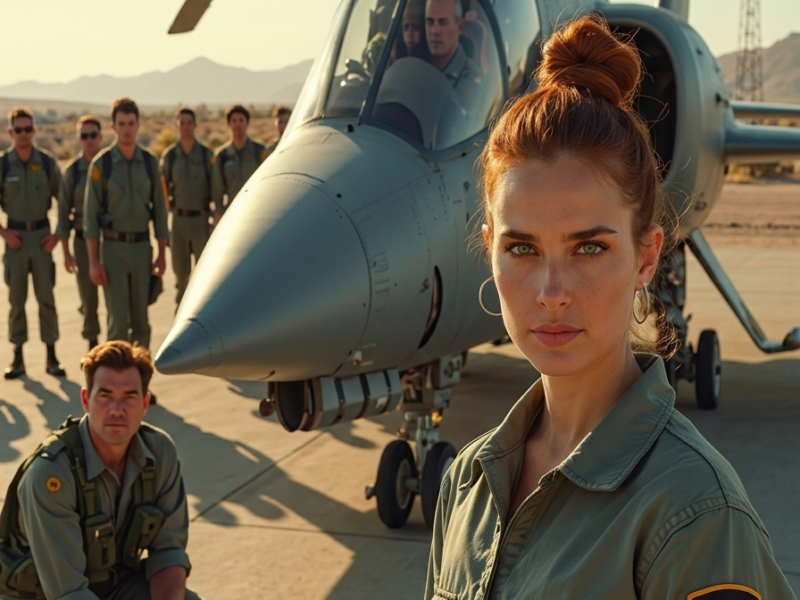
For 8 Years She Hid Her Identity as a Fighter Pilot — Then They Forced Her Into the Cockpit
The oil-stained concrete floor of Hangar 7 at Naval Air Station Oceana always smelled of JP-8 jet fuel, burnt hydraulic fluid, and cold salt spray blown in from the Atlantic. It was a sharp, biting scent that usually filled a pilot with adrenaline, but for eight years, it had served as my anchor. I sat on a low metal stool beside the exposed landing gear housing of an F/A-18E Super Hornet, wearing a grease-spattered olive-drab maintenance jumpsuit. A heavy torque wrench rested across my thighs, its steel cold even through the fabric.
Fifty feet away, near the wide-open hangar doors, a group of young strike-fighter pilots stood in a loose circle. They were dressed in crisp, flight suits with fresh squadron patches on their shoulders, laughing loudly around Colonel Richard Hayes. Hayes was a decorated veteran whose chest looked like a tapestry of ribbon bars, a man whose authority in the wing was absolute and undisputed.
“I’m telling you, the kid pulled five Gs on the turn and still missed the target array by twenty yards,” Hayes boomed, his gravelly voice carrying across the high, corrugated steel roof. “Back in my first deployment, we didn’t have computer-assisted targeting to wipe our noses for us.”
The young lieutenants laughed on cue, eager to stay in the Colonel’s good graces.
I didn’t look up. I kept my eyes focused on the hydraulic lines, adjusting a micro-valve with practiced, mechanical precision. For eight years, I had made myself part of the background noise. I spoke only when spoken to, took the late-night maintenance shifts no one else wanted, and never offered an opinion during tactical briefings. To the entire base, I was just Emily Walker: a quiet, unremarkable, mid-level maintenance officer who was slightly too old for her rank and far too reserved for the aggressive culture of naval aviation.
They didn’t know that long before I picked up a torque wrench at Oceana, I was Lieutenant Commander Emily Walker—call sign Ghost. They didn’t know I was the first female pilot assigned to a black-budget tactical development wing based out of Groom Lake, flying low-observable prototypes designed to penetrate integrated air defense networks at Mach 2.
And, above all, they didn’t know about the night over the Baltic Sea eight years ago.
It had been a cold, moonless midnight during an unsanctioned, classified intercept mission. My wingman and closest friend, Lieutenant Marcus “Vapor” Vance, was flying on my right wing when his flight-control computer locked up without warning. His aircraft pitched violently into an unrecoverable inverted spin, plunging into the pitch-black freezing waters below. When I broke formation to dive after him, defying a direct command from ground control to preserve my own classified airframe, my own instruments glitched, recording a false flight path that the subsequent naval inquiry used against me.
The official military tribunal took less than forty-eight hours to render its verdict: Pilot disorientation, gross insubordination, and flight-path deviation leading to loss of airframe and pilot.
The Navy didn’t just strip me of my wings; they erased the squadron entirely. The records were redacted, the flight logs burned, and Marcus’s family was told he died in a routine training accident over international waters. I was given a choice: face a court-martial and a military prison sentence, or accept a silent reassignment to ground logistics under an administrative seal, officially declared dead on the active aviator registry. I chose the seal. I chose to stay close to the jets, living like a phantom among the living, carrying the weight of Marcus’s death like a jagged piece of shrapnel embedded in my chest.
“Hey, Walker!” Hayes’s harsh voice cut through the hum of the hangar’s air scrubbers.
I set the wrench down slowly, wiped my grease-stained hands on a rag, and stood up. “Yes, Colonel?”
Hayes walked over, flanked by two junior pilots who looked at me with open amusement. “The fuel transfer pump on Aircraft 104 is throwing an error code. Get it sorted before the afternoon sortie, or you’re working the graveyard shift all weekend.”
“The pump was cleared two hours ago, sir,” I said softly, keeping my posture neutral, my eyes fixed on the floor three inches in front of his boots. “It’s a sensor calibration glitch in the main terminal, not a mechanical failure.”
One of the junior pilots snickered. “Look at that. The grease monkey thinks she knows more than the diagnostic computer.”
Hayes let out a short, dismissive grunt. “Just fix it, Walker. And try not to get grease on the flight deck.”
Before I could answer, the air base’s primary emergency klaxon shattered the routine. The high-pitched, warbling siren echoed off the hangar walls, instantly cutting off all conversation. The yellow emergency strobe lights above the tactical doors began to rotate, casting long, frantic shadows across the concrete.
The hangar squawk-box crackled to life with the tense, breathless voice of the Base Operations Controller. “All flight leads report to Tactical Operations immediately. We have an active emergency in Sector Four. Repeat, an F/A-18EF in wildcat condition, inbound from the Atlantic training corridor.”
The casual atmosphere vanished instantly. Hayes turned on his heel and strode toward the Tactical Operations room, his junior officers trailing behind him like a pack of wolves. I didn’t move at first, but as the sirens continued to wail, a cold, familiar electric charge ran down my spine.
“Wildcat” meant an unrecoverable control system failure in flight. It was the exact phrase Marcus had radioed eight years ago right before his jet vanished into the dark Baltic waters.
Driven by an instinct I had buried for nearly a decade, I dropped my rag and followed the officers into the darkened, screen-lit room of Tactical Operations.
The room was filled with controllers frantically typing on terminals. The main wall display showed a bright red radar target moving erratically forty miles off the coast of Virginia. The flight track wasn’t a smooth curve; it was a jagged, violent zig-zag. Outside, the skies had turned a bruised, ugly grey as an unexpected storm front rolled in from the sea, bringing thirty-knot gusts and heavy rain that slammed against the glass observation windows.
“What’s his status?” Hayes barked, shoving his way to the center console.
“It’s Lieutenant Miller, sir,” the controller answered, sweat glistening on his forehead. “Returning from a solo radar-validation flight. His primary flight computer has suffered a total bus architecture collapse. His elevators are oscillating wildly, his pitch authority is down to less than ten percent, and the storm just dropped visibility to zero down to three hundred feet.”
“Order him to eject,” Hayes said without hesitation. “Eject over the water and send a rescue chopper.”
“Negative, Boss!” The radio speaker burst with heavy static, followed by the sound of rapid, ragged breathing and the piercing, rhythmic chime of a Master Caution alarm. “The canopy latch… it’s stuck! The manual jettison handle isn’t responding! If I pull the curtain, I’ll detonate the seat against the glass!”
A sickening silence fell over the room. The young pilots stared at the radar screen, their confidence evaporating into pure horror.
“Is there anyone up there who can fly a chase plane to intercept and lead him down?” Hayes demanded, turning to his flight instructors. “Who’s current on low-visibility emergency recovery?”
The senior pilots looked at one another, then looked at the storm raging outside the window.
“Colonel, look at that turbulence track,” one seasoned flight lead said, stepping back from the table. “You go up into that soup with twenty-knot crosswinds beside a jet that’s bouncing like a loose cannon, you’re risking two aircraft. The computer is corrupt. There’s no procedure in the manual for a corrupt flight computer in zero-visibility. It’s suicide.”
Hayes slammed his fist onto the wooden briefing table with a sound like a pistol shot. “Someone needs to get that pilot home!”
No one moved. The room remained dead silent, save for the frantic alarms pinging from Miller’s cockpit over the radio.
Slowly, Hayes’s eyes swept across the room, past his decorated instructors, past his weapons school graduates, until they settled on me, standing quietly near the back wall.
“Walker,” Hayes said, his voice dropping to a harsh, cold rasp. “You worked on these flight systems. You know the software architecture. You’re going up.”
I stared at him, my heart hammering against my ribs like a trapped bird. “Sir… I’m not assigned to flight operations. I haven’t flown an active flight line in years.”
“That’s not a request, Lieutenant,” Hayes growled. He reached down to a chair near the console, picked up a heavy, scuffed white flight helmet, and hurled it straight across the table.
The helmet struck my chest hard, forcing me to step back to catch it. The plastic visor rattled against the fiberglass shell, the sound ringing through the silent room. A couple of the junior officers let out tense, uncomfortable laughter.
“Try not to embarrass the maintenance department,” Hayes added, turning back to the radar screen.
I stood there, the weight of the helmet heavy in my hands. The rain slammed against the glass outside. Slowly, I turned the helmet around and looked at the faded black stencil scratched into the synthetic leather lining beneath the rear sun-visor.
Two words were still carved into the foam, worn by time but unmistakably clear: GHOST.
For the first time in eight long years, my hands stopped shaking.
The flight suit was tight across my shoulders, smelling of ozone and rubber, but the moment I stepped onto the rain-slicked tarmac, the world narrowed into absolute clarity. The wind whipped rain across my visor, but I barely felt it. I climbed the ladder of F/A-18E Super Hornet Viper 01, my boots striking the steel rungs with a rhythmic, confident metallic click that had nothing to do with the timid maintenance officer who had walked these grounds an hour ago.
Inside the cockpit, the smell of avionics cooling fans and warm leather rushed into my nose. My fingers moved across the switch panels automatically, muscle memory taking over before my conscious mind could even process the inputs.
Battery switch—ON. APU—ENGAGE. Engine left generator—START.
The twin General Electric engines below me roared to life with a deep, vibrating thunder that shook my frame. The digital screens flickered from black to bright green, casting a soft glow over my flight gloves.
“Viper 01, you are cleared for emergency departure, runway three-six,” the tower’s voice barked into my headset. “Crosswinds thirty knots, visibility less than a quarter mile. God help you, Walker.”
I pulled the canopy down, sealing myself inside the pressurized sanctuary. “Viper 01 rolling,” I said into the mask. My voice wasn’t the quiet, faltering whisper Hayes was used to. It was low, steady, and cut through the radio chatter with absolute authority.
I slammed the throttles forward into full afterburner.
Two massive pillars of blue fire erupted behind the jet. The acceleration slammed me back into the ejection seat, pinning my chest as the runway lights blurred into a solid line of gold. At one hundred and sixty knots, I pulled back on the control stick. The nose rotated, and the fighter smashed into the dark, churning cloud layer like a kinetic bullet.
The world vanished into a blinding wall of grey chaos. Heavy rain hammered the canopy like thrown gravel. Wind shear caught the airframe, tossing the multi-million-dollar fighter violently sideways, but my hand on the stick remained fluid, compensating for the turbulence before the flight control sensors could even register the shift.
“Miller, this is Viper 01,” I said, switching to the private tactical frequency. “I am four miles behind you, climbing through seven thousand feet. Do you copy?”
“Viper 01… I copy!” Miller’s voice was borderline hysterical, the sound of wind roaring through his cockpit in the background. “I can’t hold her straight! The stick is kicking back like a wild animal! Every time I try to level the wings, the pitch computer forces the nose up forty degrees! I’m about to stall out!”
“Listen to me very carefully, Miller,” I said, bringing my throttles back slightly as my radar locked onto his glowing target marker. “Stop correcting against every movement. Stop fighting the computer. Tell me what the aircraft does when you ease all manual pressure off the stick.”
“Are you crazy?!” Miller screamed. “If I ease pressure, we’re going into the ocean!”
“Do it now!” I ordered, my voice dropping to a icy, commanding pitch that brooked no argument. “Trust me!”
There was a brief pause, filled with the screaming whine of his engines. Then Miller gasped. “The… the nose isn’t dropping. It’s pitching up at a constant six-degree increment… every four seconds… like a heartbeat.”
My blood turned to ice inside my flight suit.
A six-degree pitch increment every four seconds.
It wasn’t a mechanical breakdown. It wasn’t a sensor failure caused by rain. It was a secondary software override logic loop—a hidden, unmapped code routine that forced the aircraft’s control surfaces to ignore pilot input and execute a pre-programmed flight profile designed to stall the jet out.
It was the exact same system failure that had killed Marcus eight years ago over the Baltic Sea.
The official inquiry had sworn that no such software loop existed. They had called me crazy, told the tribunal I was inventing ghost programs to cover up my own pilot error. But here it was, eight years later, screaming in the cockpit of a young lieutenant over the Atlantic Ocean.
Someone had known about the defect all along. Someone had buried it, left the dangerous code active in the military’s primary tactical software fleet, and let Marcus die to keep the secret safe.
“Miller,” I said, my teeth clenched so tightly my jaw ached. “Your flight computer is reading a phantom command from an unmapped memory sector. To break the loop, you have to bypass the digital flight control system entirely and revert to direct mechanical feedback.”
“There is no mechanical fallback mode on the Super Hornet!” Miller yelled back. “It’s a fly-by-wire aircraft!”
“There is a hardwired circuit breaker behind your right hip panel,” I said, guiding my jet out of a dense cloud bank.
Barely fifty feet to my right, Miller’s jet appeared through the rain, bouncing violently, its tail elevators fluttering like the wings of a dying bird.
“Reach back,” I instructed, pulling my fighter right beside his wingtip, close enough that I could see his panic-stricken eyes behind his visor. “Pull breaker Alpha-Nine. Hold it out for five seconds, then cycle your digital computer switch from NORM to MECH RECOVER.”
“If I pull that breaker, I lose my auto-trim!”
“If you don’t pull it, you’re going to crash in less than two minutes,” I said coldly. “On my mark. Three… two… one… PULL.”
Through the rain-slicked glass, I watched Miller reach around his seat. For two terrifying seconds, his jet completely lost control, pitching upward violently and plunging toward the dark sea below.
“PULL THE SWITCH TO MECH RECOVER!” I shouted into the mask, diving my Super Hornet straight down into the black cloud deck after him.
The storm swallowed both of our fighters. Heavy lightning flashed inside the clouds, illuminating the churning grey turbulence that ripped at our wings. The ocean was rushing up at us fast: four thousand feet, three thousand feet, two thousand feet.
“It’s not working!” Miller shrieked over the radio. “The stick is dead!”
“Wait for the cache memory to clear!” I yelled, bringing my nose up slightly to stay parallel with his descent. “Count it! ONE! TWO!”
At twelve hundred feet above the white-capped, roaring waves, the wild fluttering of Miller’s elevators suddenly stopped. The horizontal tail surfaces locked into a stable, rigid angle. The nose of his fighter slowly began to pull out of its terrifying dive, leveling off barely six hundred feet above the water.
“I… I have mechanical response,” Miller breathed, his voice trembling with pure exhaustion. “The stick feels like it’s filled with concrete, but the nose is responding. How… how did you know that breaker existed?”
“Keep your eyes on my wing, Lieutenant,” I replied, ignoring his question as I banked my aircraft hard to the left, setting a course back toward the coast. “We aren’t home yet. You have no auto-trim, which means you have to hold manual back-pressure all the way to the deck. Stay on my formation line. When I dip, you dip. When I flare, you flare.”
“Who are you?” Miller asked suddenly, his voice filled with a quiet, stunned wonder as he matched his speed to mine. “You don’t fly like a maintenance officer. You fly like… like you’ve done this a thousand times.”
I looked out at the thick wall of storm clouds ahead, the rain streaming across my canopy like tears.
“I used to,” I said softly.
For ten grueling minutes, we flew side-by-side through the black storm, two black silhouettes carving through the tempest. I led him down through the cloud base at three hundred feet, lining both of our aircraft up with the long, glowing green arrival lights of Runway Three-Six at Oceana.
“Cut throttles in three… two… one… flare,” I commanded.
We touched down together.
THUMP.
The heavy rubber tires slammed onto the wet, grooved asphalt. A massive wall of water spray erupted behind our landing gear as our brakes engaged. Miller’s aircraft skidded dangerously toward the mud on the runway edge, but he wrestled the stick, keeping the fighter straight until both jets came to a complete stop at the far end of the taxiway.
The radio channel, which had been silent for minutes, suddenly erupted into a deafening wall of cheers from the control tower. Controllers were yelling, clapping, and screaming over the speakers.
I didn’t smile. I sat in my cockpit, listening to the high whine of my engines spooling down, my hands resting calmly on my lap. I reached into my flight suit pocket and pulled out a small, encrypted memory drive I had brought with me from my workbench. Before shutting down the avionics, I plugged the drive into my cockpit’s data port and downloaded the complete, raw telemetry log from Miller’s flight—including the hidden software override code.
Ten minutes later, I popped the canopy open and climbed down the access ladder into Hangar 7.
The entire squadron was waiting. Mechanics, fuel handlers, junior officers, and flight crews were applauding, whistling, and slapping Miller on the back as he stumbled away from his jet, weeping with relief.
When I stepped onto the concrete, the applause died down. The crowd parted slowly, creating a wide, silent path.
Colonel Hayes stood at the center of the aisle. In his right hand, he held a thick, yellowed paper file stamped with heavy red wax seals. His face was devoid of color, his jaw tight, his eyes fixed on me with an expression that was no longer arrogant or condescending, but filled with a deep, unsettling dread.
He looked at me, then down at the file, then back at my face.
“Emily Walker,” Hayes whispered, his voice barely audible over the hum of the hangar lights. “Ghost Squadron?”
I pulled my helmet off, letting my dark hair fall loose over my shoulders. I held the helmet under my arm and stared straight into his eyes.
“That squadron never existed, sir,” I said, my voice cold and crisp.
Hayes’s hand trembled slightly as he opened the file. He pulled out an old, black-and-white reconnaissance photograph stamped with a TOP SECRET – CLASS 1 clearance warning.
The photograph showed two young pilots standing proudly in front of a sleek, tailless stealth prototype jet eight years ago. One was Lieutenant Marcus Vance, smiling widely. The other was me, wearing a flight suit with the Ghost patch sewn onto the chest.
Standing directly behind us in the background of the photograph, wearing the uniform of a senior procurement director, was a man who was currently sitting in the base’s primary command structure: Vice Admiral Arthur Vance—Marcus’s own father.
Hayes stared at the photograph, then looked up toward the glass windows of the base command building overlooking the hangar.
“Emily,” Hayes said, his voice dropping to a panicked whisper as he stepped closer to me. “There’s something you need to know about that night over the Baltic. The tribunal… it wasn’t just a cover-up. It was—”
Before he could finish his sentence, the base’s primary air-defense alarm screamed again—a different, far more ominous alarm than the emergency siren.
The high-definition radar monitors along the hangar wall flashed bright red, displaying a sudden, massive security alert that overridden every terminal on the base.
UNAUTHORIZED AIRCRAFT DETECTED IN RESTRICTED AIRSPACE.
TRANSPONDER CODE: GHOST-01.
PILOT IDENTIFICATION: LIEUTENANT COMMANDER EMILY WALKER.
A cold, nauseating tilt spun through my head. The room seemed to warp around me.
I was standing right there on the hangar floor, my helmet under my arm, my flight suit damp with rain.
And whatever high-speed tactical asset was currently descending through the storm clouds directly above Naval Air Station Oceana… was using my dead identity.
The Tactical Operations room descended into utter chaos. Personnel were screaming into headsets, officers were scrambling for security terminals, and military police guards were unholstering their sidearms near the hangar doors.
“Is this a system error?!” Hayes roared, lunging toward the primary radar terminal. “How can there be a Ghost-01 on radar when Walker is standing right in front of me?!”
“Sir!” the head radar controller yelled back, his hands shaking over the console. “The target just cleared the outer defense perimeter at three thousand feet! It’s an unflagged, black-painted prototype airframe moving at eight hundred knots! Its digital transponder signature is broadcasting an old Naval Special Operations encryption key that was decommissioned eight years ago!”
I stepped up to the monitor, ignoring the guards who looked at me with open terror. I stared at the raw telemetry data cascading down the screen.
The altitude, the air-speed vector, the radar cross-section—it was impossible. It was the flight profile of the X-50 Vanguard, the black-budget experimental stealth aircraft that Marcus had been flying the night he crashed into the Baltic Sea. The jet that the Navy had officially declared destroyed, its wreckage supposedly buried beneath two hundred feet of freezing water.
“It’s not an error,” I said softly, my voice cutting through the noise in the room like steel. “That jet isn’t a phantom. It’s real.”
Hayes grabbed my shoulder, his face white as ash. “Walker, what are you talking about?! Marcus Vance died eight years ago! We recovered the wreckage!”
“You recovered a wreckage,” I snapped, turning to face him, shoving his hand off my collar. “You recovered a decoy frame to satisfy the public inquiry! Marcus didn’t crash because of a glitch, Colonel. He was intercepted! The software override that locked his controls wasn’t a defect—it was a remote command hack initiated from a ground base to force his aircraft to land in international territory!”
Hayes gasped, stumbling back a step. “That’s… that’s impossible. Who could have authorized a remote hijack of a classified U.S. asset?”
“The man who designed the program,” a deep, heavy voice answered from the doorway.
We all turned.
Standing in the entrance of the Tactical Operations room was Vice Admiral Arthur Vance. He was in his full dress uniform, his grey hair neatly combed, his chest covered in stars. But his face was hollow, his eyes sunken and dark, carrying an unspeakable weight that looked as though it had been crushing him for a decade.
Behind him stood four armed military contractors wearing unmarked black tactical gear, holding suppressed submachine guns.
“Admiral Vance?” Hayes stammered, raising his hands in confusion. “Sir, what is the meaning of this? What is that aircraft on our radar?”
“Stand down, Richard,” Admiral Vance said quietly, his voice laced with an unbearable, tragic fatigue. “This doesn’t concern you or your squadron.”
“Admiral…” I said, stepping past Hayes until I was ten feet from the man who had been like a second father to me before his son’s disappearance. “Marcus is in that plane, isn’t he?”
Tears welled in the old Admiral’s eyes, but his expression remained grim, frozen in military resolve. “Eight years ago, Emily, our program was compromised by a foreign intelligence network that had infiltrated the contractor’s software division. They activated the override code on Marcus’s jet over the Baltic to force him down onto an unflagged runway in Eastern Europe. They captured him, kept him in a dark room for eight years, and used him to reverse-engineer our entire low-observable flight architecture.”
My breath caught in my throat. “He… he stayed alive?”
“They kept him alive as an asset,” Vance whispered, his voice cracking. “And twenty minutes ago, he escaped. He broke out of an unsanctioned testing facility in international waters, stole the prototype frame they built from our designs, and flew straight for home. But he doesn’t know that the remote override software… is still active inside the airframe.”
As if on cue, the radar screen flashed violently yellow.
The trajectory of Ghost-01 shifted sharply. The aircraft had ceased its controlled approach toward the base’s runway and was now banking hard toward the base’s primary weapons depot—a massive underground storage facility containing tons of high-explosive ordnance.
“The ground link,” I gasped, looking at the screen. “The people who captured him… they just activated the override again! They’re turning his jet into a remote missile to destroy the base and wipe out the evidence!”
“My contractors are here to clear the base,” Admiral Vance said coldly, pulling a black security key from his pocket. “I have received direct orders from the Joint Chiefs to activate the base’s anti-aircraft missile batteries and shoot Ghost-01 down before it hits the depot.”
“NO!” I screamed, lunging forward, but two of the black-clad contractors instantly raised their weapons, locking their sights on my chest. “Admiral, you can’t shoot him down! He’s your son! He survived eight years of hell to get back to us!”
“He’s a dead man, Emily!” Vance shouted, tears finally streaming down his wrinkled cheeks. “He was declared dead eight years ago! If that prototype crashes into the depot or gets captured by the press, the entire military architecture collapses! I won’t let his legacy be destroyed by a treasonous scandal!”
“He isn’t a legacy!” I yelled back, stepping straight toward the barrels of the contractors’ guns, my eyes burning with a fury that made the armed men hesitate. “He is a human being! And I am not going to let you kill him twice!”
Before Admiral Vance could issue the order to his men, I slammed my hand down on the terminal’s manual override pad, locking the room’s blast doors shut and cutting the power to the base’s surface-to-air missile tracking systems.
“Walker! What have you done?!” Hayes screamed.
I didn’t answer. I grabbed my white flight helmet from the table, kicked open the emergency side exit door, and sprinted out into the pouring rain toward the flight line.
The rain was falling in blinding sheets, turning the tarmac into a river of black glass.
Behind me, the alarm sirens were screaming louder than ever, and I could hear the heavy thud of military police boots pursuing me through the storm. But I didn’t look back. I sprinted straight to Viper 01, which was still idling on the taxiway, its engines warm, its fuel tanks half-full.
I leaped up the ladder, threw myself into the cockpit, slammed the canopy down, and engaged the throttles without waiting for a ladder check.
“Viper 01, abort! Abort!” the tower speaker shrieked. “Security forces are authorized to use lethal force to prevent your departure!”
I shoved the throttles into full afterburner.
The Super Hornet surged forward like a thunderbolt, roaring down the taxiway and lifting into the grey storm clouds just as three military police vehicles screeched onto the runway behind me.
I punched through the clouds at four thousand feet, breaking out into a turbulent pocket of storm air.
“Marcus!” I screamed into the radio on the old, encrypted Ghost squadron frequency. “Marcus, can you hear me?! This is Emily! This is Ghost-Two!”
For three agonizing seconds, there was only deafening static.
Then, a voice came through the headset. It was thin, raspy, and broken by years of isolation and trauma, but the cadence was unmistakably his.
“Emily…? Is that… really you?”
“I’m here, Marcus!” I yelled, pulling my jet into a vertical climb to match his descending vector. “Look at your radar! I’m coming up on your six o’clock!”
A mile ahead of me, a sleek, angular, pitch-black aircraft emerged from the clouds. It had no military markings, no nation’s flag—only the razor-sharp lines of a black-budget stealth fighter. But the aircraft was shuddering violently, its elevators locked into the same lethal pitch-up oscillation that had destroyed our lives eight years ago.
“Emily… I can’t stop it…” Marcus sobbed over the radio. “They… they took control of the airframe from a satellite link! The plane is steering itself straight into the base’s weapons depot! I can’t override the computer!”
“Yes, you can!” I shouted, bringing my Super Hornet within twenty feet of his left wing, matching his terrifying speed. “Listen to me! They updated the software, but the physical bus architecture is still based on the original prototype! You have to manually short-circuit the primary flight computer logic array!”
“How?! The main breaker box is sealed!”
“Use your emergency canopy jettison pin!” I commanded, steering my jet alongside his through the violent turbulence. “Pull the safety pin from your seat frame, jam it directly into the diagnostic port on the right flight panel, and bridge the two ground wires! It will trigger a total system reboot and force the airframe into manual direct-drive!”
Silence filled the channel for five agonizing seconds.
Ahead of us, through a tear in the clouds, the base at Oceana appeared. The high-explosive weapons depot was less than two miles away, a massive concrete bunker looming directly in the path of Marcus’s descending fighter.
“Do it now, Marcus!” I screamed. “Trust me one last time!”
Through his canopy glass, I saw his helmeted head lean down toward the side panel.
SPARK!
A bright flash of blue electrical light erupted inside his cockpit.
The black stealth jet froze in mid-air for a fraction of a second. Its pitch-up oscillation stopped instantly. The control surfaces flapped wildly, then locked into neutral alignment.
“I’VE GOT THE STICK!” Marcus roared over the radio. “I HAVE MANUAL CONTROL!”
“PULL UP!” I screamed, pulling my own stick back with all my strength.
Both of our aircraft pulled up hard, banking away from the base barely three hundred feet above the ground. The immense G-forces slammed me back into my seat, graying out my vision for a fraction of a second as our jet engines roared at maximum thrust.
We cleared the top of the weapons depot bunker by less than fifty feet, our jet wash blowing security fences off their mountings as we launched back up into the clouds.
Ten minutes later, under the escort of four naval air patrol fighters that had been scrambled to secure the airspace, both jets rolled onto the emergency runway at NAS Oceana.
The black prototype jet came to a stop in the center of the tarmac, surrounded by flashing red lights from dozens of emergency vehicles, fire trucks, and military police cruisers.
I taxied my Super Hornet beside his, cut the engines, and popped my canopy.
The rain had stopped. The heavy storm clouds were breaking apart, allowing the gold and orange rays of a brilliant sunset to burst across the Virginia coastline.
I climbed down my ladder and walked slowly toward the black jet.
The canopy of the prototype opened with a slow pneumatic hiss. A man stepped out, his hair graying at the temples, wearing a faded flight suit with no patches. He looked down at me, his hands trembling, tears tracking through the grime on his face.
Marcus Vance climbed down the ladder, his boots hitting the wet concrete.
I stopped two feet in front of him.
For eight years, I had carried the guilt of his ghost. For eight years, I had lived as a phantom in the shadows of the base, believing I was a broken failure who had let her wingman die.
Marcus looked at my face, then at the white helmet in my hand, and slowly pulled his right hand up to his brow, delivering a crisp, perfectly executed salute.
“Permission to rejoin the formation, Lead?” he whispered, his voice choking with emotion.
I didn’t salute back. I stepped forward, wrapped my arms around his neck, and pulled him into a fierce, tight hug.
“Permission granted, Vapor,” I whispered, tears finally washing away eight years of silence and grief. “Welcome home.”
Behind us, Colonel Hayes, Admiral Vance, and dozens of officers walked out onto the tarmac. But as federal agents and naval investigators swarmed the flight line to secure the black aircraft and take the evidence into custody, I knew the hiding was over. The truth about the software, about the cover-up, and about the lives sacrificed in the dark was finally coming to light.
I looked up at the clearing sky, where the last rays of sunlight reflected off the wings of the jets lining the runway.
I was no longer a maintenance officer hiding in the grease. I was no longer a ghost.
I was an aviator. And I was finally free.
The end.









