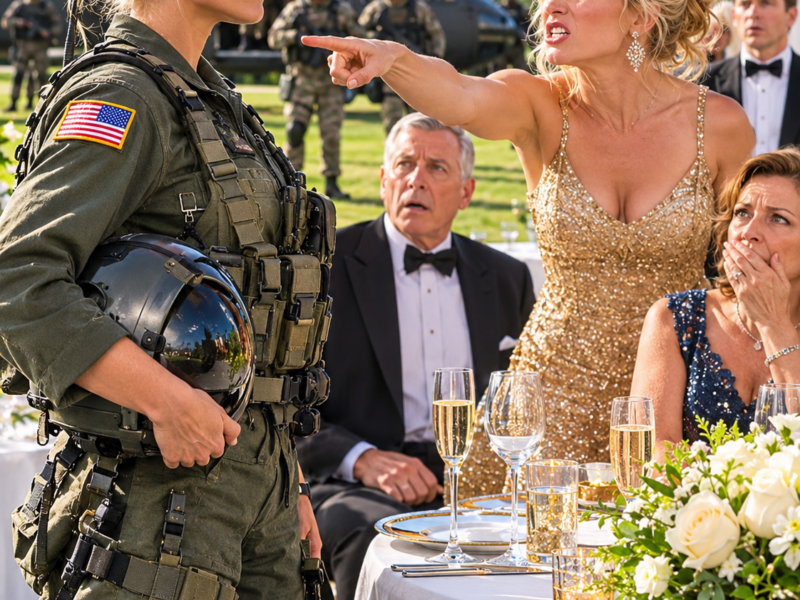
For 23 years, my mother told everyone that my sister was born to shine and I was born to stand quietly in the background
The helicopter door closed, and the world outside disappeared behind a wall of metal and glass.
For a few seconds, I could still see my family through the small window.
My mother stood beside the fountain, one hand pressed against her chest. My father hadn’t moved. Renata was a few steps ahead of them, her award plaque tucked beneath one arm.
They looked smaller than I remembered.
Or maybe I was finally seeing them from a different perspective.
Staff Sergeant Kimani Torres secured himself across from me and checked the equipment mounted along the cabin wall. He had been my executive officer’s right hand for almost three years, and I trusted him with the kind of things that didn’t need to be explained twice.
“Ready, ma’am?”
I nodded.
The aircraft lifted.
The Pine Ridge Event Center dropped beneath us, followed by the parking lot, the fountain, and the row of Bradford pear trees losing their orange leaves.
I watched until the building disappeared.
Then I turned toward the mission.
“All right, Torres. Give me the situation.”
He handed me a secure tablet.
“General Harlo wants you on the command conference as soon as we establish the connection. The situation developed approximately two hours ago. The original aviation package has been delayed, and the alternate team is requesting a change in command authority.”
“What’s the nature of the operation?”
“Recovery and extraction support. Details are on the secure channel.”
I read through the first page.
The mission wasn’t simple. A joint team operating overseas had encountered a rapidly changing situation, and the aviation support plan had become unreliable. Several decisions needed to be made before the next operational window closed.
This was why they had come for me.
Not because I was the only pilot in the Army.
Not because I had some extraordinary ability to appear whenever somebody needed a helicopter.
They needed the commander responsible for the aviation detachment, someone who understood the aircraft, the personnel, the limitations, and the consequences of making the wrong decision.
“How long until we reach the 170th?” I asked.
“Thirty-two minutes.”
“Get the operations officer on the line.”
“Already working on it.”
I leaned back and continued reading.
For the next half hour, my family was nowhere in my thoughts.
That was the strange thing about responsibility. It didn’t care whether your mother approved of your blouse or whether your sister remembered what you did for a living.
People were counting on you.
You either showed up prepared or you didn’t.
And I had spent nine years making sure I was prepared.
The command facility was already active when we arrived.
I stepped out of the aircraft, handed my helmet to the crew chief, and followed Torres through the security entrance.
A few people greeted me in the hallway.
“Morning, Colonel.”
“Ma’am.”
“Good to have you back.”
I returned the greetings and entered the briefing room.
Colonel Reed was standing near the main display. General Harlo appeared on the secure conference screen.
Neither man wasted time.
“Lauren, thanks for getting here.”
“What’s the latest?”
Reed summarized the situation. I listened, asked questions, and reviewed the revised operational picture.
The first aviation team had encountered a problem that made its original plan unsuitable. A second option was available, but it required additional coordination and a different allocation of aircraft and personnel.
I studied the map.
“Who has confirmed the alternate package?”
“Operations has two crews available.”
“Two crews aren’t enough for the original plan.”
“Agreed.”
I looked at the maintenance status report.
“What about the third aircraft?”
“Still awaiting clearance.”
“Then don’t build the plan around it.”
The room became quiet as I continued reviewing the information.
I had learned something during my first deployment: confidence wasn’t the same as certainty.
The people who worried me most were the ones who never admitted when they didn’t know something.
I preferred a commander who understood limitations.
After another twenty minutes, we had a workable plan.
General Harlo nodded from the screen.
“Proceed with the revised coordination. Keep me informed.”
“Yes, sir.”
The conference ended.
I remained in the room while Reed gathered his notes.
“You came from Tennessee?”
“Yes, sir.”
“Family event?”
“My sister received an award.”
He looked at me for a moment.
“Sorry we interrupted.”
I shook my head.
“That’s the job.”
He smiled faintly.
“Your family must be proud.”
I didn’t answer immediately.
It was an innocent comment, but something about it stayed with me.
Proud.
I wasn’t sure that was the word I would have chosen.
“They’re learning what I do,” I finally said.
Reed nodded.
“Sometimes people need a little time to catch up.”
I hoped he was right.
My family didn’t call that evening.
They didn’t call the next morning either.
I wasn’t surprised.
I had a mission to manage, aircraft to account for, and people who needed decisions from me. I spent the next two days working through the operational requirements.
But on the third evening, I found myself sitting alone in my quarters with my phone in my hand.
There were three missed calls.
One from my father.
Two from Renata.
Nothing from my mother.
I stared at the screen longer than I needed to.
Then I called my sister.
She answered on the second ring.
“Lauren?”
“Hey.”
“Are you okay?”
“I’m fine. We had some work to do.”
“Are you allowed to talk?”
“Not about the mission.”
“Right. Sorry.”
There was a pause.
I could hear television noise in the background.
Then she spoke again.
“I’ve been thinking about what happened.”
I leaned back in my chair.
“Okay.”
“Mom hasn’t stopped talking about it.”
I almost laughed.
“That sounds familiar.”
“No, I mean it. She’s been telling everyone that two helicopters came to get you.”
“That’s accurate.”
“She says the general personally requested you.”
“He did.”
Another pause.
Then Renata said something I hadn’t expected.
“She keeps saying she doesn’t understand why you never told us.”
I looked toward the dark window.
“Renata, I did tell you.”
“What?”
“I told you I was a pilot. I told you I deployed. I told you I was in the Army. I told you I couldn’t discuss certain assignments. I told you I had taken command.”
“But you never explained—”
“I couldn’t explain everything. That’s different from never telling you anything.”
She was quiet.
I continued.
“You remember when I came home after my second deployment? I told you I’d been flying missions. You asked if I was still doing that helicopter training.”
“I don’t remember.”
“I know.”
There was no anger in my voice. Just exhaustion.
“I remember because I was sitting at the kitchen table, and Mom was talking about your new business location. I waited until she finished. Then I told you I’d been overseas.”
“What did I say?”
“You said, ‘That’s nice, Lauren. Can you pass the salt?'”
Renata exhaled.
“Oh.”
“Yeah.”
“I didn’t know.”
“I know.”
That seemed to be the sentence everyone in my family had learned to say.
I didn’t know.
It was probably true.
But not knowing didn’t always happen by accident.
Sometimes people didn’t know because they had never been interested enough to ask.
“Can I ask you something?” Renata said.
“Sure.”
“Did you feel bad at the ceremony?”
I considered the question.
“Yes.”
“Because I called your job administrative?”
“Partly.”
“I’m sorry.”
I closed my eyes.
“Thank you.”
She hesitated.
“And because Mom said you were there to support the people who actually succeeded?”
“Yes.”
“I didn’t know she said that so many times.”
“She said it four times while I was standing there.”
“Oh, Lauren.”
I didn’t respond.
Renata was breathing quietly on the other end.
Finally, she said, “I wish you’d told me more.”
“I wish you’d asked.”
Neither of us spoke for several seconds.
Then she said, “I want to see you.”
“Okay.”
“When can you come home?”
“I don’t know yet. My schedule isn’t mine to control right now.”
“Just let me know.”
“I will.”
We ended the call.
For the first time since the ceremony, I felt something loosen in my chest.
It wasn’t forgiveness.
Not yet.
But it was a beginning.
My father called the following afternoon.
I almost let it go to voicemail.
Then I answered.
“Hey, Dad.”
“Lauren.”
His voice sounded different. Less certain.
“How are you doing?”
“Good. Busy.”
“I imagine.”
He cleared his throat.
“Your mother and I have been talking.”
I waited.
“She wants to know why you never told us you were in command.”
I looked down at the folder on my desk.
“Dad, I told you.”
“When?”
“Three months ago.”
He didn’t answer.
“I called after the promotion. I told you I had been selected to command a detachment.”
“I thought you meant you were managing a team.”
“I was managing a team.”
“Well, I didn’t understand it was something so important.”
I rubbed my forehead.
“Did you ask?”
Another pause.
“No.”
It was the first honest answer I’d heard from him in a long time.
“I thought you were doing some kind of government logistics work,” he continued. “Your mother said you were mostly behind the scenes.”
“I know.”
“I suppose we should have asked more questions.”
“Yes.”
He sighed.
“Your mother has been upset.”
I almost smiled.
“Why?”
“She says you embarrassed her.”
I sat up straighter.
“Embarrassed her?”
“Not exactly. She says she didn’t know what was going on and everyone was looking at her.”
I stared at the wall.
“Dad, I didn’t bring those helicopters. My unit did. I didn’t arrange a military pickup to make a point at Renata’s award ceremony.”
“I know.”
“I was there to celebrate my sister.”
“I know, sweetheart.”
“Then what exactly did I do to embarrass her?”
He didn’t answer.
I waited.
Finally, he said, “I think she’s embarrassed about what she said.”
That was different.
And it was probably the closest he had come to understanding the situation.
“Has she said that?”
“Not in those words.”
“Then I don’t know what she thinks.”
He sighed again.
“Your mother has always been proud of Renata. You know that.”
“I know.”
“She’s always thought you were more independent.”
I laughed quietly.
“Is that what we’re calling it?”
“Lauren.”
“What?”
“I don’t know how to explain it.”
“Then don’t explain it. Just tell her she doesn’t get to decide what my life means because she doesn’t understand it.”
He was quiet.
Then he said, “I should have been more interested.”
I wasn’t expecting that.
My father had never been especially good at apologizing. He was the kind of man who showed affection by changing your oil, fixing a loose cabinet hinge, or leaving money in an envelope when he thought you needed it.
He wasn’t comfortable with emotional conversations.
So when he said those words, I knew they had cost him something.
“Thank you, Dad.”
“Your mother wants to talk.”
I looked at my phone.
“Does she want to apologize?”
“I don’t know.”
“Then I’m not ready.”
He accepted that without arguing.
Before hanging up, he said, “I’m proud of you.”
I closed my eyes.
It was a simple sentence.
But I had waited a long time to hear it.
“Thank you.”
My mother called two days later.
I was in the office reviewing maintenance reports when her name appeared on the screen.
I let it ring twice before answering.
“Hi, Mom.”
“Lauren.”
Her voice was tight.
“I’ve been trying to understand what happened.”
“Okay.”
“Your father says you were upset.”
“I was.”
“Why didn’t you tell me?”
I set down my pen.
“Mom, I told you I was a pilot.”
“Yes, but I thought you were doing administrative work.”
“Why?”
“Because you never talk about anything.”
“I talk about what I can.”
She sighed.
“Well, you certainly could have mentioned that you were in command.”
“I did.”
“When?”
“Three months ago. I called you.”
“I don’t remember that.”
“I know.”
She was silent.
Then she said, “I think you misunderstood what I meant at the ceremony.”
I leaned back.
“What did you mean?”
“I wasn’t trying to insult you.”
“You told people I had failed to become a pilot.”
“I said things hadn’t worked out the way you planned.”
“They worked out exactly the way I planned.”
“Lauren, don’t be difficult.”
There it was.
The familiar turn.
The moment when a conversation stopped being about what someone had done and became about how inconvenient it was that I remembered.
I took a slow breath.
“Mom, I need you to understand something. You don’t have to know the details of my job. You don’t need to know where I deploy, what missions I fly, or who I work with. But you don’t get to invent a smaller version of my life just because I can’t give you every detail.”
“I wasn’t inventing anything.”
“You called me administrative support.”
“I was trying to explain your job.”
“You could have said you didn’t know.”
She didn’t respond.
I continued.
“And you said I support the people who actually succeed. While I was standing right there.”
“I was proud of Renata.”
“I was proud of her too.”
“Then why are you making this about you?”
I closed my eyes.
Because there it was again.
The same old argument.
If I wanted to be treated with respect, I was somehow taking attention away from my sister.
“Mom, I drove four hours to celebrate Renata. I sat through the ceremony. I congratulated her. I didn’t ask for attention. I didn’t interrupt her speech. I didn’t even correct you when you told people I was some kind of failed pilot.”
“Then what did you want?”
I thought about the question.
It was so simple.
And somehow, after all these years, she still didn’t understand the answer.
“I wanted you to stop telling people who I was without asking me.”
She said nothing.
Then, after several seconds, she asked, “Are you coming home for Thanksgiving?”
I looked at the calendar.
“Probably not.”
“Why not?”
“I haven’t decided.”
“Your sister will be there.”
“I know.”
“Your father will be there.”
“I know.”
She sounded frustrated.
“So what are we supposed to do?”
I looked out the window.
“Maybe start by having a conversation that isn’t about whether I’m disappointing you.”
She hung up without saying goodbye.
I sat there for a while.
Then I returned to the maintenance reports.
The weeks that followed were busy.
Our unit completed the assignment, and the revised aviation plan worked as intended. There were no unnecessary losses, no avoidable equipment failures, and no major surprises.
I wasn’t going to discuss operational details with my family.
I wasn’t going to turn my work into a story designed to make them feel guilty.
It was enough that the people responsible for the mission knew what had happened.
My commander submitted a formal recommendation recognizing the unit’s performance.
A few weeks later, the detachment received an internal commendation.
I didn’t tell my mother.
I didn’t tell my father.
I mentioned it to Renata during a brief phone call, and she congratulated me.
That was all.
Then, in early December, I received an envelope at my office.
It was from my sister.
Inside was a handwritten letter.
Not a text message.
Not a social media post.
A letter.
I opened it after work.
“Lauren,
I’ve been thinking about the award ceremony and about how I described your job.
I want you to know that I wasn’t trying to make you sound unimportant. I think I repeated things Mom had been saying for years because I never questioned them.
That doesn’t make it okay.
I remember you talking about flight school when we were younger. I remember you studying for hours and spending weekends away. I remember you coming home exhausted and saying you couldn’t tell us much about where you’d been.
I think I stopped asking because it was easier to talk about my own life.
You always seemed capable of handling things yourself.
I told myself you didn’t need anyone’s attention.
But maybe that was just a convenient excuse.
I’m proud of you. Not because helicopters came to the parking lot or because a general asked for you. I’m proud of you because you built a life doing something difficult, and you kept doing it even when nobody in our family understood.
I should have asked more questions.
I’m sorry.
Love,
Renata.”
I read it twice.
Then I folded it carefully and put it in the drawer of my desk.
I didn’t cry.
But I kept the letter.
Christmas approached.
My mother called once more.
This time, she didn’t begin with a question about whether I was coming home.
She said, “I received something in the mail.”
“What?”
“A photograph.”
I frowned.
“What photograph?”
“From the event center. Someone took a picture of the helicopters.”
I remembered the day.
The event coordinator had apparently taken several photographs after the aircraft landed. One of them showed the two Black Hawks in the field, with the event center behind them.
My mother continued.
“Your father says the picture is going to be included in the local paper.”
“That’s nice.”
“People keep asking about it.”
I waited.
“Your aunt Phyllis told everyone you were the commander.”
“She knows now.”
“She said you looked very professional.”
I didn’t know what to say.
Then my mother asked, “Would you come home for Christmas?”
It wasn’t an apology.
It wasn’t even an acknowledgment of what had happened.
But her tone was different.
Less demanding.
More uncertain.
“I don’t know yet, Mom.”
“Your father misses you.”
“I miss him too.”
“And I miss you.”
I looked at the letter from Renata, still tucked in my desk drawer.
“Okay.”
She seemed to wait for more.
I didn’t offer it.
Finally, she said, “I’ll let you know what we’re doing.”
“All right.”
We ended the call.
For the first time, I wondered whether my mother was beginning to understand that I wasn’t going to keep returning to the same relationship simply because she expected me to.
I went home for Christmas.
Not because everything had been fixed.
Not because I had suddenly forgiven everyone.
I went because I wanted to see my father, and because I wanted to give Renata a chance to build something different between us.
The drive took four hours.
The same highway.
The same gas stations.
The same stretch of road where the trees became denser and the towns became smaller.
When I pulled into my parents’ driveway, my father was standing on the porch.
He came down the steps before I could get out of the car.
“There’s my girl.”
He hugged me.
It was awkward at first, the way hugs sometimes are between people who haven’t practiced them enough.
Then he held on a little longer.
“Good to see you, Dad.”
“Good to see you too.”
He carried my bag inside.
My mother was in the kitchen.
She turned when I entered.
For a moment, neither of us spoke.
Then she said, “You made good time.”
“Traffic wasn’t bad.”
She nodded.
“There’s coffee.”
“Thanks.”
That was how we began.
Not with a dramatic apology.
Not with tears.
Just coffee.
And an uncomfortable understanding that something had changed.
Renata arrived an hour later with her husband and two children.
The house became loud.
My nephew ran toward me and wrapped both arms around my waist.
“Aunt Lauren!”
I lifted him.
“Hey, buddy.”
“Mom said you fly helicopters.”
“I do.”
“Like the army ones?”
“Exactly.”
“Can you take me?”
I laughed.
“Not today.”
He seemed disappointed.
“Maybe when I’m older?”
“Maybe when you’re older.”
Renata smiled from the doorway.
“He’s been asking about you all week.”
I looked at her.
“Really?”
“Yes. I showed him the picture from the event center.”
I raised an eyebrow.
“The helicopter picture?”
She nodded.
“He thinks you’re some kind of superhero.”
I laughed.
“Tell him superheroes have a lot of paperwork.”
My nephew looked horrified.
“Even superheroes?”
“Especially superheroes.”
For a few minutes, the house felt normal.
Then dinner began.
My mother had prepared most of the traditional dishes. My father carved the turkey. Renata’s husband poured drinks.
We sat around the table.
And, for the first time in years, my mother asked me a question about work.
“Do you still fly regularly?”
I set down my fork.
“Yes.”
“How often?”
“It depends on the assignment and training schedule.”
She nodded.
“Is it dangerous?”
I considered my answer.
“Flying always involves risk. That’s why training and preparation matter so much.”
She looked down at her plate.
“Your father says you have command responsibility now.”
“I do.”
“How many people?”
I gave her a general answer without sharing anything sensitive.
She nodded again.
Then she said something that surprised me.
“I don’t think I ever understood how much responsibility that was.”
I didn’t rush to answer.
My father glanced at her.
Renata stopped cutting her food.
My mother looked at me.
“I thought you were doing office work. I thought you were helping other people do their jobs.”
I took a breath.
“I know.”
She looked uncomfortable.
“I suppose I should have asked.”
“Yes.”
She nodded.
Then she looked toward Renata.
“I shouldn’t have said those things at your award ceremony.”
The room became quiet.
My mother continued.
“I was trying to explain your job, but I didn’t know what I was talking about. And I shouldn’t have told people you never became what you wanted to be.”
I felt something tighten in my chest.
It wasn’t the apology I had imagined when I was younger.
It wasn’t elegant.
It wasn’t particularly emotional.
But it was an admission.
“Thank you,” I said.
She nodded.
Then she returned to her food.
We didn’t spend the rest of dinner discussing my career.
And I was grateful for that.
After dinner, Renata and I went outside.
The air was cold.
The porch light illuminated the yard, and the old maple tree near the driveway had lost nearly all its leaves.
She leaned against the railing.
“I’ve been meaning to ask you something.”
“What?”
“Why did you never tell us more about your deployments?”
I looked toward the yard.
“Because I couldn’t.”
“I understand that.”
“No, I mean I physically couldn’t tell you some things. But there were other things I could have shared. I could have told you what it felt like to come home after being away. I could have told you how difficult training was. I could have told you about the people I worked with.”
“Why didn’t you?”
I thought about it.
“Because every time I tried, the conversation moved somewhere else.”
She nodded slowly.
“I think I did that.”
“Sometimes.”
She looked down.
“I was so focused on building my business that I didn’t notice how much of your life I was missing.”
“You were busy.”
“So were you.”
We stood quietly.
Then she said, “Do you remember when we were kids and Mom used to make us perform at the school talent show?”
I laughed.
“Yes.”
“You wanted to sing.”
“I wanted to fly.”
“You wanted to sing first.”
I shook my head.
“That was one time.”
“You were terrible.”
“So were you.”
She laughed.
For a moment, we were just sisters again.
Then her expression became serious.
“I don’t want us to be like this anymore.”
“Neither do I.”
“Can we start over?”
I looked at her.
“We can start from where we are.”
She nodded.
Then she hugged me.
It was a good hug.
Not because it fixed everything.
Because it didn’t pretend everything was already fixed.
The next morning, my mother was in the kitchen when I came downstairs.
She was making coffee.
“Good morning.”
“Morning.”
She poured a cup and placed it on the counter.
I sat down.
For a while, we talked about ordinary things.
The weather.
The roads.
Renata’s business.
My father’s plans to repair the garage door.
Then she said, “I want to ask you something, but I don’t want you to feel like you have to answer.”
I looked up.
“Okay.”
“Are you happy?”
The question caught me off guard.
Not because it was complicated.
Because I couldn’t remember the last time she had asked it.
I considered my answer.
“Yes. Most days.”
“Even with all that responsibility?”
“Even with it.”
“You’re not lonely?”
I smiled faintly.
“Sometimes.”
She looked down at her coffee.
“I used to think you were lonely because you didn’t have what Renata had.”
I waited.
“A family business. A husband. Children. A house in town. I thought you were still trying to figure out what you wanted.”
“Mom, I’ve known what I wanted for a long time.”
“I know that now.”
She looked at me.
“I think I confused your life with mine. I thought because your choices were different, they must have meant you were unhappy.”
I didn’t answer.
She continued.
“Your sister was always easier for me to understand. She liked the things I liked. She wanted the kind of life I understood.”
“And I didn’t.”
“No.”
She took a breath.
“I think I made that your problem.”
For the first time in years, I saw my mother without the certainty she usually carried into every conversation.
She wasn’t defending herself.
She wasn’t telling me how I should feel.
She was admitting that she had been wrong.
I looked at the woman who had raised me.
The woman who had attended every school event, who had packed lunches, who had sat beside me when I was sick, who had once driven me to a recruitment office even though she didn’t understand why I wanted to join the Army.
She wasn’t entirely wrong about everything.
She had loved me.
But love and understanding were not the same thing.
And sometimes love could become a cage when it insisted that the people inside it live according to someone else’s expectations.
“Mom,” I said quietly, “I don’t need you to understand every part of my job.”
She nodded.
“I just need you to respect the parts you don’t understand.”
She looked at me.
“I can try.”
“That’s all I’m asking.”
She reached across the counter and touched my hand.
I let her.
After Christmas, life returned to its usual rhythm.
I went back to Fort Campbell.
Renata sent occasional pictures of the children.
My father called every Sunday.
My mother began asking about my work, though she learned quickly that some questions couldn’t be answered.
Sometimes she asked whether I had flown that week.
Sometimes she asked whether the weather had been difficult.
Once, she sent me a photograph of a helicopter in a magazine and asked if it was like the one I’d flown.
I told her it was similar.
She replied with a smiley face.
It wasn’t a complete transformation.
There were still moments when she slipped into old habits.
At a family gathering in February, she introduced me to a neighbor as “our daughter who works with military aviation.”
I let it pass.
Later, when the neighbor asked what I did, I explained that I was an Army helicopter pilot and commanded an aviation detachment.
My mother didn’t interrupt.
That was progress.
Renata, meanwhile, became more deliberate.
She called to ask about my schedule.
She sent messages when she saw military aviation stories in the news.
She even asked whether I would be comfortable speaking to a group of students at her business about leadership and discipline.
I told her I couldn’t discuss operational work, but I could talk about leadership.
She arranged the event.
When I arrived, she introduced me without trying to explain my job for me.
“This is my sister Lauren. She’s an Army helicopter pilot and a commander. She’s spent years doing work that I don’t fully understand, but I’m proud of her.”
I looked at her.
She smiled.
And for once, I didn’t feel like I was standing in someone else’s shadow.
In the spring, I received another professional recognition.
This time, it came from within the Army.
My detachment had completed a demanding training cycle, and our command leadership recognized the team’s performance.
I stood with my personnel during the ceremony.
There were photographs, handshakes, and a few speeches.
I accepted the recognition on behalf of the unit.
Afterward, Torres approached me.
“Congratulations, ma’am.”
“Thank you.”
He smiled.
“Any news from the family?”
I looked at him.
“Why?”
He shrugged.
“Just wondering if they’ve figured it out yet.”
I laughed.
“Some of them.”
“That’s progress.”
“Apparently.”
He nodded toward the group of soldiers gathering near the hangar.
“Your people are waiting.”
I looked over.
My crew chiefs, pilots, and operations staff were standing together.
Some were laughing.
Others were checking equipment.
They were the people who knew what my days actually looked like.
They knew the long hours.
The difficult decisions.
The mistakes we corrected.
The missions we prepared for and the plans we changed.
They didn’t need helicopters to arrive at a family celebration to understand my responsibilities.
They already knew.
I walked toward them.
And I realized something important.
For a long time, I had treated my family’s approval as if it were the final piece of a puzzle.
I thought if I could just make them understand, something inside me would finally settle.
But my life had never been incomplete.
I had friends who trusted me.
Soldiers who depended on me.
A career I had worked hard to build.
A sister who was beginning to know me.
A father who was learning to ask questions.
And a mother who, slowly and imperfectly, was learning that her daughters didn’t have to shine in the same way.
I didn’t need my family to understand every detail.
I needed them to stop assuming that what they couldn’t see didn’t matter.
A few months later, I returned to Pine Ridge.
Not for another award ceremony.
This time, Renata was hosting a small business anniversary celebration at the same event center.
I almost laughed when she told me the location.
“Are you sure you want to go back there?” I asked.
She laughed.
“I know. But it’s a nice place.”
“It has a fountain.”
“And marigolds.”
“And a parking lot.”
“Lauren.”
“Just checking.”
I arrived early.
My mother was already there, arranging flowers near the entrance.
She wore a blue dress.
When she saw me, she smiled.
“You came.”
“I said I would.”
She looked at my clothes.
Navy blouse.
Black slacks.
The same general outfit I’d worn at the original ceremony.
She didn’t adjust my collar.
She didn’t tell me to change.
Instead, she said, “You look nice.”
“Thanks.”
Then she looked toward the room.
“Renata is nervous.”
“She’ll be fine.”
“She’s worked hard.”
“She has.”
My mother nodded.
Then she turned toward me.
“You know, I used to think you were both trying to get to the same place.”
I looked at her.
“What do you mean?”
“I thought you both wanted the same kind of success. Your sister wanted a business. You wanted to fly. But I kept comparing you.”
She paused.
“I don’t think I understood that you weren’t competing.”
I smiled faintly.
“No, Mom. We weren’t.”
She looked toward the fountain.
“I suppose I made it feel that way.”
I didn’t answer immediately.
Then I said, “You did.”
She nodded.
“I know.”
There was no argument.
No attempt to soften it.
Just an acknowledgment.
A few minutes later, people began arriving.
Renata greeted her guests.
My father stood near the entrance shaking hands.
My aunt Phyllis came over and hugged me.
“Look at you,” she said. “The famous pilot.”
I laughed.
“Hardly famous.”
“Well, you’re famous around here.”
I glanced at my mother.
She smiled.
Not the tight smile she used to wear when she wanted everyone to look at Renata.
A real one.
Later, during the reception, one of Renata’s business partners approached us.
“Are you two sisters?”
“Yes,” Renata said.
“What does your sister do?”
My mother was standing close enough to hear.
For a moment, I wondered whether she would answer.
She didn’t.
She looked at me.
I smiled.
“I’m a U.S. Army helicopter pilot. I also command an aviation detachment.”
The woman looked impressed.
“That’s incredible.”
“It’s demanding,” I said. “But I love it.”
Renata smiled.
“She’s been doing it for nine years.”
The woman turned toward my mother.
“You must be so proud.”
My mother looked at me.
“I am.”
Two simple words.
No comparison.
No qualification.
No mention of who shined brighter.
Just pride.
And somehow, that meant more than the helicopters had.
When the evening ended, I helped Renata carry a few boxes toward the parking lot.
The sky was dark.
The fountain lights reflected on the water.
We walked side by side.
“Do you remember what Mom used to say?” Renata asked.
I smiled.
“Which one?”
“The candles.”
I nodded.
“Some people are born to shine, and some people are born to hold the candles.”
Renata shook her head.
“She said that for years.”
“Twenty-three, if we’re counting.”
She laughed.
Then she became serious.
“I used to think it meant I was special.”
I looked at her.
“You’re special.”
“So are you.”
I stopped walking.
She continued.
“I don’t think either of us needed to be the one shining. I think Mom just didn’t know how to see two different kinds of light.”
I looked at my sister for a long moment.
Then I smiled.
“That’s actually pretty good.”
She laughed.
“I’ve been thinking about it.”
We loaded the boxes into her car.
Before she left, she hugged me.
“Call me when you get back to base.”
“I will.”
“And don’t disappear for six months.”
“I’ll try.”
She smiled.
Then she drove away.
I stood beside my car for a moment, looking toward the event center.
The same building.
The same parking lot.
The same fountain.
But I wasn’t the same woman who had arrived there months earlier with a field bag, a cup of unfinished coffee, and the quiet expectation that she would once again be asked to stand somewhere behind her sister.
I had learned something.
Being underestimated by your own family can hurt in ways that strangers never could.
Strangers don’t know the dreams you had as a child.
They don’t know how many years you spent working toward something.
They don’t know how many times you wanted to tell them about a difficult day and decided against it because you already knew how the conversation would end.
But family does know those things.
Or at least, they have the opportunity to.
And when they choose not to look, the hurt becomes complicated.
You can love them and still be disappointed.
You can forgive them without pretending their behavior never mattered.
You can give them another chance without handing them the authority to define your life again.
For nine years, I had flown aircraft.
I had crossed oceans, trained with remarkable people, and accepted responsibilities that sometimes kept me awake long after everyone else had gone home.
I had built a career I was proud of.
And for most of those years, my family had mistaken my silence for a lack of accomplishment.
I used to think I needed to correct that misunderstanding.
Now I knew better.
I didn’t need to make my life smaller so it would be easier for them to understand.
I didn’t need to announce every achievement.
I didn’t need a helicopter to land in a parking lot to prove that I had become the person I always wanted to be.
The truth had been there all along.
They simply hadn’t been looking.
I got into my car and started the engine.
Before pulling away, I glanced once more at the fountain.
My mother’s old saying came back to me.
Some people are born to shine, and some are born to hold the candles.
For a long time, I had believed she meant that I was supposed to hold the candles for everyone else.
Now I understood something she had missed.
A candle doesn’t have to be held by someone standing in the shadows.
It can be carried by someone who has found her own light.
And sometimes, the people who spent the longest time trying to keep you in the background are the last ones to realize that you were never standing there because you belonged.
You were standing there because you were patient enough to wait until you no longer needed their permission to walk away.
I put the car in drive.
And this time, when I left Pine Ridge, I didn’t look back.
The End.









