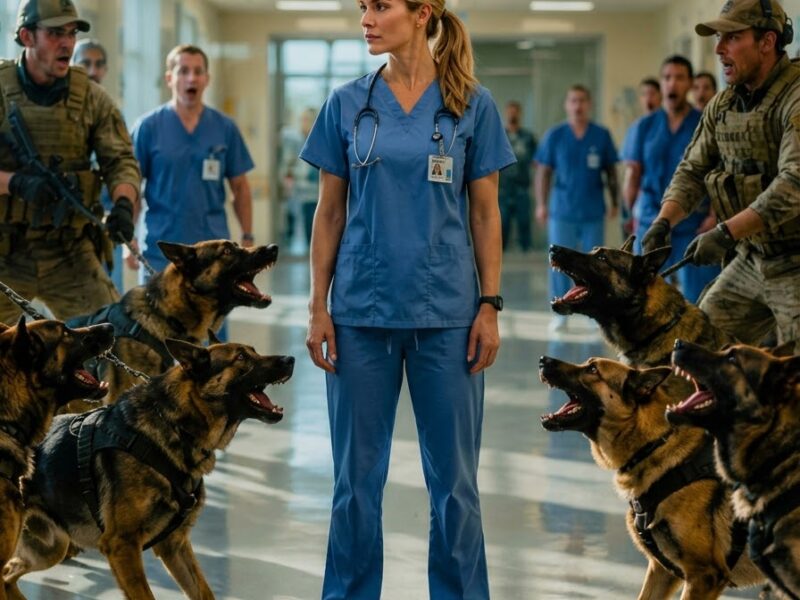
Five military K9s exploded into chaos inside a Texas hospital, dragging handlers across the emergency hallway while terrified staff backed away
The floor tiles of San Antonio Memorial Hospital’s emergency wing were cold, pristine, and polished to a mirror shine. It was a stifling Tuesday night in mid-August, precisely 2:14 a.m., when the heavy double doors at the end of the trauma corridor were kicked open with a violent, reverberating bang.
I was filing patient charts at the central nursing station, nursing a lukewarm cup of black coffee, when the noise shattered the quiet hum of the night shift. At first, I assumed it was an incoming multi-vehicle accident or an intoxicated patient being escorted by police. But then came the sound that made every nurse, orderly, and attending doctor freeze in their tracks.
It was a deep, guttural, synchronized roar—a collective howl of five high-drive military Belgian Malinois and German Shepherds erupting at once.
Five heavy-duty military K9 handlers in full tactical gear were literally dragged into the hallway, their boots skidding frantically against the slick linoleum floor. The dogs—massive, muscular, broad-chested animals clad in heavy Kevlar harnesses marked with federal tactical insignias—were completely out of control. They strained against their thick lead ropes, pulling their handlers like wild horses.
“Hold them! Hold the line!” a lead handler barked, his face red with exertion as he wrapped the heavy leather leash around his forearm, trying to dig his tactical heels into the floor.
Chairs were knocked over. A stainless-steel dressing cart was struck by the hindquarters of a dark sable Malinois, sending metal trays and sterile gauze packages clattering violently across the hallway. Patients popped their heads out of trauma bays; nurses backed away against the walls, terrified, their hands covering their mouths.
To any bystander, it looked like a catastrophic breach of military security—five lethal, attack-trained K9s snapping and snarling in an active medical environment.
“Get everyone out of the corridor! Clear the wing!” Dr. Robert Hayes shouted from behind the safety of the triage desk, gesturing frantically for the nursing staff to fall back behind the glass security partition.
The handlers fought desperately, using double-handed tension grips, short-leash commands, and physical blocks, but the dogs were entirely unresponsive to standard military obedience protocols. They weren’t biting the handlers. They weren’t lunging at the terrified staff.
They were staring, with absolute, terrifying fixity, at a single set of reinforced wooden doors at the end of the corridor—the entrance to ICU Isolation Room 12.
I stood my ground while everyone else backed away. I had worked as a night-shift trauma nurse at San Antonio Memorial for four years, but before that, I had spent my childhood on a dusty ranch in West Texas with my grandfather, Samuel Vance. My grandfather was a legendary master K9 breeder and trainer who had supplied dogs to elite military units for thirty years. I knew the difference between a dog acting out of uncontrolled aggression and a dog operating under intense, overwhelming psychological distress.
“Why are they all looking there?” I asked loudly, stepping past Dr. Hayes, my voice calm and steady above the chaos.
The lead handler, a burly sergeant with sweat dripping down his temple, glanced at me, his muscles trembling from the strain of holding back his massive sable Shepherd. “We don’t know, ma’am! We were escorting a classified transport unit through the rear service bay when all five of them broke formation! Stay back!”
The largest K9—a broad-headed sable German Shepherd weighing at least ninety pounds—suddenly broke free from his handler’s double grip. He didn’t attack. He sprinted ten yards down the hall and slammed both front paws hard against the heavy oak panel of ICU Room 12.
Boom.
The second dog—a lean, lightning-fast Belgian Malinois—escaped her leash and slammed her body right beside him.
Boom.
Then the other three followed in rapid succession, launching their front legs onto the door frame, whining, barking, scratching violently at the wood until the heavy panels shook on their steel hinges.
Boom. Boom. Boom.
The sound echoed through the high-ceilinged hallway like gunfire.
“Ma’am, step back right now! They are live tactical assets!” the sergeant yelled, reaching for his stun baton.
“Don’t touch them!” I barked back, stepping directly between the sergeant and the dogs.
Something inside my memory clicked into place. I stared at the five dogs. Their ears were pulled back flat against their skulls, their pupils were dilated, and their tails weren’t stiff in attack posture—they were tucked low, vibrating with a frantic, desperate fear.
My grandfather’s voice echoed in my head from fifteen years ago, clear as a bell: “Clara, when a trained K9 refuses an order from a qualified handler, don’t ever assume it’s disobedience. Ask yourself what he knows that you don’t. Ask what he’s trying to tell you.”
I took two steps forward until I was standing inches away from the massive sable Shepherd pounding on the door. I took a deep breath, dropped my posture, lowered my chest, and whispered a single word—a specific, low-frequency vocal command my grandfather had taught me on the ranch, a command reserved exclusively for high-stress recall in elite working dogs.
“Home.”
The transformation was instantaneous.
The massive sable Shepherd froze mid-scratch. His front paws slid slowly off the wooden door panel onto the floor. The other four dogs stopped instantly, their loud, frantic barks dying in their throats.
The entire emergency hallway fell into a dead, suffocating silence. Doctors, nurses, handlers, and security guards stood frozen, staring in absolute disbelief.
One by one, the five powerful military dogs lowered their broad heads. The largest Shepherd leaned his heavy shoulder against my hip, letting out a low, high-pitched whimper that sounded heartbreakingly human.
Dr. Hayes stepped forward cautiously, pulling a master keycard from his pocket. Without a word, he tapped the card against the electronic lock of ICU Room 12. The heavy door clicked and swung slowly inward.
Inside the dimly lit room, surrounded by chattering heart monitors and IV drips, lay an elderly veteran. He was unconscious, wrapped beneath a heavy thermal blanket, an oxygen mask strapped over his weathered face.
The moment the door opened, the five dogs didn’t rush in wildly. They walked in a single, silent file line, heads low, bodies trembling, and gathered around the bed.
The lead handler stared at me, his eyes wide with shock. “How… how did you know that command? That’s an old-school specialized recall protocol.”
I didn’t answer him. I couldn’t. I walked past him into the room, my eyes fixed entirely on the old man’s face.
The oxygen mask was clear, revealing a deep, jagged scar running from his cheekbone down to his jawline. I knew that face. I had seen it in old leather-bound photograph albums in my grandfather’s study. He was Colonel Joseph Miller—the legendary founder of the military’s specialized K9 unit and the man who had worked side-by-side with my grandfather for three decades.
On the bedside monitor, his heart rate was dropping rapidly—a sluggish 38 beats per minute.
Then, the old man’s fingers twitched against the white hospital sheet.
The largest sable Shepherd stepped closer, gently resting his heavy, velvet muzzle directly into the palm of the veteran’s limp hand.
The heart rate monitor chimed twice, sped up, and stabilized at a steady 65 beats per minute.
Everyone in the room watched in stunned silence as Colonel Miller’s eyelids fluttered open. His dark, glassy eyes moved slowly across the five dogs standing surrounding his bed, then rolled upward, locking directly onto me.
He pulled off his oxygen mask with a weak, trembling hand. His voice was a raspy, dry whisper, but it cut through the room like a razor.
“You’re… Samuel’s granddaughter,” Miller gasped.
A cold, electric shock ran down my spine. I hadn’t told anyone in this hospital my grandfather’s name. I used my mother’s maiden name on my employment records.
Colonel Miller swallowed hard, his chest heaving under the blanket, and then he whispered words that made the blood in my veins turn to solid ice.
“Your grandfather… didn’t die in that car accident twenty years ago, Clara.”
Before I could breathe, before I could ask a single question, all five military K9s in the room suddenly spun around in unison, their ears pinning flat, their eyes locked directly onto the open doorway of the ICU room.
Standing in the dimly lit hallway outside, framed by the harsh fluorescent lights, was a tall man in a dark trench coat.
And as he slowly pulled down his wet hood, I looked into the face of a man I had spent twenty years believing was buried beneath a marble headstone in West Texas.
The rain outside the high windows of the ICU wing was drumming a steady, ominous beat against the glass. Inside the room, the silence was absolute, heavy enough to weigh down my lungs.
My hands began to shake violently. The man standing in the doorway was older, his hair completely silver, his face lined with deep, rugged furrows, but those eyes—pale blue, sharp, and terrifyingly perceptive—belonged to only one person on earth.
“Grandpa?” The word left my throat in a strangled, desperate whisper.
Samuel Vance didn’t step into the room immediately. He stood on the threshold, his gaze sweeping over the five military handlers, the medical staff huddled in the hallway, and finally settling on Colonel Miller in the hospital bed.
The largest sable Shepherd—the one who had slammed against the door first—walked slowly toward my grandfather. The dog didn’t bark. He didn’t drop into a defensive stance. He dropped his snout directly into my grandfather’s left palm, giving a deep, ragged sigh of recognition.
“Stand down, Sergeant,” my grandfather said, his voice deep, gravelly, and carrying the unmistakable authority of a man who had spent forty years commanding men and animals alike. He was speaking to the lead handler. “All of you, clear the corridor. Lock the wing doors.”
The lead handler stepped forward, his hand resting on his sidearm holster, his expression torn between military protocol and shock. “Sir, I don’t know who you are, but this is an active military transport situation. This facility is under temporary federal jurisdiction—”
“I am Master Sergeant Samuel Vance, Service Number 884-01-A,” my grandfather interrupted, pulling a small, leather-bound brass credential case from his inner coat pocket and flipping it open. “And these five dogs belong to my private breeding ledger, leased to the Department of Defense under Special Operations Clause 9. Check your deployment orders, Sergeant. The contract was signed by me.”
The sergeant looked down at the brass badge, then at the digital tablet attached to his tactical vest. His face paled instantly. “Sir… the registry says you were listed as deceased in 2006.”
“The registry says what it was told to say,” Samuel said flatly. He turned his eyes back to me. “Clara. Close the door.”
My mind was spinning in a chaotic whirlwind. Twenty years of my life—twenty years of mourning, of remembering the tearful funeral, of looking at a stone monument in a quiet cemetery in El Paso—were shattered in a fraction of a second. Yet, my body moved automatically. I pushed past the stunned handlers, stepped into the hallway, and pulled the heavy oak door of ICU Room 12 shut, locking out the doctors and security guards.
I turned back, pinning my back against the locked door, staring at the ghost standing in front of me.
“You died,” I choked out, tears finally breaking through my composure, cutting warm paths down my cold cheeks. “We had a funeral, Grandpa. Mom cried herself to sleep for five years. I kept your pocket knife on my nightstand until I was eighteen. How could you do this to us?”
My grandfather closed his eyes for a brief, agonizing moment. For the first time, I saw a flicker of profound pain cross his weathered face.
“If I hadn’t died that night in 2006, Clara,” Samuel said softly, stepping closer to me, his heavy hand reaching out but hesitating before touching my shoulder, “you, your mother, and every person associated with my breeding program would have been buried in the ground within a week.”
Colonel Miller coughed weakly from the bed, his heart monitor giving a sharp chime as he forced himself to sit up slightly against the pillows. “Tell her… Samuel,” Miller rasped, his eyes fixed on the ceiling. “Tell her… before they track the K9 units… to this building.”
“Track them?” I asked, looking back and forth between the two old men. “Who is tracking you?”
My grandfather walked over to the corner of the room, pulling a small electronic device from his pocket—a black, rectangular signal jammer—and flipping the switch. A low, barely audible hum filled the room, neutralizing any cellular or radio frequencies within a fifty-foot radius.
“Twenty-two years ago,” Samuel began, his voice dropping into a low, deadly register, “Miller and I were tasked with developing a specialized canine unit for a classified intelligence branch operating out of Fort Sam Houston. They didn’t want standard protection dogs. They wanted dogs capable of detecting a specific, synthetic neurotoxin—a chemical agent developed under a black-budget contract known as Project Vanguard.”
I frowned, my nursing background instantly connecting the dots. “Vanguard… a organophosphate compound? A nerve agent?”
“Worse,” Colonel Miller interrupted, his hand resting on the head of the sable Shepherd resting beside him. “It’s an odorless, tasteless liquid toxin that mimics sudden cardiac arrest in elderly patients. It leaves no trace in standard toxicology screenings. It was designed for targeted assassinations of high-value political and military figures. The only thing on earth capable of smelling the synthetic binder in that compound before it degrades in human blood… is the olfactory system of a specific line of German Shepherds.”
My eyes widened in horror. “Your dogs.”
“My dogs,” Samuel confirmed grimly. “We bred six pups in the initial trial. These five dogs in this room—and their mother, the dog you saved when you were a child, Clara. But six months into the project, we realized the men funding Vanguard weren’t military intelligence. They were a rogue private contractor syndicate operating inside the defense network. They were planning to use the toxin domesticity.”
Samuel stepped closer to the bed, looking down at Miller. “When Miller and I tried to shut the project down and destroy the records, they staged the car crash in El Paso. I survived only because Miller pulled me from the burning wreck before the vehicle exploded. We realized the only way to protect the bloodline—and to keep you alive, Clara—was for me to go under the grid permanently.”
“Then why are you here now?” I demanded, my voice rising in panic. “Why bring five military K9s into a public hospital in the middle of San Antonio at two in the morning?”
Colonel Miller lifted his right hand. His skin was pale, gray, and covered in cold sweat.
“Because, Clara…” Miller whispered, pointing to the empty IV bag hanging from his drip pole. “They finally found me three hours ago at my farm. They poisoned me with Vanguard.”
My stomach dropped into a bottomless void. I ran to the IV pole, grabbing the empty plastic bag. Attached to the injection port was a microscopic, puncture mark.
“They didn’t just poison him to kill him,” Samuel said, his voice chillingly calm as he looked at the five dogs resting on the floor. “They poisoned him to draw out the five K9s. These dogs are the only living evidence left that can prove the existence of the Vanguard compound in a court of law. If Miller dies, and these dogs are euthanized or destroyed by the syndicate’s handlers… the men behind Vanguard become untouchable forever.”
Suddenly, the red emergency lights set into the ceiling of ICU Room 12 flickered twice, buzzed violently, and went completely dark.
The hospital’s main power grid was dead.
From the hallway outside, past the heavy wooden door, came a sudden, horrific sound—the sharp, muffled crack-crack-crack of suppressed firearms, followed by the heavy thud of bodies hitting the floor.
The dark swallowed the ICU room whole, leaving only the pale blue glow of battery-operated emergency monitors flickering against the walls. The air instantly turned heavy, thick with the smell of ozone, metallic blood, and the unmistakable stench of terror.
“Down!” my grandfather barked, his voice dropping an octave into pure combat command.
I dropped to the floor behind the heavy steel medical cabinet, my heart pounding against my ribs like a trapped bird. Beside me, all five military dogs didn’t panic. They didn’t bark. They dropped flat on their bellies in absolute unison, their ears pinned back, their bodies perfectly still, converting from distressed animals into lethal, silent weapons of war.
Through the heavy oak door of Room 12, the sounds of the hallway were terrifyingly precise.
Thump. Thump. Thump.
It was the distinct, rhythmic sound of heavy tactical boots stepping over broken glass and fallen bodies. There was no shouting, no hospital alarms ringing—the syndicate’s strike team had severed the primary power lines and muted the internal emergency broadcast system. This wasn’t a robbery or a spontaneous breach; it was a professional, high-tier clean-up operation.
“How many?” Miller whispered from the bed, his voice incredibly weak as his oxygen supply cut off with the power failure.
Samuel peered through the narrow, inch-wide glass window set into the top frame of the door. The hallway outside was bathed in the eerie red glow of emergency floor strips.
“Four men,” Samuel reported quietly, his pale eyes tracking their movement in the dark. “Full tactical gear, suppressed submachine guns, thermal optics. They’ve already taken down the military handlers in the hallway. They’re sweeping room by room.”
My blood ran cold. “The handlers… are they…”
“Incapacitated,” Samuel said flatly, keeping his tone stripped of emotion to keep my focus sharp. “Clara, look at me.”
I turned my head toward him in the red-lit shadows.
“You’re a trauma nurse,” he said, taking my hands in his. His grip was broad, calloused, and impossibly steady—the exact same grip he used to hold when he taught me how to handle wild horses on the ranch. “You know human anatomy. You know how these dogs think. In thirty seconds, those men are going to blow the lock on this door. They think they are entering a room with an unconscious old man, a terrified female nurse, and five panicked dogs.”
He reached beneath his trench coat and pulled out a heavy, matte-black 9mm pistol, checking the magazine with a slick, practiced click.
“They don’t know that you know the Vanguard operational commands,” Samuel whispered, placing a small tactical flashlight into my palm. “I can take two of them from the threshold. But the other two will breach through the side drywall. I need you to handle the K9 unit.”
“Grandpa, I haven’t commanded a working pack since I was twelve!” I whispered frantically, terror threatening to paralyze my chest.
“The dogs don’t care about your age, Clara,” Samuel said, his eyes burning into mine with absolute, unwavering faith. “They care about your alpha presence. They recognized you the moment you said ‘Home’. Now give them a reason to fight for you.”
CLICK.
A small, metallic device was slapped against the exterior lock of our door. A high-pitched electronic hum began to whine—a thermal breaching charge.
“Five seconds!” Samuel yelled.
He pulled me down behind the heavy steel frame of the crash cart, raising his pistol toward the door frame.
BOOM!
The wooden door exploded inward in a shower of splintered oak, red sparks, and heavy smoke.
Before the dust could even settle, the first tactical operator stepped through the threshold, his suppressed weapon raised, the green beam of his laser sight cutting through the smoke directly toward Colonel Miller’s bed.
PFFT! PFFT!
Samuel fired twice from his knees. The heavy 9mm rounds struck the operator directly in his chest plate. The force knocked the man back against the door frame, but his heavy Kevlar armor absorbed the kinetic impact. He recovered instantly, raising his submachine gun to return fire.
“Clara! NOW!” Samuel roared.
The fear in my body vanished, replaced by an ancient, instinctual surge of adrenaline passed down through generations of my bloodline. I didn’t hide. I stood straight up from behind the crash cart, stepping into the red emergency light, my voice cutting through the ringing in my ears like a whip crack.
“PACK! ATTACK-ONE! BREAK!”
It was the ultimate tactical breach command—a German phrase my grandfather had modified on his ranch twenty years ago, instructing a multi-dog team to split into cross-coverage angles rather than a single frontal assault.
The five military K9s launched off the tile floor like artillery shells.
The largest sable Shepherd—Thor—went straight for the lead operator’s primary weapon arm, his jaw locking around the contractor’s wrist with ninety pounds of crushing force. The weapon discharged harmlessly into the ceiling as the contractor dropped to his knees with a scream of agony.
Simultaneously, the two Belgian Malinois vaulted off the top of the medical cabinet, jumping over Thor’s head, and landed directly onto the second contractor standing in the hallway, dragging him backward out of the doorway into the darkness.
CRASH!
As Samuel predicted, the wall to our left suddenly exploded inward as the third contractor kicked through the thin hospital drywall from the adjoining room, swinging his weapon toward my grandfather’s back.
“Grandpa! Left!” I screamed.
Without waiting for my grandfather to turn, the fourth K9—a smaller, incredibly fast female Malinois—drove her body through the air, tackling the third contractor directly through the broken drywall back into Room 11.
The room erupted into absolute, violent chaos—the sound of breaking wood, screams of pain, suppressed gunshots slamming into the ceiling, and the terrifying, relentless roars of five elite K9s conducting a master-class ambush in close quarters.
The fourth contractor—the team leader—stepped through the ruined doorway, raising a heavy flashbang grenade to clear the room.
I didn’t think. I grabbed a heavy, stainless-steel oxygen cylinder from the wall rack and swung it with all my strength, slamming the heavy iron base directly into the side of his tactical helmet.
CLANG!
The helmet cracked. The team leader staggered backward, dropping the flashbang onto the floor.
Samuel lunged forward, kicking the armed grenade down the hallway away from our room, and drove his shoulder hard into the team leader’s chest, pinning him against the wall, driving his firearm away.
Within ninety seconds, the hallway went completely, terrifyingly silent once again.
All four tactical contractors were on the floor—two unconscious from blunt trauma and K9 impacts, two securely pinned beneath the jaws of Thor and the Belgian Malinois, their weapons stripped and scattered across the red-lit floor.
I stood in the center of the room, my chest heaving, holding the heavy iron oxygen tank, my scrubs covered in plaster dust and blood.
My grandfather stood over the contractor team leader, his pistol pointed directly between the man’s eyes, his breath calm and controlled. He slowly looked up at me, a faint, proud smile breaking through his dirt-streaked face.
“Not bad for a night-shift nurse,” Samuel said softly.
But before I could breathe a sigh of relief, Colonel Miller let out a terrible, gasping cough from the bed behind us.
The monitors connected to his chest began to flatline.
EEEEEEEEEEEEEE—
“He’s going into cardiac arrest!” I screamed, dropping the oxygen tank and running to the bedside. “The Vanguard compound… it’s shutting down his brainstem!”
My grandfather ran to my side, his eyes filled with sudden, desperate panic. “Can you save him, Clara?”
“Not here!” I yelled, pulling the manual resuscitation bag from the shelf and hooking it over Miller’s face. “The power is out! The crash carts are dead! We have to get him to the main surgical trauma bay on the first floor—they have emergency generator power and the counter-toxin agents!”
Samuel looked down the dark, blood-stained hallway toward the elevator shaft.
“The elevators are down,” Samuel said grimly. “We’ll have to carry him down three flights of stairs in total darkness. And their backup team is waiting outside.”
The air in the central stairwell was damp, freezing, and smelled of rust and cold rain.
The heavy concrete shaft acted like a megaphone, amplifying every sound from above and below. We were moving as a fast, tactical medical column down the narrow metal stairs—Samuel led the front, his 9mm raised, his flashlight cutting through the pitch-black darkness; I was in the middle, pushing a narrow, heavy-duty transport gurney carrying Colonel Miller, manually squeezing the rubber oxygen bag every three seconds to keep his heart beating; and behind us, guarding our rear, were the five military K9s, moving in complete, absolute silence.
Thor, the massive sable Shepherd, walked beside my knee, his nose resting against the aluminum frame of the gurney, his brown eyes never leaving Colonel Miller’s pale face.
“He’s losing oxygen saturation,” I whispered frantically as we reached the landing for the Second Floor. “His skin is turning blue, Grandpa. If I don’t get an IV line of atropine and pralidoxime into his blood within four minutes, his brain tissue will starve!”
“We’re almost at the service bay entrance,” Samuel said quietly, pausing at the heavy steel door of the second-floor landing, listening intently to the silence beyond. “The main emergency trauma bay is just fifty yards through the central radiology corridor.”
Suddenly, Thor’s ears pinned back flat against his skull. He let out a low, barely audible vibration from deep within his chest.
The other four dogs behind us instantly dropped into low crouches on the concrete stairs, their bodies rigid as iron bars.
“What is it, Thor?” I whispered, dropping to one knee, placing my hand on his head.
My grandfather leaned his ear against the heavy steel door of the stairwell. “They brought reinforcements,” he muttered, his jaw tightening. “I hear at least six men moving through the radiology corridor. They’ve established a perimeter around the trauma bay. They know we have to bring Miller there to save him.”
“They are waiting for us to walk into an ambush,” I said, my heart sinking into my stomach. “If we go out there, they’ll open fire before we can even step through the doors.”
“We aren’t going to walk through the doors,” Samuel said, his eyes flashing with a ruthless tactical intelligence. He turned to look at the five dogs resting on the stairs behind us. “Clara, do you remember the diversion drills we ran with the pups on the ranch when you were ten?”
I blinked, my mind racing back through fifteen years of childhood memories. “The… the decoy-scent split?”
“Precisely,” Samuel said, reaching into his pocket and pulling out the empty glass vial that had contained the Vanguard toxin from Miller’s room. He smashed the glass on the concrete floor, using a piece of sterile gauze from my scrub pocket to wipe up the concentrated liquid residue, absorbing the distinct, chemical scent of the compound. “These dogs have been trained for five years to track this specific chemical signature. If I send them out through the second-floor ventilation access, they will hit the radiology corridor from behind, creating an immediate, high-stress perimeter breach.”
“Grandpa, no!” I gasped, grabbing his sleeve. “They have automatic weapons! If you send the dogs out there alone, they’ll be slaughtered!”
Samuel looked down at Thor, then looked back at me, his eyes filled with an undeniable, fierce pride. “Look at them, Clara. They aren’t house pets. They are military veterans who have served three tours overseas. They know exactly what’s at stake. And they won’t fail.”
He knelt down before the five dogs. He held the scent-soaked gauze in front of Thor’s nose, then passed it down the line to the other four.
Every dog’s pupils dilated instantly. Their breathing turned into sharp, rapid huffs of pure operational readiness.
Samuel pointed to the heavy metal air duct set high into the wall of the stairwell landing—a massive, industrial ventilation shaft that led directly into the drop ceiling above the radiology corridor.
“Go,” Samuel whispered, using the low, guttural deployment command. “HUNT-CLEAR.”
Thor didn’t hesitate. He launched himself off the concrete steps, leaping onto the handrail, and plunged directly into the open metal duct. The other four dogs followed him in rapid, silent succession, their bodies disappearing into the dark, echoing ventilation system like ghosts.
“Now,” Samuel said, grabbing the handles of Miller’s gurney. “The moment they breach the ceiling, we hit the corridor floor.”
We waited fifteen agonizing seconds in the pitch darkness of the stairwell. I squeezed the oxygen bag—one… two… three… pulse. Miller’s heart rate was a terrifying 22 beats per minute on the battery monitor.
Then, through the heavy steel door, the ceiling of the radiology corridor shattered.
CRASH! CRASH! CRASH!
Five ninety-pound military K9s rained down through the acoustic ceiling tiles directly onto the heads of the tactical strike team waiting in the hallway below.
Screams of pure terror, shouts of confusion, and the chaotic noise of automatic gunfire erupted through the corridor as the contractors were hit from above by five relentless, airborne forces of nature.
“MOVE!” Samuel roared.
He kicked the heavy steel stairwell door open. We burst out into the long, brightly lit radiology corridor, pushing Colonel Miller’s gurney at a full sprint.
The hallway was a scene of utter, absolute tactical chaos. Ceiling tiles, insulation, and light fixtures were scattered across the floor. Three contractors were flat on their backs, struggling desperately against the crushing grips of the Belgian Malinois; two others were running frantically toward the rear exit, pursued by Thor.
Not a single weapon was pointed at us. The diversion was 100% effective.
We slammed through the double doors of the main emergency trauma bay. The room was brightly lit, powered by the hospital’s auxiliary emergency generators.
“I need an IV line of Atropine 2mg and Pralidoxime immediately!” I screamed at the two night-shift nurses standing frozen in shock behind the counter. “Code Red military trauma! MOVE!”
The nurses snapped into action, recognizing the pure authority in my voice. Within thirty seconds, I had pushed the stainless-steel needle into my father’s—into Colonel Miller’s—central line, flushing the powerful neutralizing agent directly into his bloodstream.
I attached the automatic respirator, stepped back, and fell against the stainless-steel prep table, my lungs burning, my entire body shaking uncontrollably.
Beside me, the digital heart monitor chimed once. Then twice.
30 beats per minute… 45 beats per minute… 60 beats per minute… 72 beats per minute.
The flat, jagged line smoothed out into a strong, perfectly rhythmic, healthy sinus rhythm.
Colonel Miller let out a long, deep, natural breath of air. His eyes opened slowly, no longer glassy or unfocused, but bright, clear, and filled with life.
He looked up at the ceiling, then turned his head slowly to look at my grandfather, who was standing beside the bed, leaning heavily on the steel rail, his eyes glistening with unshed tears.
“We… did it, Samuel,” Miller rasped, a faint, genuine smile breaking across his scarred face. “The bloodline… held the line.”
Through the double doors of the trauma bay, Thor walked slowly into the room. His sable fur was covered in plaster dust, but he walked with his head held high, stepping up to my side, placing his heavy, warm snout directly into my trembling palm.
I dropped to my knees right there on the trauma bay floor, throwing my arms around his broad, thick neck, burying my face in his fur, and wept like a child.
By 06:00 a.m., the storms over San Antonio had cleared, leaving behind a crisp, golden sunrise that washed through the floor-to-ceiling glass windows of the hospital’s main lobby.
The building was surrounded by dozens of black federal vehicles, flashing red-and-blue lights of state police cruisers, and heavily armed military personnel from Fort Sam Houston. The rogue contractor syndicate—including the three high-ranking political officials who had funded Project Vanguard—had been swept up in a massive, coordinated federal raid triggered by the encrypted data my grandfather had transmitted from the hospital’s secure terminal during the siege.
The corridor was no longer a war zone. It was filled with federal marshals, military K9 handlers standing at attention, and hospital administrators moving in quiet, respectful awe.
Inside Trauma Bay 1, Colonel Miller was sitting up in bed, drinking a cup of warm broth, surrounded by the five military K9s who refused to leave his side. Thor lay sprawled across the foot of his bed like a dark, living sentinel.
I stood near the window, holding a warm cup of coffee, watching the sun rise over the city skyline.
Footsteps approached from behind—heavy, slow, and familiar.
My grandfather stepped up beside me, leaning his forearms against the window frame, looking out at the golden light. He was dressed in a clean military utility jacket provided by the base commander, his silver hair neatly combed back.
“I know you have a thousand questions, Clara,” Samuel said quietly, his voice filled with a deep, gentle warmth I hadn’t heard in twenty years. “And I promise you, I will answer every single one of them. I’m not going anywhere ever again.”
I turned my head to look at him, my heart feeling lighter than it had in two decades. “Mom… she’s going to hit you when she sees you.”
A genuine, booming laugh echoed from my grandfather’s chest—the same deep, joyful laugh that used to echo across the West Texas ranch when I was a little girl. “She has every right to, Clara. She has every right to. But when she sees that you’ve turned into the strongest, bravest woman this family has ever produced… I think she might forgive me.”
He looked back toward the bed where Colonel Miller was gently stroking Thor’s dark ears.
“You saved his life tonight, Clara,” Samuel said softly. “And you saved mine. If you hadn’t stepped forward when those dogs broke loose… if you hadn’t remembered what I taught you…”
“I never forgot, Grandpa,” I interrupted, looking into his pale blue eyes. “Not a single word. You taught me that working dogs don’t lie. They don’t know how to betray who they are. They just follow the bond.”
“And you are part of that bond,” Samuel said, reaching out and gently squeezing my shoulder. “The Vance bloodline doesn’t just breed K9s, Clara. We protect them. And they protect us.”
The door to the trauma bay opened, and the lead military handler—Sergeant Alvarez—stepped into the room. He was no longer holding his sidearm; he carried a heavy, velvet-lined wooden box under his arm.
He walked straight up to me, coming to a sharp, flawless military attention, and saluted.
“Nurse Clara Vance,” Alvarez said, his voice echoing clear and strong through the room. “By order of the Special Operations K9 Command at Fort Sam Houston, the active service leases for K9 Thor, K9 Sentinel, K9 Maya, K9 Bear, and K9 Duchess have been officially transferred.”
He opened the wooden box. Inside lay five official, silver-plated military registration tags, stamped with my name as the primary master handler and owner of the bloodline.
“They belong to you now, ma’am,” Alvarez said with deep respect. “Where you go… they follow.”
I looked down at the wooden box, then looked at the five massive, beautiful dogs resting in the room.
Thor stood up from the bed, walked over to me, and placed his heavy, velvet head directly into my open hand. I leaned down, resting my forehead against his broad skull, feeling the steady, powerful rhythm of his breathing.
I had spent twenty years believing I was an orphan of a broken past, working lonely night shifts in a crowded hospital, searching for a purpose.
I looked at my grandfather standing beside me, at Colonel Miller smiling from the bed, and at the five elite K9s surrounding my feet.
I wasn’t alone anymore. I was home.
The end.









