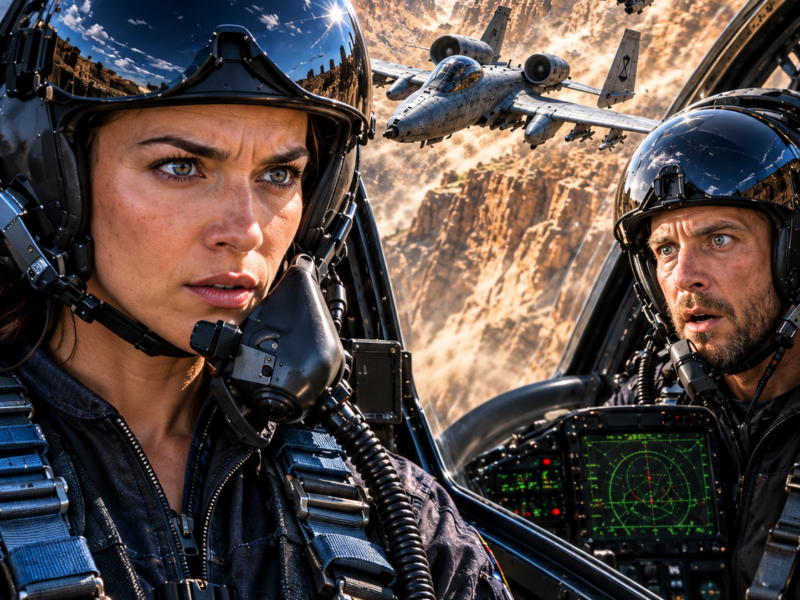
“Fat pig lost from the farm,” Reed Callahan sneered over the open radio channel. “Eject now, or burn with your junk heap.”
The first thing I noticed as we entered Devil’s Spine Canyon was how quickly the sky disappeared.
One moment, I had open desert beneath me and two enemy fighters closing from behind. The next, towering walls of dark stone rose on both sides of my canopy, swallowing the horizon.
The canyon was narrow enough to make every movement feel deliberate.
There was no room for careless turns. No room for hesitation.
And, most importantly, no room for the kind of speed Reed Callahan and Bryce Talbot had been counting on.
“Look at this,” Talbot said over the radio. “The old girl thinks she can hide in a crack.”
I kept my eyes forward.
“She’s not hiding,” Callahan replied. His voice had changed. “She’s setting something up.”
Talbot laughed.
“Then let’s finish it.”
His fighter dropped lower behind me.
I watched the canyon walls slide past and waited for the first sign that he was becoming impatient.
It didn’t take long.
A warning tone screamed through my headset.
Missile.
I pushed the A-10 into a sharp evasive movement as the missile streaked toward the canyon. The explosion flashed against the rock behind me, filling the air with dust and fragments.
My aircraft shuddered.
For one terrible second, I thought the blast had damaged something important.
Then the controls answered.
Still flying.
I exhaled.
“Missed,” I said quietly.
Talbot came back on the radio.
“Lucky shot, pig.”
I didn’t answer.
I was listening to the aircraft.
Every vibration meant something. Every change in engine noise mattered. I knew the Warthog well enough to recognize when she was unhappy.
And right now, she was very unhappy.
But she was still with me.
Behind me, Talbot and Callahan followed deeper into the canyon.
I caught a glimpse of Talbot’s fighter between two rock formations. He was pushing hard, trying to close the distance.
Callahan stayed farther back.
He wasn’t chasing blindly anymore.
That worried me more than Talbot’s aggression.
“Bryce, slow down,” Callahan warned. “Something’s wrong.”
“What’s wrong is that you’re getting old.”
“Look at her tail.”
Talbot didn’t respond immediately.
I knew what Callahan had seen.
The black hourglass.
It was painted beneath the tail number, small enough that most people would miss it unless they knew to look.
I had chosen that symbol years ago.
Not because I wanted a reputation.
Because I wanted to remember the people who never made it home.
The first time I wore it, I was flying with a different squadron in a different war.
We had been sent into a canyon to support a unit pinned down by enemy fighters. My aircraft had taken damage almost immediately.
One engine was failing.
The other was barely holding.
I had two fighters behind me and no clear route out.
I survived.
They didn’t.
The story spread through mercenary circles, growing more dramatic every time someone repeated it.
Eventually, they gave me a name.
The Widowmaker.
I never liked it.
But I never removed the symbol.
“Callahan?” Talbot finally asked.
“Break off,” Callahan ordered.
Talbot laughed.
“You’re serious?”
“That’s the Widowmaker.”
Silence.
Then Talbot spoke again.
“That’s a bedtime story.”
“Bryce, break off now!”
But Talbot had already committed.
I watched his fighter descend into the canyon behind me.
He wanted a clean shot.
He wanted to prove that the stories were nonsense.
I had no intention of helping him.
The canyon widened ahead into a natural bowl surrounded by steep rock walls. I had studied this area before, years earlier, during a training flight.
It was the only place in this section where I could turn without scraping the canyon walls.
I eased the A-10 into the open space.
Talbot followed.
Callahan remained near the entrance.
That told me everything.
One of them was still thinking.
The other was already convinced he had won.
I brought the Warthog around and faced Talbot.
For a moment, neither of us moved.
He seemed surprised.
“What’s the matter?” he asked. “Out of road?”
I watched his aircraft.
He was coming in too fast.
I didn’t need to be faster than him.
I only needed him to make one mistake.
“Last chance,” I said.
He laughed.
“Eject, old woman.”
Then he attacked.
The canyon filled with the sound of engines and warning tones. I pulled the Warthog away as his first burst passed behind me.
He corrected quickly, but the rock walls were closing around him.
His fighter was built for speed and open sky.
This was neither.
He tried to pull away.
For a brief moment, his aircraft disappeared behind a wall of stone.
Then I saw the flash.
The explosion lit the canyon.
A heavy shock rolled through the air, followed by a cloud of smoke that climbed between the cliffs.
Talbot’s fighter was gone.
I didn’t cheer.
I didn’t smile.
I simply kept flying.
“Bryce?” Callahan shouted.
No answer.
“Bryce, respond!”
The radio gave him nothing but static.
Then his voice returned, lower and colder.
“You killed my wingman.”
“He made his choice.”
“You’re going to pay for that.”
I looked at the fuel gauge.
The needle was lower than I wanted.
My countermeasures were nearly gone.
One Sidewinder remained.
And Callahan was still out there.
“Come and collect,” I said.
I pushed the A-10 toward the far end of the canyon.
Callahan didn’t follow immediately.
He climbed.
He knew the canyon had taken away his greatest advantage. Now he wanted to regain the open sky and attack from above.
I couldn’t let him choose the entire engagement.
But I couldn’t stop him from climbing either.
The Warthog was never going to win a contest of speed against his fighter.
That wasn’t what she was built for.
I needed to make him spend time, attention, and ammunition.
I needed him to believe he still had control.
As the canyon opened into the desert, I caught sight of the distant Kestrel corridor.
Smoke was rising from the road.
Briggs’s convoy.
I checked the radio.
“Briggs, this is Kesler. Status?”
Static crackled.
Then his voice came through.
“Still here, Captain. Though I wouldn’t recommend the scenery.”
I almost laughed.
“Enemy armor?”
“Still advancing. We’ve got two vehicles left and not much room to move.”
“I’m coming back.”
“Thought you were busy.”
“I am.”
A brief pause followed.
“Then we’ll try not to die before you arrive.”
I turned toward the corridor.
A warning tone sounded again.
Callahan had returned.
His fighter appeared above the desert, sunlight flashing across its wings.
He was higher, faster, and in a position I couldn’t ignore.
“Enough games,” he said over the radio.
I checked my remaining weapon.
One Sidewinder.
It wasn’t enough to guarantee a kill.
But it might be enough to change his plans.
I waited until he began his next attack.
Then I launched.
The missile climbed toward him.
Callahan reacted immediately. His fighter broke away as countermeasures scattered through the sky.
The missile lost its lock.
It disappeared into the distance.
I had spent my last air-to-air weapon.
But Callahan had been forced to abandon his attack.
For several seconds, neither of us spoke.
Then he came back on the radio.
“You’re out of missiles.”
“Yes.”
“No friends.”
“Correct.”
“And you’re running out of fuel.”
I glanced at the gauge.
He was right.
“Anything else?”
“You’re finished.”
I looked at the black hourglass painted on the tail.
“People have been telling me that for years.”
He attacked.
The first impact shook the aircraft violently.
An alarm began screaming.
The right engine temperature surged, and smoke rolled across the side of the fuselage.
The controls suddenly felt heavy.
I fought the aircraft back into a stable attitude.
Another warning appeared.
Hydraulics.
My stomach tightened.
The A-10 was tough, but toughness wasn’t magic.
She could survive damage that would destroy other aircraft, but there were limits.
I had just reached one.
The right engine was failing.
The hydraulic system was badly damaged.
I could feel the aircraft fighting every movement.
Callahan’s voice came through.
“Still alive?”
I didn’t answer.
I was busy keeping the Warthog in the air.
The right engine began to lose power.
I shut it down before the damage could spread.
The sudden silence on that side was almost worse than the noise had been.
Now I had one engine.
A damaged wing.
Degraded controls.
And a convoy that was still under attack.
I could turn south and try to make it home.
That was the sensible decision.
It was probably the decision anyone else would have made.
Then I heard Briggs again.
“Captain, we’ve got movement on the eastern side. They’re pushing through the trees.”
I looked toward the corridor.
Two burning vehicles marked the road where his convoy had been.
The remaining trucks were barely visible through the dust.
Briggs and his men were still holding.
They had stayed because they believed air support was coming.
I couldn’t abandon them now.
“Briggs, keep your people under cover.”
“Copy.”
“Do not move into the open.”
“Wasn’t planning on it.”
I turned the damaged A-10 toward the battlefield.
The aircraft responded slowly, but it responded.
I could hear the remaining engine straining.
“Come on, girl,” I whispered.
“Just a little farther.”
Callahan followed.
He had seen the damage.
He knew I was no longer a serious threat in the air.
He also knew I was heading back toward the convoy.
That made him dangerous in a different way.
He didn’t need to defeat me in a perfect dogfight.
He only needed to stop me from reaching Briggs.
I descended toward the corridor.
The smoke from my damaged engine left a dark trail behind me.
Below, enemy armor continued advancing along the eastern tree line.
Briggs’s remaining vehicles were positioned behind a low ridge, with soldiers scattered along its western edge.
I could see muzzle flashes in the distance.
The ground forces were still fighting.
I called Briggs.
“I’m coming in from the west.”
His response was immediate.
“Captain, you look terrible.”
“That’s not what my mechanic says.”
“Your mechanic hasn’t seen you yet.”
“Get your people ready.”
I couldn’t offer them a perfect strike.
I couldn’t promise that my aircraft would survive another engagement.
But I could still make the enemy look up.
And sometimes that was enough.
I passed over the ridge.
The remaining enemy vehicles changed direction as the Warthog appeared above them.
Their advance slowed.
Then it stopped.
They had expected the sky to belong to them.
Instead, they saw the same battered aircraft that had already driven them back once.
I kept the pressure on until the enemy formation began to scatter.
One vehicle abandoned the road.
Another turned toward the trees.
The rest followed.
Briggs’s men were still alive.
That was what mattered.
Then Callahan appeared behind me.
“Your little show is over,” he said.
I checked the warning panel.
The missile system was no longer giving him the reliable options he wanted.
He was going to have to come closer.
He switched to guns.
I knew what that meant.
He wanted a clean, final pass.
I also knew that the A-10 could not survive another sustained attack.
The remaining engine was already struggling.
The controls were becoming less responsive.
The aircraft was slowly running out of ways to forgive me.
“Captain,” Briggs called. “You’ve got company.”
“I know.”
“Can we help?”
“Keep your heads down.”
“That’s getting old.”
“Then stay alive long enough to complain about it.”
I leveled the Warthog.
For a moment, I did nothing.
The desert stretched ahead.
The damaged engine smoked.
The aircraft trembled.
I wanted Callahan to see exactly what he expected to see.
A wounded plane.
A tired pilot.
A target that could barely stay in the air.
He came closer.
His voice returned, almost amused.
“Looks like the legend finally ran out of luck.”
I stared through the canopy.
“No,” I said. “You just ran out of patience.”
He closed the distance.
I held steady.
The warning tone grew louder.
The canyon was behind us now.
There was no wall of stone to protect me.
No narrow passage to limit his movement.
Just open sky.
Callahan believed he had the advantage.
And he did.
But he had also spent the entire engagement trying to force me into a fight on his terms.
Now he was close enough to believe the fight was already over.
I made my move.
The damaged Warthog climbed sharply.
The maneuver was rough, ugly, and far from graceful.
My injured aircraft protested with every vibration.
For one frightening second, I thought the remaining engine would quit.
Then the nose came around.
Callahan’s fighter flashed across my view.
I fired.
The sound of the cannon overwhelmed everything else.
The sky ahead filled with smoke and bright flashes.
Callahan’s aircraft jerked away.
For a moment, it seemed to hang in the air.
Then flames appeared along its body.
He was going down.
I watched him pull away from the aircraft.
His ejection seat carried him into the sky, followed by a white parachute opening above the desert.
I didn’t celebrate.
I didn’t have the strength.
I simply watched until I was certain he was alive.
Then I turned toward the corridor.
The radio erupted.
“Captain Kesler!” Briggs shouted.
“I’m here.”
There was a pause.
Then he laughed.
“You magnificent, stubborn woman.”
“That’s one way to describe me.”
“Your aircraft looks like it’s been through a building.”
“I’m beginning to suspect it has.”
“Enemy forces are retreating. They’re pulling back toward the eastern road.”
I looked down.
The armored vehicles were no longer advancing.
Some had disappeared into the trees.
Others were moving away from the corridor.
Without their fighters, they had lost the confidence to continue.
Briggs’s remaining soldiers were standing up behind the ridge.
I could see them waving.
One of them held a helmet above his head.
Another was pointing at the Warthog.
I wished I could wave back.
But my hands were occupied.
The aircraft was becoming harder to control.
I needed to get home.
“Briggs, report your status.”
“Two vehicles operational. Several wounded. No confirmed fatalities in my immediate group.”
“Understood.”
“And, Captain?”
“Go ahead.”
“Coffee’s waiting when you get back.”
I smiled for the first time since entering the canyon.
“Make it strong.”
“After today? I’ll make a whole pot.”
I started the long journey home.
The A-10 was no longer flying like an aircraft.
It was flying like a promise that refused to be broken.
The remaining engine carried us forward.
The damaged controls responded when they could.
Every mile felt longer than the last.
I watched the temperature readings and listened for changes in the engine’s rhythm.
The smoke trail continued behind us.
I kept the aircraft as stable as I could.
The radio remained quiet for several minutes.
Then another voice came through.
“Widowmaker, this is Kestrel command. Do you copy?”
“Go ahead.”
“We have your position. Rescue and recovery crews are being prepared.”
“I’m still airborne.”
“We can see that. You’re also leaving a smoke trail visible from the next county.”
“Then you shouldn’t have trouble finding me.”
A pause followed.
“Captain, do you have any idea what you’ve just done?”
I looked at the fuel gauge.
“Saved a convoy?”
“You defeated two hostile fighters in an aircraft that should have been on the ground.”
I glanced at the damaged engine.
“She’s not on the ground yet.”
The controller gave a short laugh.
“Copy that. Bring her home.”
I didn’t tell him how uncertain I felt.
I didn’t tell him that my hands were beginning to ache from fighting the controls.
I didn’t tell him that every new vibration made me wonder whether the aircraft was about to come apart.
I just kept flying.
The airfield finally appeared ahead.
It was a small strip surrounded by dry hills and scattered buildings.
I had landed there many times.
Never had it looked so beautiful.
The tower cleared the runway.
Emergency vehicles waited nearby.
I could see people gathering along the edge of the apron.
I lowered the aircraft toward the runway.
The damaged engine shook.
The controls felt heavy.
I made one final correction and brought the Warthog down.
The landing was rough.
The aircraft bounced once before settling onto the runway.
I kept it straight.
Then the wheels slowed.
The engines fell quiet.
For several seconds, I remained in the cockpit.
I could hear my own breathing.
I looked at the damaged instruments.
At the warning lights.
At the smoke drifting past the canopy.
Then I rested my forehead against the helmet.
“We made it,” I whispered.
When I climbed down, the ground crew was already surrounding the aircraft.
Nobody spoke at first.
They simply stared at the damage.
The right side was blackened.
Part of the wing was torn.
The fuselage was scarred by impacts.
The remaining engine looked as though it had spent the entire flight trying to escape its own mounting.
A young mechanic finally broke the silence.
“Captain, how did you get this thing back?”
I looked at the Warthog.
“Carefully.”
He shook his head.
“That’s not an answer.”
“It’s the only one I’ve got.”
A medical officer approached and asked whether I was injured.
I told him I was fine.
He looked at my hands.
They were shaking.
“Captain,” he said, “you need to sit down.”
I was about to argue when I heard another voice.
“She’s right, Kesler.”
I turned.
Briggs stood a few yards away.
His uniform was dusty, his face streaked with dirt, and one arm was wrapped in a bandage.
He looked exhausted.
But he was smiling.
“You made it,” I said.
“So did you.”
He walked toward the aircraft and looked at the damage.
“That’s a lot of holes.”
“Some of them are decorative.”
“Very expensive decorations.”
I laughed.
It hurt more than I expected.
Briggs stopped beside me.
For a moment, he didn’t say anything.
Then he extended his hand.
I took it.
“Thank you,” he said.
Those two words carried more weight than any medal or speech.
I nodded.
“You kept your people together.”
“We kept them alive.”
“That’s what matters.”
He glanced toward the airfield entrance.
“By the way, they found your friend.”
I knew who he meant.
“Callahan?”
“Alive. Parachuted down beyond the eastern road. One of my teams picked him up.”
“Did he resist?”
“Not much. I think he was still trying to understand what happened.”
I looked toward the distant hills.
I imagined Callahan sitting in the back of a transport vehicle, staring at the ground.
Perhaps he was replaying the engagement.
Perhaps he was thinking about Talbot.
Perhaps he was finally understanding that the aircraft he had mocked had never been the real problem.
“Did he say anything?” I asked.
Briggs nodded.
“He asked who was flying the Warthog.”
I frowned.
“He knew who I was.”
“He said he knew the name. He just wanted to know if the stories were true.”
I looked back at the aircraft.
“What did you tell him?”
Briggs smiled.
“I told him the stories were probably exaggerated.”
“Good.”
“Then I told him he should have seen the plane.”
I shook my head.
“You’re impossible.”
“Learned from the best.”
The medical officer returned and insisted that I go inside.
This time, I didn’t argue.
As I walked away, I turned once more toward the Warthog.
The black hourglass on its tail was still visible beneath the soot.
It looked smaller now.
Less like a warning.
More like a reminder.
People would talk about this engagement.
They would tell stories about the canyon, the two fighters, and the damaged aircraft that somehow made it home.
They would probably make the Widowmaker sound fearless.
They would say I had planned every move.
They would say I had never doubted myself.
They would be wrong.
I had been afraid.
I had doubted every decision.
And there had been moments when I wasn’t sure the aircraft would carry me another minute.
But courage had never meant feeling nothing.
It meant knowing what could happen and choosing to continue because someone else was counting on you.
That evening, after the medical officer finally released me, I found Briggs sitting outside the operations building.
Two cups of coffee rested on the table beside him.
He handed one to me.
“Strong,” he said.
I took a sip.
It was terrible.
Too bitter, too hot, and probably made from whatever had been sitting in the bottom of the coffee machine for a week.
It was perfect.
“How’s your unit?” I asked.
“Being reorganized. The wounded are getting treatment. The rest are already complaining about the food.”
“Sounds healthy.”
“Very.”
He leaned back.
“Command wants to speak with you tomorrow.”
“About what?”
“Probably the engagement.”
“Tell them I was busy.”
He laughed.
“They also want to know whether you’re willing to fly again.”
I looked toward the hangar.
The Warthog sat beneath the maintenance lights, surrounded by mechanics.
She looked tired.
So did I.
“Will she fly again?” I asked.
Briggs followed my gaze.
“They’ll fix her.”
I nodded.
“Then I’ll fly again.”
He raised his cup.
“To stubborn aircraft.”
I raised mine.
“To the people waiting on the ground.”
We drank in silence.
Outside, the desert night settled over the airfield.
Somewhere beyond the eastern hills, the wreckage of two fighters lay scattered across the ground.
One pilot was dead.
Another was in custody.
And a convoy that should have been destroyed was preparing to move again.
Tomorrow, there would be reports.
There would be questions.
There would be arguments about tactics, equipment, and the decisions made in the air.
But tonight, I didn’t care about the legend.
I cared about the men and women who had made it back.
I cared about the mechanics who would spend days repairing the aircraft.
I cared about the ground crews who had waited beside the runway.
And I cared about the old Warthog that had carried me through one more impossible day.
The black hourglass would remain on her tail.
Not as a promise of death.
Not as a threat.
As a reminder that someone had to stand between the people on the ground and the danger coming for them.
That was why I flew.
That was why I had entered the canyon.
And that was why, when the Warthog was ready again, I would climb back into the cockpit.
The legend could belong to everyone else.
The mission belonged to me.
The end.









