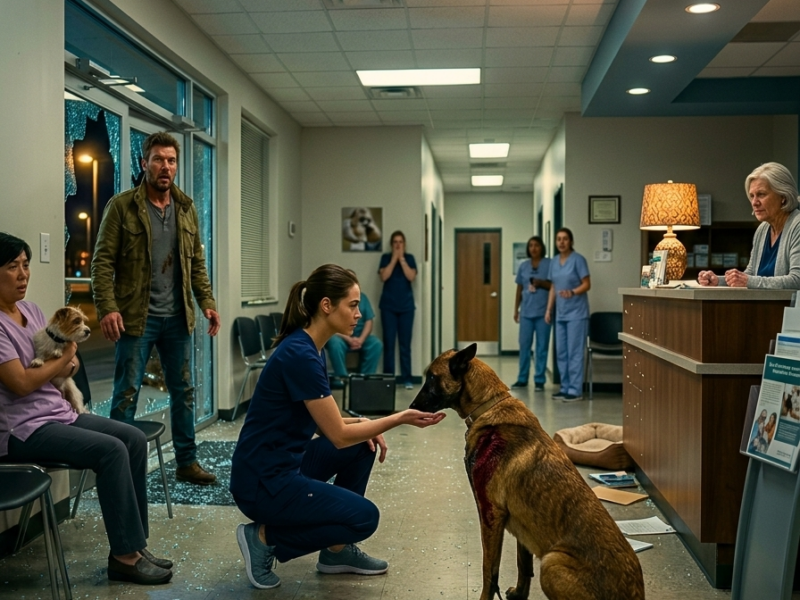
Everyone Ran From the Military Dog — But the Quiet Nurse Walked Straight Toward Him
The sharp scent of hospital disinfectant could never fully wash away the smell of copper, mud, and burnt cordite that lingered in the deepest corners of my memory. For three years, I had deliberately sought out the sterile, quiet routines of the San Diego VA Hospital. I wore faded blue scrubs, kept my hair pulled back tightly, and spoke only when spoken to. To the senior surgeons, the fast-talking residents, and even the administrative staff, I was just Nurse Clara—the soft-spoken, unremarkable woman who volunteered for night shifts and never complained about double duty. They didn’t know about the tactical medical unit I had served with in the dry, dust-choked valleys of Helmand Province. They didn’t know about the ribbons tucked away in a dusty shoe box under my bed. And they certainly didn’t know about Daniel.
It was a Tuesday afternoon, usually the quietest window in the outpatient clinic, when the structural peace of the hospital shattered.
It began with a muffled yell from the north corridor near the high-security military liaison wing. Seconds later, a heavy metal fire door slammed back against the tile wall with a thunderous crack. The sharp sound of squealing rubber soles was immediately followed by a terrifying, guttural roar that made every veteran sitting in the waiting area instinctively duck for cover.
“Clear the hall! Get back! Get behind the doors now!”
Colonel Richard Hayes’s booming, authoritative voice echoed down the hallway. He was a towering man with iron-gray hair, a pristine service dress uniform, and a reputation for unyielding arrogance. Today, however, his composure was cracking. Behind him, two armed security officers had drawn their stun weapons, their eyes wide with genuine panic.
Dragging his handler—a young sergeant whose combat boots were hopelessly sliding across the polished marble floor—was a heavy-set German Shepherd wearing a full tactical combat harness. The animal was massive, easily ninety pounds of lean muscle, coated in dark tan and sable fur. His teeth were bared, white enamel glistening with saliva, and his deep chest heaved with an unbridled, desperate rage.
Patients screamed. Elderly men in wheelchairs frantically tried to back away, while nurses jammed emergency keypads to lock down the glass doors of the adjacent waiting bays.
“Draw lethal if you have to!” Colonel Hayes shouted, his hand hovering near his own sidearm as he gestured to the security guards. “That animal is compromised! Drop him before he takes someone’s throat out!”
“No! Don’t shoot!” the handler gasped, his knuckles white as he fought to hold the heavy Kevlar leash. “He’s triggered! I don’t know what caused it—he just snapped!”
I stood right beside the central nursing desk. My right hand was buried inside the deep pocket of my scrubs, my fingers wrapped so tightly around a hard silver disc that the metal edges dug painfully into my skin.
His name was Ranger.
I didn’t need to read the faded tactical unit patch stitched into his chest rig. I knew every scar on his muzzle. I knew the slight nick in his left ear from a piece of shrapnel in a ditch outside Kandahar. My heart throbbed with a force so violent it felt as though my ribs would splinter.
When the dog whipped his head toward my direction, our eyes locked. The low, rumbling growl in his chest vibrated through the air, shaking the glass windows of the clinic.
“Ma’am, step back! Get inside the office now!” one of the security guards yelled at me, levitating his weapon toward the dog’s chest.
I ignored him entirely. The noise of the alarm, the panicked shouts, the frantic footsteps—it all melted into a dull, distant buzz. I took one smooth, deliberate step forward, moving out from behind the safety of the heavy oak desk into the open corridor.
“Clara, what are you doing?!” a head nurse shrieked from behind the safety glass. “Get back here!”
“She’s out of her mind,” Colonel Hayes barked, turning his sharp glare toward me. “Nurse, fall back immediately! That is an active military working dog in an uncontrolled psychotic state. He will tear you apart!”
I didn’t answer him. I didn’t look at his pristine uniform or his hardened, scowling face. I lowered myself slowly onto one knee right on the cold floor, placing myself directly in the dog’s path, unshielded and completely vulnerable.
“Easy, boy,” I whispered softly.
The sharp, aggressive tone in Ranger’s growl faltered. His tail, which had been stiff as an iron rod, drooped an inch. His ears flicked forward, straining to catch the timbre of a voice he hadn’t heard in over a thousand long days.
“Ranger… it’s okay. You’re okay, sweet boy,” I murmured, keeping my hands open, palms facing up, resting gently on my knees. My voice trembled slightly, but I forced my breathing to stay slow and steady.
The dog stopped dragging his handler. The heavy tension in his powerful shoulders seemed to fracture. The violent snarl vanished, replaced by a high, trembling whimper—a sound so small, fragile, and utterly heartbroken that a chilling silence fell across the entire chaotic hallway.
The security guards froze. Colonel Hayes frowned, his eyes narrowing in confusion and sudden suspicion.
Ranger pulled free from his handler’s slack grip. He didn’t charge. He took one slow, cautious step toward me, his nose twitching frantically as he caught my scent. Then another step. When he reached me, he didn’t snap or bite. He leaned his massive body entirely against my frame, burying his head deep into the crook of my neck, letting out a long, ragged exhale that felt like a sigh of pure grief.
I wrapped my arms around his neck, burying my face in his coarse fur, and let the tears flow silently down my cheeks.
Three years ago, in a burning village in the remote valleys of Afghanistan, I had knelt in the red dust holding a dying soldier. Ranger had been beside us then, bleeding from a shrapnel wound to his flank, whining just like this while mortar shells shook the earth around us. The soldier was Staff Sergeant Daniel Carter. My fiancé.
The official Department of Defense report delivered to my apartment two months later was brief, cold, and final. It stated that Daniel’s patrol had been ambushed after he made a critical tactical error, leading his team into a dead-end ravine. He had been killed instantly by enemy fire, his body unrecoverable due to a localized explosion, while Ranger had been salvaged, treated, and reassigned to active military service.
But I knew the official report was a lie. Because as Daniel lay dying in my arms before the emergency medical evacuation chopper arrived, he had grabbed my collar with blood-stained hands and whispered words that had haunted every second of my existence since:
“If anything happens to me, don’t let them tell you I betrayed my unit. It wasn’t an ambush, Clara… it was a setup from inside command. Hayes did this.”
Now, sitting on the floor of a hospital in California, Ranger pulled back slightly and began frantically pawing at the left pocket of my blue scrubs.
“What is that dog doing?” Colonel Hayes demanded, taking two heavy steps toward us, his hands clasped tightly behind his back. “Nurse, identify yourself. Why is a stray animal responding to you like this?”
I reached into my pocket and pulled out the item Ranger had smelled: a scratched, silver military dog tag hung on a beaded chain, bearing Daniel’s name, serial number, and blood type.
Ranger sniffed the metal tag gently, gave it a single lick, and then slowly turned his head toward Colonel Hayes.
The change in the dog was instantaneous and chilling. His ears flattened hard against his skull. The soft whimper died instantly, replaced by a low, guttural snarl that sounded less like an animal and more like a rising siren of vengeance. His eyes locked onto Hayes’s face with absolute hatred.
The colonel instinctively took a step back, his face draining of color. “Get that damn dog away from me!” he ordered, his voice suddenly sharp with an uncharacteristic edge of panic.
As Hayes pulled back his coat to reach for his hip, I saw it—a deep, jagged white scar running up from his chest, peeking just beneath his high starch collar. It was an old shrapnel and blade wound, shaped like a crescent moon. The exact scar Daniel had described in the final letter he had managed to mail home three days before his death.
Before anyone could react, Ranger lunged. He didn’t go for the colonel’s neck or his arms. He slammed his powerful shoulders straight into the heavy leather briefcase Hayes was holding in his left hand.
The heavy case flew from the colonel’s grasp, smashing against the hard floor. The cheap brass latches snapped under the impact, bursting open. Dozens of papers, stamped with crimson classified markers, spilled across the shiny tiles like fallen leaves.
“Don’t touch those!” Hayes roared, dropping to his knees to gather the papers.
I reacted instantly. Driven by an instinct honed over years of survival, I leaned forward and scooped up a single document that had slid directly against my shoe.
My blood ran cold.
At the top of the page, beneath the seal of the United States Special Operations Command, was Daniel’s photograph and name. Below it was a map of the very village where he had supposedly died, along with a list of four other soldiers listed as “Killed in Action—Bodies Unrecovered.” And right at the bottom, approving an unauthorized tactical strike on those exact coordinates forty-eight hours after Daniel’s unit was posted there, was the bold, unmistakable signature of Colonel Richard Hayes.
“Give me that paper, Nurse,” Hayes hissed, standing up slowly. His eyes were cold, dark, and lethal. He reached into his jacket, his hand wrapping around the grip of his concealed firearm. “You are meddling in matters of national security.”
Ranger stepped directly in front of me, his body rigid, blocking the colonel with an ominous growling threat.
Suddenly, the heavy phone in my scrub pocket vibrated violently. A crisp chime echoed in the tense silence.
I pulled out the screen with a trembling hand. An unknown, encrypted number had sent a single text message:
If Ranger has found you, Daniel is still alive. Don’t trust the colonel. Look at the entrance.
My breath caught in my throat. My heart leaped into my jaw. I looked past Colonel Hayes, past the astonished security officers, straight toward the double glass sliding doors of the main hospital entrance.
The automatic doors slid open with a soft hiss.
Standing in the frame, leaning heavily on an aluminum combat cane, was a man wearing a worn jacket and a low-slung baseball cap. His face was weathered, scarred across the left jawline, and years older than the photo on the classified paper in my hand. But those deep blue eyes were unmistakable.
He looked directly through the crowd, straight at me.
“I’m sorry I made you mourn me, Clara,” Daniel whispered, his voice carrying clearly across the silent hall.
The silence that settled over the hospital lobby was heavy and suffocating. For a terrifying three seconds, nobody moved. The nurses behind the glass panel stared with wide eyes, security guards stood frozen with their taser handles gripped in sweaty palms, and Colonel Hayes looked as though he had just seen a phantom step out of a grave.
“Daniel…” The word tore from my throat, barely louder than a breath.
My knees felt weak, almost collapsing under the sudden shock of reality breaking apart. Three years of grief, three years of silent tears in an empty apartment, three years of believing the man I loved was reduced to ash and dust in a distant desert—all of it shattered in a single second. He was standing there. Thinner, bearing a deep, jagged scar that ran from his left ear down to his collarbone, limping heavily on a metal cane, but alive.
Ranger let out a sharp, joyful bark. The dog didn’t rush forward blindly; instead, he maintained a protective stance between Colonel Hayes and me, keeping one eye on the officer while his tail whipped back and forth in frantic recognition.
Colonel Hayes was the first to break the paralysis. His hands dropped away from his inner jacket, his military discipline taking over as his expression hardened into a mask of cold, calculating fury.
“Security!” Hayes bellowed, his voice cutting through the hall like a whip. “Apprehend that man! He is a trespasser and a compromised military deserter! Secure this perimeter immediately!”
The two VA security officers, confused and overwhelmed by the sudden turn of events, hesitated for a second. They looked between the decorated colonel, the quiet nurse kneeling on the floor, and the crippled man standing at the entrance.
“Don’t move a muscle, boys,” Daniel said calmly. He didn’t panic. His blue eyes, once filled with the bright, easy warmth I had fallen in love with, were now hard as flint, forged in three years of dark survival. He raised his left hand slightly, showing a small black electronic device held between his fingers. “Colonel Hayes has three armed men stationed in the parking lot right now. If I drop this dead-man switch, an encrypted file containing the real action logs from Operation Black Dust gets broadcast directly to the Federal Bureau of Investigation and every major news network in San Diego.”
Hayes froze, his jaw tightening so hard the muscles in his cheek twitched. “You’re bluffing, Carter. You died in that ravine.”
“You certainly tried your best to make sure of that, didn’t you, Colonel?” Daniel took a slow, agonizing step forward, the tip of his metal cane clicking loudly against the marble tile. Click. Drag. Click. “You sent my team into a blind valley without air support. You gave the enemy our exact GPS grid coordinates over an unencrypted tactical channel. And when Ranger and I managed to drag ourselves out of the burning rubble, you signed a false casualty report and wiped our names from the registry.”
A gasp echoed from the nurses behind the counter. I stood up slowly, clutching the classified paper tightly against my chest. My mind was racing, connecting the pieces of a nightmare that had remained unsolved for years.
“Why?” I asked, looking directly at Hayes. My voice wasn’t shaking anymore. The sadness that had weighed me down for three long years was rapidly transforming into a searing, pure rage. “Why would you destroy your own men?”
“Because Sergeant Carter and his team stumbled onto something they were never meant to see,” Hayes said coldly, stepping closer to me and extending his hand for the document. “Give me the paper, Clara. You have no idea what kind of fire you are playing with. This isn’t a romantic war novel. This is high-level geopolitical strategy. Your fiancé interfered with an operation that involved hundreds of millions of dollars in black-budget intelligence funding.”
“It was a illegal weapons trade, Clara,” Daniel corrected, his voice raspy as he reached the center of the hallway. Ranger stepped aside just enough to let Daniel reach out and place a hand on the dog’s head. The animal leaned into his touch immediately. “Hayes wasn’t just commanding the brigade in Helmand. He was selling seized military-grade ordinance to regional warlords on the black market. My team found his supply cache hidden in the caves outside the village. Before we could radio it in to Joint Special Operations Command, our comms were jammed. Ten minutes later, the artillery shells started falling—not from the enemy, but from our own rear battery.”
The hallway seemed to shrink as the terrifying truth settled into the air. The patients watching through the glass doors were pulling out their smartphones, recording everything. Hayes noticed the glowing screens and his eyes darkened.
“You’re an insane deserter suffering from severe combat psychosis, Sergeant,” Hayes snarled, trying to regain control of the narrative. “No court in this country will take the word of a dead man over an officer with thirty years of distinguished service. Officers, arrest him now!”
“They won’t have to take just my word, Colonel,” Daniel replied softly. He turned his head toward the entrance. “I didn’t come here alone.”
From behind the automatic doors, three men in crisp, tailored dark suits walked into the lobby. The leader, a stern woman with a gold badge clipped to her belt and an earpiece running up her collar, held out a leather wallet displaying credentials from the Department of Defense Inspector General’s Office.
“Colonel Richard Hayes?” the woman announced, her voice echoing with absolute authority. “I am Special Agent Sarah Vance. Step away from the nurse and place your hands behind your back.”
Hayes turned pale. “Vance? What is the meaning of this? I report directly to the Pentagon!”
“Not anymore, Colonel,” Agent Vance said coldly, as two federal agents moved past her, their hands resting on their holstered weapons. “We’ve been tracking an unauthorized offshore bank account in the Cayman Islands for six months. An hour ago, we received a complete ledger of transactions matching serial numbers from stolen armory crates in Afghanistan. Transmitted from Sergeant Carter’s location.”
Hayes looked around frantically. He saw the security guards stepping back, refusing to follow his orders. He saw the federal agents surrounding him. He saw the phone cameras pressed against the glass doors. His pristine facade completely crumbled, revealing the desperate cornered predator beneath.
In a split second of madness, Hayes reached into his jacket, pulled a heavy black pistol from a concealed holster, and leveled it straight at Daniel’s chest.
“I won’t let a disgraced grunt ruin my life!” Hayes screamed.
“Daniel!” I shrieked, reaching out blindly.
Before Hayes could squeeze the trigger, a tan blur shot through the air. Ranger unleashed a roaring bark, launching his ninety-pound body off the tile floor. His jaws locked onto Hayes’s right forearm with ferocious force before the officer could line up his shot.
BANG!
The gunshot exploded like thunder in the enclosed hallway. The bullet ricocheted wildly off the tiled floor, shattering a heavy glass display case behind the reception desk.
Hayes screamed in pain as Ranger’s weight slammed him hard onto the floor. The pistol tumbled out of his grip, sliding across the polished tiles until Daniel brought the tip of his metal cane down firmly on top of the weapon, trapping it.
Federal agents rushed forward, pinning Hayes to the ground while Ranger, obeying a sharp whistle from Daniel, released his grip and stepped back, standing tall and proud over the fallen colonel.
Agent Vance snapped heavy steel handcuffs onto Hayes’s wrists, pulling him forcefully to his feet. The colonel was bleeding, his uniform torn, his face contorted in rage and defeat as he was dragged toward the exit.
As the chaos subsided and the federal agents led the ruined officer away, the heavy silence returned to the lobby.
I stood paralyzed, staring at Daniel. My hands were trembling violently. The document I held slipped from my fingers, fluttering softly down to the floor.
Daniel slowly stepped over the paper. He let his cane drop to the ground. It clattered against the tile, but he didn’t care. He took two unsteady steps forward, closing the distance between us, and reached out with hands that were rough, calloused, and covered in faint white scars.
“Clara,” he whispered softly. “I’m home.”
The small, windowless consultation room in the back of the hospital’s administrative wing was quiet, isolated from the buzzing media circus that had already begun assembling outside the main entrance. Federal vehicles with tinted windows choked the ambulance bay, and news helicopters hovered like noisy metallic insects in the bright San Diego sky.
Inside the room, the dim fluorescent lights hummed softly. Daniel sat on a vinyl examination table, his long legs dangling off the edge. Agent Sarah Vance stood near the closed door, holding a steaming paper cup of black coffee, her face unreadable as she reviewed a thick manila folder.
I sat on a stool across from Daniel, holding his hand. I hadn’t let go of him since we stepped out of the lobby. His skin was warm—a sharp, living contrast to the cold, lifeless memory I had carried in my heart for three long, agony-filled years. Ranger lay contentedly across Daniel’s boots, his head resting heavily on my foot, finally at peace.
“I need to hear it, Daniel,” I said softly, tracing the thick white scar that ran along the side of his palm. “All of it. How did you survive? How did you disappear?”
Daniel looked down at our joined hands, letting out a heavy, tired sigh. “When the artillery hit our position in the valley, two of my men were killed instantly. The force of the blast threw me into a dry well shaft at the edge of the village compound. Ranger fell in right after me. The collapse covered the opening with rubble, hiding us from the sweep team Hayes sent to clean up the site.”
I shuddered, imagining him buried in the dark, bleeding and trapped beneath pounds of shattered stone. “How long were you down there?”
“Three days,” Daniel said quietly. “Ranger dug us out. He literally clawed through dirt and broken brick until he made an opening wide enough for me to crawl through. My leg was shattered, my ribs were cracked, and I had a severe concussion. A local family—farmers who hated the warlords Hayes was dealing with—found us in the brush. They took us in, hid us in a cellar beneath their barn, and patched my wounds using whatever basic medicine they had.”
“Why didn’t you call me?” My voice broke, a mixture of intense relief and lingering heartbreak bleeding through. “Why didn’t you send a message? You knew I was dying inside, Daniel. I buried a flag-draped empty box!”
Daniel’s eyes filled with sudden, painful tears. He gripped my hand tighter, bringing it up to his lips and pressing a warm kiss against my knuckles.
“I wanted to, Clara. Every single second of every day, my soul screamed to reach out to you,” he whispered, his voice trembling with raw emotion. “But three weeks after the attack, while I was still bedridden and feverish, the farmer brought me a regional newspaper. Hayes had already filed the official report. He declared me a traitor and a deserter before changing it to ‘Killed in Action’ to cover his tracks. But worse than that… I found out his men were monitoring your apartment in San Diego. They watched your mail, tapped your phone, and checked your bank records.”
Agent Vance stepped forward, setting her coffee cup down on a small metal tray. “Colonel Hayes knew Sergeant Carter was a meticulous strategist,” she explained, her voice professional yet tinged with genuine sympathy. “Hayes was terrified that Carter might have handed off classified physical evidence—like digital drive backups or coordinate logs—to you before he deployed. If Daniel had contacted you, Hayes’s mercenaries would have staged a ‘tragic accident’ for you within twenty-four hours to destroy the link.”
The realization hit me like a physical blow. The strange cars that used to sit across the street from my apartment during my first year of mourning. The sudden break-ins where nothing of monetary value was taken, only my drawers rifled through. I had thought I was losing my mind to grief-induced paranoia.
They weren’t looking for money. They were looking for evidence.
“To protect you, I had to stay dead,” Daniel said, his eyes locking onto mine with absolute intensity. “I couldn’t be a man. I had to become a ghost. As long as I stayed dead, Hayes focused his energy on laundering his money and securing his promotion. It kept you safe.”
“How did you survive in the dark for three years?” I asked, fresh tears slipping down my face.
“I moved through the underground network,” Daniel said. “Former veterans, local intelligence officers who knew something was dirty in the command chain, and allies overseas. I spent eighteen months recovering, learning to walk again with this cane. Then Ranger was relocated back to the States. I knew Hayes had kept him in the system, moving him between military installations to keep tabs on his handler logs.”
“Why didn’t Hayes just have Ranger put down?” I asked, glancing at the brave dog resting on my foot.
“Because Ranger was a hero MWD with high-level clearance records,” Vance interjected. “Destroying a elite service dog without a verified medical cause triggers an automatic veterinary board review from the Pentagon. Hayes couldn’t risk the paperwork or the scrutiny. So he kept him buried in the bureaucracy, moving him from base to base.”
“Until today,” Daniel said gently. “I tracked Ranger’s transport manifest to the San Diego naval yard last night. I knew Hayes was visiting this specific VA facility today for a ribbon-cutting ceremony for the new veterans wing. I rigged Ranger’s harness with a mild, harmless synthetic scent compound before his handler brought him inside—a compound Ranger was trained to associate with high-stress combat drills. I knew it would make him rowdy, forcing the handler to take him through the central corridor.”
“You set a trap,” I realized, the full genius and desperation of his plan becoming clear.
“I knew if Ranger saw you, his natural instinct would break through whatever protocol they had him on,” Daniel admitted. “And I knew if Hayes was forced into a public confrontation in front of dozens of witnesses and live security cameras, he would panic and reveal his hand. I spent three years collecting the digital paper trail of his bank accounts, but I needed him to pull the trigger in front of federal agents to seal the trap.”
“And you used yourself as the bait,” I said, my heart pounding at how narrow the margin between success and disaster had been.
“I had to,” Daniel said simply. “Because I couldn’t spend another day breathing air on this earth while you lived in a prison of grief I built to keep you safe. You deserve the truth, Clara. You deserved your life back.”
Before I could answer, the door to the consultation room opened again. A young federal junior agent stepped inside, looking pale and carrying an encrypted tablet.
“Agent Vance,” the junior officer said nervously. “We have a major problem with the transport vehicle carrying Colonel Hayes.”
Vance’s eyes narrowed instantly. “What happened? Did he break custody?”
“No, ma’am,” the officer replied, holding out the tablet screen. “The transport van was intercepted two miles from the hospital on Interstate 5. A heavy civilian SUV rammed the side of the vehicle. Armed men wearing unmarked tactical gear extracted Colonel Hayes from the wreck.”
Daniel sat up straight, his face instantly hardening into combat readiness. “His network,” he gritted out. “Hayes isn’t the head of the operation. He’s just the regional distributor. The people supplying him with the black-market weapons aren’t going to let him talk to a federal grand jury.”
Agent Vance drew her sidearm, her posture shifting into high alert. “Lock down this facility immediately! Get extra units to this room!”
“They aren’t coming to break Hayes out so he can escape,” Daniel said, his voice dropping into an icy, terrifying register as he looked at the screen. “They extracted him to kill him before he opens his mouth. And once he’s dead, they’re going to come after every single person who saw those documents in the lobby.”
He looked directly at me, his eyes filled with fierce, protective fury.
“They’re coming for us, Clara.”
The red emergency lights of the VA hospital began to flash in silent, rhythmic pulses, painting the walls of the small consultation room in a blood-colored glow. The central alarm didn’t blare—Agent Vance had ordered a silent lockdown to prevent a full-scale mass panic among the hundreds of elderly veterans and surgical patients upstairs, but the tension in the air was thick enough to choke on.
“We need to move. Right now,” Agent Vance ordered, slapping a fresh magazine into her tactical pistol and chambering a round with a sharp, metallic clack. She turned to her junior officer. “Call the SWAT coordinator at San Diego PD. Tell them we have an active threat situation with high-tier private military contractors moving toward the medical center. Set up a hard perimeter around the perimeter roads.”
“They won’t make it in time, Vance,” Daniel said calmly, standing up from the exam table. He didn’t use his cane for support this time; the pure adrenaline flooding his system seemed to burn away his physical pain. He reached down and picked up a heavy tactical flashlight from a wall mount, testing its weight in his hand. “If Hayes’s backers used a heavy SUV to breach a federal transport van on Interstate 5 in broad daylight, they have local assets already staged within a two-minute radius. They know this hospital’s layout.”
“How could they know the layout?” I asked, my hands shaking as I pulled off my blue nursing apron to reveal the lightweight utility shirt beneath.
“Because Colonel Hayes helped design the security infrastructure for this entire facility when the new wing was built two years ago,” Daniel answered, his blue eyes sharp and calculating. “Every blind spot in the camera coverage, every service elevator that doesn’t require an encrypted keycard, every secondary maintenance exit—they have the blueprints.”
Ranger stood up beside Daniel, his back hair bristling, a low, silent vibration rumbling in his throat. The dog knew the shift in atmosphere. The gentle, affectionate animal from twenty minutes ago was gone, replaced once again by a highly trained instrument of military defense.
“Clara,” Daniel said, turning to face me. He placed his hands on my shoulders, looking deeply into my eyes. “I brought this storm to your doorstep. I thought I could control the timing, but I underestimated how fast his network would burn their assets to cover their tracks. I am so sorry.”
“Don’t you dare apologize to me, Daniel Carter,” I said, reaching up to slap my palm against his cheek, forcing him to hold my gaze. “I spent three years crying over a phantom. I am not going to lose the real man now. I was a combat nurse in the middle of a warzone before I came to this peaceful hospital. Tell me what we need to do.”
A faint, proud smile flickered across Daniel’s scarred face. “That’s my girl.”
Suddenly, the lights in the room flickered and died completely, plunging us into total darkness, save for the weak red glow of the emergency exit sign above the door. A heavy, mechanical thud echoed through the air vents—the main power generators in the basement had been manually shut down.
“Power’s out,” Vance whispered, flicking on her sidearm’s mounted tactical light. A narrow beam of white light sliced through the pitch-black room. “They’re inside.”
“Maintenance tunnel,” I said instantly, my brain recalling the hospital floor plans I had memorized during fire safety drills. “Underneath the basement laundry facility, there’s an old utility conduit that connects the main building to the municipal storm drain system. It exits three blocks away near the harbor.”
“Good,” Daniel said. “Vance, you take the junior officer and move toward the main entrance to draw their attention. Make them think we’re trying to breach the front federal perimeter. Clara, Ranger, and I will hit the maintenance tunnel.”
“I’m not leaving my high-value witness, Sergeant,” Vance countered sternly.
“If we stay together in a group of five, we’re a massive, slow-moving target on thermal imaging,” Daniel argued fiercely. “They expect me to hide behind federal badges. They don’t expect us to sink into the dark below the basement. Go! Make some noise at the front lobby!”
Vance hesitated for a fraction of a second, looking at Daniel, then at Ranger, and finally at me. She gave a single, sharp nod. “If you make it to the harbor, hit this radio frequency,” she said, tossing a small black tactical walkie-talkie to Daniel. “Don’t die, Sergeant. I still need your testimony to bring down the rest of these bastards.”
“Understood. Move!”
Vance and her officer slipped out the door, their soft footsteps quickly fading down the dark, carpeted corridor toward the main administrative hub.
Daniel grabbed my hand, interlocking his fingers with mine. “Stay close. Stay low. Ranger, heel.”
We stepped out into the pitch-black hallway. The normal sounds of the hospital—the soft beeping of heart monitors, the gentle hum of air conditioning—were gone, replaced by a eerie, hollow silence broken only by distant, echoing shouts from the upper floors where staff were frantically trying to reassure confused patients.
We moved like shadows, guided by my intimate knowledge of the hospital layout and Daniel’s tactical instincts. We slipped down a heavy service stairwell, descending three flights into the concrete sub-basement where the air grew noticeably colder and smelled of damp dust and industrial detergent.
When we reached the massive metal door marked LAUNDRY & MECHANICAL SERVICES, Daniel stopped, raising a hand.
Ranger crept to the base of the metal door, his nose pressed against the gap at the floor. A low, barely audible hiss escaped the dog’s lips.
Daniel leaned near my ear, his breath warm against my skin. “Two men inside,” he whispered. “Heavy boots. I can hear the click of suppressed rifle barrels hitting their tactical vests. They’re waiting near the primary entrance.”
“The maintenance access valve is on the far wall behind the commercial dryers,” I whispered back. “Fifty feet straight ahead, then left.”
“We can’t outrun suppressed automatic fire in an open concrete room,” Daniel said quietly. He looked around the dimly lit stairwell landing, his eyes landing on a red fire extinguisher mounted to the wall and a box of high-grade chemical floor stripper sitting on a supply shelf.
A cold, methodical calm settled over Daniel’s face—the look of an elite operator who had survived years in the wild by turning simple surroundings into lethal advantages.
He unhooked the fire extinguisher and handed it to me. “When I open this door three inches, pull the pin and spray the entire canister directly into the room at eye level. Don’t stop until it’s empty.”
“What about you?” I asked.
He reached into his pocket and pulled out a heavy metal road flare he had snagged from the administrative emergency kit earlier. A wicked smile touched his lips. “I’m going to light up their night vision.”
“Ready?” he murmured, grabbing the heavy metal door handle.
I gripped the fire extinguisher nozzle, my muscles tense, my heart beating a steady, fierce rhythm. “Ready.”
Daniel yanked the door open three inches.
I shoved the nozzle through the crack and squeezed the trigger with all my strength.
A roaring blast of compressed white chemical powder erupted into the dark room, instantly turning the air into a blinding, suffocating cloud of white dust. Shouts of surprise and coughing fits echoed from inside as the intruders were suddenly engulfed in the chemical fog.
“Now!” Daniel yelled, kicking the heavy door wide open.
He struck the striker cap of the chemical flare. A blinding, searing crimson light flared into existence, illuminating the vast basement like a nuclear sunrise.
From inside the cloud, two men dressed in black tactical gear with expensive night-vision goggles mounted to their helmets shrieked in agony as the sudden, intense brilliance of the flare blew out their sensitive light-amplification tubes, temporarily blinding them.
“Ranger, GO!” Daniel roared.
The German Shepherd surged forward like a missile, disappearing into the white fog.
The subterranean laundry facility erupted into violent, disorienting chaos.
Screams of pain echoing through heavy tactical masks mixed with the harsh, mechanical clatter of suppressed submachine gun fire as the blinded mercenaries fired wildly into the concrete walls, sending sharp sparks and shattered tile fragments flying through the chemical dust.
Ranger was an unseen phantom in the white fog. A heavy thud echoed across the room followed by a sickening crunch as the dog slammed into the first shooter, taking him down hard onto the wet concrete floor. The mercenary’s weapon clattered away, spinning across the tiles until it bumped against my boot.
Without hesitating for a single second, I reached down, grabbed the suppressed firearm, flipped the safety selector off just like Daniel had taught me during our quiet weekends at the base firing range years ago, and leveled it toward the second figure struggling to strip off his ruined night-vision goggles.
“Don’t move!” I shouted, my voice cutting through the thick dust with absolute, unwavering authority.
The mercenary froze, his hand hovering over a sidearm mounted to his tactical vest. Through the settling white powder, he saw a nurse in stained scrubs holding a tactical submachine gun with perfect sight alignment, her finger resting lightly on the reset point of the trigger. Beside her stood a former Special Forces sergeant holding a burning crimson flare that cast long, terrifying shadows across the concrete walls.
“Drop the sidearm,” Daniel ordered, his voice cold as ice. “Or she will put three rounds through your vest plate before you can clear your holster.”
The man slowly raised his hands, unclasping his belt and letting his sidearm drop to the floor. Ranger stood over the first mercenary, who was groaning in pain on the ground, his teeth pinned gently but firmly against the man’s throat, keeping him completely immobile.
“Who sent you?” Daniel demanded, stepping forward and pressing the hot tip of the flare handle against the mercenary’s chest armor. “Speak quickly. My dog hasn’t had breakfast yet.”
“Vane…” the man gasped, his eyes wide with fear as he stared at Ranger’s bared teeth. “Vane Security Solutions… we were hired by a corporate shell account… we were told to clear the witnesses and retrieve the digital drives from Hayes’s briefcase…”
“Where is Hayes?” I asked sharply.
“He’s dead,” the mercenary spat out, coughing up white chemical dust. “The extraction team executed him in the SUV ten minutes ago. He was a liability. The bosses wanted the paper trail closed permanently.”
Daniel looked at me, a somber, grim understanding passing between us. Hayes had thought he was a mastermind, a powerful puppet master orchestrating events from an air-conditioned office, only to realize too late that he was just another disposable piece on a global chessboard.
“Where is the secondary extraction team?” Daniel asked.
“Outside… waiting at the north harbor loading docks… three men in a gray launch boat,” the man stammered. “That’s all I know! I swear!”
Daniel didn’t waste another second. He used a thick roll of heavy industrial duct tape from a nearby maintenance workbench to bind both mercenaries securely to the steel structural pillars of the basement. He picked up the dropped tactical radio from the floor, jammed it into his belt, and took my hand once again.
“The maintenance tunnel,” he said. “This way!”
We ran past the towering commercial washing machines to the far wall. Daniel kicked open a small metal hatch set low into the brickwork, revealing a narrow, round concrete pipe that sloped downward into the dark.
“Ranger first, then you, Clara,” Daniel instructed. “I’ll cover our rear and seal the hatch.”
I didn’t argue. I crawled into the pipe behind Ranger, feeling the cool, damp sea air rushing up from the harbor channel ahead. Behind us, I heard the heavy iron hatch slam shut and the sound of Daniel locking the mechanical bolt from the inside, sealing off any pursuit from the hospital above.
We army-crawled through the dark concrete conduit for five agonizing minutes, the sound of our breathing and Ranger’s steady paw-steps echoing softly against the curved walls. Up ahead, a pinpoint of bright blue light began to grow larger and brighter, signaling the exit point near the coastal mouth of the storm drain system.
We burst out into the fresh, crisp salt air of the San Diego bay.
The morning sun was rising over the horizon, painting the sky in brilliant hues of gold, orange, and soft pink. The cool ocean breeze swept across my face, washing away the lingering scent of hospital bleach, gunsmoke, and chemical dust.
We were standing on a secluded concrete ledge beneath a highway overpass, right at the edge of the harbor waters. A hundred yards out in the channel, a heavy, gray high-speed launch boat was idling softly in the water, its dark-tinted windows reflecting the morning light.
Daniel emerged from the tunnel right behind me, his face covered in soot and sweat, but his eyes were bright, clear, and focused. He pulled the captured tactical radio from his belt, adjusted the frequency to match the channel Agent Vance had given him, and pressed the talk button.
“Vance, this is Carter,” Daniel announced into the mic. “Do you copy?”
Static hissed for a second, followed by the relieved, breathless voice of Agent Vance. “Carter! Where the hell are you? We’ve secured the hospital lobby! Local SWAT has surrounded the building!”
“We’re at the north harbor drain outlet beneath the Coronado overpass,” Daniel said, watching the gray launch boat in the water. “The mercenaries’ sea extraction unit is idling right in front of us. Three hostiles onboard. They’re armed, and they think they’re home free.”
“Hold your position!” Vance ordered over the speaker. “U.S. Coast Guard cutter Tern is on active patrol in the bay! I’m routing your coordinates to them right now!”
As if on cue, a deep, thunderous air horn echoed across the sparkling water.
From around the curve of the harbor peninsula, a massive, sleek white Coast Guard cutter sliced through the waves at full speed, its heavy bow wave spraying foam high into the air. Mounted on the bow, a heavy remote weapon station turned smoothly, locking its long barrel directly onto the small gray launch boat.
Over the cutter’s powerful loudspeaker, a voice boomed across the bay:
“Unidentified vessel in the channel! This is the United States Coast Guard! Cut your engines immediately and step into the open with your hands on your heads! You are surrounded!”
Through the tinted glass of the launch boat, we saw the panic set in. The mercenaries realized instantly that their escape route had been completely severed. The gray boat’s engines died, its props spinning down to a standstill as it bobbed helplessly in the water, completely boxed in by the approaching federal vessel.
Daniel let out a long, slow breath, letting his arm drop to his side. The radio slipped from his hand, clattering onto the concrete ledge.
He turned to face me. The morning sunlight caught the tears standing in his eyes, turning them into bright, shining pools of liquid blue.
Ranger walked up between us, leaning his heavy shoulder against Daniel’s leg while turning his head to rest his chin gently against my thigh, letting out a soft, contented sigh.
For three long, agonizing years, I had lived in a cold, lonely shadow, holding onto a dead man’s promise while the rest of the world moved on. I had walked through the dark halls of my life believing that honor was a forgotten word and that grief was the only companion I had left.
Now, standing on the edge of the shining ocean, surrounded by the bright golden light of a new dawn, the shadow was finally gone.
Daniel reached out, his warm, scarred hands gently framing my face. His thumbs brushed away the tear tracks dried on my cheeks.
“I kept my promise, Clara,” he whispered, his voice thick with overwhelming emotion. “I didn’t betray my unit. And I came back to you.”
“You came back,” I repeated softly, stepping into his chest, throwing my arms tightly around his neck, and pulling him close.
I buried my face in his shoulder, feeling the deep, steady, unstoppable rhythm of his heart beating right against mine. The war was over. The truth was known. And for the first time in three years, I breathed in the cool salt air and knew that we were finally, truly safe.
The end.









