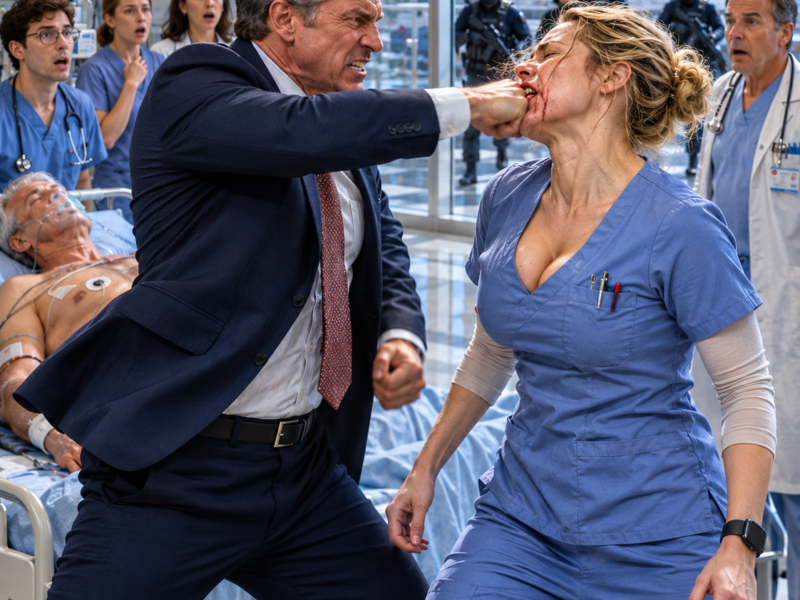
“Everyone in that hospital thought Abigail Hayes was just a quiet nurse who knew her place. Then the CEO punched her in front of a room full of witnesses
Colonel James Mitchell didn’t raise his voice.
He didn’t need to.
The entire VIP corridor had gone silent. The only sounds were the rain striking the reinforced windows and the distant thrum of the helicopters hovering above the hospital.
Richard Caldwell stood frozen near the nursing station.
His face had gone pale.
“Colonel, I believe there’s been a misunderstanding,” he began. “This is a private medical facility. I have authority over every employee and contractor in this building.”
Mitchell looked at him without blinking.
“Not tonight.”
Caldwell forced a nervous laugh.
“I don’t know who you think you are, but I can have the mayor on the phone in thirty seconds.”
“Then call him.”
The colonel glanced toward the tactical operators.
“Secure the patient. Nobody enters or leaves this floor without authorization.”
Two operators moved toward Bay Four.
The federal agent who had brought the patient into the hospital stepped forward.
“Colonel, the asset is stable enough for transfer. Major Hayes controlled the immediate emergency, but he needs definitive surgery at the designated facility.”
Mitchell nodded.
“Prepare vertical extraction.”
Caldwell looked from one man to another.
“Vertical extraction? What is this? Some kind of military exercise?”
Mitchell finally turned fully toward him.
“The man in Bay Four is a protected federal intelligence source. His identity, location, and medical condition are classified. He was transported here because the storm made ground evacuation impossible.”
Caldwell swallowed.
“And you expect me to believe that?”
“I don’t expect you to believe anything. I expect you to stay out of the way.”
Caldwell pointed toward Abigail.
“She is a hospital employee. I have every right to remove her from the premises. She refused a direct order, endangered a major donor, and assaulted my authority.”
Abigail touched the blood at the corner of her mouth.
“I didn’t assault anyone.”
“You’re fired,” Caldwell snapped. “Effective immediately.”
Colonel Mitchell took one step toward him.
“Major Abigail Hayes is a commissioned officer serving under a classified Department of Defense assignment. She does not report to you.”
Caldwell’s mouth opened.
Then closed.
Mitchell continued.
“She was placed in this facility under an authorized federal medical integration agreement. Your hospital administration received the necessary restricted documentation. You were not granted access to the operational details.”
Caldwell shook his head.
“I was never informed.”
“You were informed that certain federal patients might require emergency treatment. You signed the agreement.”
“I sign hundreds of documents!”
“Then perhaps you should read them.”
A few nurses exchanged glances.
Peter Lawson stood near the trauma bay entrance, still wearing bloodstained gloves.
He looked at Abigail.
The woman who had spent six months quietly checking medication orders and correcting his mistakes was a major in a special operations medical unit.
He could barely process it.
Inside Bay Four, the patient began to stir.
A tactical medic approached the bed.
“Sir, can you hear me?”
The older man opened his eyes.
His breathing remained labored, but the immediate threat had been controlled.
Abigail stepped forward.
“Don’t let him move. His chest tube needs to remain secured during transport.”
The medic nodded.
“We’ve got him.”
The colonel entered the room.
“Major, I need a brief medical handover.”
Abigail gave him a concise report.
“Male patient, approximately sixty-five. Two penetrating wounds to the thorax. Left-sided tension pneumothorax treated with emergency decompression and chest tube placement. Cardiac arrest occurred during initial stabilization. Return of spontaneous circulation achieved after defibrillation. He’s received blood products and remains hemodynamically fragile.”
“Any indication of internal bleeding?”
“Possible. Imaging wasn’t available before the emergency intervention. He needs a trauma surgeon and definitive assessment immediately.”
Mitchell nodded.
“Understood.”
The patient turned his head slightly.
His eyes settled on Abigail.
“Major?”
“I’m here.”
His voice was barely audible.
“Did they find the documents?”
Abigail glanced at Mitchell.
The colonel leaned closer.
“Not yet, sir. We’ll discuss that after surgery.”
The patient tried to lift his hand.
Abigail gently stopped him.
“Don’t waste your strength. You’re going to make it.”
He stared at her for several seconds.
Then he whispered something that only she and the colonel could hear.
“Tell them… the list is real.”
Mitchell’s expression changed.
“Understood.”
Abigail looked at him.
The colonel gave the slightest nod.
There was much more at stake than a wounded informant.
A few minutes later, the surgical transfer team arrived.
They moved the patient onto a specialized transport stretcher, securing the chest tube, monitoring equipment, and emergency medication.
The operators created a protective corridor from the trauma bay to the service elevator.
Abigail checked the patient’s dressing one last time.
Then she stepped back.
“Ready.”
The lead medic looked at her.
“Coming with us, Major?”
She nodded.
“I’m responsible for the handover.”
Mitchell turned toward the hallway.
“Let’s move.”
As the stretcher passed through the doors, Caldwell stepped forward again.
“You cannot simply remove a patient from my hospital without authorization!”
Mitchell stopped.
“Your hospital has been notified that this patient is being transferred under federal authority.”
“I am the CEO!”
“And I’m the officer responsible for this operation.”
Caldwell pointed at the bloodstained floor.
“You people have turned my hospital into a battlefield!”
Mitchell’s eyes narrowed.
“No, Mr. Caldwell. You did that when you decided your donor’s convenience mattered more than a dying patient’s life.”
Caldwell had no answer.
The elevator doors closed.
Abigail disappeared with the patient.
And the colonel remained in the corridor.
He was not finished.
The first federal investigator arrived before midnight.
The second arrived ten minutes later.
By 1:00 a.m., the hospital’s legal department had been contacted, the board chair had been awakened, and a federal security team was reviewing the events inside the VIP wing.
Caldwell was escorted to a private conference room.
He was not handcuffed.
Not yet.
He sat at the head of the table, demanding that someone call his attorney.
A woman in a dark suit introduced herself as Special Agent Laura Bennett.
She placed a recording device on the table.
“Mr. Caldwell, we need to establish what happened in Bay Four.”
“I’ve already explained it. A nurse disobeyed a direct order. She became aggressive when I attempted to remove her from the room.”
Agent Bennett opened a folder.
“We have statements from six witnesses.”
“Employees who depend on their jobs. Their testimony is hardly objective.”
“We also have video.”
Caldwell leaned back.
“Video from where?”
“The hospital’s internal security system.”
His expression shifted.
“The trauma bays are not supposed to be recorded.”
“Bay Four’s corridor camera captured the entrance. The room’s emergency security camera also recorded the incident. Its feed is stored separately because the bay is part of the federal integration program.”
Caldwell stared at her.
Agent Bennett pressed a button on her laptop.
The video played.
It showed Abigail preparing the patient.
It showed Caldwell entering the room.
It showed him grabbing her shoulder.
It showed her turning back toward the patient.
And then it showed him punching her in the face.
The footage continued.
Abigail never struck him.
She never threatened him.
She simply returned to the patient and continued working.
Agent Bennett paused the recording.
“Do you still maintain that she assaulted you?”
Caldwell looked away.
“I was trying to prevent an unauthorized procedure.”
“You struck a medical officer who was treating a critically injured patient.”
“I didn’t know she was a military officer.”
“Would that have made it acceptable if she weren’t?”
He said nothing.
Agent Bennett closed the laptop.
“Your position will be included in our report.”
Caldwell leaned forward.
“Listen to me. I have relationships at the highest levels of this city. I have donated millions. I know people who can make this entire incident disappear.”
Agent Bennett gathered her papers.
“That’s exactly why we’re documenting it.”
At 2:30 a.m., William Danforth arrived at the hospital.
The billionaire real estate developer had received stitches for a minor forehead laceration in another emergency treatment room.
He had spent much of the evening trying to understand why a military helicopter had landed on the hospital roof.
When he learned what had happened, he requested a meeting with the board chair.
Instead, he found Caldwell sitting in the conference room.
“Richard.”
Caldwell stood immediately.
“William. Thank God. Finally, someone reasonable.”
Danforth looked at him.
“Sit down.”
Caldwell hesitated.
“I’m glad you’re here. This entire situation has been blown out of proportion. A nurse refused to accommodate you, and then a military unit stormed the hospital.”
Danforth stared at him.
“I heard you hit her.”
Caldwell’s expression tightened.
“She was interfering with your treatment.”
“I had a cut on my forehead, Richard.”
“You were a priority patient.”
“I needed stitches.”
Caldwell opened his mouth.
Danforth raised a hand.
“Do you know what I saw when I walked into that corridor?”
Caldwell said nothing.
“I saw a nurse with blood running down her face. I saw four armed men standing around a dying patient. And I saw the CEO of this hospital shouting about a room reservation.”
He stepped closer.
“You embarrassed this institution.”
“William, you don’t understand the operational requirements—”
“No. You don’t understand medicine.”
Danforth turned toward Agent Bennett.
“I want the hospital’s board notified that my foundation is suspending all future donations pending an independent investigation.”
Caldwell’s face drained of color.
“You can’t do that.”
“I can, and I will.”
“The pediatric expansion—”
“Will proceed only if the board demonstrates that this hospital values patients more than the ego of its CEO.”
Danforth looked back at him.
“And if the board refuses to act, my lawyers will make sure the public knows exactly why.”
For the first time, Caldwell looked genuinely frightened.
Meanwhile, Abigail was in the air.
The Black Hawk had lifted from the hospital rooftop and disappeared into the storm.
She sat beside the patient, monitoring his condition while a military flight medic checked the chest tube and adjusted the oxygen supply.
Colonel Mitchell sat opposite her.
For several minutes, neither spoke.
Then he noticed the swelling along her cheek.
“Let me see.”
“It’s fine.”
“Major.”
She turned toward him.
He examined the injury carefully.
“Possible fracture?”
“No. I don’t think so.”
“You’ll be evaluated when we land.”
“Understood.”
Mitchell leaned back.
“Why didn’t you report the assault immediately?”
Abigail looked toward the patient.
“Because he was crashing.”
“That doesn’t answer the question.”
She took a breath.
“I didn’t want the room distracted.”
Mitchell studied her.
“You were punched in the face by a civilian executive, and your first concern was the patient’s airway.”
“That’s my job.”
“Your job is also to protect yourself.”
Abigail gave him a faint smile.
“I’ve had worse.”
Mitchell didn’t smile back.
“That’s not a standard we should accept.”
She looked out at the dark clouds.
For a moment, the noise of the rotors seemed to carry her somewhere else.
A desert operating tent.
A helicopter filled with smoke.
A young operator holding pressure against his own abdomen.
A medic screaming for more blood.
She closed her eyes.
“I’m not interested in making this bigger than it needs to be.”
Mitchell followed her gaze.
“It’s already bigger than you think.”
He reached into a document pouch and removed a sealed folder.
“The patient you stabilized is Daniel Voss.”
Abigail looked at him.
“That’s his real name?”
“His legal identity has been protected for years. He was a financial intelligence analyst working with a multinational task force. He discovered that a network of arms brokers was using shell companies to move money through legitimate medical and infrastructure contracts.”
Abigail frowned.
“That’s why he was targeted?”
“Yes. He was scheduled to provide testimony to a federal grand jury. Someone discovered his location and tried to kill him.”
“Did he identify the attackers?”
“He believes he recognized one of them.”
Mitchell paused.
“Before the shooting, he transferred a set of encrypted financial records to a secure location. The information could expose officials, contractors, and private companies involved in the network.”
Abigail looked down at the folder.
“And the list?”
“That’s what he was referring to.”
“Is the data safe?”
“That’s what we’re trying to establish.”
The patient shifted.
Abigail leaned forward to check his monitor.
His heart rate remained elevated but stable.
“Then let’s make sure he survives long enough to tell us.”
Mitchell nodded.
“That’s why we called you.”
The secure medical facility was located outside the city, behind a perimeter of fencing, surveillance equipment, and armed guards.
The helicopter landed shortly before dawn.
Daniel Voss was transferred directly into a protected surgical unit.
Abigail gave a full handover to the receiving trauma team, answered their questions, and remained until the surgeon confirmed that the patient was stable enough for the next stage of treatment.
Only then did she sit down.
A military physician examined her cheek.
“You’ve got significant soft-tissue swelling, but no obvious fracture. We’ll order imaging to be certain.”
Abigail nodded.
The physician cleaned the cut inside her lip.
“Does it hurt?”
“A little.”
“A little?”
She smiled.
“I’ve had worse coffee.”
He laughed.
Mitchell appeared at the doorway.
“Major. When you’re finished, come to my office.”
Abigail looked up.
“Is something wrong?”
“No.”
He paused.
“Something is overdue.”
At 7:00 a.m., Abigail sat in Colonel Mitchell’s office.
The storm had finally begun to move east.
A pale strip of morning light appeared through the narrow windows.
Mitchell placed a file on his desk.
“Your assignment here is officially over.”
Abigail nodded.
“I expected that.”
“The federal integration program was designed to be temporary. Your identity remained protected because the hospital’s administrative staff had no need to know your operational history.”
He opened the file.
“However, the assault, the unauthorized interference with a federal patient, and the security breach mean the program can no longer continue at this facility.”
Abigail looked down.
“So I’m being reassigned?”
“That’s one possibility.”
“Where?”
Mitchell slid a second document across the desk.
“There’s a position at the Joint Medical Readiness Center. They’re building a training program for civilian emergency departments that may receive federal protective details or military personnel during domestic operations.”
Abigail studied the document.
It involved teaching trauma protocols, emergency coordination, and working with local hospitals to establish clear procedures for critical transfers.
“You want me to train civilian staff?”
“I want you to help build a system that prevents another night like last night.”
She looked at him.
“You think this could have been avoided?”
“I think the patient could have been treated without an executive trying to dictate the allocation of a trauma bay.”
Mitchell paused.
“And I think the resident who stood in that room deserves to know that the right decision is not always the easiest one.”
Abigail looked at the file again.
For six months, she had tried to convince herself that she could leave the military behind completely.
She had wanted a life where nobody asked her to make decisions under fire.
But the night at Greenberg Pavilion had reminded her that her skills mattered beyond a battlefield.
“Give me a day to think about it.”
Mitchell nodded.
“Take two.”
The hospital’s board convened an emergency meeting that afternoon.
Richard Caldwell arrived with two attorneys.
He expected to defend himself.
Instead, he found the board chair waiting with a stack of documents.
The first was the hospital’s federal integration agreement.
The second was the security footage.
The third was a written statement from the attending trauma surgeon.
The fourth was a letter from William Danforth’s foundation.
Caldwell tried to explain.
He described the patient as an unidentified security risk.
He claimed Abigail had violated hospital procedure.
He argued that his responsibility was to protect the institution from liability.
The board chair listened.
Then she asked one question.
“Did you strike her?”
Caldwell hesitated.
“I was attempting to restrain her.”
“Did you strike her?”
“I was under considerable pressure.”
“Did you strike her?”
Caldwell looked at his attorneys.
One of them quietly advised him not to answer.
The board chair closed the folder.
“That is all we needed to know.”
She announced that Caldwell’s executive authority was suspended pending the outcome of the federal investigation.
Three days later, the board voted to terminate his contract.
His access to hospital facilities was revoked.
His corporate accounts and executive privileges were placed under review.
The hospital also announced an independent investigation into its treatment of staff, donor influence, and emergency patient prioritization.
Caldwell’s lawyers fought the decision.
They argued that the CEO had acted in the interest of the institution.
But the video was difficult to explain.
So were the witness statements.
And so was the fact that he had physically assaulted a nurse while a critically injured patient was receiving emergency care.
Federal prosecutors eventually reviewed the assault and the interference with the protected patient’s treatment. The case proceeded through the appropriate legal channels.
Caldwell was not convicted of some imaginary crime simply because he had argued with military officers.
He faced the consequences of what the evidence actually showed.
And his reputation never recovered.
Three weeks later, Abigail returned to the Greenberg Pavilion.
Not as an employee.
Not as a nurse.
She arrived in civilian clothes, carrying a small box of personal belongings that had been left in her locker.
The hospital felt different.
The marble floors were still polished. The expensive artwork still hung on the walls. The VIP suites still looked like luxury hotel rooms.
But the staff no longer moved as though they were afraid of being noticed.
Peter Lawson spotted her near the central nursing station.
“Major Hayes?”
She turned.
“Peter.”
He looked embarrassed.
“I mean… Abigail.”
She smiled.
“Either is fine.”
He glanced at her cheek.
“How are you feeling?”
“Better.”
He hesitated.
“I wanted to thank you.”
“For what?”
“For what happened that night.”
Abigail tilted her head.
“You helped save that patient.”
“I froze when Caldwell hit you.”
Peter looked down.
“I keep thinking I should have done something.”
Abigail studied him.
“You were a resident in a room with a crashing patient and an aggressive executive. You were overwhelmed. That’s human.”
“But you weren’t.”
She gave him a small smile.
“I was terrified.”
Peter looked up.
“You were?”
“Of course.”
“You didn’t look terrified.”
“That’s not the same as not feeling fear.”
She paused.
“Listen to me, Peter. Courage isn’t the absence of fear. It’s deciding what matters more than the fear.”
He nodded slowly.
“I’m going to remember that.”
“Good. And remember to call for help when you need it. You don’t have to be a hero to be a good doctor.”
Peter smiled.
Then he looked toward Bay Four.
“They changed the emergency allocation policy.”
“I heard.”
“Donors can’t override clinical triage anymore. There’s also a new reporting process if administrators interfere with treatment.”
“That’s a good start.”
Peter nodded.
Then he asked the question that had been on his mind since the night of the helicopters.
“Were you really a trauma surgeon in the military?”
Abigail looked at him.
“Yes.”
“Why didn’t you tell anyone?”
“Because it wasn’t relevant to my work here.”
Peter considered that.
Then he smiled.
“I think it was more relevant than anyone realized.”
Abigail didn’t answer.
She simply placed her hand on his shoulder.
“Take care of your patients.”
Then she walked toward the exit.
Six months later, the Joint Medical Readiness Center opened its new civilian-military trauma training program.
Abigail Hayes was appointed its medical operations director.
Her first assignment was to develop emergency protocols for hospitals receiving high-risk federal patients during domestic operations.
The program brought together emergency physicians, nurses, paramedics, military medics, and hospital administrators.
One of its first training modules was titled:
WHEN THE PATIENT COMES BEFORE THE DONOR.
Abigail insisted that every administrator attend.
Not just the doctors.
Not just the nurses.
Everyone who might ever have the authority to delay emergency treatment.
On the first day, she stood in front of a room of more than sixty medical professionals.
She wore a dark navy uniform instead of hospital scrubs.
The small silver oak leaves on her shoulder caught the light.
She looked across the room.
“I’m not here to teach you how to be soldiers,” she began.
“I’m here to remind you why you entered medicine.”
She displayed a photograph of a hospital trauma bay.
Then she displayed another image.
A close-up of an emergency monitor showing a failing heart rhythm.
“During a crisis, people will try to make you forget the patient. They will remind you about liability, status, money, reputation, and authority.”
She paused.
“Those things may matter later. But when someone is dying, your first responsibility is to the person on the table.”
The room remained silent.
Abigail continued.
“Your job is not to impress the most powerful person in the building. Your job is to make the best clinical decision you can, within your training, the evidence, and the law.”
A young nurse raised her hand.
“What if the person giving the order is your boss?”
Abigail looked directly at her.
“Then you document the concern, escalate through the appropriate chain, and protect the patient. Authority does not make a medically unsafe order safe.”
She paused.
“And if you ever see someone assaulting a colleague who is trying to save a life, don’t stand there pretending you didn’t see it. Get help. Protect your colleague. Report what happened.”
The young nurse nodded.
Abigail looked around the room.
“Because one day, the person on that table could be your father. Your sister. Your child. Or you.”
Nobody spoke.
Then she advanced to the next slide.
On the anniversary of the night at Greenberg Pavilion, Abigail received a letter.
It was from Peter Lawson.
He had completed his residency and accepted a position as an attending emergency physician.
The letter was short.
He wrote that he still remembered the moment the CEO struck her.
He remembered the blood on her scrubs.
He remembered the monitor screaming.
And he remembered that, even after being assaulted, she had turned back toward the patient.
At the bottom, he had written:
I used to think being a good doctor meant knowing every answer. That night taught me it means remembering who needs you most when everyone else is shouting.
Abigail folded the letter carefully.
She placed it in the top drawer of her desk.
Then she looked at the small photograph beside her computer.
It showed her old JSOC medical team standing beside a helicopter in Afghanistan.
Several faces had been crossed out in black.
Others were smiling.
She had survived years of operations that never appeared in official reports.
She had watched people die.
She had saved people who had been given almost no chance.
She had learned that the most important moments in medicine rarely happened in front of cameras.
And she had learned that real leadership did not require a loud voice.
Sometimes it required one person standing between a dying patient and someone who believed money gave him the right to decide who deserved care.
That evening, Abigail received a call from Colonel Mitchell.
“Major Hayes.”
“Colonel.”
“How’s the new program?”
“Busy.”
“Good. I have something for you.”
She sat back.
“What is it?”
“A request for a medical advisor on an upcoming joint exercise. Remote location. High-altitude environment. Complicated extraction scenario.”
Abigail smiled.
“Sounds familiar.”
“I thought it might.”
There was a pause.
Then Mitchell’s voice softened.
“You did good work that night, Abigail.”
She looked through the window at the city.
“Thank you, sir.”
“And for what it’s worth, the people who matter know what you did.”
Abigail was quiet.
Then she said, “I wasn’t trying to prove anything.”
“I know.”
“I just wanted him to live.”
“That’s why I trust you.”
The call ended.
Abigail looked at the photograph on her desk once more.
Then she closed the folder and switched off the office light.
Outside, New York continued moving.
Ambulances crossed intersections.
Hospital windows glowed against the dark.
Somewhere, a nurse was preparing medication for a patient who would never know her name.
Somewhere else, a doctor was making a decision that might save a life.
And somewhere in a hospital boardroom, another executive was learning that wealth could buy a building, a private suite, and a seat at a powerful table.
But it could never buy the right to stand above the lives of other people.
Richard Caldwell had believed the hospital belonged to him.
He had mistaken a title for authority and money for respect.
He had struck a nurse because he thought she was powerless.
He never understood that Abigail Hayes had spent a decade learning how to remain calm when powerful men lost control.
The helicopters had not come because she needed rescuing.
They had come because one of their own had been assaulted while protecting a life.
And when they arrived, they didn’t find a helpless nurse waiting to be saved.
They found Major Abigail Hayes standing exactly where she had always stood.
Between danger and the people who needed her.
THE END









