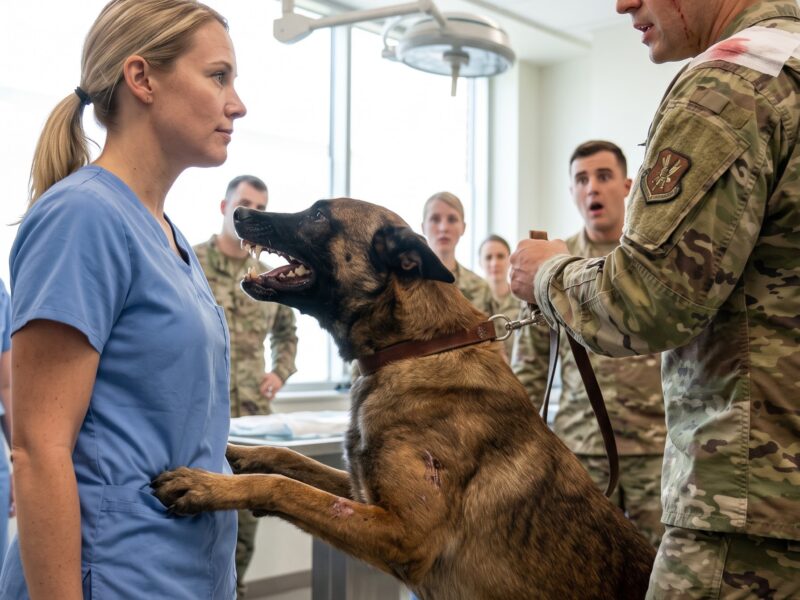
“EVERYONE BACK!” the Navy SEAL shouted as his K9 suddenly broke formation, ignored three armed handlers
The rain over Naval Base Coronado did not fall in a gentle mist; it hammered down in sheets, heavy with the salt air of the Pacific and cold enough to numb the skin within seconds. Sirens blared from every direction, their red and blue strobes slashing through the dark rain like raw wounds. Emergency vehicles, military police cruisers, and tactical vans sat bumper-to-bumper across the staging area, engine exhaust curling thick and white into the wet night.
I stood beside the rear doors of the primary transport ambulance, holding a heavy metal tray of trauma packs against my chest. My uniform—the navy-blue scrubs of a civilian contract nurse—was already soaked through at the shoulders. Rain trickled from the rim of my hair down my neck.
Around me, chaos moved in fast forward. Armed sentries in tactical gear shouted over the roar of idling engines, herding non-essential personnel and civilian contractors back behind the primary perimeter. A massive power failure had struck the lower quadrant of the base twenty minutes ago, and the sudden darkness had triggered a base-wide lockdown.
Nobody looked at me. Nobody ever did. In a place filled with elite operators, heavy weaponry, and high-ranking brass, a civilian nurse standing near an ambulance was background noise. I had spent the last six years mastering the art of being invisible.
Then the sound changed.
A sharp, metallic clatter echoed from the rear of a heavily armored tactical van thirty yards away. A voice, hard and commanding, pierced the ambient roar of the storm.
“Hold him! Pull him back!”
I turned my head slightly. Three men in full combat uniforms were struggling with a massive German Shepherd. The dog’s coat was black as charcoal, mixed with silver across his powerful chest. He wore a heavy tactical harness lined with communication gear and a reinforced lead.
“HE’S NOT RESPONDING! GET CONTROL OF HIM!” a senior handler barked, digging his boots into the slick asphalt.
The dog didn’t bark. He didn’t snap. He simply lunged forward with a terrifying, single-minded focus, pulling two full-grown men off balance on the wet pavement.
“EVERYONE BACK!” the lead Navy SEAL shouted, his hand dropping to his sidearm as the leash tore out of his teammate’s gloved grip.
The heavy leather lead whipped across the asphalt. The dog tore across the open staging area, ignoring the armed sentries, ignoring the flashing lights, and sprinting with absolute precision toward the shadow of the ambulance.
Toward me.
My heart slammed against my ribs. Logic screamed at me to drop the tray and step back into the vehicle, but my boots felt glued to the wet concrete.
The dog didn’t slow down. He crossed the final ten feet in a flash of dark fur and wet muscle, pulling up sharply just inches from my knees.
The world around us seemed to instantly mute. The sirens, the yelling of the guards, the rushing rain—all of it faded into a dull background hum.
The dog stood motionless, his chest heaving, water dripping from his ears. Slowly, deliberately, he lowered his heavy head. He didn’t bite. He didn’t growl. He extended his dark muzzle and pressed his wet nose firmly against the pulse point of my right wrist.
“Ma’am, don’t move!” the SEAL shouted, closing the distance with his rifle raised to low-ready, his boots slapping loudly against the puddles. Two other operators fanned out behind him, their faces masked in tactical balaclavas.
I didn’t move. I couldn’t.
The dog took a deep, shuddering breath, sniffing the soaked fabric of my sleeve. Then, he raised his head, looked directly into my eyes, and let out a quiet, high-pitched whine.
It was a sound of immense, desperate recognition.
A cold knife slipped into my chest. My hands began to shake so violently that the metal tray rattled.
I knew that whine.
I had heard it seven years ago, miles away from the quiet shores of California, in a damp, pitch-black basement in Syria where a field surgical unit had been pinned down by mortar fire for fourteen hours.
The lead SEAL reached us, grabbing the loose leash but keeping his distance, his sharp eyes darting between the dog and my face. “He’s an attack asset, ma’am. He doesn’t approach strangers. You know this dog?”
My throat felt full of glass. “No,” I whispered.
It was a lie. A instinctual, desperate lie.
His name was Ghost.
And seven years ago, before he was designated an elite military working asset, he was a scrawny, half-starved pup rescued from a bombed-out village by my husband.
My husband, Petty Officer First Class Daniel Mercer. Daniel had been a Navy SEAL corpsman—a combat medic assigned to the most clandestine units in the military. Six years ago, during a dark, off-the-books deployment in the mountains of the Hindu Kush, his unit was ambushed. The official military report handed to me by two dress-uniformed officers on my front porch was brief: Helicopter down over hostile terrain. Catastrophic explosion. No remains recovered.
I was given a folded flag, a pension, and a silent mandate to move on. I spent six years grieving a ghost. I built a quiet, lonely life around his absence, working night shifts at naval hospitals, keeping my head down, surrounded by the uniform he used to wear.
Ghost dropped his head lower, ignoring the SEAL’s firm tug on his harness. He stepped closer, nudged my leg with his shoulder, and raised one heavy paw, scratching urgently at the lower side pocket of my canvas medical bag hanging over my shoulder.
“Open it,” the SEAL commanded, his voice dropping into a dangerous, quiet register.
“It’s just trauma gear,” I stammered, my breathing ragged. “It’s just bandages—”
“Open the bag, ma’am. Slowly.”
My trembling fingers reached for the heavy zipper. I pulled it back. Inside lay standard issue supplies: rolls of sterile gauze, tourniquets, a penlight, trauma shears.
Ghost barked once—a short, sharp command.
I reached past the top layer of gauze, my fingers dipping into the deep, dark seam of the lining. My fingertips brushed against something cold, hard, and unmistakably heavy.
I froze. I had carried this bag for three years. I checked its contents every single shift. That pocket had been empty when I picked it up from the locker room two hours ago.
“Pull it out,” the SEAL ordered, taking a step closer.
I wrapped my fingers around the cold object and pulled it into the dim light of the emergency strobes.
It was a key. A solid, antique-style brass key with intricate, heavy notch patterns cut along its spine, attached to a tarnished steel ring.
The lead SEAL’s eyes widened slightly. His breath hitched. “Where the hell did you get that?”
“I… I don’t know,” I gasped, staring at the metal in my palm. “It was just in my bag—”
“That’s a Master Mechanical Bypass key,” the SEAL interrupted, his voice tight. “It belongs to the subterranean ordnance vault beneath Hangar 4. That vault was sealed six years ago after Operation Blackwood. Nobody carries those.”
My vision swam. Operation Blackwood. That was the classified code name printed at the top of Daniel’s death certificate.
A memory flashed behind my eyes with blinding clarity. The night before Daniel deployed for the last time, he had stood in our small kitchen in Imperial Beach. He had slipped his hand into mine, pressing a cold piece of metal into my palm.
“If I don’t come home, Sarah, never give this to anyone,” he had whispered, his eyes dark with a fear I had never seen in him before. “Not to the Navy, not to my team, not to the police. No matter what they tell you happened to me.”
Three weeks later, they told me he was dead. And two months after that, during a break-in at my house where my home was systematically torn apart, the key had been stolen from my jewelry box. I thought it was gone forever.
Now, it was sitting in my hand, dripping with rain outside Hangar 4.
The lead SEAL took a heavy step toward me, his hand extending. “Who are you?”
My voice cracked. “Sarah. Sarah Mercer. I’m… I was Daniel’s wife.”
The SEAL went rigid. Before he could speak, Ghost suddenly whipped his head around. His ears pinned back against his skull, his lips pulled back over his teeth, and a deep, terrifying growl rattled in his chest.
He wasn’t looking at us. He was looking past the ambulance, straight into the pitch-black mouth of Hangar 4 fifty yards away.
SNAP.
Every single emergency floodlight surrounding the staging area cut out at once. The sirens died mid-wail. The flashing strobes vanished, plunging the entire tarmac into pitch-black shadow, broken only by the dim amber clearance lights of distant trucks.
In the sudden, suffocating darkness, the pocket of my scrub top vibrated violently.
My hand darted to my phone. The screen illuminated my face with a harsh blue glow.
One new text message. No sender number. No contact name. Just four words written in sharp capital letters:
HE KNOWS YOU’RE HERE.
A sudden burst of movement tore through the dark. Ghost snapped his lead cleanly out of the SEAL’s grip with a powerful jerk. He didn’t bark again. He launched himself forward like a black arrow, sprinting straight toward the dark silhouette of Hangar 4.
“Ghost! Halt!” the SEAL screamed, pulling a tactical flashlight from his vest and illuminating a narrow beam through the heavy rain. “Nurse Mercer, stay back!”
I didn’t stay back. For six years, I had lived in a quiet room of grief, staring at a blank wall, accepting a lie because it was safer than the truth. But as I looked at the dark opening of that hangar where my husband’s dog was running, something inside me ignited.
I locked my hand around the brass key, shoved it deep into my pocket, and ran into the dark after him.
The rain hit my face like needles as I sprinted across the open tarmac. Behind me, shouts flared up—the sharp commands of Navy SEALs trying to re-establish a perimeter, the clatter of boots on wet pavement, and the sudden harsh glare of handheld tactical lights slicing through the storm.
“Mercer! Stop! That’s an active scene!” the lead SEAL’s voice echoed behind me, but his words were swallowed by the wind.
I didn’t stop. I couldn’t.
Ahead of me, the massive sliding doors of Hangar 4 stood yawning open like the jaws of a sunken ship. The hangar had been decommissioned years ago, a relic of Cold War architecture left to rot at the edge of the air station. Its corrugated steel skin groaned under the force of the wind.
I crossed the threshold into the building. The sound of the rain instantly shifted from a roar to a deafening drumbeat pounding against the high arched tin roof overhead.
“Ghost!” I called out, my voice trembling, bouncing off the hollow steel walls. “Ghost!”
A low, rhythmic scratching sound echoed from the far corner of the vast space.
I pulled my cell phone from my pocket, using the weak glow of the screen to cut through the thick, dusty darkness. The hangar was vast and cavernous. Old, tarp-covered equipment, rusting jet engines, and stacked wooden crates cast long, twisted shadows across the cracked concrete floor.
Near the back wall, a narrow lightbeam darted across the floor.
Ghost was there. He was standing in front of a heavy steel hatch set directly into the concrete floor—a subterranean access door painted with faded yellow warning stripes. A massive electronic keypad sat beside the hatch, its red display screen dead due to the power outage.
Below the dead digital keypad was a manual lock cylinder.
Ghost was pawing frantically at the iron ring of the hatch, his nose pressed to the crack between the steel doors. As I approached, he turned his dark eyes toward me and let out that same low, desperate whine.
My heart hammered against my ribs like a trapped bird.
I reached into my pocket and pulled out the heavy brass key. The key that had vanished from my home six years ago. The key Daniel had told me never to give to anyone.
“How did this get in my bag, Ghost?” I whispered, dropping to my knees on the cold concrete beside him.
The dog nudged my hand with his wet snout, pressing his forehead against my arm, pushing me toward the lock.
I slid the brass key into the manual cylinder. It fit perfectly. No resistance, no looseness.
With a deep breath, I gripped the square top of the key and turned it to the right.
CLACK.
A heavy, hydraulic thud echoed beneath the floorboards. A sharp hiss of pressurized air escaped from the seal, carrying a smell that instantly made my stomach turn.
It wasn’t the smell of rust, or oil, or wet concrete.
It was the smell of antiseptic. Standard military-grade chlorhexidine, mixed with the faint, metallic tang of fresh blood.
“Dear God…” I breathed.
The heavy steel hatch unlocked. Ghost didn’t wait. He used his powerful snout to shove the heavy door upward, revealing a steep flight of narrow metal stairs descending into absolute blackness.
A faint, rhythmic beep echoed from deep below.
Beep… Beep… Beep…
It was the distinct, unmistakable pulse of a cardiac heart monitor.
My hands shook so hard I nearly dropped my phone. I was a trauma nurse. I had listened to that rhythm thousands of times. Someone was down there. Someone connected to a life-support system.
“Mercer!”
The sharp beam of a high-powered tactical flashlight suddenly cut through the entrance of the hangar fifty yards behind me. Boots were clattering fast against the concrete floor. The SEALs were inside.
“Sarah! Step away from the hatch!” the lead operator called out. His voice was calm, but there was an edge of severe tension in it now. “You don’t understand what’s down there. Close the door and step back.”
I looked back at the light blinding me from the entrance, then down into the pitch-black stairwell.
If I stepped back, they would take the key. They would lock the hatch. They would file another report, give me another quiet explanation, and send me back to my empty life.
Ghost didn’t hesitate. He melted into the darkness of the stairwell, his claws clicking rapidly against the metal steps as he descended.
“Ghost!” I whispered.
I didn’t turn back. I ducked through the open hatch, pulled the heavy steel door down until it clicked shut behind me, and plunged myself into the subterranean dark.
The stairwell was narrow, cold, and dripping with condensation. The air grew colder with every step I took, thick with the heavy scent of iodine and damp earth. I pressed one hand against the rough concrete wall to steady myself, using the weak flashlight on my phone to illuminate the steps ahead.
At the bottom of the stairs lay a long, narrow corridor lined with exposed conduit pipes and heavy steel doors. It looked like an old military bunker, forgotten by time—except for the brand-new thick black cables snake-ing along the floor, drawing power from an unseen source.
The cardiac monitor’s steady tone was clearer down here.
Beep… Beep… Beep…
“Ghost?” I called out softly, my voice barely a whisper.
A shadow moved at the end of the hall. Ghost was standing outside a heavy reinforced door at the far end. The door was slightly ajar, a thin sliver of stark white fluorescent light spilling out onto the dirty floor.
I crept down the hallway, my nurse’s shoes making no sound against the damp concrete. Every instinct in my body screamed at me to turn around, but the faint, rhythmic beep pulled me forward like a tether.
I reached the door and gently pushed it open.
The room inside was massive, clean, and filled with state-of-the-art medical equipment that looked completely out of place in a subterranean bunker. Monitors hummed quietly, powered by silent backup batteries. Shelves were lined with IV bags, surgical trays, and rows of unmarked medicine vials.
In the center of the room stood a single hospital bed surrounded by monitoring equipment.
Sitting in a steel chair beside the bed was a man.
He wore no military uniform. He was dressed in a dark tactical jacket, his face shadowed, his posture rigid. On the table beside him lay a suppressed handgun and a radio receiver that was currently crackling with static.
When the hinges groaned, the man didn’t jump. He didn’t draw his gun. He simply turned his head slowly toward me.
The breath was instantly crushed out of my lungs.
The skin on his face was scarred—a long, jagged line running from his left temple down to his jawline. His hair was streaked with gray, his cheeks hollow, his posture worn down by years of unspeakable strain.
“Sarah,” he said softly.
His voice was lower than I remembered, rougher, like gravel dragged across glass. But it was him.
“Daniel?” My voice was barely a gasp. My phone slipped from my fingers, clattering onto the floor, its light projecting across the ceiling.
Six years.
Six years of staring at a framed photograph on my mantle. Six years of telling myself he was gone, that his body was scattered in a mountain range half a world away.
“You… you died,” I stammered, taking a step backward, my hand flying to my mouth as tears flooded my eyes. “They told me your chopper went down. They gave me a flag!”
Daniel stood up slowly. He looked older, tired beyond measure, but his blue eyes—the same eyes that had looked at me across our kitchen table—were pinned on mine with absolute, agonized clarity.
“They had to tell you that, Sarah,” he whispered, his chest heaving. “If they thought I was alive, if they knew what I took from that compound in Syria, they would have used you to pull me out of the dark.”
Ghost walked up to Daniel, resting his heavy head against the man’s knee. Daniel lowered one hand, his calloused fingers burying themselves deep in the dog’s fur.
“What is this?” I sobbed, pointing a shaking finger at the medical equipment, at the dark vault, at him. “Who put that key in my bag tonight? Why am I here?”
“I did,” Daniel said quietly. “Or rather… one of the few men I still trust did. I had to get you inside the perimeter before the base went on full lockdown.”
“Why?”
Daniel turned his head slightly, gesturing toward the hospital bed behind him.
I took a slow, hesitant step forward, leaning around Daniel’s frame to look at the figure lying in the bed.
The person under the heavy white blanket was hooked up to a mechanical ventilator and three separate IV drips. His face was pale, his breathing shallow and artificial. His head was wrapped in heavy bandages.
I stepped closer, my medical instincts temporarily overriding my sheer shock. I looked at the heart monitor, reading the vital signs automatically.
Pulse: 52. Oxygen saturation: 88%. Blood pressure: 90 over 50.
“He’s in septic shock,” I said instantly, looking up at Daniel. “His lung parameters are failing. Who is he?”
Daniel looked down at the unconscious man. His expression darkened with a profound, terrifying grief.
“That’s Commander Marcus Vance,” Daniel said. “The man who led our team in Syria. The man who ordered the official report that claimed I was dead.”
I stared at Daniel, my mind spinning into a vortex of confusion. “Your commanding officer? He hid you? He kept you down here?”
“No,” Daniel said, his voice dropping into a harsh, cold tone. “He didn’t hide me. He hunted me. For six years, Vance has been running a black-budget intelligence operation out of this base, selling intercepted military assets to private contractors.”
“Then why is he in a bed in your vault?” I demanded.
Daniel looked me straight in the eyes. “Because three days ago, Vance realized his partners were going to burn the whole operation down and eliminate everyone involved—including him. He was shot during a drop at the harbor. He dragged himself to my safe house because I’m the only medic alive who knows how to operate this subterranean bay.”
“He framed you! He stole six years of your life!” I shouted, tears streaming down my cheeks. “Why aren’t you letting him die?”
“Because,” Daniel stepped closer, reaching out to gently touch my trembling hand, “he has the drive. The encrypted drive that contains the names of every officer involved in the cover-up. The drive that can clear my name and bring me home to you.”
Daniel’s grip tightened on my fingers.
“But he’s dying, Sarah. The bullet tore through his upper left lobe. He’s pooling blood in his chest cavity. I’m a combat medic, but I don’t have the surgical precision to clear that airway without collapsing his lung entirely. You do. You’re a senior trauma nurse.”
The air in the room felt impossibly thin.
“You brought me down here… to save the man who ruined our lives?” I whispered.
“I brought you down here,” Daniel said, his eyes burning with intense devotion, “because if he dies, the truth dies with him. And I spend the rest of my life as a ghost.”
Before I could answer, a loud, metallic THUD echoed from the top of the stairwell corridor.
The iron door at the end of the hall was slammed violently against the wall.
“DANIEL! STAND DOWN!”
The voice echoed down the concrete corridor, amplified by a megaphone. It wasn’t the lead SEAL from the tarmac. It was a deeper, older voice—sharp, authoritative, and chillingly familiar.
Daniel’s entire demeanor shifted instantly. The gentle husband vanished; the hardened combat operator took his place. He snatched the suppressed handgun from the table, racking the slide with a clean, lethal motion.
“They’re inside,” Daniel grunted, stepping in front of me and forcing me down behind the steel medical console. “Stay low!”
“Who is that?” I gasped, crouching beside Ghost, who was vibrating with aggressive tension, his lips curled back in a silent snarling display.
“Captain Miller,” Daniel said, keeping his eyes glued to the heavy steel door of the vault. “Vance’s second-in-command. He’s the one who turned off the power across the base tonight. He’s not here to arrest us, Sarah. He’s here to make sure Vance never wakes up to talk.”
Footsteps pounded down the hallway—heavy, tactical boots moving in a coordinated fire-team formation.
“Daniel!” Miller’s voice called out from just beyond the doorway. “We know you’re in there with the nurse! Hand over Vance and the drive, and we’ll let her walk out of here alive! You know how this ends, son. You’re a dead man walking anyway!”
Daniel didn’t answer. He looked back at me, his eyes darting to the chest tube assembly resting on a sterile tray beside the bed.
“Sarah,” he whispered urgently. “I need three minutes to hold this doorway. Can you insert a chest drain and relieve the tension in Vance’s thoracic cavity?”
My hands were shaking. I was a nurse, but performing an emergency chest tube insertion under active fire in a subterranean bunker was light-years away from a sterile hospital operating room.
“I… I haven’t done an unassisted insertion in two years,” I stammered.
“Look at me,” Daniel commanded, grabbing my face in his warm, calloused hands. “You are the best nurse I have ever seen. You saved more guys in Syria than I did. You can do this. Save his life, get that drive, and we finish this tonight.”
He kissed my forehead—a quick, desperate touch that smelled of rain and gun oil—and then stepped into the doorway, raising his weapon.
POP! POP! POP!
The quiet hiss of suppressed gunfire echoed through the corridor. Spurlock of concrete dust erupted from the doorframe. Daniel fired back, two precise rounds that forced the advancing team to scatter for cover in the narrow hallway.
“DO IT NOW, SARAH!” Daniel yelled over his shoulder.
I wiped the tears from my face with the sleeve of my scrub top, forcing my breathing to slow down. The chaotic noise of the gunfight faded as my clinical instincts took control.
I turned to the bed. Commander Vance was turning blue around his lips. His chest was uneven—his left side was completely expanded, trapped air crushing his heart and preventing blood from returning to his brain. Tension pneumothorax. If I didn’t release the pressure in sixty seconds, his heart would stop.
“Forgive me for saving your life,” I muttered bitterly through my teeth.
I grabbed a bottle of iodine, pouring it over his left chest. I snatched a sterile scalpel from the tray. My hand stopped shaking the moment the steel touched his skin.
Incise at the fifth intercostal space.
I made a quick, firm two-inch incision through the skin and muscle.
Outside the door, a heavy explosion rocked the bunker. A flashbang grenade. The blast knocked three metal trays off the counters, sending surgical instruments clattering onto the floor. Dust rained down from the ceiling.
Daniel stumbled back a step, his shoulder slamming into the doorframe, a streak of crimson blood blooming across his left sleeve.
“Daniel!” I screamed.
“KEEP WORKING!” he roared, leaning around the frame and firing three more shots down the dark hall. Ghost stood beside him, barking furiously, his jaws snapping at the smoke drifting through the opening.
I ignored the blood, ignored the smoke, and shoved my gloved finger into the incision on Vance’s chest, clearing a path through the intercostal muscle into the pleural space.
I grabbed the heavy plastic chest tube, sliding it along my finger directly into the chest cavity.
PFFFFFFFFFFFFFFT!
A violent rush of trapped air and dark, stagnant blood hissed out of the tube, spraying across my scrubs and the white sheets.
Instantly, the cardiac monitor’s erratic tone changed.
Beep… Beep… Beep…
The pulse rate stabilized. The oxygen levels began to climb.
Vance’s eye suddenly snapped open.
He gasped violently, his hands flying up to grip my wrists with surprising strength. His bloodshot eyes rolled in their sockets before locking onto my face.
“The… the key…” Vance choked out, his voice a wet, rattling gasp through his ventilator tube.
“I have the key!” I shouted over the sound of gunfire. “Where is the drive?!”
Vance’s shaking hand moved slowly up to his neck. He reached for a thin, silver dog-tag chain wrapped tightly around his throat. Dangling from the chain wasn’t a standard military tag.
It was a heavy, metallic micro-drive encrypted with a biometric thumb-reader.
“Take it…” Vance wheezed, his grip on my wrist slipping as he fought for air. “It… clears… Daniel…”
I snapped the chain off his neck just as a heavy boot slammed into the vault door, throwing it wide open.
The door exploded inward, breaking off its hinges.
Daniel was thrown backward onto the concrete floor by the sheer force of the impact, his sidearm skittering away under the medical equipment.
Captain Miller stepped into the room. He was a broad-shouldered man with grey hair, wearing an unbuttoned tactical vest over an officer’s uniform. In his hand, he held a heavy tactical shotgun raised directly at Daniel’s head.
Behind him, two armed men covered the hallway, their weapons trained on the darkness.
“End of the line, Mercer,” Miller said, his voice cold, devoid of any emotion. “You were supposed to stay dead six years ago. You just couldn’t let it go, could you?”
Daniel lay on the floor, gasping for breath, blood pooling beneath his wounded shoulder. He didn’t look at the gun. He looked at me.
“Run, Sarah,” he whispered.
I stood beside the bed, holding the blood-stained drive tight in my fist, my body trembling with rage and fear.
Miller turned his cold eyes toward me, noticing the drive in my hand. A cruel smile touched the corner of his lips. “Hand it over, Mrs. Mercer. You’re a civilian nurse. You don’t belong in this war. Give me the drive, and I’ll make sure your death is listed as an tragic accident during base lockdown.”
“You took my husband,” I said, my voice surprisingly steady, stepping between Miller’s shotgun and Daniel. “You took six years of our lives. You made me walk into an empty house every single night thinking he was dust.”
“It was business, ma’am,” Miller sneered, racking the slide of the shotgun with a loud, sickening CLACK. “Now step aside.”
“No,” I said.
Miller’s finger tightened on the trigger.
He didn’t see Ghost.
The black dog had drifted into the deep shadows behind the overturned supply cabinet when the door burst open. He hadn’t made a sound. He hadn’t barked. He had waited, trained by years of clandestine warfare to attack only on opportunity.
Ghost launched himself through the air like a catapult.
One hundred pounds of muscle and teeth slammed directly into Miller’s torso before he could pull the trigger. The shotgun blasted harmlessly into the concrete ceiling, shattering the light fixtures and plunging the vault into near-total darkness.
Miller screamed as Ghost’s jaws locked around his forearm.
“GET HIM OFF ME!” Miller shrieked, striking the dog with his free hand.
Daniel didn’t waste a split second. Despite his wound, he lunged across the floor, driving his weight into Miller’s legs, bringing the heavy captain down onto the hard floor.
“SARAH! THE HATCH! GO!” Daniel roared as he wrestled Miller for control of the fallen shotgun.
“I am NOT leaving you again!” I screamed.
I snatched a heavy stainless-steel oxygen tank from the wall rack, stepped over the struggling men, and swung it with everything I had into the side of Miller’s tactical helmet.
CLANG!
Miller went instantly limp. Ghost released his arm, standing over the unconscious captain, chest heaving, his muzzle slick with sweat and rain.
Outside, the subterranean hallway erupted with the sound of approaching boots—not Miller’s men, but heavy, organized military police teams screaming clear orders.
“NAVAL SPECIAL WARFARE! HANDS IN THE AIR! DROP YOUR WEAPONS!”
Bright white tactical lights flooded the vault doorway as a squad of elite base security operators poured into the room, their weapons trained on every corner. Behind them stepped the lead SEAL from the staging area on the tarmac, his face dripping with rain, his weapon lowered.
He looked at the unconscious captain, looked at Vance on the bed, and then looked at Daniel lying bloody on the floor.
“Mercer?” the lead SEAL whispered, his eyes wide in absolute disbelief. “Jesus Christ… you’re alive.”
Daniel slowly pushed himself up against the wall, holding his bleeding shoulder, his breathing heavy and ragged. He looked up at his fellow operator.
“I’m alive, Evans,” Daniel said softly, pointing at the drive clinched tight in my blood-stained hand. “And it’s time to bring everyone home.”
The morning sun broke over San Diego Bay with a blinding, golden light, burning away the thick rain clouds that had choked the coast all night.
I sat on the rear bumper of the ambulance parked at the edge of the tarmac, wrapped in a heavy olive-green military blanket. A paper cup of warm black coffee sat untouched in my hands.
The staging area was still filled with federal agents, military investigators, and brass from Washington, but the chaotic panic of the previous night had settled into a quiet, serious silence. Captain Miller and his conspirators were in federal custody. The contents of the encrypted drive had already triggered a sweeping series of arrests across three naval installations.
The rear doors of an official medical transport vehicle twenty yards away opened.
Daniel stepped out. His left arm was immobilised in a clean white sling, his face freshly bandaged, but he was wearing a clean set of Navy utility fatigues.
Beside him walked Ghost. The dog’s harness had been removed; he moved with a slow, relaxed gait, his tail wagging slightly as he caught my scent in the morning breeze.
Daniel walked across the wet tarmac, his eyes fixed entirely on me.
Six years of mourning, six years of quiet pain, six years of living with a ghost—all of it seemed to evaporate into the warm morning light as he closed the distance between us.
He stopped in front of me. He didn’t say anything at first. He just reached out his good hand, his thumb gently wiping a smear of dry dirt from my cheek.
“I’m sorry it took me so long to come back,” he whispered, his voice cracking with raw emotion.
I set the coffee cup aside, stood up from the bumper, and threw my arms around his neck, burying my face in his chest. I felt the warm, steady beat of his heart against my cheek—real, powerful, and alive.
Ghost pressed his heavy head against our legs, letting out a soft, contented sigh.
“You’re not a ghost anymore, Daniel,” I murmured into his chest, tightening my grip on his shirt as the warm California sun filled the sky around us. “You’re home.”
The end.









