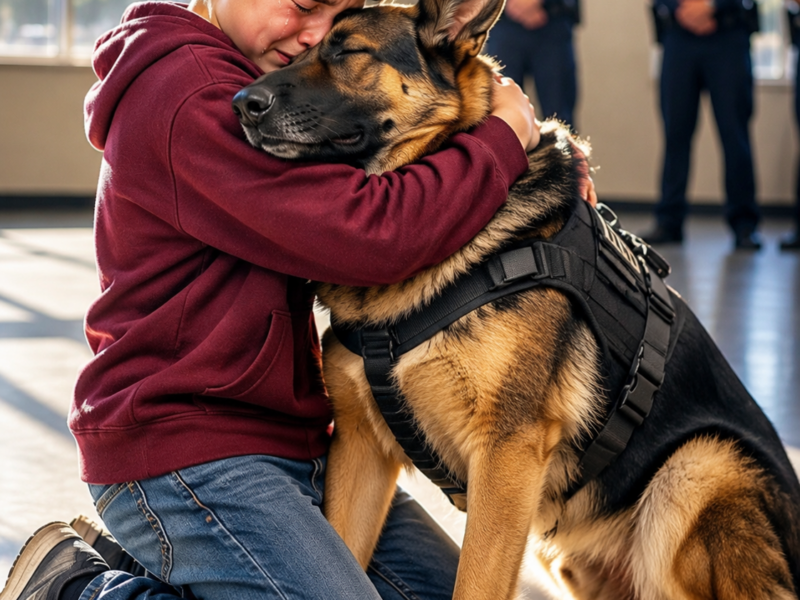
“Everyone at the shelter said the veteran’s dog was too dangerous to touch, but when a little boy with one arm stepped into the kennel and whispered a single word
The man in the dark jacket didn’t pull a weapon.
He pulled out a badge.
“Federal investigator,” he said. “My name is Robert Hayes. I need everyone to step away from that dog.”
I didn’t move.
Neither did Bear.
The German Shepherd stood between Noah and the stranger, his body rigid, his scarred muzzle lifted just enough to show his teeth.
“Put the badge away,” I said. “You haven’t explained why you think this dog should have been destroyed.”
Hayes glanced at me.
“And you are?”
“Daniel Brooks. Army veteran. Shelter volunteer.”
“Then you should understand that some animals carry dangerous operational histories.”
“I understand that a frightened dog isn’t automatically a dangerous dog.”
Hayes looked past me toward Noah.
“What’s your name, son?”
Noah didn’t answer.
His mother, Sarah, pulled him closer.
“His name is Noah. And you’re not taking him anywhere.”
Hayes sighed.
“I’m not here for your son.”
“Then why did you tell us to get him away from Bear?”
“Because that dog was involved in an incident overseas.”
I looked at the military tag.
“Unit 17?”
Hayes nodded slowly.
“That’s correct.”
“What happened?”
“An operation went wrong. A soldier died, classified equipment disappeared, and the working dog was never recovered.”
I held up the photograph.
“Was this soldier involved?”
Hayes looked at it.
For the first time, his expression changed.
“Where did you get that?”
“Bear dropped it.”
He reached for the photograph.
I pulled it back.
“You can look. You can’t take it.”
Hayes stared at me for a moment.
Then he said something that made Sarah gasp.
“That soldier was Noah’s father, Sergeant Matthew Ellis.”
Noah lowered his head.
Sarah closed her eyes.
I looked at her.
“You knew?”
She nodded slowly.
“Matthew was my husband. He died three years ago.”
Hayes corrected her.
“His death was never officially confirmed.”
Sarah turned toward him.
“You told me he was dead.”
“I told you the Army had no record of him surviving the incident.”
“You came to my house in uniform. You handed me a folded flag. You told me there was nothing left to investigate.”
Hayes didn’t answer.
Her voice began to shake.
“Do you understand what that did to my son?”
Noah stared at the floor.
Bear moved closer and gently pressed his muzzle against the boy’s knee.
That small gesture told me more than Hayes’s badge ever could.
Noah trusted the dog.
And the dog knew him.
I crouched beside the kennel.
“Noah, did your father teach you that word?”
The boy nodded.
“Home.”
“Why?”
He looked at Bear.
“Dad said it meant we were safe.”
I felt something tighten in my chest.
“Did he teach Bear too?”
Noah nodded again.
“Before he left, Dad said Bear would always come back if he heard it.”
Sarah covered her mouth.
I turned toward Hayes.
“What exactly happened during that operation?”
Hayes lowered his voice.
“Three years ago, Unit 17 was assigned to recover stolen communications equipment from a remote facility. Sergeant Ellis and his team entered the location. There was an explosion during the extraction.”
“And the dog?”
“Bear disappeared.”
“Along with Matthew?”
“Yes.”
“Then why does Bear have a collar?”
Hayes looked toward the dog.
“Because someone recovered him afterward.”
The shelter director, Mrs. Collins, stepped closer.
“Recovered him from where?”
Hayes hesitated.
“An unauthorized holding facility.”
I frowned.
“Whose facility?”
“That’s part of the investigation.”
It was an answer designed to end the conversation.
I had heard plenty of those during my military years.
I stood.
“Then tell us why this dog was labeled unadoptable and why nobody mentioned his military identification.”
Hayes looked at the shelter director.
“Mrs. Collins, I need access to his intake records.”
She crossed her arms.
“You can request them through the proper channels.”
Hayes’s jaw tightened.
“This is a federal matter.”
“And this is my shelter. You’re not walking out with an animal because you flashed a badge.”
For the first time, I almost smiled.
Mrs. Collins was small, gray-haired, and usually more concerned about muddy paw prints than government paperwork.
But she wasn’t backing down.
Hayes took a breath.
“Fine. I’ll return with the necessary authorization.”
He looked at Noah one more time.
“Don’t let that boy get too attached.”
Then he walked out.
The moment the door closed, Bear began scratching at the kennel.
Noah leaned toward him.
“It’s okay,” he whispered.
Bear stopped.
Sarah turned to me.
“Daniel, can we talk somewhere private?”
I nodded.
We moved into the small office behind the reception desk.
Mrs. Collins stayed with Noah.
Through the window, I could see Bear lying beside the kennel door, his eyes fixed on the boy.
Sarah sat across from me.
Her hands trembled as she removed a folded photograph from her purse.
It showed Matthew in uniform, holding a much younger Bear.
Noah stood beside him, barely three years old.
“He was born with one arm,” Sarah explained. “The doctors said he would need years of therapy. Matthew refused to let him believe he was limited by it.”
She smiled faintly.
“He used to tell Noah that courage wasn’t about having two hands. It was about deciding what to do with the one you had.”
I looked down at the photograph.
“Matthew sounds like a good father.”
“He was.”
Her smile faded.
“After he left for that operation, I received a call saying his team had been caught in an explosion. They said there were no survivors.”
“And Bear?”
“They told me the dog had been destroyed because of his injuries.”
I looked through the window.
Bear had no visible injuries beyond the scar on his muzzle.
“What happened after that?”
Sarah swallowed.
“About eight months later, someone began leaving messages at our house. No name. No return address. Just warnings telling me not to ask questions about Matthew.”
“Did you report them?”
“Twice. The local police said there was nothing they could do.”
“Why didn’t you contact the military again?”
“I did. They said the investigation was closed.”
She reached into her purse and pulled out another item.
A small envelope.
“Then, last month, this arrived.”
Inside was a handwritten note.
The message was brief.
BEAR IS ALIVE.
FIND HIM BEFORE THEY DO.
There was no signature.
I looked at the date.
The note had been sent two weeks before Bear arrived at the shelter.
“Why didn’t you tell the shelter?”
“Because I didn’t know whether it was a trap. I didn’t know who I could trust.”
“Why bring Noah here?”
Sarah looked toward the window.
“He saw the shelter’s website. He recognized Bear from the photograph.”
I stared at her.
“You knew the dog was here?”
“I suspected it.”
“Then why didn’t you say something?”
She wiped her eyes.
“Because I needed to know whether Bear would remember my son.”
I understood then.
This wasn’t a random visit.
It was a test.
And Bear had passed it.
I returned to the kennel.
Noah was sitting on the floor with his back against the wall.
Bear had rested his head beside the boy’s leg.
“Can I ask you something?” I said.
Noah nodded.
“Did your father ever tell you about Unit 17?”
His expression changed.
He glanced at his mother.
Sarah slowly shook her head.
Noah looked down.
“Dad said there were bad people who wanted something from him.”
“What did they want?”
He hesitated.
“His little black box.”
I looked at Sarah.
“What black box?”
She shook her head.
“I don’t know.”
Noah pointed toward Bear.
“Dad said Bear would keep it safe.”
I stared at the dog.
“Where?”
Noah didn’t answer immediately.
Then he pointed at the old blanket.
I examined it.
The fabric was worn and stained, but the lining felt unusually thick.
I carefully turned it over.
There was a small opening sewn shut along one edge.
I looked at Mrs. Collins.
“Do you have scissors?”
She brought a pair from the office.
I cut through the stitching.
A small black device slid into my palm.
It was about the size of a matchbox, with a scratched metal casing and a narrow strip of faded lettering.
UNIT 17 — FIELD RECORDER.
My pulse quickened.
“Does anyone know this is here?” I asked.
Sarah shook her head.
“No.”
I looked toward the front entrance.
Hayes had left.
But that didn’t mean we were safe.
I placed the device in an evidence bag Mrs. Collins found in the supply cabinet.
Then I called Commander James Walker, a former officer I trusted.
He answered on the second ring.
“Daniel. What’s wrong?”
I told him about Bear, Noah, the photograph, and the device.
He went silent.
“Where are you?”
“County animal shelter.”
“Don’t touch that recorder again. Don’t connect it to anything. Keep the dog and the family somewhere secure.”
“Why?”
“Because Unit 17 was officially dismantled after that operation. Anything connected to its equipment should have been accounted for.”
“Was Matthew Ellis killed?”
Another silence.
Then Walker said, “I don’t know.”
“You’re telling me the Army gave his family a folded flag without confirming his death?”
“Daniel, I wasn’t involved in the notification.”
“That’s not an answer.”
“No,” he said quietly. “It isn’t.”
He promised to send someone I could trust.
Before ending the call, he added:
“Do not let Robert Hayes take that device.”
I looked at the evidence bag.
“Why?”
“Because Hayes was removed from the Unit 17 investigation eighteen months ago.”
My stomach tightened.
“Why?”
“He was suspected of leaking information.”
The call ended.
I turned toward Sarah.
“We need to leave.”
She looked frightened.
“What about Bear?”
“We’re taking him.”
Mrs. Collins appeared in the doorway.
“I can arrange a temporary foster placement.”
“No,” Noah said.
It was the first time I’d heard him speak loudly.
Everyone turned.
He stood beside the kennel.
“Bear comes with us.”
Sarah knelt beside him.
“Sweetheart, we need to make sure he’s safe.”
Noah shook his head.
“Dad said we don’t leave family behind.”
Bear rose.
He pressed his nose against the boy’s hand.
I looked at Mrs. Collins.
“Can you release him to Sarah under a temporary medical and safety agreement?”
She hesitated.
“I can begin the paperwork.”
“Please.”
She nodded.
“Give me ten minutes.”
We didn’t get ten minutes.
A dark SUV pulled into the parking lot.
Then another.
Both stopped near the entrance.
I recognized the first vehicle from its license plate.
It was the same one I’d seen parked across the road when I arrived that morning.
Two men stepped out.
One wore a gray jacket.
The other carried a long black case.
Sarah grabbed Noah’s shoulder.
“Are they with Hayes?”
“I don’t know.”
The front door opened.
The man in the gray jacket walked inside.
“Good afternoon,” he said.
His voice was calm.
Too calm.
“I’m here to collect government property.”
I stepped between him and the kennel.
“You’ll need documentation.”
He smiled.
“I’m afraid we don’t have time for paperwork.”
Mrs. Collins came out of her office.
“You can’t take an animal from this facility without authorization.”
The man looked at her.
“Move.”
She didn’t.
The second man opened the black case.
Inside was a handheld scanner.
Bear began growling.
Noah’s face went pale.
“That’s what Dad said they used.”
I looked at him.
“What do you mean?”
He pointed at the scanner.
“They used it when they made Bear scared.”
The man in gray stopped smiling.
“Get the dog.”
The second man raised the device.
Bear lunged toward the kennel door.
I grabbed the metal latch.
“Back away!”
The man in gray pulled a small electronic control from his pocket.
Bear screamed.
It wasn’t a bark.
It was a sound of pure terror.
He collapsed against the kennel floor, trembling violently.
Noah cried out.
“STOP!”
The man raised the control again.
I moved before I could think.
I struck his wrist, knocking the device across the floor.
The second man lunged toward me.
I blocked his first swing, but my bad knee buckled when he shoved me into the reception desk.
Pain shot through my leg.
He reached for the evidence bag.
Mrs. Collins grabbed a heavy clipboard and struck his arm.
“Get away from my shelter!”
The man stumbled.
Sarah pulled Noah behind her.
Then the front door burst open.
Two federal agents entered with Commander Walker behind them.
“Everybody freeze!”
The man in gray tried to run.
An agent tackled him before he reached the door.
The second man dropped to his knees.
Walker rushed toward me.
“Are you hurt?”
“My knee. I’ll survive.”
He looked at Bear.
“Is he alive?”
I nodded.
“He’s terrified.”
Walker crouched beside the kennel.
“Easy, boy.”
Bear growled.
Noah stepped forward.
“Home.”
The dog stopped trembling.
Slowly, he lifted his head.
Walker stared at the boy.
Then he looked at the device on the floor.
“Where did they get that?”
One of the agents picked it up.
“Looks like a remote stimulus controller.”
Walker stood.
“That’s not authorized equipment.”
The man in gray laughed.
“You have no idea what you’re dealing with.”
Walker looked at him.
“I think I do.”
The man stopped laughing.
His name was Victor Shaw.
He had worked as a contractor for the company that managed the old Unit 17 facility.
The second man was an employee of the same company.
Neither had legal authority to collect Bear.
Neither had any legitimate reason to possess the control device.
And neither was willing to explain who had sent them.
The agents arrested both men.
Walker examined the black recorder.
“We need to get this to a secure lab.”
“Can it tell us what happened to Matthew?”
“If it still works, maybe.”
I looked at Sarah.
She was holding Noah tightly.
The boy had one hand buried in Bear’s fur.
“Can we take them somewhere safe?” I asked.
Walker nodded.
“My team has a protected location.”
But before we left, Noah asked one question.
“Can Bear come too?”
Walker looked at the dog.
Then at the boy.
“Yes, son. Bear is coming.”
For the first time that day, Noah smiled.
The secure facility was an old federal training center outside the city.
Bear was examined by a veterinarian who specialized in working dogs.
His injuries were mostly old.
The scar on his muzzle came from a deep cut.
His trembling and panic responses appeared connected to repeated exposure to the electronic control device.
The veterinarian explained that Bear wasn’t inherently dangerous.
He had learned to associate certain sounds and sensations with pain.
He had been punished until he expected every human approach to hurt him.
I sat beside his recovery kennel.
“Someone spent a lot of time teaching you not to trust people.”
Bear rested his head on his paws.
I understood that feeling.
Across the room, Noah was drawing in a notebook.
He had drawn a large German Shepherd beside a little boy.
Above them, he had written one word.
HOME.
Walker entered with a laptop.
“We recovered most of the data from the recorder.”
I stood.
“Did you find Matthew?”
“Not directly.”
My heart sank.
“But we found a recording made forty-eight hours after the operation.”
He placed the laptop on a table.
A man’s voice came through the speakers.
It was weak, distorted, but recognizable.
“Bear, stay close.”
Sarah covered her mouth.
“That’s Matthew.”
The recording continued.
“Tell Noah I’m coming home.”
Then another voice spoke.
“Sergeant, you need to surrender the device.”
Matthew answered.
“You already have the equipment. You don’t need the people.”
A loud crash followed.
Then silence.
Walker stopped the recording.
“That’s all we recovered from that file.”
“Was he alive after the explosion?”
“We believe so.”
Sarah gripped the table.
“Where is he?”
Walker looked down.
“The recorder contains a location marker. It was transmitted from an abandoned medical facility near the original training site.”
I stared at him.
“How long ago?”
“Twenty-nine days.”
Sarah began to cry.
Twenty-nine days.
Matthew might have been alive less than a month ago.
“Then we go there,” I said.
Walker nodded.
“Federal agents are already preparing a search.”
“I’m going too.”
“You’re not an active-duty operator, Daniel.”
“I know.”
“And your knee isn’t fit for an entry team.”
“I know that too.”
He studied me.
“Then what can you do?”
I looked at Bear.
“I can help the dog find the person he’s been waiting for.”
The veterinarian cleared Bear for a short supervised walk.
When we brought him near the laptop, he sniffed the speaker.
Then he began pacing.
Noah approached.
“Home,” he whispered.
Bear turned toward him.
The boy pointed at the screen.
“Dad.”
Bear pressed his nose against it.
Then he made a low sound in his throat.
A sound that wasn’t fear.
It was recognition.
The next morning, we arrived at the abandoned medical facility with a federal search team.
The building stood behind an overgrown fence.
Windows were boarded.
The entrance was chained.
The location marker had led us to a room beneath the old treatment wing.
Agents entered first.
I waited outside with Sarah, Noah, and Bear.
The boy held the leash with his right hand.
His fingers were trembling.
“You don’t have to go in,” I told him.
He shook his head.
“Bear knows where Dad is.”
We waited.
Then a voice came over the radio.
“Command, we’ve located a survivor.”
Sarah nearly collapsed.
Walker caught her arm.
“Is it Matthew?” she asked.
There was a pause.
Then the radio crackled.
“Confirming identity now.”
A few seconds later, the voice returned.
“It’s Sergeant Ellis.”
Sarah began sobbing.
Noah froze.
Bear pulled forward so hard the leash tightened.
“Easy,” I whispered.
But the dog already knew.
The doors opened.
Two agents appeared, supporting a thin man in a worn hospital gown.
His hair was longer than in the photograph.
His face was pale.
But his eyes were unmistakable.
Matthew Ellis.
Sarah ran toward him.
“Matthew!”
He looked up.
For a moment, he didn’t move.
Then his face broke.
“Sarah?”
She threw her arms around him.
He held her like he was afraid she’d disappear.
Noah stood several feet away.
His right hand covered his mouth.
Matthew looked over Sarah’s shoulder.
Then he saw his son.
“Noah.”
The boy took one step.
Then another.
Matthew lowered himself carefully.
“Come here, buddy.”
Noah ran into his father’s arms.
Bear broke free from my loose grip and raced toward them.
I expected chaos.
Instead, he slowed just before reaching Matthew.
He lowered his head.
Matthew placed a trembling hand on the dog’s scarred muzzle.
“Good boy,” he whispered.
Bear began to whimper.
Matthew closed his eyes.
“I knew you’d bring them home.”
I turned away.
Not because I was ashamed of crying.
Because some moments deserve privacy, even when they’re witnessed by strangers.
The investigation took another two months.
Matthew had been held in the medical facility after refusing to identify the people who had stolen the equipment.
The men responsible had planned to use Bear’s tracking system to recover the missing field recorder.
They had repeatedly used the electronic control device to make the dog easier to transport.
When Bear escaped, they assumed he would eventually be captured or killed.
Instead, he ended up at the shelter.
And the boy who knew the word that meant safety found him.
Robert Hayes was arrested after investigators uncovered messages showing he had provided the contractors with information about the recorder.
Victor Shaw and his associate were charged with unlawful detention, assault, conspiracy, and possession of unauthorized military equipment.
The original Unit 17 investigation was reopened.
Matthew gave a full statement.
His death certificate was withdrawn.
And the military formally acknowledged the failure that had allowed him to disappear.
But the biggest change didn’t happen in a courtroom.
It happened at home.
A few months later, I visited the Ellis family.
Matthew was still recovering.
He walked slowly and tired easily, but he was alive.
Sarah had returned to work part-time.
Noah was speaking more, laughing more, and slowly learning that the world could be safe again.
Bear slept beside the living-room couch.
He no longer flinched whenever a door closed.
Sometimes he still woke from nightmares.
When that happened, Noah would sit beside him and whisper:
“Home.”
And Bear would settle again.
I had expected the family to thank me.
They did.
But what I remember most was something Matthew said when we stood outside on the porch.
“You know, Daniel, I thought Bear was the one who needed saving.”
I looked toward the dog.
“What changed your mind?”
Matthew smiled.
“He brought my son back to me.”
I nodded.
“He recognized him before any of us understood why.”
Matthew looked at Noah, who was tossing a soft ball for Bear in the yard.
“Dogs remember the people who make them feel safe.”
I thought about my own years in uniform.
About the men I’d lost.
About the things I’d carried home without knowing how to put them down.
“I think people do too,” I said.
Matthew rested a hand on my shoulder.
“You helped save my family.”
I shook my head.
“Your dog did most of the work.”
He laughed.
“Then I guess I owe him a steak.”
Bear heard his name and lifted his head.
Noah laughed.
For the first time in years, the sound of a dog barking didn’t make me think about danger.
It sounded like a homecoming.
And as I watched that family standing together in the afternoon light, I finally understood something I’d spent too long forgetting.
Being strong doesn’t mean you never need help.
Sometimes it means trusting someone enough to let them bring you home.
The ENd.









