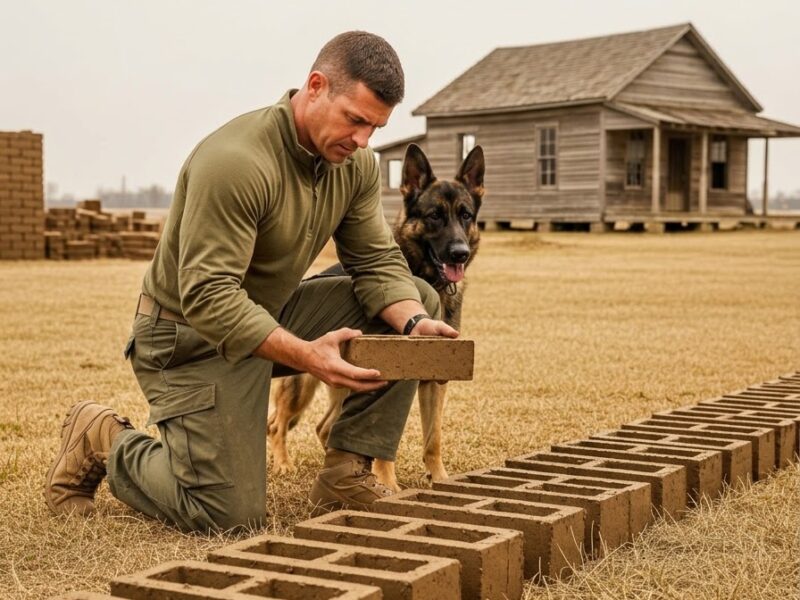
Everyone at the coastal training camp laughed when I watched a Navy SEAL and his old dog stack mud bricks beside a hurricane shelter
The sun over Point Tempest did not warm the skin; it baked it until the salt from the Atlantic crystallized into a white, itching crust across our foreheads. It was a miserable spit of barrier island off the Carolina coast, used for advanced maritime insertion and coastal survival drills. We called it the Sandbox, though most of the time it was just an endless expanse of brackish marshes, dead pine scrubs, and humid, stagnant heat that sat in your lungs like wet cotton.
I was cleaning my service rifle under the corrugated tin overhang of the motor pool when the wheelbarrow first came squeaking across the gravel.
The sound was like an ungreased axle grinding down to bone. Every head on the mechanic’s line turned. Out from the tidal inlet path emerged Master Sergeant Raymond Mason. He was fifty years old if he was a day, built like an old railway sleeper—flat, knotty, and scarred from decades in the Teams. He didn’t wear the lightweight synthetic gear the rest of us favored. He wore faded tiger-stripe utility trousers cut off at the hems, no shirt, and combat boots that looked older than half the recruits on base.
Trotting directly beside his left knee was Duke. Duke was a German Shepherd whose black-and-tan muzzle had long since faded to a dusty ash gray. His hips swung with a slight, arthritic hitch, but his eyes never once left Mason’s right shoulder. In his jaws, the old dog carried three short, frayed loops of manila hemp rope, walking with the solemn discipline of an acolyte carrying sacramental bread.
Mason dropped the handles of the wooden wheelbarrow right in the open dirt square between the newly built hurricane barracks and the brass-plated administrative bunker. The cargo was vile: a heavy, wet mound of blue-gray river clay, dredged straight from the marsh bottom, dripping stagnant pond water and reeking of sulfur.
“Look at him,” whispered Miller, a young, swaggering technician fresh out of Great Lakes who thought an engineering degree outweighed twenty years of operational dirt. “The old man’s lost his marbles. He’s going to make mud pies.”
Laughter rippled down the mechanics’ bench. I didn’t laugh, but I grinned. Mason was legendary for his silence and his absolute refusal to engage with base politics, but dragging marsh mud into the center of a military compound was bizarre, even for an old salt-dog on his terminal tour.
“What are you building there, Mason?” Miller shouted across the clearing, wiping grease on his overalls and leaning against the tool chest. “Planting a vegetable garden, or are you trying to camouflage the latrine?”
Mason didn’t look up. He drove a rusty square-point shovel into the mound, cutting a neat block of wet clay.
“A shelter,” he said. His voice was low, rasping like dried leaves over tarmac.
Miller barked a laugh, looking back at the rest of us for approval. “A shelter? With mud? Sergeant, the Navy just spent seven million dollars putting up those modular pre-fab barracks behind you. Steel-reinforced fiberboard, pressure-treated pine, and interlocking corrugated alloy roofing. Certified up to Category Three. You’re building with mud?”
Mason didn’t answer. He simply flipped the clay over, threw in two double-handfuls of coarse beach sand, and tossed in an armful of dried cordgrass he’d cut from the dunes. He poured fresh water from an olive-drab jerrycan, stepped directly into the muck with his bare boots, and began to tread it down, stomping the mixture into a thick, uniform paste.
Duke laid the three loops of hemp rope precisely at Mason’s feet, then sat down on his haunches, his golden eyes scanning the camp with total indifference to the jeering.
“He’s sun-baked,” another mechanic chuckled. “Too many diving tours in the Gulf.”
I pulled out my phone. It was against regulation to take civilian snapshots of operational facilities, but Mason wasn’t an operational facility; he was a spectacle. I took three pictures: Mason knee-deep in gray sludge; Duke dutifully nudging a bundle of straw toward the pit; and the crude, wooden rectangular frame Mason had lashed together from discarded shipping pallets. I sent the photos to our squad chat with the caption: Pre-historic SEAL training: Step 1, rediscover fire.
For three blistering days, the performance never stopped.
While the base went about its routine—rigid-hull inflatable boat maneuvers, physical conditioning, electronic warfare calibrations—Mason worked from the morning twilight until the mosquito swarms drove everyone else behind screen doors. He didn’t take a lunch break. He ate hardtack and canned tuna on an overturned bucket, feeding half of each can directly into Duke’s waiting jaws.
He laid down a low, thick footing of local river stone, cementing it together with the pungent clay slurry. Then came the bricks. They weren’t kiln-fired; they were sun-dried, dense, fibrous blocks of sand, silt, and grass, nearly twelve inches thick and two feet long. Whenever a brick cracked during drying, Mason broke it apart with a mallet and pressed it back into the mud pit without a single curse or sign of frustration.
By Thursday afternoon, the walls had risen to five feet, curved into an odd, stubby elliptical shape that resembled an oversized baker’s oven or an ancient beehive kiln. The entrance was a narrow, low-slung gap facing strictly away from the ocean, flanked by heavy driftwood logs Mason had dragged from the tide line with Duke pulling alongside him on a harness.
“It looks like an overgrown badger den,” Miller declared on Friday morning, walking right up to the wet wall and poking it with the toe of his steel-capped boot. “Ugly as hell, Mason. Base Commander’s going to make you bulldoze this the second inspection roll calls next Monday.”
Mason laid another layer of wet mud over the joints, smoothing it out with his bare, calloused palms. His skin was stained the color of wet slate.
“The wind doesn’t care about pretty,” Mason said softly. It was the longest sentence he’d spoken all week.
“The wind?” Miller snorted, pointing up at the clear, cloudless turquoise sky. “It’s eighty-five degrees, Mason. The sea is like glass.”
Mason didn’t reply. He looked past Miller’s shoulder, past the high barbed wire of the perimeter fence, out toward the flat, empty line of the eastern horizon. Duke stood up, walked to the threshold of the rounded doorway, and let out a single, deep, chest-rattling rumble.
Six hours later, the teletype in the meteorological office began screaming.
It wasn’t a standard tropical depression. It was Hurricane Deborah, and she had spent forty-eight hours feeding on an abnormal plume of superheated water rising through the Gulf Stream. The storm hadn’t crept up the coast; it had bloomed like an oil fire, jumping from a disorganized swirl to a Category Four monster in less than eighteen hours. By four in the afternoon, the sky had turned a bruised, yellow-green color that cast no shadows. The gulls had completely disappeared from the dunes. The salt marsh went dead, utterly silent, as if every insect and crab had burrowed six feet into the mud to hide from the coming wrath.
By eight in the evening, the base was in full emergency lockdown.
All small craft were dry-docked and strapped down with steel cables. The non-essential personnel were bused inland toward Raleigh, but thirty of us—essential maintenance, communications, and base defense—were ordered to hole up in Barracks Alpha, the newest and most expensive structure on Point Tempest. It was a long, modular building that smelled of fresh paint, adhesive, and laminate flooring, boasting high-impact polycarbonate windows and heavy steel tie-downs anchored into the sandy ground.
“See that?” Miller boasted, tapping the reinforced frame of the central briefing room window as the first sheets of rain struck the glass with the sound of thrown gravel. “Category Five tested. Computer-modeled wind deflection. This is twenty-first-century military engineering. Mason’s probably out there right now watching his mud pie wash into the storm drain.”
Nobody laughed this time. The air pressure in the room was dropping so fast our ears were popping every thirty seconds, like we were descending in a damaged transport plane.
By eleven, the hurricane hit with its full, unbridled fury.
The sound was not that of rushing air; it was the deafening, mechanical shriek of a thousand freight trains tearing across bare iron tracks. The rain didn’t fall from above; it flew horizontally, driven by sustained hundred-and-thirty-mile-per-hour gusts that stripped the bark from the pines and turned loose shell grit into buckshot.
At eleven-fifteen, the first window didn’t shatter—it imploded.
A three-foot length of two-by-four, ripped from an exterior storage shed, punched straight through the “high-impact” polycarbonate pane like a bullet through parchment. With the breach, the atmospheric pressure inside the barracks equalized instantly in a concussive boom that blew out the interior drywall.
A hurricane-force gale instantly surged inside the long hallway. Office chairs, tactical binders, and emergency lights were ripped from their mountings and hurled down the corridor. Rain poured through the breach in a blinding, horizontal torrent, soaking the floor within seconds.
“Get to the interior hall!” the lieutenant screamed, his voice shredded by the howling wind. “Grab the structural beams!”
The building began to lift.
I felt it beneath my boots—a terrifying, elastic bounce as the floorboards separated from the foundation piers. The cheap modular walls, held together with zinc-plated brackets and composite resin, began to twist. Groaning metal fasteners snapped with the sound of small-caliber gunshots. Across the compound, visible through the shattered opening, one of the maintenance garages simply disintegrated, its corrugated roof peeling away like silver foil before vanishing into the churning darkness.
We were gathered in the central corridor, twenty-eight men and women pressed against each other, watching the ceiling panels tear away to reveal the structural trusses bending like wet cardboard.
Suddenly, the side door of the barracks was wrenched open against the gale. A shadow filled the frame, framed by blinding sheets of white water.
It was Mason.
He had Duke tucked firmly beneath his left arm, the old dog wrapped in a canvas poncho. Mason’s face was bleeding where a piece of flying glass or grit had cut his cheek, but his posture was as rigid as a steel piling.
“Out!” Mason roared. His voice cut through the hurricane with an impossible, concussive clarity that shocked us out of our paralysis. “Move! Now! The roof is dead!”
“We can’t go out there!” Miller wailed, clinging to a water cooler pipe. “The flying debris will kill us!”
“Stay here and you drown in timber!” Mason didn’t wait. He dropped Duke, grabbed Miller by his tactical collar with one massive hand, and literally ripped him from his anchorage, dragging him toward the howling blackness of the exterior doorway. “Out! Run for the mound! Follow the dog!”
We broke. It was pure, unadulterated animal instinct. When a building begins to twist around your ears, the fear of the open sky vanishes.
We stumbled out into the teeth of the gale, locking arms, falling to our knees in the knee-deep surge water that was already sweeping across the gravel square. The wind hit my chest like a solid slab of wet timber, knocking the breath from my lungs. The salt spray was so thick it blinded me, stinging my corneas until I was crying salt tears into the gale.
Ahead of us, Duke moved through the churning floodwater with slow, methodical precision, his tail held low, leading the way not toward the other concrete bunkers, but directly toward the dark, rounded silhouette of the mud shelter.
The pre-fab barracks behind us gave one final, agonizing shriek of tearing metal.
I looked back just in time to see the entire eastern wall fold inward under a hundred-and-forty-mile-per-hour gust. The roof, catching the updraft, was ripped clean from its trusses, sailing thirty yards into the pine woods before breaking apart into a thousand jagged splinters of fiberglass and wood. The building didn’t just fail; it ceased to exist.
Mason shoved the last recruit through the narrow, recessed driftwood doorway of his earthen dome, then hauled me in by my belt loop, tumbling in behind us. He dragged the heavy driftwood plug door shut, dropping a massive beam of weathered yellow pine across the internal iron hooks.
Inside, the world stopped.
It didn’t just get quiet; it felt as if we had stepped into an ancient tomb buried forty feet beneath the earth. The sound of the hurricane, which had been deafening outside, was reduced to a deep, muffled, oceanic hum, like the sound of surf heard through twenty feet of deep-sea water. There were no vibrations in the walls. No creaking joists. No groaning steel.
Twenty-two soldiers, technicians, and mechanics sat huddled on the dry, compacted sand floor, gasping for air in the absolute, velvety dark.
Mason struck an old military sulfur match. The tiny yellow flame flared, perfectly still, untouched by the slightest draft. In the golden light, the rough, curved mud walls rose over us like the ribs of an ancient whale, thick, dark, and utterly motionless.
“How?” I whispered, my voice trembling as the adrenaline began to drain from my limbs. I reached out and laid my palm against the inner surface of the wall. It wasn’t cold, and it wasn’t wet. It was solid as granite, yet it felt strangely soft, almost alive. “How is this holding? The pre-fab was rated for Category Four.”
Mason blew out the match and clicked on a small, low-lumen elbow flashlight, setting it facedown on an empty ammunition box so its indirect glow filled the rounded ceiling.
“Clay absorbs vibration,” Mason said, his voice flat and steady. “Steel bends until it snaps. Concrete cracks when the ground settles underneath it. Mud doesn’t fight the storm. It just eats the shock.”
He knelt down beside Duke, running his calloused hand over the dog’s wet ears. The old Shepherd was already breathing slowly, curled into a tight crescent on the dry earth, completely undisturbed by the apocalypse raging three feet on the other side of the earthen barrier.
Mason looked up at the curved apex of the ceiling, his eyes distant, shadowed with an exhaustion that had nothing to do with the physical labor of the past three days.
“Mason…” Miller began, his face pale as chalk, his hands shaking so violently he had to tuck them under his thighs. “You… you knew that barracks was going down. You built this because of Deborah.”
Mason shook his head slowly. A faint, bitter smile touched the corner of his cracked lips.
“Deborah was just an excuse,” Mason whispered. “I didn’t build this for this storm.”
Before anyone could ask what he meant, Duke’s head snapped up.
The old dog didn’t whine; his body went completely rigid. He scrambled to his feet, ignoring his arthritic hips, and walked directly to the rear curved wall, where the earthen floor met the stone foundation. He dropped his muzzle to the dirt and began scratching with frantic, rhythmic precision, his claws throwing up clods of dry sand.
Mason’s face lost every shred of its stoic calm. The blood drained from his cheeks until he looked even paler than Miller.
“Not now,” Mason muttered, his voice barely audible above Duke’s scratching. “Not again.”
He pushed past me, dropping to his knees beside the dog. With his bare fingers, Mason began clearing the loose sand Duke had loosened, until his knuckles struck a flat, square edge of unmortared river stone set flush into the ground.
The stone was no larger than a standard paving tile, but it had been carved from dense basalt, dark and heavy, with two finger-notches chipped into its side. Mason wedged his thumbs into the depressions and pulled. The stone came free with a damp, sucking gasp of displaced vacuum, revealing a rectangular cavity cut three feet down into the hardpan beneath the shelter’s floor.
Inside the void sat an olive-drab, watertight ammunition container—a vintage M2A1 model, its surface scarred by deep pits of orange rust, its rubber gasket dried and cracked with age.
Miller, still shivering from the shock of the collapse, leaned forward from the circle of huddled soldiers. “Mason… what the hell is that? You buried an ammo box while you were mixing the clay?”
“I didn’t bury it this week,” Mason said. His hands were steady now, but his jaw was clamped so tight the muscles twitched beneath his weathered skin. “It’s been sitting here for fifteen years.”
A cold stillness settled over the dome, deeper than the damp chill of the hurricane outside.
“Fifteen years?” I looked at the thick, seamless mud walls around us. “Mason, you built this shelter seventy-two hours ago. I watched you drag the clay from the marsh with my own eyes.”
“I built this shell three days ago,” Mason corrected, unlatching the rusted steel clasps of the box with two sharp, metallic snaps. “The foundation was already here. Buried under two feet of coastal drift and berm grass. My father poured this footing in the summer of 2009.”
He lifted the heavy steel lid. The scent that drifted out was not the rotten egg smell of the salt marsh, but the dry, chemical tang of preserved paper, mothballs, and old machine oil.
From the container, Mason lifted a thick bundle wrapped in waxed canvas, bound together with the exact same three-loop hemp rope hitch Duke had been carrying in his mouth on Tuesday morning. He laid the bundle flat on the dirt floor between us, untying the knots with practiced, ritualistic care.
Inside were two dozen black-and-white and early digital photographs, protected inside heavy polyethylene sleeves, along with a stack of blue-bound, mimeographed official documents marked with the embossed seal of the Department of the Navy.
Mason picked up the top photograph and held it out toward me.
The image was grainy, taken in the harsh, flat daylight that always follows a coastal catastrophe. I recognized the low, scrubby dune line immediately. It was Point Tempest. But the compound in the picture bore no resemblance to the modern base we had inhabited this morning. There were no pre-fab barracks, no satellite arrays, no asphalt motor pools. There were only the shattered, pulverized remains of wooden officer quarters, scattered across the sand like box of broken toothpicks. Trees were snapped in half six feet above the ground. Military transport trucks lay overturned in the tidal marsh, half-swallowed by mud.
The entire camp had been wiped from the face of the island.
Except for one single, stubborn point in the center of the devastation.
There, standing completely intact amidst the field of splintered timber, was a squat, curved mud-and-straw dome—an exact, mirror-image twin of the very shelter we were sitting in right now.
“Hurricane Kyle,” Mason said quietly. His voice dropped into that low, flat register soldiers use when they are talking about ground they never wanted to walk on again. “September 2009. Sustained winds of one-hundred-and-sixty miles per hour. A fifteen-foot storm surge that crossed the island from the sound to the sea. The Navy told the garrison to shelter in the newly constructed timber-frame barracks. They said the timber was flexible. They said modern fasteners could ride out the shear.”
He pointed a blunt, grease-stained finger at the scattered wreckage in the photograph.
“Forty-two men were inside that barracks when it broke,” Mason continued. “Eighteen of them made it to the trees. The rest were swept into the sound before midnight.”
“And your father?” I asked, looking from the ruined base in the photograph to the thick, curved wall behind Mason’s head.
“Chief Warrant Officer Thomas Mason,” he said. He tapped a faded photograph showing an older man with Raymond Mason’s deep-set eyes, wearing a grease-stained dungaree uniform and holding a young German Shepherd with the exact same broad, black forehead as Duke. “Civil Engineer Corps. He spent thirty years studying how indigenous coastal peoples built along the barrier islands before the government started shipping in cheap pine and sheet metal. He told the base commander that the modern barracks were a death trap. He told them the soil on Point Tempest couldn’t hold concrete footings during a liquefied surge.”
“What did they do?” Miller asked, his voice hushed, the bravado completely washed away by the photograph.
“They laughed at him,” Mason replied, his tone devoid of anger, which made it infinitely worse. “Just like you did on Tuesday, Miller. They called him the ‘Mud Dauber.’ They told him if he wanted to play with dirt, he could do it on his own leave time. So he did. He took two weeks of accrued leave, dragged clay from the creek with Duke’s grandfather, and built that dome right here on this stone ring.”
“Did he survive?” Miller whispered.
Mason looked down at the floor, his fingers tracing the rim of the recessed cavity.
“He wasn’t in the dome when the eye hit,” Mason said. “He went back out into the surge to pull the communications officer out of the collapsed barracks. A flying corrugated sheet caught him across the chest fifty yards from the door. Duke’s grandfather dragged his body onto the threshold, but he was gone before dawn.”
A heavy silence filled the shelter. Outside, the muffled roar of the hurricane surged again, a deep, earth-shaking thrum that made the sand beneath our boots hum like a live wire, but the mud bricks didn’t so much as shed a grain of dust.
Mason reached back into the ammunition box and pulled out the thickest document—a bound engineering report sixty pages long, titled: Alternative Low-Cost Structural Masonry for High-Velocity Coastal Impact Zones. It was stamped by the Naval Facilities Engineering Command, dated March 14, 2010—six months after the disaster that killed Thomas Mason.
He flipped the report open to the final summary page and held it beneath the beam of the elbow flashlight.
The text was precise, dense with mathematical calculations, stress vectors, and soil cohesion metrics. In clear, unvarnished technical language, the lead engineer had concluded:
…The un-fired, fibrous clay-sand monolithic dome structure constructed by CWO3 T. Mason withstood dynamic wind loadings in excess of 180 PSF (Pounds per Square Foot) and total immersion surge forces without structural failure or hydrostatic displacement. It is the urgent recommendation of this board that all subsequent temporary and permanent personnel shelters constructed in littoral hazard zones adopt this un-fired earthen matrix method as the standard survival specification, phasing out modular composite structures…
Across the bottom of the page, across the neat columns of numbers and the signature of the chief naval architect, a thick, violent line had been drawn with a red grease pencil.
Scrawled beneath the line, in the sharp, arrogant handwriting of an administrative pencil-pusher, were two short words:
Too expensive.
Below that, a smaller notation had been added in the same red wax: Projected maintenance labor cost per unit exceeds commercial pre-fab replacement thresholds. File under historical curiosities.
“Too expensive,” Mason read aloud, the words dropping like stones into the quiet dome. “Clay costs nothing. Sand is free on the beach. Cordgrass grows in the marsh until it rots. But it takes three days of human muscle to stamp the bricks. It takes men willing to get their hands caked in filth. You can’t write a kickback contract for mud. You can’t give a seven-million-dollar supply grant to a senator’s brother for river clay.”
He looked at Miller, then at me, then at the twenty other recruits sitting shoulder-to-shoulder in the dark.
“So they bought the pre-fabs,” Mason said softly. “They bought them in 2010. They fell down in 2016 during Matthew. They bought them again in 2018. They fell down during Florence. And last year, they spent seven million dollars putting up the very building you all were sitting in two hours ago.”
“My God,” one of the young communication techs whispered, burying her face in her dirty hands. “They knew. They’ve known for fifteen years.”
“They knew the cost of the lumber,” Mason said, tossing the report back onto the canvas. “They just factored our lives into the replacement budget.”
Outside, another catastrophic impact shook the island—a sound like a massive iron bell being struck underwater. A fuel tank from the generator station had torn loose, rolling across the asphalt until it detonated against the concrete apron of the motor pool. Even through the earthen walls, the orange flash reflected faintly through the narrow ventilation slits Mason had cut near the roofline.
Duke, who had been resting his gray chin across Mason’s boot, suddenly lifted his head.
His ears didn’t just prick up; they flattened back against his skull. The soft, heavy breathing of the old dog ceased entirely. His lips curled back from his yellowed teeth, exposing his gums in a silent, terrifying sneer.
A low, subterranean growl began in the very pit of his stomach.
“Duke,” Mason said, his voice dropping instantly into operational sharpness. “Easy.”
The dog didn’t back down. He stood up, his spine arching, his hackles rising in a stiff, bristling ridge from the base of his neck to the root of his tail. He wasn’t looking at the door. He wasn’t looking at the ceiling where the wind was roaring.
He was facing the solid, rear curved wall of the shelter—the side that pressed directly against the rising slope of the interior sand dune.
“Mason…” I whispered, shifting my weight back onto my heels, my hand instinctively dropping to the empty holster at my hip. “What is he looking at?”
The room went dead silent. The breathing of twenty soldiers seemed to stop at once.
From inside the thick, twelve-inch wall of dried mud and stone, something clicked.
It was not the sound of settling clay. It was a sharp, rhythmic, metallic tap-tap-tap, followed by the distinct, wet sound of something heavy dragging itself through gravel, right behind the unyielding surface of the earth.
Mason reached out, his hand hovering two inches from the mud plaster. His eyes widened with an expression I had never seen on a senior combat veteran: pure, unadulterated bewilderment.
“Mason,” Miller stammered, his eyes bulging in the dim flashlight beam. “You said the wall was solid. You said it was just clay and grass.”
Mason didn’t turn around. He pressed his ear directly against the damp face of the mud brick, his breath fogging slightly against the surface.
“The shelter is solid,” Mason whispered, his voice trembling for the first time since the sky had turned black. “That isn’t part of the shelter.”
The scratching inside the wall did not stop; it intensified. It was accompanied by a wet, sucking sound, like heavy boots being pulled from deep tidal silt, interspersed with the distinct, hollow chime of iron striking iron.
Duke let out a sharp, ear-splitting bark, lunging two steps toward the curved rear bulkhead. His teeth snapped within inches of the dry mud plaster.
“Mason, get back from that!” I shouted, scrambling across the packed dirt floor to grab the collar of his utility vest. “If the dune behind us is giving way, that whole side of the dome is going to blow inward from hydrostatic pressure!”
“It’s not hydrostatic pressure,” Mason said without moving. His ear remained glued to the wall. His knuckles, pressed flat against the dried brick, were white from tension. “Water doesn’t use a mechanical cadence. Listen to it. That’s a three-count pattern.”
We froze. In the dim, indirect glow of the elbow flashlight, twenty soldiers held their breath while the Category Four hurricane screamed like a dying god on the far side of the dome.
Clack. Clack. Thud.
Clack. Clack. Thud.
It was muffled, distorted through twelve inches of compacted clay, sand, and straw, but the cadence was unmistakable. It was deliberate. It was human.
“There’s someone out there,” Miller stammered, his eyes wide with horror. “Someone got trapped in the storm. They’re trying to dig through from the dune side!”
“Nobody is digging through eight feet of storm-packed coastal dune with their bare hands in the middle of a hundred-and-forty-mile-per-hour gale,” Mason said, pushing himself up to his feet. His face had hardened back into the granite mask he wore on the drill field, but his eyes were burning with an intensity that frightened me more than the storm. “And they aren’t on the outside.”
He reached into the vintage ammunition box still sitting open in the floor cavity, shoved aside the engineering reports, and pulled from the bottom a heavy, carbon-steel entrenching tool with a serrated edge. With a single, violent motion, he unfolded the spade and locked the collar with a harsh twist of his wrist.
“Sergeant, what are you doing?” I asked, stepping between him and the wall. “You break the integrity of this shell, the pressure differential will tear this whole dome apart! You told us the mud eats the shock—don’t crack the casing!”
“The casing was never finished,” Mason said, his voice flat and terrifyingly cold. “My father didn’t just build a shelter on this stone ring in 2009. He built an access port.”
He didn’t wait for an objection. Mason swung the steel spade with the full force of his shoulders.
The hardened blade bit deep into the curved rear wall, four feet above the floor. The sound was not the dull thud of dry earth, but a sharp, resonant crack. A chunk of mud plaster, six inches thick, peeled away from the wall and crashed onto the floor, shattering into dry fragments.
Behind the mud was not more brick. Nor was it the yellow sand of the barrier dune.
It was green. Corroded, oxidized, riveted marine bronze.
“What in the name of God…” Miller breathed, leaning forward so far he nearly fell over Duke.
Mason struck again, and again, his blows landing with rhythmic, surgical precision. With every strike, large sections of the sun-dried clay skin fell away, like rind being stripped from an ancient fruit. Within two minutes, he had cleared a three-foot-wide circle of the underlying structure.
It was a heavy, circular watertight bulkhead door—the kind installed on World War II-era fleet submarines and coastal artillery bunkers. The bronze surface was pitted with deep green verdigris, but the central mechanical dogging wheel was solid steel, slathered in thick, black preservative grease that looked as fresh as if it had been applied yesterday.
The knocking from the other side stopped instantly.
The silence that followed was heavy, suffocating, broken only by the panting of Duke and the dull roar of the storm raging somewhere far above our heads.
Then, from the other side of the bronze plate, came a sound that made every hair on the back of my neck stand up like needles.
A voice. Thin, raspy, distorted by thick metal, but unmistakably human.
“Thomas?” the voice whispered through the seam of the bulkhead. “Thomas, is the surge passing?”
Mason dropped the entrenching tool. The steel spade clattered against the stone floor with a noise that sounded like a gunshot. The Master Sergeant stood there, his arms hanging limp at his sides, staring at the green bronze wheel as if the devil himself had spoken his name.
“That’s… that’s impossible,” Mason whispered. His voice was no longer that of a hardened SEAL; it sounded like the voice of a terrified child lost in a dark house. “He died fifteen years ago. I buried his empty casket in Arlington.”
“Mason,” I said, my heart hammering against my ribs so hard it made my vision pulse. “Who is on the other side of that door?”
“Thomas?” the voice came again, slightly louder, accompanied by the wet, metallic rattle of a heavy internal latch being tested from within. “The air scrubbers failed when the power line snapped. We’re breathing diesel fumes down here. Did the barracks hold?”
“Holy Mary, mother of God,” Miller whimpered, crossing himself frantically. “It’s a ghost. The storm brought up a ghost.”
“Shut up, Miller!” I snapped, though my own teeth were chattering. I turned to Mason. “Raymond! Talk to me! What did your father build this dome over?”
Mason slowly reached out his right hand, his fingers trembling as they hovered an inch from the cold bronze wheel.
“In the fifties,” Mason said, his voice distant, sounding as if it were echoing down a long concrete tube, “Point Tempest wasn’t a training camp. It was an emergency listening post. Nike missile batteries. Submarine detection hydrophones. They built an auxiliary bunker seventy feet beneath the dunes, anchored directly into the granite bedrock below the sand shelf.”
He swallowed hard, his throat clicking.
“In 2009, during the base remodeling, the Navy declared the lower bunker flooded, condemned, and permanently sealed. They poured ten tons of concrete down the main access elevator behind the motor pool and wrote it off the asset rolls.”
“And your father?” I asked, my eyes locked on the dogging wheel, which was now vibrating with a faint, counter-clockwise tremor.
“My father was the engineer who signed the demolition certification,” Mason said. “He was the only man on base who had the architectural blueprints for the secondary emergency escape shaft.”
He looked at the mud bricks scattered across the floor at his feet.
“He didn’t build this dome to prove the Navy wrong about mud bricks,” Mason whispered, the horrific truth finally breaking through his voice. “He built it to hide the exit.”
CLANK.
The central bronze wheel on the bulkhead door violently jerked forty-five degrees to the left. The black grease around the central spindle squeezed out in thick, dark beads.
Duke didn’t bark. He retreated two steps, lowered his entire body into a hunting crouch, and let out a sound that was half-whine, half-wail—the sound a dog makes when it smells something that has been dead for far too long.
“Get your weapons,” I ordered, turning back toward the huddle of soldiers. “Every sidearm, every knife, every piece of steel you’ve got. Now!”
Fourteen mechanics and communications techs scrambled in the dark, pulling pocket knives, heavy flashlights, and two 9mm service pistols that had survived the evacuation from the pre-fab barracks. The click of slides chambering rounds sounded pathetically small against the subterranean groan of the door.
CLANK. CLANK.
The wheel made another half-turn. A thin, horizontal hiss of high-pressure air escaped from the circumference of the bronze hatch, carrying a smell that made three soldiers immediately gag and retch into the dirt.
It was not the smell of fresh sea air. It was not even the smell of the stagnant swamp.
It smelled of seventy-year-old leaded paint, ozone, damp carbon filters, and the sickly, sweet stench of rotting leather and canned meat that had been expired for decades. It was the breath of a tomb that had been hermetically sealed while the occupants were still drawing breath.
“Hold the line!” I yelled, bringing my borrowed service pistol up, aiming the iron sights directly at the center of the bronze circle. “Mason, get behind us!”
Mason didn’t move. He stood like an iron statue, his eyes fixed on the center of the door.
“Father?” Mason called out, his voice cracking into a ragged sob.
The wheel completed its final revolution.
With a deafening, concussive SHUCK, the four internal locking dogs cleared their bronze seats.
The door did not swing outward into the room. It was sucked inward three inches by the lower atmospheric pressure of the hurricane raging outside, then paused, trembling on its heavy counterbalanced hinges.
From the black, yawning rectangular slit between the bronze door and the frame, five pale, skeletal fingers curled around the edge.
The fingers were caked in dry, yellow lime dust. The fingernails were worn down to the quick, split and bleeding into the skin. But around the wrist was a tarnished, stainless-steel military identity bracelet, its embossed lettering catching the dim, yellow beam of the flashlight on the ammunition box:
MASON, T. – CWO3 – USN – 441-28-9014 – B POS.
A voice drifted from the absolute, ink-black void beyond the door. It wasn’t raspy anymore. It was cold. Hollow. And it didn’t belong to an old man.
“You took too long, Raymond,” the thing behind the door whispered. “The water is already up to our chests.”
The bronze door swung open six more inches with a scream of rusted iron hinges that set our teeth on edge.
Nobody moved. Nobody breathed. Even the hurricane outside seemed to draw in its breath, the wind dropping into an unnatural, momentary lull that left the small earthen dome in an agonizing, pressurized silence.
The five yellowed fingers gripping the bronze frame tightened until the knuckles showed through the skin like bare ivory. Then, slowly, the face emerged from the darkness.
It was not a skeleton. It was not a ghost. It was a man, but a man who appeared to have been preserved in a jar of vinegar and machine oil. His hair was long, matted with white lime dust and dark grease, falling down over hollow cheeks that were translucent and mapped with blue, spider-web veins. He wore the tattered, salt-stained remains of a Navy utility uniform, but the fabric was so degraded it hung from his collarbones in shredded ribbons.
His eyes were wide, completely dilated, with pupils so large they swallowed the brown of his irises. In the dim yellow beam of our flashlight, those eyes were milk-white and milky, unblinking, reflecting the light like the tapetum of a deep-sea fish.
Miller dropped to his knees, his hands pressed over his mouth, his stomach heaving violently onto the dry sand floor.
Mason didn’t retreat. He took a single, slow, mechanical step forward, his boots crunching on the dried mud fragments he had hacked from the wall.
“Dad?” Mason’s voice was barely a breath. “Dad, is that… how are you alive?”
The figure’s milk-white eyes did not track Mason’s face. They stared blankly past him, fixed on the curved apex of the mud ceiling above us, watching the faint dust motes drifting in the flashlight beam.
“The air,” the man whispered. His tongue was thick, coated in a grayish-white fur, clicking against the roof of his mouth with every syllable. “The air is… sweet. Is the diesel cleared?”
I stepped up beside Mason, my pistol leveled at the man’s sternum. My tactical training was screaming at me: anomaly, quarantine breach, biohazard. But the raw, physical reality of the man standing before us defied every procedure in the naval handbook.
“Sir,” I said, trying to make my voice sound like an officer’s, though it shook like a dry reed. “Identify yourself. State your name and operational unit.”
The man’s head jerked toward me with a sickening, bird-like twitch. His neck made a series of dry, cracking sounds, as if the vertebrae hadn’t turned on their axis in years.
“Thomas Mason,” he recited, his voice flat, mechanical, stripped of all inflection. “Chief Warrant Officer Three. Naval Facilities Engineering Command. Point Tempest Auxiliary Works. Service number 441-28-9014. The… the blast doors sealed at 2300 hours. The command staff said the purge would take twenty minutes.”
He paused, his chest hitching in a shallow, silent gasp that didn’t seem to expand his ribs.
“How long was the storm?” he asked.
“Fifteen years,” Raymond Mason whispered, tears finally breaking through his squinting eyes, tracing two clean tracks through the gray mud on his cheeks. “Dad… it’s been fifteen years. The hurricane was in 2009.”
The man in the doorway didn’t blink. He raised his other hand—a hand that clutched a heavy, brass-handled naval service flashlight whose battery had died long before most of the recruits in this room had finished grade school.
“Not fifteen years,” the man whispered. “The clock on the wall… the dial only has twelve numbers, Raymond. It went around twice. That’s two days. We have three days of water left in the emergency cistern.”
“We?” I caught the word like a tripwire. “Who is we?”
From the black shaft behind the man, deep within the bowels of the earth where the temperature smelled of cold iron and dead brine, came another sound.
A cough.
Then another.
Then the unmistakable, rhythmic scrape of leather soles dragging along steel-grated decking, accompanied by the low, murmuring hum of multiple voices speaking in low, frightened whispers.
Is that him?
Did the civilian relief boats arrive?
Tell them the radio generator burned out.
We need stretcher bearers for the Commander.
The sounds were coming up the escape ladder.
Mason lunged forward, grabbing the tattered lapels of the man’s uniform. “Who is down there, Dad? The base reported the entire administrative staff dead! They buried forty-two flag-draped coffins with sandbags inside them because they said the surge took your bodies out to the continental shelf!”
The old man looked down at Mason’s hands on his chest. His white, dilated eyes seemed to struggle to focus on the scarred, fifty-year-old face before him.
“They couldn’t let the papers out, Raymond,” the old man murmured, his voice dropping into a secret, conspiratorial hiss that chilled my blood. “The foundation reports. The steel tenders. The cost-analysis manifests for the third-district seawalls. If the Senate committee saw what we wrote in the ledger… if they saw that the hurricane walls were filled with dredge silt instead of rebar…”
He leaned forward, his forehead nearly touching Mason’s.
“The Commander locked the blast doors from the outside,” Thomas Mason whispered. “He said we were the only ones who knew where the money went. He told us to wait in the auxiliary bunker until the emergency inspection team left the island.”
“The Commander?” I interrupted, my grip tightening on the pistol. “Who was the installation commander in 2009?”
Mason’s face went dead white. He slowly turned his head to look back through the low driftwood door of our shelter, out toward the ruins of Point Tempest where the hurricane was still tearing the world apart.
“Rear Admiral Vance,” Mason whispered. “He retired three months after Kyle. He’s currently the Chairman of the House Armed Services Sub-Committee on Naval Readiness. He’s the one who signed the seven-million-dollar appropriation for the pre-fab barracks we were standing in tonight.”
The pieces didn’t just fall into place; they crashed together like two trains on a single track.
The mud shelter wasn’t a survival dome. It wasn’t an engineering protest.
It was a marker.
Thomas Mason had known he was going to be sealed into that hole. He had slipped out through the unfinished emergency escape shaft before the final dogging pins were thrown, thrown down this stone ring, and built the earthen dome over the hatch—the only structure on the island that could survive the coming storm without drawing the attention of Vance’s demolition crews. He had tried to get his son to the site, tried to leave the breadcrumbs in the ammunition box, before Vance’s security detail caught him on the tarmac and staged his ‘heroic death’ in the storm surge.
“They didn’t die in the storm,” Miller said, his voice rising into a shrill, hysterical shriek. “They didn’t drown! They’ve been down there… they’ve been down there in the dark for fifteen years!”
“No,” I said, my skin crawling as I looked at the man standing in the doorway. “Look at him, Miller. Look at his skin. Look at his eyes.”
A human being does not survive fifteen years in a concrete box seventy feet beneath the sand with three days of emergency rations and a broken diesel scrubber.
Duke knew it.
The old German Shepherd hadn’t moved from his hunting crouch. His eyes weren’t fixed on the face of the man who looked like Thomas Mason. The dog was staring with primal, unadulterated terror at the shadow the man cast across the curved bronze bulkhead.
In the yellow light of the elbow flashlight, the shadow did not move with the man.
When Thomas Mason’s head tilted to the right, the shadow on the bronze remained perfectly upright, its neck elongated, its shoulders broad and misshapen, spreading out like the black, oily wings of a roosting cormorant across the green metal.
“Dad?” Raymond Mason whispered, his voice trembling as he too finally noticed the discrepancy between the flesh and the dark silhouette behind it.
The man’s mouth stretched open.
It didn’t open like a human mouth speaking a word. It opened wide, the jaw dropping past its natural hinges with a soft, tearing sound of cartilaginous tissue, revealing a throat that was completely lined with glistening, wet blue marsh clay—the exact same blue-gray clay Raymond Mason had dragged from the creek bottom on Tuesday morning.
“The mud eats the shock, Raymond,” the thing that wore Thomas Mason’s uniform gurgled, its voice now sounding like twenty voices speaking simultaneously from the bottom of an iron cistern. “The clay absorbs everything. The water. The salt. The rot. The memory.”
From behind the bronze door, the sound of the approaching footsteps stopped.
In their place came a sound that made every man in the room drop their weapons and press their hands over their ears.
It was the sound of forty men screaming.
Not in anger. Not in pain. It was the synchronized, rhythmic, gurgling scream of men whose lungs have been packed with five hundred pounds of wet, coastal silt, their voices vibrating through the very mud bricks that formed the walls of our shelter.
The entire earthen dome began to shake.
Not from the wind of Hurricane Deborah. Not from the flying debris of the shattered base.
The vibration was coming from within the bricks themselves.
The mud walls of the dome were weeping.
It wasn’t condensation from our breath, nor was it rainwater leaking through the joints. Thick, viscous rivulets of gray-blue silt were bleeding from between the sun-dried bricks, oozing down the curved interior surface like melting tallow. The scent of sulfur and dead marsh filled the dome so quickly that two of the communications technicians fell to their knees, vomiting dry bile onto the trembling dirt floor.
“Fall back!” I roared, grabbing Miller by the harness of his tactical vest and hauling him toward the driftwood entrance. “Mason! Break the door! We have to get out of the dome!”
“You can’t go out there!” Miller shrieked, his mind snapping under the double-jawed vise of the storm and the horror in the wall. “The wind! The flying steel!”
“The wind is dead!” I yelled back.
I was right. Through the narrow ventilation slits above the entrance, the terrifying, mechanical freight-train roar of Hurricane Deborah had vanished. The absolute, unnatural stillness of the eye had fallen over Point Tempest. The silence outside was complete, thick as grease, broken only by the sluggish, rhythmic slosh of the ten-foot storm surge washing over the crushed remains of the asphalt motor pool.
We had perhaps twenty minutes before the back wall of the hurricane hit with reversed winds of one-hundred-and-fifty miles per hour. Twenty minutes between two deaths.
Mason didn’t move toward the exit. He was still standing two feet from the open bronze bulkhead, his hands locked onto the tattered canvas of his father’s uniform. His boots were buried to the ankles in the slick, gray slurry that was pouring from the threshold of the subterranean shaft.
“Raymond,” the thing in the doorway gurgled. Its jaw remained distended, its eyes milk-white and motionless, while the voice rattled out from deep within its silt-packed gullet. “The ledger is down here. The signatures. The original soil core samples Vance replaced with beach sand. You have to carry the ledger to the district attorney.”
“Where is he?” Mason demanded, his voice cracking into a ragged, bloody sound. He shook the tattered uniform, and the dry, paper-like flesh of the man’s neck tore slightly, revealing no red blood, no muscle, only dense, fiber-reinforced mud and strands of dried marsh cordgrass. “Where is my father’s body?”
“He stayed in the shaft,” the voice wheezed. “He held the dogging wheel from the inside so Vance’s men couldn’t weld the hatch shut. He held it until the water filled the airlock. He’s been holding it for fifteen years, Raymond. His bones are rusted to the bronze.”
A wet, heavy hand reached out from the darkness of the shaft behind the speaker.
It was followed by another. And another.
They weren’t human hands anymore. They were sculptural horrors made of compacted barrier silt, sea-glass, and corroded brass buttons, their forms held together by the cold, stubborn will of forty men who had been buried alive in the dark so an admiral could keep his pension and a contractor could keep his yacht. They pressed against the bronze frame, their featureless faces emerging into the dim beam of our flashlight—faces of clay, with hollow indentations where eyes should have been, their mouths open in silent, yawning screams of suffocated agony.
Duke launched himself.
The old German Shepherd didn’t retreat. With an explosive, ragged bark, he leaped past Mason’s hip, his jaws clamping around the wrist of the thing wearing Thomas Mason’s name tag.
There was no sound of breaking bone; it was the sickening, wet crunch of dried clay shattering under seventy pounds of canine jaw pressure. The arm sheared off at the elbow, crumbling into a dry, fibrous powder that rained down into the rising muck on the floor.
The thing didn’t flinch. It didn’t cry out. It simply tilted its head down toward the dog, its milk-white eyes vacant and serene.
“Good boy, Duke,” the multiple voices echoed from the walls. “Still guarding the perimeter.”
“Mason! The entrenching tool!” I screamed, lunging forward through the muck that was now halfway up my calves. I grabbed the fallen steel spade from the floor and thrust the wooden handle into Mason’s chest. “Seal it! If those things come into the dome, we drown in the silt before the eye passes!”
Mason looked down at the spade in his hands. Then he looked at the shattered stump of the arm, at the four-count locking dogs on the bronze frame, and finally down at the vintage ammunition box sitting in the floor cavity, surrounded by the rising gray water.
“They aren’t trying to come out, Miller,” Mason said softly.
His voice had lost its madness. It had settled into the cold, terrifying clarity of an operator who has identified the primary target and knows his own extraction is no longer part of the operational plan.
“What?” I panted, my boots slipping in the mud.
“They’ve been holding the hatch against the ocean for fifteen years,” Mason said, looking past the clay figures into the black, vertical shaft that plunged into the granite bedrock. “The surge… the eye of the storm dropped the surface pressure. The water in the lower bunker is boiling up through the ventilation shafts. If this hatch stays open, the hydraulic pressure from the deep bedrock will blow the top off this dune like a cork from a champagne bottle.”
He grabbed the heavy brass-bound ledger from the open ammunition box—the thick, water-stained diary Thomas Mason had kept during his final days, containing the un-redacted signatures of Admiral Vance and the engineering manifests from 2009.
He didn’t keep it. He thrust the ledger into my chest with such violence that it knocked me back two steps into Miller’s arms.
“Take it,” Mason ordered. It wasn’t a request; it was the final, non-negotiable directive of a senior non-commissioned officer to the men he was leaving behind. “Get the recruits out of the dome. Run for the high dune behind the radio tower. The concrete pad there is anchored to the granite.”
“Mason, no!” I yelled, dropping the spade and reaching for his arm. “We can dog the hatch from this side! We can throw the wheel together!”
“The dogs are sheared on this side,” Mason said, pointing to the bronze rim where the four steel locking lugs had been ground down to flat, polished nubs by fifteen years of subterranean vibration. “My father didn’t build this to be locked from the outside. It only holds from within the airlock.”
“Raymond…” the clay-throated thing whispered, its remaining hand reaching out, its fingers brushing the faded tiger-stripe fabric of Mason’s trousers.
Mason didn’t look back at us. He dropped his hand onto Duke’s head, his thick fingers scratching the old dog behind his gray, tattered ears for three slow, deliberate seconds.
“Duke. Heel,” Mason said.
The old dog looked up at him, whined once—a soft, high-pitched sound that was almost human—and then, with the unquestioning, heartbreaking obedience of an old soldier, turned and trotted toward the driftwood exit where Miller and the recruits were huddled.
“Mason!” I screamed through the rising stench.
“Move, Sergeant!” Mason roared, his voice cracking with the authority of thirty years of command. “Get those kids out of the footprint! That’s an order!”
He stepped across the bronze threshold.
The mud on the other side swallowed his combat boots to the shins. He didn’t hesitate. He seized the central steel dogging wheel with both hands, planted his bare, scarred shoulders against the bronze casing, and hauled the heavy door toward him.
The bronze door swung inward into the darkness.
Through the narrowing, two-inch gap between the door and the frame, I caught one final glimpse of Master Sergeant Raymond Mason.
He wasn’t looking at the monsters in the dark. He had his back pressed against the inside of the door, his boots braced against the rusted steel rungs of the vertical ladder, his face tilted up toward the shaft where the black water was already rising around his knees. Beside him, emerging from the dark walls of the airlock, dozens of clay-coated hands reached out, not to tear him, not to drag him, but pressing their flat, broad palms against the bronze plate alongside his, adding their impossible, dead weight to his living muscle.
CLANK.
The internal dogs slammed home with the sound of a closing bank vault.
The wheel spun. The seam sealed.
“GO!” I screamed, grabbing Miller by the nape of his neck and shoving him out through the low driftwood door into the eerie, dead-calm center of the hurricane.
We tumbled out onto the sand just as the eye began to close.
The sky above Point Tempest was a circular chimney of black, towering storm clouds, five miles high, its center lit by the cold, greenish-blue glare of constant high-altitude lightning. The base around us was unrecognizable. The pre-fab barracks were gone—reduced to a flat, wet field of splintered composite boards and twisted zinc brackets, completely submerged beneath four feet of sluggish, retreating storm surge.
Duke was the first to reach the base of the radio tower dune, fifty yards to the west, his paws tearing through the wet sea oats, looking back every three strides with his ears flattened against the wind that was already beginning to rise from the opposite direction.
We scrambled up the sandy slope on our hands and knees, dragging each other, hauling the two young female techs who couldn’t find their footing in the liquefied berm.
We reached the high concrete pad of the decommissioned transmission tower just as the southern eye-wall struck.
The wind hit like an artillery barrage—one-hundred-and-fifty-five miles per hour, coming straight out of the northwest, cold as iron, screaming with the fury of a storm that had been cheated of its prey.
I turned back to look at the clearing.
In the center of the flooded, ruined camp, the small, rounded mud dome stood alone amidst the churning waters.
Then, the ground beneath it convulsed.
It was not a structural collapse; it was an eruption. A massive, geyser-like plume of black, subterranean water and pressurized diesel foam erupted from the sand dune behind the shelter, shooting eighty feet into the howling gale. The earth beneath the stone ring collapsed inward, forming a massive, swirling sinkhole that drank the retreating storm surge in a violent, roaring whirlpool.
The mud dome didn’t shatter.
It didn’t splinter into lethal shards like the seven-million-dollar barracks.
As the ground gave way beneath its river-stone foundation, the curved, monolithic shell of sun-dried clay, sand, and cordgrass simply settled. It sank into the liquefied earth as a single, unbroken unit, sliding down into the dark, churning mouth of the sinkhole like an ancient, stone capstone being dropped over an open grave.
Within ninety seconds, the hole was filled with five hundred tons of shifting coastal sand, smoothed flat by the howling, horizontal torrent of Deborah’s trailing winds.
The mud had eaten the shock. The mud had eaten the past.
Three days later, the sun over Point Tempest was once again baking the salt into an itching white crust across our foreheads.
The relief cutters from the Coast Guard were anchored half a mile offshore, their orange-and-white hulls gleaming against a flat, sapphire-blue sea that looked as if it had never known a wave higher than two feet.
On the concrete pad by the radio tower, Miller and I sat on two overturned supply crates, our uniforms dried into stiff, salt-caked boards. Duke lay between my boots, his gray muzzle resting across the heavy, brass-bound ledger that had never left my hands since Mason shoved it into my chest.
A twin-engine Navy transport helicopter dropped out of the clear sky, its rotors kicking up a blinding cloud of fine dune sand as it touched down on the cleared perimeter road.
The side door slid open.
Out stepped three men in pristine, pressed summer-white uniforms, their gold braid and silver stars blazing in the high noon sun. Walking at the head of the delegation, leaning on an ivory-handled cane with the casual, untouchable arrogance of a man who owned the committees that bought the fuel for those very rotors, was Rear Admiral Vance (Retired).
He was seventy years old, his silver hair neatly parted, his eyes hidden behind polarized aviator sunglasses. He took two steps onto the gravel, looked at the pulverized remains of the modular barracks, and shook his head with an expression of performative, theatrical grief.
“Terrible,” Vance said, his voice carrying clearly across the quiet sand as his staff clustered around him with clipboards and digital cameras. “An absolute tragedy of modern meteorology. The structural fasteners simply couldn’t withstand the unprecedented micro-bursts.”
He paused, his eyes sweeping across the empty clearing until they landed on the twenty-two surviving soldiers huddled around the base of the transmission tower.
His gaze stopped on Duke. Then it dropped to the heavy, blue-bound ledger resting across the dog’s front paws.
The Admiral’s face didn’t pale. A man doesn’t reach three stars by losing his nerve on a sunny beach. But the cane in his right hand stopped dead against the sand, sinking two inches into the soft drift.
He walked toward us slowly, his polished black low-quarters crunching on the shells, his aides fluttering behind him like white gulls.
“Sergeant,” Vance said, stopping six feet from my boots, his eyes fixed on the ledger. “I’m glad to see there were survivors. We were told the entire garrison had been lost when the pre-fabs failed.”
“The pre-fabs did fail, Admiral,” I said, remaining seated. I didn’t salute. I didn’t stand. In the military, that is mutiny; on this beach, after that night, it was simply the truth. “They failed within twenty minutes of the first gust.”
Vance’s jaw tightened, a microscopic twitch behind his aviator shades. “A design flaw. The contractors will be held accountable by my committee. But I see you managed to salvage some of the base’s historical administrative files.”
He reached out his manicured hand, palm upward, pointing his fingers directly at the ledger beneath Duke’s chin.
“I’ll take custody of those documents, Sergeant. For the congressional inquiry.”
Duke didn’t growl.
He didn’t bare his teeth.
The old dog simply lifted his gray head from the canvas, opened his golden eyes, and looked Vance dead in the face.
From the dog’s jowls, still caked with the dry, blue-gray river silt from the bottom of the sinkhole, a single, tiny flake of sun-dried mud fell away, landing with a soft, dry pat against the top of Vance’s polished black shoe.
Vance looked down at the mud.
For a fraction of a second, the mask of the statesman slipped, and I saw the terrified lieutenant who had stood on this spit of sand fifteen years ago, listening to forty men scream through a brass-bound tube while the diesel smoke rose from the dunes.
“The inquiry isn’t going to your committee, Admiral,” I said, leaning forward, resting my forearms across my knees. “The master copies were sent out two hours ago on the Coast Guard cutter’s secure satellite uplink. Directly to the Naval Criminal Investigative Service and the Department of Justice.”
Vance’s hand remained suspended in the empty air between us. The breeze off the Atlantic ruffled the gold braid on his shoulder boards, making them flutter like dry straw.
“Sergeant,” Vance whispered, his voice dropping into that smooth, venomous tone that has destroyed a thousand careers in the corridors of the Pentagon. “You have no idea how much it costs to rebuild a base like this. You have no idea what the Navy needs to survive.”
I stood up. Miller stood up behind me. Then the twenty other soldiers, technicians, and mechanics rose to their feet in a silent, unbroken line along the concrete footing of the tower, their faces caked in dried gray silt, their uniforms torn, their eyes as cold and empty as the high desert sky.
“We know what it costs, Admiral,” I said, looking him straight through his dark lenses into the rot behind them. “It costs three days of muscle. Some river clay. Some straw. And men who aren’t afraid of the dirt.”
I whistled once—a short, low three-count cadence Mason had used to call his team out of the surf.
Duke rose to his feet, gripped the handle of Thomas Mason’s ledger in his jaws, and turned his back on the Admiral, walking slowly toward the awaiting Coast Guard boat with the steady, unhurried gait of an old soldier who has finally finished his watch.
The end.









