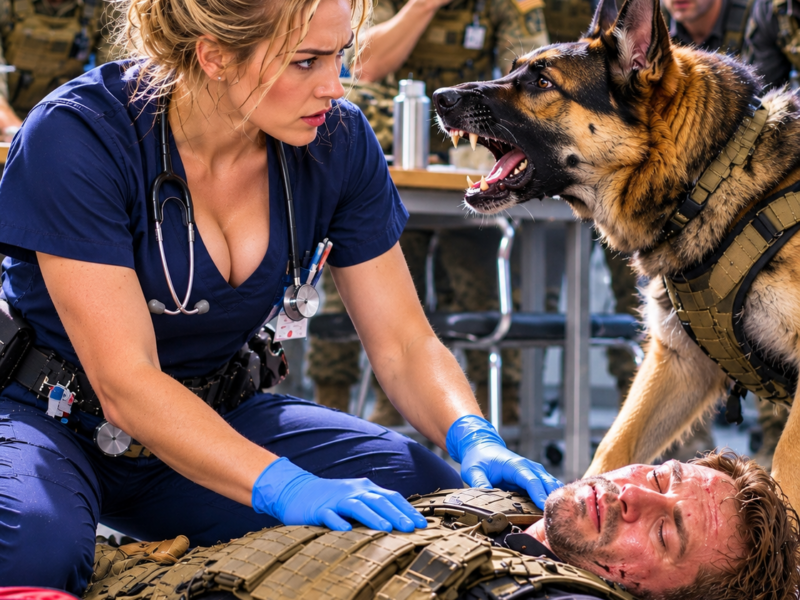
“Every Navy SEAL in that room thought the commander was having a heart attack. Every one of them was wrong
The first thing Abigail Hayes noticed when she entered the hospital was the smell.
Blood. Antiseptic. Burned coffee. The familiar combination of a trauma center working beyond its limits.
The second thing she noticed was that nobody was listening.
Commander David Caldwell had been rushed into the surgical wing at Naval Medical Center San Diego less than twenty minutes earlier. His blood pressure had continued to fall during transport, and the medical team had barely managed to keep him alive long enough to reach the operating room.
Now the doors were closed.
Behind them, Captain Thomas Arrington, the hospital’s chief trauma surgeon, was preparing to open Caldwell’s abdomen.
Abby stood outside the surgical corridor with Titan beside her.
The Belgian Malinois had refused to leave her.
His harness was still attached, and his amber eyes kept moving between the operating room doors and the commander’s empty stretcher bay. Every few seconds, he released a low whine.
Abby placed a hand on his neck.
“I know, buddy.”
Across the waiting area, Lieutenant Connor Davis was pacing.
Chief Petty Officer Greg Miller sat with his elbows on his knees, staring at the floor. Neither man had spoken much since the helicopter landed.
Dr. Samuel Harrison stood near the nurses’ station, making phone calls and trying to explain why a commander who had entered a briefing room apparently healthy was now fighting for his life.
His voice was tense.
His explanations were getting shorter.
Finally, Davis stopped pacing.
“Can somebody tell me what happened to him?”
Abby looked up from her laptop.
“I can tell you what I suspect.”
“Then tell me.”
She turned the screen toward him.
“I need the exact report from the medic who removed the shrapnel. Not the summary. The original field documentation.”
Davis frowned.
“Why?”
“Because the injury doesn’t make sense.”
“He was hit by debris. The medic removed it. They cleaned the wound and closed it.”
“That’s what the report says?”
“That’s what I was told.”
Abby shook her head.
“His blood vessels weren’t simply damaged. The tissue around the injury was deteriorating. The bruising was too extensive, the swelling was too severe, and Titan’s reaction was unusual.”
Miller looked toward the dog.
“What exactly did Titan smell?”
“I don’t know yet.”
Abby turned back to the laptop.
“But he wasn’t responding to ordinary blood loss alone.”
She opened the classified post-deployment medical archive. Her temporary credentials gave her access to the medical equipment evaluation files, but the original incident documentation was stored under a different classification.
She requested access.
The system rejected it.
She tried again.
Rejected.
Abby exhaled.
“Of course.”
Davis stepped closer.
“Can I help?”
“I need someone with operational authorization.”
Davis pulled out his identification card.
“Try mine.”
The system accepted his credentials.
A folder appeared.
Abby opened the field medical report and began reading.
The first page contained the usual information: time of injury, location, estimated blood loss, wound description, treatment administered.
Then she reached the section describing the recovered fragment.
Her fingers stopped.
“What’s wrong?” Miller asked.
Abby enlarged the image.
The metal fragment was irregular, twisted, and darkened by corrosion. It looked less like ordinary explosive debris and more like a piece of industrial equipment.
“Where was this recovered?”
“Near the compound,” Davis answered. “The team found several improvised devices in the area.”
Abby scrolled further.
The report mentioned that the fragment had been recovered from an improvised explosive device constructed using agricultural equipment.
Her expression changed.
“Did anyone test the material?”
Davis shook his head.
“Not that I know of.”
“Was the device handled by an explosives specialist?”
“Yes. But the fragment was already embedded in Caldwell’s side when they reached him.”
Abby enlarged the photograph again.
The fragment’s surface appeared to contain a dark residue.
She stared at it for several seconds.
Then she opened another database.
“What’s that?” Miller asked.
“Environmental hazard records.”
She searched the deployment coordinates and cross-referenced them with known industrial contamination reports.
The results were incomplete.
But one entry caught her attention.
An abandoned agricultural chemical storage site had been reported less than two miles from the location of the ambush.
Abby read the entry twice.
Her stomach tightened.
“Lieutenant, I need to know whether that site was inspected after the operation.”
Davis looked confused.
“Why would it matter?”
“Because if that metal came from contaminated equipment, Caldwell may have been exposed to something far more dangerous than an ordinary battlefield infection.”
Dr. Harrison approached.
“That’s enough.”
Abby looked up.
He had heard the last part.
“You’re speculating about chemical contamination based on an old photograph and an environmental report.”
“I’m identifying a possibility that needs to be tested.”
“You’re a civilian nurse. You don’t get to direct a classified medical investigation.”
“I’m not directing anything. I’m telling you that your patient may have a toxic exposure that hasn’t been addressed.”
Harrison gave a humorless laugh.
“The surgeon is already operating. Your job is finished.”
Abby closed the laptop halfway.
“My job is finished when the patient is safe.”
“Then let the doctors handle it.”
Before she could respond, a sharp alarm sounded from the surgical corridor.
A nurse hurried through the doors.
“Captain Arrington needs additional blood products!”
Harrison immediately turned.
“What happened?”
The nurse looked at him.
“They can’t control the bleeding.”
Abby was already standing.
“Did they identify the source?”
“The splenic artery. The tissue is extremely friable. The clamps aren’t holding.”
Abby felt the room tilt.
That confirmed her suspicion.
The tissue was breaking down.
Not simply bleeding.
Deteriorating.
She grabbed her laptop and ran toward the operating room.
Harrison followed.
“Nurse Hayes! You cannot enter the surgical area!”
“Then put me on the intercom!”
A surgical technician opened the observation station.
Abby pressed the communication button.
“Captain Arrington, this is Abigail Hayes. I need to speak with you.”
Inside the operating room, Arrington looked up briefly.
“Go ahead.”
“The field report identifies the fragment as debris from agricultural equipment. There was a contaminated chemical storage site near the ambush location. I believe you need to investigate toxic exposure and aggressive soft-tissue infection.”
Arrington’s eyes narrowed.
“What’s your evidence?”
“The tissue around the puncture wound was already deteriorating before the collapse. The field antibiotic treatment may have controlled the surface infection without addressing the underlying exposure.”
Harrison stepped toward the intercom.
“She has no confirmed diagnosis. Do not change your treatment plan based on speculation.”
Arrington didn’t look at him.
“Doctor, I asked the nurse a question.”
Harrison fell silent.
Abby continued.
“Please send tissue samples and the recovered fragment for urgent toxicology and microbiology testing. Also request infectious disease consultation. The surgical team needs to know what it’s dealing with before attempting reconstruction.”
Arrington looked down at Caldwell.
The commander’s abdomen was open, and blood continued to collect in the suction canisters.
The tissue surrounding the damaged artery looked abnormal.
Arrington knew it.
He had seen thousands of traumatic injuries, but this one was different.
“Get me the toxicology team,” he ordered.
A nurse immediately moved.
“Send samples to the laboratory. I want a full infectious disease panel and chemical analysis of the fragment.”
Harrison shook his head.
“This is unnecessary.”
Arrington finally turned toward him.
“Then it should be easy to prove.”
He looked back at the operating table.
“Now let’s save this man.”
For the next hour, Abby remained at the observation station.
She watched the surgeons work.
She watched the blood pressure fluctuate.
She watched the monitor display numbers that seemed to become worse every time she blinked.
Titan sat beside her.
He hadn’t moved.
At one point, a nurse offered to take him outside.
He refused.
Abby knelt beside him.
“Your commander is stubborn,” she whispered. “I think you already know that.”
Titan rested his head against her shoulder.
She closed her eyes for a moment.
Four years of partnership.
Four years of training.
Four years of following the same man into places where most people would never willingly go.
The dog had sensed something wrong long before the commander understood it himself.
And now Abby needed the medical team to understand what Titan had been trying to say.
At 10:47, the laboratory called.
The preliminary findings were concerning.
The fragment carried chemical residue consistent with an industrial pesticide exposure. The wound samples also showed evidence of a rapidly progressing bacterial infection.
The exact organisms and contaminants were still being identified.
But the findings supported Abby’s suspicion that Caldwell’s injury involved more than mechanical trauma.
Arrington listened to the report.
Then he looked toward the observation window.
“Get Nurse Hayes back on the intercom.”
Abby stepped forward.
“I’m here.”
“Your suspicion was right. We have evidence of contamination and aggressive tissue infection. I need you to explain the history of that site and what you found in the field records.”
Abby opened her laptop.
“The chemical storage facility was abandoned before the operation. The report indicates that agricultural chemicals had been stored there for years. The explosive device may have been constructed from material taken from that facility.”
“Can you identify the exact substance?”
“Not from the photograph. The laboratory needs to complete its analysis.”
“Understood.”
Arrington looked at his team.
“We’re going to have to remove the damaged tissue and rebuild the artery. But we need infectious disease and toxicology guiding the treatment.”
He paused.
“Thank you, Nurse Hayes.”
It was the first time anyone in the room had thanked her.
It wouldn’t be the last.
By early afternoon, the operating room had become a coordinated effort between trauma surgery, infectious disease, toxicology, and the hospital’s laboratory team.
The doctors identified the primary infection and began targeted treatment.
The chemical residue was handled as a separate exposure issue, with the toxicology team directing the appropriate management.
Arrington removed the irreversibly damaged tissue and repaired the artery using a synthetic graft.
The procedure was difficult.
Several times, Caldwell’s blood pressure dropped dangerously low.
Once, the cardiac monitor began sounding an alarm that made everyone in the observation area freeze.
Abby gripped the edge of the counter.
Titan stood.
His ears lifted.
Then, after several seconds, the alarm stopped.
The monitor returned to a steady rhythm.
Abby exhaled.
At 1:36 p.m., Captain Arrington stepped out of the operating room.
His surgical cap was damp with sweat.
His eyes were tired.
But he was smiling.
“Commander Caldwell is alive.”
Davis stood so quickly that his chair fell backward.
“Is he going to make it?”
Arrington removed his gloves.
“He has a long recovery ahead. The next forty-eight hours will be critical. But we controlled the bleeding, removed the damaged tissue, and repaired the artery.”
Miller covered his face with one hand.
For a moment, neither man spoke.
Then Davis looked at Abby.
“You saved him.”
Abby shook her head.
“Titan found the problem.”
“You understood it.”
She glanced down at the dog.
“We worked together.”
Titan’s tail moved once against the floor.
It was the first sign of relief anyone had seen from him all day.
Commander David Caldwell woke up three days later.
His first sensation was pain.
His second was the irritating sound of a heart monitor.
His third was the weight of something warm resting against his hand.
He opened his eyes.
Titan was lying beside the hospital bed, his enormous head resting on the mattress.
The dog’s eyes opened immediately.
His tail struck the floor.
Caldwell tried to speak.
“Hey, buddy.”
His voice was barely audible.
Titan stood and gently pressed his nose against the commander’s palm.
Caldwell smiled.
Then he noticed Abby sitting near the window.
She was reviewing a medical report.
“Hayes?”
She looked up.
“Good morning, Commander.”
He swallowed.
“How long?”
“Three days since surgery.”
Caldwell frowned.
“What happened?”
Abby closed the report.
“You collapsed during the briefing. You had severe internal bleeding caused by a damaged artery. The injury had also become complicated by contamination and a rapidly progressing infection.”
Caldwell looked down at his bandaged abdomen.
“I remember Titan acting strange.”
“He was trying to warn you.”
“He wouldn’t let anyone near me.”
“He was protecting you.”
Caldwell looked at the dog.
For several seconds, he simply rested his hand on Titan’s head.
“Good boy,” he whispered.
Titan’s tail thumped again.
Then Caldwell turned back to Abby.
“What did you do?”
“I recognized what Titan was trying to communicate. The medical team handled the surgery.”
“That’s not what I asked.”
Abby met his eyes.
“I helped them identify the problem before it was too late.”
Caldwell studied her.
“I heard about the first doctor.”
Abby didn’t answer.
“Apparently, he thought I was having a heart attack.”
“He was working with incomplete information.”
“And you weren’t?”
“I was working with a dog who wouldn’t stop pointing at your abdomen.”
Caldwell gave a weak laugh.
It turned into a grimace.
“That’s fair.”
The door opened.
Captain Arrington entered, carrying a tablet.
“Look who’s finally awake.”
Caldwell tried to raise his head.
“Captain.”
“Don’t move. You have enough stitches to keep a tailor employed for a week.”
Caldwell settled back.
Arrington checked the monitors and reviewed the chart.
“Your recovery is progressing. The infection is responding to treatment. Your kidney function is stable, and the graft is holding.”
“How long until I’m back?”
Arrington stared at him.
“Back where?”
“Work.”
“Commander, you nearly died. You are not returning to operational duty next week.”
Caldwell frowned.
“Two weeks?”
“Try several months, depending on your recovery.”
Caldwell looked deeply offended.
Abby smiled.
“Doctor’s orders.”
He glanced at her.
“Don’t encourage him.”
Arrington laughed.
Then his expression became serious.
“There’s something else we need to discuss.”
He turned the tablet toward Caldwell.
“The laboratory completed the analysis of the recovered fragment. It contained chemical residue from an industrial pesticide. The wound also involved a serious bacterial infection.”
Caldwell’s expression hardened.
“Was the material identified?”
“Some of it. The full investigation is ongoing. The device may have been assembled using contaminated industrial equipment from an abandoned storage facility near the operation site.”
“Did the field team know?”
“Not yet. We’re requesting the original explosive ordnance reports and the deployment medical records.”
Caldwell looked toward Davis, who had just entered the room.
“Connor.”
The lieutenant straightened.
“Commander.”
“I want every member of the team evaluated. Anyone who handled that equipment, debris, or contaminated material needs a medical screening.”
“Already underway, sir.”
“Good.”
Caldwell looked back at Arrington.
“And I want to know why the original injury was treated as routine.”
Arrington nodded.
“That’s part of the investigation.”
Abby watched the commander.
Even after three days in intensive care, he was already thinking about his people.
That, she realized, explained why Titan had been so determined to keep him alive.
Two days later, the hospital held a formal review of the incident.
The meeting took place in a small conference room near the medical command offices.
This time, Abby wasn’t sitting in the back.
She was seated at the center of the table.
Dr. Harrison sat across from her.
His expression was controlled, but his discomfort was obvious.
Captain Arrington opened the meeting.
“This review concerns the collapse of Commander Caldwell, the initial medical response, and the subsequent discovery of chemical and infectious complications.”
He turned to Harrison.
“Doctor, please explain your initial assessment.”
Harrison cleared his throat.
“Commander Caldwell presented with sudden loss of consciousness, pallor, diaphoresis, and an abnormal pulse. My initial concern was a cardiac emergency.”
“Did you examine his abdomen?”
Harrison hesitated.
“Not before preparing the initial cardiac response.”
“Did you account for the recent shrapnel injury?”
“I was not aware of its full significance.”
Abby looked at him.
“It was documented in the deployment medical report.”
Harrison turned toward her.
“I didn’t have the complete file at the time.”
“Then the question is why the file wasn’t requested before treatment.”
The room became quiet.
Arrington leaned back.
“That is a fair question.”
Harrison looked down at his notes.
“I made an error in prioritization.”
Caldwell, who had been cleared to attend for a limited period, sat at the far end of the table in a wheelchair.
He looked thinner than before, but his eyes were sharp.
“Doctor.”
Harrison looked up.
“Commander.”
“If Nurse Hayes had not intervened, what would have happened?”
Harrison took a breath.
“I cannot say with absolute certainty.”
Caldwell waited.
Harrison’s shoulders lowered.
“The proposed treatment could have worsened your condition. The blood-thinning medication would have been particularly dangerous in the presence of uncontrolled internal bleeding.”
“And the defibrillator?”
“Unnecessary without a shockable rhythm.”
Caldwell nodded.
“So the person you dismissed identified a problem you hadn’t examined.”
Harrison said nothing.
Caldwell looked toward Abby.
“Would you like to add anything?”
She considered the question.
Then she spoke calmly.
“This wasn’t only about one doctor’s mistake. It was about a system where people assumed that the quietest person in the room had the least useful information.”
She glanced around the table.
“I wasn’t asking anyone to believe me because I was a nurse. I was asking them to look at the evidence. Titan was showing us where to look. The wound told us what was happening. The medical record told us where the injury came from.”
She paused.
“If we had spent another five minutes arguing about rank, we might have lost him.”
Caldwell looked at Harrison.
“That’s the lesson.”
Harrison nodded slowly.
“I understand.”
It wasn’t a dramatic apology.
It wasn’t enough to erase what had happened.
But it was a beginning.
The following week, Abby received an unexpected invitation.
It came from the office of the director of the Defense Advanced Research Projects Agency.
She read the message twice.
Then she looked toward the hospital room where Caldwell was beginning physical therapy.
“Something wrong?” Davis asked.
Abby closed her laptop.
“No. Something unexpected.”
“Good unexpected or bad unexpected?”
“I’m not sure yet.”
She picked up her phone and stepped into the hallway.
The call connected almost immediately.
“Dr. Hayes,” a familiar voice said. “We’ve reviewed the incident report.”
Abby closed her eyes.
“Of course you have.”
“The results from the K9 alert were remarkable. We need a complete account of what happened.”
“I can provide that.”
“And we’d like you to return to Washington.”
Abby looked through the glass at Titan.
The dog was lying beside Caldwell’s wheelchair while a physical therapist guided the commander through a slow walking exercise.
“Not yet,” she said.
There was a pause.
“Dr. Hayes, the project is important.”
“So is the work here.”
“Your assignment was temporary.”
“I know.”
“Then what are you proposing?”
Abby watched Caldwell stop to rest.
Titan immediately stood and pressed his nose against the commander’s hand.
Abby smiled.
“I want to revise the evaluation. Not just the equipment. The entire medical response system.”
“Explain.”
“We trained detection animals to identify specific threats. But we haven’t done enough to train the humans around them to interpret their alerts. Titan gave us a warning. The response nearly became a disaster because the warning wasn’t understood.”
The voice on the other end remained silent.
Abby continued.
“I want a joint training program involving medical personnel, K9 handlers, and trauma specialists. I want standardized procedures for medical alert behavior. And I want junior medical staff to be able to raise concerns without being dismissed because of their position.”
“That would require a broader review.”
“Then let’s do one.”
Another pause.
Finally, the director answered.
“Send me your proposal.”
Abby ended the call.
For the first time since Caldwell collapsed, she felt that something good might come from the incident beyond one man’s survival.
Commander Caldwell’s recovery took longer than he wanted.
He hated physical therapy.
He hated the restrictions.
He especially hated being told he couldn’t return to operational duty until his body was ready.
Titan, however, seemed perfectly satisfied with the new arrangement.
The dog accompanied him through the hospital courtyard every afternoon. He walked beside the wheelchair, keeping his body close enough to touch the commander’s leg.
Sometimes Caldwell spoke to him.
Sometimes he didn’t.
But Titan never left.
One afternoon, Abby joined them outside.
The California sun was warm, and the ocean breeze carried the smell of salt through the courtyard.
Caldwell was sitting on a bench.
Titan lay beside his boots.
“You leaving soon?” he asked.
Abby sat at the other end of the bench.
“Washington wants me back.”
“Do they?”
“They do.”
“Are you going?”
“Eventually.”
Caldwell nodded.
“Can’t blame them. Someone with your expertise probably has a lot of work waiting.”
Abby looked at him.
“That’s a polite way of asking me to stay.”
He gave a small smile.
“Was it that obvious?”
“Very.”
Caldwell leaned back carefully.
“I’ve spent most of my adult life working with people who are trained to recognize danger. But I never considered how much we might be missing because we only listen to certain voices.”
Abby looked down at Titan.
“Dogs don’t care about rank.”
“No. They don’t.”
“Neither does a medical emergency.”
Caldwell laughed softly.
“That’s probably the most accurate thing anyone has told me in years.”
He looked toward the courtyard entrance.
“I’m going to make a recommendation.”
“For what?”
“For a permanent medical-K9 training program here. I want you involved.”
Abby raised an eyebrow.
“You don’t have authority over my assignment.”
“No. But I have a little influence with people who do.”
“That’s not the same thing.”
“I’m aware.”
She smiled.
Caldwell looked at Titan.
“And I want that dog involved in every stage of the program.”
Abby reached down and scratched Titan behind the ears.
“He’s earned it.”
“He saved my life.”
“He saved your life because you trusted him enough to work beside him.”
Caldwell became quiet.
Then he said something that surprised her.
“I almost ordered them to restrain him.”
Abby looked at him.
“I know.”
“I thought he was losing control.”
“He was trying to keep everyone from making the wrong decision.”
Caldwell stared at the dog for a long moment.
“Four years together, and I still didn’t understand what he was telling me.”
Abby shook her head gently.
“You understood him when it mattered. You just needed someone to translate.”
Three months later, Naval Amphibious Base Coronado hosted its first advanced medical-K9 training demonstration.
The event attracted military physicians, combat medics, K9 handlers, and senior officers from several commands.
A large training room had been converted into a demonstration area.
On one side stood a medical simulation mannequin.
On the other stood Titan, wearing a new working harness.
Caldwell attended in uniform, walking without assistance for the first time since his surgery.
He still wasn’t cleared for full operational duty, but he was recovering well.
Davis and Miller stood nearby.
Abby stepped to the front of the room.
She wore a simple navy-blue professional uniform with a small identification badge.
The room became quiet.
“Three months ago,” she began, “a decorated commander collapsed during a classified briefing. His team believed he was having a cardiac emergency. The first medical response was prepared to treat that assumption.”
She looked toward Titan.
“But one dog recognized that something else was happening.”
She allowed a moment of silence.
“Titan didn’t diagnose an injury. He didn’t identify a chemical by name. He communicated a change in his handler’s condition through trained behavior. That warning gave us the opportunity to investigate before it was too late.”
She turned toward the medical personnel.
“The purpose of this program is not to replace doctors with dogs. It’s to make sure we don’t ignore useful information simply because it comes from an unexpected source.”
A senior physician raised his hand.
“How do you prevent false alerts?”
“By documenting behavior, establishing baselines, and using veterinary and medical specialists to validate the signals. We don’t treat an alert as a diagnosis. We treat it as a reason to investigate.”
Another officer asked, “And what happens when a handler disagrees with the alert?”
Abby looked toward Caldwell.
“That is why the handler must be trained to understand the animal. But the medical team must also be trained to listen.”
She stepped aside.
A demonstration began.
Titan was led through a series of controlled scenarios involving simulated injuries and scent samples.
The dog moved calmly, followed the handler’s cues, and indicated the target area with precision.
The audience watched in silence.
Then Caldwell spoke from the front row.
“That’s my partner.”
Everyone turned.
He smiled.
“And he’s better at his job than I ever gave him credit for.”
The room laughed.
Titan looked toward him.
His tail moved.
Abby smiled too.
For the first time, the people in the room weren’t looking at the dog as a piece of military equipment.
They were looking at him as a teammate.
The new program expanded over the following months.
Medical personnel learned to recognize canine alert patterns.
Handlers learned to document changes in their animals’ behavior.
Trauma teams practiced responding to unusual medical warnings without allowing assumptions about rank or position to interfere.
Abby’s proposal also introduced a formal reporting channel for junior medical staff.
A corpsman could raise a concern.
A nurse could challenge an initial assessment.
A civilian specialist could request further investigation.
And the person receiving the information was required to document the response.
It wasn’t a perfect system.
No system was.
But it was better than the one that had nearly cost Caldwell his life.
Dr. Harrison was eventually assigned additional training and oversight responsibilities. He submitted a formal written acknowledgment of his initial errors and participated in the new medical response program.
He never became Abby’s closest colleague.
But he stopped dismissing people before hearing them.
That was progress.
Meanwhile, Caldwell returned to limited command duties.
His doctors continued monitoring the repaired artery and the effects of the infection.
He still had days when the pain reminded him of how close he had come to dying.
On those days, Titan stayed close.
The dog had developed a habit of resting his head on Caldwell’s knee whenever the commander sat down.
Caldwell never told him to move.
One evening, nearly six months after the incident, Abby was preparing to leave the base when she heard footsteps behind her.
“Dr. Hayes.”
She turned.
Caldwell stood near the parking area.
Titan was beside him, wearing his working harness.
“Commander.”
“I wanted to thank you properly.”
“You already did.”
“Not really.”
He reached into his pocket and removed a small metal coin.
It bore the insignia of his SEAL team on one side and the words Leave No One Behind on the other.
He held it out.
Abby looked at it.
“Commander, I can’t accept that.”
“Why not?”
“I’m not a SEAL.”
“Neither is Titan.”
She looked down at the dog.
Caldwell smiled.
“Still, I think he would agree that you belong with the team.”
Abby accepted the coin.
Its weight settled into her palm.
“Thank you.”
Caldwell nodded.
Then he glanced toward the parking lot.
“I also wanted to tell you something else.”
“What is it?”
“I’m going back to the training program next week. Not operational deployment. Just command oversight.”
“That’s good news.”
“I’m bringing Titan.”
“Of course you are.”
“And I was hoping you’d be there.”
Abby smiled.
“I’ll be there.”
Caldwell looked down at the dog.
“Titan has been looking for you every time we pass the medical building.”
Abby knelt.
Titan immediately approached, pressing his head against her shoulder.
“Hey, handsome,” she whispered.
He released a soft, happy sound.
Caldwell watched them.
“You know, I used to think courage meant moving forward no matter what.”
Abby stood.
“And now?”
“Now I think sometimes courage means stopping long enough to listen.”
She looked at him.
“That’s a good lesson.”
He glanced at the coin in her hand.
“It’s one I learned the hard way.”
For a moment, none of them spoke.
The evening sun lowered over Coronado, casting long golden shadows across the pavement.
A distant helicopter crossed the sky.
Somewhere beyond the base, the Pacific Ocean rolled against the shore.
Abby tucked the coin into her pocket.
Then she turned toward the medical building.
Caldwell and Titan walked beside her.
The commander had survived because a dog refused to stop warning him.
The dog had been understood because one quiet woman knew how to listen.
And the military had learned something that no classified briefing could have taught it.
Sometimes the most important voice in the room doesn’t belong to the highest-ranking person.
Sometimes it doesn’t even belong to a person.
Sometimes it comes as a whine, a paw against the floor, or a stubborn animal refusing to move away from someone he loves.
And sometimes, the difference between life and death is simply whether anyone is willing to pay attention.
THE END









