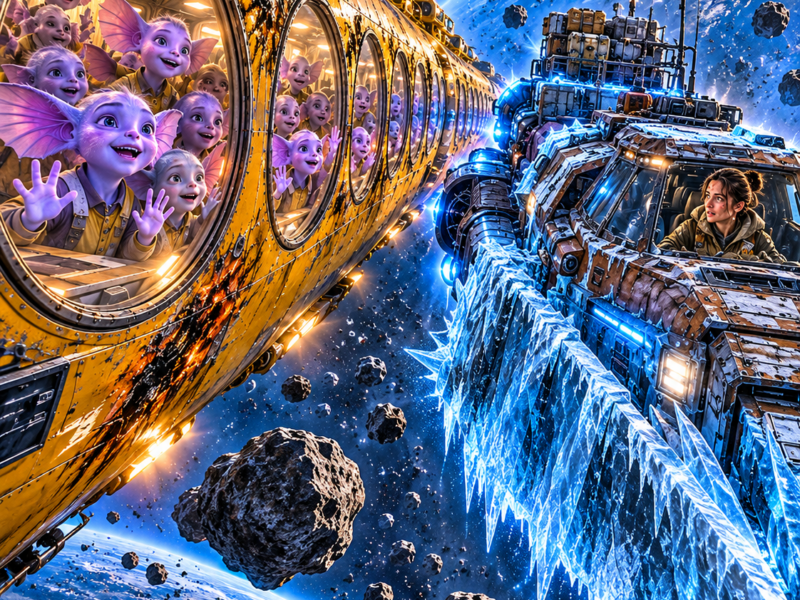
“Every navy in the sector had declared forty-two children dead, but I was staring at their little yellow schoolship on my screen
The black ship emerged from the gray haze without warning.
One moment, the scanner showed nothing but tumbling rocks and drifting metal. The next, a long, armored silhouette slid into the open space behind the Bright Abacus, its engines glowing a dull red.
Hamish saw it first.
“Dagy,” he said quietly. “Tell me that’s a piece of wreckage.”
I stared at the screen.
Wreckage didn’t have turrets.
Wreckage didn’t have a sharpened ram mounted beneath its nose.
And wreckage certainly didn’t turn its weapons toward a schoolship full of children.
“That’s the Iron Toll,” Hamish said. “Bastavi raiders. I’ve heard stories.”
“Good stories?”
“Not one.”
The radio crackled.
A broad gray face appeared on the display, covered in thick bony plates. Two yellow eyes stared at me from beneath a heavy brow. When the creature spoke, every sentence ended with a sharp click of its jaw.
“Freighter,” it said. “I am Thubbing Cade, master of the Iron Toll.”
I looked at the ship’s weapons, then at the small yellow school vessel trapped behind us.
“Dagy Raven Scroft Mutisa,” I answered. “Captain of the Overdue Invoice.”
The creature’s jaw clicked.
“Your ship is blocking our approach.”
“Funny. I was about to say the same thing about yours.”
Hamish closed his eyes.
He knew that tone. It was the tone I used when I had already decided something terrible and was simply waiting for the universe to catch up.
Thubbing Cade leaned closer to his camera.
“We have waited at the edge of this field for the schoolship to die. The rocks prevented us from entering. You have made a path through them.”
I glanced at the scanner.
He was right. Every turn we had taken, every opening Tiffet had found, every gap we had crossed had left a narrow trail through the debris.
The Iron Toll had followed our path.
“Give us the schoolship,” Cade continued. “The Sanuki home world will pay well for live children. Dead children pay nothing.”
For a moment, I couldn’t hear anything except the old pipe in my ship, clanking somewhere behind the cockpit wall.
Then I thought about the voice on the radio.
Are you coming anyway?
“Yes,” I had told Saskaroo.
And now forty-two children were waiting for me to keep that promise.
I pressed the transmit button.
“Let me think about it.”
I cut the channel.
Hamish stared at me.
“That’s a warship, Dagy.”
“I noticed.”
“We’re a box covered in ice.”
“I noticed that too.”
“They have plasma cannons. We have farming equipment.”
I looked at the frozen wedge on the front of the Overdue Invoice. Half a meter of ice covered its surface, and the sprayers were still working along the hull.
Then I looked at the weapons on the Iron Toll.
“Hamish, when we hit that first rock, what happened to the ice?”
“It cracked and flew off.”
“And when the raiders shot the schoolship, what did their guns use?”
He frowned.
“Heat. Plasma. Why?”
I pointed toward the sprayer controls.
“Get on every sprayer we’ve got. I want the thickest coat of ice you can build on the side facing them.”
His eyes widened.
“Oh, that’s either brilliant or the stupidest thing you’ve ever said.”
“Those are usually the same thing.”
The Iron Toll fired thirty seconds later.
A white-hot bolt crossed the darkness and struck our port flank.
The impact shook the entire ship. A warning light flashed, and Hamish grabbed the side of his chair.
But the bolt didn’t reach the metal.
It struck the fresh layer of ice.
For a fraction of a second, the surface glowed.
Then the ice became steam.
Not a little steam. Not the thin mist that rose from a warm cup.
A massive white cloud exploded from our hull, spreading across the space between the ships until the Iron Toll disappeared inside it.
“Dagy!” Hamish shouted.
“I see it!”
The targeting beam swept through the fog, searching for us. It moved left, then right, then vanished.
The raiders could no longer see the schoolship.
They couldn’t see us either.
“Keep spraying,” I ordered.
The pumps groaned. Water streamed from the nozzles and froze against the hull. Our armor grew thicker while the remaining ice evaporated in the heat of the plasma fire.
We had turned our ship into a moving cloud machine.
But steam wouldn’t save us forever.
The Iron Toll was still armed, and we were running out of room.
“Dagy,” Hamish said. “The foam tunnel.”
I looked at the Bright Abacus.
Its emergency hatch was still open, but the distance between the two vessels was too great for the children to cross. We couldn’t use the docking port because the raiders had melted it shut.
There were forty-two children, one teacher, and two pilots on that ship.
We had three adult spacesuits.
Even if I could get across, I couldn’t bring them back one at a time before the raiders found us.
Then I understood what Hamish was thinking.
“The rivet foam,” I said.
He nodded.
“We make a bridge. A sealed tunnel between the emergency hatch and our cargo hold.”
“Can it hold pressure?”
“If I build it properly.”
“And if you don’t?”
“Then we’ll all find out what vacuum feels like.”
I turned toward the radio.
“Saskaroo, this is Dagy. I need you to listen carefully.”
Her voice came back through the static.
“This is Saskaroo. We are listening.”
“We’re going to connect our ships. I need every child away from the outer walls and ready to move. No running, no pushing. Stay together.”
“We can do that.”
“And Saskaroo?”
“Yes?”
“I’m going to need you to count everyone again.”
There was a pause.
“This is counted,” she said.
Hamish pulled on his orange spacesuit. He clipped foam canisters to his belt and checked the seals on his gloves.
I watched him through the cargo hold camera as he entered the airlock.
“Don’t be a hero,” I said over the radio.
He gave me a look through the helmet.
“I’m an engineer. Heroes don’t get paid enough.”
The outer hatch opened.
Hamish floated into the gap between our ships, surrounded by the white fog and the occasional flash of a passing rock. He moved slowly, gripping the side rails as debris rattled against the ice armor.
He reached the Bright Abacus emergency hatch and began spraying.
A thick ring of white foam formed around the opening.
He worked upward, canister after canister, building a curved wall that connected the schoolship to our cargo ramp. The foam swelled, hardened, and joined together in a lumpy tube.
It looked like a giant caterpillar had swallowed a mattress.
“Thirty seconds,” Hamish panted. “Then it sets.”
The Iron Toll fired again.
A bolt struck the side of our ship, and another cloud of steam swallowed the cargo hold camera.
“Hamish!”
“I’m still here!”
“Are you finished?”
“I’m trying to make art!”
He sprayed the final seam and pushed himself back toward our airlock.
“Pressurize it!”
I opened the valve.
Air hissed into the foam tunnel. The pressure gauge trembled. The walls bulged slightly, then settled.
For one awful second, I thought the whole thing would burst.
Then the needle stopped moving.
“It’s holding,” Hamish said.
I opened the cargo camera.
“Bright Abacus, open your emergency hatch.”
A clank came through the speakers.
Then a hiss.
And then the first child appeared.
He crawled through the white tunnel, tumbled into our cargo hold, and floated upside down among the construction supplies.
His name was Bambazu.
I knew because he immediately announced, “This ship smells like feet.”
Hamish pulled off his helmet.
“It’s called character, kid. Move along. You’re blocking the road.”
The children began coming through.
First one, then two, then groups holding hands. Their violet fur floated around their faces, and their fan-shaped ears were pressed flat with fear.
Saskaroo stood at the entrance, counting every child aloud.
I watched her on the camera while I kept the ship steady.
One.
Two.
Three.
Every number mattered.
Tiffet came through near the end, clutching her little bead toy. She was the smallest of them all.
Then Hamish and Saskaroo returned for the adults.
The teacher, Halumana, was still unconscious. The two pilots were barely breathing. Hamish secured them to a cargo sled and pulled them through the tunnel carefully.
At last, the final pilot entered our hold.
Saskaroo looked around.
Her ears trembled.
“Forty-two,” she said.
She swallowed.
“Forty-two children and three grown-ups.”
“This is counted,” she whispered.
I wanted to tell her she had done well.
I wanted to tell her we were safe.
But at that exact moment, the engine room produced a sound I had never heard before.
A long metallic scream.
Then every warning light on my console turned red.
“Hamish?”
He was already moving.
“The coolant pump!”
He disappeared into the engine room.
I followed the camera feed as he reached the pump housing. The plasma strike had damaged the coolant line, and the pump shaft had sheared clean through.
“It’s gone,” he said.
“How long?”
He checked the reactor temperature.
“Forty minutes, maybe less. Without coolant, the reactor will shut down. Then we lose the engine, the heat, and eventually the air.”
I looked through the forward window.
The steam fog was thinning.
Beyond it, the Iron Toll waited in the narrow opening that led out of the Clatterfield.
It had placed itself directly between us and open space.
We had rescued the children.
Now we had to get them home.
“Can you repair the pump?” I asked.
“Not here. Not in forty minutes.”
I stared at the engine room.
Along the walls ran the hoses from our agricultural sprayers. Eleven small pumps had been mounted to the hull to build our ice armor.
They were still connected to the water tank.
“Those pumps,” I said.
Hamish followed my gaze.
“No.”
“Eleven of them.”
“They’re garden pumps.”
“Can they move water?”
“Of course they can move water. They’re designed to spray fertilizer over lettuce.”
“Then connect them in a chain.”
He stared at me.
“You want eleven tiny pumps to replace one reactor coolant pump?”
“I want eleven tiny pumps to try.”
He looked at the temperature gauge.
Then he reached for his tools.
The next thirty minutes were the strangest engineering job of my life.
We disconnected the sprayers one by one and dragged their pumps into the engine room. Hamish bolted them along the wall, connecting the outlet of each pump to the inlet of the next.
He used hose clips, rivet foam, and, in one place, his own belt.
The children crowded around the doorway.
“Out!” Hamish shouted. “This is dangerous!”
“Nothing is safe,” Saskaroo answered. “We are in the Clatterfield.”
I almost laughed.
Then the pumps started.
Eleven small motors whined together, creating a thin, uneven chorus. The coolant began moving through the reactor line.
Slowly.
Too slowly.
The temperature continued climbing.
“Some pumps are pushing harder than others,” Hamish said. “They’re fighting each other. I can’t tell which ones.”
A small voice came from above us.
“Number four.”
We looked up.
Tiffet was hanging upside down from a pipe, her bead toy tucked against her chest.
“Number four is singing too high,” she said. “It sounds tired.”
Hamish looked at the fourth pump.
He touched its casing.
It was hot.
He turned its speed down.
“And number nine is stuttering,” Tiffet added. “Like Bambazu when he says he didn’t eat the last sweet.”
“I do not stutter!” Bambazu shouted from the doorway.
Hamish followed the hose to number nine.
There was a kink in it.
He straightened the line.
The chorus of pumps changed.
Their whining settled into one steady note.
I watched the temperature gauge.
It stopped climbing.
One breath.
Two.
Three.
Then the needle began to fall.
The engine room erupted in cheers.
Bambazu attempted a cartwheel with all four arms. Hamish lifted Tiffet down from the pipe and looked at her as if she had just invented faster-than-light travel.
“You’re hired,” he said solemnly.
“How much do you pay?” she asked.
“Badly.”
“Then I will think about it.”
I left them laughing and returned to the cockpit.
Saskaroo was already sitting in the co-pilot’s chair.
Her ears had drooped.
Outside, the Iron Toll still blocked the exit.
“We cannot go past it,” she said.
“Not yet.”
She looked down at her hands.
“When the raiders attacked us, I was supposed to count the little ones into the middle of the ship. I counted forty-one. I couldn’t find Tiffet.”
Her voice shook.
“She was at the back window, listening to the rocks. I was slow. If something had hit that window, she might have—”
She stopped.
“I am not a good monitor.”
I looked at her for a long moment.
“My mother drove a school bus,” I said.
Saskaroo turned toward me.
“On Earth. A big yellow thing, older than this freighter and twice as loud. She drove forty children every morning and forty children every afternoon for thirty years.”
I smiled.
“She had one rule. Nobody gets left at the stop.”
“What does that mean?”
“It means she counted every child on the bus and every child off the bus. Every day. Every single stop. It didn’t matter if it rained, if the bus broke down, or if somebody was hiding because they didn’t want to go home.”
I paused.
“One day, a boy fell asleep under the seats. My mother counted thirty-nine children getting off. She refused to drive away. The other drivers honked. Her boss called. She sat there until she found him.”
Saskaroo’s ears slowly lifted.
“You counted forty-one,” I said. “Then you went back and found Tiffet. That’s the whole job. You went back.”
She looked through the window at the dark raider ship.
“Nobody gets left at the stop,” she repeated.
“Not ever.”
“This is counted,” she said.
I turned back toward the controls.
Then I heard it.
A deep note rolled through the scanner speakers, so low that I felt it more than heard it.
Something enormous was moving through the field.
“Saskaroo,” I said. “Ask Tiffet something for me.”
A few minutes later, Tiffet’s voice came through the radio.
“What do you want to know, Dagy?”
“That big cathedral rock. The one that passes every forty-one counts. How close does it come to the opening?”
There was a pause.
Then Tiffet answered.
“It does not pass close to the door.”
I frowned.
“Then where does it go?”
“Every fourth time, it goes through the door.”
Hamish came up behind me.
His face changed.
The cathedral rock was so large that it filled the entire narrow gap when it passed through. It scraped the smaller rocks aside and blocked the opening for eleven long counts.
The next pass was coming in about ten minutes.
“The raiders don’t know,” I said.
Hamish looked at the scanner.
“They’re watching dots. They don’t understand the music.”
I stared at the black warship.
It had parked itself in the only exit.
It thought it had trapped us.
But it had no idea that something much larger was coming.
“So what do we do?” Hamish asked.
I eased the Overdue Invoice out of the still pocket.
“We ride the rock.”
He looked at me as if I had finally lost my mind.
“You want to put this ship against a moving mountain?”
“Not against it. Behind it.”
We moved slowly, following Tiffet’s directions. Every turn was measured. Every adjustment was small.
The cathedral rock appeared on the forward screen.
It was enormous, gray, and scarred with glittering mineral veins. It rolled through the darkness like a mountain that had broken free from its planet.
“Thirty counts,” Tiffet said.
I matched our speed to the rock.
“Twenty.”
I turned the freighter until the frozen V of our bow faced its trailing surface.
“Ten.”
The ice creaked as I eased us closer.
“Five.”
The wedge touched the rock.
The Overdue Invoice shuddered.
For one terrifying moment, I thought the impact would tear the nose off.
Then the ship settled into the rock’s shadow.
We were moving with it.
Like a small animal hiding behind its mother.
On the scanner, the Iron Toll sat directly in the opening.
Its turrets began to turn.
“Thirty counts,” Tiffet said again.
The raider captain’s voice crackled over the radio.
“Freighter! What are you doing?”
I pressed the transmit button.
“Making a delivery.”
“You cannot pass!”
I watched the cathedral rock fill the forward window.
“You’re in the loading zone.”
The Iron Toll fired its engines and lurched backward.
Too late.
The gap was already closing.
The raiders had nowhere to go except back toward open space. The cathedral rock filled the passage from wall to wall, and its massive surface swept through the smaller debris as if clearing a road.
The Iron Toll retreated with its engines blazing.
Plasma bolts struck the rock and splashed across its surface in molten streaks.
Then the cathedral passed through.
Open stars appeared beyond it.
“Now!” I shouted.
I threw the throttle forward.
The Overdue Invoice burst out from behind the rock.
We were free.
But the Iron Toll was turning toward us.
Its sharpened ram swung into view, and its weapons began to charge.
“Dagy!” Hamish yelled.
I saw the ram coming.
There was no time to dodge.
So I did the one thing Hamish had designed the wedge to do.
I pointed the nose straight at it.
The ram struck our frozen V.
The entire ship screamed.
Metal groaned. Ice exploded into fragments. The wedge bent under the impact, but its angled surface turned the force sideways instead of allowing the ram to punch through our hull.
The Iron Toll’s nose slid off the wedge.
Its huge body spun sideways, helpless, and drifted back toward the opening.
Behind it, the cathedral rock continued its ancient journey.
It did not strike the raider ship with a sudden blow.
It simply rolled over.
The enormous mass leaned against the Iron Toll’s engines and pinned the warship against the side of the gap like a beetle beneath a stone.
Its engine bells crumpled.
Its turrets jammed.
The crew remained sealed inside their armored vessel, alive but unable to move.
The radio crackled.
For the first time, Thubbing Cade had nothing to say.
I leaned back in my chair.
My hands were shaking.
Hamish let out a long breath.
“Dagy?”
“Yeah?”
“I think your ship needs a new nose.”
I looked at the wrecked wedge.
“I think your ship needs a new engineer.”
He laughed.
Then the scanner lit up.
Forty warships were approaching the edge of the Clatterfield.
Three navies.
They had finally arrived.
For several seconds, nobody spoke.
The great vessels hung in formation, their shields glowing and their weapons ready. They looked at our small, scorched freighter, at the rescued schoolship, and at the black raider pinned in the rocks.
Then Rear Warden Ostrumble Hadnai appeared on my screen.
His scales were perfectly still.
“It was assessed as impossible,” he said.
“I heard.”
Behind him, officers stood in silence.
“There is a raider vessel trapped in your exit,” I added. “You may want to collect it.”
The rear warden looked at the damaged Iron Toll.
Then he looked at me.
“And your passengers?”
“Forty-two children. One teacher. Two pilots. All alive. They need a doctor and a hot meal.”
For a long moment, he said nothing.
Then every scale on his body lifted and turned, catching the light like silver.
The officers behind him did the same.
I didn’t know what it meant until much later.
It was the Iridane salute, reserved for those who had done something that could not be done.
I returned the gesture as best I could.
Then I asked for a medical escort.
We reached Brummage Station eighteen hours later.
Eleven warships escorted us, although the Overdue Invoice didn’t need an escort so much as a repair yard and several months of sleep.
The station docks were packed.
Every species on Brummage had come to watch.
Guz Abrell stood at the front, his amber lenses wide and his brass limbs trembling.
The irritating Iridane traders who had laughed at our plan were there too.
Nobody laughed now.
When the ramp lowered, the crowd went silent.
Then the children came down.
Two by two, holding hands.
Saskaroo stood beside me, counting them aloud.
One.
Two.
Three.
I counted with her.
Every child came down safely.
Teacher Halumana was awake now, her head bandaged. Hamish helped her down the ramp, and she cried quietly as she looked at the children.
The pilots were taken straight to the medical bay.
When the final child reached the dock, Saskaroo looked at me.
“Forty-two,” she said.
I nodded.
“Forty-two.”
“This is counted.”
The crowd began to cheer.
I would have remembered that sound for the rest of my life.
But then I noticed something strange on the front of my ship.
The children had found a can of construction paint in the cargo hold. It was bright yellow, the kind used to mark dangerous areas on mining sites.
Somehow, they had managed to paint across the scarred bow beside the battered V-shaped wedge.
The letters were crooked.
They were enormous.
And they spelled one word.
HAMMERJAW.
Bambazu floated down from the side hatch, grinning.
“It eats rocks,” he explained. “And raiders. It is a very good name.”
Saskaroo shook her head.
“Everybody says nobody says.”
I looked at the name.
Then I looked at the children.
“I say it stays.”
And it stayed.
In the months that followed, the Sanuki home world paid off every debt the Overdue Invoice had ever owed.
Guz Abrell tore up my invoice in front of the entire dock.
He claimed it was a business decision, but I saw him wiping one of his amber lenses afterward.
The Iridane Picket Fleet sent engineers to examine the wedge, the pump chain, and the foam tunnel.
They measured everything.
They asked Hamish so many questions that he eventually began charging them for answers.
Within a year, the navies of the sector had a new class of rescue ship.
Small.
Ugly.
Ice-armored.
Built with a reinforced plow on its nose and enough room to carry people out of places no warship could enter.
They called the class Hammerjaw.
The first ship had a human pilot and a Sanuki listener.
In its first month, it rescued two hundred miners from a collapsing comet.
I was offered a place in the program.
I refused.
The original Hammerjaw was still mine.
It was still a scabby brown box with a dented plow, a battered engine, and a crooked yellow name.
People laughed when they saw it.
They stopped laughing when they saw my face.
On the last night before the children returned home, Tiffet climbed into the co-pilot seat.
She carried her bead toy and sat quietly beside me.
“Dagy?”
“What’s up, little one?”
“What did your mother say when she found the boy sleeping under the bus seats?”
I smiled.
“She said the only number that matters is all of them.”
Tiffet tilted her head.
“What number is that?”
I looked out at the stars.
“Forty-two.”
She counted softly, touching each bead on her toy.
Then she looked at me.
“This is counted.”
And for the first time in a very long time, I believed the universe might be a little less cruel than it looked.
Because the navies had called the rescue impossible.
The raiders had called the children valuable cargo.
The rocks had filled the sky like an endless storm.
But none of that changed the one rule my mother had taught me.
Nobody gets left at the stop.
Not in a school bus.
Not in a broken ship.
Not in the middle of a field full of flying rocks.
Nobody.
THE END









