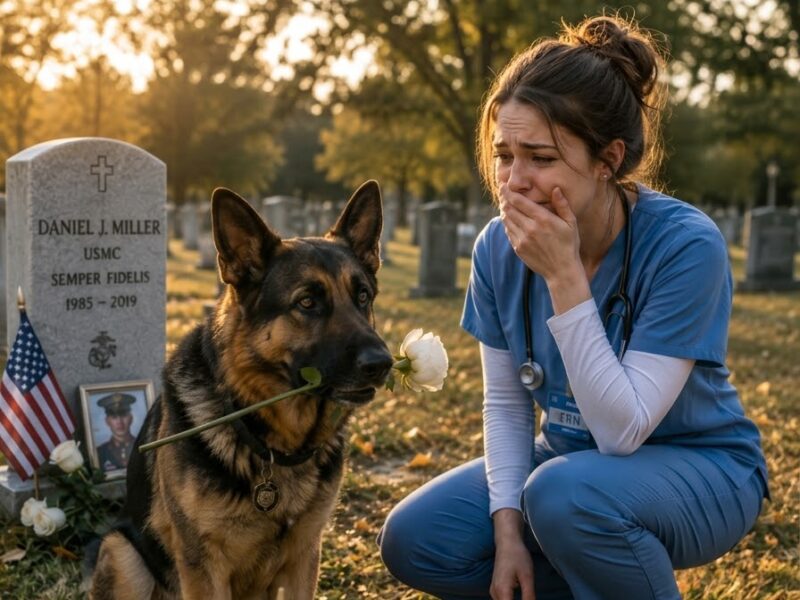
Every morning outside a Boston hospital, I watched the same K9 quietly steal a single white rose from the flower cart
The morning air outside Boston City Hospital was cold enough to turn a man’s breath into thin white mist. It was autumn, and the sharp wind blowing off the Charles River carried the bitter scent of fallen leaves and wet pavement. Every day, I sat in the glass-enclosed coffee shop across from the hospital entrance, holding a paper cup of lukewarm black coffee, watching the city wake up.
I’m a journalist by trade—or at least, I used to be, before burnt-out exhaustion and personal tragedy drove me into an extended sabbatical. My days had dissolved into a quiet, meaningless rhythm of observing strangers. But three weeks ago, my eyes locked onto a creature of habit who put my own repetitive life to shame.
His name was Bear. He was a retired military working dog, a massive German Shepherd with a dark, grizzled snout, a thick coat, and eyes that held a heavy, solemn intelligence. He wore a simple tactical harness without any military patches, stripped of his former combat identity. His handler was a gentle, gray-haired veteran named Arthur, a patient recovering from a long-term pulmonary illness in the hospital’s west wing. Arthur allowed Bear a surprising amount of freedom around the facility grounds; the dog was so exceptionally well-trained and gentle that the security staff treats him like an un-badged honorary employee.
Every single morning at precisely 8:10 AM, Bear executed the exact same ritual.
He would slip out through the automatic sliding doors of the main entrance, trotting purposefully toward a wooden flower cart operated by an old street vendor named Mario. Mario’s cart was always overflowing with vibrant red roses, bright yellow sunflowers, and deep purple orchids. But Bear never glanced at the colors.
With surgical delicacy, the ninety-pound dog would stretch his neck over the wooden rim, open his jaws, and wrap his teeth around the middle of a single stem. He picked only white roses. He never pinched the fragile petals, nor did he tear the leaves. He gripped the stem right beneath the thorns, lifted it free, and turned around.
The nurses on shift change would invariably laugh as Bear trotted past them, his ears perked, carrying the stolen flower like a quiet prize.
“Look at him! That dog has expensive taste,” one nurse called out with a warm chuckle, reaching down to pat Bear’s side. “Mario’s going to start sending the hospital board a bill for those white roses!”
I laughed along with everyone else on the sidewalk. It was a sweet, endearing sight—a tough, battle-hardened war dog acting like an eccentric thief with a romantic streak.
Yet, as I watched him more closely over those three weeks, I realized something that made the laughter feel hollow in my throat. Bear never looked playful. He didn’t tail-wag or bounce on his paws like a dog playing a game. His head was held level, his amber eyes locked forward in an intense, unyielding gaze. He moved with a heavy, purposeful gait, carrying the white rose carefully between his teeth, stepping through the sliding doors and disappearing into the shadow of the hospital’s east wing.
On the twenty-second morning, my curiosity finally stripped away my self-restraint.
I finished my coffee, threw the paper cup into the trash, and walked across the street just as Bear plucked his daily white rose from Mario’s cart. Mario simply waved a hand at the dog, smiling fondly. “Go on, handsome. Take it,” the vendor muttered softly, as if he knew trying to stop the animal was entirely pointless.
I stepped through the automatic glass doors a few paces behind the Shepherd.
Bear didn’t turn around. He didn’t seem to care that he was being followed. He navigated the bustling hospital corridors with practiced ease, weaving around rolling stretchers, busy doctors, and clattering food carts. He didn’t take the elevators. Instead, he led me down a long, sterile corridor toward the far edge of the building—a quiet, low-traffic hallway tucked away behind the old physical therapy department.
The bright fluorescent lights gave way to soft, flickering yellow fixtures. The noise of the busy hospital faded into a heavy, suffocating quiet.
Bear stopped outside a room at the very end of the hall. Room 104.
The wooden door was firmly closed. The brass handle was tarnished. Bear didn’t bark, nor did he scratch at the wood. He approached the threshold, lowered his heavy head, and gently laid the fresh white rose onto the linoleum floor, right beneath the tiny gap under the door. Then he sat back on his haunches, his posture straight, staring at the painted wood.
I stood five feet behind him, my heart beating with an unsettling rhythm.
“Bear?” I whispered, my voice echoing slightly in the empty hallway. “What are you doing, buddy?”
The dog didn’t whine. He slowly turned his head to look at me, his deep eyes reflecting a profound, ancient sadness. Then, with deliberate slowness, he reached out with his snout and nudged the heavy door. It hadn’t been latched shut. The door creaked open an inch, then swung wide into the dark room.
I took a step closer and peered over his broad shoulders.
The room was completely bare. The hospital bed had been stripped down to a bare, plastic-covered mattress. The IV stands were empty, pushed into the corner like abandoned skeletons. There were no flowers on the nightstand, no get-well cards, no sign of life.
The room was empty.
Directly across from the bed, taped securely to the bare plaster wall, was a single framed photograph. It showed a young soldier in desert camouflage, his face smudged with dust, smiling brightly with his arm draped over a younger, scars-less version of Bear.
I recognized the uniform, the unit patch, and the unmistakable family resemblance. The young soldier in the picture was Arthur’s son.
I had read the local newspaper obituaries two weeks ago. Arthur’s son had been killed overseas years ago, and Arthur himself—the elderly patient I thought Bear was visiting—had passed away quietly in his sleep right here in this room two weeks prior.
My stomach dropped into a sickening void. My vision blurred as the realization hit me like a physical blow.
“Bear… oh God,” I whispered, tears welling in my eyes. “He doesn’t know. He doesn’t know they’re both gone…”
I stepped fully into the room, my boots making soft clicking sounds on the clean floor. But as I drew closer to the wall where the photograph hung, I stopped dead in my tracks.
Neatly arranged on the floor directly beneath the photograph of the young soldier was a delicate, heartbreaking pile of white roses.
Nineteen of them.
Some were dried, their petals brown, shriveled, and brittle as parchment. Others were a few days old, their stems drooping. And right at the front sat the fresh, pristine white rose Bear had just carried in from the morning cold.
Nineteen days. Nineteen white roses. He had come here every single day since his master had died in this bed, delivering the same silent tribute to a shadow on the wall.
The weight of the dog’s devotion crushed the air from my chest. I sank to my knees on the cold floor, unable to hold back the quiet sobs that racked my shoulders. Bear walked over slowly. He didn’t bark or display anxiety; he simply leaned his heavy torso against my leg, resting his broad head upon my knee, letting out a long, shuddering sigh.
“He knows,” a quiet, raspy voice spoke from the doorway.
I jumped slightly, wiping my eyes as I turned around.
Standing in the doorway was an elderly janitor holding a mop bucket. He wore faded gray overalls, a worn blue cap pulled low over his silver hair, and a nametag that read Elias. His face was lined with deep, sympathetic wrinkles, his eyes soft as he looked at the dog.
“He knows his master isn’t in that bed,” Elias said quietly, leaning his hands on the wooden handle of his mop. “Dogs like him… they smell death long before the doctors even sign the paperwork. He knows Arthur is gone.”
I looked at the pile of roses, then back up at the old man. “Then why does he keep doing it? Why white roses? Why every morning?”
Elias took a slow step into the room, his eyes lingering on the photograph taped to the wall. “Because Arthur’s son used to bring him one white rose every Sunday before he deployed. It was their little tradition. When Arthur was admitted here three months ago, he was too sick to get out of bed. He used to hold Bear’s head, look him in the eye, and make him promise… he made Bear promise that if anything ever happened, he’d bring a white rose every day to keep the memory alive.”
I stared at the German Shepherd. Bear raised his head from my knee, his ears pricking forward as he listened to Elias’s voice.
“A promise,” I repeated, my voice shaking. “He’s keeping a promise to a dead man.”
“Aye,” Elias murmured. “Animals remember the debts of love far better than humans do.”
Bear suddenly shifted his posture. He stood up, his body tensing, his nose twitching as if he caught a strange, unexpected scent in the stale air of the empty hospital room.
He took a step backward, shaking his head. As he did, a small, worn metallic object slipped from the inside lining of his thick leather collar and clattered onto the linoleum floor.
It was a faded, plastic-laminated photograph, no larger than a playing card, attached to a tarnished brass ring.
I leaned forward and picked it up. The plastic was scratched and clouded with age. On the front was a photograph of a woman standing in front of an old brick townhouse, her face blurred by time. I turned the small photograph over.
Written on the back in dark, faded blue ink—in tight, frantic handwriting—were four simple words:
Find the woman in white.
A cold chill ran down my spine, freezing the tears on my cheeks. I looked up at Elias, but the old janitor was staring at the card in my hand with an expression of sudden, pale horror.
“Where did he get this?” I asked, my voice barely a whisper.
Before Elias could answer, Bear let out a sharp, breathless whine. He spun around toward the open doorway, his body locked in a rigid, trembling point.
I looked past Elias, out into the dimly lit hallway.
At the far end of the quiet corridor, standing near the fire exit doors under the pale green light, was a tall woman. She wore a pristine, ankle-length white coat. Her face was obscured by the deep shadows of the hall, but her posture was completely, terrifyingly still. She was staring directly into Room 104.
The moment Bear’s eyes locked onto her white coat, the heavy war dog didn’t growl. He dropped the rose stem from his jaw, knocked past Elias, and sprinted down the hallway toward her at full speed.
The heavy click of Bear’s claws against the polished linoleum sounded like rapid gunfire down the narrow corridor.
“Bear! Stop!” I shouted, scrambling up from the floor and charging out of Room 104 after him.
The woman in the white coat didn’t panic. The instant the dog launched himself down the hall, she spun on her heel, pushed open the heavy steel crash doors of the fire exit, and vanished into the stairwell. The heavy door slammed shut behind her, the magnetic lock buzzing with a sharp, warning beep.
By the time I reached the end of the hall, Bear was throwing his chest repeatedly against the reinforced steel door, his powerful paws scratching at the metal frame, uttering deep, frustrated barks that echoed through the stairwell.
“Stand back, boy!” I yelled, pulling out the small keycard I kept in my wallet—a leftover credential from my old press days—and attempting to bypass the emergency lock. The red light flashed twice and chimed an error. The door was hard-locked from the inside.
I dropped to one knee and grabbed Bear by his tactical harness, pulling his heavy frame back from the door. He was panting heavily, his muscles vibrating like high-voltage wires under his skin.
“Who was that?” I panted, looking over my shoulder at Elias, who had walked slowly down the hall, his mop forgotten near the door of Room 104. “Elias, who was that woman?”
The old janitor reached into his overalls, pulled out a handkerchief, and wiped his pale, sweating forehead. His hands were shaking violently.
“You shouldn’t have picked up that card, son,” Elias said, his voice dropping into a raspy, frightened whisper. “You shouldn’t be following that dog. Some things in this hospital… some ghosts aren’t meant to be dug up.”
“That wasn’t a ghost,” I said, holding up the small, plastic-laminated photograph I had retrieved from Bear’s collar. “That was a living person. And Arthur wrote this note. I know his handwriting from the medical chart logs I saw on his door. Why did Arthur hide this in Bear’s collar? Who is the woman in white?”
Elias looked around nervously, checking the empty hallway as if he expected the walls to have ears. “Arthur wasn’t just a patient here,” he whispered, leaning in closer. “Before he got sick, before his son was killed… Arthur was the Chief Archivist for the hospital’s military medical research wing back in the nineties. He managed the classified records.”
My journalistic instincts, dormant for nearly two years, flared back to life with sudden, razor-sharp intensity. “What kind of records?”
“Files on experimental military trauma treatments,” Elias said, his voice barely audible over the low hum of the fluorescent lights. “Surgeries, chemical trials… things done to wounded soldiers returning from early Gulf War deployments. Things that were supposed to save lives, but ended up destroying them. When Arthur’s son deployed six years ago, Arthur found out his boy was being placed in a specialized unit linked to those old trials. He tried to pull him out. He tried to blow the whistle.”
“And?”
“And two weeks later, his son was reported killed in action under classified circumstances,” Elias said, his eyes filled with a grim, heavy sorrow. “Arthur spent the last five years of his life pretending to be a broken, quiet old man, rotting in Room 104. But he wasn’t broken. He was compiling evidence. He kept everything on microfiche and encrypted drives, waiting for someone he could trust.”
I looked down at Bear. The German Shepherd had stopped barking. He was looking up at me, his intelligent amber eyes fixed on the photograph in my hand.
“He didn’t trust the doctors,” I realized out loud. “He didn’t trust the police. He trusted his dog.”
“Bear wasn’t just carrying white roses to that room to honor a promise,” Elias said softly. “The white roses were a signal. Every morning at 8:10 AM, Bear went to Mario’s cart. The white roses were delivered to Mario every night by an anonymous courier. Each rose stem had a tiny, microscopic code etched onto the base beneath the thorns—dates, file numbers, drop locations. Arthur was using the dog to receive data from an outside contact while he was stuck in that bed.”
My mind raced. The daily ritual wasn’t an act of aimless animal grief. It was a cold, brilliantly executed intelligence operation disguised as a heart-wrenching hospital myth.
“The nineteenth rose,” I muttered, turning the photo over in my hand. “Today was the nineteenth rose. The file is complete.”
“And the woman in white?” I asked Elias.
“Her name is Dr. Evelyn Vance,” Elias said, his jaw tightening. “She’s the head of the hospital’s board of directors, and the daughter of the general who authorized those trials thirty years ago. If she knows Bear has that final piece of data… she won’t let that dog leave this building alive.”
Right on cue, a loud, metallic announcement squawked over the hospital’s overhead PA system:
“Code Gray. Security lockdown in East Wing, Sub-Level 1. All visitors remain in place. Security personnel report to Sector 4.”
The red emergency lights along the ceiling began to flash, casting a blood-red glow over the white linoleum walls. The heavy magnetic fire doors at both ends of the hallway clicked shut simultaneously, locking us inside the corridor.
Bear let out a low, guttural growl, his lips pulling back to reveal his sharp white fangs. He stepped in front of me, placing his body firmly between me and the locked doors.
“They’ve isolated the wing,” Elias said, his face turning gray. “They know you have the photo.”
“How do we get out?” I demanded, shoving the laminated photo deep into my inner jacket pocket and grabbing the handle of Bear’s harness.
“The laundry chute at the end of the hall leads to the basement boiler room,” Elias said, pointing toward a small metal door built into the wall near Room 104. “It’s tight, but a man and a dog can slide down. From the boiler room, there’s an old coal delivery tunnel that runs beneath the street directly to Mario’s flower shop across the square.”
Heavy footfalls echoed from the other side of the fire doors—the rhythmic, coordinated sound of tactical boots.
“Go!” Elias urged, grabbing his mop and stepping back toward Room 104. “I’m just an old janitor who didn’t see anything. Get that dog out of here!”
“Come with us, Elias!”
“I’m seventy-two years old, son,” Elias smiled faintly, a spark of quiet defiance in his eyes. “I’ve been cleaning these floors for forty years. It’s about time I made a mess they can’t sweep up. Go!”
I didn’t argue. I pulled open the heavy metal hatch of the laundry chute. It was a steep, stainless-steel slide leading down into darkness.
“Bear, down!” I ordered.
The war dog didn’t hesitate. He gathered his limbs, slid into the chute, and vanished into the darkness below. I took a deep breath, squeezed my shoulders through the metal frame, and launched myself down after him into the black void of the hospital’s underground veins.
The slide down the laundry chute was a terrifying, disorienting blur of smooth metal, icy drafts, and deafening echoes. I slammed onto a massive pile of dirty hospital linens at the bottom, tumbling onto the concrete floor of the Sub-Level 2 laundry room.
Before I could clear the dust from my eyes, a warm snout pressed hard against my face. Bear was standing over me, his tail giving two sharp, tense wags before he turned his head to survey the vast, cavernous room.
The basement smelled of steam, detergent, rust, and damp earth. Massive industrial washing machines lined the walls like sleeping iron beasts, their copper pipes hissing softly in the dim, amber emergency light.
“Good boy,” I coughed, picking myself up from the pile of sheets and checking my hands. “You okay?”
Bear let out a soft huff, his ears rotating toward a heavy iron door at the far end of the boiler room.
I reached into my pocket and pulled out the laminated card again. In the brighter light of the basement, I noticed something I had missed earlier. The faded blue ink on the back wasn’t just handwriting; under the phrase Find the woman in white, there was a tiny series of grid coordinates and a six-digit cipher code: 44-09-12.
“A location,” I muttered to myself. “Not a person. A physical location within the city.”
Suddenly, the heavy iron door of the laundry chute above us rattled violently. The sound of metal scraping against metal echoed down the tube. They were coming down the chute.
“This way!” I whispered, grabbing Bear’s harness.
We sprinted through the maze of steam pipes and concrete pillars toward the old coal tunnel Elias had mentioned. Tucked behind a row of obsolete water heaters was a low, arched wooden doorway reinforced with rusted iron bands. A heavy padlock held the latch closed, but the wood around the frame was rotted through with decades of moisture.
I didn’t have time to look for a key. I backed up two steps, raised my heavy leather boot, and slammed my heel into the lock mechanism with all the force I could muster.
The rotten wood splintered with a loud crack. I kicked it a second time, and the door swung open, revealing a dark, narrow brick tunnel stretching out beneath the foundation of the hospital.
“In, Bear! Go!”
We ducked inside just as the heavy canvas sack of a security officer crashed onto the linen pile in the laundry room behind us. I pulled the splintered wooden door shut, wedged an iron pipe across the interior handles, and turned on the flashlight app on my phone.
The beam of light cut through a thick fog of hanging dust and cobwebs. The tunnel was cold, the air thick with the smell of old coal dust and stagnant river water. The brickwork was vintage nineteenth-century Boston—arched, damp, and dripping with condensation.
Bear walked ahead of me, his head lowered, his nose sweeping the ground like a vacuum. He wasn’t just running; he was tracking. His military conditioning had taken complete control of his broad frame. He moved with silent, deadly precision, checking every dark alcove and branching drainage pipe before allowing me to pass.
“Where are we going, Bear?” I asked softly, the sound of our footfalls muffled by the soft layer of soot covering the ground.
He didn’t answer with a bark. He simply kept moving forward, his pace quickening as the brick tunnel began to incline upward.
After ten minutes of breathless marching through the subterranean gloom, the tunnel terminated at a heavy, vertical iron ladder leading up to a square wooden hatch in the ceiling. Drops of water were leaking through the seams of the wood above.
Bear stood at the base of the ladder, looking up, then turned his eyes to me.
“Wait here,” I whispered.
I climbed the rusted iron rungs, pressed my shoulder against the wooden hatch, and pushed upward with steady pressure. The hatch swung open with a creak, blinding me with the sudden, sharp glare of morning sunlight.
I poked my head out. We were inside a small, dusty storage shed filled with wooden crates, burlap sacks, and fresh cut flowers. The sweet, overwhelming scent of roses hit my nose instantly.
It was Mario’s storage shop, located in the alleyway right behind his flower cart on the main square.
“Mario?” I called out softly, climbing out of the hatch and helping Bear scramble up the ladder behind me.
The storage shed was silent. The front wooden door leading to the alley was slightly ajar, letting in the cool morning breeze.
I stepped out into the alleyway, Bear clinging to my hip. The street was quiet, but the distant sound of police sirens was already blaring around the perimeter of the hospital two blocks away.
Sitting on an overturned wooden crate in the middle of the alley was Mario, the flower vendor. He wasn’t wearing his usual apron. He wore a heavy wool overcoat, his hands resting on his knees. He looked up at us, his old face showing neither surprise nor fear—only a profound, exhausted relief.
“You made it,” Mario said, his voice deep and rough. “I was beginning to think Elias wouldn’t get you to the chute in time.”
I stopped, my hand tightening on Bear’s harness. “You knew? You’re the contact?”
Mario let out a low, breathless laugh, standing up slowly. “Who do you think has been buying those white roses for the past three weeks, son? You think a street vendor gives away sixty dollars worth of pristine imports every morning to a stray dog for fun?”
Bear walked up to Mario, lowered his head, and allowed the old vendor to lay a heavy, calloused hand on his broad skull.
“Arthur was my spotter in Vietnam,” Mario said, his eyes misting over with old memories. “Fifty years ago, we crawled through the mud in the Mekong Delta together. When his boy was killed, and when Arthur realized what Dr. Vance’s group was doing at the hospital, he called me. I promised him I’d help him get the truth out.”
“What truth, Mario?” I pulled out the plastic-laminated card and held it out. “What is this code? What is ‘the woman in white’?”
Mario looked at the card, then looked up into my eyes with a dead serious expression.
“The woman in white isn’t Dr. Evelyn Vance,” Mario said quietly. “The woman in white is a boat.”
The revelation hung in the chilly alley air like a specter.
“A boat?” I repeated, looking down at the four words written on the back of the photograph.
“A 1978 wooden cutter, painted head-to-toe in white marine enamel,” Mario explained, stepping toward a hidden shelf behind a stack of flower crates and pulling out a small black duffel bag. “Her name is The Lady in White. She’s docked at Pier 14 down near the old navy yard in Charlestown. Arthur bought her under a shell company twenty years ago. It’s where he stored the master servers, the hard physical paper trails, and the military autopsy reports before he checked into the hospital.”
“Why didn’t you just go get the files yourself?” I asked.
“Because Pier 14 has been watched by Vance’s private security firm for the past month,” Mario said, handing me the black duffel bag. “They knew Arthur had a hideout somewhere along the waterfront, but they didn’t know which vessel it was. The ship’s main storage safe is locked with a biometric and key-code system that only two living beings can open.”
Mario pointed a weathered finger at the German Shepherd.
“The physical key is embedded in Bear’s microchip,” Mario said. “And the six-digit code on that card—44-09-12—is the coordinate offset for the safe’s manual override. Without the dog, those files are just unreadable brick data. That’s why Vance was trying to kill him.”
My blood ran cold. The sheer scale of Arthur’s contingency planning was staggering. He had transformed his loyal working dog into the ultimate vault key, hiding the master index in plain sight under the guise of an old man’s tragic death and a heart-wrenching hospital myth.
“Why me?” I asked, looking Mario dead in the eye. “Why let me follow him today?”
Mario smiled sadly. “Because I’m eighty-two years old, son. I can’t run from tactical security teams down at the docks. And Arthur watched you sitting in that coffee shop every morning for two months before he was admitted. He knew who you were. He knew you were the investigative reporter who brought down the corrupt state veterans’ board three years ago before you quit.”
I froze. “Arthur knew who I was?”
“Arthur didn’t believe in coincidences,” Mario said gently. “He saw a broken journalist who needed a reason to live, and a broken war dog who needed someone to finish the mission. Now get moving. Vance’s team will have traced the laundry tunnel by now.”
Mario shoved a set of keys into my hand. “Take my delivery van parked at the end of the alley. Get to Pier 14 before the police lock down the harbor bridges.”
“What about you?” I asked.
“I’m going to sit right here and sell my roses,” Mario grunted, sitting back down on his wooden crate with a stubborn, unbreakable grin. “Now go. Finish Arthur’s work.”
I didn’t waste another second. “Bear, let’s go!”
We piled into the rusty blue flower delivery van. I slammed the key into the ignition, threw the engine into gear, and tore out of the alley just as two black SUVs with tinted windows turned the corner onto the main square.
The drive to Charlestown was a nerve-wracking nightmare. The sky over Boston was darkening with heavy gray rain clouds, and the sound of sirens echoed across the city like an rising storm. I kept my eyes glued to the rearview mirror, my hands trembling on the steering wheel, while Bear sat in the passenger seat, his nose pressed against the side window, watching the city streets flash past.
We crossed the Charlestown Bridge under a light drizzle. Pier 14 was a neglected, industrial stretch of dockland tucked behind an abandoned sugar refinery. Rusted iron cranes stood like skeletal giants against the gray waters of the harbor.
I parked the van behind an overturned shipping container a hundred yards from the dock entrance.
“Stay low,” I muttered to Bear.
We slipped out of the van and moved quietly through the fog and drizzle toward the wooden slips. The smell of salt water, diesel fuel, and rotting wood filled the air.
At the far end of Slip 4, rocking gently in the dark, churning water, was a magnificent thirty-five-foot wooden cutter. Her hull was painted a blinding, immaculate shade of white, stark and luminous against the dreary gray of the harbor.
The Lady in White.
The ship appeared completely deserted. Her canvas sails were tied down tight, her brass fixtures dull with sea salt. But as we stepped onto the wooden planks of the pier, Bear suddenly stopped. His ears flattened against his skull, and a low, subsonic vibration began in his chest.
From the shadows of the ship’s wheelhouse, three figures stepped out onto the deck.
They wore dark waterproof coats and carried tactical sidearms. And walking out behind them, wearing a long, elegant white wool coat and holding a black umbrella, was Dr. Evelyn Vance.
“You’re late, Mr. Miller,” Dr. Vance said, her voice smooth, refined, and entirely devoid of emotion as her security guards raised their weapons toward us. “We’ve been waiting for Arthur’s little delivery boy for quite some time.”
The wind howling off the Atlantic Ocean carried a cold, biting rain that stung my skin. I stood on the slick wooden planks of the pier, my hands raised slowly to chest height, my body positioned carefully in front of Bear.
“Dr. Vance,” I said, keeping my voice steady despite the three laser sights dancing across my coat. “I see you finally came out from behind your hospital desk.”
Evelyn Vance stepped to the railing of the cutter, looking down at us with cold, aristocratic disdain. “Arthur was a foolish old man,” she said, her voice easily cutting through the sound of the crashing waves. “He thought a few stolen medical files could tear down a legacy my family spent forty years building. He thought he could use an animal to outsmart me.”
“It wasn’t just a few files,” I replied, taking a small, deliberate step forward. “It’s forty years of illegal human experimentation on veterans. It’s the truth about Arthur’s son. It’s the names of every doctor, general, and executive who signed off on those death warrants.”
Vance smiled thinly, shaking her head. “And where is that evidence now, Mr. Miller? It’s locked in the digital vault below deck. A vault that requires a microchip signal that dies the second that dog’s heart stops beating. Hand the dog over, and I’ll let you walk away. Refuse, and your body will be at the bottom of Boston Harbor before the tide turns.”
I looked down at Bear. The German Shepherd wasn’t looking at the guards or their guns. He was looking at the ship’s cabin door, his nostrils flaring as he caught a lingering scent—the scent of his old master, preserved in the wooden walls of the boat he had built.
“Bear,” I whispered, so quietly only his sharp ears could catch it. “Seek.”
The military command triggered an instant, instinctive reflex.
Bear didn’t attack the guards. He launched himself sideways off the pier, vaulting across four feet of open water and landing heavily onto the slippery wooden deck of the cutter.
“Kill the dog!” Vance screamed, dropping her umbrella.
A gunshot cracked through the rainy air, the bullet splintering the wooden railing where Bear had been standing a microsecond before.
I didn’t hesitate. I charged the guard nearest to the gangplank, driving my shoulder into his chest and sending both of us tumbling into the freezing, dark waters of the harbor. The shock of the icy ocean took the breath from my lungs, but years of survival instincts kicked in. I struck the guard in the jaw under the water, broke his grip, and kicked wildly toward the surface.
I hauled myself up onto the stern ladder of the vessel, gasping for air, water streaming from my clothes.
On the deck above, chaos had erupted. Bear was a whirlwind of dark fur and white teeth. He had stripped the weapon from the second guard’s hands, pinning the man to the deck, while the third guard panicked, backing up toward the wheelhouse with a raised pistol.
“Bear, Angriff!” I roared, sliding onto the deck.
The Shepherd released the first guard and leaped through the rain, his broad chest slamming into the third guard before the man could squeeze the trigger. The pistol clattered across the wet deck and slipped over the edge into the sea.
Dr. Vance backed away toward the bow, her composure completely shattered, her white coat soaked with rain and sea spray. She reached into her pocket and pulled out a small, nickel-plated revolver, her hands shaking violently as she pointed it directly at Bear’s chest.
“Get back!” she shrieked. “Get away from me, you beast!”
Bear didn’t rush her. He stopped five feet away, his broad head lowered, his amber eyes fixed on her face. He didn’t growl. He didn’t bare his teeth. He simply took one slow, deliberate step forward, projecting a aura of absolute, unstoppable authority.
“I said stay back!” Vance screamed, pulling the hammer back on the revolver.
I lunged forward from behind, grabbing her wrist and forcing the barrel skyward just as the gun went off with a deafening BANG. The shot disappeared into the storm clouds. I twisted her arm, forcing her to drop the weapon, and pinned her against the ship’s wooden mast.
“It’s over, Vance,” I panted in her ear, pulling a pair of heavy marine cable-ties from the deck locker and binding her wrists tightly behind her back. “The game is up.”
Minutes later, the harbor was illuminated by the flashing red and blue lights of three U.S. Coast Guard cutters and a dozen federal law enforcement vehicles pulling onto Pier 14.
The federal agents, tipped off by the master encrypted transmission Arthur had set to trigger automatically once Bear reached the ship’s proximity, flooded the dock. They secured the scene, took Vance and her surviving guards into custody, and brought in a team of specialized cyber-forensics officers.
I sat on the deck of The Lady in White, wrapped in a thick wool blanket provided by a Coast Guard medic, holding a hot cup of coffee.
Beside me, the forensic team emerged from the lower cabin carrying three heavy, fireproof hard drives and boxes of physical microfiche records. The evidence was pristine, intact, and totally damning. Decades of corruption, murder, and illegal medical trials were laid bare in black and white.
An FBI special agent stepped up to me, looking down at Bear with profound respect. “The information on these drives is going to result in dozens of federal indictments,” the agent said softly. “Arthur’s son… and all those soldiers… they’re finally getting justice.”
I looked down at the German Shepherd sitting by my knee. Bear was quiet now. The tension that had held his muscle-bound frame tight for three weeks had completely melted away. He looked tired—profoundly, deeply tired—but his eyes were peaceful.
The storm had passed. The heavy gray clouds over Boston harbor were breaking apart, allowing long, golden rays of morning sunlight to pierce through the fog, turning the surface of the ocean into a sheet of shimmering gold.
I stood up, shedding the wool blanket, and walked over to the side of the vessel.
In my right hand, I held the final white rose—the nineteenth rose, which I had retrieved from Room 104 and kept safe inside my jacket pocket throughout the entire ordeal. The petals were slightly bruised, but the blossom was still beautiful, brilliant, and white.
I knelt beside Bear. “We did it, boy,” I whispered softly. “You kept your promise.”
Bear looked at the flower in my hand, then raised his eyes to the golden horizon out over the open sea. He let out a long, quiet breath—a sigh that sounded like the release of a burden he had carried across battlefields, hospital halls, and cold city streets.
I placed the white rose between his teeth one last time.
Bear held it gently, stepped up to the edge of the bow, and leaned over the wooden railing. He opened his jaws and let the white rose drop into the golden, sunlit water below.
We watched together as the ocean tide caught the flower, carrying it slowly out to sea, toward the open horizon where the spirits of soldiers and their faithful hounds finally rest in peace.
I reached down and clipped a brand-new leather leash onto Bear’s collar—not as a master commanding a working dog, but as a friend walking beside a partner.
“Come on, Bear,” I said softly, as the sun broke fully over the city of Boston. “Let’s go home.”
And for the first time since I had met him, Bear turned his head, leaned his heavy body into my side, and gave a soft, happy wag of his tail.
The end.









