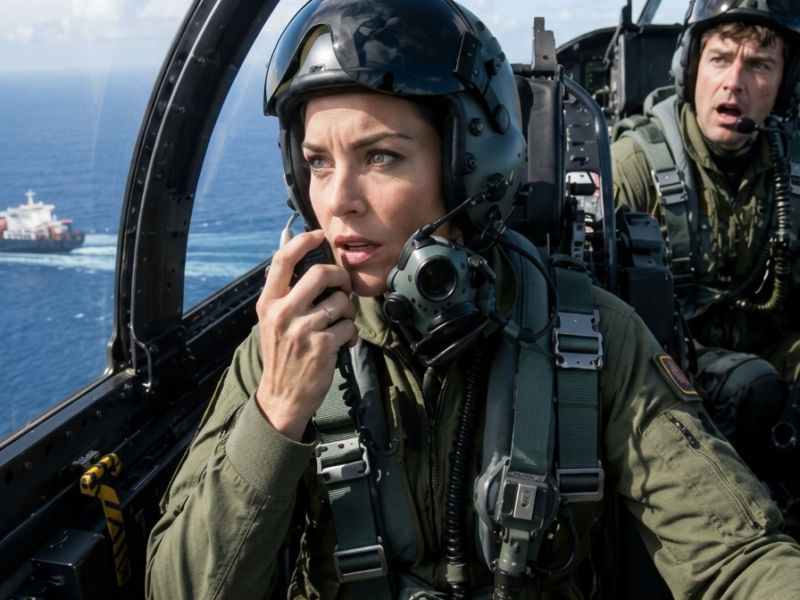
Eight hundred miles from the nearest runway, I felt the aircraft drop out of the sky while the captain stared at me with cold disbelief and said, “We’re finished,”
Eight hundred miles from the nearest runway, I felt the aircraft drop out of the sky while the captain stared at me with cold disbelief and said, “We’re finished,” but he didn’t know I had already made one call that could expose the secret hidden inside our cargo.
The cabin lights flickered, casting eerie, dancing shadows across the cramped cockpit as the twin turboprop engines coughed violently against the oppressive darkness of the endless Pacific. Outside the windshield, there was no horizon, no moon, and no navigation beacons—nothing but black water below and a sky stripped clean of stars. We were flying through an oceanic vacuum, completely isolated from the rest of the world.
We had lost secondary navigation, long-range communications, and our left engine within a span of twenty agonizing minutes. What had started as a routine, non-scheduled logistics run across the remote South Pacific had spiraled into an immediate battle for survival.
Captain David Vance kept re-checking the fuel totalizer. His knuckles were bone-white as he gripped the control yoke, his right hand trembling with an involuntary tremor that I had never seen in his fifteen years of flying.
“How much time do we actually have, Vance?” I asked, forcing my voice to remain steady as I recalibrated the altimeter manually.
“Forty minutes. Maybe thirty-five if the drag from the dead engine keeps pulling us down,” Vance muttered without turning his head. He looked at me, his eyes hollow and bloodshot, then he glanced back out into the black ocean. “There’s nowhere to land, Liam. There isn’t an island big enough to hold a tricycle within eight hundred miles.”
I knew he was right about the geography. The charts were clear. We were deep inside a dead zone, far outside standard commercial air corridors. But there was something Vance didn’t know—something he thought I hadn’t noticed.
Three hours earlier, during our final pre-flight inspection at a private airfield in Pago Pago, I had discovered an unauthorized, custom-built sealed compartment beneath the main cargo deck floor. It wasn’t listed on any manifest. When I shone my tactical flashlight down into the dark recess, I found a heavy, military-grade titanium case secured with hydraulic dampeners. No tracking label. No customs clearance stamp. Just a ten-digit alphanumeric code burned directly into the top lid.
When I had brought it up to Vance before engine start, his response had been swift and unsettlingly cold. He told me to shut my mouth, forget I’d seen it, and stick to my duties as first officer if I wanted to keep my license.
Now, with our altitude dropping through twelve thousand feet and the remaining engine whining under severe thermal stress, I reached down to the flight console and pulled out the encrypted satellite phone.
Vance’s hand shot across the center pedestal, his fingers clamping onto my wrist with bruising force. “What the hell do you think you’re doing?”
“Making a call,” I said, glaring back at him.
“To who? Sector control is dead. The high-frequency radio is fried.”
I reached into my flight bag, pulled out a notepad where I had scribbled down the sequence of numbers found inside the compartment, and locked eyes with him. “To someone who actually knows what we’re carrying.”
Vance’s face changed in an instant. It wasn’t the panic of a pilot facing an ocean ditching. It was a sharp, calculating shock—recognition. That was the exact moment I realized the titanium case wasn’t just high-value freight. It was something personal, dangerous, and illegal.
Before he could overpower me, I hit the speed-dial sequence hardwired to the satellite phone from the compartment’s inner panel. I pressed the speaker button.
It rang once. Twice.
A click sounded over the static, followed by a calm, unhurried voice that sounded entirely devoid of emotion. “Are you airborne?”
“Yes,” I shouted over the dull roar of the failing right engine. “We’re in severe distress. Losing altitude rapidly.”
“Is the captain with you?” the voice asked coldly.
I looked across the dimly lit cockpit at Vance. “He’s right here.”
The line went silent for three long seconds. The atmospheric static hissed through the speaker like a coil of snakes. Then came four words that made the blood freeze in my veins:
“Don’t trust your captain.”
My stomach dropped into a bottomless pit. Before I could process the warning, the aircraft suddenly lurched violently downward, throwing me forward against my shoulder harness. The altimeter needle spun into a terrifying downward spiral.
Vance had slammed his hand down and pulled the emergency descent lever, dumping our remaining altitude on purpose.
“What are you doing?!” I yelled, reaching over to seize the flight controls, fighting him for command of the yoke as the wind howled furiously against the nose cone. “You’re going to dive us straight into the water!”
Vance stared straight ahead into the abyss, his teeth grit, his expression locked in a terrifying mask of fatalistic resolve. “Because they can’t find us if we disappear, Liam! They can’t recover what’s in the belly if we’re six thousand feet underwater!”
“You’re out of your mind!” I pulled back on the yoke with everything I had, straining every muscle in my upper body to level the nose as the warning horn began to blare inside the cabin: TERRAIN. PULL UP. TERRAIN.
Below us, the oceanic dark stretched out forever, but as we broke through the low-hanging rain clouds at nine hundred feet, a strange flicker appeared through the mist. A faint, precise line of high-intensity deck lights cut through the storm.
It wasn’t a runway. It was a massive, pitch-black vessel cut through the rolling waves.
The voice on the satellite phone spoke again through the speaker: “Land on it.”
I stared at the display in disbelief, my breath catching in my throat. “That’s impossible! It’s a ship! We’re flying a fixed-wing cargo aircraft, not a helicopter!”
“Not for that ship,” the voice replied calmly. “Line up with the bow lights now.”
Vance lunged across the console, his hand reaching out to cut the fuel shutoff valves to starve our only working engine and force a dead-stick crash into the waves. I swung my forearm hard, striking his wrist away, and slammed the throttle forward to maintain control. For the first time since we had taken off, Captain Vance looked genuinely terrified.
I kicked the rudder pedals, banking the heavy aircraft sharply to the left, lining up our descending glide path directly with the narrow row of lights piercing the squall.
As we descended through five hundred feet, four hundred feet, three hundred feet, the massive ship’s deck began unfolding beneath us in a complex mechanical ballet. Heavy hydraulic steel plates moved outward, expanding the upper deck into a wide, flat runway platform equipped with high-friction arrestor nets and magnetic dampeners. It wasn’t a commercial cargo vessel. It was a unregistered, high-tech emergency recovery carrier.
And painted in bold, reflective white across the flat center deck was the exact same ten-digit code that had been burned into the titanium case beneath our feet.
“Brace for impact!” I screamed, pulling the nose up at the very last second.
The aircraft slammed onto the steel deck with brutal force, a jarring crash that felt like it would snap my spine. The nose gear shattered on impact, sparks flying wildly across the wet deck as the heavy arrestor cables caught our main gear, dragging us to a violent, metal-screeching halt just feet from the open ocean edge.
My head slammed against the side window, leaving me dazed and bleeding from the temple. The right engine sputtered, threw a cloud of black smoke, and finally died. Silence enveloped the cockpit, broken only by the heavy pounding of rain against the windshield and the sound of our own ragged breathing.
Before I could unbuckle my harness, the cockpit side door was yanked open from the outside. Flashlight beams blinded me. A team of heavily armed personnel dressed in unmarked tactical gear surrounded the aircraft, weapons raised, securing the perimeter with silent efficiency.
One of the operatives, wearing a communications headset beneath his helmet, dropped down to his knees and used a hydraulic cutter to slice open the lower cargo hold compartment. He pulled the titanium case out, popped the heavy pressure seals, and opened the lid.
I leaned out of the broken cockpit door, coughing through the smoke, trying to see what was inside.
The operative shined his tactical light into the interior of the box. He paused, his shoulders relaxing slightly, and then he looked up at his team leader and whispered loud enough for me to hear:
“She’s alive.”
I stared down at him, my mind spinning into complete confusion. “Who? Who’s alive? What is in that box?”
The operative turned his head slowly, looking past me and fixing his gaze directly on Captain Vance, who was sitting motionless in his seat, his head bowed in defeat.
“The woman he told us was murdered three years ago,” the operative said.
Vance slowly closed his eyes as a heavy set of tactical flex-cuffs was slapped around his wrists.
And suddenly, standing on the deck of a secret ship in the middle of a storm, the terrible truth crashed down on me. We hadn’t been flying eight hundred miles away from civilization to deliver cargo. We had been used to transport a living human being who was never supposed to exist.
The storm raged on outside, but inside the main deck hangar of the recovery vessel Nautilus-9, the air was thick with tension and the smell of ozone. I sat on an aluminum storage crate, a medic pressing a sterile gauze strip against the bleeding cut on my forehead. My body was still trembling from the adrenaline rush of the crash landing, but my mind was hyper-focused on the scene unfolding in the center of the room.
The titanium case sat on a reinforced stainless-steel medical table. It wasn’t a cargo container; it was a sophisticated, self-contained cryo-stasis capsule, fitted with advanced life-support systems, IV lines, and a digital monitoring display that beeped with a slow, steady pulse.
Inside lay a woman no older than thirty, her face pale, her dark hair framed by the frost coating the inner glass. She looked peaceful, almost as if she were simply asleep, but the array of biometric sensors attached to her temples told a far more complex story.
A tall man in an tailored dark trench coat stepped into the hangar lights. He carried himself with the quiet authority of someone who commanded armies from the shadows. He walked straight past the medical team and stood in front of Captain Vance, who was forced down onto his knees by two armed guards.
“You almost made it, David,” the man in the trench coat said, his voice smooth, cold, and instantly recognizable. It was the voice from the satellite phone. “Eight hundred miles off the grid. A dead-zone flight path. A deliberate sabotage of your own aircraft to sink the evidence into the Marianas Trench. A brilliant, desperate plan.”
Vance spat blood onto the steel floor, glaring up at the man. “She was never meant to be a bargaining chip, Marcus! You promised me she’d be safe! You lied to me from the start!”
“I promised you she would remain hidden,” Marcus corrected him coldly, leaning down until he was inches from Vance’s face. “You were the one who broke protocol by trying to move her without authorization. You thought you could sell her to the syndicate in Manila.”
“Sell her?” Vance laughed bitterly, a broken, tragic sound. “She’s my sister, Marcus! You made her a ghost! You staged her death, locked her in a box, and used her research to build your empire while she rotted in a state of artificial coma!”
I stood up from the crate, pushing the medic’s hand away. “Hold on. Someone talk to me. What the hell is going on here? Who is she, and why did you put my life on the line for this flight?”
Marcus turned his gaze toward me for the first time. His sharp grey eyes inspected me with a mixture of curiosity and mild respect. “First Officer Liam Vance—no relation to David, despite the shared surname. A coincidental assignment that proved quite fortunate for us tonight. You flew remarkable well under pressure, Liam. If you hadn’t defied your captain’s order to cut the engine, both you and Dr. Elena Vance would currently be sitting at the bottom of the ocean.”
“Dr. Elena Vance…” I repeated, looking back at the capsule. The name instantly clicked in my head. Three years ago, Dr. Elena Vance was the lead neuro-biologist for Aegis Dynamics, a massive defense contractor. Her sudden death in a lab explosion in Geneva had been global news—a tragic accident that halted groundbreaking research into bio-synthetic memory neural storage.
“She didn’t die in Geneva,” I whispered, the puzzle pieces falling into place with terrifying clarity.
“No,” Marcus said, stepping closer to the capsule and running a gloved hand along the frosted glass. “Elena discovered a method to compress human consciousness into an organic digital array—a way to store high-level classified intelligence directly within human neural tissue, bypassing all digital firewalls and network security. She became a walking, living hard drive containing the blueprinted security infrastructure of every major Western intelligence agency.”
“She became too dangerous to be left awake,” Vance snarled from the floor. “So Aegis put her under! They used a weaponized sedative to lock her mind, stripped her of her identity, and turned her into a portable vault! Marcus didn’t save her—he enslaved her!”
“We protected her from falling into the wrong hands,” Marcus corrected, his voice dropping an octave, losing its calm facade and revealing a razor-thin edge. “Hands like yours, David. Hands that were willing to trade her to highest bidder in exchange for fifty million dollars and a clean identity.”
“That’s a lie!” Vance roared, struggling against his restraints. “I was taking her to a medical team in Palau! A team that knew how to wake her up without frying her brain!”
“A medical team funded by the Vory syndicate,” Marcus replied coldly. He motioned to the guards. “Take him to the brig. Secure him until we reach international waters.”
As the guards dragged a screaming, cursing Captain Vance out of the hangar deck, I stood alone with Marcus and the cold, silent body of Elena Vance. The hum of the ship’s massive engines vibrated through the soles of my boots.
“So what happens to me now?” I asked, keeping my body relaxed, though my hand hovered inches away from the heavy wrench I had slipped into my back pocket during the walk from the crash site. “I’m just the commercial pilot who got caught in the middle of your black-ops family feud.”
“You are a witness, Liam,” Marcus said, turning to face me. “And in our world, witnesses are either eliminated or recruited. Given your piloting skills and the fact that you saved the cargo, I am inclined to offer you the latter.”
Before I could answer, a loud red warning light began flashing across the hangar ceiling. A deafening klaxon pierced the air, echoing through the vast steel chamber.
The ship’s automated defense system began to blare over the loudspeakers: WARNING. RADAR LOCK DETECTED. MULTIPLE FAST-APPROACHING CONTACTS. IMPACT IN THREE MINUTES.
Marcus’s calm composure shattered. He pulled a radio from his belt. “Bridge, report! What is that?”
“Sir! We have three unmarked tactical attack helicopters coming in low off our stern!” the bridge commander yelled over the radio, amid the sound of gunfire and explosions in the distance. “They aren’t responding to our identification signals! They’ve already disabled our radar dish!”
The heavy steel doors leading to the ship’s upper deck exploded inward with a deafening blast of fire and shrapnel.
Smoke filled the hangar immediately. Through the thick black haze, shadowy figures clad in heavy dark armor and night-vision visors began rappelling down from the shattered ceiling, firing suppressed automatic weapons with deadly precision.
The ship’s guards were taken down before they could raise their weapons. Marcus pulled a sidearm from his coat and fired two shots into the smoke before a heavy burst of gunfire forced him to dive behind a stack of supply crates.
I threw myself flat onto the deck floor, sliding under the metal medical table right beneath Elena’s stasis capsule. Bullets ricocheted off the titanium casing with sharp, pinging sounds.
Through the chaos and blinding smoke, I saw one of the armored attackers march directly toward the medical table. He carried a heavy magnetic transport rig—designed specifically to haul the stasis capsule away.
They weren’t here to destroy the ship. They were here to harvest Dr. Elena Vance.
I looked up at the digital interface on the capsule. The sudden concussive shockwaves from the explosions had breached the outer thermal seal. The frost on the glass was melting rapidly. Green fluid began draining out through the lower emergency relief valves.
The life-support monitor began to beep frantically: WARNING. CRITICAL STASIS BREACH. SUBJECT AWAKENING.
Underneath the glass, the woman’s eyelids fluttered. Her fingers twitched against the metal lining.
The armored soldier reached out to grab the edge of the capsule. I didn’t think. I drove my foot forward with everything I had, slamming my boot into the side of his knee. The joint snapped with a sickening crack, sending him crashing onto the steel deck.
I scrambled out from under the table, grabbed his dropped assault rifle, and fired a burst into his body armor, knocking him unconscious.
I grabbed the manual override handle on the stasis capsule and yanked it down with all my weight. The heavy glass lid hissed and popped open.
Elena Vance gasped violently, sitting up in a cloud of freezing vapor, her lungs desperately taking in the warm, smoky air of the hangar. Her eyes, a striking, sharp emerald green, darted around in blind terror until they locked onto mine.
She grabbed my jacket collar with surprising strength, her whole body shaking, her breath ragged.
“Where… where is the drive?” she choked out, her voice raw and hoarse.
“What drive?” I yelled over the deafening roar of incoming mortar fire.
She pressed her thumb hard against the back of her own neck, right below her skull, revealing a thin, glowing blue surgical port embedded beneath her skin. “The drive… they put it inside me… if they plug in the override key… it will wipe my mind forever…”
Before she could finish her sentence, a heavy hand grabbed me from behind and threw me hard against the bulkhead. I hit the steel wall, gasping for air as my vision blurred.
Standing over us was a giant of a man in commander’s tactical gear, holding a strange, glowing metallic device that resembled a heavy neural interface syringe. He looked down at Elena with a cruel, cold smile.
“Time to clean the drive, Doctor,” he said.
Pain shot through my shoulder as I hit the deck, but I didn’t have the luxury of staying down. The giant commander stepped forward, lowering the heavy neural device toward the back of Elena’s neck.
Elena scrambled backward inside the opening capsule, her limbs still weak from three years of muscular atrophy and chemical sedation. She kicked out blindly, knocking a tray of surgical tools off the side table, but the man didn’t even flinch as the metal scalpel bounced off his heavy chest armor.
“Liam!” she screamed, her voice cracking with terror.
I didn’t try to stand up. Instead, I grabbed the heavy industrial wrench I had tucked into my back belt, lunged forward along the slippery floor, and swung it like a baseball bat directly into the back of the commander’s exposed knee joint.
The heavy steel tool hit home with a dull, heavy thud. The commander grunted in pain, his balance breaking just enough to throw his aim off. The glowing needle of the neural device slammed into the titanium side of the stasis pod, sending violent blue sparks showering across the deck.
He spun around with unnatural speed, backhanding me across the face with his tactical glove. The force of the blow sent me sliding across the wet, oil-slicked steel floor, my vision flashing white.
“Pest,” the commander growled, raising his sidearm to finish me off.
Before he could pull the trigger, a sharp burst of gunfire echoed from the far end of the hangar. Three round struck his back armor, staggering him forward.
Marcus stepped out from behind a wall of shipping containers, a high-caliber tactical rifle pressed against his shoulder, firing with ruthless precision. “Step away from the asset, Vance!”
I blinked away the blood dripping into my eyes and realized what Marcus had just said. Vance?
The giant commander slowly turned his head toward Marcus, pulling off his shattered tactical visor to reveal a scarred, hardened face that bore a horrifying, twisted resemblance to the man currently locked in the ship’s brig.
It was Captain David Vance. Or rather, it was what was left of him.
I stared in utter shock, looking between the commander and the memory of the trembling man I had flown across the Pacific with. “What… what is this?”
Elena, her breath ragged as she pulled herself out of the capsule, slid down to the deck beside me, her hands trembling as she held onto my arm for support. “It’s a clone,” she whispered, her voice filled with absolute horror. “They didn’t just store the data in my brain, Liam… they cloned the security flight crew to ensure the cargo could always be retrieved and destroyed if compromised.”
The man standing before us wasn’t Captain David Vance, the broken pilot trying to save his sister. He was a genetically engineered unit—a weaponized duplicate designed by Aegis Dynamics to execute black-ops extractions with absolute zero empathy. The man in the cockpit with me had been the real brother, but this… this was the cleanup crew.
“You’re too late, Marcus,” the clone cold-stated, his voice entirely devoid of human cadence. “The recovery ship is compromised. The orbital satellite link has already initiated the remote wipe sequence. If Dr. Vance’s neural drive isn’t extracted within five minutes, her entire central nervous system will suffer a fatal thermal overload.”
“Lie!” Marcus shouted, firing another burst that ricocheted off the commander’s shoulder plate. “The safety overrides are held on the master key!”
“The master key was destroyed when the plane landed,” the clone replied calmly. He reached for his belt and pulled out a small, blinking detonator. “And this vessel is scheduled for scuttling.”
My blood ran cold. “He’s got the ship rigged!”
Without waiting another second, I grabbed Elena by the waist, pulling her up onto her feet. She could barely stand, her legs buckling beneath her weight, but she dug her fingers into my jacket, determination burning behind her emerald eyes.
“The lower deck,” she gasped in my ear, her voice desperate. “The sub-deck launch bay! There’s a high-speed submersible tied to the primary cooling system! If we can reach it, I can use my override codes to air-lock us out before the detonation!”
“Marcus!” I yelled across the smoke-filled hangar. “The ship is gonna blow! Move!”
Marcus glanced at us, then at the clone who was advancing on him with an automatic weapon raised. Marcus didn’t retreat. Instead, a dark, terrible smile crossed his face. He lowered his rifle, reached into his trench coat, and pulled out a heavy metal control box equipped with a single red switch.
“I built this ship, David,” Marcus said coldly to the clone. “Did you really think I didn’t build a backdoor into your squad’s neural implants?”
The clone stopped dead in his tracks. His eyes widened in sudden, chaotic panic as the glowing blue lights beneath his collar began to pulse violently out of control. “You… you wouldn’t—”
Marcus flipped the red switch.
A high-pitched acoustic scream ripped through the air—a sound so intense it made my teeth ache and brought me down to one knee. The clone dropped his weapon, grabbing his head with both hands as a thick stream of dark blood began pouring from his nose and ears. The other armored soldiers throughout the hangar collapsed simultaneously, writhing in silent agony as their internal neural interfaces overloaded.
“Go, Liam!” Marcus roared over the sound of the blaring alarms, his own nose beginning to bleed from the feedback loop. “Take her and get off this ship! The data in her head is the only thing that can expose Aegis to the world! Don’t let them have it!”
I didn’t ask questions. I didn’t hesitate. I hoisted Elena over my shoulder in a firefighter’s carry and sprinted toward the narrow steel stairwell marked SUB-DECK ACCESS.
Behind us, a violent explosion rocked the entire ship. The hull groaned in protest as thousands of gallons of sea water began pouring into the lower hangar deck. The primary power grid failed, plunging the narrow stairwell into pitch darkness, illuminated only by the frantic strobing of red emergency lights.
I took the stairs three at a time, my lungs burning, the weight of Elena heavy against my chest. Every violent lurch of the vessel threatened to knock us down the steep iron steps.
“Liam!” Elena cried out, clinging to my neck as seawater began cascading down the stairwell like a freezing waterfall. “The door at the bottom—it’s pressure-sealed! You need my thumbprint to open it!”
We hit the bottom landing. The water was already up to my knees, freezing cold and pulling with a dangerous current toward the open bilge lines.
I set Elena down against the heavy titanium airlock door. Her hands were shivering so violently she couldn’t align her thumb with the glowing optical scanner.
“Look at me, Elena,” I said, grabbing her face with both hands, forcing her to focus through the pain and the freezing water. “Look at me! You survived three years in a box. You are not dying in a stairwell today. Put your thumb on that scanner!”
She locked her eyes onto mine, drew a deep, shuddering breath, and slammed her thumb against the scanner plate.
The optical sensor flashed red once. Twice. Then turned a solid, glowing green.
ACCESS GRANTED. DEPRESSURIZING SUB-BAY.
The massive steel door unlatched with a loud pneumatic hiss, sliding open to reveal a compact, sleek two-person stealth submersible resting inside a flooded launching tube.
“Get in!” I shoved her into the rear passenger seat and scrambled into the pilot’s chair, slamming the hatch shut just as a wall of black ocean water slammed into the stairwell glass outside, shattering it completely.
The submersible rocked violently as the floodwaters filled the bay. I frantically flipped the start switches, the digital displays blooming to life in front of me.
Through the front viewport, I saw the massive steel hull of the Nautilus-9 beginning to buckle under a series of massive internal explosions. The ship was breaking in half, sinking rapidly into the endless abyss of the Pacific.
“Release the umbilical!” Elena shouted from behind me, tapping frantically on her console. “We have ten seconds before the hull collapse drags us down with it!”
I slammed my hand down on the manual emergency jettison lever.
The heavy steel clamps holding us to the ship released with a loud metallic clank. I shoved the thruster controls forward to maximum power.
The submersible shot out into the pitch-black ocean water like a bullet, just as the Nautilus-9 erupted into a massive underwater fireball, the shockwave hitting our small craft and throwing us forward into the dark, silent depths.
The underwater explosion of the Nautilus-9 threw our small sub into a terrifying spin. Emergency alarms chimed softly in the enclosed glass cockpit as the automated gyroscopes fought desperately to stabilize our descent.
Outside the thick acrylic viewport, there was nothing but deep, pitch-black water—an endless abyssal void thousands of feet below the surface of the South Pacific.
I pulled back hard on the auxiliary dive controls, fighting the steering yolk until the thrusters finally caught hold, leveling us off at a depth of four hundred meters. The violent turbulence slowly subsided into a steady, silent drift.
Inside the tiny cabin, the only light came from the soft blue glow of the instrument panels. The sound of our heavy breathing filled the tight space.
I leaned back against my seat, taking deep, ragged breaths, my chest heaving. “Are you alright?” I asked without turning around, my hands still locked tightly around the controls.
“I’m… I’m alive,” Elena’s voice came from the darkness behind me. She was wrapped in an emergency thermal blanket she had pulled from the sub’s survival kit. Her face was still pale, but the color was slowly returning to her lips.
I checked the sonar display. The wreckage of the Nautilus-9 was disappearing from our short-range radar, sinking down into the deep trench where no one would ever recover it. There were no secondary contacts. No surface ships. No attack helicopters. We had vanished into the blue belt of the Pacific.
“We have about twelve hours of life support,” I said, analyzing the battery levels. “The thrusters took a heavy hit from the blast shockwave. We can’t make the mainland on this power, but if we stay at this depth and drift with the equatorial current, we can reach the outer shoals of the Tuamotu Archipelago by dawn.”
Elena didn’t answer right away. I heard the quiet click of a digital panel. I turned my head slightly and saw her looking at her own reflection in the small side mirror of the passenger console.
She pulled her long hair back, touching the soft skin behind her neck. Beneath her fingers, a faint blue light throbbed beneath her skin—the neural interface port, pulsing like a tiny, artificial heart.
“They didn’t just put files in my head, Liam,” she said softly, her voice filled with a devastating sadness. “They turned my brain into a decryption key. Do you know what happens to a human mind when it’s forced to store fifty terabytes of military-grade algorithmic data?”
“It damages the brain?”
“It overwrites it,” she corrected me, tears glistening in her eyes. “Every time the key is accessed, a piece of my original memory is permanently erased to make room for the data buffer. My childhood. My mother’s face. The memory of my graduation… all gone. Replaced by structural firewalls, launch codes, and corporate corruption ledgers.”
I turned full around in my chair, looking directly at her. “Why didn’t you let them wipe it? Why keep fighting to protect something that’s destroying your mind?”
“Because if Aegis gets this key, they don’t just win a lawsuit or secure a contract,” she said, leaning forward, her emerald eyes locked onto mine with incredible intensity. “They have developed a targeted biological neural network—a way to manipulate human perception through cellular transmission towers. The data in my head contains the activation codes for a global trial they are planning to roll out within six months.”
My heart skipped a beat. “Mind control?”
“Not control in the science-fiction sense,” she said grimly. “Emotional suppression. The ability to induce absolute complacency, to erase civil unrest, to make entire populations entirely submissive to corporate directives. My brother David realized what they were building. He tried to get me out three years ago, but Marcus caught us.”
“And David… the pilot I flew with?”
“He was the real David,” she whispered, a tear slipping down her cheek. “He spent three years trying to find where Marcus had hidden my stasis pod. He faked his allegiance to Aegis, became their off-the-books courier, waiting for the one moment when they would trust him to move me. But he knew Marcus would have him watched. He knew he couldn’t do it alone.”
“That’s why he recruited me,” I said, the final piece of the terrifying puzzle falling into place. “He didn’t just pick a random co-pilot. He picked someone who could fly through a storm without panicking. Someone who would question things when the numbers didn’t add up.”
“He sacrificed his reputation… his life… just to give me a fighting chance to get this key to the surface,” she said, clutching the thermal blanket around her shoulders. “And now he’s dead. Killed on that ship.”
“We don’t know that for sure,” I said, though in my heart, I knew the odds of anyone surviving the destruction of the Nautilus-9 were practically zero.
Suddenly, a sharp, metallic ping echoed through the cabin floor.
I jumped back around to face the main flight console. The sonar display was flashing again. A red icon had just appeared on the edge of our sixty-knot sweeping radius.
“Is it a recovery ship?” Elena asked, panic instantly spiking in her voice.
“No,” I said, staring at the telemetry reading. “It’s too small for a ship. It’s moving fast… underwater. Depth three hundred meters. It’s heading straight for our coordinates.”
“A hunter-seeker drone,” Elena gasped, her face draining of color once more. “Aegis deploys autonomous acoustic torpedoes to scour crash sites. It locked onto our thruster signal!”
“I’m cutting main power!” I immediately reached up and flipped the master battery switches off.
The submersible’s lights killed instantly. The faint hum of the engines died, plunging us into total, terrifying dark and absolute silence. The only sound left was the quiet, rhythmic tapping of the cold seawater against our outer titanium shell.
Through the front glass, I watched the dark water.
Ping… ping… ping…
The acoustic signal of the approaching drone grew louder, echoing through our hull like a ticking time bomb. It was passing directly above us, searching for thermal signatures or electrical emissions.
I reached out through the dark and grabbed Elena’s hand. Her fingers were freezing, shaking uncontrollably. I squeezed her hand tightly, holding my breath, praying that our silent drift would be enough to keep us invisible.
The red light of the passing drone flickered through the dark ocean outside, sweeping across our cockpit glass like the eye of a monster searching for its prey.
It paused directly over us for five agonizing seconds. My chest felt like it was going to burst from holding my air in.
Then, with a low mechanical whine, the drone turned away, its thrusters pushing it further out into the deep trench, chasing a false thermal echo created by the sinking debris of the ship.
I let my breath out in a long, shaky sigh.
“Did we lose it?” Elena whispered in the dark.
“For now,” I said, slowly flipping the low-draw emergency radio power back on. “But we’re out of time, Elena. The battery is depleted. We can’t drift forever.”
I tuned the low-frequency radio to an open international distress frequency, setting the transmitter power to a localized directional beam aimed straight up toward the surface.
“This is First Officer Liam Vance,” I said into the headset, my voice calm, resolute, and unwavering. “Broadcast to all open channels. I am in possession of Dr. Elena Vance and the master neural key for Project Aegis. If anyone is listening… the truth is coming up.”
I hit the emergency ballast release.
The heavy weights at the bottom of our sub dropped away into the dark abyss. The craft shuddered, turned its nose toward the sky, and began its fast, unstoppable ascent toward the surface of the Pacific Ocean.
The submersible broke through the surface of the ocean like a breaching whale, throwing a mountain of white spray into the cool morning air.
The violent motion rocked us back and forth in our seats as the craft bobbed on the gentle rolling swells of the open Pacific. After hours spent in the claustrophobic, pitch-black silence of the deep ocean, the sudden transition was overwhelming.
I unlocked the main hatch manual seal. With a loud, echoing hiss of pressure release, I pushed the heavy round hatch open and climbed out onto the small upper deck of the sub.
The sun was just beginning to peek over the eastern horizon, painting the sky in brilliant, fiery shades of orange, pink, and gold. The air was crisp, salty, and sweet—the cleanest air I had ever smelled in my life. The storm from the night before had completely vanished, leaving behind a glassy, smooth ocean that stretched out endlessly in every direction.
I turned around and reached down into the hatch, helping Elena climb up onto the narrow deck beside me. She sat down, pulling her legs up to her chest, her eyes wide as she stared at the rising sun. For three years, she had lived in an artificial ice-filled darkness. To see the sunlight again brought a quiet stream of tears down her cheeks.
“It’s beautiful,” she whispered, her voice barely louder than the soft lapping of the waves against our hull.
“Yeah,” I said, sitting down next to her, resting my arms on my knees. “It really is.”
For a few minutes, neither of us said a word. We just sat there on top of a floating piece of metal in the middle of nowhere, letting the warm sunlight soak into our freezing skin. The horrors of the crash landing, the gunfire in the hangar, and the terrifying descent in the dark felt like a distant, bad dream.
But the reality of our situation hadn’t changed.
I checked the handheld emergency beacon attached to my life vest. The battery was flashing green, broadcasting our encrypted GPS coordinates across international search-and-rescue frequencies.
“How long do you think we have before someone picks up that signal?” Elena asked quietly.
“A commercial flight path is about three hundred miles north of here,” I replied, checking my watch. “Coast Guard or a passing container ship could be here in three hours. But…” I paused, looking down at the water. “Aegis might intercept the signal first.”
Elena reached up, her hand gently touching the back of her neck. The glowing blue light of her neural port had faded, leaving behind only a faint, silver surgical mark beneath her hairline.
“They won’t be able to use the data even if they find us,” she said calmly.
I looked at her, surprised. “What do you mean?”
She offered a small, tired smile—a smile of pure victory. “While we were ascending… while you were busy keeping us alive… I used the sub’s internal diagnostic link to initiate a master decryption dump. The entire Aegis ledger, the neural override codes, the identity of every corporate executive involved in Project Aegis… it wasn’t sent to a private server.”
“Where did you send it?”
“Every major news network, regulatory agency, and open-source intelligence hub on the planet,” she said, her voice filled with quiet triumph. “The moment our sub hit the surface and connected to the global satellite network, the upload was completed. It’s public domain now, Liam. The secret is out. They can never hide it again.”
I stared at her for a long moment, then a slow, genuine laugh escaped my chest. “You really are a brilliant scientist, Doctor.”
“I had a very good pilot,” she replied softly, leaning her head against my shoulder.
An hour passed in peaceful silence as the sun rose higher into the clear blue sky, warming the quiet ocean around us.
Then, a deep, rhythmic thrumming sound echoed across the water from the north.
I stood up on the deck, shielding my eyes against the morning glare. Far out on the horizon, two dots appeared in the sky, rapidly growing larger as they approached our position.
Helicopters.
I reached for the flare gun stored in the sub’s emergency kit, my body tensing up automatically, preparing for one final fight if it turned out to be Aegis operatives coming to clean up the mess.
The two aircraft swooped in low over the water, banking sharply as they circled our position. But as they came closer, the bright sunlight illuminated the bold, high-visibility orange and white markings on their hulls, along with the distinct emblem of the United States Coast Guard.
A radio speaker on the lead helicopter squawked to life over the water, a loud, booming voice echoing across the waves:
“Unidentified vessel, this is United States Coast Guard Rescue Flight 602. We have received your distress signal. Maintain your position. A rescue swimmer is entering the water.”
I lowered the flare gun, letting out a long, shuddering breath I felt like I’d been holding since we took off from Pago Pago.
I looked down at Elena. She looked up at me, a profound look of relief washing over her face. The long, terrifying night was finally over.
As the Coast Guard helicopter hovered overhead, creating a wide circle of churning white spray in the water below, a rescue diver dropped into the ocean, swimming swiftly toward our sub.
I reached out my hand and helped Elena stand up on the narrow metal deck.
“What are you going to do now?” I asked her over the loud roar of the helicopter blades above us. “When all of this is finally settled?”
Elena looked out across the vast, open Pacific Ocean, then turned back to me, her green eyes clear, bright, and full of life for the first time in years.
“For three years, people have been telling me who I am, what I know, and what I’m supposed to be,” she said, raising her voice to be heard over the wind. “I think… for the first time in my life… I’m going to figure that out for myself. What about you, First Officer?”
I looked up at the sky, then back at the woman whose life I had helped save eight hundred miles from anywhere.
“I think I’m done flying cargo,” I said with a faint smile. “I think I’ll stick to clear skies from now on.”
The rescue swimmer reached the side of the sub, hauling himself up onto the steel casing with a warm, reassuring smile. “Morning, folks! Looks like you two had one hell of a night.”
“You have no idea,” I said, stepping back to let him secure Elena into the rescue harness.
As the winch lifted Elena up toward the safety of the helicopter cabin, she looked down at me one last time, waving through the mist and spray. I strapped myself into the second harness, watching the broken, floating shell of the submersible sink slowly into the waves behind us as we were pulled up into the sky.
Below us, the ocean stretched out endlessly beneath the bright morning sun—no longer a cold, dark graveyard of secrets, but an open horizon full of endless possibilities. The flight was over, the secret was exposed, and for the first time in a very long time, we were finally free.
The end









