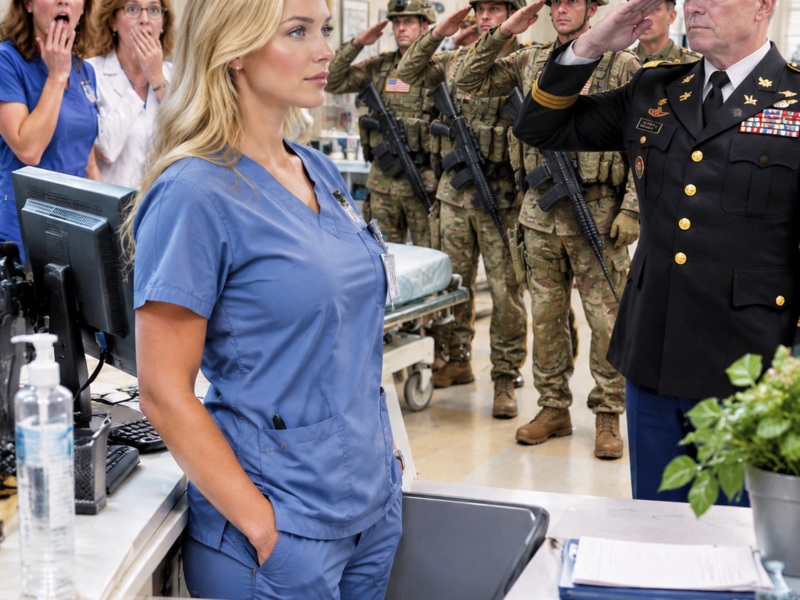
“During my third night in a row being told to wait in the corner of a rural emergency room, a young nurse rolled her eyes and said
“Not until we know who’s been hiding the truth all these years.”
Colonel Whitmore’s words stayed between us.
I looked down at the photograph again.
My younger self stood beside six soldiers, her dark hair tucked beneath a military cap, her uniform pressed neatly, and her expression far more confident than I remembered.
My husband, Thomas, stood to my left.
He was smiling.
I hadn’t seen that particular smile in years.
But the handwriting on the back belonged to Captain Michael Reeves, the man officially declared dead in 1987.
I knew because I had kept one of his letters in a wooden box in my bedroom for almost forty years.
“Where did you get this?” I asked.
Colonel Whitmore pulled a chair closer.
“From a military archive. It was attached to a file that had been sealed for decades.”
“Why?”
“That’s what I’ve been trying to establish.”
Madison was still standing nearby, holding her clipboard.
Her earlier impatience had disappeared.
The emergency room doctor, a broad-shouldered man with gray hair, approached us.
“I’m Dr. Harris. Colonel, I don’t know what this is about, but Mrs. Hayes is a patient. We need to address her symptoms.”
Whitmore immediately stepped aside.
“You’re right, Doctor. She’s been reporting chest pain and dizziness. She needs medical attention.”
Dr. Harris turned to me.
“Mrs. Hayes, let’s get you into an examination room.”
For the first time that evening, someone seemed genuinely interested in listening.
A nurse brought a wheelchair.
As they wheeled me away, I saw Madison lower her eyes.
I didn’t feel satisfied.
I only felt tired.
The doctor ordered an EKG, blood tests, and a cardiac evaluation.
Within twenty minutes, he returned with a serious expression.
“Mrs. Hayes, your heart rhythm is abnormal. Your blood pressure is also concerning. We’re admitting you for observation, and I want a cardiologist to examine you tonight.”
I nodded.
Then I looked toward the doorway.
Colonel Whitmore was waiting outside.
“Can he come in?” I asked.
Dr. Harris glanced at him.
“If you want him here, that’s fine.”
When the colonel entered, he removed his cap and sat beside my bed.
For a moment, neither of us spoke.
Then I asked the question I had been avoiding.
“What happened to Michael Reeves?”
Whitmore folded his hands.
“Before I answer, I need to explain something about Fort Campbell.”
I waited.
“In 1987, there was a medical evacuation exercise involving a small group of soldiers and military medical personnel. The exercise was supposed to simulate a transport emergency.”
“I remember.”
“During that operation, a transport vehicle disappeared from the scheduled route. Several hours later, military command received a report that there had been an accident.”
I frowned.
“An accident?”
“That’s what the official report said.”
He paused.
“But the report was incomplete.”
I looked at the photograph.
“Michael was on that vehicle?”
“Yes.”
“And Thomas?”
Whitmore nodded.
My fingers tightened around the blanket.
“My husband told me Michael died during a training accident.”
“That’s what the Army told everyone.”
“Was he lying?”
The colonel didn’t answer immediately.
That hesitation hurt more than I expected.
“I don’t know how much your husband knew,” he finally said. “But I know he spent years trying to correct the official record.”
I stared at him.
“Thomas never mentioned that.”
“There’s a reason he may not have.”
He reached into his briefcase and removed a thin folder.
Inside were copies of old military documents, some with blacked-out sections.
One page contained a list of names.
My name was there.
ELEANOR HAYES — MEDICAL OPERATIONS.
Thomas’s name appeared beneath it.
And next to Michael Reeves’s name was a handwritten note.
STATUS UNCONFIRMED.
I read it twice.
“Why would they write that if he was dead?”
“Because nobody could establish that he had died.”
I looked at Whitmore.
“Then why was his family told he was dead?”
“That is the question.”
He opened another page.
It contained a letter dated three months after the incident.
The signature at the bottom belonged to Thomas.
I recognized his handwriting immediately.
My husband had written:
I cannot allow this matter to disappear. The transport record does not match the official timeline. Someone changed the destination after the evacuation was approved.
I felt the room tilt slightly.
The colonel noticed.
“Are you all right?”
I shook my head.
“Keep going.”
He explained that the original transport had been scheduled to take three injured personnel to a military medical facility.
However, the vehicle had been redirected to a smaller installation outside the approved route.
The driver later reported that he had been ordered to change course.
That order had never appeared in the final investigation.
“Who gave the order?” I asked.
Whitmore turned another page.
“The name is missing.”
I looked at him.
“How convenient.”
He gave a tired smile.
“That’s why I wanted to find you.”
I didn’t understand.
“Why me?”
“Because you were the medical officer assigned to the original evacuation team.”
The words landed heavily.
For years, I had tried to convince myself that those days belonged to another person.
A young woman who wore combat boots, carried medical supplies, and knew how to remain calm when other people were frightened.
I had been twenty-nine.
Thomas had been thirty-one.
We were both serving at Fort Campbell.
And Michael Reeves had been our closest friend.
I remembered his terrible jokes, his habit of leaving coffee cups everywhere, and the way he always called me Doc even when I told him I wasn’t a physician.
He was the kind of man who remembered everyone’s birthday.
His daughter, Emily, had been four years old when he disappeared.
I remembered holding her little hand at the memorial service.
She kept asking when her father would come home.
Nobody had an answer.
I swallowed.
“Why are you reopening this now?”
Whitmore looked toward the window.
“Because someone recently accessed the original archive.”
“Who?”
“We don’t know.”
“And what did they find?”
He placed a final document on my blanket.
It was a photocopy of a military incident report.
The date was October 14, 1987.
My signature appeared at the bottom.
I stared at it.
Then I noticed something strange.
The signature was mine, but the sentence above it wasn’t.
I had never approved the transfer described in that document.
“I didn’t sign this.”
Whitmore leaned forward.
“Are you certain?”
“Colonel, I know my own signature.”
I pointed to the page.
“Someone copied it from another document.”
He studied the writing.
“That’s what our forensic examiner suspects.”
I looked at him.
“Then why haven’t you told anyone?”
“Because we need to establish who altered the report and why.”
He closed the folder.
“And because someone has been calling the people connected to this case.”
My mouth went dry.
“Calling them?”
“Your former colleagues. Some have received anonymous messages.”
“What kind of messages?”
“Questions about the incident. Questions about whether they still have their original paperwork.”
I looked at the photograph again.
“Has anyone else disappeared?”
Whitmore’s expression changed.
“One former transport officer died last winter. His family believes it was natural causes. I have no evidence connecting his death to this matter.”
He spoke carefully.
That was when I realized how little he was willing to tell me.
And how much he didn’t know.
I turned my face toward the window.
Outside, the hospital parking lot was nearly empty.
A pickup truck rolled slowly past the entrance.
Its headlights swept across the room.
“Colonel, I need to ask you something.”
“Go ahead.”
“Why did you salute me?”
He looked down at his hands.
Then he answered.
“Because my life began again after you refused to let me die.”
I turned toward him.
He took a breath.
“I was nineteen when I arrived at Fort Campbell. I was a young private, scared of making mistakes and convinced that everybody else knew what they were doing.”
A faint smile crossed his face.
“During one training exercise, I was injured badly enough that the doctors thought I might lose my leg.”
I remembered.
Not the injury itself, but the young soldier who kept apologizing for bleeding on the medical tent floor.
“You were there,” he said. “You stayed with me until the helicopter arrived.”
I studied his face.
“Daniel?”
He nodded.
“You remember.”
I looked closer.
The years had changed him, but I recognized the boy behind the colonel’s uniform.
“You were the one who kept asking for your mother’s telephone number.”
He laughed softly.
“That was me.”
“I thought you recovered.”
“I did. I went back to training. Eventually, I became an officer.”
His eyes grew moist.
“But I never forgot the woman who treated me like my life mattered when everybody else was worried about the schedule.”
I looked away.
I didn’t know what to say.
He stood.
“Get some rest, Mrs. Hayes. We’ll speak tomorrow.”
Before leaving, he placed his business card on the bedside table.
Then he hesitated.
“One more thing.”
I looked up.
“Have you kept anything from your husband’s military years? Letters, notebooks, photographs?”
I thought of the wooden box in my bedroom.
“There may be something.”
“Please don’t throw anything away.”
“I won’t.”
He nodded and left.
For the next two days, I remained in the hospital.
The cardiologist discovered that I had a heart rhythm disorder requiring treatment and closer monitoring.
It explained much of the dizziness and weakness I had experienced.
I was prescribed medication and given instructions to follow up with a specialist.
Madison came into my room on the morning of my discharge.
She stood beside the bed, holding a folder.
“I owe you an apology,” she said.
I looked at her.
She seemed uncomfortable.
“I read your previous visits. I saw the notes about your symptoms, and I should have taken them more seriously.”
I waited.
She lowered her voice.
“I thought you were exaggerating because you were anxious.”
“Why?”
She glanced at the floor.
“I don’t know. I guess I made assumptions.”
I watched her for a moment.
Then I said, “The next person who tells you their chest hurts may not get another chance to explain.”
Her eyes filled slightly.
“I understand.”
I didn’t tell her it was all right.
It wasn’t.
But I accepted her apology.
Outside, Colonel Whitmore was waiting beside a dark SUV.
He drove me home.
The autumn trees along Cedar Lane had begun turning orange and gold.
When we reached my farmhouse, he carried my bag inside and placed it near the stairs.
I looked around the living room.
Thomas’s old reading glasses were still on the side table.
His favorite blue sweater hung over the back of the chair.
I had never been able to bring myself to move it.
“Would you like some coffee?” I asked.
“Only if you’re having some.”
I went into the kitchen.
While the coffee brewed, I climbed the stairs slowly and retrieved the wooden box from the back of my closet.
It was an old cedar box with a brass latch.
Thomas had given it to me on our twentieth anniversary.
I carried it downstairs.
The colonel stood when he saw it.
“Is that everything?”
“Almost.”
I opened the lid.
Inside were letters, military photographs, a few service medals, and a small leather notebook.
I had not opened that notebook since Thomas’s funeral.
It had belonged to him.
The leather was cracked at the corners.
I placed it on the table.
Whitmore looked at the notebook without touching it.
“May I?”
I nodded.
He opened the first few pages.
Most contained ordinary notes about schedules, supply orders, and medical inventory.
Then he reached a page dated October 13, 1987.
He stopped.
“What is it?” I asked.
He turned the notebook toward me.
Thomas had written:
Michael is alive. I saw him after the transport was redirected. He was being held at the secondary facility. I was ordered not to report the sighting.
My fingers went numb.
I read the sentence again.
Then again.
The next page contained another entry.
If anything happens to me, Eleanor must never be blamed for the transfer. Her signature was taken from the medical log without her permission.
I looked up.
“Why would he write that?”
Whitmore shook his head.
“I don’t know.”
I turned another page.
The writing became hurried.
Someone has copies of the original route authorization. Michael tried to send one home before he was moved. I believe the person responsible is still in a position to destroy the evidence.
There was no name.
Only a short line beneath it.
I have to find him before they make Eleanor part of this.
I closed the notebook.
My husband had spent years carrying something I knew nothing about.
And he had done it while sitting across from me at breakfast, asking whether I wanted more toast.
I remembered the last winter of his life.
He had become quieter.
Sometimes he would wake in the middle of the night and walk downstairs.
I used to find him sitting at the kitchen table with a cup of cold coffee.
When I asked what was wrong, he always said the same thing.
“Just old memories, Ellie.”
I had believed him.
Now I wondered how many times he had wanted to tell me the truth.
The following morning, Colonel Whitmore returned with a woman named Sarah Mitchell.
She was an Army investigator assigned to review the historical records.
She carried a laptop and a folder of documents.
After introductions, she placed a printed photograph on my kitchen table.
It showed a small military building with a faded sign.
“Do you recognize this location?” she asked.
I leaned closer.
“That’s the secondary medical facility.”
“Do you remember anything about the night of October 14?”
I closed my eyes.
At first, all I could remember was rain.
Then the sound of a vehicle engine.
The smell of diesel fuel.
And Thomas standing outside the medical tent, speaking to a man in uniform.
I opened my eyes.
“Someone came to the tent that night.”
Sarah leaned forward.
“Who?”
“I don’t know his name. He wasn’t part of our regular medical team. He wore a dark green jacket and carried a folder.”
“What did he say?”
I searched my memory.
“He asked whether the transfer papers were ready.”
“Which papers?”
“The ones for the injured soldiers.”
Sarah exchanged a glance with Whitmore.
I continued.
“I told him I hadn’t received an authorization. He became irritated and said the order had already been approved.”
“Did you sign anything?”
“No.”
“Are you certain?”
I nodded.
“I refused. Thomas was there. He told the man to leave.”
Whitmore’s face tightened.
“Did you see where he went?”
“He walked toward the transport vehicles.”
I closed my eyes again.
There was another memory.
Something small.
Something I had forgotten.
“He had a ring.”
Sarah looked up.
“What kind of ring?”
“Silver. A square face. There was a little blue stone in the middle.”
Whitmore went still.
Sarah noticed.
“Colonel?”
He looked at me.
“Did you see that ring clearly?”
“Yes.”
“Do you remember anything else about the man?”
I shook my head.
“Not his face. Only the ring.”
Sarah opened her laptop.
She showed me several old photographs of personnel connected to the facility.
I studied them carefully.
Most of the faces were unfamiliar.
Then I reached the last photograph.
A senior officer stood beside a military vehicle.
His uniform was immaculate.
His expression was stern.
And on his right hand was a silver ring with a square blue stone.
I felt the coffee cup tremble against my fingers.
I knew that face.
Not because I had seen him at Fort Campbell.
Because I had seen him much more recently.
“That’s impossible,” I whispered.
Sarah turned the laptop toward me.
“Who is he?”
I pointed at the photograph.
“General Richard Caldwell.”
Whitmore looked at Sarah.
She slowly closed the laptop.
Caldwell had retired years earlier, but he had remained influential in military circles.
He was the man who had delivered the eulogy at Thomas’s funeral.
He had stood beside me afterward and told me that my husband had served with extraordinary honor.
He had even visited my farmhouse twice after I moved to Millbrook.
The last time was only four months ago.
I remembered him sitting in Thomas’s old chair, drinking coffee and asking whether I still had any of my husband’s papers.
At the time, I had thought it was an ordinary gesture of concern.
Now I remembered that he had looked toward the closet where the cedar box was stored.
I looked at Whitmore.
“Are you telling me that General Caldwell knew what happened to Michael?”
“I don’t know yet,” he replied.
“But the records suggest he may have been involved in the unauthorized transfer.”
I stood.
“Then why was he at my husband’s funeral?”
Neither of them answered.
The next week was a blur of interviews, phone calls, and old memories returning at inconvenient moments.
Sarah asked me to write down everything I could remember about the night of the transport.
I spent hours at the kitchen table.
Sometimes I remembered a voice.
Sometimes a uniform.
Sometimes nothing at all.
Then, on Friday afternoon, Colonel Whitmore called.
“We found something,” he said.
“What?”
“The original route authorization.”
I sat down.
“Where?”
“It was stored in a separate archive under a different incident number.”
“Does it have the name?”
“Yes.”
I waited.
“The order was signed by General Caldwell.”
I closed my eyes.
For a few seconds, I couldn’t speak.
“Was Michael alive?”
Whitmore took a breath.
“The original medical log indicates he arrived at the secondary facility alive.”
I pressed a hand against my mouth.
“And after that?”
“There’s no official departure record.”
I stared at the kitchen wall.
“Then where did he go?”
“We’re working on that.”
I wanted to be angry.
I wanted to scream at someone.
But all I could think about was Emily Reeves.
She had grown up without a father because a group of men had decided that a missing soldier was easier to explain than a compromised operation.
“Have you contacted his daughter?” I asked.
“Not yet. We wanted to verify the record first.”
“Then you need to find her.”
“We will.”
“No, Colonel. You need to find her now.”
He was silent.
I continued.
“She deserves to know that her father may not have died when they told her he did.”
“I understand.”
“Do you?”
My voice cracked.
“Because I held that little girl at her father’s memorial. I watched her put a drawing inside his coffin. She drew him holding her hand.”
Whitmore didn’t interrupt.
“And I went home and cooked dinner with Thomas as though the world hadn’t just taken a father away from his child.”
I wiped my eyes.
“Find her.”
He promised he would.
That evening, I took Thomas’s notebook into the living room.
I sat in his chair.
For the first time since his funeral, I allowed myself to be angry with him.
Not because he had tried to protect me.
But because he had made that decision without giving me the chance to stand beside him.
I turned to the last page.
There was a small envelope tucked inside the back cover.
My name was written across it.
Eleanor.
My hands began to shake.
The envelope had been sealed.
I carefully opened it.
Inside was a single letter.
Ellie,
If you’re reading this, then someone finally found the records I couldn’t recover.
I wanted to tell you everything.
More times than I can count.
But every time I tried, I remembered how frightened Michael’s little girl was at the memorial. I knew someone had already changed the story once. I was afraid that telling you would put you in danger.
I also knew you would never have accepted silence if you understood what was happening.
I looked at the next paragraph.
I made mistakes. I trusted the wrong people, and when Michael disappeared, I believed the official report for longer than I should have.
I am sorry for that.
But there is one thing I need you to understand.
You did nothing wrong.
They used your medical signature because they knew you would never approve that transfer.
I turned the page.
If I could go back, I would tell you the truth before we ever left Fort Campbell.
You deserved that much.
I pressed the letter against my chest.
At the bottom, Thomas had written one final sentence.
Michael’s daughter is the only person who can decide what happens when the truth comes out.
I read it several times.
Then my telephone rang.
It was Colonel Whitmore.
“We found Emily,” he said.
I sat up.
“Where is she?”
“She lives in Nashville. She’s fifty-three now.”
I closed my eyes.
“Does she know?”
“Not yet.”
“Can I speak to her?”
There was a pause.
“I think she should hear it from someone who knew her father.”
I looked at Thomas’s letter.
“I knew him.”
Whitmore gave me her number.
I stared at it for several minutes before dialing.
A woman answered on the fourth ring.
“Hello?”
I opened my mouth, but nothing came out.
“Hello?”
“My name is Eleanor Hayes.”
The line went quiet.
Then I heard a breath.
“Mrs. Hayes?”
“Yes.”
“My mother told me about you.”
I swallowed.
“I remember you when you were little.”
She laughed faintly, but there was sadness in it.
“I remember you bringing me a stuffed rabbit at the memorial service.”
I covered my eyes.
“I remember.”
We spoke for almost an hour.
I told her about the transport record, the medical log, and the investigation.
I didn’t promise that her father was alive.
I didn’t offer hope I couldn’t support.
I only told her what we knew.
At the end, she asked one question.
“Did he know I was waiting for him?”
I couldn’t answer immediately.
Then I said, “I believe he did.”
She began to cry.
I stayed on the phone until her breathing settled.
Before we hung up, she said she wanted to meet.
Three days later, Emily arrived at my farmhouse.
She was a tall woman with brown hair and a small scar near her chin.
She carried a photograph of her father in a frame.
When I opened the door, she looked at me for a long moment.
Then she said, “I don’t know whether I should hug you or ask you why nobody told me.”
I stepped aside.
“You can do both.”
She laughed through her tears.
We sat at the kitchen table.
I made coffee.
She placed the photograph between us.
“Mom said he was a hero,” she said.
“He was.”
“Then why did everyone stop looking?”
I looked down at my hands.
“Because the people who were supposed to protect the truth failed him.”
She nodded slowly.
I told her about the drawing she had placed in the coffin.
She remembered making it.
“I thought he’d see it wherever he was.”
I reached across the table and touched her hand.
“I think he would have wanted to.”
For the first time, I felt that something inside me had finally begun to move.
Not because the past was repaired.
It wasn’t.
But because Emily no longer had to carry the story she had been given without question.
The investigation continued for several months.
General Caldwell was contacted by Army investigators.
He initially denied authorizing any unauthorized transfer.
However, the original routing documents, the altered medical report, and the testimony of former personnel contradicted his statement.
A formal review eventually established that he had approved the redirection of the transport.
He had also signed off on a report that falsely classified Michael as deceased before his status had been verified.
The investigation did not establish that Caldwell had ordered Michael’s death.
It did establish that he had concealed the unauthorized transfer and allowed a false official account to stand for decades.
When confronted with the documents, he claimed he had been following orders from a superior whose identity could no longer be established.
That explanation did not erase his responsibility.
He was stripped of his remaining honorary military appointments, and the Army issued a public correction to the historical record.
The correction came thirty-nine years too late.
But it came.
Michael Reeves’s status was changed from deceased to missing in action pending further investigation.
A separate search located a retired civilian records clerk who had worked at the secondary facility.
She remembered a young soldier being transferred under an assumed administrative designation.
She could not establish what happened afterward.
No grave was found.
No verified record of his final days surfaced.
And no one could honestly tell Emily whether her father had survived.
That uncertainty became the hardest part of the truth.
One afternoon, she came to my house carrying the same framed photograph.
“I used to think I needed to know exactly how he died,” she said.
“Now I think I need to know that people finally stopped pretending they knew.”
I nodded.
She looked toward the window.
“I spent thirty years thinking he had died in an accident. I was angry at him for not coming home, even though I knew it wasn’t his fault.”
Her voice broke.
“I don’t know what to do with all that time.”
I stood and walked around the table.
Neither of us tried to make the pain sound smaller.
I simply held her.
The following spring, Colonel Whitmore invited me to a small ceremony at Fort Campbell.
I nearly refused.
I had spent decades avoiding military buildings, ceremonies, and the sound of marching boots.
But Emily asked if she could come with me.
So I agreed.
The ceremony was modest.
A few officers, several retired soldiers, and families connected to the original incident gathered in a quiet room.
A corrected service record for Michael was presented to his daughter.
There were no grand speeches about glory.
There were only facts, names, and apologies.
Colonel Whitmore stood at the front.
He spoke about the importance of preserving accurate records and honoring those whose stories had been overlooked.
Then he turned toward me.
“Thirty-nine years ago, Sergeant Eleanor Hayes refused to approve a transfer she believed was unsafe. Her signature was later misused to support an order she never authorized.”
I stared at the floor.
He continued.
“Her actions were not a failure of duty. They were an example of it.”
When he finished, he stepped toward me.
And again, he saluted.
This time, I didn’t ask him to stop.
I returned the salute as best I could, my hand trembling slightly.
Emily stood beside me.
She was crying.
After the ceremony, we walked outside.
The air smelled of wet grass and fresh rain.
Colonel Whitmore approached us.
“Mrs. Hayes, I owe you something.”
I looked at him.
“What?”
“Thank you.”
I shook my head.
“You don’t owe me that.”
“I do. You reminded me why I wanted to serve in the first place.”
He smiled.
“Not because of medals or titles. Because somebody has to make sure the people without power aren’t forgotten.”
I looked at Emily.
She was holding her father’s corrected service record against her chest.
For the first time, she wasn’t holding a memorial program or a story about an accident.
She was holding the truth.
When I returned home, I placed Thomas’s letter back inside the cedar box.
I kept his wedding ring on the table beside it.
For a long time, I had thought that loving someone meant protecting the version of them I wanted to remember.
Now I understood that love could also mean accepting the truth, even when it made grief more complicated.
I still missed Thomas.
I missed the man who made terrible coffee, forgot where he put his reading glasses, and sang off-key while washing dishes.
I also knew he had made a choice that hurt me.
Both things were true.
And I no longer needed to pretend otherwise.
A few weeks later, I returned to Millbrook County Hospital for a follow-up appointment.
Madison was at the reception desk.
She recognized me immediately.
“Mrs. Hayes. How are you feeling?”
“Better, thank you.”
She smiled.
Then she looked at my wrist, where the hospital band had been during that terrible night.
“I’ve thought about what happened,” she said.
“I hope you have.”
She nodded.
“I have.”
I was about to walk away when she added, “I started listening differently.”
I stopped.
“That’s good.”
She looked down at the paperwork in her hands.
“I can’t change how I treated you. But I can make sure I don’t do it again.”
I gave her a small nod.
“Then start with the next person who walks through those doors.”
She smiled, and this time, it reached her eyes.
As I stepped outside, my phone buzzed.
It was a message from Emily.
She had attached a photograph of a small garden she had planted in her backyard.
In the center stood a wooden plaque.
MICHAEL REEVES
A FATHER WHO WAS LOVED
A MAN WHO WAS NOT FORGOTTEN
Beneath it, she had written:
“I don’t know where Dad’s story ends, Ellie. But I finally know where the truth begins.”
I stood beside my car for a long time, reading those words.
Then I looked up at the clear Kentucky sky.
I had spent years believing that silence was the kindest thing I could leave behind.
But silence had never protected the people I loved.
It had only given the truth more time to disappear.
That evening, I opened the curtains in the living room and moved Thomas’s blue sweater from the back of his chair.
I folded it carefully and placed it in the cedar box.
Not because I wanted to forget him.
Because I was finally ready to remember all of him.
The end.









