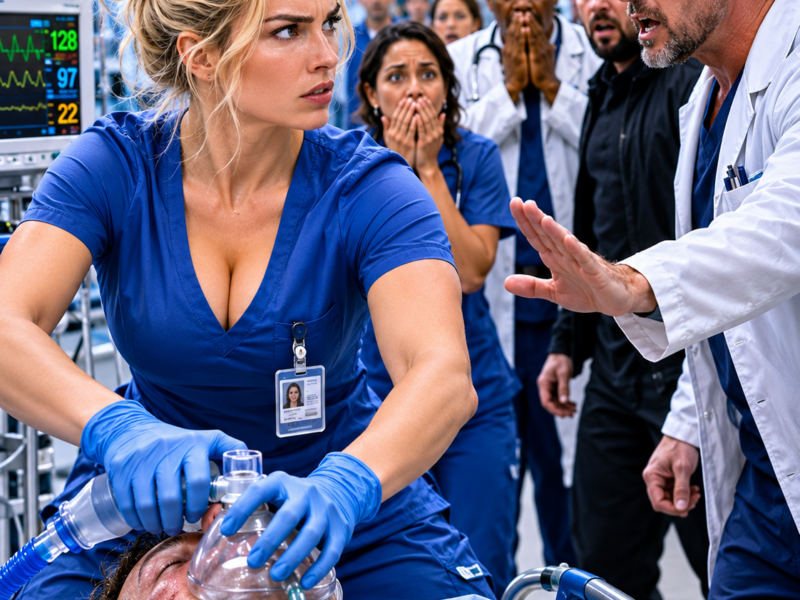
“Dr. Cobb publicly dismissed my warning about a construction worker’s breathing, then ordered me to spend four shifts counting medical supplies while the man nearly died from the injury I’d identified
I reached for the folder.
Dr. Cho didn’t let go of it immediately.
“Before you read this, Serena, I want you to understand something. I didn’t call you in here to accuse you of anything.”
“Then why does it feel like I’m about to be questioned?”
She gave a tired smile.
“Because you’re observant.”
She released the folder.
I opened it to the page she’d marked.
The first document was a clinical incident report concerning the construction worker from my first week.
His name was Thomas Reed.
Forty-six years old. Married. Two children. Employed by a commercial roofing company.
I’d remembered his face because he had apologized repeatedly for taking up space in the emergency department.
The report described how his condition had deteriorated after he was moved to a standard treatment bay.
A tension pneumothorax had developed, requiring emergency intervention and admission to the trauma unit.
He had survived, but his recovery had been complicated.
I turned the page.
There was a second document.
An internal review conducted by the hospital’s quality assurance department.
It contained a timeline of my initial assessment, Dr. Cobb’s decision to downgrade the patient’s priority, and the subsequent deterioration.
At the bottom was a handwritten note.
“Initial warning documented by Nurse Serena Valk. Recommendation not followed.”
I looked up.
“What’s the problem?”
Dr. Cho took a breath.
“The problem is that this wasn’t the first time.”
She turned her monitor toward me.
A list of incidents appeared on the screen.
There were seven.
Seven patients over the previous eleven months whose conditions had deteriorated after their initial triage classifications had been lowered.
In three cases, nurses had documented concerns that were never addressed.
In two cases, residents had requested higher levels of monitoring.
One patient had required emergency surgery after being left in an observation area.
Another had suffered a cardiac arrest.
I read through the reports.
My stomach tightened.
“Are these all under Dr. Cobb’s supervision?”
“Yes.”
“Did anyone investigate?”
“Several cases were reviewed individually. None triggered a comprehensive departmental audit.”
“Why?”
Dr. Cho looked toward the window.
“Because the documentation was incomplete, because the patients survived, because staffing pressures complicated the reviews, and because people trusted Dr. Cobb’s judgment.”
I closed the folder.
“That’s not an answer.”
“No,” she said quietly. “It isn’t.”
She explained that the Army liaison had originally contacted the hospital because of the Meridian incident.
He had been asked to verify portions of my service history and assess whether my training was relevant to emergency department operations.
During that process, he had spoken with someone familiar with the hospital’s previous quality reviews.
That person had mentioned a pattern of concerns about triage decisions.
The liaison hadn’t accused anyone.
He had simply recommended that the hospital examine its own records.
Dr. Cho had done so.
And what she found troubled her.
“Why are you telling me this?” I asked.
“Because you’re being offered a leadership position, and I don’t want you accepting it without knowing what you’re walking into.”
I looked again at the promotion letter.
Trauma Triage Clinical Lead.
It was the kind of position I’d never imagined wanting.
“I’ll need access to the complete reports,” I said.
“You’ll have it.”
“And I want the review conducted independently.”
Dr. Cho nodded.
“Agreed.”
“Nobody should be disciplined based on a spreadsheet. I want the actual patient records, the staffing circumstances, the decisions, and the people involved.”
“That’s reasonable.”
I folded the promotion letter.
“But if the system is failing, changing my job title won’t fix it.”
Dr. Cho watched me for a moment.
“That’s why I think you’re the right person.”
I didn’t answer immediately.
I thought about the men I’d treated overseas.
I thought about the four patients who had survived the Meridian incident because someone had noticed the warning signs before they became obvious.
Then I thought about Thomas Reed.
He had come into the hospital asking for help.
He hadn’t needed a heroic rescue.
He had needed someone to listen.
“All right,” I said. “I’ll accept the position.”
Dr. Cho extended her hand.
“Welcome to the leadership team, Serena.”
I shook it.
“But I have one condition.”
“What’s that?”
“The nurses need to be able to raise concerns without worrying about being humiliated or punished.”
Her expression softened.
“That condition should have been part of the job description.”
I found Dr. Cobb outside the physician workroom that afternoon.
He was reviewing laboratory results on his tablet.
When he noticed me, he lowered it.
“Congratulations,” he said.
The words were polite.
His expression wasn’t.
“I heard about the promotion.”
“Thank you.”
“Quite a jump for someone who’s been here three weeks.”
I stopped beside him.
“Dr. Cho believes the department needs a different approach to mass casualty triage.”
“And apparently, she believes you can provide it.”
“I hope I can.”
He studied me.
“You’re going to find that leading a department is different from treating a few patients correctly.”
“I know.”
“Protocols exist for a reason, Ms. Valk. You can’t run an emergency department based on instinct.”
“I agree.”
He seemed surprised by that answer.
I continued.
“But protocols should help us recognize danger, not prevent us from responding when the circumstances change.”
His jaw tightened.
“That’s a very convenient philosophy.”
I looked at him.
“Thomas Reed is still recovering.”
For a moment, he said nothing.
Then he looked away.
“I know about Mr. Reed.”
“His initial assessment documented signs of a developing pneumothorax.”
“I reviewed the case.”
“And?”
He exhaled.
“The department was overwhelmed that morning.”
“I understand.”
“We had limited trauma beds.”
“I understand that too.”
He turned toward me.
“Then you should understand why I made the decision I did.”
I nodded slowly.
“I understand the pressure. I don’t understand dismissing a documented concern without reassessing the patient.”
His eyes narrowed.
“Are you suggesting I don’t care about my patients?”
“No.”
I held his gaze.
“I’m suggesting that being responsible for a department means being willing to examine what happens when your decisions are wrong.”
He didn’t respond.
I continued down the hallway.
I wasn’t trying to win an argument.
I had learned a long time ago that an argument could consume an entire day without helping a single patient.
The records would tell us more than either of us could.
My first official week as clinical lead was harder than I expected.
Not because the medical work was unfamiliar.
Because changing a system meant dealing with people who had spent years learning how to survive inside it.
Some nurses welcomed me immediately.
Others were cautious.
A few residents seemed convinced that my appointment meant they would now be taking orders from someone with less civilian experience than they had.
I didn’t blame them.
I had seen what happened when leadership changed without explanation.
So I started with conversations.
I met individually with the nurses, residents, respiratory therapists, paramedics, and support staff.
I asked them the same question.
“What is one thing that makes it harder for you to recognize a patient who is getting worse?”
The answers were revealing.
One nurse told me that reassessment intervals were often missed during crowded shifts.
A respiratory therapist said airway concerns were sometimes treated as secondary unless oxygen saturation had already fallen.
A resident admitted that people hesitated to challenge senior physicians, even when they believed something was wrong.
Paulette was particularly direct.
“People here know what they’re seeing,” she told me one evening.
“They just don’t always feel safe saying it.”
We were sitting in the break room.
Her coffee had gone cold.
“Do you think that will change because I have a new title?”
She looked at me.
“No.”
I smiled faintly.
“Honest.”
“You’ll need to prove it.”
She was right.
I began by creating a simple escalation process.
Any nurse or clinician could request an immediate reassessment when a patient’s condition or presentation didn’t match the assigned triage category.
The request had to be acknowledged.
If the disagreement remained unresolved, the concern went to the designated second reviewer.
Nobody could dismiss it simply because the person raising it was junior.
We also began rewriting the mass casualty protocol.
The old version treated structural collapse, chemical exposure, and burn injuries as separate categories.
Meridian had demonstrated that real emergencies didn’t respect those divisions.
We added procedures for combined exposure events, early airway evaluation, decontamination, and coordination with regional Hazmat teams.
We also established clearer reassessment intervals for patients whose initial vital signs appeared reassuring despite concerning mechanisms of injury.
It was slow work.
But the department began to change.
Then, on Thursday afternoon, I received a phone call from the hospital’s patient relations office.
A woman named Margaret Reed wanted to speak with me.
She was Thomas Reed’s wife.
I met her in a small consultation room near the outpatient entrance.
She was in her early forties and carried a folder of medical paperwork.
“Thank you for seeing me,” she said.
“Of course.”
She placed the folder on the table.
“I wanted to ask you something about my husband.”
I waited.
“He remembers you.”
I looked at her.
“He does?”
“Yes. He says you’re the nurse who kept coming back to check on him when he was waiting in that regular bay.”
I nodded.
“I was concerned about his breathing.”
She looked down at the folder.
“He’s been home for two weeks, but he’s still having trouble sleeping. Sometimes he wakes up feeling like he can’t breathe.”
“I’m sorry.”
“He’s angry too.”
I didn’t interrupt.
“Not at you,” she continued. “At himself. He keeps saying he should have known something was wrong.”
I leaned forward.
“Thomas didn’t do anything wrong.”
Margaret looked at me.
“He says he should’ve insisted on seeing a doctor sooner.”
“He came to the hospital because he knew something wasn’t right. That’s exactly what he should have done.”
She nodded slowly.
Then she pulled a folded piece of paper from her folder.
“This was in his discharge paperwork.”
I opened it.
It was a copy of the original triage assessment.
My handwritten notes were visible.
Shallow respirations.
Left-sided chest discomfort.
Reduced breath sounds.
Urgent reassessment recommended.
Beneath them was the physician’s note.
Routine musculoskeletal presentation.
No immediate trauma activation indicated.
Margaret pointed toward the second line.
“Can you explain this?”
I looked at her.
“I can explain what I observed. I can’t discuss another clinician’s personnel review.”
She nodded.
“I understand.”
Then she said something I hadn’t expected.
“I don’t want anyone fired just because my husband got hurt.”
I watched her carefully.
“I want to know that the next person who comes in with the same symptoms won’t be ignored.”
There it was.
The reason I had accepted the position.
Not the promotion.
Not the recognition.
Not the opportunity to prove Dr. Cobb wrong.
A woman wanted to know that the hospital would listen the next time.
“I can’t promise that mistakes will never happen,” I said. “But I can promise that we’re changing how concerns are handled.”
Margaret folded her hands.
“That’s all I wanted to hear.”
Before she left, she gave me a small photograph.
Thomas was sitting in a chair on their back porch.
He looked thinner than I remembered, but he was smiling.
On the back, he had written:
“Still breathing. Thanks for noticing.”
I kept the photograph.
The independent review began two weeks later.
Dr. Cho appointed a committee that included an emergency physician from another hospital, a nursing quality specialist, and a patient safety officer.
I was asked to provide my observations and documentation.
Dr. Cobb was also asked to participate.
He attended the first meeting with a thick folder and the defensive posture of a man who believed he was about to be judged by people who didn’t understand his workload.
The committee reviewed every identified case.
They examined staffing levels, bed availability, physician assignments, and the original clinical notes.
They also interviewed the nurses who had raised concerns.
Some of the interviews were uncomfortable.
One nurse described being told she was “creating drama” after requesting a reassessment for an elderly patient.
Another admitted that she had stopped escalating concerns because she didn’t want to be labeled difficult.
Dr. Cobb listened without interrupting.
At the end of the meeting, he looked exhausted.
“I didn’t realize people felt that way,” he said.
Paulette, who had attended as a witness, spoke quietly.
“People told you, Warren.”
He looked at her.
“Maybe I didn’t hear them.”
Nobody answered.
The committee’s preliminary findings were delivered the following Monday.
There was no evidence that Dr. Cobb had deliberately harmed patients or falsified records.
However, the review found repeated failures in reassessment, poor escalation practices, and an institutional culture in which junior staff sometimes hesitated to challenge senior decisions.
Several of the triage decisions had been clinically inappropriate.
The report also noted that the original protocol had not been updated sufficiently to account for the department’s changing patient population.
Dr. Cobb was placed under a formal performance improvement plan.
He would receive additional training in triage oversight, communication, and patient safety.
His role as chief of emergency medicine would be reviewed after ninety days.
Some people thought the consequences were too lenient.
Others thought they were too severe.
I didn’t celebrate.
A report couldn’t give patients back the hours they’d spent deteriorating in hospital beds.
But it could prevent the same mistakes from becoming routine.
That was enough to begin.
Three days after the report was released, Dr. Cobb asked to meet with me.
I found him in the empty conference room.
He was sitting beside the window with a cup of coffee.
He looked older than he had a month earlier.
“Sit down, Serena.”
I took the chair opposite him.
He placed a document on the table.
It was his original triage protocol.
The one he’d designed fifteen years earlier.
“I built this when the department had half the volume it has now,” he said.
“I know.”
“At the time, it was considered innovative.”
“It probably was.”
He turned the pages slowly.
“I’ve spent a lot of years believing that the system worked because I understood it better than anyone else.”
He stopped at a section covering respiratory presentations.
“Somewhere along the way, I stopped asking whether the system was still working.”
I said nothing.
He looked at me.
“When you warned me about Thomas Reed, I thought you were trying to show off.”
“I wasn’t.”
“I know that now.”
He rubbed his forehead.
“I was embarrassed. You were new, and you were challenging a decision I’d made in front of two residents.”
I considered that.
“That doesn’t make it acceptable.”
“No.”
He nodded.
“It doesn’t.”
For the first time since I’d met him, he wasn’t trying to defend himself.
“I owe you an apology.”
I looked at the man who had assigned me four shifts of inventory because I had recognized a dangerous injury.
“Thank you.”
He leaned back.
“Do you think I can come back from this?”
It was an unexpected question.
I took a moment before answering.
“That depends on what you do next.”
He looked toward the window.
“I’ve been a physician for thirty years. I don’t know how to work in a department where people question every decision I make.”
“Neither do I.”
He glanced at me.
“I thought you knew everything.”
I almost laughed.
“No, Dr. Cobb. I just learned a long time ago that the moment you think you know everything is usually the moment you stop noticing what matters.”
He looked down at the protocol.
“Will you help me revise this?”
I studied him.
“Yes.”
He seemed surprised.
“Even after everything?”
“Especially after everything. But the nurses who raised concerns need to be part of the process.”
He nodded.
“Agreed.”
We spent the next hour reviewing the old protocol.
It wasn’t a reconciliation.
Not yet.
But it was the first conversation we’d had that wasn’t about who had authority over whom.
And that mattered.
The following month brought another emergency.
At 6:18 on a Friday evening, an ambulance called ahead with a report of a serious highway collision.
A minivan had been struck by a commercial truck.
Three passengers were injured.
One was a child.
The emergency department began preparing before the ambulance arrived.
This time, the triage team used the revised escalation process.
Paulette coordinated the incoming reports.
A resident prepared the airway equipment.
Dr. Cobb reviewed the trauma assignments.
I stood beside the central monitor, watching the incoming vital signs.
The first patient arrived.
A woman in her thirties with multiple fractures.
The second was a teenage boy with a head injury.
The third was an eight-year-old girl named Lily.
She was conscious but frightened, with a significant chest injury.
The paramedic reported that her initial oxygen saturation had been acceptable.
But her breathing pattern concerned me.
I leaned toward the stretcher.
“Lily, can you tell me where it hurts?”
She pointed toward her left side.
Her voice was faint.
I listened to her chest.
The breath sounds were unequal.
“She’s priority one,” I said. “I need immediate trauma evaluation.”
Dr. Cobb was standing beside me.
He looked at the monitor.
Then at Lily.
“Agreed,” he said.
He turned toward the resident.
“Prepare for immediate imaging and respiratory support. Don’t wait for her numbers to deteriorate.”
The resident moved.
I glanced at Cobb.
He caught my eye.
For a moment, neither of us spoke.
Then he said quietly, “Good catch.”
It was a small sentence.
But it carried something I hadn’t heard from him before.
Respect without qualification.
Lily’s injury was serious, but the trauma team identified it quickly and treated her before her breathing deteriorated further.
Her parents arrived shortly afterward.
Her mother was crying.
Her father kept asking whether she would be all right.
I stood beside them while the physician explained the treatment plan.
When they were finally allowed into the room, Lily reached for her mother’s hand.
I stepped into the hallway.
Dr. Cobb was there.
He watched the family through the glass.
“That’s why we do this,” he said.
I nodded.
“Yes.”
He turned toward me.
“I’ve been thinking about something you said.”
“Which part?”
“About knowing everything.”
He gave a small, tired smile.
“I think I might have confused being experienced with being right.”
I looked back toward Lily’s room.
“Experience is useful, Dr. Cobb. But it doesn’t replace paying attention.”
He nodded.
Then he returned to the department.
By the end of the ninety-day review, the changes were becoming visible.
The new escalation process had been used dozens of times.
Some concerns turned out to be false alarms.
Others led to earlier imaging, additional monitoring, or immediate treatment.
Nobody was punished for requesting a second assessment in good faith.
The mass casualty protocol had been updated and tested in a full departmental simulation.
We invited paramedics from surrounding counties to participate.
We also created a quarterly review of serious triage discrepancies.
Dr. Cobb completed his improvement plan and remained in emergency medicine, although his administrative responsibilities were adjusted.
He no longer controlled every triage decision.
He became more willing to listen.
Not perfectly.
Nobody changes perfectly.
But the department was better.
And that was what mattered.
One afternoon, Dr. Cho called me into her office.
She handed me a small plaque.
I looked at it.
It recognized my appointment as Trauma Triage Clinical Lead.
I smiled.
“Thank you.”
“You’ve done good work.”
“We’ve done good work.”
She nodded.
“I know. That’s why I wanted to give you this.”
I placed the plaque on her desk.
“Can I ask you something?”
“Of course.”
“Why did the Army liaison seem so concerned about my final deployment?”
Her expression changed slightly.
She opened a drawer and removed a sealed envelope.
“I was wondering when you’d ask.”
I recognized the military markings.
My name was printed across the front.
I stared at it.
“Where did that come from?”
“It was delivered through the appropriate military channels after your service was verified. I was told it was intended for you.”
I picked it up.
The envelope was heavier than it looked.
Inside was a formal letter and a photograph.
The photograph showed a group of soldiers standing outside a temporary medical facility in Afghanistan.
I recognized several faces.
Then I saw the man in the middle.
Sergeant David Mercer.
He had been nineteen when I’d treated him during my first deployment.
He’d arrived with a severe abdominal injury after an explosion.
I’d spent nearly two hours assisting the surgical team while he fought to stay alive.
The letter was from him.
It said he had recovered, completed his service, and recently become a father.
He had spent years trying to find a way to contact the medic who had stayed beside him.
The Army liaison had finally connected us through the appropriate channels.
At the bottom, David had written:
“Sergeant Valk, you once told me that surviving was only the first part. You said the hard part was learning what to do with the life you got back. I have a daughter now. I think I’m finally starting to understand.”
I read the sentence twice.
Then I looked at the photograph.
The reason the liaison had been so careful wasn’t because I had done something wrong.
It was because the military had been trying to protect the privacy of the people whose lives had crossed mine.
And one of them had finally found a way to say thank you.
I folded the letter.
For years, I’d believed that leaving the military meant leaving those people behind.
I was beginning to understand that the work didn’t disappear just because the uniform did.
That evening, Paulette found me at the triage desk.
She placed a cup of coffee beside my paperwork.
“Promotion coffee,” she announced.
I looked at the cup.
“Is it better than the usual?”
“Absolutely not.”
I laughed.
She pulled up a chair.
“How are you doing?”
I looked around the department.
The monitors were beeping.
A resident was explaining discharge instructions to an elderly patient.
A paramedic was restocking a trauma bag.
Dr. Cobb was helping a new nurse review a triage assessment.
Nothing extraordinary was happening.
And that was precisely what I wanted.
“I’m good,” I said.
Paulette studied me.
“Really?”
I thought about the construction worker who had nearly died.
The nineteen people from Meridian.
The frightened man named Eddie.
The little girl who had arrived after the highway collision.
I thought about David’s letter.
“I’m getting better at being here.”
Paulette smiled.
“That’s a pretty good answer.”
She stood and returned to her station.
I opened the next patient chart.
A woman in her sixties had arrived complaining of dizziness and weakness.
Her initial vital signs were stable.
I read the notes carefully.
Then I looked up at the waiting room.
She was sitting with her daughter, holding a paper cup of water.
I walked over.
“Ma’am, I’m Serena. I’d like to ask you a few more questions.”
She looked surprised.
“Is something wrong?”
“Not necessarily. I just want to make sure we haven’t missed anything.”
Her daughter moved closer.
The woman began describing her symptoms.
I listened.
Not because I had a military background.
Not because I had become a department leader.
Not because someone had finally decided I was worth noticing.
I listened because she was sitting in front of me, asking for help.
And that was enough.
Across the department, Dr. Cobb looked up from his paperwork.
Our eyes met briefly.
He nodded.
I nodded back.
Then I turned to the patient and continued my assessment.
I had spent eight years learning how to keep people alive in places where there was almost nothing to work with.
Now I was learning something different.
Sometimes the most important thing a person can do in an emergency department isn’t to move faster, speak louder, or take control of the room.
Sometimes it’s to notice the quiet warning everyone else has learned to ignore.
And sometimes, the person who needs to be heard most is the one who has been standing quietly at the triage desk all along.
The End.









