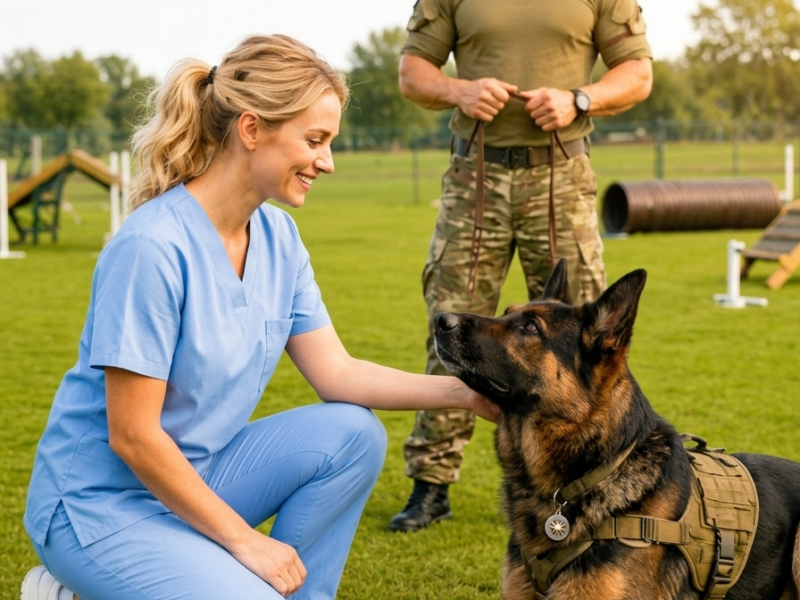
“Don’t shoot!” the nurse screamed as the armed deputies surrounded the emergency room, but when the military K9 suddenly dropped beside the wounded stranger
The rain had been battering the reinforced glass of Mercy General Hospital since midnight, turning the pine-covered ridges of western Virginia into an impenetrable black wall. Rural hospitals in the Blue Ridge have a particular rhythm in the dead of winter; after two in the morning, the corridors normally belong to the low hum of refrigeration units, the scent of antiseptic bleach, and the exhausted shuffle of nurses charting on night shift.
I was at the nursing station finishing my second pot of bitter coffee when the double doors of the ambulance bay burst open with a crash that rattled the stainless-steel chart racks.
“Trauma team, move aside! Step clear!” Deputy Sheriff Frank Alvarez was shouting before he even cleared the threshold. His service Glock wasn’t drawn, but his right thumb had already popped the safety snap on his level-three retention holster. Behind him, Deputy Tom Walker hurried through with his hand planted firmly on his sidearm, his eyes darting frantically across the empty triage waiting area.
Between them rolled gurney four, pushed violently by two county paramedics whose faces were white with panic.
“Don’t shoot!” Staff Nurse Sarah Evans screamed, dropping a tray of sterile prep instruments that clattered loudly across the linoleum. “What are you doing? This is an emergency room!”
“Clear the hall, Sarah!” Alvarez barked, his uniform soaked through and reeking of wet leaf litter and gunpowder. “Get Dr. Vance down here right now! We’ve got an unidentified male, blunt-force trauma, penetrating lacerations to the abdomen and left shoulder. Keep your distance from his hands!”
I ran forward, my rubber clogs squeaking against the wet tile. The man lying on the gurney was barely conscious, shivering violently under a thin, blood-stained wool blanket. His face was a map of old scars cut open by fresh bruises; one eye was swollen shut, and dark red riverlets drained through the silver-streaked stubble along his jawline. Rainwater dripped from his ragged canvas coat, pooling onto the vinyl mattress. He was tall, heavily built beneath the gaunt hollows of starvation, with shoulders that had once carried incredible weight.
Despite his shallow, gasping breaths, his right hand was clamped around the strap of a faded olive-drab canvas bag tucked against his ribs. His knuckles were raw, split open to the bone, and gripped with a rigor-like ferocity that defied medical sedation.
“Where did you find him?” I asked, tearing open an IV start kit while Sarah scrambled to hook up the cardiac monitor.
“Mile marker 14 on the old logging road,” Alvarez said, his voice dropping into an uneasy whisper. “Right along the perimeter fence of Camp Dawson. The old decommissioned special warfare annex. He was stumbling in the ditch. When Walker hit the spotlight, the guy went down like he’d been ambushed. There’s something bad going on out there, Vance. There was another vehicle abandoned in the brush a mile north, engine still hot, doors wide open.”
The heart monitor gave a rapid, stuttering beep. Heart rate was 142, blood pressure dropping fast at 82 over 50.
“He’s bleeding internally,” I said, peeling back the sodden jacket. Underneath was a faded thermal shirt shredded by wire and punctured by two distinct, clean entry wounds just beneath his left collarbone. “These aren’t branches, Alvarez. These are shrapnel tears or close-range ricochets. Get me two units of O-negative and a central line kit, now!”
Just then, heavy footsteps echoed down the south corridor. Sergeant Jim Miller, head of county facility security, turned the corner. Beside him strode Rex.
Rex was an eighty-five-pound Belgian Malinois, a veteran military working dog retired from service three years prior due to blast-induced shrapnel in his hip. Miller had adopted him through the base transition program, bringing the old canine in on overnight shifts to patrol the perimeter. Rex was normally stone-faced, disciplined to an unnatural degree, ignoring patients, sirens, and crying children without a twitch of his scarred muzzle.
The moment Rex crossed the threshold into Trauma Bay 4, he stopped dead.
His rigid posture vanished. His ears shot forward, trembling. His nostrils flared wide, drinking in the coppery air of the room, pulling something out of the scent of blood and rain that no human could detect. A low, sharp whine vibrated in the dog’s chest—a sound Miller had later told me he hadn’t heard since they were clearing hide sites in Kunar province.
“Rex, heel,” Miller commanded softly, confused.
The dog ignored him completely. Rex took two deliberate, trembling steps toward the gurney.
“Miller, control your animal!” Alvarez yelled, his hand tightening on his gun. “Step back!”
“Rex, halt!” Miller yelled, reaching for the nylon lead.
Rex lunged—not with aggression, but with an agonizing, desperate urgency. He slipped past Miller’s outstretched hand, ignored Alvarez’s drawn weapon, and pressed his muscular chest directly against the metal rail of the gurney. He didn’t bare his teeth. He didn’t bark.
He lowered his large, grizzled snout and gently pressed it into the stranger’s bleeding, uncovered left palm.
The man’s eyelids fluttered. The erratic spikes on the cardiac monitor began to steady, descending from 140 to 110, then to 95. The man let out a long, ragged breath that sounded like a sob trapped behind crushed ribs. His bloodied fingers, which had been locked in a death grip on the canvas bag, uncurled slightly. His hand moved an inch and buried itself into the thick fur of the Malinois’s neck.
“You remembered me,” the stranger whispered. The voice was like crushed stone grinding underwater.
The emergency bay went dead silent. The only sound was the rhythmic hum of the oxygen wall valve and the steady downpour against the dark glass.
Miller stood frozen, his jaw slack, staring at the scarred animal who had never allowed another human being within two feet of his workspace. “That’s impossible,” Miller muttered, his face draining of color. “Rex doesn’t take to strangers. He hasn’t broken heel in six years.”
The wounded man didn’t answer right away. Slowly, painstakingly, he reached his left hand inside the flap of the torn canvas bag. Alvarez drew his weapon halfway, but Miller grabbed the deputy’s forearm, shaking his head with sudden, fierce intensity.
The man pulled out a laminated military credential, cracked across the center, the plastic yellowed and spotted with dried salt water. He let it slip onto the white sheet between his chest and the dog’s resting head.
I leaned in to wipe away the smeared grease. It was a photograph taken under harsh desert sunlight. It showed Rex, significantly younger, wearing a Kevlar assault harness, leaning against the shoulder of a broad-shouldered soldier in desert digital fatigues. The soldier was laughing, one arm wrapped around the Malinois, his eyes clear and alight with fierce life.
It was the man lying on our gurney.
Miller stepped forward, his boots feeling heavy against the floor. He picked up the photograph with a hand that shook visibly. “Captain Cole Bennett,” Miller read aloud, his voice cracking. “Special Operations Canine Handler, 7th Raider Group. No… no, that can’t be. Cole Bennett was killed in action eleven years ago. An ambush in the Helmand River Valley. The entire reconnaissance team was wiped out. They held a memorial at Fort Bragg. I attended it.”
The man on the gurney turned his bruised face toward the light. A terrible, bitter smile touched the corner of his cracked lips. “They held a funeral for an empty box, Jim,” the stranger whispered. “They had to. You can’t let the public see what happens when command leaves six men behind to die.”
Before Miller could speak, my eyes dropped to the bottom corner of the credential. A thick black line had been scored through Cole Bennett’s name, carved deep into the laminate with a knife tip. Beneath it, written in crude permanent marker, was a different name: Colonel Marcus Kane.
Miller saw it a second after me. His breath hitched in his throat. His eyes went wide with pure, visceral terror. “Why is Kane’s name on your tag, Cole?”
Cole Bennett closed his eyes as Sarah applied pressure to his shoulder wound. “Because Kane didn’t lose us,” Cole murmured, his breathing growing dangerously shallow again. “He sold us. And tonight, he found out I made it back.”
A sudden crack of lightning shattered the sky outside, illuminating the darkened hills in a blinding flash of silver. In the hallway, the fluorescent ceiling panels flickered once, twice, and then dropped out, plunging the emergency ward into the eerie red glow of emergency battery power.
Rex suddenly tore his head away from Cole’s chest. The dog’s lips curled back over his teeth, exposing gleaming white fangs. A deep, guttural growl tore from the back of his throat as he faced the emergency room entrance doors.
Through the rain-streaked glass of the exterior ambulance bay, two black, unmarked SUVs rolled to a stop, headlights turned off, engines purring in the dark.
The emergency backup generators kicked in with a dull, low vibration that hummed through the concrete floors, casting the trauma bay in a sickly amber light.
“Alvarez, lock those outer bay doors right now,” Miller said, his voice entirely changed. The casual security guard was gone; in his place stood an infantry veteran reading a tactical map he never wanted to see again. “Walker, get your shotgun from the cruiser. Don’t ask questions. Move!”
“Hold on, Miller,” Alvarez said, backing toward the desk, his hand now resting firmly on the grip of his service weapon. “We don’t know who this guy is. He could be an escaped felon, he could be an insurgent, he could—”
“I served under Marcus Kane for four years at Fort Bragg, Frank!” Miller hissed, grabbing Alvarez by his tactical vest and dragging him two inches from his face. “If Cole Bennett is alive, and Marcus Kane is coming down this mountain after him, nobody in this hospital is safe. You lock that outer gate or we are going to die in this room.”
Outside, the car doors of the black SUVs clicked open through the sheeting rain. Four men stepped into the downpour. They wore civilian wet-weather tactical gear—no badges, no agency insignia, carrying short-barreled automatic carbines held low against their chests in the low-ready position.
Rex was vibrating with rage, his front paws dug into the linoleum, claws scratching the slick surface.
“Dr. Vance,” Cole Bennett whispered, his voice tighter now, the pain clearly tearing through his remaining stamina. “You have… you have a surgical suite on this floor?”
“Upstairs, on three,” I replied, applying fresh pressure dressings to his abdomen. The bleeding was arterial; bright red blood was beginning to soak through the third layer of gauze. “You need two liters of saline and a vascular clamp, Captain. You won’t survive thirty minutes without surgery.”
“No third floor,” Cole gasped, grabbing my wrist with shocking strength. His skin was burning with infection, but his grip felt like an iron band. “No elevators. Elevators are kill zones. They cut the grid… they trap you. We stay on the ground level. Staff exits. Maintenance tunnels.”
“There are no tunnels here, Cole,” Miller said, turning back to him. “Just the sub-basement boiler room and the old linen chute that leads out to the loading dock.”
“That’ll do,” Cole said. He coughed, a thin spray of blood hitting the white collar of his coat. “The bag, Jim. Don’t let them take the canvas bag.”
Miller reached down and scooped the torn bag from the corner of the gurney. It was heavy, weighing at least twenty pounds, clinking with the distinct sound of metallic cases and insulated drives.
Suddenly, the automatic sliding doors at the front entrance were forced open. The screech of the rubber safety seals resounded down the linoleum hallway.
“Dr. Vance! Help me move him!” Sarah cried, unlocking the wheels of the gurney.
We threw our weight against the metal frame, shoving the gurney out of Trauma Bay 4 and down the secondary hallway toward the restricted pharmaceutical stockroom and the maintenance stairwell. Miller kept his left hand on the gurney’s rail while his right drew his sidearm—a well-worn Sig Sauer P226 he hadn’t carried in anger in nearly a decade. Rex moved like a shadow beside him, every muscle coiled, his tail rigid, his head low to the ground.
Footsteps echoed from the main lobby. Crisp. Synchronized. Professional.
“Sheriff’s Department!” Alvarez’s voice suddenly boomed from the end of the hall. He had chosen to stand his ground near the nursing station. “Drop your weapons! This is a restricted medical facility!”
A single, suppressed pop cracked through the air. It sounded like an air hose snapping under pressure.
There was a heavy thump, followed by the clatter of a radio skittering across the floor.
“Alvarez!” Walker screamed from the darkness of the reception desk. Another double-tap echoed through the corridor—thwip-thwip. Walker’s yell was cut short into a wet, choking gasp.
“They’re executing them,” Sarah whimpered, tears streaming down her cheeks as she shoved the gurney through the heavy fire doors into the service corridor. “Oh God, they just killed Frank and Tom.”
“Keep moving!” Miller snarled. “Sarah, you cry later. Keep that gurney moving!”
We rounded the corner into the narrow back hallway lined with utility closets, laundry hampers, and electrical junction boxes. The emergency lighting here was even dimmer, a series of dull red lanterns spaced fifty feet apart.
“In here,” Miller whispered, kicking open the door to the central linen depot. It was a massive, windowless room filled with tall steel carts stacked with sheets, surgical drapes, and chemical cleaning supplies. At the far end was a heavy steel door that led down to the maintenance basement.
We pushed the gurney behind a row of industrial rolling carts. Cole was pale as paper now, his head rolling back against the pillow, his lips blue.
“I need light,” I said, pulling a penlight from my pocket. “He’s going into hypovolemic shock. If I don’t clamp this bleeder in his shoulder, his heart is going to arrest.”
“Do what you have to do, Vance. Rex, watch the door,” Miller ordered.
The dog positioned himself directly behind the crack of the fire door, his nose twitching, his ears shifting independently as he tracked the footsteps advancing down the hallway.
I cut away Cole’s shirt completely. Across his chest and abdomen were three separate surgical scars—jagged, unprofessionally closed with thick monofilament wire, the kind of crude surgery performed in mountain caves or clandestine safe houses. And across his ribs was a brand: the letters TF-9, scorched into the skin with raw heat.
“Task Force Nine,” Miller whispered, staring at the brand. “That was Kane’s personal black-budget unit. They were supposed to be operating out of Bagram, tracking illicit financing.”
“They weren’t tracking financing,” Cole rasped, his eyes opening halfway, locking onto Miller. “They were running it. Opium routes through Turkey. Weapons shipments into northern Syria. Kane wasn’t an intelligence officer, Jim. He was an arms broker in uniform. Our team… our team intercepted one of his courier convoys in the valley. We thought they were Taliban.”
Cole groaned as I pushed my gloved fingers into the open wound, searching for the retracted artery. My fingers found the spurting vessel, and I clamped it with a pair of curved Kelly forceps Sarah handed me with trembling fingers.
“We called Kane for extraction,” Cole continued, his breath coming in ragged gasps that rattled his ribs. “He gave our coordinates to an insurgent mortar battery. They hammered us for four hours. I watched my boys burn to death in the command truck. The only reason I survived… was because Rex dragged me into an irrigation ditch before the shrapnel caught his hip.”
Miller turned his head slowly to look down at the Malinois. Rex was staring at Cole, his tail giving a single, subtle thump against the industrial tile floor.
“When the contractors came to clear the site,” Cole said, “they found Rex guarding my body. They thought I was dead. They took the dog, tagged him as surplus salvage, and shipped him back stateside through Germany. But Kane’s men locked me in a private facility north of Quetta. For eleven years, Miller. Eleven years in an eight-by-ten hole in the ground.”
“How did you get out?” Sarah asked, her hands shaking as she tied off the IV line.
“Kane brought me back two weeks ago,” Cole whispered, his voice trembling with cold rage. “He retired last year. He bought an estate up here in the mountains… right above Camp Dawson. He kept me alive all these years because he couldn’t crack the encryption on the primary ledger. He thought eleven years in a hole would break me. He brought me to his private cabin to watch him burn everything down.”
Cole reached up and tapped the canvas bag sitting on Miller’s lap.
“The drive is in there,” Cole said. “Every bank account, every corrupt defense official, every shipment manifest. And the true casualty reports of forty-two American soldiers who didn’t die in accidents… but were murdered because they figured out what Marcus Kane was doing.”
Suddenly, Rex emitted a low, razor-sharp hiss.
Miller raised his weapon and aimed it directly at the door.
Through the narrow glass slit in the heavy fire door, a shadow passed. Then came the sound of a radio microphone clicking twice—a tactical signal.
“They’re outside the linen room,” Miller whispered.
A cold, cultured voice echoed through the metal vents above our heads, calm and completely detached from the slaughter that had just occurred in the lobby.
“Cole,” the voice said, sounding through the intercom speaker on the wall. “You always were an exceptional field operative. But you’re bleeding to death on a hospital floor, surrounded by civilian nurses who have no idea what you’ve brought to their door. Hand over the bag, Cole. I’ll let the doctor and the girl walk out to their cars. You have my word as an officer.”
Cole looked at Miller. A faint, deadly smirk appeared on the wounded soldier’s face.
“Marcus,” Cole said loudly toward the ceiling vent. “You haven’t been an officer since the day you traded your men for Swiss gold.”
A split second of dead silence followed.
Then the fire door was blown off its hinges by a breaching charge.
The concussion wave blew Sarah and me backward into the linen carts, sending towering stacks of sterile sheets flying into the air like burning white confetti. The acrid smell of high-explosive cordite flooded the room, choking our lungs and blinding our eyes with gray, billowing smoke.
Through the haze, the outline of a tactical helmet appeared.
“Fire!” Miller roared, squeezing the trigger of his P226 three times in rapid succession.
The heavy nine-millimeter rounds punched through the plywood shelving, hitting the first operative in the chest plate. The man stumbled back into the hallway, his weapon discharging wildly into the ceiling tiles, tearing down plastic light diffusers and insulation.
Before the second breacher could raise his carbine, eighty-five pounds of muscle, teeth, and raw fury launched from the darkness.
Rex hit the man at chest height, knocking him completely off balance. The Malinois locked his jaws around the operative’s right forearm, twisting violently with the brutal, bone-snapping efficiency he had been trained to execute on the battlefields of the Middle East. The operative shrieked, dropping his carbine as Rex drove him to the floor, pinning him under the weight of his forepaws.
“Rex, out!” Miller yelled, moving up to the doorway and firing two rounds down the hall to suppress a third man advancing behind a ballistic shield. “Fall back! To the laundry chute! Vance, grab the bag!”
I scrambled to my feet, my ears ringing so loudly I could barely hear my own breathing. Sarah was already helping Cole to his feet; the wounded captain had torn the IV line from his arm, his left shoulder hanging limp, but his right hand had picked up a heavy stainless-steel surgical tray from the floor.
“I can walk,” Cole growled, blood soaking through the makeshift bandages across his ribs. “Move, Doctor! Don’t look back!”
I grabbed the heavy canvas bag from the floor. It felt like an anchor in my arms, but the weight of forty-two dead men’s names seemed to press down through the wet canvas.
We dragged Cole toward the back wall of the linen depot where a heavy square access hatch was set three feet off the ground—the industrial laundry chute that dropped down into the sub-basement processing room.
“Sarah, you first!” Miller shouted, swapping the empty magazine of his pistol with a fresh one from his duty belt. “Slide down, clear the bottom! Vance, follow her!”
“I’m not leaving you here!” Sarah protested, coughing through the thick smoke.
“Go, damn it!” Miller roared.
Sarah climbed into the chute and slid down into the darkness with a metallic screech.
“Now you, Vance!” Cole commanded, shoving me toward the opening.
I dove into the steel tunnel, clutching the canvas bag to my chest. The slide was steep and slick with decades of detergent residue; I plummeted twenty feet through total darkness before being ejected onto a mountainous pile of soiled hospital linens in the cavernous concrete basement.
A second later, Cole landed beside me with a sickening thud, crying out in muffled agony as his fractured ribs took the impact. I scrambled to his side, catching him by the vest to keep him from rolling onto the concrete floor.
Above us, in the chute opening, gunfire erupted again—rapid, heavy bursts from automatic rifles answered by the sharp, measured retorts of Miller’s service pistol.
“Miller!” I shouted up the tube.
A body tumbled down the chute, followed immediately by a heavy thud. It was Miller. His uniform was torn, blood pouring from a grazing wound along his temple, his left leg twisted awkwardly beneath him.
Right behind him came Rex, sliding down the chute on his belly, landing gracefully on his feet and instantly turning to face the ceiling with his hackles raised and a low, threatening growl rumbling in his throat.
“They’re coming down the stairs,” Miller wheezed, clutching his knee. “The chute won’t hold them for more than two minutes. They’ll drop flashbangs down that pipe.”
“Where does that door lead?” I asked, pointing toward a heavy iron bulkhead at the far end of the basement, past the massive industrial washing drums and steam boilers.
“Back drainage tunnels,” Miller groaned, trying to stand and immediately collapsing back onto the pile of sheets. “Built during the Cold War when this place was an emergency fallout clinic. Leads out to the old sewage retention pond near the river. Half a mile through the dark.”
“You can’t walk,” Cole said, limping over to Miller and extending his uninjured right hand. “Come on, Sergeant. On your feet. We don’t leave men behind.”
Miller looked up at the man he had believed was dead for more than a decade. A slow, pained smile broke across his blood-spattered face. “You’re a stubborn son of a bitch, Bennett.”
“That’s why you liked me,” Cole answered, hauling Miller up onto his shoulder.
Sarah took Miller’s other side, supporting his weight, while I held the canvas bag in one hand and grabbed a heavy steel crowbar from a tool cart by the boiler.
We moved across the concrete floor just as the first flashbang detonated at the top of the laundry chute. The blast was deafening, a blinding white flash that illuminated the basement in a horrifying silhouette of smoke and flying sparks.
We stumbled through the iron bulkhead into the drainage tunnel. The air here was freezing, smelling of damp earth, rust, and stagnant water. The tunnel was barely six feet tall, constructed of arched red brick that wept moisture down its curved walls.
Rex took the lead without hesitation. His tail was tucked low, his nose skimming the muddy floor, his body shielding the group as he moved methodically through the black corridor.
Behind us, the sound of boots hitting the basement floor was unmistakable.
“Two targets down the chute, three entering through the east stairwell,” Cole whispered, his trained senses analyzing the acoustics of the gunfire and movement behind us with chilling accuracy. “Kane is with them. He won’t let his contractors do the final sweep alone. He needs to see the ledger destroyed with his own eyes.”
“Why did he wait eleven years?” Sarah asked, her teeth chattering from the cold mud soaking through her scrub pants as we sloshed through ankle-deep water. “If he had you locked up, why bring you here now?”
“Because a federal grand jury was convened three weeks ago in Alexandria,” Cole said, his breath hitching with every step. “Someone on the inside started leaking logistics manifests. Kane knew the noose was tightening. He needed to extract the private master encryption keys from my memory and burn every trace of the old 7th Raider supply logs. He thought he could break me, bury me in the Virginia woods, and vanish to South America.”
“And the dog?” I asked. “How did he find you?”
“He didn’t find me,” Cole said softly, looking ahead at the white-tipped tail of the Malinois cutting through the darkness. “I escaped his compound five hours ago. I knew Rex was here in this county. I saw an article in a local paper Kane left on his desk two years ago—a story about a retired war dog working rural security with a former Army handler. I didn’t run to the police. The police don’t have the weapons to stop Kane’s men. I ran to the only partner I knew would never turn his back on me.”
Suddenly, Rex stopped.
Fifty yards ahead, where the brick tunnel intersected with an old concrete spillway opening onto the riverbank, a red laser line danced across the wet water surface.
Someone was already waiting at the exit.
The narrow drainage tunnel suddenly felt like an iron coffin.
“Kill the light,” Cole hissed, his hand dropping onto my shoulder with enough force to pin me against the slick brick wall.
I switched off the penlight immediately. The red laser dot danced across the shallow, rushing water six inches from my boots, cutting through the murky mist rising from the drainage ditch.
Behind us, fifty yards back through the tunnel, we could hear the methodical, splashing steps of Kane’s sweep team. They weren’t rushing now. They knew we were pinched between the exit and their advancing line.
“How many at the mouth?” Miller whispered, leaning heavily against the brickwork, his pistol held steady despite the blood dripping into his left eye.
“Two,” Cole replied without hesitation, his eyes adjusted to the pitch-black corridor. “One covering the high ground on the embankment, one crouching behind the spillway grate. Spotter and shooter. Standard perimeter containment.”
“We can’t fight our way through that,” Sarah whispered, her breath trembling in the darkness. “They have rifles. We have a handgun and a crowbar.”
“We have Rex,” Cole said softly.
He dropped down to his knees in the icy water, ignoring the groan of torn tissue in his freshly clamped shoulder. He reached out with both hands and took Rex’s broad head between his palms. The dog leaned into the touch, his dark eyes glowing faintly in the reflected ambient moonlight filtering through the concrete spillway opening.
“Listen to me, boy,” Cole whispered, his voice dropping into a guttural, rhythmic cadence that sounded almost like another language—the precise German and Pashto hybrid commands used by tier-one combat canine teams. “Fass das Ziel. Leise. Bring sie runter.”
Rex’s ears twitched once. He gave no whine, no bark, no outward sign of excitement. His muscles simply locked into absolute focus.
“On my mark,” Cole whispered, turning his head toward Miller. “When Rex engages the man at the grate, the shooter on the ridge will look down. Jim, you take the high shooter. Two rounds, center mass. Don’t look at the dog. Vance, you and Sarah push through the spillway into the brush along the river. Take the bag.”
“I’m not leaving you, Cole,” Miller said through gritted teeth.
“You’re not leaving me,” Cole said, a cold, dangerous resolve settling into his haggard features. “I’m going to finish this with Kane.”
Cole tapped the side of Rex’s neck twice.
The dog vanished into the darkness.
He didn’t splash. Rex moved with the terrifying, predatory grace of an animal that had crossed minefields and ambushed insurgent outposts without shifting a single pebble. He kept low, his belly nearly brushing the muddy current, using the natural curve of the brick wall to shield his silhouette.
Ten seconds passed. The advancing boots behind us were growing louder—perhaps thirty yards away now. I could smell the chemical tang of their rifle lubricants.
Then, a sudden, muffled yelp echoed from the mouth of the tunnel.
It was instantly followed by the sound of a body slamming hard against the iron spillway bars and the frantic, gurgling shout of a man trying to draw a sidearm while eighty pounds of canine jaw crushed his trachea.
Above on the embankment, a flashlight snapped on, illuminating the churning water at the tunnel exit.
“Movement at the grate! Brown’s down! Brown’s—”
Bang! Bang!
Miller fired twice over our heads, the muzzle flash illuminating the red brick vault in blinding staccato bursts. On the ridge above the spillway, the flashlight beam jerked violently skyward. A man screamed, tumbling headfirst down the steep muddy embankment and crashing into the swollen current with a dead splash.
“Move! Now!” Cole roared.
We surged forward through the water, breaking out of the suffocating mouth of the tunnel into the roaring, rain-lashed darkness of the Virginia wilderness.
The river was a brown, violent torrent ten feet wide, swollen with winter rain and crashing against jagged boulders. Thick laurel and black walnut trees crowded the banks, offering dense cover.
Sarah scrambled up the muddy slope, dragging Miller with every ounce of strength in her small frame. I followed close behind, holding the heavy canvas bag against my chest like a shield.
Rex was standing over the motionless form of the operative pinned against the rusted iron bars, his muzzle dripping crimson. When Cole reached him, the dog stepped back into a heel position, his breathing steady, his tail high.
“Cole!” A voice bellowed from the mouth of the tunnel behind us.
We froze on the bank.
Stepping out from the drainage archway, completely unbothered by the water soaking his pristine tactical coat, was a tall, silver-haired man. He carried no rifle—only an ivory-gripped Colt .45 held loosely at his side.
Marcus Kane.
Behind him emerged two surviving contractors, their carbines trained directly on us.
“Eleven years, Cole,” Kane said, his voice carrying clearly over the roar of the rushing river. “You survived a mortar strike, two years of interrogation in the mountains, and a winter escape through the Appalachians. And for what? To die behind a country hospital, in the mud, like a stray dog?”
“I didn’t run to hide, Kane,” Cole said, stepping out in front of Sarah, Miller, and me. He was barely standing, leaning his weight against an uprooted pine trunk, but his eyes were burning with an intensity that made the two armed contractors hesitate. “I ran to bring you out into the open.”
Kane chuckled—a dry, aristocratic sound that turned my stomach. “Into the open? Look around you, Captain. The sheriff’s department is dead. The hospital communications are down. In forty minutes, my team will secure that bag, load your bodies into the back of a van, and torch your remains in an abandoned mine shaft. By dawn, the media will report a tragic domestic terror attack on a rural health center.”
Kane raised his pistol, aiming it directly between Cole’s eyes.
“Give me the bag, Cole. And I’ll make sure the dog is buried with you.”
Cole didn’t move. He didn’t blink. He simply turned his head an inch to the left and looked down at Rex.
“Rex,” Cole whispered. The tone was barely audible over the roaring river, but to the dog, it was an undeniable command. “Glaube.”
Faith.
Rex didn’t charge Kane. Instead, the dog spun on his hind legs, seized the strap of the heavy canvas bag from my hands with his teeth, and leaped outward into the black, raging torrent of the flooded river.
“Shoot the dog!” Kane screamed, his calm façade shattering into absolute hysteria. “Kill that goddamn animal!”
The two contractors opened fire instantly, muzzle flashes strobing against the driving rain as automatic bursts tore the surface of the river into frothing geysers of spray and shattered timber.
Rex vanished beneath the churning brown water, pulled downstream by the fierce current, the canvas bag clutched stubbornly in his jaws.
“No!” Sarah screamed, lunging toward the riverbank, but I grabbed her jacket and threw her down behind the protective root ball of a fallen oak tree.
In that single second of chaos—with Kane’s men focused entirely on the water—Cole moved.
Despite his crushed ribs, his torn shoulder, and the arterial blood seeping through his bandages, he exploded forward with the terrifying speed of an ambush predator. He closed the ten-foot gap between himself and the nearest contractor before the man could swing his barrel back toward the bank.
Cole drove his uninjured right shoulder into the man’s sternum, tackling him into the shallow edge of the spillway. As they hit the water, Cole’s hand snapped out, seizing the contractor’s combat knife from its chest sheath and driving it upward under the man’s body armor with ruthless, lethal efficiency.
The second contractor swung his weapon toward Cole, but Miller fired the final bullet in his magazine from fifteen yards away. The nine-millimeter slug caught the shooter in the hip, spinning him off balance.
Cole rolled, lunged from the mud, and wrenched the contractor’s rifle from his hands, striking him across the helmet with the heavy buttstock, dropping him cold into the riverbed.
Silence fell over the clearing, broken only by the deafening roar of the river and the hammering rain.
Cole turned slowly. He was holding the captured M4 carbine, the muzzle pointed at the mud.
Kane stood alone five yards away. His silver hair was plastered to his forehead, his designer coat spattered with the blood of his own men. His ivory-gripped pistol was still in his hand, but his arm was shaking violently now.
“You’re an animal, Cole,” Kane breathed, his chest heaving. “A savage. You never understood the bigger picture. You were just a hound we sent into the dirt to bite whoever we pointed at.”
“You’re wrong, Marcus,” Cole said, his voice flat, devoid of rage, filled only with the devastating clarity of an executioner. “Rex and I… we knew exactly what we were fighting for. We were fighting for the men beside us. You were fighting for numbers on a screen.”
Kane raised his weapon.
Cole didn’t fire the rifle. He stepped inside the line of Kane’s arm, caught the colonel’s wrist, twisted it until the bone cracked with a sickening snap, and sent the ivory-handled pistol spinning into the black water.
Kane fell to his knees in the mud, clutching his broken wrist, sobbing with pain and humiliation.
“Kill me, then,” Kane spat, looking up through the rain with bloodshot eyes. “Do it! It doesn’t matter! The bag is gone! It’s at the bottom of the Shenandoah! The evidence is destroyed, Bennett! You have nothing! You’re just a dead man who forgot to lie down!”
Cole looked down at the broken officer. He dropped the carbine into the mud at Kane’s feet.
“I don’t need to kill you, Marcus,” Cole whispered. “And the bag isn’t lost.”
From downstream, fifty yards past the bend where the current slowed into a wide, sandy eddy, came the sharp, triumphant bark of a dog.
We scrambled down the bank, sliding through wet leaves and mud until we reached the gravel bar.
Sitting on the sand, shivering violently, his black-and-tan fur plastered to his ribs, was Rex.
Between his front paws lay the canvas bag. The heavy, water-resistant military material had held; the brass zippers were intact. Rex looked up as we broke through the brush, his tail giving three steady, rhythmic thumps against the gravel.
Cole dropped to his knees beside the animal, burying his face in the dog’s wet neck. Rex let out a soft, breathy whine, leaning his entire body weight into his handler, his tongue licking the blood from Cole’s jaw.
Sarah and I immediately knelt beside them. “Cole, stay still,” I urged, pulling off my soaked jacket to wrap around his shoulders. “Your pulse is threadbare. We need an ambulance out here right now.”
“Radio… the state police,” Miller wheezed, limping out of the brush, holding his dislocated knee with one hand. “The real ones. Tell them… tell them we have Marcus Kane, and we have the files from Task Force Nine.”
Cole reached down, his fingers trembling with hypothermia, and unzipped the canvas pouch. Inside, sealed in three heavy Pelican cases, were stacks of hard-drive modules, handwritten logs bearing the official seals of the Department of Defense, and dog tags—dozens of silver military identification tags belonging to men who had been reported missing or dead across two decades of covert operations.
Cole picked up one set of tags. They were tarnished with smoke, the chain blackened by fire.
“Corporal David Reyes,” Cole read quietly, his voice cracking with eleven years of unshed grief. “Sergeant Thomas Lee. Specialist Marcus Vance.”
I froze. My breath caught in my throat.
“Specialist Vance?” I repeated, my voice barely a whisper against the rain.
Cole looked up at me, his hollow, scarred face softening with sudden, profound realization. “Marcus Vance. 7th Raider Group. Combat medic. He was twenty-two.”
“He was my brother,” I said, tears burning my eyes for the first time since the ambulance doors had opened two hours ago. “They told our family his convoy hit a roadside bomb outside Kandahar. They gave us an empty casket with an American flag folded over it.”
Cole held up the dog tags, letting the cold silver metal drop gently into my trembling, open palm.
“Your brother didn’t die in an accident, Doctor,” Cole said, his hand closing over mine with the warm, unbreakable grip of a comrade who had survived hell to bring the truth home. “He died saving three wounded men from Kane’s mortar barrage. He was the bravest soldier I ever commanded.”
In the distance, the wail of sirens began to rise over the mountain ridges—dozens of them, accompanied by the thrum of state police helicopter rotors beating the night air as they descended upon the hospital grounds.
Rex lifted his head, barking once at the flashing blue and red lights reflecting off the low winter clouds.
Cole Bennett laid his head back against the gravel, his hand resting securely on the dog’s neck. For the first time in eleven years, the ghost of the Helmand Valley closed his eyes, not in fear of an ambush, but in the absolute, unshakable peace of a soldier who had finally completed his mission.
The end









