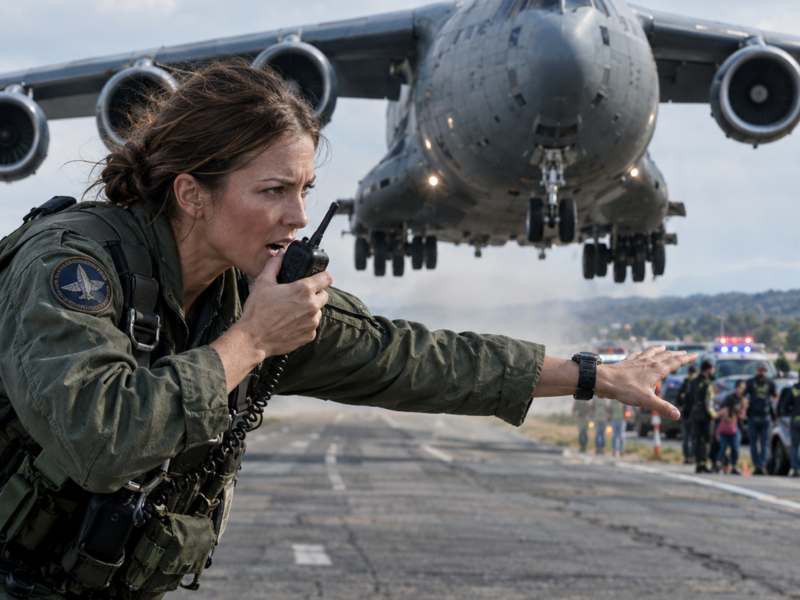
Colonel Richard Walker humiliated Captain Rebecca Hayes in front of an entire military hangar, stripped her of her wings
Colonel Richard Walker humiliated Captain Rebecca Hayes in front of an entire military hangar, stripped her of her wings, and called her a danger to every pilot under his command. Three days later, when his crippled C-17 began falling toward an interstate packed with families, one voice on the emergency frequency made every soldier within earshot freeze—and when the legendary call sign behind that voice was finally revealed, even the armed guards snapped to attention.
The morning Rebecca Hayes lost her career, the rain smelled like JP-8 fuel, hot metal, and something burning that nobody wanted to investigate.
Inside Hangar 4 at McGhee Tyson Air National Guard Base in Tennessee, the deep rumble of turbofan engines shook dust from the steel rafters. Ground crews moved beneath the wings of parked aircraft, their reflective vests glowing beneath rows of industrial lights. Hydraulic carts hissed, pneumatic tools rattled, and somewhere outside, a C-17 Globemaster III thundered down the taxiway.
Rebecca stood beside a folding table, wearing a faded flight jacket over a plain gray shirt and black trousers. Her boots were scuffed. Her dark hair was pulled into a tight knot. A paper cup of untouched coffee rested beside a stack of maintenance reports.
Across from her stood Colonel Richard Walker, immaculate in his pressed uniform, his silver insignia catching the overhead lights.
Around him gathered two dozen pilots, maintenance chiefs, intelligence officers, and members of the base’s security detail. They had been summoned for what Walker called an administrative review.
Everyone knew what that meant.
Someone was about to become an example.
Walker held up a report.
“Captain Hayes violated a direct command during a formation training exercise. She abandoned her assigned position, disregarded flight-control instructions, and placed two aircraft at risk.”
Rebecca watched his finger tap the document.
He was tapping the wrong paragraph.
The report described an unexpected closure rate between two aircraft, but it omitted the moment when the lead jet’s transponder had briefly transmitted a corrupted altitude value. Rebecca had seen the error in real time. She had also seen the other pilot’s aircraft descending into the same airspace.
Her maneuver had prevented a collision.
The official report called it reckless.
Walker looked around the hangar.
“Apparently, some people believe instinct gives them permission to disregard the chain of command.”
A few officers shifted uncomfortably.
One young pilot stared at the floor.
Rebecca said nothing.
Walker turned toward her.
“Would you like to explain yourself, Captain?”
“Yes, sir.”
“Then explain why you ignored my order.”
“Because the displayed altitude of the second aircraft was incorrect, sir. Its actual flight path intersected ours. The collision warning came less than four seconds before impact would have occurred.”
Walker gave a thin smile.
“And you determined that from your cockpit?”
“Yes, sir.”
“Without authorization?”
“Yes, sir.”
A maintenance chief near the back cleared his throat.
“Colonel, the telemetry does show a brief transponder discrepancy.”
Walker didn’t even turn around.
“Thank you, Chief. I’ll decide which data matters.”
Rebecca’s eyes moved to the report in his hand. The transponder discrepancy had been logged at 14:32:08. The official record placed her evasive maneuver at 14:32:14.
Six seconds.
The difference between a successful recovery and two funerals.
Walker folded the report.
“Your actions created unacceptable operational uncertainty. Effective immediately, your flight status is revoked pending separation from service.”
The hangar seemed to grow quieter.
Rebecca had spent years learning to read aircraft through vibrations in the stick, changes in engine pitch, and tiny alterations in pressure that most passengers would never notice. She had endured punishing training schedules, freezing night flights, and landings in weather that made the runway lights disappear until the last possible moment.
Now a man who had ignored six seconds of telemetry was ending her career with a sentence.
She looked at him.
“Are you dismissing me for preventing a collision?”
“I’m dismissing you because you believe your judgment supersedes my authority.”
“Those aren’t the same thing, sir.”
A murmur moved through the gathered personnel.
Walker’s face hardened.
“Security.”
Two armed guards stepped forward.
“Escort Captain Hayes from the hangar. Her credentials are to be deactivated immediately.”
Rebecca didn’t argue. She didn’t raise her voice. She simply removed her identification badge and placed it on the table.
Then she noticed something else.
Beyond Walker’s shoulder, a maintenance technician was closing the access panel beneath the left wing of a C-17 parked in the adjacent bay. The aircraft’s tail number was 70421.
Rebecca’s gaze narrowed.
The technician had secured the panel, but a narrow strip of fresh inspection paint near the lower fastener was cracked. Not scratched. Cracked.
She knew that pattern.
Six months earlier, she’d reported an abnormal vibration on that same aircraft during a high-power engine run. The vibration had appeared within a narrow operating range and disappeared when the engine’s load changed. Maintenance had attributed it to a sensor fault.
But the pattern had never made sense.
A sensor fault would not explain the physical vibration she’d felt through the airframe.
She stepped toward the aircraft.
“Chief, who signed off the left-side inspection on 70421?”
The technician looked up, startled.
Walker spun around.
“Captain Hayes, your access has been revoked.”
“I’m asking who inspected the engine assembly.”
“Your escort is waiting.”
“The vibration report was never properly closed.”
Walker’s expression turned dangerous.
“You are no longer responsible for this aircraft.”
Rebecca glanced at the cracked inspection paint once more.
“No, sir,” she said quietly. “Apparently, nobody is.”
The words landed harder than a shouted accusation.
For a moment, even Walker had nothing to say.
Then he pointed toward the exit.
“Get her out of my sight.”
Rebecca walked between the two guards without resistance. As she crossed the hangar threshold, the warm smell of fuel gave way to cold rain. Water streamed down the concrete apron, reflecting the red warning lights of the parked aircraft.
She could hear Walker speaking behind her.
“Let this be a lesson. No pilot is indispensable.”
Rebecca kept walking.
At the personnel office, a clerk collected her access card, her flight-line authorization, and the keys to her assigned locker. Her uniform was folded into a cardboard box. A framed photograph of her first operational flight was placed on top.
By sunset, she was driving away from the base with the box strapped into the passenger seat.
She didn’t cry.
She kept thinking about the cracked paint.
Three days later, at 4:17 p.m., Rebecca was driving east along Interstate 40 through rural Tennessee when her phone erupted with an emergency alert.
MILITARY AIRCRAFT EMERGENCY — AVOID THE INTERSTATE CORRIDOR.
She glanced at the screen, then at the traffic ahead. Cars filled both lanes. An SUV carried two children in the back. A delivery truck was changing lanes. Farther ahead, brake lights glowed in the late-afternoon haze.
Then a second alert appeared.
C-17 GLOBEMASTER III REPORTS CRITICAL SYSTEM FAILURE.
Rebecca’s hands tightened around the steering wheel.
She pulled onto the shoulder and stepped out into the damp evening air. The rumble came first—a low, uneven roar that seemed to vibrate inside her chest.
Then the aircraft emerged beneath the clouds.
The enormous transport was descending far too low, its nose slightly offset from its direction of travel. A dark trail streamed behind the left engine. Its wings rocked in shallow, uneven movements as it struggled to maintain a stable path.
Rebecca didn’t need a radar display to recognize the danger.
The descent rate was wrong.
The aircraft wasn’t merely losing altitude. It was losing the ability to control how quickly it lost altitude.
She raised her phone and zoomed in.
The tail number came into focus.
70421.
For one terrible second, the world seemed to stop.
She remembered the inspection panel. The unexplained vibration. The cracked paint. The report that had disappeared into a maintenance system nobody would let her examine.
Her old flight bag lay on the truck’s rear seat. Inside was a portable aviation radio she had kept after leaving the service, along with a handwritten list of emergency frequencies she had used during training.
She grabbed it and switched it on.
Static hissed through the speaker.
Then a strained voice broke across the frequency.
“Mayday, mayday. Military transport experiencing multiple system failures. We have degraded engine output and limited flight-control response.”
Rebecca recognized the voice immediately.
Colonel Richard Walker.
She looked toward the interstate.
The C-17 was now descending toward the traffic corridor, and the cars beneath it had nowhere to go.
She could have stayed beside her truck.
She could have watched the man who had destroyed her career discover what it meant to be helpless.
Instead, she pressed the transmit switch.
“C-17, this is former Captain Hayes. Colonel Walker, do you read?”
A burst of static followed.
Then Walker answered.
“Hayes? You’re not authorized on this frequency.”
“Your left engine is failing. Your descent rate is increasing, and your current track intersects the interstate.”
“We are aware of our situation.”
“Then you should also be aware that your current approach will put you into civilian traffic.”
A pause.
“We’ve lost primary flight-control response,” Walker said. His voice had lost its familiar arrogance. “We have limited directional authority and unreliable engine indications.”
Rebecca watched the aircraft’s nose drift, then correct too abruptly.
The correction was a warning in itself.
“Colonel, stop chasing the nose. You’re making the oscillation worse.”
“You are not in my cockpit, Hayes.”
“No, sir. But I can see your aircraft.”
She looked beyond the interstate toward a ribbon of river reflecting the gray sky. Two miles east lay an abandoned industrial airstrip, a remnant of a factory complex that had closed years ago. Its runway was cracked, its markings faded, and its approach was partially obstructed by trees.
It was never intended for a C-17.
But it was away from the highway.
And it was the only stretch of ground she could identify that offered even a chance of keeping the aircraft out of the traffic.
“Turn east toward the river,” she transmitted. “There is an abandoned industrial runway ahead. It’s your only alternative to the interstate.”
“That’s a condemned strip.”
“I know.”
“It’s too short.”
“I know that, too.”
“You’re asking me to land a crippled Globemaster on a runway that was never designed for it?”
Rebecca watched a minivan pass beneath the aircraft’s shadow.
“I’m asking you to choose where you want the aircraft to stop, Colonel. Because if you continue on this heading, you won’t get to choose.”
Silence filled the radio.
Then Walker’s voice returned, quieter this time.
“Give me your instructions.”
Rebecca started toward her truck.
“Follow the river. I’ll get ahead of you and guide you toward the approach.”
She climbed behind the wheel and pulled onto the access road, the tires throwing water across the gravel. Ahead, the crippled C-17 sank beneath the cloud base, its engines producing an uneven thunder that echoed across the fields.
Rebecca gripped the radio with one hand and the steering wheel with the other.
“70421, this is Hayes. Listen carefully. You’re not going to save the aircraft by saving your career, and you’re not going to save yourself by pretending you still have full control. From this moment on, you fly the situation you have—not the one you wish you had.”
For the first time since she had known him, Walker didn’t argue.
Then another voice broke into the frequency, sharp and urgent.
“Control, we have visual confirmation of the ground guide. Stand by—cross-checking identity.”
Rebecca slowed as she approached the rusted gate leading to the abandoned airstrip. Beyond it, the cracked runway stretched toward a distant tree line.
A military vehicle appeared on the service road behind her. Two more followed, their lights flashing against the wet pavement. Armed personnel spilled out, followed by a major carrying a radio and a sealed document pouch.
The major looked from Rebecca to the descending aircraft.
Then she heard the radio operator repeat the name coming through the command channel.
“Confirming identity. The voice guiding the aircraft is Captain Rebecca Hayes.”
A second transmission followed, this one from a senior officer inside the airborne command network.
“Correction. Confirm the call sign.”
The radio operator straightened.
His expression changed.
He looked at Rebecca as if the woman standing beside the rusted gate had suddenly become someone from a classified history lesson.
“Confirmed,” he said. “That’s GHOST SIX.”
The major’s face went pale.
The armed guards stopped moving.
The radio operator lowered his hand, then snapped into a rigid salute. The major followed. One by one, every uniformed person beside the runway came to attention, their heels striking the wet pavement as the name passed from one radio to another.
Even Colonel Walker, thousands of feet above the interstate, fell silent when the command channel confirmed who was guiding him.
Rebecca didn’t look at the saluting personnel.
She looked at the C-17.
Its left engine was trailing smoke. Its wings were trembling. The runway ahead was too short, the pavement too damaged, and the trees at the far end too close.
She raised the radio.
“70421, Ghost Six. Your approach begins now.”
The first thing Colonel Richard Walker heard after the call sign Ghost Six was confirmed was the sound of his own breathing inside his oxygen mask.
The second was the voice of a young operations officer who had forgotten to mute his microphone.
“Sir, is that really her?”
Walker stared at the failing engine indicators on the cockpit display.
“Get off this frequency.”
“Sir, the command center is requesting confirmation. They say Ghost Six hasn’t transmitted on an operational channel in almost four years.”
Walker tightened his grip on the control yoke.
“Then tell them she’s transmitting now.”
The C-17 shuddered violently.
A warning tone sounded, followed by another. The left engine’s output continued to fluctuate, and the aircraft’s flight-control system was struggling to reconcile conflicting sensor inputs. Walker could feel every correction through the airframe, each one arriving a fraction of a second later than he expected.
His copilot, Major Daniel Brooks, was sweating beneath his headset.
“Colonel, we’re losing directional stability again.”
“I’m aware of that.”
“Sir, the right engine is showing abnormal vibration, too.”
Walker glanced at the instruments.
For the first time, he noticed the numbers he had been trying not to see.
The problem wasn’t confined to one engine.
The aircraft was developing a chain of failures.
“Contact the command center,” he ordered. “Tell them we need immediate technical guidance.”
Brooks looked at him.
“Sir, command has already assigned Ghost Six to guide our approach.”
Walker turned sharply.
“I haven’t authorized anyone to take control of this aircraft.”
“They aren’t taking control, sir. They’re asking us to follow her instructions.”
The distinction should have been meaningless.
Instead, it struck Walker like an accusation.
Three days earlier, he had stood in a hangar and told an entire squadron that Rebecca Hayes was a danger to everyone who flew with her. He had signed the paperwork that ended her military career. He had watched security escort her off the flight line.
Now his survival depended on a woman he had publicly declared unfit to fly.
And the aircraft beneath him was the same one she had warned him about.
“Put her through,” he said.
Outside, Rebecca Hayes stood at the edge of the abandoned industrial airstrip, rainwater dripping from the brim of her borrowed cap. The wind swept across the cracked pavement, carrying the sharp smell of wet weeds and aviation fuel from the distant highway.
She could hear the C-17 long before she could see it clearly.
The sound was wrong.
The left engine’s rumble rose and fell in uneven pulses, while the right engine produced a thinner, strained whine. The massive aircraft appeared between the trees, banking slightly as it followed the river.
Rebecca watched the wings.
Not the smoke.
Not the nose.
The wings.
Their movement told her more than the cockpit’s warning lights ever could.
“70421, Ghost Six. Report your current control response.”
Walker’s voice came back through the radio.
“Limited response. We have intermittent control inputs, unreliable airspeed indications, and fluctuating engine output. The flight computer is giving us contradictory warnings.”
“Understood. Stop making large corrections. Small inputs only. Tell your copilot to monitor the aircraft’s actual attitude against the standby instruments.”
“Hayes, we have a full cockpit crew.”
“And I have eyes on your aircraft, Colonel. Use both.”
There was a pause.
Then Brooks answered instead.
“Ghost Six, standby instruments confirm our indicated attitude is drifting from the primary display.”
Rebecca closed her eyes for half a second.
There it was.
The same discrepancy she had suspected six months earlier.
Not a simple sensor fault. Not a harmless vibration. Something deeper was feeding unreliable information into the aircraft’s systems.
She opened her eyes.
“Major Brooks, do you have a stable heading reference?”
“Standby heading is usable.”
“Then establish which instruments you trust and cross-check every major indication. Do not chase a single display when the other instruments disagree.”
Walker interrupted.
“We need to discuss whether this runway is viable.”
Rebecca looked down the strip.
The old industrial runway had been built for smaller aircraft carrying equipment between regional factories. Its pavement was cracked in several places, and weeds had pushed through the seams. At the far end, a line of trees stood like a wall.
The strip was not merely short.
It was unforgiving.
A C-17 could not be treated like a large passenger jet, and its enormous weight would not disappear just because the pilot needed it to. Even with a successful touchdown, stopping distance would depend on the aircraft’s actual weight, its remaining braking capability, the runway surface, and the condition of its systems.
Rebecca had no reliable way to calculate all of those factors from the ground.
She knew that.
What she also knew was that the interstate offered no margin for error at all.
“Colonel, I cannot promise you a safe landing.”
“That’s reassuring.”
“I can tell you the highway guarantees a civilian casualty event if you continue on your present track.”
Walker said nothing.
Rebecca continued.
“The runway is your best remaining option. We have emergency crews approaching from the west. I’ll help you identify the approach, but your cockpit crew must make the final decisions based on your instruments and aircraft response.”
For the first time, she heard no objection.
Behind Rebecca, the military vehicle doors slammed shut. The major approached with two officers and a portable communications unit.
“Captain Hayes?”
“I’m busy.”
The major stopped.
It was the first time anyone on the scene had heard Rebecca speak to an officer without a rank attached to the words.
The major didn’t seem offended.
Instead, she glanced at the aircraft and said, “My name is Major Elena Cross. I’ve been ordered to establish a secure command link. Headquarters wants you to assume tactical coordination of the emergency.”
Rebecca kept her eyes on the C-17.
“Tell headquarters to send fire and rescue to the east access road. The main gate is blocked by an abandoned fuel truck.”
Cross immediately relayed the instruction.
One of the officers beside her stared at Rebecca.
“Captain, the Colonel revoked your credentials. Technically, you don’t have authorization to direct military personnel.”
Rebecca finally turned.
“Then you can explain to the families on that highway why we spent thirty seconds arguing about paperwork.”
The officer’s mouth closed.
Major Cross lifted her radio.
“Command, this is Cross. Ghost Six has requested emergency services reposition to the east access road. Execute immediately.”
The reply came within seconds.
“Confirmed. Emergency units are redirecting.”
Cross looked at Rebecca with a new expression.
Not admiration.
Recognition.
“You really are Ghost Six.”
Rebecca said nothing.
Cross glanced toward the runway.
“Your file says you were removed from flight status after an unauthorized maneuver during a training exercise.”
“My file says a lot of things.”
“The after-action report says you prevented a midair collision.”
Rebecca’s jaw tightened.
“Then someone should ask why the report and the dismissal paperwork tell different stories.”
Before Cross could respond, the communications unit crackled.
“Emergency command to Ghost Six. We have recovered the original maintenance record associated with aircraft 70421. The record contains an unresolved vibration report dated six months ago.”
Rebecca’s expression changed.
“Who signed the closure?”
Static.
Then the answer came.
“Maintenance closure authorized by Colonel Richard Walker.”
For several seconds, the only sound was the distant roar of the approaching aircraft.
Major Cross looked toward the sky.
Rebecca stared at the radio.
Walker had signed the closure.
The same man who had dismissed her for acting on evidence had signed a report declaring that evidence resolved.
But there was something else.
Rebecca remembered the inspection paint on the access panel. The cracked strip near the fastener. The maintenance technician who had refused to meet her eyes.
A signature alone didn’t explain the physical evidence.
Someone had touched that aircraft after the original report was closed.
Someone had either missed a second problem or deliberately concealed it.
“Command,” Rebecca transmitted, “preserve the original maintenance record. No one is to amend, replace, or remove any associated inspection documents. I want the access history and every subsequent maintenance entry secured.”
Major Cross relayed the request.
The reply was immediate.
“Confirmed. Records preservation order initiated.”
Walker broke in.
“Hayes, what exactly are you implying?”
Rebecca looked at the C-17, now descending toward the western edge of the industrial site.
“Nothing yet, Colonel.”
“You’re accusing me of falsifying maintenance records.”
“No, sir. I’m asking that the records be preserved.”
“You will not use this emergency to revisit your dismissal.”
Rebecca’s voice remained level.
“I’m not interested in my dismissal right now.”
“Then what are you interested in?”
She watched the left wing dip, then recover.
“Keeping your aircraft out of a highway.”
The radio went silent.
Major Cross lowered her head briefly, concealing what might have been the beginning of a smile.
Then the C-17’s warning system erupted through the open channel.
“Warning! Flight-control malfunction.”
Brooks’ voice followed.
“Colonel, we’ve lost another control channel!”
The aircraft lurched.
Its nose dropped, and the left wing dipped far enough that the underside became visible from the ground. A dark trail of smoke stretched behind the engine.
Rebecca felt her pulse strike once, hard.
“70421, Ghost Six. Report.”
Brooks answered in a strained voice.
“We’re fighting the aircraft. Primary display is unreliable, and we’re getting inconsistent responses.”
“Use your verified standby references. Avoid abrupt corrections. Confirm whether your directional control remains available.”
Walker cut across the transmission.
“We’re losing altitude faster than expected.”
Rebecca looked down the runway.
The C-17 was approaching the river bend. Its remaining distance to the airstrip was shrinking rapidly.
If it continued descending at that angle, it might never reach the runway.
She turned to Major Cross.
“Get everyone off the runway. No vehicles on the approach path. Move the rescue crews beyond the far boundary and keep the access road clear.”
Cross relayed the orders without hesitation.
Rebecca lifted the radio again.
“70421, Ghost Six. I need your present position and your estimated time to the runway.”
“Less than two minutes,” Brooks replied.
Rebecca glanced at the aircraft’s attitude.
“Then we don’t have time to argue.”
The C-17 emerged fully from behind the trees.
It looked impossibly large against the narrow strip of cracked pavement, its wings spanning the industrial grounds as it descended toward the only available landing surface.
Cars had stopped along the distant interstate. People stood beside their vehicles, staring upward. Blue emergency lights flashed along the access road.
Rebecca could see the runway’s worst defect from where she stood: a broken section of pavement near the middle, surrounded by dark patches of standing water.
She couldn’t repair the runway.
She couldn’t restore the aircraft’s systems.
She couldn’t know exactly how the C-17 would respond when its wheels met the pavement.
But she could help Walker understand what he was seeing.
“70421, the runway is in sight. Maintain your verified references and keep your corrections smooth. Report any further loss of directional control immediately.”
Walker’s voice came through, quieter than before.
“Hayes, if we put this aircraft down here and it doesn’t stop—”
“Then we’ll deal with what happens next.”
“You make that sound simple.”
“It isn’t.”
The C-17’s landing gear emerged from its enormous fuselage.
A moment later, the aircraft dropped behind a line of trees, disappearing from view as it aligned with the runway.
Rebecca held her breath.
Then the sound changed.
A deep, brutal roar rolled across the industrial grounds as the aircraft descended toward the pavement.
The radio erupted with overlapping voices.
“Touchdown imminent!”
“Control response degrading!”
“Stand by, stand by—”
Rebecca stepped forward, eyes fixed on the runway threshold.
“70421, Ghost Six. You’re committed now. Fly the aircraft all the way to the stop.”
For one suspended moment, the C-17 hung above the cracked pavement like a giant struggling against gravity itself.
Then its wheels struck the runway.
The impact shook the ground.
The aircraft bounced hard, its nose rising as a shower of water and debris burst beneath the main landing gear. One wing rocked violently. The left engine coughed, and the sound of the tires screaming against the wet surface carried across the empty industrial grounds.
Rebecca’s hand tightened around the radio.
“Keep it straight!”
The C-17 hit the pavement again.
This time, the wheels held.
The giant transport thundered down the strip, brakes and remaining systems fighting against its momentum. Smoke curled behind the landing gear. Sparks flashed briefly beneath the fuselage as the aircraft crossed a broken seam in the pavement.
It passed the midpoint.
Then the final third.
At the far end, the trees grew larger.
Rebecca stopped breathing.
The aircraft began to slow.
Ten seconds passed.
Then another five.
Finally, the C-17 shuddered to a halt just short of the tree line, its nose angled slightly toward the grass.
For several seconds, nobody moved.
The radio was silent.
Then Brooks’ voice emerged.
“Aircraft stopped. We have stopped.”
A cheer erupted from the emergency crews.
Major Cross closed her eyes and exhaled.
Rebecca lowered the radio but kept watching the aircraft.
The engines were quieting. Rescue vehicles were approaching. The crew was alive.
That should have been enough.
Then the C-17’s emergency door opened, and Colonel Richard Walker appeared on the steps, pale and unsteady.
He looked across the runway until his eyes found Rebecca.
He descended slowly.
When he reached the pavement, he walked toward her without speaking. His uniform was streaked with sweat, and one sleeve was torn near the elbow.
The officers gathered around them fell silent.
Walker stopped a few feet away.
For a moment, he looked as though he might salute.
Instead, he said, “You saved my crew.”
Rebecca held his gaze.
“I helped you find a place to land.”
“You saved the people on that highway.”
She glanced toward the distant interstate.
“They never knew how close they came.”
Walker swallowed.
“I was wrong about you.”
Rebecca’s expression did not change.
“You were wrong about the aircraft, too.”
His eyes dropped.
Before he could answer, Major Cross approached, holding a sealed evidence pouch.
“Colonel, we need to secure your cockpit recordings and maintenance documents immediately.”
Walker turned toward her.
“This is hardly the time for an investigation.”
“Actually, sir, it is exactly the time.”
Cross removed a photograph from the pouch.
It showed the C-17’s left engine assembly, taken during an inspection several months earlier. A technician had circled a small area near the assembly’s mounting structure.
Rebecca recognized the location.
Her stomach tightened.
The photograph had been taken after her original vibration report was filed.
Someone had known the problem existed.
Someone had documented it.
And someone had allowed the aircraft to return to service.
Cross turned the photograph over.
On the back, four words had been written in black ink.
SHE WAS NEVER THE TARGET.
Rebecca looked at Walker.
For the first time since she had known him, the Colonel appeared genuinely frightened.
Because he had just realized that the aircraft’s failure might not have been an accident.
And the woman he had fired for being reckless might have been the only person who could uncover the truth.
The four words on the back of the photograph changed everything.
SHE WAS NEVER THE TARGET.
Captain Rebecca Hayes read them twice beneath the flickering lights of the abandoned industrial airstrip. Behind her, emergency crews swarmed around the crippled C-17, their boots splashing through puddles as firefighters inspected the smoking left engine. The air smelled of scorched rubber, wet concrete, and hot hydraulic fluid.
Colonel Richard Walker stood beside Major Elena Cross, staring at the photograph as though it might suddenly explain the nightmare he had just survived.
“Where did you get this?” he demanded.
Cross sealed the photograph inside its evidence pouch.
“From a classified maintenance archive recovered less than an hour ago.”
“Who authorized its release?”
“An investigator attached to the Air Force Office of Special Investigations.”
Walker glanced at Rebecca.
“Did you know about this?”
“No.”
“You reported the vibration six months ago.”
“Yes.”
“And you believe someone deliberately concealed the problem?”
Rebecca looked toward the C-17.
“I believe someone documented a problem, then returned the aircraft to service without resolving the evidence we have. Whether that was negligence, corruption, or sabotage is what the investigation needs to establish.”
Walker looked as though he wanted to argue.
Then an emergency technician shouted from beneath the aircraft.
“Major Cross! We need you over here!”
Cross hurried toward the transport. Rebecca followed, but Walker remained motionless for a moment, looking at the photograph through its transparent evidence pouch.
He had spent years believing that authority could settle any disagreement.
Now he was beginning to understand that authority could also protect the wrong person.
And somewhere inside his own command, someone might have been counting on that.
The temporary command center was established inside an abandoned maintenance building adjacent to the runway. Its concrete walls were stained by decades of industrial use, and its overhead fluorescent lights hummed above folding tables crowded with laptops, radio equipment, and printed aircraft diagrams.
A portable generator rattled outside.
On the largest monitor, a technical schematic of C-17 tail number 70421 glowed against a black background.
Rebecca stood over the table, still wearing her faded flight jacket. Her hair had come loose at the temples, and rainwater darkened the shoulders of her clothes.
Around her sat Major Cross, two aircraft maintenance officers, an intelligence specialist, and Colonel Walker.
Nobody had offered her a chair.
She hadn’t asked for one.
A maintenance officer named Captain Lewis turned the laptop toward the group.
“We’ve recovered the aircraft’s onboard fault history. The left engine showed intermittent vibration warnings during two previous sorties. Both events were classified as sensor anomalies.”
Rebecca leaned closer to the screen.
“Show me the timestamps.”
Lewis opened the event log.
Rebecca scanned the entries, then pointed to a sequence of numbers.
“Stop there.”
Lewis paused.
“What are you seeing?”
“The warnings occur under similar operating conditions, but the recorded vibration values don’t rise and fall the way I’d expect from an isolated sensor problem.”
She traced the sequence with one finger.
“Look at the relationship between the engine data and the flight-control alerts. The timing is too consistent to dismiss without further examination.”
The maintenance officers exchanged glances.
One of them shook his head.
“Those systems don’t share a common mechanical cause.”
“Not necessarily a direct one,” Rebecca replied. “But that doesn’t mean the simultaneous warnings are unrelated. We need the raw recordings, not just the summarized fault codes.”
Walker folded his arms.
“You’re speculating.”
Rebecca turned toward him.
“Then let the raw data prove me wrong.”
The room fell silent.
Major Cross intervened before Walker could respond.
“Captain Lewis, retrieve the full recording and preserve the original. No one works from an edited copy.”
Lewis nodded and began typing.
Rebecca returned her attention to the screen.
There was something else in the maintenance history that bothered her: a gap in the aircraft’s inspection record shortly before its most recent flight. The gap was brief, but it fell between two entries that should have been linked by a documented inspection.
She pointed to it.
“Who had access to the aircraft during this interval?”
Lewis checked the record.
“Maintenance personnel, the flight crew, and authorized ground support.”
“Names?”
“I’m pulling the access list now.”
A moment later, a list appeared.
Rebecca scanned it.
Then she stopped.
One name appeared twice under different authorization categories.
Technical contractor: Daniel Mercer.
She knew the name.
Mercer had been a civilian systems specialist assigned to the base during her final months there. He had attended a briefing in which she presented her concerns about the C-17’s vibration.
At the time, he had said almost nothing.
Afterward, he had approached her near the hangar doors and asked an unusually specific question about the aircraft’s flight-control indications.
She had assumed he was simply interested in the technical issue.
Now she wondered why he had been so interested in her report.
“Who is Daniel Mercer?” Cross asked.
Lewis looked at the screen.
“Contractor. Systems integration and maintenance support. His authorization was suspended this afternoon.”
“Why?”
“His access credentials were used to retrieve archived records that he wasn’t scheduled to review.”
Cross straightened.
“Where is he now?”
Lewis checked another screen.
Then his expression changed.
“His last recorded access was to Hangar 4.”
Rebecca felt a cold weight settle in her chest.
The same hangar where Walker had fired her.
The same hangar where she had seen the cracked inspection paint on the C-17.
“Is there surveillance footage?” she asked.
Lewis nodded.
“Hangar cameras. But there’s a problem.”
“What’s the problem?”
“The footage from the relevant period is missing.”
Walker leaned forward.
“Missing?”
“Not corrupted, sir. Removed from the accessible archive.”
Cross stood immediately.
“Secure the remaining recordings. I want the original storage devices preserved, and I want a record of every account that accessed the system.”
She turned toward Rebecca.
“Captain, do you have any reason to believe Mercer knew about your report?”
Rebecca considered the question.
“He knew I had reported the vibration. He also knew I was asking why the aircraft had been cleared to fly.”
“Did he threaten you?”
“No.”
“Did he attempt to persuade you to withdraw the report?”
“No.”
Cross studied her face.
“Then what makes you suspect him?”
Rebecca pointed at the access list.
“I don’t suspect him because his name appears there. I want to know why his access overlaps with the missing maintenance records and the inspection gap.”
Cross nodded slowly.
“That’s a reasonable distinction.”
Walker, however, looked increasingly agitated.
“Mercer had authorization to work on military systems. His name on an access log proves nothing.”
“Agreed,” Rebecca said.
He seemed surprised that she had conceded the point.
She continued.
“But if the missing records are connected to the aircraft’s failure, then the access history matters. And if someone is deliberately concealing the evidence, the clock is already running.”
As if summoned by her words, a communications officer hurried through the door.
“Major Cross, we’ve got a problem.”
Cross turned.
“What kind?”
“The contractor’s credentials just attempted to access the maintenance archive remotely.”
Lewis spun toward his laptop.
“That shouldn’t be possible. His account was suspended.”
“Then somebody may be using another account,” Rebecca said.
The communications officer swallowed.
“There’s more. The request originated from a terminal inside the base.”
Nobody spoke.
Walker slowly lowered his arms.
The enemy, if there was one, might not be somewhere beyond the perimeter.
It might be sitting at a desk inside the command structure.
Twenty minutes later, Rebecca stood beside Major Cross in the building’s communications room. The room was cramped and cold, filled with the low hum of server equipment and the occasional crackle of radio traffic.
On a monitor, an access log displayed the time of the attempted connection.
Cross pointed to the entry.
“Can we identify the terminal?”
The communications officer shook his head.
“Not conclusively. The request passed through an internal relay, and the originating device stopped responding before we could establish its identity.”
Rebecca examined the sequence.
“Did it request the entire archive?”
“No. It requested a specific group of files.”
“Which files?”
The officer hesitated.
“The maintenance reports connected to tail number 70421.”
Rebecca stared at the screen.
Someone wasn’t simply trying to hide a general security breach.
Someone wanted those records.
“Secure the archive offline,” she said. “Make verified copies under investigator control. Then preserve the logs showing who tried to access them.”
Cross nodded.
“Do it.”
The officer moved immediately.
Rebecca turned to Cross.
“If Mercer is involved, he may be trying to erase the evidence.”
“Or someone is using his credentials to make it look that way.”
“Exactly.”
Cross gave her a sharp look.
“You’re being very careful not to accuse anyone.”
“I watched a report disappear once already. I’m not going to replace evidence with a guess.”
For the first time that evening, Cross smiled.
“Now I understand why they gave you that call sign.”
Rebecca’s expression tightened.
“Who told you about Ghost Six?”
“Your former squadron commander.”
“He should have kept it to himself.”
“Apparently, he tried. But there are people in the service who remember the night you earned it.”
Rebecca looked away.
She had no interest in reliving that night.
Not now.
Not while another aircraft might be in danger.
The communications officer interrupted them.
“Major, we have an incoming secure call from headquarters. The deputy director of flight safety is requesting Captain Hayes by name.”
Cross accepted the call and activated the room’s secure speaker.
A man’s voice filled the room.
“Captain Hayes, this is Brigadier General Thomas Vance. I’ve reviewed the preliminary incident report from the emergency landing.”
Rebecca stood straighter.
“Sir.”
“I understand you were dismissed from flight status three days ago.”
“Yes, sir.”
“And you subsequently assisted Colonel Walker in bringing aircraft 70421 to the ground.”
“I provided guidance from the ground, sir. The crew flew the aircraft.”
“Fair enough. I also understand you reported a vibration anomaly on that aircraft six months ago.”
“Yes, sir.”
“Your report was closed.”
“Yes, sir.”
“Did you consider the closure justified?”
“No, sir.”
“Why not?”
Rebecca glanced toward the monitor displaying the recovered fault history.
“Because the recorded symptoms did not support the conclusion that the problem had been resolved. I requested further investigation.”
“And that request was denied?”
“Yes, sir.”
“By whom?”
Rebecca paused.
She could have named Walker.
She could have described the meeting in the hangar, the humiliation, and the termination papers.
Instead, she answered the question precisely.
“The closure was authorized under Colonel Walker’s command. However, I cannot establish from the documents available to me whether he personally reviewed all the underlying evidence.”
A long silence followed.
Then Vance spoke again.
“That’s an important distinction, Captain.”
Rebecca said nothing.
“I am reopening your original report and ordering an independent investigation into the aircraft’s maintenance history. Your dismissal will be reviewed separately.”
“Understood, sir.”
“There is one more matter. A preliminary review suggests your report may have intersected with a classified inquiry already underway before your dismissal.”
Rebecca’s attention sharpened.
“What kind of inquiry, sir?”
“I can’t discuss the details over this channel.”
“Then why tell me?”
“Because someone accessed the records connected to that inquiry shortly before your report was closed. And the access trail suggests the person was looking for your identity.”
Rebecca felt the room contract around her.
“My identity?”
“Yes, Captain.”
“Why would anyone be looking for me?”
“We don’t know yet.”
She thought of the photograph.
She was never the target.
“Sir, does the inquiry concern aircraft 70421?”
Another pause.
“Yes.”
“Was the aircraft deliberately compromised?”
“We have insufficient evidence to make that determination.”
Rebecca accepted the answer.
It was the only responsible one.
Then Vance added something that made the blood drain from her face.
“Captain Hayes, your report wasn’t the first document to identify the vibration problem. A similar warning was submitted by another pilot eleven months before yours.”
“Who?”
“We’re still verifying the original submission. The pilot was transferred shortly afterward, and the report was reclassified.”
Rebecca looked at Cross.
Cross had heard every word.
“Sir, do you know why the pilot was transferred?”
“We’re investigating that now.”
“And do you know where the pilot is?”
The general’s answer came slowly.
“The personnel record lists the pilot as deceased.”
Nobody moved.
Rebecca stared at the monitor, but she no longer saw the maintenance logs.
Eleven months before her own report, someone had noticed the same problem.
Someone had raised the alarm.
And that person was dead.
“Captain Hayes,” Vance continued, “until we establish the facts, you are not to approach the aircraft’s maintenance systems without investigator authorization. Do you understand?”
“Yes, sir.”
“Your role is advisory. Do not attempt to conduct an independent investigation.”
“Understood.”
The call ended.
For several seconds, Rebecca stood motionless.
Then she turned toward Cross.
“I need the identity of that pilot.”
Cross’s expression was grave.
“You heard the general. We need to follow the proper process.”
“Then start the process.”
“We will.”
Rebecca looked again at the photograph inside its evidence pouch.
The four words had seemed like a warning.
Now they felt like the beginning of something much larger.
At 11:38 p.m., the security team located Daniel Mercer.
He wasn’t at the base.
He wasn’t at his home.
He was sitting in a parked rental car outside a closed roadside diner approximately twelve miles from the airfield.
When investigators approached, Mercer did not run. He did not resist. He simply stared at the approaching headlights, then raised both hands where the officers could see them.
They found no weapons in the vehicle.
They found no maintenance documents.
But in the passenger seat lay a small envelope containing a printed photograph.
The image showed Rebecca standing beside C-17 tail number 70421 six months earlier, shortly after she had submitted her vibration report.
On the back, someone had written a date.
The date was three days before her dismissal.
Below it were six words.
REMOVE HAYES BEFORE THE NEXT FLIGHT.
When Major Cross showed Rebecca the photograph shortly after midnight, Rebecca felt a strange calm settle over her.
Not relief.
Not fear.
Recognition.
Someone had wanted her away from the aircraft before it flew again.
But the C-17 had still been flown.
And Colonel Walker had been in command.
“Does Mercer admit writing this?” Rebecca asked.
Cross shook her head.
“He says he received the photograph anonymously. He claims he was trying to determine whether you were in danger.”
“Do you believe him?”
“I’m not deciding that tonight.”
“Good.”
Cross looked at her.
“You really don’t trust anyone, do you?”
Rebecca considered the question.
“I trust evidence.”
She returned the photograph.
“And right now, the evidence says someone knew the aircraft was unsafe, someone wanted me removed, and someone has been trying to access the records.”
Cross slipped the photograph back into its evidence pouch.
“There’s something else.”
Rebecca waited.
“The investigators recovered the identity of the pilot who filed the earlier report.”
“Who was it?”
Cross lowered her voice.
“Major Jonathan Reed.”
Rebecca’s breath caught.
She knew that name.
Everyone who had flown in her former operational group knew it.
Jonathan Reed had been her instructor, mentor, and closest friend during her first years in military aviation. He had taught her to read weather patterns by looking beyond the horizon, to recognize the difference between a warning and a genuine emergency, and to trust the aircraft’s physical behavior when its instruments contradicted one another.
He had died eleven months earlier in what the official report described as a routine training accident.
His aircraft had gone down during a night exercise.
The investigation had concluded that pilot error was the most likely cause.
Rebecca had attended his memorial in uniform.
She had stood in the rain while his name was read aloud.
And she had never questioned the report.
Not until now.
“Major Reed filed the original vibration complaint?” she whispered.
Cross nodded.
“According to the recovered archive, yes.”
Rebecca looked toward the window.
Beyond it, the night was black, and the airfield lights glowed in the distance.
Jonathan had seen the problem before she did.
He had reported it.
Then he had died.
And three days before her own dismissal, someone had written an order to remove her before the next flight.
She turned back to Cross.
“I want to see his original report.”
“It’s classified.”
“Then get the clearance.”
“Captain—”
“Major, I am not asking you to declare anyone guilty. I’m asking to read the document that may explain why two pilots reported the same dangerous condition and one of them never came home.”
Cross studied her for a long moment.
Then she nodded.
“I’ll request access.”
Rebecca picked up her flight jacket.
“Where are you going?” Cross asked.
“To the aircraft.”
“It’s secured.”
“Then I’ll stand outside the perimeter.”
“Why?”
Rebecca looked toward the distant hangar.
“Because if someone tried to remove me before that aircraft flew, I want to know what they were afraid I’d discover.”
As she reached the door, Cross’s secure phone vibrated.
She glanced at the message.
Then her face went white.
“Rebecca.”
It was the first time she had used her first name.
Rebecca turned.
“What is it?”
Cross held out the phone.
A new message had arrived from an unknown sender. It contained a single line of text and an attachment.
YOU SAVED THE WRONG MAN.
The attachment was a photograph taken minutes earlier.
It showed Colonel Richard Walker standing alone beside the disabled C-17, speaking to a man whose face was hidden in shadow.
Rebecca recognized the location.
She recognized Walker.
But it was the date in the corner of the image that made her blood run cold.
The photograph had been taken eleven months earlier.
On the night Major Jonathan Reed died.
The photograph lay on the hangar table beneath a harsh fluorescent light.
Colonel Richard Walker stood on one side of it. Major Jonathan Reed, Rebecca Hayes’s former mentor, stood on the other. Between them was a man whose face had been deliberately obscured by a reflection in the glass behind him.
Eleven months ago, on the night Reed died, Walker had met someone who should never have been inside a restricted maintenance facility.
Rebecca stared at the image.
“Colonel Walker,” she said quietly, “you told General Vance you never spoke to Reed after his final inspection.”
Walker’s jaw tightened.
“I told him I never spoke to Reed about the aircraft.”
“That’s not what you said.”
“No,” Walker admitted. “It isn’t.”
Major Elena Cross folded her arms.
“Then you’d better start explaining.”
Before Walker could answer, every phone in the hangar vibrated at once.
An alarm sounded from the operations building.
A second later, a technician burst through the door.
“General! We have an aircraft emergency!”
General Thomas Vance turned sharply.
“What aircraft?”
“A C-17. Tail number 70419. It just departed on a scheduled transport mission. The crew reports severe vibration, fluctuating engine readings, and intermittent flight-control warnings.”
Rebecca felt the blood drain from her face.
70419.
The aircraft parked beside 70421 during the same maintenance cycle.
The same aircraft whose records had vanished from the database.
“Who’s on board?” she demanded.
The technician checked his tablet.
“Seven crew members and twenty-six personnel. They’re carrying equipment to a forward operating location.”
“Where are they now?”
“Twenty miles east of the base. They’re climbing through twelve thousand feet.”
Rebecca looked at Walker.
“Was 70419 inspected after Reed’s death?”
Walker didn’t answer immediately.
That was answer enough.
Vance grabbed his radio.
“Operations, this is General Vance. Declare an emergency. Get me the aircraft commander on a secure frequency. Now.”
Static crackled through the speaker.
Then a strained voice broke through.
“Mayday, Mayday, this is Reach Four One Niner. We have severe vibration and unreliable engine indications. Flight controls are responding, but we’re getting conflicting warnings. Request immediate assistance.”
Rebecca stepped toward the radio.
“Reach Four One Niner, this is Captain Hayes. Do you have control?”
A pause.
“Who is this?”
“Captain Rebecca Hayes. I’m here to help you get that aircraft on the ground.”
The reply came almost instantly.
“Captain Hayes? We were told you were no longer cleared for flight operations.”
“I’m not asking you to read my personnel file. I’m asking whether you have control.”
“Yes. For now.”
“Good. Keep flying the aircraft. Tell me exactly what you see, and don’t chase every warning at once.”
Cross was already moving toward the operations console.
“Rebecca, you can advise them from here.”
Rebecca watched the flight track on the display. The aircraft was approaching a region of low clouds and rising terrain. Its intended destination lay farther east, but the vibration was worsening. Continuing the planned route would leave the crew with fewer safe options if another system failed.
“Divert them to the western emergency field,” Rebecca said. “They need the shortest viable route to a suitable runway.”
The controller shook his head.
“That field is closed. There’s construction equipment near the approach end, and the wind is gusting across the runway.”
“Then we need the current field survey and wind report. Not last week’s notice.”
Vance pointed at a technician.
“Get them.”
Rebecca returned to the radio.
“Reach Four One Niner, reduce workload. Confirm your present heading, airspeed, and the status of your primary flight controls.”
The crew answered in clipped fragments. The captain sounded composed, but Rebecca could hear the effort behind each word.
A moment later, the technician returned with the updated runway report.
“Runway’s clear. Crosswind is stronger than forecast, but it’s usable. They’ll have to make a tight approach around the weather.”
“Send them the updated data,” Rebecca said. “And keep every other aircraft clear of their route.”
She studied the screen.
The aircraft’s track shifted.
Then it jerked sharply to the north.
“That wasn’t the crew,” Cross said.
Rebecca leaned closer.
“Say again?”
“The transponder track just changed. The aircraft turned north, then corrected south. That’s not consistent with the heading they reported.”
The radio crackled.
“Reach Four One Niner, confirm your heading. Your displayed track is inconsistent with your last report.”
The pilot answered through a burst of static.
“We’re holding the commanded heading. Something’s wrong with the indications.”
Rebecca’s eyes narrowed.
“Ask them to compare the displayed heading with their standby instruments.”
The answer came back several seconds later.
“Standby heading differs by nearly thirty degrees.”
The room went silent.
That was no longer just an engine problem.
If the crew trusted a faulty indication during an emergency approach, they could turn away from the runway without realizing it.
Rebecca looked at the old photograph again.
Walker. Reed. The unknown man.
Then she remembered the words written on the maintenance photograph found inside 70421:
SHE WAS NEVER THE TARGET.
She had assumed the message referred to her.
Now she wasn’t so sure.
“General,” she said, “this aircraft may have been compromised in more than one system. We need to treat this as deliberate interference until the evidence says otherwise.”
Vance’s face hardened.
“Can you get them down?”
“Yes.”
“From here?”
Rebecca hesitated for half a second.
“I can guide them. But if the instruments keep disagreeing, they need someone who understands how this aircraft behaves when the numbers stop making sense.”
Walker stepped forward.
“Then I’ll take the aircraft.”
Rebecca turned on him.
“You can barely stand upright after the last emergency landing.”
“I’m still qualified.”
“And you’re the commander whose authorization closed the original vibration report.”
The accusation landed hard.
Walker looked as if he wanted to strike back. Instead, he stared at the aircraft symbol crawling across the display.
Then he said something Rebecca hadn’t expected.
“I didn’t close Reed’s report because I thought it was safe.”
Vance moved closer.
“What did you say?”
Walker swallowed.
“I closed it because someone told me the aircraft was needed for an urgent mission. I was assured the vibration had been corrected. When Reed challenged the paperwork, I was ordered to keep the aircraft moving.”
“Ordered by whom?” Cross demanded.
Walker looked at the photograph.
“The man in the middle.”
Before anyone could question him further, the radio erupted.
“Mayday! We’ve lost the right-side engine indication. Vibration is increasing. We’re getting a flight-control caution now!”
The aircraft’s track lurched again.
Rebecca grabbed the console.
“Reach Four One Niner, do not attempt to follow the faulty heading display alone. Use your standby instruments and cross-check with the controller. Tell us your actual flight path.”
A breathless voice answered.
“We’re turning. We didn’t command this turn!”
The aircraft began drifting toward the rising terrain.
Rebecca stared at the screen, her mind working faster than the alarms.
“Give them a new heading based on their verified position, not the suspect display,” she told the controller. “Keep the emergency field’s runway in sight if they can get below the cloud layer safely. No aggressive maneuvering unless the terrain demands it.”
Cross glanced at her.
“They’re going to need a near-impossible correction to line up.”
“They need a controlled one,” Rebecca replied. “Impossible is what happens when you run out of options.”
She keyed the radio again.
“Reach Four One Niner, listen carefully. You still have an aircraft. Don’t let the warnings convince you otherwise. Tell me what the controls are doing, not what the screens say.”
For a few seconds, there was only static.
Then the captain replied.
“Aircraft is responding. We have a heavy roll tendency. We’re correcting.”
“Good. Make small corrections. Verify each one. We’re getting you to the runway.”
The flight track began to bend west.
Not smoothly. Not safely enough.
But west.
The emergency field appeared on the operations camera as a narrow gray strip surrounded by industrial buildings and open ground.
The wind sock snapped almost horizontal.
“Crosswind is worsening,” the controller reported. “They’re going to have trouble keeping the aircraft aligned.”
Rebecca studied the approach data.
“Tell them to prioritize control and a stable approach. If they can’t maintain it, they go around only if the aircraft can safely climb. We’re not going to force a landing just because the runway is there.”
The captain came back over the radio.
“Captain Hayes, we’re losing the right engine’s reliable readings. The aircraft is pulling left. We’re fighting it.”
Rebecca’s fingers tightened around the edge of the console.
“Understood. You have twenty-six people behind you who need you to keep thinking. Don’t fight the aircraft harder than necessary. Make deliberate corrections and report any change in control response.”
A warning tone sounded in the operations room.
The aircraft had dropped below its planned approach profile.
“They’re descending too quickly,” Cross said.
“Because the crew is compensating for a turn they may not actually be making.”
Rebecca looked at the display, then at the field camera. The aircraft was not yet visible through the clouds.
“Reach Four One Niner, confirm your position against the ground references. Do not rely on the heading display alone.”
The pilot answered with a shaky breath.
“We have the industrial complex on our left. Runway should be ahead, but we can’t see it.”
“Maintain your verified course. The controller will give you position updates. When you acquire the runway, tell us immediately.”
Seconds stretched.
Then the pilot shouted.
“Runway in sight!”
The aircraft emerged from the clouds, low and tilted against the wind. Its wings rocked as the crew fought to keep it stable.
Several people in the operations room instinctively leaned toward the screen.
“Too much bank,” Cross whispered.
Rebecca kept her voice steady.
“Reach Four One Niner, ease the correction. Keep the wings as level as conditions allow. Don’t chase the gusts. Fly the aircraft you have.”
The C-17 crossed the perimeter of the field.
For one terrible moment, its nose drifted away from the runway.
Then the crew corrected.
The aircraft rolled back toward alignment, descending toward the concrete in a wide, ugly arc that looked less like a landing approach than a last-minute negotiation with gravity.
“Come on,” Rebecca murmured.
The main landing gear struck the runway.
The aircraft bounced once.
Its nose swung sideways.
A gust hit the fuselage, and the right wing dipped toward the ground.
“Correct gently!” Rebecca called into the radio.
The crew recovered just enough alignment to keep the aircraft on the pavement. The landing gear slammed down again. Tires smoked. The aircraft shuddered violently, then began slowing.
Nobody in the room spoke.
The C-17 rolled past the midpoint of the runway before finally coming to a stop.
For three seconds, the radio was silent.
Then the captain’s voice returned.
“Reach Four One Niner. We’re stopped. All personnel accounted for. No serious injuries.”
A wave of relief passed through the operations room.
Cross closed her eyes briefly.
General Vance gripped the back of a chair.
Rebecca let out the breath she had been holding.
“Reach Four One Niner,” she said, her voice softer now, “you did the hard part. Stay with the aircraft until emergency crews reach you.”
The pilot answered.
“Captain Hayes… I don’t know how to thank you.”
“Get your people home. That’s enough.”
She released the radio.
Then a new alert appeared on the main screen.
UNAUTHORIZED ACCESS DETECTED — MAINTENANCE ARCHIVE.
Cross hurried to the terminal.
“Someone’s accessing the original files right now.”
“Can you trace it?” Vance demanded.
“I’m trying.”
A second alert appeared.
FILE DELETION IN PROGRESS.
“Lock the archive!” Vance ordered.
Cross entered her credentials. The system rejected them.
“Someone has overridden my access.”
Rebecca leaned over the screen.
“Disconnect the archive from the network.”
A technician reached for the isolation control, but the display changed before he could act.
A single file opened.
It was a scanned maintenance report dated eleven months earlier—the original report filed by Major Jonathan Reed.
The report contained a warning about abnormal vibration in both aircraft.
Below it was a second page: a handwritten authorization to continue operations despite the unresolved defect.
At the bottom sat a signature.
COLONEL RICHARD WALKER.
Walker stared at it.
“I never signed that.”
Cross looked up.
“What?”
“That signature isn’t mine.”
The room went still.
Rebecca studied the document. The signature looked convincing at first glance, but the final stroke was wrong. She had seen Walker sign flight authorizations hundreds of times during her service.
“This could be a forged authorization,” she said. “Or someone altered the report. We need the original record and a forensic examination.”
Vance turned to the technician.
“Preserve everything. Pull the access logs. Nobody touches that terminal without authorization.”
The screen flickered.
The report disappeared.
In its place, a black background filled the display. White text appeared, one line at a time.
YOU SAVED THEM AGAIN, CAPTAIN HAYES.
Then another line appeared.
NOW ASK WALKER WHY REED DIED.
Rebecca felt the room closing around her.
She turned toward Walker.
He looked pale, but not surprised.
“Tell me what happened that night,” she demanded.
Walker glanced at Cross, then at Vance.
Finally, he looked directly at Rebecca.
“Reed discovered that the aircraft problems weren’t accidents. He believed someone was using maintenance failures to make certain missions go wrong.”
“Who?”
“I never found out.”
“You signed the authorization.”
“I was told the report had been corrected. When Reed died, I was ordered to stop asking questions. I thought the investigation was being handled above my level.”
“And you let them fire me.”
Walker’s expression broke.
“Yes.”
The admission was quiet, but it carried more weight than any shouted defense.
“I knew your report was accurate,” he continued. “I knew you had been trying to stop another accident. But if I challenged the order, I thought they’d bury the entire investigation—and everyone connected to it.”
Rebecca stared at him.
“You didn’t protect the investigation, Colonel. You protected the people who controlled it.”
Walker lowered his eyes.
For the first time since she had known him, he had no answer.
Then Cross’s phone rang.
She listened for several seconds before turning toward Vance.
“General, security has identified the source of the archive intrusion.”
“Who?”
Cross looked at Rebecca.
“The access originated from a terminal inside this building.”
“Which terminal?” Vance asked.
Cross swallowed.
“Your command office.”
Every face turned toward the general.
Vance said nothing.
Then the hangar doors began closing automatically.
The lights went out.
And from somewhere beyond the operations room came the sharp sound of a weapon being chambered.
Rebecca reached for the nearest radio.
A voice emerged from the darkness.
“Captain Hayes. Step away from the colonel.”
It was a voice she recognized.
A voice she had heard on the recording from the night Major Reed died.
The unknown man from the photograph had finally found her.
And he was standing inside the base.
The lights went out.
For three seconds, the operations room became a black box filled with frightened breathing and the distant whine of aircraft engines.
Then Rebecca heard the unmistakable click of a weapon being readied.
“Captain Hayes. Step away from the colonel.”
The voice was calm. Almost polite.
Rebecca recognized it from the recording associated with Major Jonathan Reed’s final night.
She did not move.
“Identify yourself,” General Thomas Vance demanded.
A flashlight beam cut across the room. A man in a security uniform stood near the doorway, his pistol raised. Behind him, two more figures emerged from the corridor.
Rebecca caught a glimpse of the first man’s face.
Daniel Mercer.
The maintenance contractor who had claimed someone was threatening her. The man who had handed investigators evidence and pretended to be afraid.
He had been standing beside them all along.
“You gave us the photograph,” Rebecca said.
Mercer smiled faintly.
“I gave you exactly what you needed to see.”
“You wanted us to suspect Walker.”
“I wanted you looking at Walker while I finished what Jonathan Reed started.”
Walker stepped forward.
“You killed Reed?”
Mercer’s expression hardened.
“Reed killed himself the moment he decided a transport aircraft was more important than the people who controlled it.”
“That isn’t an answer,” Rebecca said.
“No. It isn’t.”
Mercer shifted his weapon toward the general.
“Everyone in this room has spent eleven months asking the wrong question. You keep asking who damaged the aircraft. Ask who was supposed to be on it.”
Rebecca felt a cold weight settle in her stomach.
“What mission?”
Mercer looked directly at her.
“The flight you were scheduled to command three days ago.”
The room seemed to tilt.
Rebecca had been assigned to an evaluation flight before Walker fired her. It was a routine transport mission that had been quietly canceled after she challenged the training order that ended her career.
70421 had been scheduled for that flight.
The aircraft that had nearly fallen out of the sky with Walker aboard.
“You sabotaged 70421 because you thought I would be flying it,” she said.
Mercer nodded.
“Your inspection report threatened a contract worth hundreds of millions. You had found the defect, and you were about to put your findings into a permanent flight-safety record. If you died in an accident, the report could be dismissed as a mistake made by an inexperienced captain.”
“And Reed?”
“He found the same pattern before you. He refused to keep quiet.”
“So you killed him.”
Mercer said nothing.
Walker stepped toward him.
“You used my authorization.”
“We used your reputation,” Mercer corrected. “You were the perfect officer to blame. You followed orders, protected your career, and assumed someone else had checked the paperwork.”
Walker looked as if the words had struck him physically.
Mercer continued.
“Reed was supposed to die in an aircraft accident. Hayes was supposed to die in another. Two tragedies, two unrelated investigations. No pattern. No contract scandal. No questions about why perfectly serviceable aircraft were being declared safe after critical warnings.”
Rebecca remembered the words on the photograph.
SHE WAS NEVER THE TARGET.
The message had been meant to confuse her.
Or perhaps it had been a warning.
She was not the target because the true target was the evidence she carried—the report that could expose the entire operation.
“You didn’t just want to silence me,” Rebecca said. “You wanted my death to discredit every report I had ever filed.”
Mercer’s smile vanished.
“You always were too observant.”
“That’s why you needed me to look reckless.”
“That’s why we needed you gone.”
Vance slowly raised his hands.
“Mercer, this is over. You are surrounded.”
Mercer laughed.
“Are we?”
A sharp crack sounded from the corridor.
One of the lights flickered back on.
Then another.
Outside the operations room, security personnel were moving into position. Mercer glanced toward the doorway, calculating his options.
Rebecca saw his mistake.
He was watching the armed guards.
He wasn’t watching her.
“Mercer,” she said, “you made one mistake.”
He swung his pistol toward her.
“Which one?”
“You assumed I was going to do what you expected.”
She kicked the rolling chair beside her into his path.
Mercer stumbled as the chair struck his legs. Walker lunged from the side, grabbing his weapon arm. The pistol fired once into the ceiling.
Rebecca drove into Mercer’s shoulder, forcing him against the wall.
The security team rushed in.
Within seconds, Mercer was on the floor, disarmed and restrained.
As the room filled with light, Rebecca stood over him, breathing hard.
Mercer looked up at her.
“You think this changes anything?” he spat. “You think one arrest destroys a network that’s been operating for years?”
“No,” Rebecca replied. “But it gives us a place to start.”
Vance ordered the building sealed. Every terminal, maintenance record, and flight authorization was secured. Mercer and his accomplices were taken into custody, and investigators began tracing the falsified reports, hidden payments, and altered aircraft records.
The truth did not emerge in a single dramatic confession.
It came in fragments.
Financial transfers. Forged signatures. Missing inspection photographs. Communications between contractors and officers who had approved aircraft for service despite unresolved defects.
And finally, a recovered recording from the night Major Reed died.
On it, Reed could be heard arguing with Mercer about the vibration reports. Minutes later, Walker’s voice entered the conversation—not agreeing to murder, but demanding that the aircraft be grounded until the defect was understood.
Then came a third voice.
The same voice that had ordered Mercer to silence Reed.
An executive working for the contractor responsible for the maintenance program.
Investigators discovered that Reed had died after being ordered to conduct a flight in an aircraft whose unresolved defect had been concealed. Mercer had arranged the circumstances to make the crash appear to be a tragic training accident.
Walker had not killed Reed.
But he had failed to protect him.
And when Rebecca raised the same alarm, Walker had chosen obedience over courage.
That failure had nearly cost another crew their lives.
Three weeks later, Rebecca stood outside the hangar where 70421 had been grounded.
The aircraft sat behind a barrier, its engines silent. Investigators had removed panels, tagged components, and photographed every damaged seal. The maintenance program was under independent review, and the affected aircraft had been withdrawn until their safety could be established.
Major Elena Cross approached with a folder.
“The preliminary investigation confirms that your original vibration report was accurate,” she said. “The defect had been deliberately concealed. Your dismissal is being reversed, effective immediately.”
Rebecca accepted the folder but didn’t open it.
“What about Reed?”
Cross’s expression softened.
“His record has been corrected. His family has been informed of the findings. The official report will no longer describe his death as pilot error.”
Rebecca looked toward the silent aircraft.
For eleven months, Reed’s name had been buried beneath a false conclusion.
Now the truth would follow him into history.
“Thank you,” she said.
Cross nodded.
“You should hear the rest from the general.”
General Vance was waiting in the briefing room. Walker stood beside him, stripped of his command authority pending the completion of a separate review.
Vance addressed Rebecca first.
“Captain Hayes, the board has concluded that your actions during the training incident were intended to prevent a collision. Your judgment was sound. The disciplinary action against you was unjustified.”
He paused.
“The board has also recommended your reinstatement to flight duty, subject to the usual medical and operational clearances.”
Rebecca nodded.
“Understood, sir.”
Walker stepped forward.
“Captain Hayes.”
She turned toward him.
“I owe you an apology,” he said. “Not the kind that goes into a report. A real one.”
Rebecca waited.
“I knew your instincts were good. I knew you were right about the aircraft. I let my fear of challenging the wrong people become more important than the safety of my crews. Then I punished you for having the courage I lacked.”
His voice faltered.
“I can’t undo what happened to Reed. I can’t undo what I did to you. But I’m sorry.”
Rebecca studied the man who had publicly humiliated her, revoked her credentials, and tried to convince an entire unit that she was dangerous.
“I accept your apology,” she said at last. “But I won’t tell you it was enough.”
Walker nodded slowly.
“I wouldn’t expect you to.”
“Then make sure the next pilot who reports a defect gets listened to. Even if that pilot outranks nobody and makes everyone uncomfortable.”
“I will.”
“Don’t promise me. Prove it.”
Walker lowered his head.
“Yes, Captain.”
For the first time, he addressed her by her rank without a trace of sarcasm.
The ceremony took place the following month.
There were no television cameras and no dramatic speeches about heroes. There was simply a formation of airmen, a flag moving in the morning wind, and a photograph of Major Jonathan Reed displayed beside the podium.
Rebecca stood in uniform at the front of the formation.
General Vance presented her with a commendation for extraordinary judgment under pressure and for her role in bringing the compromised maintenance program to light.
When he finished, he stepped aside.
Rebecca looked out at the assembled crews.
“I didn’t save those people because I was fearless,” she said. “I was afraid. I knew the aircraft was failing. I knew the runway was dangerous. I knew that if I made the wrong decision, people could die.”
She paused.
“But fear isn’t a reason to stop thinking. And rank isn’t a reason to stop listening.”
The formation remained silent.
“Major Reed taught me that an aircraft doesn’t care who signed the paperwork. Gravity doesn’t care who has the highest rank. And a warning doesn’t become less important because it comes from someone inconvenient.”
She glanced toward Reed’s photograph.
“His report should have saved lives. Instead, people buried it. We cannot change that. But we can make sure his final act of courage wasn’t wasted.”
When the ceremony ended, the airmen began to disperse.
Then one pilot stepped forward and saluted Rebecca.
Another followed.
Then another.
Within moments, the entire formation stood at attention.
Rebecca returned the salute, her eyes fixed on the faces before her.
Not because she had defeated a colonel.
Not because she had exposed a conspiracy.
But because the people who had once been told she was reckless now understood what she had actually been fighting for.
The right to tell the truth before someone died.
That evening, Rebecca returned to the hangar one last time.
The recovered flight recorder from 70421 sat in an evidence case nearby. Its data had helped investigators reconstruct the failure and expose the deliberate interference.
Beside it lay Reed’s original report, restored to the official record.
Rebecca ran a finger along the edge of the document.
At the bottom, in Reed’s familiar handwriting, was a sentence the investigators had almost missed:
An aircraft can survive a mechanical failure. A crew may not survive a culture that teaches them to ignore one.
Rebecca closed the folder.
Outside, another C-17 started its engines. The deep rumble rolled across the airfield, steady and powerful.
She watched it taxi toward the runway.
Her flight status had been restored. Her name had been cleared. The people responsible for the cover-up would face the consequences of their actions.
But the greatest victory was quieter than any of that.
The next time a young pilot raised a concern, someone would have to listen.
Rebecca stepped into the evening air and looked up as the aircraft lifted into the sky.
For the first time in months, the sound of a military transport taking flight didn’t remind her of what had been lost.
It reminded her of what could still be saved.
THE END









