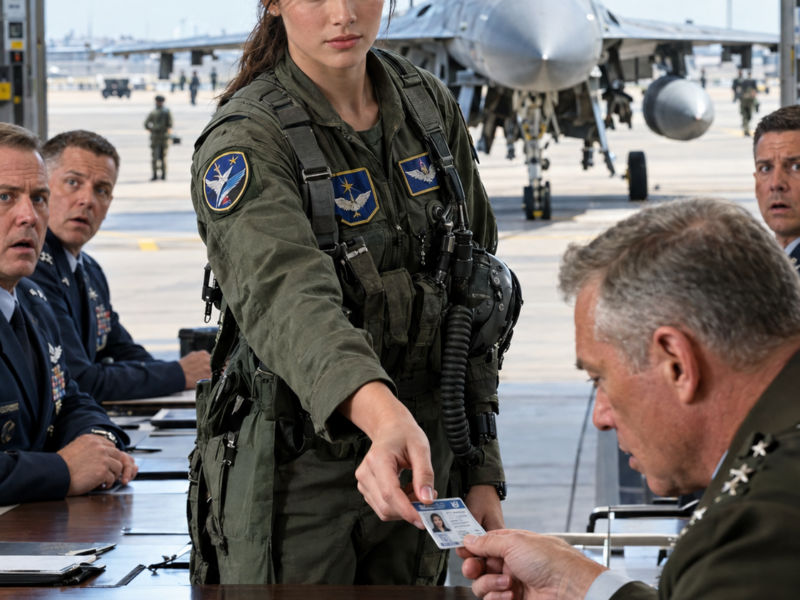
Colonel Richard Hayes held a young female officer’s pilot identification card up for the entire squadron to see
Colonel Richard Hayes held a young female officer’s pilot identification card up for the entire squadron to see, smirking as he demanded to know who had authorized her presence at Andrews Air Force Base. But when he read the number beneath her photograph, his smile vanished, his hands began to shake, and every officer in the room realized they were standing in front of the ghost of a pilot the United States military had declared dead twelve years earlier.
The rain had started before sunrise, turning the flight line at Joint Base Andrews into a sheet of black glass. Beneath the hangar lights, the angular silhouettes of parked aircraft gleamed against the gray morning. Somewhere beyond the concrete barriers, a turbofan engine wound down with a deep, uneven rumble that vibrated through the soles of every boot in the operations building.
Inside Briefing Room Three, the air smelled of burnt coffee, damp uniforms, and the sharp chemical trace of aviation fuel carried in on flight jackets.
Major Daniel Cross stood beside a wall-sized tactical display, explaining the day’s classified flight exercise to a dozen officers. Red and blue symbols crawled across a digital map of the Atlantic coast. Weather overlays showed a fast-moving storm system approaching from the southwest, while a separate screen displayed simulated radar returns from a training corridor.
At the rear of the room stood a woman in a plain olive flight jacket.
She wore no decorations on her chest. Her dark hair was pulled into a practical knot, and her black flight boots showed the scuffs of someone who had spent more time around aircraft than in offices. A thin folder rested beneath her arm.
Her name was Lieutenant Evelyn Mercer.
To most of the people in that room, she looked like someone who had taken a wrong turn on her way to an administrative appointment.
A young captain glanced at her temporary access badge.
“Ma’am, the personnel office is in the next building.”
Evelyn looked at him.
“I’m aware.”
He waited for her to explain herself.
She didn’t.
A few officers exchanged smiles.
At the head of the table, Colonel Hayes adjusted his immaculate uniform and turned toward her. At fifty-two, he had the broad shoulders, silver temples, and practiced expression of a man accustomed to having the last word. His reputation had been built on aggressive training schedules, uncompromising discipline, and a particular dislike of anyone who challenged him in public.
He had already spent twenty minutes asking why a lieutenant had been assigned to a restricted flight operation involving senior test pilots and special-mission aircraft.
Apparently, he had decided the answer was incompetence.
“Lieutenant Mercer,” he said, looking at a tablet. “Your personnel file says you were assigned here three days ago.”
“Yes, sir.”
“And yet you have no squadron patch, no operational qualification listed in the summary, and no authorization to attend this briefing.”
“The authorization is attached to my orders, sir.”
“Then perhaps you can explain why nobody in my command has seen those orders.”
“They were transmitted directly to the operations security office.”
A couple of officers looked down to conceal their amusement.
Hayes smiled without warmth.
“How convenient.”
Evelyn said nothing.
He turned back to the display and resumed the briefing. The exercise involved a high-speed interception profile, electronic surveillance, and a coordinated approach through a narrow weather corridor. Several aircraft would operate under instrument flight rules while a test platform collected data on radar performance in degraded conditions.
It was an ambitious schedule, especially with the approaching storm.
Evelyn studied the weather overlay.
Then she looked at the wind vector.
Her expression changed by less than an inch.
The displayed surface winds were consistent with the forecast, but the upper-level data told a different story. A narrow band of rapidly strengthening crosswinds was sliding toward the planned corridor. The wind field had shifted between the last two telemetry updates, yet the route-planning software was still extrapolating from the earlier profile.
She moved closer to the screen.
“Major Cross?”
The major paused mid-sentence.
“Yes?”
“May I see the raw wind data from the last telemetry update?”
Hayes exhaled loudly.
“Is there a reason we’re interrupting an operational briefing for a weather question?”
“The displayed wind field is lagging behind the latest observation, sir.”
Cross frowned and tapped his console. A second set of numbers appeared.
Evelyn leaned toward the display.
“That confirms it.”
Hayes folded his arms.
“Confirms what, Lieutenant?”
“The corridor is moving into a zone of increasing crosswind shear. Your projected interception point is based on the previous wind solution. If the aircraft reach the turn point on the scheduled timing, the formation could encounter a much steeper wind gradient than the briefing predicts.”
The room quieted slightly.
One of the test pilots, Captain Marcus Reed, looked at the data.
“The forecast shows a moderate change.”
“The forecast does,” Evelyn replied. “The measured data doesn’t.”
She pointed to a narrow discontinuity in the upper-level wind plot.
“The second observation is being smoothed into the previous sample. Look at the timestamps. The sensor update arrived, but the route model hasn’t incorporated the full change.”
Cross checked the figures.
For the first time that morning, his expression became serious.
“She’s right about the timestamps.”
Hayes looked irritated.
“That doesn’t establish that the route is unsafe.”
“No, sir,” Evelyn said evenly. “It establishes that the route solution is no longer current. The aircraft could still fly it, but the separation and timing calculations should be reviewed before anyone launches.”
There was no triumph in her voice. She sounded as though she were pointing out a loose panel fastener.
That seemed to annoy Hayes more than an argument would have.
“Are you a meteorologist now?”
“No, sir.”
“An avionics engineer?”
“No, sir.”
“Then perhaps you should let the people responsible for those systems do their jobs.”
Evelyn lowered her hand.
“Understood.”
Captain Reed continued studying the plot. The numbers bothered him, even if he wasn’t prepared to say so aloud.
Hayes noticed.
“Captain, do you have a concern?”
Reed straightened.
“Not yet, sir.”
“Good. Then let’s proceed.”
Evelyn returned to the back of the room, but her attention remained on the display. The latest wind reading was now nearly seven minutes old. In stable weather, that might have been acceptable. In a rapidly developing system, it was a lifetime.
She glanced toward the secure communications terminal.
A yellow status indicator blinked beside the weather-data feed.
The backup source had stopped updating.
That was the second anomaly.
The first could have been a software delay. The second suggested a problem with the data path itself.
She opened her folder and checked the printed telemetry summary she’d received before entering the room. The backup sensor had reported a sudden pressure change along the same corridor less than half an hour earlier.
She remembered the figure.
She also remembered the oddity in the pressure trend: a drop too localized to match the broad storm system, but too persistent to dismiss as a single faulty reading.
Something was developing over the water.
And the briefing was sending aircraft toward it.
“Colonel,” she said, “I recommend holding the launch until the weather feed is independently verified.”
Hayes slowly turned around.
“That is the second time you’ve interrupted me.”
“The backup sensor has stopped updating.”
“Then the technicians will fix it.”
“The pressure readings are inconsistent with the current forecast.”
“And you have determined that from a printed summary?”
“From the summary, the timestamps, and the last two telemetry returns, sir.”
Hayes stepped away from the table.
“You have been in my building for three days, Lieutenant. I have pilots with thousands of hours of experience preparing for this operation. I have engineers who designed the equipment you’re questioning. And I have a schedule approved at a level you apparently don’t understand.”
Evelyn met his eyes.
“Then verifying the feed should be straightforward.”
A sharp breath escaped someone near the window.
Hayes stared at her.
The silence that followed was no longer amused.
It was dangerous.
“Give me your pilot identification.”
Evelyn reached into the inner pocket of her flight jacket and handed him the card.
He held it between two fingers, as if it were evidence of some minor administrative offense.
“You will explain why a lieutenant with no current operational assignment has been allowed into a restricted briefing.”
He turned the card over.
Then he looked at the photograph.
His eyebrows drew together.
The photograph showed Evelyn at approximately twenty-four, wearing a dark flight suit, her hair tucked beneath a helmet, the expression in her eyes far more severe than the one she wore now.
Hayes looked at the identification number.
His smirk disappeared.
He brought the card closer to his face.
Then he checked the number again.
“No,” he whispered.
Evelyn’s fingers tightened once around the edge of her folder.
She had spent twelve years expecting someone, somewhere, to recognize that number.
She had not expected it to happen here.
Hayes looked up.
“Where did you get this?”
“It’s my assigned identification, sir.”
“Don’t play games with me.”
“I’m not.”
He turned toward the security officer beside the door.
“Lock this room down. Nobody leaves.”
The door shut with a heavy mechanical click. Two armed security personnel moved into position while the officers around the table exchanged uneasy glances.
Hayes carried the card to the briefing console and entered the identification number into the restricted personnel database.
For several seconds, the screen remained blank.
Then the display flashed red.
RESTRICTED RECORD — ACCESS REVOKED BY ORDER OF THE JOINT CHIEFS.
Below it appeared a second line.
SUBJECT STATUS: DECEASED.
Nobody spoke.
Major Cross moved closer to the screen.
“Sir, what is that?”
Hayes didn’t answer.
He tried another access route, entered a verification code, and waited.
The database returned a single archived record.
MERCER, EVELYN A.
CALL SIGN: WRAITH.
STATUS: KILLED IN ACTION.
INCIDENT: BLACK RIDGE.
The colonel stepped backward as though the monitor had struck him.
“That’s impossible.”
Evelyn felt the room tilt around a memory she had spent years trying to bury.
Black Ridge.
She had been sixteen when two men in civilian clothes arrived at her family’s house. They wore no uniforms and carried no visible weapons. One presented her mother with a sealed envelope. The other stood in the doorway, looking past the family photographs as if he were searching for something.
They said Captain Daniel Mercer had died during a classified reconnaissance mission.
They said the operation had gone wrong.
They said his body could not be recovered.
Three days later, a folded flag was placed in her mother’s hands beside a sealed coffin.
Evelyn had never believed the coffin contained her father.
She had never said so aloud.
For twelve years, she had lived with the unanswered questions, the closed investigations, the missing records, and the carefully worded condolences from men who refused to meet her eyes.
Now a colonel she had never met was staring at her as if she had returned from the dead.
Hayes lowered the identification card.
“That pilot died twelve years ago.”
Evelyn’s voice remained steady.
“Then why is her number still active?”
The colonel looked at her.
For the first time, he appeared to understand that he wasn’t the only person in the room who knew something was wrong.
He turned toward the security officer.
“Take her into custody.”
Neither guard moved immediately.
Hayes’s face darkened.
“That was an order.”
Evelyn placed her folder on the table.
“Colonel, before you do that, you should check the current aircraft telemetry. The weather feed is still frozen.”
“Get her out of my sight!”
She collected her folder, tucked it beneath her arm, and walked toward the door without arguing.
She did not threaten him. She did not demand an explanation. She did not tell the room what the call sign Wraith meant to the people who had once flown beside her.
But as she passed the tactical display, she saw the launch countdown advance.
Four minutes.
The wind vector had shifted again.
The backup feed remained dead.
And one of the aircraft assigned to the exercise had already begun taxiing toward the runway.
Evelyn stopped.
The others kept watching her.
“Colonel,” she said quietly, “if that aircraft launches on the current route solution, it may enter the shear before the system recognizes the change.”
Hayes’s jaw tightened.
“Security. Now.”
Evelyn looked at the countdown one last time, then continued through the door.
Outside, rain hammered the covered walkway. Red warning lights reflected across the wet concrete as ground crews hurried between aircraft. A transport helicopter idled near the far end of the flight line, its rotor wash scattering water into silver sheets.
The smell of JP-8 hung heavy in the cold air.
Then a siren sounded.
Not the routine alert announcing a weather hold.
The emergency launch alarm.
Evelyn turned toward the runway.
A test aircraft had just lifted off.
Its nose rose into the gray sky, but the climb looked wrong. The pilot corrected left, then right, fighting a gust that should not have reached that part of the corridor yet. A burst of static crackled from the outdoor speaker.
“Tower, Raven Two. We’re getting an unexpected air-data disagreement. Indicated airspeed is fluctuating. Request immediate vectors.”
A second voice cut in.
“Raven Two, confirm altitude. Your telemetry is dropping.”
The aircraft banked sharply.
On the flight line, ground personnel stopped moving.
Evelyn could see the danger in the aircraft’s unstable corrections. The pilot was receiving conflicting information and trying to reconcile it while flying into worsening conditions.
The tower’s response came through the speaker, clipped and strained.
“Raven Two, maintain assigned heading. Do not deviate from the published profile.”
Evelyn looked toward the operations building.
The colonel was still inside.
The pilot was running out of time.
She started toward the communications station.
A security guard stepped into her path.
“Lieutenant, you’re under orders to remain outside.”
“Move.”
“Ma’am—”
The aircraft lurched against the storm, its wings flashing pale beneath the clouds.
Evelyn’s eyes locked on the telemetry display visible through the station window.
The problem wasn’t simply the weather.
One of the air-data channels was disagreeing with the others, and the flight-control system was trying to compensate for a measurement that no longer matched the aircraft’s actual motion. The pilot needed accurate information and a safe way out of the developing shear, not another instruction to hold a heading that had become dangerous.
She reached for the radio.
The guard caught her sleeve.
“Do not touch that equipment!”
Evelyn turned toward him.
“If you want to explain to his family why you stopped me, you can do it after we get him home.”
Something in her expression made the guard hesitate.
She slipped past him, entered the station, and took the spare headset from its cradle.
“Raven Two, this is ground operations. Identify your current flight-control status.”
Static.
Then a breathless reply.
“Ground, Raven Two. Air-data disagreement is worsening. I’m getting conflicting indications, and the aircraft isn’t responding the way it should.”
Evelyn watched the display.
“Raven Two, acknowledge. Do not make another abrupt correction. Confirm your flight-control warnings and follow your aircraft’s approved emergency procedures.”
A warning tone sounded behind her as the station’s door slammed open.
Colonel Hayes strode inside, followed by Major Cross and two armed guards.
“Put the headset down!” Hayes shouted. “You are not authorized to communicate with that aircraft!”
Evelyn didn’t turn.
On the screen, Raven Two drifted toward the edge of its assigned corridor.
The pilot’s voice broke through the static.
“Ground, I’m losing confidence in the airspeed indications. I need someone who understands what this aircraft is doing.”
Hayes lunged for the console.
Evelyn moved the headset closer to her mouth.
“Raven Two, listen carefully. Your instruments are giving you conflicting information. Stay ahead of the aircraft, use your approved standby references, and tell me exactly what warnings you’re seeing.”
“Who is this?” the pilot demanded.
Hayes reached for the radio.
Evelyn caught his wrist.
For one suspended second, the colonel stared at the woman he had ordered removed from his briefing room.
Then a new voice broke across the secure communications channel.
It was older, roughened by static and years of silence, but the authority in it made every person in the station freeze.
“All stations, stand by. Authenticate the operator currently transmitting on the ground emergency frequency.”
A pause.
Then the voice returned, sharper.
“Her identification is valid. Her operational record is sealed under Joint Chiefs authority. The officer you are attempting to remove is Captain Evelyn Mercer, call sign WRAITH.”
The room went utterly silent.
The speaker continued.
“She was the lead pilot on Black Ridge. She is not to be detained. All personnel will render appropriate military honors.”
Colonel Hayes went white.
Major Cross snapped to attention.
The armed guards straightened as though a single command had pulled them upright. Across the station, officers, pilots, and security personnel turned toward Evelyn and raised their hands in a rigid salute.
Evelyn kept the headset pressed to her ear.
Then the voice on the radio spoke again, low enough that only those nearest the console could hear it.
“Captain Mercer, if you can hear me, your father is alive.”
For three seconds after the voice on the radio said her father was alive, Captain Evelyn Mercer forgot the aircraft, the storm, and the dozen people standing rigidly behind her.
Her father was alive.
The words should have brought relief. Instead, they opened a wound that twelve years of unanswered questions had never managed to close.
She tightened her grip on the headset.
“Identify yourself.”
Colonel Richard Hayes stared at her as though she had just committed an act of treason.
The voice on the radio answered without hesitation.
“General Thomas Whitaker, Joint Special Operations Command. Authentication code follows.”
A sequence of numbers came through the secure channel.
Evelyn closed her eyes.
She knew the pattern.
Her father had taught it to her when she was a child, long before she understood why he sometimes woke at three in the morning and checked every window in their house. It wasn’t a conventional military authentication sequence. It was a personal challenge-and-response protocol used by a small reconnaissance unit whose existence had never appeared in public records.
She answered with the correct response.
The general exhaled.
“Good God. It really is you.”
“General, where is my father?”
“Not on this channel.”
“Then put me on one where you can tell me.”
Hayes stepped toward the console.
“General Whitaker, Colonel Richard Hayes, Andrews operations command. I need an explanation for why a deceased officer has just assumed control of an active emergency frequency.”
Whitaker’s response came back cold.
“Colonel, you need to explain why you have interfered with a verified emergency transmission from an officer whose record is restricted above your current authorization.”
Hayes stiffened.
“With respect, sir, she entered a classified briefing without proper identification.”
“She entered with valid credentials. You failed to recognize them.”
“I followed security procedures.”
“You attempted to remove the pilot who may be the only person on your base capable of helping that aircraft.”
The colonel glanced at the telemetry screen.
Outside, the storm was swallowing the runway lights.
Raven Two was still airborne.
Evelyn pulled the flight display closer. The aircraft’s projected position flickered across the screen, while its reported airspeed continued to disagree with the ground-based tracking data.
She didn’t waste another second on the argument.
“Raven Two, this is Wraith. Confirm your current configuration and the warnings on your display.”
A burst of static answered her.
Then the pilot’s voice emerged, strained but controlled.
“Wraith, Raven Two. I’ve got an air-data fault, intermittent flight-control warnings, and a rapidly changing wind picture. I’m getting contradictory information from the primary displays.”
Evelyn studied the telemetry.
“Understood. Are you experiencing unusual control forces, or are the indications disagreeing without a corresponding change in aircraft response?”
“Both. I make a small correction, and the response feels delayed. Then the next correction comes in harder than expected.”
Evelyn’s gaze moved to the aircraft’s recorded attitude changes.
The pilot was fighting more than one problem. The air-data disagreement was complicating his assessment, while the turbulence was making the aircraft’s response difficult to predict.
She needed to know whether the control problem was genuine, whether the instruments were misleading him, or whether both faults were interacting.
“Raven Two, avoid abrupt control inputs. Follow your aircraft’s approved emergency checklist, and tell me what the standby instruments show.”
Hayes leaned over her shoulder.
“You cannot direct that pilot without knowing the full failure mode.”
“Correct,” Evelyn replied. “Which is why I’m asking him to establish what information he can trust.”
She didn’t look at the colonel again.
The pilot reported the standby indications. Evelyn compared them with the ground track and the last reliable telemetry update. One discrepancy stood out: the aircraft’s reported motion did not align with the ground-based position changes.
The weather was worsening, but weather alone could not explain everything.
She turned toward Major Cross.
“Pull the maintenance history for Raven Two. I want the most recent air-data system work, the last flight-control test, and any unresolved discrepancies.”
Cross moved immediately.
Hayes watched him go.
“Major, I did not authorize—”
“Sir,” Cross said, already at the terminal, “the aircraft is in an emergency.”
It was the first time anyone had interrupted Hayes without apologizing.
The colonel’s face hardened, but he said nothing.
Evelyn continued monitoring the radio. She could hear the pilot breathing through the headset, the faint clicks of cockpit switches, and the sharp electronic warnings behind his voice.
She remembered those sounds.
Twelve years earlier, they had filled her own cockpit as Black Ridge disintegrated around her.
She had been twenty-four then, flying a classified reconnaissance profile with her father leading the mission. The official report claimed their aircraft had been lost in mountainous terrain after an equipment failure. The recovery team had found debris, damaged equipment, and enough fragments to declare both aircrew dead.
But no bodies had ever been recovered.
Evelyn remembered ejecting into freezing rain. She remembered a red warning light blinking through smoke, the violent snap of her parachute opening, and the distant thunder of aircraft she could no longer see.
She remembered waking in a medical facility without windows.
When she asked about her father, nobody answered.
When she asked to contact her mother, a doctor told her that her identity had been compromised.
Three weeks later, she was given a choice: disappear into a protected identity while an investigation continued, or risk exposing an operation that someone inside the command structure was determined to erase.
She had chosen to disappear.
The investigation had never officially ended.
Now, twelve years later, General Whitaker was telling her that her father was alive.
“General,” she said, “I want his location.”
“Captain, I understand.”
“No, sir. You understand the words. You don’t understand what they cost.”
The channel fell silent.
When Whitaker spoke again, his voice had changed.
“Your father was recovered after Black Ridge. He survived, but the mission exposed a network that was using classified flight operations to conceal unauthorized weapons transfers. Several people involved had access to the mission plans, the telemetry, and the recovery orders.”
Evelyn looked at Hayes.
The colonel’s expression had become unreadable.
“Who?” she asked.
“We’re still establishing the full extent of the network.”
“Then why tell me now?”
“Because someone just attempted to kill one of our pilots using a failure pattern that resembles the original Black Ridge incident.”
The room seemed to grow colder.
Evelyn turned toward the telemetry screen.
“You’re saying Raven Two’s emergency may not be an accident.”
“I’m saying we have evidence that requires immediate investigation.”
Major Cross returned with a maintenance report.
“Captain, I found something.”
He placed the report beside the console.
“The air-data system was serviced forty-eight hours ago. The final test was signed off, but the record shows a replacement component was installed without the usual independent verification.”
Evelyn read the entry.
Then she read it again.
The component itself was approved. The installation record looked ordinary at first glance, but the sign-off timestamps were out of sequence. The final inspection had supposedly occurred before the maintenance entry was closed.
That didn’t prove sabotage.
It did prove the paperwork could not be trusted.
“Who signed the inspection?” she asked.
Cross checked the record.
“Staff Sergeant Miller.”
“Where is he?”
“Maintenance control, last I heard.”
“Get him on a secure line. Don’t accuse him of anything. Ask him to preserve every record connected to this aircraft.”
Cross nodded.
Hayes stepped forward.
“Enough. This is now a formal security investigation. Captain Mercer, you will surrender the headset and remain available for questioning.”
Evelyn finally turned to face him.
“Colonel, the aircraft is still airborne.”
“And I am responsible for this installation.”
“Then act like it.”
The words landed harder than a shout.
Hayes’s face reddened.
“You will not speak to me that way.”
“Then give me a reason to discuss something else.”
For a moment, it looked as though he might order the guards to seize her.
Then Raven Two’s warning alarm sounded through the communications speaker.
“Ground, Raven Two. The aircraft is becoming increasingly difficult to control. I need an immediate decision.”
Evelyn returned to the console.
“Raven Two, acknowledge. Continue your approved emergency procedures. Tell me whether the control response is becoming more predictable or less predictable.”
“Less predictable.”
She glanced at the weather display.
The storm had advanced beyond the forecast boundary. Rain was hammering the station’s windows, and the wind readings were changing faster than the tactical software could refresh.
The aircraft could not remain in the worst of that weather indefinitely.
But she wasn’t going to give the pilot an improvised maneuver based on incomplete data.
She needed an authorized recovery plan, accurate aircraft information, and a decision from someone who understood both the aircraft and the risks.
“Major Cross,” she said, “get the squadron’s qualified flight-control specialist on the line. I want the emergency checklist and the aircraft’s verified configuration in front of us.”
Cross was already moving.
Hayes looked toward the general’s secure channel.
“Sir, with respect, this operation is now beyond the scope of a routine flight emergency.”
Whitaker answered immediately.
“Agreed. Colonel Hayes, you are relieved of operational control of this incident pending review.”
The colonel froze.
“You cannot relieve me on an unsecured—”
“This is a secure command channel, Colonel. Your authority over this emergency is suspended. Major Cross will coordinate with Captain Mercer until an authorized incident commander assumes control.”
Hayes stared at the headset.
Then he slowly stepped away from the console.
Evelyn didn’t celebrate.
She had no interest in humiliating him. She wanted the aircraft on the ground, the pilot alive, and the truth about Black Ridge uncovered.
“General,” she said, “I need to speak with my father.”
Whitaker paused.
“I’ll arrange it.”
“When?”
“As soon as we secure the situation.”
“That’s what they told my mother twelve years ago.”
The general didn’t answer immediately.
When he finally spoke, the words were quiet.
“Your father has been trying to reach you for years. Every attempt was intercepted. We believed the channels were compromised, but we couldn’t identify how deeply.”
Evelyn felt the old anger rise, sharp and familiar.
“Who intercepted them?”
“We have a name.”
She leaned closer to the microphone.
“Say it.”
“Not until I can verify the evidence.”
A sudden burst of static swallowed the channel.
Every display in the operations station flickered.
The tactical map went black, returned, and then filled with red warning symbols.
Major Cross looked up from his terminal.
“Captain, we’ve lost the primary weather feed.”
“Switch to the independent source.”
“It’s not responding.”
“Local sensors?”
“Partially available.”
The emergency radio crackled.
Raven Two’s pilot sounded frightened now.
“Ground, Raven Two. I have a new warning. I can’t confirm the aircraft’s configuration.”
Evelyn’s blood turned cold.
“What warning?”
“Flight-control system fault. I’m getting a configuration message that wasn’t there thirty seconds ago.”
Cross examined the data.
“That shouldn’t happen from the air-data discrepancy alone.”
“No,” Evelyn said. “It shouldn’t.”
She studied the last available telemetry. The aircraft was still transmitting, but the data stream had begun dropping packets. Somewhere between the aircraft and the ground, information was disappearing.
She looked at the network status.
A new indicator appeared.
REMOTE MAINTENANCE CONNECTION — ACTIVE.
Evelyn stared at it.
“Major, who authorized a remote connection to an airborne test aircraft?”
Cross’s face drained of color.
“No one in this room.”
The connection terminated.
For several seconds, nobody moved.
Then a message appeared on the console, written in a format that resembled a routine maintenance acknowledgment.
BLACK RIDGE PROTOCOL: PHASE TWO INITIATED.
Evelyn felt the room disappear around her.
She knew those words.
They had appeared on a display twelve years earlier, just before her father’s aircraft vanished from radar.
The same phrase.
The same sequence.
The same impossible signature.
She reached for the secure handset.
“General Whitaker, you need to listen carefully. This is not simply a maintenance failure. Someone has activated a system connected to Black Ridge.”
No answer came.
She tried again.
“General, respond.”
Only static.
Then the emergency channel opened by itself.
A man’s voice emerged, calm and deliberate.
“Captain Mercer. You’ve been difficult to find.”
Evelyn stood perfectly still.
She recognized the voice.
It belonged to the man who had stood beside her mother’s front door twelve years ago, carrying the envelope that declared her father dead.
The man who had looked at a sixteen-year-old girl and promised that the military would take care of her family.
The man she had never forgotten.
He spoke again.
“Your father should have stayed buried.”
The connection died.
Outside, lightning illuminated the flight line.
On the main display, Raven Two’s position marker began drifting toward the storm’s darkest region.
Evelyn removed the headset, set it down carefully, and looked at Major Cross.
“Get me the aircraft’s verified technical data, the full maintenance history, and an independent weather picture. Lock down every connection to that aircraft.”
Cross nodded.
“And if the connection comes back?”
Evelyn looked at the red message still glowing on the screen.
“Then we find out who’s on the other end.”
A final alert appeared.
RAVEN TWO — EMERGENCY RECOVERY REQUIRED.
The pilot’s voice broke through the radio once more.
“Wraith, I need you. I’m running out of options.”
Evelyn put the headset back on.
“I’m here, Raven Two.”
Then, for the first time in twelve years, she used the name she had been ordered to forget.
“This is Wraith. We’re bringing you home.”
The emergency siren at Joint Base Andrews had been screaming for eleven minutes when Captain Evelyn Mercer made a decision that Colonel Richard Hayes would remember for the rest of his career.
She was going back into the sky.
Not as a passenger. Not as an observer. Not as the dead pilot whose name had been buried in a classified database.
She was going to fly.
Outside the operations building, the storm had swallowed most of the runway lights. Rain swept across the concrete in silver sheets, and gusts shoved water beneath the hangar doors. Ground crews hurried toward shelter while warning beacons painted the aircraft shelters in alternating flashes of red and amber.
Inside the tactical center, every available display showed some variation of the same nightmare.
RAVEN TWO was airborne, experiencing a flight-control emergency, and drifting toward a storm system that had advanced far faster than the forecast predicted.
The aircraft was still transmitting, but its telemetry had become unreliable. The maintenance network had recorded an unauthorized connection. And someone had invoked a classified protocol associated with an operation that officially had never gone wrong.
Major Daniel Cross approached Evelyn with a tablet.
“Captain, we have the latest maintenance records. The replacement air-data component passed its initial bench test, but the independent verification was never completed.”
Evelyn scanned the report.
“Who released the aircraft?”
“Staff Sergeant Miller signed the maintenance entry. He says the paperwork was already approved when he arrived for his shift.”
“Who approved it?”
Cross hesitated.
“The authorization traces back to the command maintenance office.”
“Name?”
“Colonel Hayes’s office.”
The colonel, standing several feet away, snapped his head around.
“I never authorized a technician to bypass a required inspection.”
Evelyn looked at him.
“Then someone used your authority.”
Hayes’s face tightened.
“Are you accusing my staff of sabotage?”
“I’m saying that the aircraft’s maintenance record is inconsistent, the telemetry feed was compromised, and an unauthorized connection appeared during an emergency. We can argue about the reason after the pilot is safe.”
For once, Hayes had no immediate response.
Evelyn turned back to Cross.
“How long until the aircraft reaches the outer edge of the storm?”
“Based on the last reliable position, less than twelve minutes.”
“And the recovery window?”
“If the aircraft remains controllable, the weather may leave us a narrow opening.”
“May?”
Cross swallowed.
“The wind profile is changing too quickly for a reliable estimate.”
Evelyn nodded once.
That was enough.
She walked to the operations desk and placed both hands on the console.
“Contact the squadron commander. I need the aircraft’s approved emergency recovery procedure, the verified configuration, and an authorized recovery plan. Tell the tower to prepare for an emergency arrival and keep the runway clear.”
Cross began issuing instructions.
Hayes stepped into her path.
“Where do you think you’re going?”
“To the flight line.”
“You are not cleared to fly.”
“My operational record says otherwise.”
“Your record says you’re dead.”
Evelyn looked at him for a long moment.
“Then perhaps someone should have checked the record before sending an aircraft into the storm.”
She walked past him.
Hayes followed.
“Mercer, stop!”
She continued toward the exit.
“I am ordering you to remain on this base until this investigation is complete.”
Evelyn pushed through the door into the rain.
“Then investigate quickly, Colonel.”
The wind struck her hard enough to make her jacket snap against her shoulders. Across the flight line, a pair of maintenance trucks crawled toward the hangars, their headlights cutting pale tunnels through the rain.
She headed for the hardened aircraft shelter at the eastern end of the apron.
Inside stood an F-16 assigned to the base’s test and evaluation detachment. Its gray fuselage gleamed beneath the overhead lights, and rainwater streamed from its wings onto the concrete floor.
A crew chief looked up as Evelyn entered.
“Ma’am, the shelter is closed. We’re suspending flight operations.”
“Not all operations.”
She glanced over the aircraft, taking in the external panels, the landing gear, and the visible condition of the control surfaces. A technician had left a maintenance stand near the nose. The crew chief stood beside a checklist clipped to a board.
Evelyn stopped beside him.
“What’s the status of this aircraft?”
The crew chief blinked.
“Mission-capable for the scheduled evaluation, but we haven’t completed the post-maintenance release.”
“How much remains?”
“Final inspection, documentation, and the command authorization.”
“Then nobody touches it until the inspection is complete.”
He stared at her.
“Ma’am?”
“Check the maintenance records against the actual configuration. I want every discrepancy resolved before anyone signs the release.”
The crew chief looked toward the shelter entrance, where Hayes had just appeared.
The colonel was soaked, furious, and accompanied by two security officers.
“You will not touch that aircraft,” he barked.
Evelyn turned.
“I haven’t.”
“You are suspended from flight duties pending a formal inquiry.”
“Then authorize another qualified pilot to take the recovery mission.”
Hayes opened his mouth.
Nothing came out.
Every pilot available for immediate response was either airborne, committed to another task, or waiting for a verified assessment of Raven Two’s emergency. The few remaining qualified personnel were already working through the storm recovery plan.
Evelyn knew it.
So did Hayes.
“You cannot simply walk into a shelter and decide you’re flying,” he said.
“I’m not deciding anything, sir. I’m identifying the available options.”
“Your judgment is not the issue.”
“Then the aircraft’s emergency should be.”
A gust shook the hangar doors.
Somewhere outside, a warning horn sounded.
The crew chief’s radio crackled.
“Operations to all ground units. Raven Two reports deteriorating control response. Estimated recovery time is now under eight minutes.”
Hayes looked toward the radio.
Evelyn looked at the F-16.
She could hear her father’s voice from another lifetime, teaching her that a pilot’s job was not to make the sky obey. It was to understand what the sky was doing before it became impossible to respond.
She had learned to read an aircraft through vibration, sound, and the small differences between what the instruments reported and what the machine actually did.
Black Ridge had taught her what happened when someone deliberately made those differences impossible to trust.
She stepped toward the crew chief.
“Call the squadron commander. Tell them I am available for an authorized recovery sortie, subject to the aircraft’s release and the commander’s approval.”
Hayes laughed once, bitterly.
“You expect me to sign off on that?”
“No, sir.”
“Then what exactly do you expect?”
“Someone with the authority to make the decision.”
The crew chief picked up his radio.
Hayes turned toward the security officers.
“Escort her from the shelter.”
Neither moved immediately.
The crew chief’s radio suddenly burst with the voice of General Whitaker.
“All personnel, this is General Whitaker. Captain Mercer is authorized to assist with the Raven Two recovery operation. Flight release remains subject to normal airworthiness and mission-clearance requirements. Colonel Hayes, you will not interfere with that authorization.”
Hayes went rigid.
“General, this is a direct violation of—”
“Colonel, I am aware of your objections.”
“She has no current flight assignment.”
“Her qualifications are being verified through a secure channel. Until then, you will preserve the aircraft and personnel needed for the recovery.”
The radio clicked off.
For a moment, the only sound in the shelter was the rain.
Then the crew chief straightened.
“Captain, I’ll get the inspection team moving.”
Evelyn nodded.
“Thank you.”
She did not rush toward the aircraft. She waited while the crew chief checked the documentation, confirmed the configuration, and called the maintenance supervisor. The shelter’s technicians moved with the focused urgency of people who understood that an emergency did not excuse a careless mistake.
Evelyn watched the work without interfering.
When a technician reached for a panel that had not been cleared for inspection, she stopped him.
“Check the maintenance release first.”
He glanced at the clipboard, then at the panel.
“You’re right. That inspection hasn’t been signed off.”
“Then don’t open it.”
The technician corrected the paperwork and called his supervisor.
Hayes watched from the shelter entrance.
The woman he had dismissed as an administrative error was now the calmest person in a building full of people trying to outrun a disaster.
His radio crackled again.
“Operations to shelter personnel. Raven Two has lost its primary data link.”
The crew chief looked at Evelyn.
“Captain?”
She was already moving toward the communications station.
“Tell the tower to maintain the emergency channel. We need the pilot’s voice, not a disappearing stream of numbers.”
She put on the headset.
“Raven Two, this is Wraith. Do you read?”
For several seconds, there was nothing but static.
Then a faint voice emerged.
“Wraith, Raven Two. Reading you intermittently.”
“Understood. Are you still receiving the standby indications?”
“Affirmative, but I’m not confident in the primary display.”
“Then continue with the approved emergency procedure. Report what the aircraft is doing, not what you think the instruments want you to see.”
A pause followed.
“Understood.”
Evelyn listened to the engine noise in the background, the pilot’s breathing, and the faint electronic tones bleeding through the microphone.
She could not see his cockpit. She could not feel the control response through the seat or read his expressions. All she had was his description, intermittent telemetry, and the aircraft’s verified technical documentation.
She needed to be careful.
“Raven Two, tell me whether the control response changes when the turbulence eases.”
The pilot took a breath.
“Affirmative. It’s more predictable between gusts.”
That mattered.
It suggested the weather was amplifying the problem rather than fully explaining it. But it did not establish the precise fault.
Evelyn kept her voice level.
“Copy. Don’t chase every instrument fluctuation. Use the approved references and procedures for your aircraft, and tell me immediately if the control response changes.”
“Copy, Wraith.”
Then a new voice broke across the emergency channel.
It was the same calm, deliberate voice that had appeared during the maintenance-network intrusion.
“Captain Mercer, you should have stayed buried.”
Evelyn’s face became still.
The crew chief turned toward her.
“Did you hear that?”
She held up one finger, signaling for silence.
The voice continued.
“Your father made the same mistake. He thought he could bring the truth home.”
Evelyn pressed the transmit switch.
“Who is this?”
A faint laugh crackled through the speaker.
“You already know.”
“Then you know I won’t stop until I find you.”
“That’s what we’re counting on.”
The transmission ended.
Evelyn removed the headset for a moment and looked at the crew chief.
“Record that transmission. Preserve the raw audio and timestamps. Don’t route it through the maintenance network.”
He nodded.
“Understood.”
She returned to the headset.
“Raven Two, are you still with me?”
“Affirmative. I’m still here.”
“Good. Stay focused on the aircraft and your approved recovery procedure. We’re working on getting you home.”
A new alarm sounded from the communications console.
The maintenance-network status had changed again.
REMOTE CONNECTION ATTEMPT BLOCKED.
Then another line appeared.
AUTHORIZATION SOURCE: COMMAND ACCESS NODE.
Major Cross came over the radio.
“Captain, we’ve isolated the aircraft’s maintenance link from the ground network. The connection attempt appears to have originated from a command-level account.”
“Can you identify the account holder?”
“Not yet. The credentials were routed through an internal relay.”
Evelyn glanced toward Hayes.
He was standing alone near the shelter entrance, staring at his radio.
She couldn’t tell whether he was frightened, angry, or beginning to understand how badly his command had been compromised.
She wasn’t prepared to trust him.
She wasn’t prepared to accuse him, either.
Not without evidence.
“Major, preserve the logs and have an independent security team verify the source. Nobody involved in the original maintenance authorization should have access to the evidence.”
“Understood.”
Evelyn removed the headset and faced the crew chief.
“What’s the status of the F-16?”
“Inspection is complete. The aircraft is serviceable for its approved mission, pending final release and weather authorization.”
“Good. Keep the documentation with the aircraft.”
She looked toward the rain-smeared shelter doors.
The F-16 was not Raven Two. It was not configured to duplicate the test aircraft’s mission, and she would not pretend that climbing into another jet automatically made the emergency solvable.
But it could provide a qualified airborne platform for a separately authorized assessment if the commander determined that was necessary and the weather and aircraft limitations permitted it.
That distinction mattered.
Her father had taught her that courage without judgment was simply another way to lose an aircraft.
The radio crackled.
“Captain Mercer,” General Whitaker said, “your operational qualifications have been authenticated. The recovery commander is reviewing the available options. Stand by for a decision.”
Evelyn answered immediately.
“Understood, General.”
Then she added, “I need the truth about Black Ridge.”
Whitaker was silent for several seconds.
“When Raven Two is safe, I’ll tell you what I can.”
“No more sealed coffins. No more anonymous voices. No more promises that the truth will come later.”
“I understand.”
“Do you?”
The general exhaled.
“Yes, Captain. I do.”
The channel went quiet.
Outside the shelter, a fresh gust drove rain across the apron. The F-16’s navigation lights glowed beneath the overhead lamps, and the aircraft’s dark canopy reflected the red warning beacons.
Evelyn walked toward it but stopped at the ladder.
For twelve years, she had believed the cockpit was the one place where the rules made sense. The aircraft did not care who your father was, what rank you wore, or what secrets were hidden in your personnel file. It responded to physics, configuration, and the decisions made by the person in the seat.
But Black Ridge had changed that.
Someone had turned the systems she trusted into weapons. Someone had erased her identity, falsified a death, and spent twelve years making certain she stayed silent.
Now that person was reaching for another aircraft.
And her father was somewhere out there, alive, hunted, and running out of time.
Evelyn placed one gloved hand against the F-16’s fuselage.
“I’m coming,” she whispered.
Her radio snapped alive.
“Captain Mercer, this is recovery command. You are cleared to report to the squadron ready room for final mission authorization.”
She climbed down from the maintenance stand.
The crew chief handed her a sealed document packet.
“Captain, your flight gear is being brought over now.”
She took the packet.
“Thank you.”
At the shelter entrance, Colonel Hayes stepped into her path one final time.
“Mercer.”
She stopped.
His expression had changed. The contempt was gone, replaced by a grim uncertainty that made him look older.
“If your father really is alive, and if Black Ridge was compromised from inside this command, then we may be dealing with people who can reach anywhere on this base.”
Evelyn studied him.
“Yes, sir.”
Hayes swallowed.
“That means I may have been wrong about you.”
She held his gaze.
“You were wrong about the aircraft first, Colonel. I’m only the part you noticed.”
For several seconds, he said nothing.
Then he stepped aside.
Evelyn walked into the rain toward the ready room, her identification card secure inside her jacket and the call sign Wraith echoing through the radios around her.
Behind her, the F-16 waited beneath the hangar lights.
Ahead of her, the storm was closing over Raven Two.
And somewhere inside the command network, the person who had killed her identity twelve years earlier had just discovered that the ghost was flying again.
The storm had swallowed the western horizon by the time Captain Evelyn Mercer entered the ready room.
Rain hammered the narrow windows, and every few seconds lightning illuminated the airfield in a violent white flash. Beyond the glass, ground crews hurried between shelters while the wind dragged sheets of water across the runway. The smell of wet concrete and aviation fuel seeped through the building whenever a door opened.
On the main display, Raven Two’s flight symbol flickered.
Then it vanished.
“Where is the aircraft?” Colonel Hayes demanded.
A controller leaned over his console, fingers racing across the keyboard.
“We still have intermittent telemetry, sir. The aircraft is transmitting, but the tracking feed is dropping out.”
“Then restore it.”
“We’re trying.”
Evelyn stood behind them, studying the display. She noticed something the others had overlooked: the aircraft’s reported position jumped several miles between updates, but its fuel estimate barely changed. The data wasn’t simply delayed. Some of it was inconsistent.
“Those coordinates aren’t reliable,” she said.
Hayes turned sharply.
“Did I ask for your assessment, Captain?”
“No, sir. But if Raven Two is where that screen says it is, the fuel and flight-time figures don’t agree.”
The controller stopped typing.
He compared the latest telemetry with an independent radar return.
“She may be right. We’re receiving conflicting position data.”
The room went quiet.
General Thomas Whitaker stepped toward the console.
“Give me the independent track.”
A second symbol appeared, faint but steady, moving toward a band of violent weather north of the airfield.
“Raven Two confirmed,” the controller said. “We have a weak return. The pilot is still airborne.”
Evelyn leaned closer.
“Can we establish voice contact?”
The radio operator tried.
Static answered.
Then came three clipped words, almost buried beneath the hiss.
“…controls… unstable…”
The transmission broke apart.
Hayes rubbed a hand across his jaw.
“We have a pilot in an aircraft with questionable telemetry, approaching a storm, and we can barely communicate with him.”
“Which means we should stop treating the display as the truth,” Evelyn replied.
Hayes faced her.
“And what would you have us do?”
“Give him a second set of eyes. Someone who can assess the situation independently and help guide him toward a safe recovery.”
“You’re proposing to fly into that weather?”
“I’m proposing we bring our pilot home.”
For several seconds, the only sound was the rain.
Whitaker looked toward the duty operations officer.
“Is Mercer’s aircraft ready?”
“Inspection is complete. The maintenance team has signed the release, and her flight authorization is in the system.”
“Then confirm every requirement before launch. No shortcuts. No assumptions.”
Evelyn nodded. She had no interest in proving herself by gambling with another pilot’s life. Courage meant nothing if it became an excuse to ignore a preventable risk.
Within minutes, she was moving toward the hangar.
The F-16 waited beneath the floodlights, its gray skin slick with rain. Ground personnel had completed their checks, and a crew chief stood beside the ladder, holding a final document.
“Captain Mercer. All required inspections are signed off. Your aircraft is released.”
She reviewed the paperwork, then looked him in the eye.
“Any unresolved discrepancies?”
“None recorded, ma’am.”
“Good. Keep the maintenance records and access logs preserved. Nobody alters those entries until the investigation team secures them.”
The crew chief hesitated, then nodded.
“Yes, ma’am.”
A voice sounded behind her.
“Captain.”
Hayes stood at the hangar entrance. For once, his expression held no trace of amusement.
“You understand this is an emergency recovery mission, not an opportunity to settle old scores.”
Evelyn fastened her flight gear.
“I’m going up for the pilot, Colonel. Nothing else.”
“And if you lose contact?”
“I follow my authorization, trust verified information, and avoid making a bad situation worse.”
Hayes seemed ready to challenge her. Instead, he stepped aside.
“Bring him home.”
Evelyn climbed into the cockpit.
The canopy came down with a solid mechanical thump, shutting away the rain and the watching faces. The familiar cockpit surrounded her. Displays glowed against the darkness. The engine’s rising whine vibrated through the seat, becoming a deep, physical roar.
For one fleeting instant, the smell of heated electronics and aviation fuel carried her back twelve years—to another aircraft, another storm, and a radio transmission that had ended with her father’s voice calling her name.
She closed her eyes for half a breath.
Not now, she told herself.
The past could wait.
“Tower, this is Mercer One. Requesting departure clearance for authorized emergency recovery.”
The response came promptly.
“Mercer One, clearance granted. Proceed under mission control direction. Weather is deteriorating rapidly.”
“Understood.”
The F-16 surged forward.
As the runway lights streaked beneath her, Evelyn felt the aircraft lift into the storm-dark sky. The airfield fell away behind her, replaced by clouds that flashed silver whenever lightning tore through them.
Her instruments remained steady.
For now.
“Mercer One, mission control,” Whitaker said over the radio. “We have a weak voice signal from Raven Two. You are cleared to assist with recovery. Do not pursue unidentified contacts without authorization.”
“Understood, General.”
A burst of static interrupted the channel.
Then Raven Two’s pilot came through, breathing hard.
“Mayday, mayday. Raven Two. I have degraded flight-control response and conflicting indications. I’m struggling to maintain a stable flight path.”
Evelyn’s jaw tightened.
“Raven Two, this is Mercer One. I hear you. You are not alone. Tell me what you can confirm about your aircraft, and disregard any indication you cannot independently verify.”
“Mercer One, I’m getting warnings that don’t make sense. The aircraft feels different every few seconds.”
“Copy. Stay with your approved emergency procedures and keep talking to me.”
She listened to his breathing, the pauses between his words, the subtle changes in his voice. Panic could make a pilot chase every warning at once. She needed him focused on what he could verify, not on what a malfunctioning display seemed to demand.
Then her own radar showed something unexpected.
A contact appeared near Raven Two.
It had no identifying code.
“Mission control, Mercer One. I have an unidentified contact near Raven Two. Request identification.”
The reply came after a pause.
“We have no authorized aircraft in that position.”
Evelyn watched the symbol hold near the damaged aircraft before shifting behind it.
“Can you confirm whether it’s crewed?”
“Negative. We cannot determine that from the available information.”
The unidentified contact disappeared.
Then Raven Two’s voice broke through again.
“Mercer One, something just passed beneath me. I saw a light, then lost it.”
Evelyn felt the old coldness settle in her stomach.
This was no longer simply a recovery in bad weather.
“Raven Two, maintain communication. I’m here.”
She kept her attention on the aircraft, the weather, and the changing information arriving through her headset. The storm had made every decision harder. The unreliable telemetry made every decision more dangerous.
Then the unknown contact reappeared.
Closer.
“Mercer One, mission control. We have a new report of an unidentified airborne object in your operating area. Exercise caution. We are attempting to establish its identity.”
“Copy.”
The contact’s track changed abruptly.
A warning sounded in Evelyn’s cockpit.
For one sharp second, the world narrowed to instruments, rain-streaked canopy, and the voice in her ear.
Raven Two’s pilot shouted, “I’m losing it! I can’t tell which indication is right!”
“Listen to me,” Evelyn answered, her voice firm without becoming loud. “You still have a choice. Don’t let the warnings make it for you.”
She studied the information available to her. The unknown contact was behaving erratically, while Raven Two’s reported position continued to contradict independent tracking. Whatever was happening, she could not safely assume that the picture on her screen was complete.
She requested updated guidance from mission control.
Then she made her decision.
Rather than chase the unidentified contact or make an aggressive move into the worst of the storm, Evelyn positioned herself to maintain contact with Raven Two while keeping room to respond to changing conditions. She coordinated with mission control and concentrated on giving the struggling pilot one consistent voice to follow.
It was not the dramatic maneuver Hayes might have expected.
It was better.
It was disciplined, deliberate, and built around bringing two aircraft home rather than winning an argument in the sky.
“Raven Two, I’m staying with you. We’ll work this one step at a time.”
For the first time, the other pilot’s breathing began to slow.
“Copy, Mercer One.”
Then a new transmission entered the channel.
It was not mission control.
It was not Raven Two.
A man spoke with unsettling calm, as though the storm outside were nothing more than background music.
“Evelyn Mercer.”
Her hands tightened around the controls.
The voice continued.
“You should have stayed dead.”
Before she could answer, the unidentified contact surged across her display. Raven Two’s telemetry collapsed into a cascade of contradictory warnings, and the radio filled with the pilot’s sudden cry.
“Mercer One, I’ve got another failure!”
Evelyn looked toward the dark wall of cloud ahead.
The recovery had become a race against a failing aircraft, a hostile mystery, and a storm that was closing around them both.
“Raven Two, stay with me,” she said. “We are bringing you home.”
But as she turned to reassess their options, a final message appeared on her secure display.
BLACK RIDGE PROTOCOL — SUBJECT MERCER CONFIRMED AIRBORNE.
Beneath it, a second line appeared.
AUTHORIZE FINAL MEASURE.
Evelyn stared at the words.
Twelve years ago, someone had erased her life.
Now that same shadow had followed her into the sky.
And whatever came next, it was no longer trying to keep her buried.
It was trying to make sure she never landed.
The warning on Evelyn Mercer’s display remained visible for three seconds.
Then it disappeared.
She did not waste time trying to bring it back.
“Mission control, Mercer One. I received an unauthorized message referencing Black Ridge Protocol. Preserve all secure-channel records and restrict access to the investigation team.”
General Whitaker answered immediately.
“Copy, Mercer One. We have the message logged. Your priority remains the recovery.”
“Understood.”
A burst of static swallowed the channel.
“Mercer One!” Raven Two’s pilot shouted. “My aircraft is responding again, but I don’t trust the indications. I’m getting conflicting information.”
Evelyn glanced at the instruments, then at the distant, wavering light that marked the other aircraft through the storm.
“Then we don’t make decisions based on information we can’t verify. Stay with your approved emergency procedures. Tell me what you can confirm.”
“Roger.”
She heard the strain in his voice. He was frightened, exhausted, and fighting the instinct to react to every new alarm.
She knew that feeling.
Twelve years earlier, she had been the one listening to a voice over a radio, trying to understand how an ordinary flight had become a nightmare. Her father had told her to trust her training. Then the transmission had ended, and the military had informed her that Captain Daniel Mercer was dead.
No body had ever been recovered.
No explanation had ever made sense.
Now someone was trying to repeat the same nightmare with another pilot.
Not today.
“Mission control,” Evelyn said, “I need updated weather and recovery options for both aircraft. Prioritize the safest available route, not the shortest.”
“Copy. Stand by.”
A moment later, Whitaker returned.
“Mercer One, conditions are deteriorating across your current area. We are coordinating a recovery plan with the airfield. You have authority to disengage if continuing becomes unsafe.”
Evelyn appreciated the distinction. The order was not to win. It was to make the right decision with incomplete information.
She looked toward Raven Two’s faint lights.
“Raven Two, do you hear me?”
“Loud and clear.”
“Good. Keep talking.”
They worked through the emergency one verified fact at a time. Evelyn refused to speculate about the unexplained warnings or the unidentified contact. She kept Raven Two focused on his aircraft, his authorized procedures, and the instructions issued through mission control.
Then the unknown contact vanished again.
This time, it did not return.
“Mission control,” Evelyn said, “the unidentified contact is no longer visible on my display.”
“Copy. We are checking independent surveillance feeds.”
A pause followed.
Then Whitaker spoke.
“Mercer One, we have no confirmation of an authorized aircraft in that position. Continue to treat the contact as unidentified.”
Evelyn looked through the canopy at the storm. Lightning flashed across the clouds, revealing a world of shifting silver and black.
Someone had known her name.
Someone had known she would fly.
And someone had attempted to interfere with an aircraft carrying a pilot who had done nothing except take off for a test mission.
She felt anger rising, hot and familiar.
She forced it aside.
Anger could wait until everyone was safely on the ground.
“Raven Two,” she said, “recovery remains our objective. You keep communicating. I’ll remain with you as authorized.”
“Copy, Mercer One. And… thank you.”
She did not answer immediately.
There had been a time when she would have given anything to hear her father’s voice one more time. Now she understood how much a single calm voice could mean to someone who believed he was running out of choices.
“You don’t owe me thanks,” she finally replied. “Just get home.”
The next several minutes stretched painfully.
Mission control coordinated the recovery. Ground personnel prepared for the approaching weather, while the operations team continued to investigate the conflicting aircraft data. Evelyn followed the authorized plan, keeping her attention on Raven Two and the changing conditions around them.
At last, the airfield appeared through a break in the clouds.
The runway lights formed a bright line in the darkness.
“Raven Two, Mercer One. The airfield is ahead. Follow the recovery instructions from mission control.”
“Copy.”
His voice was steadier now.
Evelyn remained alongside long enough to confirm that he had the necessary communication and guidance, then followed the separation and recovery instructions issued by the controller. There would be no last-second stunt, no unnecessary risk, no attempt to impress anyone watching from the ground.
There was only the job.
One aircraft reached the runway.
Its landing lights swept over the wet surface, and for a moment Evelyn could see the machine clearly through the rain. The wheels met the runway with a muted thump. The aircraft bounced once, settled, and continued down the strip as ground crews watched from their protected positions.
“Raven Two is down,” the controller announced.
Nobody in the operations room cheered.
Not yet.
They were waiting for the pilot to confirm that he was safe.
Seconds passed.
Then the radio crackled.
“Raven Two, on the ground. I’m safe.”
The room erupted.
Someone let out a breath that sounded almost like a laugh. A controller leaned back in his chair and covered his face with both hands. Even Colonel Hayes closed his eyes briefly.
General Whitaker stood motionless, listening to the pilot repeat his status.
Then he spoke.
“Good work, Raven Two. Follow ground instructions and proceed with the post-flight checks.”
Evelyn heard the words and felt the tension in her shoulders loosen for the first time since takeoff.
One pilot was home.
Now she had to bring herself back.
She followed her assigned recovery plan and returned to the airfield. The storm continued to buffet the aircraft, but the runway lights remained visible, and mission control guided her through the final stages.
She made no attempt to hurry.
When the F-16 touched down, the tires sent a fan of water across the runway. The aircraft slowed, turned, and taxied toward the designated area.
Evelyn shut down the engine.
Silence settled over the cockpit.
For a few seconds, she remained seated, listening to the cooling metal tick beneath her and feeling the last vibrations fade from the seat. Her gloves were damp. Her breathing was controlled. Her hands trembled slightly only after the danger had passed.
Then she opened the canopy.
Rain-cooled air rushed in.
A ground crew member approached, followed by General Whitaker, Colonel Hayes, and several members of the operations team.
Evelyn climbed down the ladder.
Whitaker reached her first.
“Captain Mercer. Raven Two is safe. The pilot is being evaluated, and the aircraft is secured.”
“Thank you, sir.”
“You did exactly what we needed you to do.”
Hayes stood a few steps behind him. The colonel who had demanded her identification in front of the entire room now looked at her with an expression that was difficult to read.
Finally, he extended his hand.
“Captain Mercer, I owe you an apology.”
Evelyn looked at his hand, then accepted it.
“For what, sir?”
“For assuming I understood your capabilities before I understood your record.”
“That record was sealed for a reason, Colonel.”
His expression tightened.
“Yes. And I intend to find out why.”
Whitaker motioned toward the operations building.
“We have more to discuss.”
Inside, the atmosphere had changed completely. The same officers who had questioned Evelyn’s identity now stood aside as she entered. Nobody demanded that she prove she belonged there. Nobody made a joke about her age, her rank, or the call sign that had appeared on the authentication screen.
But Evelyn barely noticed.
Her attention was fixed on the secure display at the front of the room.
The unauthorized message had been preserved.
So had the access records connected to Raven Two’s telemetry disruption. Investigators were examining the discrepancies, the maintenance release, and the remote connection that had appeared during the emergency.
Nothing yet proved who was responsible.
But the evidence was no longer disappearing into the same sealed files that had swallowed her life.
Whitaker turned toward her.
“Captain, I want you to know something. Whatever happened at Black Ridge, you will not be asked to investigate it alone.”
Evelyn studied him carefully.
“Then I need an answer, General. You told me my father was alive. I want to know where he is.”
Whitaker’s expression changed.
For the first time that evening, he looked genuinely afraid.
“I can’t give you his location in this room.”
“Why not?”
“Because I don’t know who can still access our communications.”
The words seemed to lower the temperature around them.
Hayes stepped closer.
“General, are you saying this installation has been compromised?”
“I’m saying we have evidence of unauthorized access, forged or inconsistent records, and an unidentified party who knew Captain Mercer would be airborne tonight. Until we understand how those things connect, we treat every channel with caution.”
Evelyn stared at the preserved message.
BLACK RIDGE PROTOCOL — SUBJECT MERCER CONFIRMED AIRBORNE.
“Who authorized the protocol?” she asked.
Whitaker did not answer.
Instead, he reached inside his uniform and removed a small envelope. It had no return address and no official markings. He placed it on the table in front of her.
“This arrived for me three days ago. I was trying to establish whether it was authentic before I told you.”
Evelyn opened it.
Inside was a photograph.
The image showed a man standing beside a hangar, older than she remembered him but unmistakable. His hair had turned gray at the temples. His face was thinner. A scar crossed his left cheek.
Her father.
Alive.
On the back, someone had written a single sentence:
ASK YOUR GENERAL WHY HE SIGNED THE ORIGINAL DEATH CERTIFICATE.
Evelyn looked up.
Whitaker did not deny it.
“I signed the paperwork that officially closed the Black Ridge incident,” he said quietly. “At the time, I was told the evidence was conclusive.”
“But there was no body.”
“No.”
“And you signed anyway?”
His eyes dropped to the photograph.
“Yes.”
The room seemed to tilt around her.
For twelve years, she had believed that her father was dead because the military had told her he was dead. She had buried him without a body, mourned him without answers, and built a life around the certainty that he was never coming back.
Now the man who had signed the document stood before her, admitting that the certainty had never existed.
Evelyn folded the photograph carefully.
“Where is he?”
Whitaker took a breath.
“I received one more message this afternoon. It said your father was preparing to expose the people behind Black Ridge.”
“Then take me to him.”
“I will.”
“When?”
“Tonight.”
Before Evelyn could respond, the secure telephone on the table rang.
Every officer in the room went still.
Whitaker looked at the display. No caller identification appeared.
He answered without giving his name.
For several seconds, he listened.
Then his face drained of color.
Evelyn stepped forward.
“General?”
Whitaker slowly lowered the handset.
His eyes met hers.
“It was your father.”
The room fell silent.
“What did he say?” Evelyn demanded.
Whitaker swallowed.
“He said they found him.”
A second later, the line rang again.
This time, the caller identification appeared.
CAPTAIN DANIEL MERCER — STATUS: DECEASED.
Evelyn stared at the screen as the telephone continued ringing.
Then a voice emerged from the speaker without anyone touching the handset.
Her father’s voice.
Older. Weaker. But unmistakably his.
“Evelyn, if you’re hearing this, they’ve already reached the base.”
A pause.
Then the words that made every person in the room freeze.
“Don’t trust Whitaker.”
The call ended.
Evelyn looked at the general.
Whitaker did not move.
And somewhere beyond the rain-streaked windows, a siren began to wail.
The end









